COGNITIVISM
     By: Team 6

   (Amanda & Gina)
KEY PEOPLE ASSOCIATED
   WITH THE THEORY:

              KEY PEOPLE

Noam Chomski- Key
person in replacing
Behaviorism as a
dominant theory in the
1960s.
KEY PEOPLE

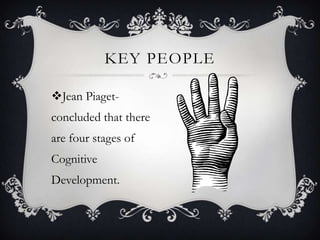
Jean Piaget-
concluded that there
are four stages of
Cognitive
Development.
KEY PEOPLE

 David Merrill – Proposed the
Component Display Theory
(CDT). This theory states that for
a particular objective and
learner, there is a unique
combination of presentation
forms that result in the most
effective learning experience.
KEY PEOPLE
 Charles Reigeluth (Elaboration
Theory)- The Elaboration theory
is an instructional design theory
that argues that content to be
learned should be organized from
simple to complex order, while
providing a meaningful context in
which ensuing ideas can be
incorporated.
KEY PEOPLE

Roger Schank
According to Roger, the
only way we learn is
through "doing," and
failure.
KEY PEOPLE
 J.M. Scandura (structural
learning)- Structural learning
argues that what is learned are
rules which consist of a
domain, range, and procedure.
The rule sets may change for
different tasks. Higher order rules
can account for creative behavior
and the creation of new rules.
KEY IDEAS OF
                 COGNITIVISM

      MENTAL FUNCTION CAN BE UNDERSTOOD
 focuses on the inner mental activities
 opening the “black box” of the human mind is valuable and
necessary for understanding how people learn
 People are not “programmed animals” that simply respond to
stimuli in their environment; but their actions are a consequence of
thinking
F O U R S TAG E S O F C O G N I T I V E
           D E V E L O P M E N T-

 1. Sensorimotor           stage- Newborn – 2 years,. The child explores the world through his/her
senses: taste, touch, sight, sound, and smell. The Child begins to be aware of things existence even when
they cannot see the objects, but lacks symbolic representation understanding.

 2. Preoperational           stage- Ages 2-7. The child develops language and thinking skills and also
becomes focused on himself/herself and how the world relates to themselves.

 3. Concrete        operations- Ages 7 to 11. The child begins to think
abstractly, conceptualize, and create logical expressions

 4. Formal         operations - Ages 11-15. The child's cognition reaches its final form. Their
abstract thinking is similar to adult, and he/she is capable of hypothetical and deductive reasoning.
CLASSROOM IMPLICATIONS

         With Technology                      Without Technology
                                        only assign tasks for which the child
 Use educational computer games       is prepared
 Stimulate the child's senses.         maintain a proper balance between
 Engage them in various cognitive     guiding the child and allowing them to

tasks.                                 learn things for themselves
                                        be concerned with the process of
 Examples: ABCmouse.com, PBS
                                       learning rather than the end product
Kids Educational Games, and Spelling
                                        Encourage Peer learning
City.
                                        Sorting Games, flash cards and
                                       puzzles are good examples of activities
WORKS CITED
                                                               Facts


   "Structural Learning Theory." Instructional Design. Web. 22 Nov. 2011.
<http://www.instructionaldesign.org/theories/structural-learning.html>.
   "Roger Schank: Script Theory." Massage CE Continuing Education Home Study NCBTMB, NCCAOM Ethics
Fibromyalgia TMJ Acupressure TCM. Web. 22 Nov. 2011. <http://www.lifecircles-
inc.com/Learningtheories/constructivism/Schank.html>.
    "Teaching and Learning Resources / Cognitivism." Teaching and Learning Resources / TLR Home. Web. 22 Nov.
2011. <http://teachinglearningresources.pbworks.com/w/page/31012664/Cognitivism>.
   "M. David Merrill and Component Display Theory." Massage CE Continuing Education Home Study
NCBTMB, NCCAOM Ethics Fibromyalgia TMJ Acupressure TCM. Web. 22 Nov. 2011. <http://www.lifecircles-
inc.com/Learningtheories/merrill.html>.
   "Elaboration Theory (Reigeluth)." Learning Theories. Web. 22 Nov. 2011. <http://www.learning-
theories.com/elaboration-theory-reigeluth.html>.
                                                              Images
    http://www.chomsky.info/chomsky.jpg
    http://www.lifecircles-inc.com/Learningtheories/merrill_files/page90_1.jpg
   http://www.lifecircles-inc.com/Learningtheories/constructivism/Schank_files/page60_1.jpg

Cognitivism team6

  • 1.
    COGNITIVISM By: Team 6 (Amanda & Gina)
  • 2.
    KEY PEOPLE ASSOCIATED WITH THE THEORY: KEY PEOPLE Noam Chomski- Key person in replacing Behaviorism as a dominant theory in the 1960s.
  • 3.
    KEY PEOPLE Jean Piaget- concludedthat there are four stages of Cognitive Development.
  • 4.
    KEY PEOPLE  DavidMerrill – Proposed the Component Display Theory (CDT). This theory states that for a particular objective and learner, there is a unique combination of presentation forms that result in the most effective learning experience.
  • 5.
    KEY PEOPLE  CharlesReigeluth (Elaboration Theory)- The Elaboration theory is an instructional design theory that argues that content to be learned should be organized from simple to complex order, while providing a meaningful context in which ensuing ideas can be incorporated.
  • 6.
    KEY PEOPLE Roger Schank Accordingto Roger, the only way we learn is through "doing," and failure.
  • 7.
    KEY PEOPLE  J.M.Scandura (structural learning)- Structural learning argues that what is learned are rules which consist of a domain, range, and procedure. The rule sets may change for different tasks. Higher order rules can account for creative behavior and the creation of new rules.
  • 8.
    KEY IDEAS OF COGNITIVISM MENTAL FUNCTION CAN BE UNDERSTOOD  focuses on the inner mental activities  opening the “black box” of the human mind is valuable and necessary for understanding how people learn  People are not “programmed animals” that simply respond to stimuli in their environment; but their actions are a consequence of thinking
  • 9.
    F O UR S TAG E S O F C O G N I T I V E D E V E L O P M E N T-  1. Sensorimotor stage- Newborn – 2 years,. The child explores the world through his/her senses: taste, touch, sight, sound, and smell. The Child begins to be aware of things existence even when they cannot see the objects, but lacks symbolic representation understanding.  2. Preoperational stage- Ages 2-7. The child develops language and thinking skills and also becomes focused on himself/herself and how the world relates to themselves.  3. Concrete operations- Ages 7 to 11. The child begins to think abstractly, conceptualize, and create logical expressions  4. Formal operations - Ages 11-15. The child's cognition reaches its final form. Their abstract thinking is similar to adult, and he/she is capable of hypothetical and deductive reasoning.
  • 10.
    CLASSROOM IMPLICATIONS With Technology Without Technology  only assign tasks for which the child  Use educational computer games is prepared  Stimulate the child's senses.  maintain a proper balance between  Engage them in various cognitive guiding the child and allowing them to tasks. learn things for themselves  be concerned with the process of  Examples: ABCmouse.com, PBS learning rather than the end product Kids Educational Games, and Spelling  Encourage Peer learning City.  Sorting Games, flash cards and puzzles are good examples of activities
  • 11.
    WORKS CITED Facts  "Structural Learning Theory." Instructional Design. Web. 22 Nov. 2011. <http://www.instructionaldesign.org/theories/structural-learning.html>.  "Roger Schank: Script Theory." Massage CE Continuing Education Home Study NCBTMB, NCCAOM Ethics Fibromyalgia TMJ Acupressure TCM. Web. 22 Nov. 2011. <http://www.lifecircles- inc.com/Learningtheories/constructivism/Schank.html>.  "Teaching and Learning Resources / Cognitivism." Teaching and Learning Resources / TLR Home. Web. 22 Nov. 2011. <http://teachinglearningresources.pbworks.com/w/page/31012664/Cognitivism>.  "M. David Merrill and Component Display Theory." Massage CE Continuing Education Home Study NCBTMB, NCCAOM Ethics Fibromyalgia TMJ Acupressure TCM. Web. 22 Nov. 2011. <http://www.lifecircles- inc.com/Learningtheories/merrill.html>.  "Elaboration Theory (Reigeluth)." Learning Theories. Web. 22 Nov. 2011. <http://www.learning- theories.com/elaboration-theory-reigeluth.html>. Images  http://www.chomsky.info/chomsky.jpg  http://www.lifecircles-inc.com/Learningtheories/merrill_files/page90_1.jpg  http://www.lifecircles-inc.com/Learningtheories/constructivism/Schank_files/page60_1.jpg