JEAN PIAGET’S BRIEFBACKGROUND
• Born in 1895
• Died in 1980
• Was a Swiss but of French origin
• Was an epistemological philosopher as well as a
biologist
• Was interested in how humans use knowledge for
adaptation
• In 1963 he hypothesised that children’s cognitive
development is orderly and in a sequence of stages
5.
MEANING OF COGNITION
•Mental activities involved in the acquisition,
processing, organisation and usage of
knowledge
• It involves thinking, remembering and
problem solving
• It is all the mental processes that take place
when people are learning.
6.
COGNITIVE DEVELOPMENT DEFINED
•A continuous process by which people get to know
things about themselves and the world around them
• The development of a person’s mental capacity to
engage in thinking, reasoning, understanding,
remembering, organising information and problem
solving.
• It is the understanding of how children’s mental skills
and abilities change overtime from the period of
being young to an adult.
7.
Assumptions of Piaget’scognitive
development theory
• Children’s concept of the world grows more
sophisticated through maturation and
experience hence the need to call it stage
dependent
• Stages may fuse into one another so that the
learner may on one concept reveal concrete
operations yet on another he reveals formal
operations
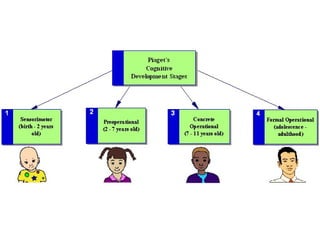
STAGE 1( SENSORIMOTOR)
• The child learns through reflex and motor
actions
• Thought derives from sensation and movement
e.g. handling objects and tasting them.
• A vital concept acquired at this stage is object
permanence (aspects of the environment
continue to exist even though they may be
outside the reach of their senses.
11.
Stage 1 continued
•At this stage the child develops circularity- a
tendency to repeat its habits. Children tend to
reproduce specific behaviours seemingly
endlessly because they produce pleasurable
sensations e.g. thumb-sucking.
• Children imitate – when they play they copy
the behaviours they observe e.g. a 2year old
may brush her teeth or those of her teddy bear
when given a tooth brush.
12.
STAGE 2 (PRE-OPERATIONAL)
•Operation refers to thought processes governed
by rules, so pre-operational implies that the
child has not yet mastered such rules.
• They are not yet capable of logical processes of
reasoning on the basis of concrete evidence.
• Thinking is egocentric and animistic- Children
believe that all things are meant for them and
that all things are living and hence capable of
actions, feelings and intentions.
13.
Stage 2 continued
•Children lack conservation awareness – that
physical quantities remain constant in spite of
changes in shape and appearance.
• Language is used as a reflection of cognitive
development though thinking is confined to what
is perceived.
• This stage is divided into two phases:
i. Pre-conceptual (2-4 years)
ii. Intuitive (4-7 years)
14.
The pre-conceptual phase
•The child is unable to understand what the
concept involves e.g. a child may have the
concept that all men are fathers.
15.
The intuitive phase
•Thinking is not based on logic but on
perceptions from which conclusions are
drawn. The child fixes her attention on one
dimension.
• Children cry a lot at this stage.
16.
STAGE 3 (CONCRETEOPERATIONAL)
• Children develop the ability to think logically
but not abstractly.
• They understand some of the basic
conservation concepts.
• Some of them start understanding views from
other people
• They understand things concretely through
use of objects
17.
STAGE 4 (FORMALOPERATIONAL)
• Thinking is logical and reasoning is abstract.
• There is systematic formation and testing of
concepts.
• Mature adult thought emerges.
• Thinking is characterised by deductive logical
consideration of possibilities before acting to
solve the problem.
• A stage of mental trial and error.
18.
Stage 4 continued
•There is questioning of ethics and values.
• Researchers agree that some people never
reach this stage.
19.
EDUCATIONAL IMPLICATIONS
• Teachersshould take note of teachable
moments when there is likely to be more
learning.
• Adjust curriculum to suit level of learners
(children should be taught certain content at
certain stages).
• Consider individual differences – children
learn at different rates.
20.
Implications continued
• Encouragechildren to explore and manipulate
materials and objects i.e. the need to use
instructional media.
• Provide stimulating learning environments.
• Learners learn more through actions,
therefore provide children with chances of
investigation, exploration and enquiry.