
Cognitivism
Nurul Ulfa
Group : 1
Definition of Cognitivism
1. Cognitivism is cognitivist theory that based on thought process behind
the behaviour.
2. Cognitivism is "the psychology of learning which emphasizes
human cognition or intelligence as a special endowment enabling
man to form hypotheses and develop intellectually“.
The underlying concepts of cognitivism involves how we think and gain
knowledge. Cognitivism involves examining learning, memory, problem
solving skills, and intelligence.
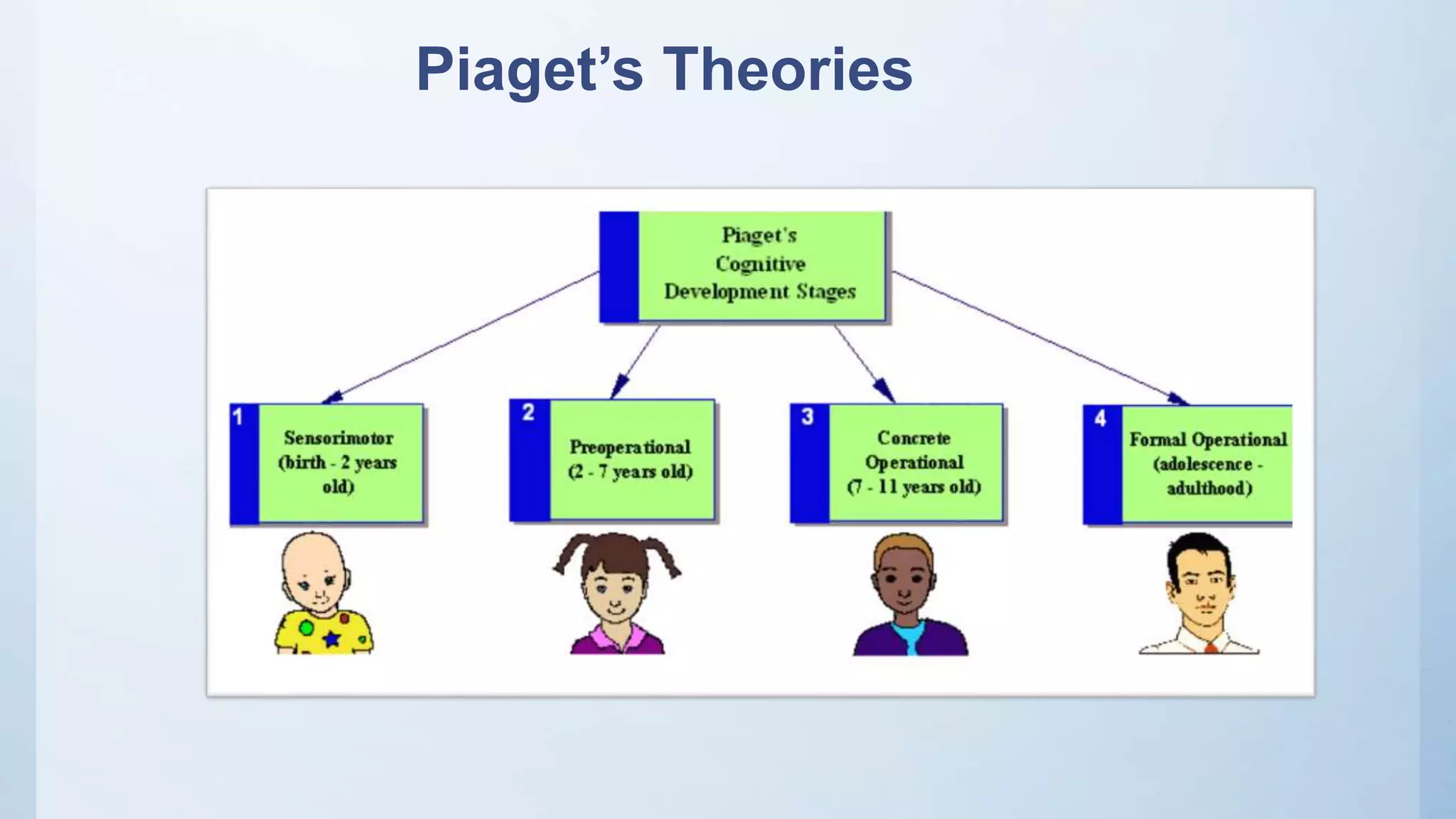
Piaget’s Theories
• Jean Piaget (1896 - 1980) was employed at the Binet Institute in the 1920s,
where his job was to develop French versions of questions on English
intelligence tests.
• He became intrigued with the reasons children gave for their wrong answers
on the questions that required logical thinking. He believed that these incorrect
answers revealed important differences between the thinking of adults and
children.
• Piaget (1936) was the first psychologist to make a systematic study of
cognitive development. His contributions include a theory of cognitive child
development, detailed observational studies of cognition in children, and a
series of simple but ingenious tests to reveal different cognitive abilities.
• Before Piaget’s work, the common assumption in psychology was that children
are merely less competent thinkers than adults. Piaget showed that young
children think in strikingly different ways compared to adults.
Piaget’s Theories
Piaget’s Theories
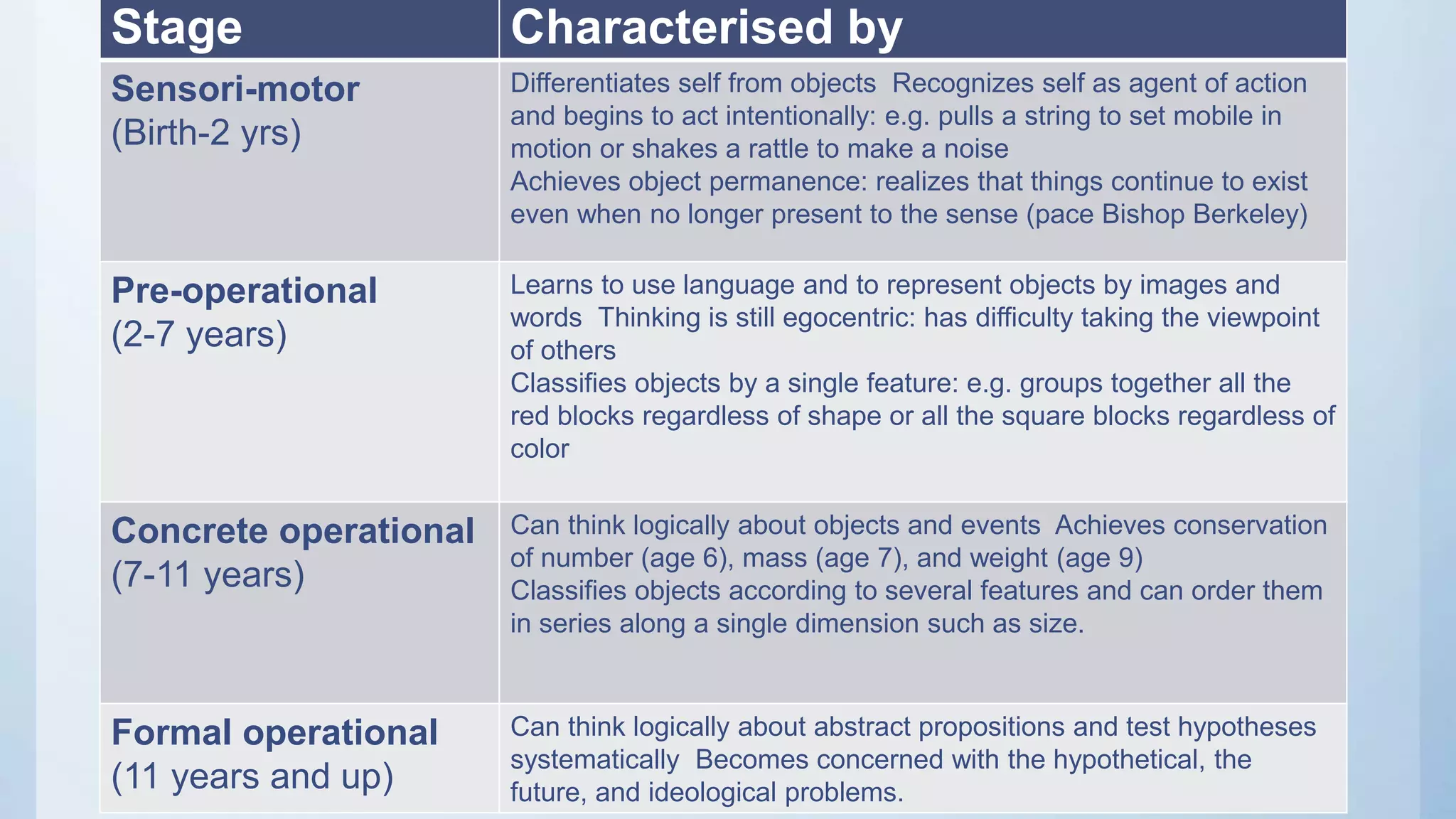
Stage Characterised by
Sensori-motor
(Birth-2 yrs)
Differentiates self from objects Recognizes self as agent of action
and begins to act intentionally: e.g. pulls a string to set mobile in
motion or shakes a rattle to make a noise
Achieves object permanence: realizes that things continue to exist
even when no longer present to the sense (pace Bishop Berkeley)
Pre-operational
(2-7 years)
Learns to use language and to represent objects by images and
words Thinking is still egocentric: has difficulty taking the viewpoint
of others
Classifies objects by a single feature: e.g. groups together all the
red blocks regardless of shape or all the square blocks regardless of
color
Concrete operational
(7-11 years)
Can think logically about objects and events Achieves conservation
of number (age 6), mass (age 7), and weight (age 9)
Classifies objects according to several features and can order them
in series along a single dimension such as size.
Formal operational
(11 years and up)
Can think logically about abstract propositions and test hypotheses
systematically Becomes concerned with the hypothetical, the
future, and ideological problems.
FACTORS INFLUENCED THE
DEVELOPMENT OF COGNITIVISM
• Experimental psychology
The factor emphasized in how the memory was laid down by using
nonsense syllables and words that was begun in the 1880s by Herman
Ebbinghuns.
• Language Acquisition
The factor showed that the result of contested theories of language
acquisition was the evidence of human cognition. In this case language is as
the result which is shaped by the stimulus- response.
• Computer and Artificial Intelligence
The factor showed the relationship between computers and cognitivism
theory.
STRENGTH AND WEAKNESSES
• The strength is the students are trained to do the task in the same way
to produce the students who have consistency behavior (
Schuman,1996 in Mergel, 1998). It also makes the students think
creatively.
• The weakness of cognitivism is teori tidak menyeluruh untuk semua
tingkat pendidikan; sulit di praktikkan khususnya di tingkat lanjut;
beberapa prinsip seperti intelegensi sulit dipahami dan
pemahamannya masih belum tuntas.
Thank you

Cognitivsm

  • 1.
  • 2.
    Definition of Cognitivism 1.Cognitivism is cognitivist theory that based on thought process behind the behaviour. 2. Cognitivism is "the psychology of learning which emphasizes human cognition or intelligence as a special endowment enabling man to form hypotheses and develop intellectually“. The underlying concepts of cognitivism involves how we think and gain knowledge. Cognitivism involves examining learning, memory, problem solving skills, and intelligence.
  • 3.
  • 4.
    • Jean Piaget(1896 - 1980) was employed at the Binet Institute in the 1920s, where his job was to develop French versions of questions on English intelligence tests. • He became intrigued with the reasons children gave for their wrong answers on the questions that required logical thinking. He believed that these incorrect answers revealed important differences between the thinking of adults and children. • Piaget (1936) was the first psychologist to make a systematic study of cognitive development. His contributions include a theory of cognitive child development, detailed observational studies of cognition in children, and a series of simple but ingenious tests to reveal different cognitive abilities. • Before Piaget’s work, the common assumption in psychology was that children are merely less competent thinkers than adults. Piaget showed that young children think in strikingly different ways compared to adults. Piaget’s Theories
  • 5.
  • 6.
    Stage Characterised by Sensori-motor (Birth-2yrs) Differentiates self from objects Recognizes self as agent of action and begins to act intentionally: e.g. pulls a string to set mobile in motion or shakes a rattle to make a noise Achieves object permanence: realizes that things continue to exist even when no longer present to the sense (pace Bishop Berkeley) Pre-operational (2-7 years) Learns to use language and to represent objects by images and words Thinking is still egocentric: has difficulty taking the viewpoint of others Classifies objects by a single feature: e.g. groups together all the red blocks regardless of shape or all the square blocks regardless of color Concrete operational (7-11 years) Can think logically about objects and events Achieves conservation of number (age 6), mass (age 7), and weight (age 9) Classifies objects according to several features and can order them in series along a single dimension such as size. Formal operational (11 years and up) Can think logically about abstract propositions and test hypotheses systematically Becomes concerned with the hypothetical, the future, and ideological problems.
  • 7.
    FACTORS INFLUENCED THE DEVELOPMENTOF COGNITIVISM • Experimental psychology The factor emphasized in how the memory was laid down by using nonsense syllables and words that was begun in the 1880s by Herman Ebbinghuns. • Language Acquisition The factor showed that the result of contested theories of language acquisition was the evidence of human cognition. In this case language is as the result which is shaped by the stimulus- response. • Computer and Artificial Intelligence The factor showed the relationship between computers and cognitivism theory.
  • 8.
    STRENGTH AND WEAKNESSES •The strength is the students are trained to do the task in the same way to produce the students who have consistency behavior ( Schuman,1996 in Mergel, 1998). It also makes the students think creatively. • The weakness of cognitivism is teori tidak menyeluruh untuk semua tingkat pendidikan; sulit di praktikkan khususnya di tingkat lanjut; beberapa prinsip seperti intelegensi sulit dipahami dan pemahamannya masih belum tuntas.
  • 9.