Intelligent distance
environment for engineering
education
Introduction
Prediction of the educational, learner-oriented process
in the computer-based learning systems provides
the ability to customize it, and as a result, improve
the quality, efficiency and manageability.

The individualization of the learning process is based
on a number of scientific results obtained by the authors:
domain model, learner's fuzzy model, learning scenario,
diagnostic procedures and learning process planning.
The learning content is an experience, which is put
in the learning programs, techniques, methods,
models and practices.
The principles of intelligence,
individualization
The principle of intelligence implies that to increase
efficiency and quality of distance e-learning it is necessary
to apply the rich experience of artificial intelligence theory
and practice, including smart- technologies.
The principle of individualization implies that to develop
the required competencies of trainees it is necessary
to form their individual trajectories of engineering
education containing methodological, supervisory
and design pedagogical components.
The principles of integration,
accessibility
The principle of integration means the interaction
between educational environment with the enterprise
information assets.
The principle of accessibility implies that m-training
is available for any place , any time and any category
of students (3–For Principle) and is provided
by organizational and technical means of cloud computing.
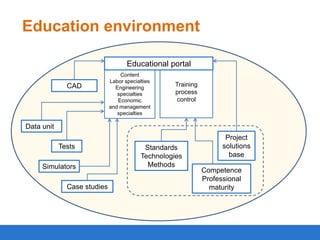
Education environment
Educational portal
CAD

Content
Labor specialties
Engineering
specialties
Economic
and management
specialties

Training
process
control

Data unit
Tests
Simulators
Case studies

Standards
Technologies
Methods

Project
solutions
base
Competence
Professional
maturity
Mathematical software:
the domain model
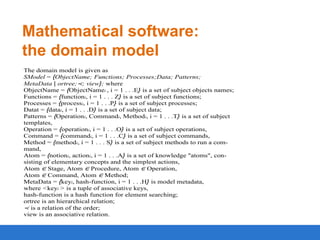
The domain model is given as
SModel = {ObjectName; Functions; Processes;Data; Patterns;
MetaData | ortree;≺; view}; where
ObjectName = {ObjectNamei , i = 1 . . .E} is a set of subject objects names;
Functions = {functioni, i = 1 . . . Z} is a set of subject functions;
Processes = {processi, i = 1 . . .P} is a set of subject processes;
Datat = {datai, i = 1 . . .D} is a set of subject data;
Patterns = {Operationi, Commandi, Methodi, i = 1 . . .T} is a set of subject
templates,
Operation = {operationi, i = 1 . . .O} is a set of subject operations,
Command = {commandi, i = 1 . . .C} is a set of subject commands,
Method = {methodi, i = 1 . . . S} is a set of subject methods to run a command,
Atom = {notioni, actioni, i = 1 . . .A} is a set of knowledge "atoms", consisting of elementary concepts and the simplest actions,
Atom ∈ Stage, Atom ∈ Procedure, Atom ∈ Operation,
Atom ∈ Command, Atom ∈ Method;
MetaData = {keyi, hash-function, i = 1 . . .H} is model metadata,
where <keyi > is a tuple of associative keys,
hash-function is a hash function for element searching;
ortree is an hierarchical relation;
≺ is a relation of the order;
view is an associative relation.
Mathematical software:
the learner model
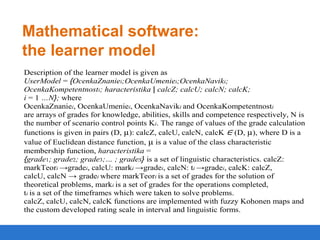
Description of the learner model is given as
UserModel = {OcenkaZnaniei;OcenkaUmeniei;OcenkaNaviki;
OcenkaKompetentnosti; haracteristika | calcZ; calcU; calcN; calcK;
i = 1 …N}; where
OcenkaZnaniei, OcenkaUmeniei, OcenkaNaviki and OcenkaKompetentnosti
are arrays of grades for knowledge, abilities, skills and competence respectively, N is
the number of scenario control points Ki. The range of values of the grade calculation
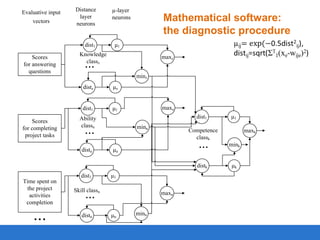
functions is given in pairs (D, µ): calcZ, calcU, calcN, calcK ∈ (D, µ), where D is a
value of Euclidean distance function, µ is a value of the class characteristic
membership function, haracteristika =
{grade1; grade2; grade3;… ; gradeS} is a set of linguistic characteristics. calcZ:
markTeori →gradei, calcU: marki →gradei, calcN: ti →gradei, calcK: calcZ,
calcU, calcN → gradei where markTeori is a set of grades for the solution of
theoretical problems, marki is a set of grades for the operations completed,
ti is a set of the timeframes which were taken to solve problems.
calcZ, calcU, calcN, calcK functions are implemented with fuzzy Kohonen maps and
the custom developed rating scale in interval and linguistic forms.
Evaluative input
vectors

Distance
layer
neurons

dist1
Scores
for answering
questions

µ-layer
neurons

μ1

Knowledge
classz

maxz

...

minz
distz

μz

dist1
Scores
for completing
project tasks

Mathematical software:
the diagnostic procedure

μ1

maxu
dist1

Ability
classu

minu

...

μ1

Competence
classk

maxk

dist1

Time spent on
the project
activities
completion

distn

μu

μ1

Skill classn

...

...

...

maxn

μn

minn

mink

distk

distu

μk
Mathematical software:
a model of learning scenario
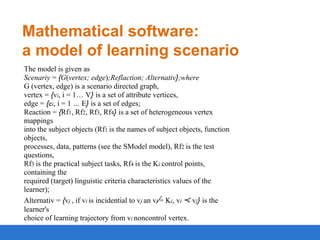
The model is given as
Scenariy = {G(vertex; edge);Reflaction; Alternativ};where
G (vertex, edge) is a scenario directed graph,
vertex = {vi, i = 1… V} is a set of attribute vertices,
edge = {ei, i = 1 … E} is a set of edges;
Reaction = {Rf1, Rf2, Rf3, Rf4} is a set of heterogeneous vertex
mappings
into the subject objects (Rf1 is the names of subject objects, function
objects,
processes, data, patterns (see the SModel model), Rf2 is the test
questions,
Rf3 is the practical subject tasks, Rf4 is the Ki control points,
containing the
required (target) linguistic criteria characteristics values of the
learner);
Alternativ = {vj , if vi is incidential to vj an vi = Ki, vi ≺ vj} is the
learner's
choice of learning trajectory from vi noncontrol vertex.
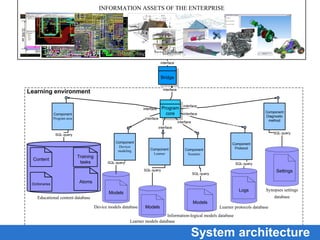
INFORMATION ASSETS OF THE ENTERPRISE

interface

Bridge
interface

Learning environment
IUnknown

IUnknown

interface
Component
Program area

Program
core

interface
Component
Diagnostic
method

interface

interface
interface
IUnknown

interface
IUnknown

IUnknown

IUnknown

SQL-query

SQL-query
Component
Devices
modeling

Content

Training
tasks

Component
Learner

Component
Scenario

Component
Protocol

SQL-query

SQL-query
SQL-query

Settings

SQL-query
Dictionaries

Atoms
Logs

Models

Synopses settings
database

Educational content database
Models
Device models database

Models

Learner protocols database

Information-logical models database
Learner models database

System architecture
Contacts
Ulyanovsk State Technical University,
The Institute of Distance and Further Education.
Engelsa str. 3. 432063, Ulyanovsk, Russia
tel. +7-8422-77-88-45
http://gc.ulstu.ru, http://ido.ulstu.ru
Alexander Afanas’ev, pro-rector for the distance
and further education, UlSTU
E-mail: a.afanasev@ulstu.ru

UlSTU-IDO_CeBIT

  • 1.
  • 2.
    Introduction Prediction of theeducational, learner-oriented process in the computer-based learning systems provides the ability to customize it, and as a result, improve the quality, efficiency and manageability. The individualization of the learning process is based on a number of scientific results obtained by the authors: domain model, learner's fuzzy model, learning scenario, diagnostic procedures and learning process planning. The learning content is an experience, which is put in the learning programs, techniques, methods, models and practices.
  • 3.
    The principles ofintelligence, individualization The principle of intelligence implies that to increase efficiency and quality of distance e-learning it is necessary to apply the rich experience of artificial intelligence theory and practice, including smart- technologies. The principle of individualization implies that to develop the required competencies of trainees it is necessary to form their individual trajectories of engineering education containing methodological, supervisory and design pedagogical components.
  • 4.
    The principles ofintegration, accessibility The principle of integration means the interaction between educational environment with the enterprise information assets. The principle of accessibility implies that m-training is available for any place , any time and any category of students (3–For Principle) and is provided by organizational and technical means of cloud computing.
  • 5.
    Education environment Educational portal CAD Content Laborspecialties Engineering specialties Economic and management specialties Training process control Data unit Tests Simulators Case studies Standards Technologies Methods Project solutions base Competence Professional maturity
  • 6.
    Mathematical software: the domainmodel The domain model is given as SModel = {ObjectName; Functions; Processes;Data; Patterns; MetaData | ortree;≺; view}; where ObjectName = {ObjectNamei , i = 1 . . .E} is a set of subject objects names; Functions = {functioni, i = 1 . . . Z} is a set of subject functions; Processes = {processi, i = 1 . . .P} is a set of subject processes; Datat = {datai, i = 1 . . .D} is a set of subject data; Patterns = {Operationi, Commandi, Methodi, i = 1 . . .T} is a set of subject templates, Operation = {operationi, i = 1 . . .O} is a set of subject operations, Command = {commandi, i = 1 . . .C} is a set of subject commands, Method = {methodi, i = 1 . . . S} is a set of subject methods to run a command, Atom = {notioni, actioni, i = 1 . . .A} is a set of knowledge "atoms", consisting of elementary concepts and the simplest actions, Atom ∈ Stage, Atom ∈ Procedure, Atom ∈ Operation, Atom ∈ Command, Atom ∈ Method; MetaData = {keyi, hash-function, i = 1 . . .H} is model metadata, where <keyi > is a tuple of associative keys, hash-function is a hash function for element searching; ortree is an hierarchical relation; ≺ is a relation of the order; view is an associative relation.
  • 7.
    Mathematical software: the learnermodel Description of the learner model is given as UserModel = {OcenkaZnaniei;OcenkaUmeniei;OcenkaNaviki; OcenkaKompetentnosti; haracteristika | calcZ; calcU; calcN; calcK; i = 1 …N}; where OcenkaZnaniei, OcenkaUmeniei, OcenkaNaviki and OcenkaKompetentnosti are arrays of grades for knowledge, abilities, skills and competence respectively, N is the number of scenario control points Ki. The range of values of the grade calculation functions is given in pairs (D, µ): calcZ, calcU, calcN, calcK ∈ (D, µ), where D is a value of Euclidean distance function, µ is a value of the class characteristic membership function, haracteristika = {grade1; grade2; grade3;… ; gradeS} is a set of linguistic characteristics. calcZ: markTeori →gradei, calcU: marki →gradei, calcN: ti →gradei, calcK: calcZ, calcU, calcN → gradei where markTeori is a set of grades for the solution of theoretical problems, marki is a set of grades for the operations completed, ti is a set of the timeframes which were taken to solve problems. calcZ, calcU, calcN, calcK functions are implemented with fuzzy Kohonen maps and the custom developed rating scale in interval and linguistic forms.
  • 8.
    Evaluative input vectors Distance layer neurons dist1 Scores for answering questions µ-layer neurons μ1 Knowledge classz maxz ... minz distz μz dist1 Scores forcompleting project tasks Mathematical software: the diagnostic procedure μ1 maxu dist1 Ability classu minu ... μ1 Competence classk maxk dist1 Time spent on the project activities completion distn μu μ1 Skill classn ... ... ... maxn μn minn mink distk distu μk
  • 9.
    Mathematical software: a modelof learning scenario The model is given as Scenariy = {G(vertex; edge);Reflaction; Alternativ};where G (vertex, edge) is a scenario directed graph, vertex = {vi, i = 1… V} is a set of attribute vertices, edge = {ei, i = 1 … E} is a set of edges; Reaction = {Rf1, Rf2, Rf3, Rf4} is a set of heterogeneous vertex mappings into the subject objects (Rf1 is the names of subject objects, function objects, processes, data, patterns (see the SModel model), Rf2 is the test questions, Rf3 is the practical subject tasks, Rf4 is the Ki control points, containing the required (target) linguistic criteria characteristics values of the learner); Alternativ = {vj , if vi is incidential to vj an vi = Ki, vi ≺ vj} is the learner's choice of learning trajectory from vi noncontrol vertex.
  • 10.
    INFORMATION ASSETS OFTHE ENTERPRISE interface Bridge interface Learning environment IUnknown IUnknown interface Component Program area Program core interface Component Diagnostic method interface interface interface IUnknown interface IUnknown IUnknown IUnknown SQL-query SQL-query Component Devices modeling Content Training tasks Component Learner Component Scenario Component Protocol SQL-query SQL-query SQL-query Settings SQL-query Dictionaries Atoms Logs Models Synopses settings database Educational content database Models Device models database Models Learner protocols database Information-logical models database Learner models database System architecture
  • 11.
    Contacts Ulyanovsk State TechnicalUniversity, The Institute of Distance and Further Education. Engelsa str. 3. 432063, Ulyanovsk, Russia tel. +7-8422-77-88-45 http://gc.ulstu.ru, http://ido.ulstu.ru Alexander Afanas’ev, pro-rector for the distance and further education, UlSTU E-mail: a.afanasev@ulstu.ru