INTERVENTIONS STRATEGIES IN SPECIAL
EDUCATION: HOW EFFECTIVE ARE THEY FOR
CULTURALLY AND LINGUISTICALLY DIVERSE
STUDENTS WITH DISABILITIES?
SYSTEMATIC REVIEW
EDPS 664: RESEARCH SEMINAR
Ayuuba Gibrilla
OUTLINE
 Background
 Response-to-Intervention (RTI) Used in Special
Education
 The Big Questions in Educating CLDs/ELLs With
Disabilities
 Objectives of the Review
 Method
 Search Findings
 Summary Information of studies reviewed
 Analysis
 Implication of the findings in teaching ELLs
 Conclusion
BACKGROUND
 U.S Public schools serve 52 million children and youth.
 45% are from racial groups
 21% are from CLD households.
(Aud et al., 2010)
BACKGROUND
 ELLs as “triple threat students”
 “Three Strikes” against them:
a. Disability
b. Limited English Proficiency
c. Lower Socioeconomic Status
 ELLs perform below their English proficient peers (Abedi,
2006)
RESPONSE-TO-INTERVENTION (RTI) USED IN
SPECIAL EDUCATION
 Meeting the needs of CLD students must be done within
a context
 Response-to-Intervention (RTI)
 RTI?
 It is a proposed comprehensive model of instruction that
includes both regular and special education (SOURCE)
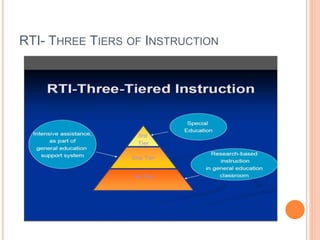
 RTI uses Three Tiers of Instruction
RTI- THREE TIERS OF INSTRUCTION
INEFFECTIVENESS OF RTI
 Culturally and linguistically diverse backgrounds
students do not respond to intervention treatments
(Bennett et al., 2004; Conchas & Noguera,
2004; Sanders, 2000)
THE BIG QUESTIONS IN EDUCATING CLDS/ELLS
WITH DISABILITIES
1. What are the factors or potential variables that
contribute to the ineffectiveness of RTI and other
instructional strategies when implemented on CLD/ELLs
population?
2. Can teachers realistically and effectively teach these
students in the absence of research based teaching
grounded in cultural responsive interventions?
3. Are teachers providing the right services to the CLD
population?
OBJECTIVES OF THE REVIEW
 Objective 1: To find out what make these students resist RTI
and instructional strategies.
 Objective 2: To find out if the interventions used are carried
out within the context of RTI.
 Objective 3: To find out if there are research based culturally
and linguistically responsive interventions in special education
service delivery.
METHOD
 Inclusion criteria
Peer reviewed publications from:
 Google scholar
 RTI State Database
 CEC database
 The review included research articles published in
English from 2008 - present
 Key search terms:
 Response to intervention
 Response to instruction
 Intervention strategies, disabilities
 Culturally and linguistically diverse Students
 English Language Learners
SCREENING PROCESS
 Two steps screening process
Step 1: Searching by title and abstract,
Step 2: Reading of the full text .
INCLUSION CRITERIA
 Characteristics of studies included:
 Studies Published in peer-reviewed journals
 Studies had to include ELLs.
 Study had to be grounded in an RTI framework &
instructional strategies
EXCLUSION CRITERIA
 Narrative reviews,
 Editorials, commentaries,
 Unpublished manuscripts & dissertations,
 Government reports, book chapters, conference
proceedings, meeting abstracts, lectures and addresses.
 Non-systematic Research design
 Studies that did not report methods.
 Research population that are native English language
speakers
SEARCH FINDINGS
 Over 15 studies used some elements of RTI model
 Reviewed 4 that make reference to cultural factors
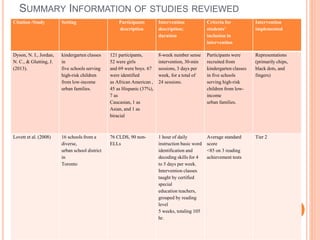
SUMMARY INFORMATION OF STUDIES REVIEWED
Citation /Study Setting Participants
description
Intervention
description;
duration
Criteria for
students’
inclusion in
intervention
Intervention
implemented
Dyson, N. I., Jordan,
N. C., & Glutting, J.
(2013).
kindergarten classes
in
five schools serving
high-risk children
from low-income
urban families.
121 participants,
52 were girls
and 69 were boys. 67
were identified
as African American ,
45 as Hispanic (37%),
7 as
Caucasian, 1 as
Asian, and 1 as
biracial
8-week number sense
intervention, 30-min
sessions, 3 days per
week, for a total of
24 sessions.
Participants were
recruited from
kindergarten classes
in five schools
serving high-risk
children from low-
income
urban families.
Representations
(primarily chips,
black dots, and
fingers)
Lovett et al. (2008) 16 schools from a
diverse,
urban school district
in
Toronto
76 CLDS, 90 non-
ELLs
1 hour of daily
instruction basic word
identification and
decoding skills for 4
to 5 days per week.
Intervention classes
taught by certified
special
education teachers,
grouped by reading
level
5 weeks, totaling 105
hr.
Average standard
score
<85 on 3 reading
achievement tests
Tier 2
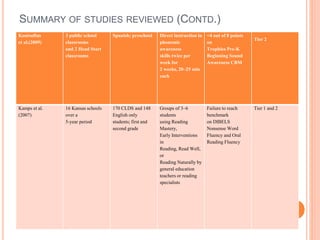
SUMMARY OF STUDIES REVIEWED (CONTD.)
Koutsoftas
et al.(2009)
3 public school
classrooms
and 2 Head Start
classrooms
Spanish; preschool Direct instruction in
phonemic
awareness
skills twice per
week for
2 weeks, 20–25 min
each
<4 out of 8 points
on
Trophies Pre-K
Beginning Sound
Awareness CBM
Tier 2
Kamps et al.
(2007)
16 Kansas schools
over a
5-year period
170 CLDS and 148
English only
students; first and
second grade
Groups of 3–6
students
using Reading
Mastery,
Early Interventions
in
Reading, Read Well,
or
Reading Naturally by
general education
teachers or reading
specialists
Failure to reach
benchmark
on DIBELS
Nonsense Word
Fluency and Oral
Reading Fluency
Tier 1 and 2
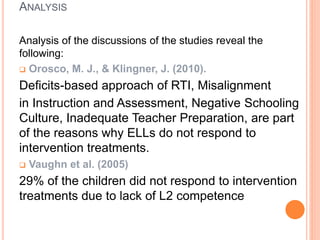
ANALYSIS
Analysis of the discussions of the studies reveal the
following:
 Orosco, M. J., & Klingner, J. (2010).
Deficits-based approach of RTI, Misalignment
in Instruction and Assessment, Negative Schooling
Culture, Inadequate Teacher Preparation, are part
of the reasons why ELLs do not respond to
intervention treatments.
 Vaughn et al. (2005)
29% of the children did not respond to intervention
treatments due to lack of L2 competence
ANALYSIS (CONTD.)
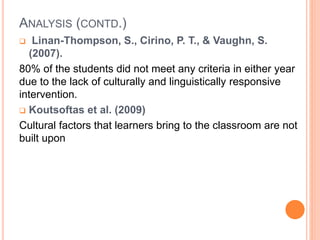
 Linan-Thompson, S., Cirino, P. T., & Vaughn, S.
(2007).
80% of the students did not meet any criteria in either year
due to the lack of culturally and linguistically responsive
intervention.
 Koutsoftas et al. (2009)
Cultural factors that learners bring to the classroom are not
built upon
IMPLICATION OF THE FINDINGS IN TEACHING
ELLS
 Teachers trained in the instruction of ELLs.
 The use of explicit instruction, frequent opportunities to
practice new skills, and collaborative learning activities.
 Curriculum modification anchored in vocabulary
development
 Understand that second language acquisition takes time
and that ELLs can follow different learning trajectories
than their mainstream peers
 View families as valued partners
CONCLUSION
 For RTI to work with ELLs it must be Culturally and
Linguistically Responsive
 Best Practice for ELLs should be based on
scientific research findings
REFERENCES
 Abedi, J. (2006). Psychometric issues in ELL assessment and special education
eligibility. Teachers College Record, 108, 2282 – 2303
 Dyson, N. I., Jordan, N. C. & Glutting, J. (2013). A number sense intervention for low-
income Kindergartners at risk for mathematics difficulties. Journal of learning
disabilities, 46(2), 166-181.
o Koutsoftas, A. D., Harmon, M. T., & Gray, S.(2009). The effect of Tier 2 intervention for
phonemic awareness in a response-to-intervention model in low-income preschool
classrooms. Language, Speech, and Hearing Services in Schools, 40, 116 – 130.
 Linán-Thompson, S. and Ortiz, A. A. 2009. Response to intervention and English-
language learners: Instructional and assessment considerations. Seminars in Speech
and Language, 30(2): 105–120.
 Kamps , D. , Abbott , M. , Greenwood , C. , Arreaga-Mayer , C. , Wills , H. , Longstaff ,
J. , Walton, C. (2007). Use of evidence-based, small-group reading instruction for
English language learners in elementary grades: Secondary-tier intervention. Learning
Disability Quarterly, 30, 153 – 168.
 Lovett , M. W. , De Palma , M. , Frijters, J. , Steinbach , K. , Temple , M. , Benson , N. ,
& Lacerenza, L. (2008). Interventions for reading difficulties: A comparison of response
to intervention by ELL and EFL struggling readers. Journal of Learning Disabilities, 41,
333 – 352.
Interventions Strategies in Special Education

Interventions Strategies in Special Education

  • 1.
    INTERVENTIONS STRATEGIES INSPECIAL EDUCATION: HOW EFFECTIVE ARE THEY FOR CULTURALLY AND LINGUISTICALLY DIVERSE STUDENTS WITH DISABILITIES? SYSTEMATIC REVIEW EDPS 664: RESEARCH SEMINAR Ayuuba Gibrilla
  • 2.
    OUTLINE  Background  Response-to-Intervention(RTI) Used in Special Education  The Big Questions in Educating CLDs/ELLs With Disabilities  Objectives of the Review  Method  Search Findings  Summary Information of studies reviewed  Analysis  Implication of the findings in teaching ELLs  Conclusion
  • 3.
    BACKGROUND  U.S Publicschools serve 52 million children and youth.  45% are from racial groups  21% are from CLD households. (Aud et al., 2010)
  • 4.
    BACKGROUND  ELLs as“triple threat students”  “Three Strikes” against them: a. Disability b. Limited English Proficiency c. Lower Socioeconomic Status  ELLs perform below their English proficient peers (Abedi, 2006)
  • 5.
    RESPONSE-TO-INTERVENTION (RTI) USEDIN SPECIAL EDUCATION  Meeting the needs of CLD students must be done within a context  Response-to-Intervention (RTI)  RTI?  It is a proposed comprehensive model of instruction that includes both regular and special education (SOURCE)  RTI uses Three Tiers of Instruction
  • 6.
    RTI- THREE TIERSOF INSTRUCTION
  • 7.
    INEFFECTIVENESS OF RTI Culturally and linguistically diverse backgrounds students do not respond to intervention treatments (Bennett et al., 2004; Conchas & Noguera, 2004; Sanders, 2000)
  • 8.
    THE BIG QUESTIONSIN EDUCATING CLDS/ELLS WITH DISABILITIES 1. What are the factors or potential variables that contribute to the ineffectiveness of RTI and other instructional strategies when implemented on CLD/ELLs population? 2. Can teachers realistically and effectively teach these students in the absence of research based teaching grounded in cultural responsive interventions? 3. Are teachers providing the right services to the CLD population?
  • 9.
    OBJECTIVES OF THEREVIEW  Objective 1: To find out what make these students resist RTI and instructional strategies.  Objective 2: To find out if the interventions used are carried out within the context of RTI.  Objective 3: To find out if there are research based culturally and linguistically responsive interventions in special education service delivery.
  • 10.
    METHOD  Inclusion criteria Peerreviewed publications from:  Google scholar  RTI State Database  CEC database  The review included research articles published in English from 2008 - present  Key search terms:  Response to intervention  Response to instruction  Intervention strategies, disabilities  Culturally and linguistically diverse Students  English Language Learners
  • 11.
    SCREENING PROCESS  Twosteps screening process Step 1: Searching by title and abstract, Step 2: Reading of the full text .
  • 12.
    INCLUSION CRITERIA  Characteristicsof studies included:  Studies Published in peer-reviewed journals  Studies had to include ELLs.  Study had to be grounded in an RTI framework & instructional strategies
  • 13.
    EXCLUSION CRITERIA  Narrativereviews,  Editorials, commentaries,  Unpublished manuscripts & dissertations,  Government reports, book chapters, conference proceedings, meeting abstracts, lectures and addresses.  Non-systematic Research design  Studies that did not report methods.  Research population that are native English language speakers
  • 14.
    SEARCH FINDINGS  Over15 studies used some elements of RTI model  Reviewed 4 that make reference to cultural factors
  • 15.
    SUMMARY INFORMATION OFSTUDIES REVIEWED Citation /Study Setting Participants description Intervention description; duration Criteria for students’ inclusion in intervention Intervention implemented Dyson, N. I., Jordan, N. C., & Glutting, J. (2013). kindergarten classes in five schools serving high-risk children from low-income urban families. 121 participants, 52 were girls and 69 were boys. 67 were identified as African American , 45 as Hispanic (37%), 7 as Caucasian, 1 as Asian, and 1 as biracial 8-week number sense intervention, 30-min sessions, 3 days per week, for a total of 24 sessions. Participants were recruited from kindergarten classes in five schools serving high-risk children from low- income urban families. Representations (primarily chips, black dots, and fingers) Lovett et al. (2008) 16 schools from a diverse, urban school district in Toronto 76 CLDS, 90 non- ELLs 1 hour of daily instruction basic word identification and decoding skills for 4 to 5 days per week. Intervention classes taught by certified special education teachers, grouped by reading level 5 weeks, totaling 105 hr. Average standard score <85 on 3 reading achievement tests Tier 2
  • 16.
    SUMMARY OF STUDIESREVIEWED (CONTD.) Koutsoftas et al.(2009) 3 public school classrooms and 2 Head Start classrooms Spanish; preschool Direct instruction in phonemic awareness skills twice per week for 2 weeks, 20–25 min each <4 out of 8 points on Trophies Pre-K Beginning Sound Awareness CBM Tier 2 Kamps et al. (2007) 16 Kansas schools over a 5-year period 170 CLDS and 148 English only students; first and second grade Groups of 3–6 students using Reading Mastery, Early Interventions in Reading, Read Well, or Reading Naturally by general education teachers or reading specialists Failure to reach benchmark on DIBELS Nonsense Word Fluency and Oral Reading Fluency Tier 1 and 2
  • 17.
    ANALYSIS Analysis of thediscussions of the studies reveal the following:  Orosco, M. J., & Klingner, J. (2010). Deficits-based approach of RTI, Misalignment in Instruction and Assessment, Negative Schooling Culture, Inadequate Teacher Preparation, are part of the reasons why ELLs do not respond to intervention treatments.  Vaughn et al. (2005) 29% of the children did not respond to intervention treatments due to lack of L2 competence
  • 18.
    ANALYSIS (CONTD.)  Linan-Thompson,S., Cirino, P. T., & Vaughn, S. (2007). 80% of the students did not meet any criteria in either year due to the lack of culturally and linguistically responsive intervention.  Koutsoftas et al. (2009) Cultural factors that learners bring to the classroom are not built upon
  • 19.
    IMPLICATION OF THEFINDINGS IN TEACHING ELLS  Teachers trained in the instruction of ELLs.  The use of explicit instruction, frequent opportunities to practice new skills, and collaborative learning activities.  Curriculum modification anchored in vocabulary development  Understand that second language acquisition takes time and that ELLs can follow different learning trajectories than their mainstream peers  View families as valued partners
  • 20.
    CONCLUSION  For RTIto work with ELLs it must be Culturally and Linguistically Responsive  Best Practice for ELLs should be based on scientific research findings
  • 21.
    REFERENCES  Abedi, J.(2006). Psychometric issues in ELL assessment and special education eligibility. Teachers College Record, 108, 2282 – 2303  Dyson, N. I., Jordan, N. C. & Glutting, J. (2013). A number sense intervention for low- income Kindergartners at risk for mathematics difficulties. Journal of learning disabilities, 46(2), 166-181. o Koutsoftas, A. D., Harmon, M. T., & Gray, S.(2009). The effect of Tier 2 intervention for phonemic awareness in a response-to-intervention model in low-income preschool classrooms. Language, Speech, and Hearing Services in Schools, 40, 116 – 130.  Linán-Thompson, S. and Ortiz, A. A. 2009. Response to intervention and English- language learners: Instructional and assessment considerations. Seminars in Speech and Language, 30(2): 105–120.  Kamps , D. , Abbott , M. , Greenwood , C. , Arreaga-Mayer , C. , Wills , H. , Longstaff , J. , Walton, C. (2007). Use of evidence-based, small-group reading instruction for English language learners in elementary grades: Secondary-tier intervention. Learning Disability Quarterly, 30, 153 – 168.  Lovett , M. W. , De Palma , M. , Frijters, J. , Steinbach , K. , Temple , M. , Benson , N. , & Lacerenza, L. (2008). Interventions for reading difficulties: A comparison of response to intervention by ELL and EFL struggling readers. Journal of Learning Disabilities, 41, 333 – 352.

Editor's Notes