
Separating EdTech Fact
from Fiction
Adaptive Math Learning Community Launch
Tim Hudson, PhD
Senior Director of Curriculum Design
DreamBox Learning
@DocHudsonMath
May 28, 2014
Introduction
• Senior Director of Curriculum Design for
DreamBox Learning
• Over 10 years in public education
o High School math teacher
o K-12 Math Curriculum Coordinator
o Strategic Planning Facilitator
• Degrees in Math, Math Education, and
Educational Leadership
• Consult and work with Authentic Education
& Grant Wiggins
• Co-authored a chapter with Cathy Fosnot
Classrooms Where Children Learn in an
NCTM book Math Intervention Models:
Reweaving the Tapestry (I get no royalties)
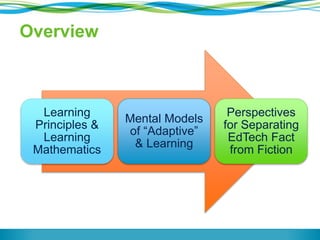
Overview
Learning
Principles &
Learning
Mathematics
Mental Models
of “Adaptive”
& Learning
Perspectives
for Separating
EdTech Fact
from Fiction
Tech & Learning Survey Definition
“Adaptive learning systems are software-
based technologies that automatically
customize curriculum to the knowledge level
of the learner. The algorithms actively track
and access student performance to provide
feedback to the teacher and student about
the student’s progress on an ongoing basis.”
2013 survey conducted by Tech & Learning (www.techlearning.com) and commissioned by DreamBox Learning
Why Adaptive?
Why Differentiated?
Why Individualized?
Why Personalized?
Plan Curriculum Backwards
1. Identify desired
results
2. Determine
acceptable
evidence
3. Plan learning
experiences
and instruction
Understanding by Design, Wiggins & McTighe, ©2005
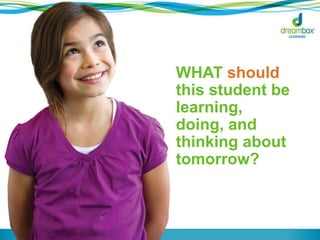
WHAT should
this student be
learning,
doing, and
thinking about
tomorrow?
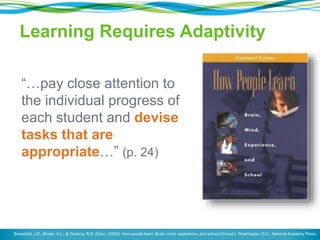
Learning Requires Adaptivity
“…pay close attention to
the individual progress of
each student and devise
tasks that are
appropriate…” (p. 24)
Bransford, J.D., Brown, A.L., & Cocking, R.R. (Eds.). (2000). How people learn: Brain, mind, experience, and school (2nd ed.). Washington, D.C.: National Academy Press.
Differentiation Defined
• Educators’ Purpose…
• All students must master important content.
• Make specific and continually evolving plans to
connect each learner with key content.
• Expect differences in the nature of scaffolding.
• Therefore we Ask…
• What does this student need at this moment in
order to be able to progress with this key
content, and what do I need to do to make that
happen?”
Leading and Managing a Differentiated Classroom by C.A. Tomlinson & M.B. Imbeau, ASCD, © 2010, pp. 13-14
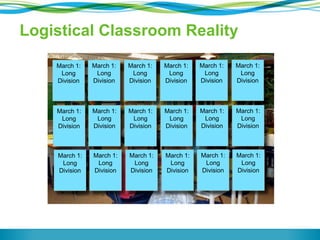
Logistical Classroom Reality
March 1:
Long
Division
March 1:
Long
Division
March 1:
Long
Division
March 1:
Long
Division
March 1:
Long
Division
March 1:
Long
Division
March 1:
Long
Division
March 1:
Long
Division
March 1:
Long
Division
March 1:
Long
Division
March 1:
Long
Division
March 1:
Long
Division
March 1:
Long
Division
March 1:
Long
Division
March 1:
Long
Division
March 1:
Long
Division
March 1:
Long
Division
March 1:
Long
Division
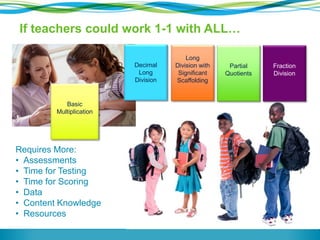
If teachers could work 1-1 with ALL…
Decimal
Long
Division
Long
Division with
Significant
Scaffolding
Partial
Quotients
Fraction
Division
Requires More:
• Assessments
• Time for Testing
• Time for Scoring
• Data
• Content Knowledge
• Resources
Basic
Multiplication
Rethinking Differentiation
Typical mental models of learning often
cause educators to differentiate in two wrong
ways:
1. around knowledge, skills, and procedures
rather than around ideas, understanding, and
complex performance
2. in response to student knowledge AFTER
being shown a skill instead of in response to
student thinking when solving an unfamiliar
problem or when forming initial conceptions.
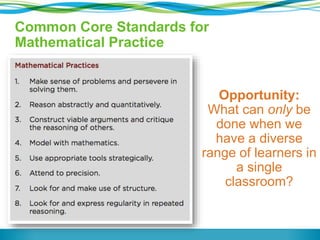
Common Core Standards for
Mathematical Practice
Opportunity:
What can only be
done when we
have a diverse
range of learners in
a single
classroom?
WHAT could
this student be
learning,
doing, and
thinking about
tomorrow?
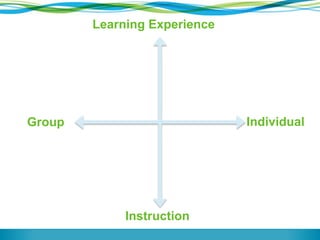
Collaborative
Projects,
Group Inquiry,
Community
Building
Independent
Projects,
Mentoring,
Interactive
Software or
Apps
Whole Class
or Small
Group
Lecture,
Online or In
Person
Explanation,
Tutoring,
Online Videos
from the
Teacher or
Other Source
IndividualGroup
Learning Experience
Instruction
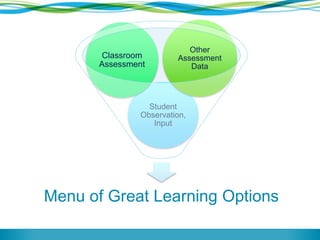
Menu of Great Learning Options
Student
Observation,
Input
Classroom
Assessment
Other
Assessment
Data
Embedded Formative Assessment
Three key elements:
1. elicit evidence about learning to close the gap
between current and desired performance,
2. adjust the learning experience to close the
performance gap with useful feedback
3. involve students in the assessment and
learning process
Adapted from Margaret Heritage, 2008
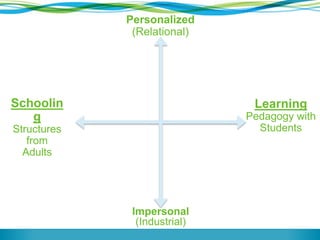
Personalized
Schooling
Personalized
Learning
Industrial
Schooling
Industrial
Learning
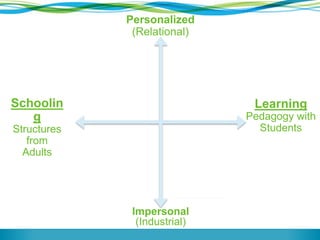
Personalized
(Relational)
Impersonal
(Industrial)
Learning
Pedagogy with
Students
Schoolin
g
Structures
from
Adults
WHAT is
her
birthdate?
Impersonal
Industrial
Schooling First
Asks:
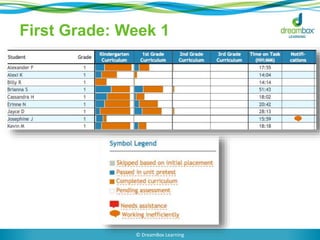
First Grade: Week 1
© DreamBox Learning
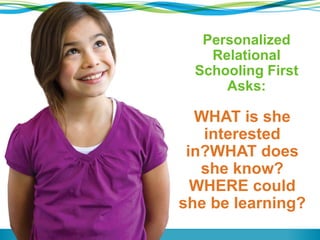
WHAT is she
interested
in?WHAT does
she know?
WHERE could
she be learning?
Personalized
Relational
Schooling First
Asks:
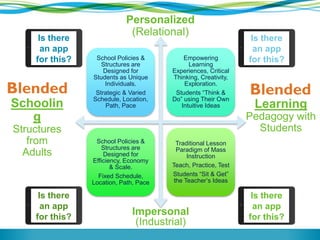
School Policies &
Structures are
Designed for
Students as Unique
Individuals.
Strategic & Varied
Schedule, Location,
Path, Pace
Empowering
Learning
Experiences, Critical
Thinking, Creativity,
Exploration.
Students “Think &
Do” using Their Own
Intuitive Ideas
School Policies &
Structures are
Designed for
Efficiency, Economy
& Scale.
Fixed Schedule,
Location, Path, Pace
Traditional Lesson
Paradigm of Mass
Instruction
Teach, Practice, Test
Students “Sit & Get”
the Teacher’s Ideas
Personalized
(Relational)
Impersonal
(Industrial)
Learning
Pedagogy with
Students
Schoolin
g
Structures
from
Adults
School Policies &
Structures are
Designed for
Students as Unique
Individuals.
Strategic & Varied
Schedule, Location,
Path, Pace
Empowering
Learning
Experiences, Critical
Thinking, Creativity,
Exploration.
Students “Think &
Do” using Their Own
Intuitive Ideas
School Policies &
Structures are
Designed for
Efficiency, Economy
& Scale.
Fixed Schedule,
Location, Path, Pace
Traditional Lesson
Paradigm of Mass
Instruction
Teach, Practice, Test
Students “Sit & Get”
the Teacher’s Ideas
Personalized
(Relational)
Impersonal
(Industrial)
Learning
Pedagogy with
Students
Schoolin
g
Structures
from
Adults
Blended Blended
Is there
an app
for this?
Is there
an app
for this?
Is there
an app
for this?
Is there
an app
for this?
Plan Schooling Backwards
“Contemporary school reform efforts…
typically focus too much on various
means: structures, schedules,
programs, PD, curriculum, and
instructional practices (like cooperative
learning)”
[or personalized learning]
[or blended learning]
[or flipped classrooms]
[or iPads®, hardware]
[or adaptive learning]
p. 234-235, Wiggins & McTighe, © 2007
Plan Schooling Backwards
“Certainly such reforms serve
as the fuel for the school
improvement engine, but
they must not be mistaken as
the destination…[which is]
improved learning.”
p. 234-235, Wiggins & McTighe, © 2007
Adaptive
Learning
Platform or Program
Adaptive
Learning
Platform or Program
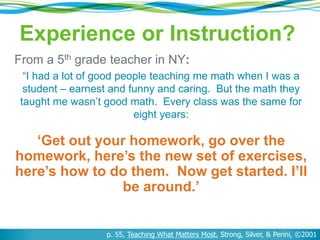
From a 5th grade teacher in NY:
“I had a lot of good people teaching me math when I was a
student – earnest and funny and caring. But the math they
taught me wasn’t good math. Every class was the same for
eight years:
‘Get out your homework, go over the
homework, here’s the new set of exercises,
here’s how to do them. Now get started. I’ll
be around.’
p. 55, Teaching What Matters Most, Strong, Silver, & Perini, ©2001
Experience or Instruction?
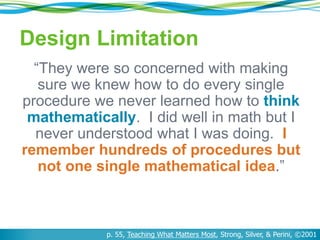
Design Limitation
“They were so concerned with making
sure we knew how to do every single
procedure we never learned how to think
mathematically. I did well in math but I
never understood what I was doing. I
remember hundreds of procedures but
not one single mathematical idea.”
p. 55, Teaching What Matters Most, Strong, Silver, & Perini, ©2001
Common Teaching Cycle
Whole
Class or
Small
Group
Instruction
Independent
Practice
Whole
Class
Assessment
Use Data
Formatively
to Plan
Use Data
Summatively
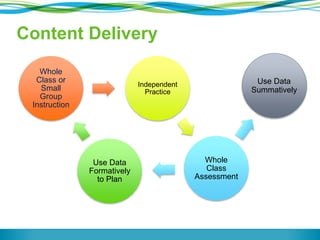
Content Delivery
Whole
Class or
Small
Group
Instruction
Independent
Practice
Whole
Class
Assessment
Use Data
Formatively
to Plan
Use Data
Summatively
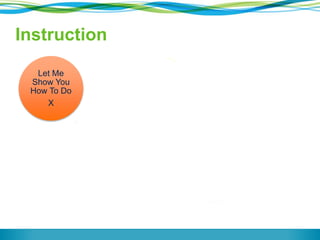
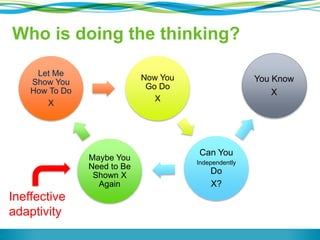
Let Me
Show You
How To Do
X
Now You
Go Do
X
Can You
Independently
Do
X?
Maybe You
Need to Be
Shown X
Again
You Know
X
Instruction
Let Me
Show You
How To Do
X
Now You
Go Do
X
Can You
Independently
Do
X?
Maybe You
Need to Be
Shown X
Again
You Know
X
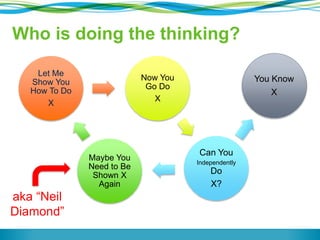
Who is doing the thinking?
Ineffective
adaptivity
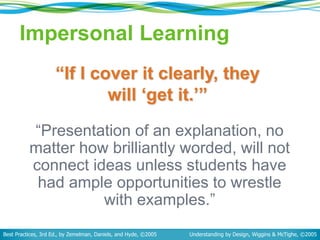
Impersonal Learning
“Presentation of an explanation, no
matter how brilliantly worded, will not
connect ideas unless students have
had ample opportunities to wrestle
with examples.”
Best Practices, 3rd Ed., by Zemelman, Daniels, and Hyde, ©2005 Understanding by Design, Wiggins & McTighe, ©2005
“If I cover it clearly, they
will ‘get it.’”
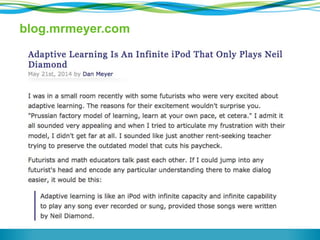
blog.mrmeyer.com
Let Me
Show You
How To Do
X
Now You
Go Do
X
Can You
Independently
Do
X?
Maybe You
Need to Be
Shown X
Again
You Know
X
Who is doing the thinking?
aka “Neil
Diamond”
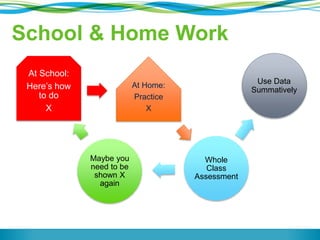
School & Home Work
At School:
Here’s how
to do
X
At Home:
Practice
X
Whole
Class
Assessment
Maybe you
need to be
shown X
again
Use Data
Summatively
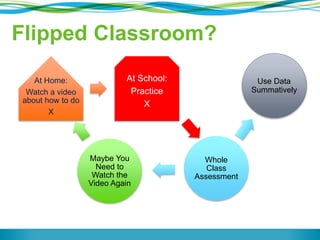
Flipped Classroom?
At Home:
Watch a video
about how to do
X
At School:
Practice
X
Whole
Class
Assessment
Maybe You
Need to
Watch the
Video Again
Use Data
Summatively
Learning Principle
“Understandings cannot
be given; they have to be
engineered so that learners
see for themselves the
power of an idea for making
sense of things.”
p. 113, Schooling by Design, Wiggins & McTighe, ©2007
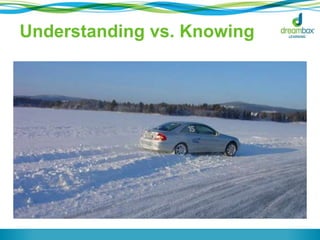
Understanding vs. Knowing
Don’t Start by Telling
“Providing students with opportunities to
first grapple with specific information
relevant to a topic has been shown to create
a ‘time for telling’ that enables them to
learn much more from an organizing
lecture.”
How People Learn, p. 58
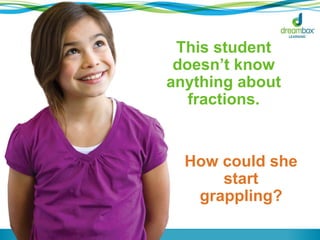
This student
doesn’t know
anything about
fractions.
How could she
start
grappling?
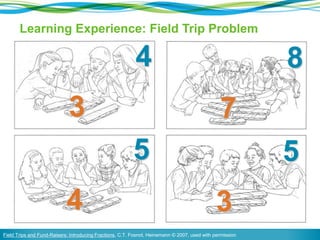
Learning Experience: Field Trip Problem
Field Trips and Fund-Raisers: Introducing Fractions, C.T. Fosnot, Heinemann © 2007, used with permission
3
4
4
5
7
8
3
5
Dewey, 1916
Democracy & Education
Chapter 12: Thinking in Education
“…thinking is the method of an
educative experience. The essentials of
method are therefore identical with the
essentials of reflection.”
Democracy and Education: an Introduction to the Philosophy of Education, J. Dewey, 1916
Dewey, 1916
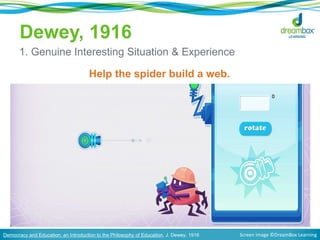
“First that the pupil have a genuine situation of
experience—that there be a continuous activity in which
he is interested for its own sake.”
Democracy and Education: an Introduction to the Philosophy of Education, J. Dewey, 1916
Field trip + Lunch = Interest
Dewey, 1916
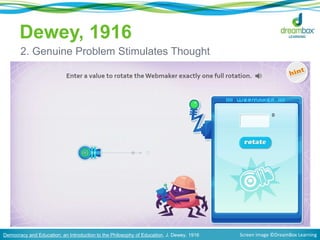
“Secondly, that a genuine problem develop within this
situation as a stimulus to thought.”
Democracy and Education: an Introduction to the Philosophy of Education, J. Dewey, 1916
Is it fair?
Dewey, 1916
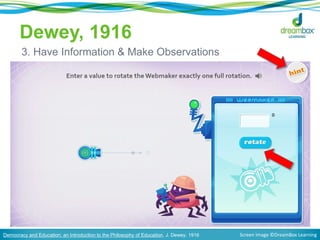
“Third, that he possess the information and make the
observations needed to deal with it.”
Democracy and Education: an Introduction to the Philosophy of Education, J. Dewey, 1916
Time for sense-making, modeling,
manipulatives, conversation, and
argumentation
Dewey, 1916
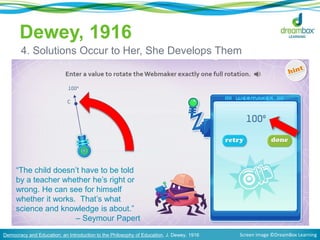
“Fourth, that suggested solutions occur to him which he
shall be responsible for developing in an orderly way.”
Democracy and Education: an Introduction to the Philosophy of Education, J. Dewey, 1916
How do we know when something
“occurs” to a student?
5th grader in intervention: “So it
looks like a half of a fifth is a tenth.
That’s easy!”
Dewey, 1916
“Fifth, that he have opportunity and occasion to test his
ideas by application, to make their meaning clear and to
discover for himself their validity.”
Democracy and Education: an Introduction to the Philosophy of Education, J. Dewey, 1916
Convince yourself through inquiry,
exploration, feedback
Learning is not accomplished
by putting thoughts into a
mind, but rather by
empowering a mind to
generate thoughts.
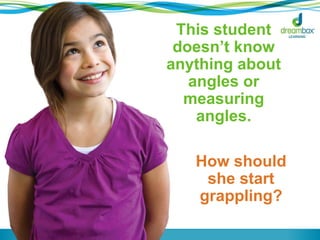
This student
doesn’t know
anything about
angles or
measuring
angles.
How should
she start
grappling?
Angle Measurement – Common Core
4.MD.6
Measure angles in whole-number degrees using a
protractor. Sketch angles of specified measure.
4.MD.7
Recognize angle measure as additive. When an angle
is decomposed into non-overlapping parts, the angle
measure of the whole is the sum of the angle measures
of the parts. Solve addition and subtraction problems
to find unknown angles on a diagram in real world and
mathematical problems, e.g., by using an equation with
a symbol for the unknown angle measure.
Digital Instruction?
When an angle is decomposed
into non-overlapping parts, the
angle measure of the whole is
the sum of the angle measures
of the parts.
Angle Measurement – Common Core
4.MD.5a
An angle is measured with reference to a circle with its
center at the common endpoint of the rays, by
considering the fraction of the circular arc between the
points where the two rays intersect the circle. An angle
that turns through 1/360 of a circle is called a “one-
degree angle,” and can be used to measure angles.
4.MD.5b
An angle that turns through n one-degree angles is
said to have an angle measure of n degrees.
Angle Measurement – Common Core
4.MD.5a
An angle is measured with reference to a circle with its
center at the common endpoint of the rays, by
considering the fraction of the circular arc between the
points where the two rays intersect the circle. An angle
that turns through 1/360 of a circle is called a “one-
degree angle,” and can be used to measure angles.
4.MD.5b
An angle that turns through n one-degree angles is
said to have an angle measure of n degrees.
Dewey, 1916
1. Genuine Interesting Situation & Experience
Democracy and Education: an Introduction to the Philosophy of Education, J. Dewey, 1916 Screen image ©DreamBox Learning
Help the spider build a web.
Dewey, 1916
2. Genuine Problem Stimulates Thought
Democracy and Education: an Introduction to the Philosophy of Education, J. Dewey, 1916 Screen image ©DreamBox Learning
Dewey, 1916
3. Have Information & Make Observations
Democracy and Education: an Introduction to the Philosophy of Education, J. Dewey, 1916 Screen image ©DreamBox Learning
Dewey, 1916
4. Solutions Occur to Her, She Develops Them
Democracy and Education: an Introduction to the Philosophy of Education, J. Dewey, 1916 Screen image ©DreamBox Learning
“The child doesn’t have to be told
by a teacher whether he’s right or
wrong. He can see for himself
whether it works. That’s what
science and knowledge is about.”
– Seymour Papert
Dewey, 1916
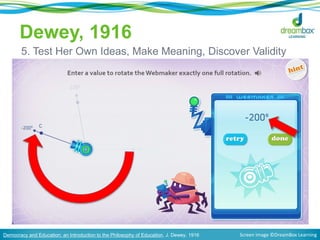
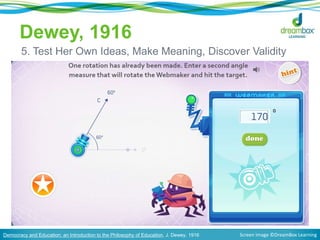
5. Test Her Own Ideas, Make Meaning, Discover Validity
Democracy and Education: an Introduction to the Philosophy of Education, J. Dewey, 1916 Screen image ©DreamBox Learning
Dewey, 1916
5. Test Her Own Ideas, Make Meaning, Discover Validity
Democracy and Education: an Introduction to the Philosophy of Education, J. Dewey, 1916 Screen image ©DreamBox Learning
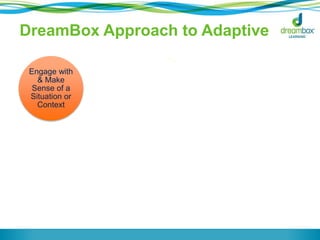
DreamBox Approach to Adaptive
Engage with
& Make
Sense of a
Situation or
Context
Student’s
Own
Ideas &
Intuition
Specific,
Instant,
Custom
Feedback
Engine
Adapts &
Differentiates
Student
Independently
Transfers
“Offline,” Too
Student
Independently
Transfers
“Offline,” Too
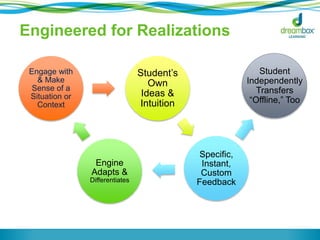
Engineered for Realizations
Engage with
& Make
Sense of a
Situation or
Context
Student’s
Own
Ideas &
Intuition
Specific,
Instant,
Custom
Feedback
Engine
Adapts &
Differentiates
Student
Independently
Transfers
“Offline,” Too
Truly Adaptive Learning
Technology requires
dynamic content be built
from the ground up to
invite, analyze and respond
to initial conceptions.
Thank you!
timh@dreambox.com
@DocHudsonMath
www.dreambox.com

EdTech Fact or Fiction

  • 1.
    Separating EdTech Fact fromFiction Adaptive Math Learning Community Launch Tim Hudson, PhD Senior Director of Curriculum Design DreamBox Learning @DocHudsonMath May 28, 2014
  • 2.
    Introduction • Senior Directorof Curriculum Design for DreamBox Learning • Over 10 years in public education o High School math teacher o K-12 Math Curriculum Coordinator o Strategic Planning Facilitator • Degrees in Math, Math Education, and Educational Leadership • Consult and work with Authentic Education & Grant Wiggins • Co-authored a chapter with Cathy Fosnot Classrooms Where Children Learn in an NCTM book Math Intervention Models: Reweaving the Tapestry (I get no royalties)
  • 3.
    Overview Learning Principles & Learning Mathematics Mental Models of“Adaptive” & Learning Perspectives for Separating EdTech Fact from Fiction
  • 4.
    Tech & LearningSurvey Definition “Adaptive learning systems are software- based technologies that automatically customize curriculum to the knowledge level of the learner. The algorithms actively track and access student performance to provide feedback to the teacher and student about the student’s progress on an ongoing basis.” 2013 survey conducted by Tech & Learning (www.techlearning.com) and commissioned by DreamBox Learning
  • 5.
    Why Adaptive? Why Differentiated? WhyIndividualized? Why Personalized?
  • 6.
    Plan Curriculum Backwards 1.Identify desired results 2. Determine acceptable evidence 3. Plan learning experiences and instruction Understanding by Design, Wiggins & McTighe, ©2005
  • 7.
    WHAT should this studentbe learning, doing, and thinking about tomorrow?
  • 8.
    Learning Requires Adaptivity “…payclose attention to the individual progress of each student and devise tasks that are appropriate…” (p. 24) Bransford, J.D., Brown, A.L., & Cocking, R.R. (Eds.). (2000). How people learn: Brain, mind, experience, and school (2nd ed.). Washington, D.C.: National Academy Press.
  • 9.
    Differentiation Defined • Educators’Purpose… • All students must master important content. • Make specific and continually evolving plans to connect each learner with key content. • Expect differences in the nature of scaffolding. • Therefore we Ask… • What does this student need at this moment in order to be able to progress with this key content, and what do I need to do to make that happen?” Leading and Managing a Differentiated Classroom by C.A. Tomlinson & M.B. Imbeau, ASCD, © 2010, pp. 13-14
  • 10.
    Logistical Classroom Reality March1: Long Division March 1: Long Division March 1: Long Division March 1: Long Division March 1: Long Division March 1: Long Division March 1: Long Division March 1: Long Division March 1: Long Division March 1: Long Division March 1: Long Division March 1: Long Division March 1: Long Division March 1: Long Division March 1: Long Division March 1: Long Division March 1: Long Division March 1: Long Division
  • 11.
    If teachers couldwork 1-1 with ALL… Decimal Long Division Long Division with Significant Scaffolding Partial Quotients Fraction Division Requires More: • Assessments • Time for Testing • Time for Scoring • Data • Content Knowledge • Resources Basic Multiplication
  • 12.
    Rethinking Differentiation Typical mentalmodels of learning often cause educators to differentiate in two wrong ways: 1. around knowledge, skills, and procedures rather than around ideas, understanding, and complex performance 2. in response to student knowledge AFTER being shown a skill instead of in response to student thinking when solving an unfamiliar problem or when forming initial conceptions.
  • 13.
    Common Core Standardsfor Mathematical Practice Opportunity: What can only be done when we have a diverse range of learners in a single classroom?
  • 14.
    WHAT could this studentbe learning, doing, and thinking about tomorrow?
  • 15.
    Collaborative Projects, Group Inquiry, Community Building Independent Projects, Mentoring, Interactive Software or Apps WholeClass or Small Group Lecture, Online or In Person Explanation, Tutoring, Online Videos from the Teacher or Other Source IndividualGroup Learning Experience Instruction
  • 16.
    Menu of GreatLearning Options Student Observation, Input Classroom Assessment Other Assessment Data
  • 17.
    Embedded Formative Assessment Threekey elements: 1. elicit evidence about learning to close the gap between current and desired performance, 2. adjust the learning experience to close the performance gap with useful feedback 3. involve students in the assessment and learning process Adapted from Margaret Heritage, 2008
  • 18.
  • 19.
  • 20.
    First Grade: Week1 © DreamBox Learning
  • 21.
    WHAT is she interested in?WHATdoes she know? WHERE could she be learning? Personalized Relational Schooling First Asks:
  • 22.
    School Policies & Structuresare Designed for Students as Unique Individuals. Strategic & Varied Schedule, Location, Path, Pace Empowering Learning Experiences, Critical Thinking, Creativity, Exploration. Students “Think & Do” using Their Own Intuitive Ideas School Policies & Structures are Designed for Efficiency, Economy & Scale. Fixed Schedule, Location, Path, Pace Traditional Lesson Paradigm of Mass Instruction Teach, Practice, Test Students “Sit & Get” the Teacher’s Ideas Personalized (Relational) Impersonal (Industrial) Learning Pedagogy with Students Schoolin g Structures from Adults
  • 23.
    School Policies & Structuresare Designed for Students as Unique Individuals. Strategic & Varied Schedule, Location, Path, Pace Empowering Learning Experiences, Critical Thinking, Creativity, Exploration. Students “Think & Do” using Their Own Intuitive Ideas School Policies & Structures are Designed for Efficiency, Economy & Scale. Fixed Schedule, Location, Path, Pace Traditional Lesson Paradigm of Mass Instruction Teach, Practice, Test Students “Sit & Get” the Teacher’s Ideas Personalized (Relational) Impersonal (Industrial) Learning Pedagogy with Students Schoolin g Structures from Adults Blended Blended Is there an app for this? Is there an app for this? Is there an app for this? Is there an app for this?
  • 24.
    Plan Schooling Backwards “Contemporaryschool reform efforts… typically focus too much on various means: structures, schedules, programs, PD, curriculum, and instructional practices (like cooperative learning)” [or personalized learning] [or blended learning] [or flipped classrooms] [or iPads®, hardware] [or adaptive learning] p. 234-235, Wiggins & McTighe, © 2007
  • 25.
    Plan Schooling Backwards “Certainlysuch reforms serve as the fuel for the school improvement engine, but they must not be mistaken as the destination…[which is] improved learning.” p. 234-235, Wiggins & McTighe, © 2007
  • 26.
  • 27.
  • 28.
    From a 5thgrade teacher in NY: “I had a lot of good people teaching me math when I was a student – earnest and funny and caring. But the math they taught me wasn’t good math. Every class was the same for eight years: ‘Get out your homework, go over the homework, here’s the new set of exercises, here’s how to do them. Now get started. I’ll be around.’ p. 55, Teaching What Matters Most, Strong, Silver, & Perini, ©2001 Experience or Instruction?
  • 31.
    Design Limitation “They wereso concerned with making sure we knew how to do every single procedure we never learned how to think mathematically. I did well in math but I never understood what I was doing. I remember hundreds of procedures but not one single mathematical idea.” p. 55, Teaching What Matters Most, Strong, Silver, & Perini, ©2001
  • 32.
    Common Teaching Cycle Whole Classor Small Group Instruction Independent Practice Whole Class Assessment Use Data Formatively to Plan Use Data Summatively
  • 33.
  • 34.
    Let Me Show You HowTo Do X Now You Go Do X Can You Independently Do X? Maybe You Need to Be Shown X Again You Know X Instruction
  • 35.
    Let Me Show You HowTo Do X Now You Go Do X Can You Independently Do X? Maybe You Need to Be Shown X Again You Know X Who is doing the thinking? Ineffective adaptivity
  • 36.
    Impersonal Learning “Presentation ofan explanation, no matter how brilliantly worded, will not connect ideas unless students have had ample opportunities to wrestle with examples.” Best Practices, 3rd Ed., by Zemelman, Daniels, and Hyde, ©2005 Understanding by Design, Wiggins & McTighe, ©2005 “If I cover it clearly, they will ‘get it.’”
  • 37.
  • 38.
    Let Me Show You HowTo Do X Now You Go Do X Can You Independently Do X? Maybe You Need to Be Shown X Again You Know X Who is doing the thinking? aka “Neil Diamond”
  • 39.
    School & HomeWork At School: Here’s how to do X At Home: Practice X Whole Class Assessment Maybe you need to be shown X again Use Data Summatively
  • 40.
    Flipped Classroom? At Home: Watcha video about how to do X At School: Practice X Whole Class Assessment Maybe You Need to Watch the Video Again Use Data Summatively
  • 41.
    Learning Principle “Understandings cannot begiven; they have to be engineered so that learners see for themselves the power of an idea for making sense of things.” p. 113, Schooling by Design, Wiggins & McTighe, ©2007
  • 42.
  • 43.
    Don’t Start byTelling “Providing students with opportunities to first grapple with specific information relevant to a topic has been shown to create a ‘time for telling’ that enables them to learn much more from an organizing lecture.” How People Learn, p. 58
  • 44.
    This student doesn’t know anythingabout fractions. How could she start grappling?
  • 45.
    Learning Experience: FieldTrip Problem Field Trips and Fund-Raisers: Introducing Fractions, C.T. Fosnot, Heinemann © 2007, used with permission 3 4 4 5 7 8 3 5
  • 46.
    Dewey, 1916 Democracy &Education Chapter 12: Thinking in Education “…thinking is the method of an educative experience. The essentials of method are therefore identical with the essentials of reflection.” Democracy and Education: an Introduction to the Philosophy of Education, J. Dewey, 1916
  • 47.
    Dewey, 1916 “First thatthe pupil have a genuine situation of experience—that there be a continuous activity in which he is interested for its own sake.” Democracy and Education: an Introduction to the Philosophy of Education, J. Dewey, 1916 Field trip + Lunch = Interest
  • 48.
    Dewey, 1916 “Secondly, thata genuine problem develop within this situation as a stimulus to thought.” Democracy and Education: an Introduction to the Philosophy of Education, J. Dewey, 1916 Is it fair?
  • 49.
    Dewey, 1916 “Third, thathe possess the information and make the observations needed to deal with it.” Democracy and Education: an Introduction to the Philosophy of Education, J. Dewey, 1916 Time for sense-making, modeling, manipulatives, conversation, and argumentation
  • 50.
    Dewey, 1916 “Fourth, thatsuggested solutions occur to him which he shall be responsible for developing in an orderly way.” Democracy and Education: an Introduction to the Philosophy of Education, J. Dewey, 1916 How do we know when something “occurs” to a student? 5th grader in intervention: “So it looks like a half of a fifth is a tenth. That’s easy!”
  • 51.
    Dewey, 1916 “Fifth, thathe have opportunity and occasion to test his ideas by application, to make their meaning clear and to discover for himself their validity.” Democracy and Education: an Introduction to the Philosophy of Education, J. Dewey, 1916 Convince yourself through inquiry, exploration, feedback
  • 52.
    Learning is notaccomplished by putting thoughts into a mind, but rather by empowering a mind to generate thoughts.
  • 53.
    This student doesn’t know anythingabout angles or measuring angles. How should she start grappling?
  • 54.
    Angle Measurement –Common Core 4.MD.6 Measure angles in whole-number degrees using a protractor. Sketch angles of specified measure. 4.MD.7 Recognize angle measure as additive. When an angle is decomposed into non-overlapping parts, the angle measure of the whole is the sum of the angle measures of the parts. Solve addition and subtraction problems to find unknown angles on a diagram in real world and mathematical problems, e.g., by using an equation with a symbol for the unknown angle measure.
  • 55.
    Digital Instruction? When anangle is decomposed into non-overlapping parts, the angle measure of the whole is the sum of the angle measures of the parts.
  • 56.
    Angle Measurement –Common Core 4.MD.5a An angle is measured with reference to a circle with its center at the common endpoint of the rays, by considering the fraction of the circular arc between the points where the two rays intersect the circle. An angle that turns through 1/360 of a circle is called a “one- degree angle,” and can be used to measure angles. 4.MD.5b An angle that turns through n one-degree angles is said to have an angle measure of n degrees.
  • 57.
    Angle Measurement –Common Core 4.MD.5a An angle is measured with reference to a circle with its center at the common endpoint of the rays, by considering the fraction of the circular arc between the points where the two rays intersect the circle. An angle that turns through 1/360 of a circle is called a “one- degree angle,” and can be used to measure angles. 4.MD.5b An angle that turns through n one-degree angles is said to have an angle measure of n degrees.
  • 58.
    Dewey, 1916 1. GenuineInteresting Situation & Experience Democracy and Education: an Introduction to the Philosophy of Education, J. Dewey, 1916 Screen image ©DreamBox Learning Help the spider build a web.
  • 59.
    Dewey, 1916 2. GenuineProblem Stimulates Thought Democracy and Education: an Introduction to the Philosophy of Education, J. Dewey, 1916 Screen image ©DreamBox Learning
  • 60.
    Dewey, 1916 3. HaveInformation & Make Observations Democracy and Education: an Introduction to the Philosophy of Education, J. Dewey, 1916 Screen image ©DreamBox Learning
  • 61.
    Dewey, 1916 4. SolutionsOccur to Her, She Develops Them Democracy and Education: an Introduction to the Philosophy of Education, J. Dewey, 1916 Screen image ©DreamBox Learning “The child doesn’t have to be told by a teacher whether he’s right or wrong. He can see for himself whether it works. That’s what science and knowledge is about.” – Seymour Papert
  • 62.
    Dewey, 1916 5. TestHer Own Ideas, Make Meaning, Discover Validity Democracy and Education: an Introduction to the Philosophy of Education, J. Dewey, 1916 Screen image ©DreamBox Learning
  • 63.
    Dewey, 1916 5. TestHer Own Ideas, Make Meaning, Discover Validity Democracy and Education: an Introduction to the Philosophy of Education, J. Dewey, 1916 Screen image ©DreamBox Learning
  • 64.
    DreamBox Approach toAdaptive Engage with & Make Sense of a Situation or Context Student’s Own Ideas & Intuition Specific, Instant, Custom Feedback Engine Adapts & Differentiates Student Independently Transfers “Offline,” Too Student Independently Transfers “Offline,” Too
  • 65.
    Engineered for Realizations Engagewith & Make Sense of a Situation or Context Student’s Own Ideas & Intuition Specific, Instant, Custom Feedback Engine Adapts & Differentiates Student Independently Transfers “Offline,” Too
  • 66.
    Truly Adaptive Learning Technologyrequires dynamic content be built from the ground up to invite, analyze and respond to initial conceptions.
  • 67.

Editor's Notes

  • #19 People are getting what they need and when they need it. Better learning, not regurgitating. What do you think about content X? Explore, make sense How many people use Personalized Learning & Personalized Schooling interchangeably?
  • #23 People are getting what they need and when they need it. Better learning, not regurgitating. What do you think about content X? Explore, make sense How many people use Personalized Learning & Personalized Schooling interchangeably?
  • #24 People are getting what they need and when they need it. Better learning, not regurgitating. What do you think about content X? Explore, make sense How many people use Personalized Learning & Personalized Schooling interchangeably?