Comprehensive
Geriatric Assessment
By: TAUQEER AHMED
A- Learning Objectives
 To know the Definition of Comprehensive Geriatric
Assessment.
 To understand the Importance of Comprehensive
Geriatric Assessment.
 To know the multiple Domains of Geriatric evaluation.
 To know the Useful tools used for evaluation
B- Outline:
 Introduction Case
 Defining Comprehensive Geriatric assessment (CGA)
 Explain the importance of CGA based on literature.
 Domains of evaluation: list and tools.
 Conclusion
C- Introduction:
 K.R, 85 year old Female, living at home by herself, had
fallen down the stairs one week ago. Since her fall, she
walks slowly while holding her hands to the furniture,
doesn’t want to leave the apartment, not eating well and
calling anxiously her daughter multiple times per day.
 Her daughter brought to the primary care clinic for
evaluation.
 Physical exam practically normal.
 How can the family physician (or the Referral Geriatrician)
evaluate this patient?
JKH luk, HKMJ 2000;6:93-8 Rubenstein.Clin Geriatr Med 1987;3:1-15.
1-Comprehensive Geriatric Assessment
Definition
 Multidimensional,Multidisciplinary diagnostic process.
 Goal: determine a frail elderly person’s
medical,psychosocial, and functional capacities and
problems.
 Objective: develop an overall plan of treatment
& long-term follow-up.
 Concept started in 1930 (Dr Warren); now regarded as the
“technology” of geriatric medicine.
 Assessment involves an interdisciplinary team:
- Geriatrician or primary care physician
- Geriatric nurse
- Social worker
- Physical therapist/Occupational therapist
- Pharmacist
- Psychologist/Psychiatrist
- Dietitian
1- Definition of Comprehensive
Geriatric Assessment
2- Importance of Comprehensive
Geriatric assessment:
 Population is aging
 1998: Age 65+ numbered 34 million (in USA)
 2030: Age 65+ will number 70 million
 Largest increase in those over age 85
 Majority of elderly will be cared for by internists and
family practitioners
(Hendriksen et al.,1984; Vetter et al.,1984; Applegate et al.,1990; Saltvedt et al.,2002;
H.-K kuo et al. Arch Gero & Geria 39 2004 245-254)
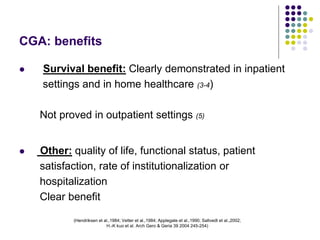
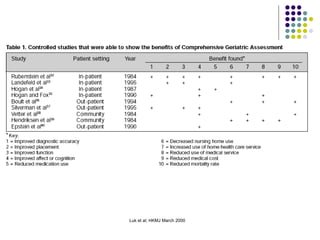
CGA: benefits
 Survival benefit: Clearly demonstrated in inpatient
settings and in home healthcare (3-4)
Not proved in outpatient settings (5)
 Other: quality of life, functional status, patient
satisfaction, rate of institutionalization or
hospitalization
Clear benefit
Luk et al; HKMJ March 2000
 ---------------------------------------------------------------------------
ًWHO.health of the elderly.1989
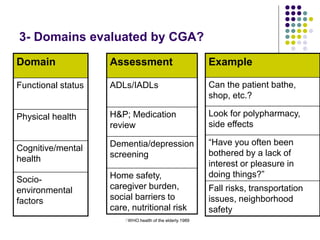
3- Domains evaluated by CGA?
Domain
Functional status
Physical health
Cognitive/mental
health
Socio-
environmental
factors
Assessment
ADLs/IADLs
H&P; Medication
review
Dementia/depression
screening
Home safety,
caregiver burden,
social barriers to
care, nutritional risk
Example
Can the patient bathe,
shop, etc.?
Look for polypharmacy,
side effects
“Have you often been
bothered by a lack of
interest or pleasure in
doing things?”
Fall risks, transportation
issues, neighborhood
safety
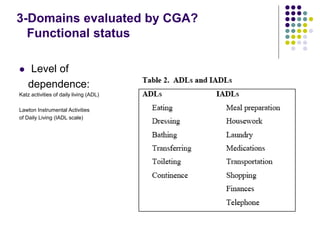
3-Domains evaluated by CGA?
Functional status
 Level of
dependence:
Katz activities of daily living (ADL)
Lawton Instrumental Activities
of Daily Living (IADL scale)
Small changes in function make a big difference
in quality of life for patients and their caregivers.
3-Domains evaluated by CGA?
Physical health
 Vision: don’t forget Underreporting of symptoms
 Hearing: Presbycusis : present in > 50 % of older persons.
 Urinary continence
 Sexual History: discomfort may result from physician rather than
patients attitudes; simple open-ended question.
 Falls and Gait & medications *
Rubenstein et al; J Gerontol 96:M366-72,2001
3-Domains evaluated by CGA?
Nutritional Status
 MNA: mini-nutritional assessment
-30 items
-Association of: anthropometric and dietary parameters,
global evaluation and a subjective evaluation of health
-The first 6 items are enough for screening
-Well validated in USA and Europe (6)
- Able to classify 75 % of patients
- Good nutritionnal status >24
- Denutrition < 17
3-Domains evaluated by CGA?
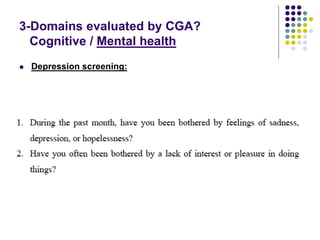
Cognitive / Mental health
 Depression screening:
SCHEIKH JI et al; Clin Gerontol, 1986; 5:161-73.
3-Domains evaluated by CGA?
Cognitive / Mental health
 Depression Evaluation:
 Geriatric Depression scale: GDS
-15 items
-Validated in multiple countries for ambulatory patients.
-Score > 6/15 --> depression : Se 92% Sp 81%.
-To be used only for patients with a mini-mental > 14/30
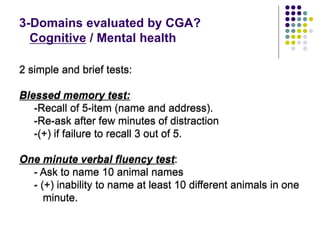
2 simple and brief tests:
Blessed memory test:
-Recall of 5-item (name and address).
-Re-ask after few minutes of distraction
-(+) if failure to recall 3 out of 5.
One minute verbal fluency test:
- Ask to name 10 animal names
- (+) inability to name at least 10 different animals in one
minute.
3-Domains evaluated by CGA?
Cognitive / Mental health
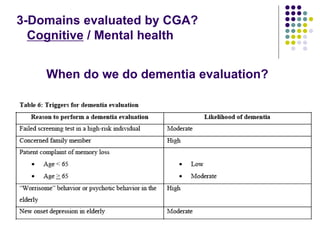
When do we do dementia evaluation?
3-Domains evaluated by CGA?
Cognitive / Mental health
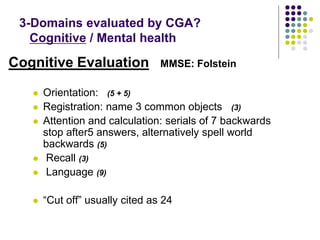
Cognitive Evaluation MMSE: Folstein
 Orientation: (5 + 5)
 Registration: name 3 common objects (3)
 Attention and calculation: serials of 7 backwards
stop after5 answers, alternatively spell world
backwards (5)
 Recall (3)
 Language (9)
 “Cut off” usually cited as 24
3-Domains evaluated by CGA?
Cognitive / Mental health
Crum; JAMA 1994
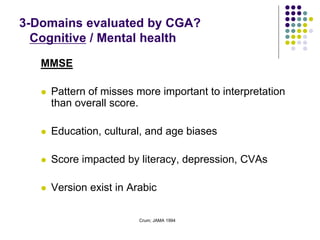
MMSE
 Pattern of misses more important to interpretation
than overall score.
 Education, cultural, and age biases
 Score impacted by literacy, depression, CVAs
 Version exist in Arabic
3-Domains evaluated by CGA?
Cognitive / Mental health
Berkman LF.Am J Epidem 1986;123:559
4- Domains evaluated by CGA
Socio-environmental Factors
 Detailed knowledge of any change in living, who is
available at home or in the local community.
 Inquiring about: stairs, rugs, thresholds, bathing
facilities, heating.
 Home visit is the best method
 Extent of Social relationships is a powerful predictor of
functional status and mortality.
Screening for Specific Problems:
Falls and Gait Disorders
Major cause of morbidity and mortality
- 1/3 of elderly fall each year
- Major cause of NH placement
- Falls, mobility impairment, and functional
impairment closely related
 Fall History Assessment:
 Ask the Patient: Have you fallen in the past year?
 Gait Assessment
 Up and Go Test
 Rise from chair, walk 10 feet, turn around, walk
back, sit down
 Timed Up and Go Test- normal less than 10 seconds
Screening for Specific Problems:
Caregiver Stress and Abuse
 Caregiver stress highly correlated with increased risk
of institutionalization, abuse and neglect.
 Education & support of Caregiver is very important.
 Clues: Caregiver miss appointments,concerned about
medical costs, history of substance abuse, dominates
interview,defensive, hostile, dependence on patient for
income.
•Q & A: Do you feel Safe at home?
Screening for Specific Problems:
Medications
 Elderly use 3X more medications than younger patients.
 Drug distribution, elimination, excretion, &
pharmacodynamics altered in elderly.
 ADR’s and drug-drug interactions increase markedly with
# drugs used.
 Medications linked to “reversible dementias”, falls,
incontinence, hospitalizations, death.
Clinical Case:
 K.R, 85 year old Female, living at home by herself, had
fallen down the stairs one week ago. Since her fall, she
walks slowly while holding her hands to the furniture,
doesn’t want to leave the apartment, not eating well and
calling anxiously her daughter multiple times per day.
 Her daughter brought to the primary care clinic for
evaluation.
 Physical exam practically normal.
 How can the family physician (or the Referral Geriatrician)
evaluate this patient?
Clinical Case
 “Get up and go”: test takes 45 sec; difficulty rising of the
chair; incapacity of advancement without holding to the
furniture.
 ADL (5/6): needs aid for toileting and eating.
 IADL (10/14): (budget management issue…)
 MMS: 20/30: (short term memory problems, moderate
temporo-spatial disorientation, calculcation problems)
 GDS: 8/15
 MNA: 23/30
 Social evaluation: daughter is 55 y o with a husband
having lung cancer; can take her home on weekends; a
niece available twice per week; earns 600 dollars per
month; can’t perceive any allocation at home;
 Impression: post-fall syndrome with depressive
symptomatology; Recent loss of autonomy; moderate
cognitive problems; De-nutrition risk.
 Management proposed by the doctor:
 Physical therapy at home.
 Antidepressant treatment.
 Visiting nurse at home twice a week (for complete
toileting)
 Family intervention on week-end and for budget
management.
 Visiting maid for help in eating
 Follow-up evaluation in 2 months.
Conclusion
 Primary health care practitioners play important roles in patient care.
 The primary health care system is not well established in Lebanon;
elderly assessment is shifted to hospitals and specialist care.
 GPs need to learn more about geriatric care.
 Importance of multidisciplinary Geriatric assessment
 Assess all the domains
 Screen for geriatric syndromes:
 falls, incontinence, dementia, depression, hearing, vision, pain…
Thank you
References:
1- JKH lukU et al. Using the CGA technique to assess elderly patient;
HMMJ Vol 6 No 1 March 2000.
2- Rainfray Muriel et al.: Comprehensive Geriatric assessment: a useful
tool for prevention of acute situation in elderly;
Ann.Med.Interne,2002;153,6,347-402.
3-Saldvedt et al. Reduced mortality in treating acutely sick, frail older
patients in a geriatric evaluation and management unit.
J.Am.Geriatr.Soc,2002; 50,792-798.
4- Appelgate et al.; 1991;Geriatric evaluation and management: current
status and future research directions.J.Am.Geriatr.Soc;39,2S-7S.
5- H-K kuo et al.The influence of outpatient Geriatric assessment on
survival; a meta-analysis; Arch of Geront and Geriartrics 39 (2004)
245-254.
 6- Scheikh Ji, Yesavage Ja: Geriatric depression scale (GDS):
recent evidence and development of a shorter version.Clin Gerontol,
1986;5:161-173.
 7- Guigoz et al.: mini-nutritionnal assessment: a practical
assessment tool for grading nutritionnal state of elderly patients.
Facts Res Gerontol, 1994:21-60.

cognitive asssessment tool (Dementia).ppt

  • 1.
  • 2.
    A- Learning Objectives To know the Definition of Comprehensive Geriatric Assessment.  To understand the Importance of Comprehensive Geriatric Assessment.  To know the multiple Domains of Geriatric evaluation.  To know the Useful tools used for evaluation
  • 3.
    B- Outline:  IntroductionCase  Defining Comprehensive Geriatric assessment (CGA)  Explain the importance of CGA based on literature.  Domains of evaluation: list and tools.  Conclusion
  • 4.
    C- Introduction:  K.R,85 year old Female, living at home by herself, had fallen down the stairs one week ago. Since her fall, she walks slowly while holding her hands to the furniture, doesn’t want to leave the apartment, not eating well and calling anxiously her daughter multiple times per day.  Her daughter brought to the primary care clinic for evaluation.  Physical exam practically normal.  How can the family physician (or the Referral Geriatrician) evaluate this patient?
  • 5.
    JKH luk, HKMJ2000;6:93-8 Rubenstein.Clin Geriatr Med 1987;3:1-15. 1-Comprehensive Geriatric Assessment Definition  Multidimensional,Multidisciplinary diagnostic process.  Goal: determine a frail elderly person’s medical,psychosocial, and functional capacities and problems.  Objective: develop an overall plan of treatment & long-term follow-up.  Concept started in 1930 (Dr Warren); now regarded as the “technology” of geriatric medicine.
  • 6.
     Assessment involvesan interdisciplinary team: - Geriatrician or primary care physician - Geriatric nurse - Social worker - Physical therapist/Occupational therapist - Pharmacist - Psychologist/Psychiatrist - Dietitian 1- Definition of Comprehensive Geriatric Assessment
  • 7.
    2- Importance ofComprehensive Geriatric assessment:  Population is aging  1998: Age 65+ numbered 34 million (in USA)  2030: Age 65+ will number 70 million  Largest increase in those over age 85  Majority of elderly will be cared for by internists and family practitioners
  • 8.
    (Hendriksen et al.,1984;Vetter et al.,1984; Applegate et al.,1990; Saltvedt et al.,2002; H.-K kuo et al. Arch Gero & Geria 39 2004 245-254) CGA: benefits  Survival benefit: Clearly demonstrated in inpatient settings and in home healthcare (3-4) Not proved in outpatient settings (5)  Other: quality of life, functional status, patient satisfaction, rate of institutionalization or hospitalization Clear benefit
  • 9.
    Luk et al;HKMJ March 2000  ---------------------------------------------------------------------------
  • 10.
    ًWHO.health of theelderly.1989 3- Domains evaluated by CGA? Domain Functional status Physical health Cognitive/mental health Socio- environmental factors Assessment ADLs/IADLs H&P; Medication review Dementia/depression screening Home safety, caregiver burden, social barriers to care, nutritional risk Example Can the patient bathe, shop, etc.? Look for polypharmacy, side effects “Have you often been bothered by a lack of interest or pleasure in doing things?” Fall risks, transportation issues, neighborhood safety
  • 11.
    3-Domains evaluated byCGA? Functional status  Level of dependence: Katz activities of daily living (ADL) Lawton Instrumental Activities of Daily Living (IADL scale)
  • 12.
    Small changes infunction make a big difference in quality of life for patients and their caregivers.
  • 13.
    3-Domains evaluated byCGA? Physical health  Vision: don’t forget Underreporting of symptoms  Hearing: Presbycusis : present in > 50 % of older persons.  Urinary continence  Sexual History: discomfort may result from physician rather than patients attitudes; simple open-ended question.  Falls and Gait & medications *
  • 14.
    Rubenstein et al;J Gerontol 96:M366-72,2001 3-Domains evaluated by CGA? Nutritional Status  MNA: mini-nutritional assessment -30 items -Association of: anthropometric and dietary parameters, global evaluation and a subjective evaluation of health -The first 6 items are enough for screening -Well validated in USA and Europe (6) - Able to classify 75 % of patients - Good nutritionnal status >24 - Denutrition < 17
  • 16.
    3-Domains evaluated byCGA? Cognitive / Mental health  Depression screening:
  • 17.
    SCHEIKH JI etal; Clin Gerontol, 1986; 5:161-73. 3-Domains evaluated by CGA? Cognitive / Mental health  Depression Evaluation:  Geriatric Depression scale: GDS -15 items -Validated in multiple countries for ambulatory patients. -Score > 6/15 --> depression : Se 92% Sp 81%. -To be used only for patients with a mini-mental > 14/30
  • 18.
    2 simple andbrief tests: Blessed memory test: -Recall of 5-item (name and address). -Re-ask after few minutes of distraction -(+) if failure to recall 3 out of 5. One minute verbal fluency test: - Ask to name 10 animal names - (+) inability to name at least 10 different animals in one minute. 3-Domains evaluated by CGA? Cognitive / Mental health
  • 19.
    When do wedo dementia evaluation? 3-Domains evaluated by CGA? Cognitive / Mental health
  • 20.
    Cognitive Evaluation MMSE:Folstein  Orientation: (5 + 5)  Registration: name 3 common objects (3)  Attention and calculation: serials of 7 backwards stop after5 answers, alternatively spell world backwards (5)  Recall (3)  Language (9)  “Cut off” usually cited as 24 3-Domains evaluated by CGA? Cognitive / Mental health
  • 21.
    Crum; JAMA 1994 MMSE Pattern of misses more important to interpretation than overall score.  Education, cultural, and age biases  Score impacted by literacy, depression, CVAs  Version exist in Arabic 3-Domains evaluated by CGA? Cognitive / Mental health
  • 22.
    Berkman LF.Am JEpidem 1986;123:559 4- Domains evaluated by CGA Socio-environmental Factors  Detailed knowledge of any change in living, who is available at home or in the local community.  Inquiring about: stairs, rugs, thresholds, bathing facilities, heating.  Home visit is the best method  Extent of Social relationships is a powerful predictor of functional status and mortality.
  • 23.
    Screening for SpecificProblems: Falls and Gait Disorders Major cause of morbidity and mortality - 1/3 of elderly fall each year - Major cause of NH placement - Falls, mobility impairment, and functional impairment closely related
  • 24.
     Fall HistoryAssessment:  Ask the Patient: Have you fallen in the past year?  Gait Assessment  Up and Go Test  Rise from chair, walk 10 feet, turn around, walk back, sit down  Timed Up and Go Test- normal less than 10 seconds
  • 25.
    Screening for SpecificProblems: Caregiver Stress and Abuse  Caregiver stress highly correlated with increased risk of institutionalization, abuse and neglect.  Education & support of Caregiver is very important.  Clues: Caregiver miss appointments,concerned about medical costs, history of substance abuse, dominates interview,defensive, hostile, dependence on patient for income. •Q & A: Do you feel Safe at home?
  • 26.
    Screening for SpecificProblems: Medications  Elderly use 3X more medications than younger patients.  Drug distribution, elimination, excretion, & pharmacodynamics altered in elderly.  ADR’s and drug-drug interactions increase markedly with # drugs used.  Medications linked to “reversible dementias”, falls, incontinence, hospitalizations, death.
  • 27.
    Clinical Case:  K.R,85 year old Female, living at home by herself, had fallen down the stairs one week ago. Since her fall, she walks slowly while holding her hands to the furniture, doesn’t want to leave the apartment, not eating well and calling anxiously her daughter multiple times per day.  Her daughter brought to the primary care clinic for evaluation.  Physical exam practically normal.  How can the family physician (or the Referral Geriatrician) evaluate this patient?
  • 28.
    Clinical Case  “Getup and go”: test takes 45 sec; difficulty rising of the chair; incapacity of advancement without holding to the furniture.  ADL (5/6): needs aid for toileting and eating.  IADL (10/14): (budget management issue…)  MMS: 20/30: (short term memory problems, moderate temporo-spatial disorientation, calculcation problems)  GDS: 8/15  MNA: 23/30  Social evaluation: daughter is 55 y o with a husband having lung cancer; can take her home on weekends; a niece available twice per week; earns 600 dollars per month; can’t perceive any allocation at home;
  • 29.
     Impression: post-fallsyndrome with depressive symptomatology; Recent loss of autonomy; moderate cognitive problems; De-nutrition risk.  Management proposed by the doctor:  Physical therapy at home.  Antidepressant treatment.  Visiting nurse at home twice a week (for complete toileting)  Family intervention on week-end and for budget management.  Visiting maid for help in eating  Follow-up evaluation in 2 months.
  • 30.
    Conclusion  Primary healthcare practitioners play important roles in patient care.  The primary health care system is not well established in Lebanon; elderly assessment is shifted to hospitals and specialist care.  GPs need to learn more about geriatric care.  Importance of multidisciplinary Geriatric assessment  Assess all the domains  Screen for geriatric syndromes:  falls, incontinence, dementia, depression, hearing, vision, pain…
  • 31.
  • 32.
    References: 1- JKH lukUet al. Using the CGA technique to assess elderly patient; HMMJ Vol 6 No 1 March 2000. 2- Rainfray Muriel et al.: Comprehensive Geriatric assessment: a useful tool for prevention of acute situation in elderly; Ann.Med.Interne,2002;153,6,347-402. 3-Saldvedt et al. Reduced mortality in treating acutely sick, frail older patients in a geriatric evaluation and management unit. J.Am.Geriatr.Soc,2002; 50,792-798. 4- Appelgate et al.; 1991;Geriatric evaluation and management: current status and future research directions.J.Am.Geriatr.Soc;39,2S-7S. 5- H-K kuo et al.The influence of outpatient Geriatric assessment on survival; a meta-analysis; Arch of Geront and Geriartrics 39 (2004) 245-254.
  • 33.
     6- ScheikhJi, Yesavage Ja: Geriatric depression scale (GDS): recent evidence and development of a shorter version.Clin Gerontol, 1986;5:161-173.  7- Guigoz et al.: mini-nutritionnal assessment: a practical assessment tool for grading nutritionnal state of elderly patients. Facts Res Gerontol, 1994:21-60.