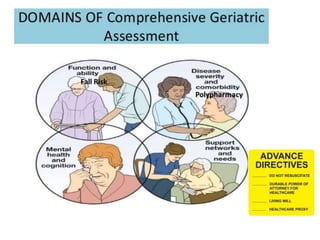
COMPREHENSIVE GERIATRIC
ASSESSMENT
Dr. Divyamol Sasidharan
Senior Resident
Dept. of Geriatrics
AIMS, Kochi
What is CGA???
A multidisciplinary
diagnostic and treatment process that identifies
medical, psychosocial, and functional limitations
of a frail older person in order to develop
a coordinated plan to
maximize overall health
with aging
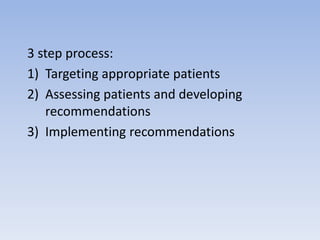
3 step process:
1) Targeting appropriate patients
2) Assessing patients and developing
recommendations
3) Implementing recommendations
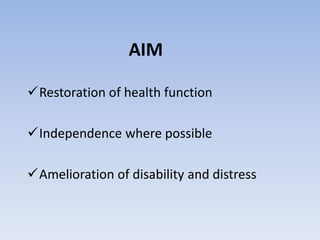
AIM
Restoration of health function
Independence where possible
Amelioration of disability and distress
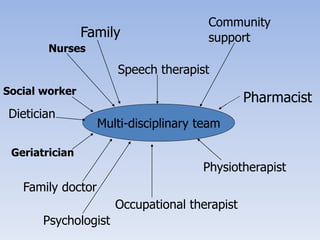
Multi-disciplinary team
Family doctor
Nurses
Speech therapist
Dietician
Physiotherapist
Occupational therapist
Pharmacist
Community
supportFamily
Geriatrician
Multi-disciplinary team
Psychologist
Social worker
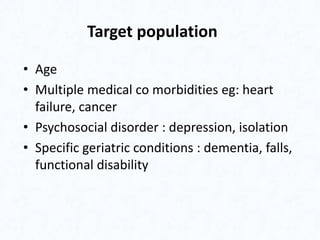
Target population
• Age
• Multiple medical co morbidities eg: heart
failure, cancer
• Psychosocial disorder : depression, isolation
• Specific geriatric conditions : dementia, falls,
functional disability
Target population
• Previous or predicted high health care
utilisation
• Considering of change in living situation
from independent living to assisted, nursing
home or in home care givers
Target population
• Too Sick to Benefit
: Critically ill or medically unstable
: Terminally ill
: Disorders with no effective treatment
• Too Well to Benefit
: One or a few medical conditions
: Needing prevention measures only
Target population
• Appropriate and Will Benefit
: Multiple interacting biopsychological problems
that are amenable to treatment
: Disorders that require rehabilitation therapy
FRAME WORK
1) Data-gathering
2) Discussion among the team, increasingly
including the patient and/or caregiver as a
member of the team
3) Development, with the patient and/or caregiver,
of a treatment plan
4) Implementation of the treatment plan
5) Monitoring response to the treatment plan
6) Revising the treatment plan
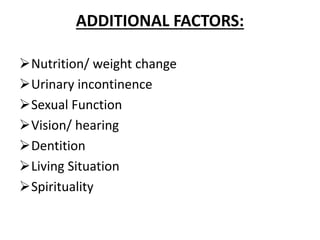
ADDITIONAL FACTORS:
Nutrition/ weight change
Urinary incontinence
Sexual Function
Vision/ hearing
Dentition
Living Situation
Spirituality
Efficacy
• Multiple meta-analyses have found home
assessments to be consistently effective in
reducing functional decline as well as overall
mortality
1. Stuck AE, Egger M, Hammer A, et al. Home visits to prevent nursing home admission and functional decline in elderly
people: systematic review and meta-regression analysis. JAMA 2002; 287:1022.
2. Elkan R, Kendrick D, Dewey M, et al. Effectiveness of home based support for older people: systematic review and
meta-analysis. BMJ 2001; 323:719.
3. Huss A, Stuck AE, Rubenstein LZ, et al. Multidimensional preventive home visit programs for community-dwelling
older adults: a systematic review and meta-analysis of randomized controlled trials. J Gerontol A Biol Sci Med Sci 2008;
63:298.
Stuck AE, Siu AL, Wieland GD, et al. Comprehensive geriatric assessment: a meta-analysis of controlled trials. Lancet
1993; 342:1032.
• 17 randomized trials evaluating geriatric
rehabilitative units (within an acute care
hospital or a rehabilitation hospital) found that
inpatient multidisciplinary programs were
associated with improvement in all outcomes
at discharge, including better functional status
(OR 1.75, 95% CI 1.31-2.35), decreased nursing
home admission (relative risk [RR] 0.64, 0.51-
0.81), and reduced mortality (RR 0.72, 0.55-
0.95).
Bachmann S, Finger C, Huss A, et al. Inpatient rehabilitation specifically designed for geriatric patients:
systematic review and meta-analysis of randomised controlled trials. BMJ 2010; 340:c1718.
• A meta-analysis of 22 randomized trials of
inpatient CGA by mobile teams or in
designated wards found that patients who
received CGA were more likely to be alive and
in their own homes at the end of the
scheduled follow-up (OR 1.1, 95% CI 1.05-
1.28) and less likely to be living in residential
care (OR 0.78, 95% CI 0.69-0.88), compared
with usual care
Ellis G, Whitehead MA, Robinson D, et al. Comprehensive geriatric assessment for older adults
admitted to hospital: meta-analysis of randomised controlled trials. BMJ 2011; 343:d6553.
COMPONENTS OF CGA
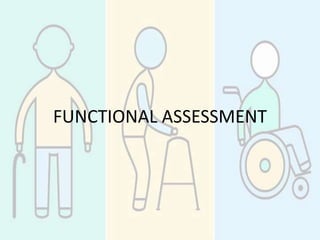
FUNCTIONAL ASSESSMENT
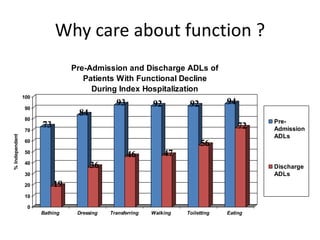
Why care about function ?
73
19
84
36
93
46
92
47
92
56
94
72
0
10
20
30
40
50
60
70
80
90
100
%Independent
Bathing Dressing Transferring Walking Toiletting Eating
Pre-Admission and Discharge ADLs of
Patients With Functional Decline
During Index Hospitalization
Pre-
Admission
ADLs
Discharge
ADLs
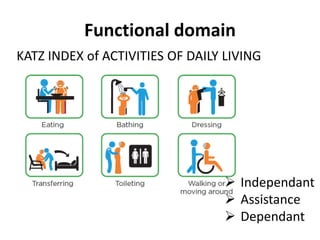
Functional domain
KATZ INDEX of ACTIVITIES OF DAILY LIVING
 Independant
 Assistance
 Dependant
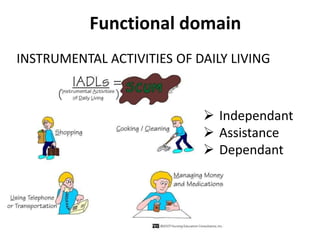
Functional domain
INSTRUMENTAL ACTIVITIES OF DAILY LIVING
 Independant
 Assistance
 Dependant
Functional domain
Advanced Activities of Daily Living
Ability to fulfill societal, community and
family roles and participate in recreational or
occupational tasks
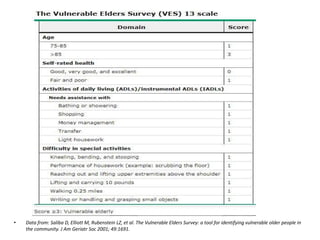
• Data from: Saliba D, Elliott M, Rubenstein LZ, et al. The Vulnerable Elders Survey: a tool for identifying vulnerable older people in
the community. J Am Geriatr Soc 2001; 49:1691.
FALLS/ IMBALANCE
Approximately
1/3rd community-dwelling persons age 65 years
1/2 of those over 80 years of age fall/year.
1/5th of the elderly in Ernakulam fall/year.
 higher risk of having a subsequent fall and
losing independence
Screening for fall/ risk for falling
• History of falls in prior 12 months
• Presents with acute fall
• Difficulty with walking or balance
.
The Prevention of Falls in Older Persons: Clinical Practice Guideline(http://www.medcats.com/FALLS/frameset.htm)
from the American Geriatrics Society. For more information visit the AGS online at www.americangeriatrics.org
Functional domain
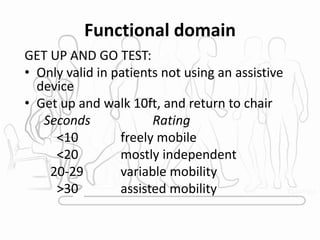
GET UP AND GO TEST:
• Only valid in patients not using an assistive
device
• Get up and walk 10ft, and return to chair
Seconds Rating
<10 freely mobile
<20 mostly independent
20-29 variable mobility
>30 assisted mobility
Functional domain
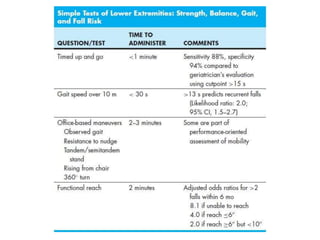
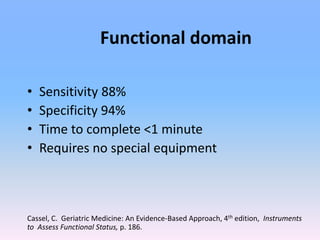
• Sensitivity 88%
• Specificity 94%
• Time to complete <1 minute
• Requires no special equipment
Cassel, C. Geriatric Medicine: An Evidence-Based Approach, 4th edition, Instruments
to Assess Functional Status, p. 186.
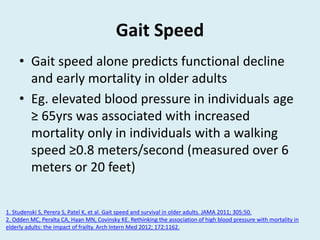
Gait Speed
• Gait speed alone predicts functional decline
and early mortality in older adults
• Eg. elevated blood pressure in individuals age
≥ 65yrs was associated with increased
mortality only in individuals with a walking
speed ≥0.8 meters/second (measured over 6
meters or 20 feet)
1. Studenski S, Perera S, Patel K, et al. Gait speed and survival in older adults. JAMA 2011; 305:50.
2. Odden MC, Peralta CA, Haan MN, Covinsky KE. Rethinking the association of high blood pressure with mortality in
elderly adults: the impact of frailty. Arch Intern Med 2012; 172:1162.
COGNITIVE ASSESSMENT
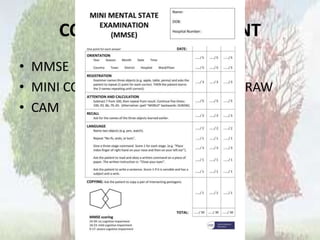
• MMSE
• MINI COG – 3 ITEM RECALL, CLOCK DRAW
• CAM
AFFECTIVE ASSESSMENT
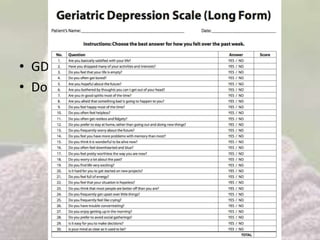
• GDS
• Do you often feel sad or depressed?
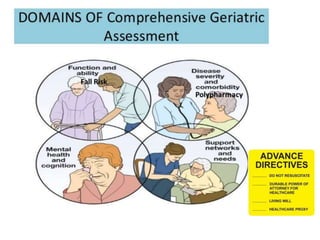
POLYPHARMACY
VISUAL IMPAIRMENT
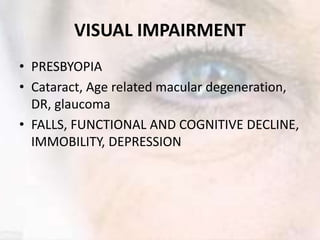
• PRESBYOPIA
• Cataract, Age related macular degeneration,
DR, glaucoma
• FALLS, FUNCTIONAL AND COGNITIVE DECLINE,
IMMOBILITY, DEPRESSION
HEARING IMPAIRMENT
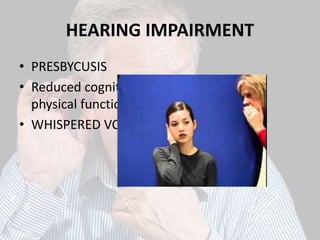
• PRESBYCUSIS
• Reduced cognitive, emotional, social and
physical function
• WHISPERED VOICE TEST
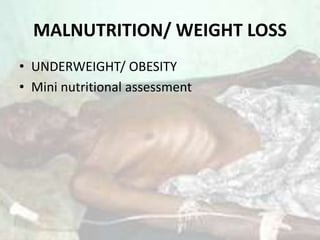
MALNUTRITION/ WEIGHT LOSS
• UNDERWEIGHT/ OBESITY
• Mini nutritional assessment
URINARY INCONTINENCE
SOCIAL SUPPORT
ECONOMIC ASSESSMENT
ENVIRONMENTAL ASSESSMENT
• Safety of home environment
• Adequacy of access to needed personal and
medical services
SPIRITUALITY
Advanced directive
• CPR ?
• Artificial feeding
NG tube
IV
• Ventilators?
• Medications
Antibiotics, Antidiabetics,
Antihypertensive
Advanced directive
• Catheters
• Comfort medications
Pain
Dyspnoea
Secretions
Enema
NEWER APPLICATIONS OF CGA
• cancer patients undergoing chemotherapy [1]
• considerations of surgery, or transcatheter
aortic valve replacement for patients with
aortic stenosis [2]
• postoperative mortality risk [3].
1. Kalsi T, Babic-Illman G, Ross PJ, et al. The impact of comprehensive geriatric assessment interventions on tolerance to
chemotherapy in older people. Br J Cancer 2015; 112:1435.
2. Boureau AS, Trochu JN, Colliard C, et al. Determinants in treatment decision-making in older patients with symptomatic
severe aortic stenosis. Maturitas 2015; 82:128.
3. Kim SW, Han HS, Jung HW, et al. Multidimensional frailty score for the prediction of postoperative mortality risk. JAMA
Surg 2014; 149:633.
Conclusion
• Multi disciplinary approach
• Targeted population
• High efficacy
• Can be brought to practice easily
• Essential part of geriatric care
Comprehensive geriatric assessment

Comprehensive geriatric assessment

  • 1.
    COMPREHENSIVE GERIATRIC ASSESSMENT Dr. DivyamolSasidharan Senior Resident Dept. of Geriatrics AIMS, Kochi
  • 4.
    What is CGA??? Amultidisciplinary diagnostic and treatment process that identifies medical, psychosocial, and functional limitations of a frail older person in order to develop a coordinated plan to maximize overall health with aging
  • 5.
    3 step process: 1)Targeting appropriate patients 2) Assessing patients and developing recommendations 3) Implementing recommendations
  • 6.
    AIM Restoration of healthfunction Independence where possible Amelioration of disability and distress
  • 7.
    Multi-disciplinary team Family doctor Nurses Speechtherapist Dietician Physiotherapist Occupational therapist Pharmacist Community supportFamily Geriatrician Multi-disciplinary team Psychologist Social worker
  • 8.
    Target population • Age •Multiple medical co morbidities eg: heart failure, cancer • Psychosocial disorder : depression, isolation • Specific geriatric conditions : dementia, falls, functional disability
  • 9.
    Target population • Previousor predicted high health care utilisation • Considering of change in living situation from independent living to assisted, nursing home or in home care givers
  • 10.
    Target population • TooSick to Benefit : Critically ill or medically unstable : Terminally ill : Disorders with no effective treatment • Too Well to Benefit : One or a few medical conditions : Needing prevention measures only
  • 11.
    Target population • Appropriateand Will Benefit : Multiple interacting biopsychological problems that are amenable to treatment : Disorders that require rehabilitation therapy
  • 12.
    FRAME WORK 1) Data-gathering 2)Discussion among the team, increasingly including the patient and/or caregiver as a member of the team 3) Development, with the patient and/or caregiver, of a treatment plan 4) Implementation of the treatment plan 5) Monitoring response to the treatment plan 6) Revising the treatment plan
  • 14.
    ADDITIONAL FACTORS: Nutrition/ weightchange Urinary incontinence Sexual Function Vision/ hearing Dentition Living Situation Spirituality
  • 15.
    Efficacy • Multiple meta-analyseshave found home assessments to be consistently effective in reducing functional decline as well as overall mortality 1. Stuck AE, Egger M, Hammer A, et al. Home visits to prevent nursing home admission and functional decline in elderly people: systematic review and meta-regression analysis. JAMA 2002; 287:1022. 2. Elkan R, Kendrick D, Dewey M, et al. Effectiveness of home based support for older people: systematic review and meta-analysis. BMJ 2001; 323:719. 3. Huss A, Stuck AE, Rubenstein LZ, et al. Multidimensional preventive home visit programs for community-dwelling older adults: a systematic review and meta-analysis of randomized controlled trials. J Gerontol A Biol Sci Med Sci 2008; 63:298. Stuck AE, Siu AL, Wieland GD, et al. Comprehensive geriatric assessment: a meta-analysis of controlled trials. Lancet 1993; 342:1032.
  • 16.
    • 17 randomizedtrials evaluating geriatric rehabilitative units (within an acute care hospital or a rehabilitation hospital) found that inpatient multidisciplinary programs were associated with improvement in all outcomes at discharge, including better functional status (OR 1.75, 95% CI 1.31-2.35), decreased nursing home admission (relative risk [RR] 0.64, 0.51- 0.81), and reduced mortality (RR 0.72, 0.55- 0.95). Bachmann S, Finger C, Huss A, et al. Inpatient rehabilitation specifically designed for geriatric patients: systematic review and meta-analysis of randomised controlled trials. BMJ 2010; 340:c1718.
  • 17.
    • A meta-analysisof 22 randomized trials of inpatient CGA by mobile teams or in designated wards found that patients who received CGA were more likely to be alive and in their own homes at the end of the scheduled follow-up (OR 1.1, 95% CI 1.05- 1.28) and less likely to be living in residential care (OR 0.78, 95% CI 0.69-0.88), compared with usual care Ellis G, Whitehead MA, Robinson D, et al. Comprehensive geriatric assessment for older adults admitted to hospital: meta-analysis of randomised controlled trials. BMJ 2011; 343:d6553.
  • 18.
  • 19.
  • 20.
    Why care aboutfunction ? 73 19 84 36 93 46 92 47 92 56 94 72 0 10 20 30 40 50 60 70 80 90 100 %Independent Bathing Dressing Transferring Walking Toiletting Eating Pre-Admission and Discharge ADLs of Patients With Functional Decline During Index Hospitalization Pre- Admission ADLs Discharge ADLs
  • 21.
    Functional domain KATZ INDEXof ACTIVITIES OF DAILY LIVING  Independant  Assistance  Dependant
  • 22.
    Functional domain INSTRUMENTAL ACTIVITIESOF DAILY LIVING  Independant  Assistance  Dependant
  • 23.
    Functional domain Advanced Activitiesof Daily Living Ability to fulfill societal, community and family roles and participate in recreational or occupational tasks
  • 24.
    • Data from:Saliba D, Elliott M, Rubenstein LZ, et al. The Vulnerable Elders Survey: a tool for identifying vulnerable older people in the community. J Am Geriatr Soc 2001; 49:1691.
  • 25.
    FALLS/ IMBALANCE Approximately 1/3rd community-dwellingpersons age 65 years 1/2 of those over 80 years of age fall/year. 1/5th of the elderly in Ernakulam fall/year.  higher risk of having a subsequent fall and losing independence
  • 26.
    Screening for fall/risk for falling • History of falls in prior 12 months • Presents with acute fall • Difficulty with walking or balance . The Prevention of Falls in Older Persons: Clinical Practice Guideline(http://www.medcats.com/FALLS/frameset.htm) from the American Geriatrics Society. For more information visit the AGS online at www.americangeriatrics.org
  • 28.
    Functional domain GET UPAND GO TEST: • Only valid in patients not using an assistive device • Get up and walk 10ft, and return to chair Seconds Rating <10 freely mobile <20 mostly independent 20-29 variable mobility >30 assisted mobility
  • 29.
    Functional domain • Sensitivity88% • Specificity 94% • Time to complete <1 minute • Requires no special equipment Cassel, C. Geriatric Medicine: An Evidence-Based Approach, 4th edition, Instruments to Assess Functional Status, p. 186.
  • 30.
    Gait Speed • Gaitspeed alone predicts functional decline and early mortality in older adults • Eg. elevated blood pressure in individuals age ≥ 65yrs was associated with increased mortality only in individuals with a walking speed ≥0.8 meters/second (measured over 6 meters or 20 feet) 1. Studenski S, Perera S, Patel K, et al. Gait speed and survival in older adults. JAMA 2011; 305:50. 2. Odden MC, Peralta CA, Haan MN, Covinsky KE. Rethinking the association of high blood pressure with mortality in elderly adults: the impact of frailty. Arch Intern Med 2012; 172:1162.
  • 31.
    COGNITIVE ASSESSMENT • MMSE •MINI COG – 3 ITEM RECALL, CLOCK DRAW • CAM
  • 32.
    AFFECTIVE ASSESSMENT • GDS •Do you often feel sad or depressed?
  • 33.
  • 34.
    VISUAL IMPAIRMENT • PRESBYOPIA •Cataract, Age related macular degeneration, DR, glaucoma • FALLS, FUNCTIONAL AND COGNITIVE DECLINE, IMMOBILITY, DEPRESSION
  • 35.
    HEARING IMPAIRMENT • PRESBYCUSIS •Reduced cognitive, emotional, social and physical function • WHISPERED VOICE TEST
  • 36.
    MALNUTRITION/ WEIGHT LOSS •UNDERWEIGHT/ OBESITY • Mini nutritional assessment
  • 38.
  • 39.
  • 40.
  • 41.
    ENVIRONMENTAL ASSESSMENT • Safetyof home environment • Adequacy of access to needed personal and medical services
  • 42.
  • 43.
    Advanced directive • CPR? • Artificial feeding NG tube IV • Ventilators? • Medications Antibiotics, Antidiabetics, Antihypertensive
  • 44.
    Advanced directive • Catheters •Comfort medications Pain Dyspnoea Secretions Enema
  • 45.
    NEWER APPLICATIONS OFCGA • cancer patients undergoing chemotherapy [1] • considerations of surgery, or transcatheter aortic valve replacement for patients with aortic stenosis [2] • postoperative mortality risk [3]. 1. Kalsi T, Babic-Illman G, Ross PJ, et al. The impact of comprehensive geriatric assessment interventions on tolerance to chemotherapy in older people. Br J Cancer 2015; 112:1435. 2. Boureau AS, Trochu JN, Colliard C, et al. Determinants in treatment decision-making in older patients with symptomatic severe aortic stenosis. Maturitas 2015; 82:128. 3. Kim SW, Han HS, Jung HW, et al. Multidimensional frailty score for the prediction of postoperative mortality risk. JAMA Surg 2014; 149:633.
  • 46.
    Conclusion • Multi disciplinaryapproach • Targeted population • High efficacy • Can be brought to practice easily • Essential part of geriatric care

Editor's Notes

  • #21 Pre admission and discharge ADL’s of pts with functional decline during index hospitalisation
  • #22 One measure of independence is the capacity to perform functional tasks Necessary for daily living. Katz’s ADL’s----developed in the 1960’s. Measuring six functions,each noted either as independent or dependent Initially used by a professional (nurse in an inpt setting) based on observations over a week Since then, many modifications Mnemonic---- “DEATH” --- a way to help you remember the activities Evaluated--- D= dressing, E=eating, A=ambulating, T= toileting, H=hygiene
  • #23 Labor saving equipment may change laundry from an impossiblity to a manageable task Some men who can not prepare meals may simply not know how to cook Instrumental (community interactions)--- mnemonic “SHAFT” S=shopping, 2.H=housework, 3. A=Accounting, 4. F=food preparation and 5. T=transportation In JAGS 1999 community dwelling more tan 65 years, followed up at 1 yr, 3 yr, 5 yr . 4 modalities – telephone, transportation, medication, finance At 3 years, IADL impairment is a predicator of incident dementia