Fibromyalgia
Done By: Eman Al-zawwad & Jenna Risch
HL 621
Case Study
 Mary is a 50 year old woman who states she has suffered from mild muscle
discomfort in her neck, spine, and upper and lower extremities for more than 6
months, but the pain has progressively gotten worse in the last 3 months. She also
states she was in a car accident about 6 months ago. The patient reported that she
feels the pain all the time during rest and when she performs normal ADLs. She
also reports that she always feels tired/fatigued due to her difficulty of sleeping at
night and she does not want to get out of bed because the pain is so severe
(morning stiffness). The pain has gotten so severe that she even has difficulty
concentrating on her reading. Mary was referred to a physical therapist.
Vitals
 Height: 5’4
 Weight: 200 lbs (90.7 kg)
 BMI: 34.3 kg/m2
 BP: 142/75 mmHG
 Resting heart rate: 72 beats/minute
 Lungs: clear
 Heart sound: normal
Lab values
 LDL: 130 mg/dL
 TG: 152 mg/dL
 HDL: 40 mg/dL
 FBG: 120 mg/dL
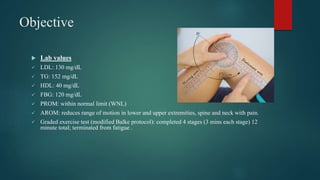
 PROM: within normal limit (WNL)
 AROM: reduces range on motion in lower and upper extremities, spine and neck
with pain
 Tender point assessment: 12 of the 18 tender point sites were tender, with the
patient reporting mild to severe pain on palpation
 Graded exercise test (modified Balke protocol): completed 4 stages (3 mins each
stage) 12 minute total; terminated from fatigue
 Medications: Lisinopril (antihypertension) and acetomacetaminophen 500 mg as
needed (usually 2 or 3 tablets daily for pain)
Step 1: SOAP notes
SOAP NOTES
3- Assessment
2- Objective
1- Subjective
4- Plan
Subjective
 Mary is a 50 year old woman
 She states she has suffered from mild muscle discomfort in her neck, spine, and upper
and lower extremities for more than 6 months, but the pain has progressively gotten
worse in the last 3 months.
 She also states she was in a car accident about 6 months ago.
 The patient reported that she feels the pain all the time during rest and when she
performs normal ADLs.
 She also reports that she always feels tired/fatigued due to her difficulty of sleeping at
night and she does not want to get out of bed because the pain is so severe (morning
stiffness).
 The pain has gotten so severe that she even has difficulty concentrating on her reading.
 Mary was referred to a physical therapist.
Objective
 Vitals:
Height: 5’4
Weight: 200 lbs (90.7 kg)
BMI: 34.3 kg/m2
BP: 142/75 mmHG
Resting heart rate: 72 beats/minute
Lungs: clear
Heart sound: normal
Objective
 Lab values
 LDL: 130 mg/dL
 TG: 152 mg/dL
 HDL: 40 mg/dL
 FBG: 120 mg/dL
 PROM: within normal limit (WNL)
 AROM: reduces range of motion in lower and upper extremities, spine and neck with pain.
 Graded exercise test (modified Balke protocol): completed 4 stages (3 mins each stage) 12
minute total; terminated from fatigue .
Objective
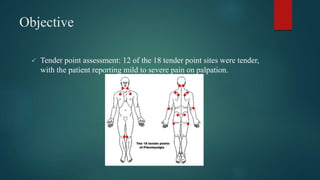
 Tender point assessment: 12 of the 18 tender point sites were tender,
with the patient reporting mild to severe pain on palpation.
Objective
 Medications:
1- Lisinopril (antihypertension)
2- Acetaminophen 500 mg as needed (usually 2 or 3 tablets daily for
pain)
Assessment
 Fibromyalgia
 Joint stiffness
 Hyperlipidemia
 Obese
 Prediabetes
 Hypertensive
 Metabolic syndrome
Plan of Action
 Initiate therapy to lower the LDL and TG’s level.
 Improving muscle and joint function.
 Increase physical activity through exercise and ADL.
 Decrease pain that associated with fibromyalgia .
 Refer to physical therapy for treatment of fatigue, weakness, range of
motion deficits, and pain.
 Refer to dietitian to manage patient dietary intake
 Change body composition.
 Refer to psychologist to treat psychosocial issues that often come with
Fibromyalgia.
Consideration
 Patient at risk of cardiovascular disease due to hypertension and
hyperlipidemia.
 Physical activity with pain and muscles weakness.
Step 2: Exercise Programming
 Exercise Program Goals:
 Improve muscle and joint function
 Increase functional capacity through exercise.
 Promote lifestyle modifications.
 Change body composition through increase lean mass and decrease
fat mass.
 Decrease blood pressure.
 Management of metabolic syndrome.
 Decrease and prevent psychosocial issues
Exercise Program
 Patient may be hesitant to exercise or to increase the intensity of activity due to
pain
 Consist of low –to moderate- intensity aerobic activities
 Avoid repetitive overhead exercises that may cause irritation
 Morning exercise should be avoided because of morning stiffness
 Program should be individualized based on the how bad the patient’s pain is and
where their trigger points are located
 Can give patient the 36- item short form health survey (SF-36)
 A set of generic, coherent, and easily administered survey questions that help
to measure the patient’s quality of life
 Used to get an idea of the patient’s overall health, pain, and any limitations
due to health problems
 Patient is on Lisinopril which may cause dizziness, headache, fatigue, and muscle
pain
 Aerobic (warm water aquatic exercises, cycling, walking)
 2-3 days/week
 Duration: 20-30 min/session slowly progress to 30-40 mins
 Intensity: start at 25% of HRR and increase slowly about 5% of HRR
 Strength (dumbbells, weight machines)
 2 days/week
 Duration: 1 set, 8 reps progress to 12 reps
 Intensity: 40% 1 RM and slowly progress to 60-70% 1 RM
 Pause in between reps
 Flexibility (sit and reach)
 Before and after each session
 5-10 minutes
 Focus on shoulders, hips, knees
 Increase ROM and decrease risk of injury

Fibromyalgia

  • 1.
    Fibromyalgia Done By: EmanAl-zawwad & Jenna Risch HL 621
  • 2.
    Case Study  Maryis a 50 year old woman who states she has suffered from mild muscle discomfort in her neck, spine, and upper and lower extremities for more than 6 months, but the pain has progressively gotten worse in the last 3 months. She also states she was in a car accident about 6 months ago. The patient reported that she feels the pain all the time during rest and when she performs normal ADLs. She also reports that she always feels tired/fatigued due to her difficulty of sleeping at night and she does not want to get out of bed because the pain is so severe (morning stiffness). The pain has gotten so severe that she even has difficulty concentrating on her reading. Mary was referred to a physical therapist.
  • 3.
    Vitals  Height: 5’4 Weight: 200 lbs (90.7 kg)  BMI: 34.3 kg/m2  BP: 142/75 mmHG  Resting heart rate: 72 beats/minute  Lungs: clear  Heart sound: normal
  • 4.
    Lab values  LDL:130 mg/dL  TG: 152 mg/dL  HDL: 40 mg/dL  FBG: 120 mg/dL  PROM: within normal limit (WNL)  AROM: reduces range on motion in lower and upper extremities, spine and neck with pain  Tender point assessment: 12 of the 18 tender point sites were tender, with the patient reporting mild to severe pain on palpation  Graded exercise test (modified Balke protocol): completed 4 stages (3 mins each stage) 12 minute total; terminated from fatigue  Medications: Lisinopril (antihypertension) and acetomacetaminophen 500 mg as needed (usually 2 or 3 tablets daily for pain)
  • 5.
    Step 1: SOAPnotes SOAP NOTES 3- Assessment 2- Objective 1- Subjective 4- Plan
  • 6.
    Subjective  Mary isa 50 year old woman  She states she has suffered from mild muscle discomfort in her neck, spine, and upper and lower extremities for more than 6 months, but the pain has progressively gotten worse in the last 3 months.  She also states she was in a car accident about 6 months ago.  The patient reported that she feels the pain all the time during rest and when she performs normal ADLs.  She also reports that she always feels tired/fatigued due to her difficulty of sleeping at night and she does not want to get out of bed because the pain is so severe (morning stiffness).  The pain has gotten so severe that she even has difficulty concentrating on her reading.  Mary was referred to a physical therapist.
  • 7.
    Objective  Vitals: Height: 5’4 Weight:200 lbs (90.7 kg) BMI: 34.3 kg/m2 BP: 142/75 mmHG Resting heart rate: 72 beats/minute Lungs: clear Heart sound: normal
  • 8.
    Objective  Lab values LDL: 130 mg/dL  TG: 152 mg/dL  HDL: 40 mg/dL  FBG: 120 mg/dL  PROM: within normal limit (WNL)  AROM: reduces range of motion in lower and upper extremities, spine and neck with pain.  Graded exercise test (modified Balke protocol): completed 4 stages (3 mins each stage) 12 minute total; terminated from fatigue .
  • 9.
    Objective  Tender pointassessment: 12 of the 18 tender point sites were tender, with the patient reporting mild to severe pain on palpation.
  • 10.
    Objective  Medications: 1- Lisinopril(antihypertension) 2- Acetaminophen 500 mg as needed (usually 2 or 3 tablets daily for pain)
  • 11.
    Assessment  Fibromyalgia  Jointstiffness  Hyperlipidemia  Obese  Prediabetes  Hypertensive  Metabolic syndrome
  • 12.
    Plan of Action Initiate therapy to lower the LDL and TG’s level.  Improving muscle and joint function.  Increase physical activity through exercise and ADL.  Decrease pain that associated with fibromyalgia .  Refer to physical therapy for treatment of fatigue, weakness, range of motion deficits, and pain.  Refer to dietitian to manage patient dietary intake  Change body composition.  Refer to psychologist to treat psychosocial issues that often come with Fibromyalgia.
  • 13.
    Consideration  Patient atrisk of cardiovascular disease due to hypertension and hyperlipidemia.  Physical activity with pain and muscles weakness.
  • 14.
    Step 2: ExerciseProgramming  Exercise Program Goals:  Improve muscle and joint function  Increase functional capacity through exercise.  Promote lifestyle modifications.  Change body composition through increase lean mass and decrease fat mass.  Decrease blood pressure.  Management of metabolic syndrome.  Decrease and prevent psychosocial issues
  • 15.
    Exercise Program  Patientmay be hesitant to exercise or to increase the intensity of activity due to pain  Consist of low –to moderate- intensity aerobic activities  Avoid repetitive overhead exercises that may cause irritation  Morning exercise should be avoided because of morning stiffness  Program should be individualized based on the how bad the patient’s pain is and where their trigger points are located  Can give patient the 36- item short form health survey (SF-36)  A set of generic, coherent, and easily administered survey questions that help to measure the patient’s quality of life  Used to get an idea of the patient’s overall health, pain, and any limitations due to health problems  Patient is on Lisinopril which may cause dizziness, headache, fatigue, and muscle pain
  • 16.
     Aerobic (warmwater aquatic exercises, cycling, walking)  2-3 days/week  Duration: 20-30 min/session slowly progress to 30-40 mins  Intensity: start at 25% of HRR and increase slowly about 5% of HRR  Strength (dumbbells, weight machines)  2 days/week  Duration: 1 set, 8 reps progress to 12 reps  Intensity: 40% 1 RM and slowly progress to 60-70% 1 RM  Pause in between reps  Flexibility (sit and reach)  Before and after each session  5-10 minutes  Focus on shoulders, hips, knees  Increase ROM and decrease risk of injury