Anthony J. Caprio, MD
Ellen Roberts, PhD, MPH
Jan Busby-Whitehead, MD
The University of North Carolina at Chapel Hill
With Support from The Donald W. Reynolds Foundation
Geriatric Assessment
© The University of North Carolina at Chapel Hill, Center for Aging and Health.
All Rights Reserved.
2
Objectives
1) To illustrate the importance of physical,
cognitive, and psychosocial assessments
for older adults
2) To describe Activities of Daily Living
(ADLs) and Instrumental Activities of Daily
Living (IADLs)
3) To demonstrate gait assessment and falls
risk assessment with an older adult
4) To demonstrate cognitive and depression
screening with an older adult
3
Function, Function, Function
• In real estate it’s “location,” in geriatric assessment the
focus is on function
• Physical Functioning
•Gait and balance
•Ability to perform daily self-care activities
• Cognitive Functioning
•Memory, reasoning, and judgment
•Ability to perform “life-maintenance” activities
• Psychosocial Functioning
•Depression and mental health
•Adequate caregiver support
•Financial resources
4
What Does Every Practitioner Need to
Know?
• Overall functional assessment or impression: Big
Picture
• Ask questions, but..
• Don’t just tell me, show me. (performance-based
testing)
• Make careful observations!
• Trust your gut, if something doesn’t look right, it
probably isn’t
• Screen and know when to refer for further evaluation
5
Asking About Function
"Can you tell me what your typical day is like?”
• When do you get up?
• What do you do in the morning?
• Do prepare your own meals?
• How many meals do you usually eat?
• Do you get out of the house? Shopping? Church?
• How do you spend the rest of the day?
• Do you watch TV? Read?
• When do you go to bed?
• Are you generally satisfied with how you spend your
days?
6
Activities of Daily Living (ADLs)
Dressing
Eating (feeding)
Ambulating (transferring)
Toileting (continence)
Hygiene (bathing)
Independent
Partially Dependent
Dependent
• Transferring
• Walking
• Toileting
• Bathing
• Dressing
• Eating (feeding)
• Continence
7
Instrumental Activities of
Daily Living (IADLs)
Shopping
Housekeeping
Accounting
Food preparation
Transportation
• Driving or using the bus
(transportation)
• Using the telephone
• Managing medications
• Buying groceries
• Preparing meals
• Housework, laundry
• Paying bills, managing
money
Independent
Partially Dependent
Dependent
8
Why are ADLs/IADLs Important?
• ADL impairment is a stronger predictor of hospital
outcomes than admitting diagnoses, Diagnosis
Related Group (DRG), or other physiologic indices of
illness burden
• Functional decline
• Length of stay
• Institutionalization (nursing home placement)
• Death
• Approximately 25% to 35% of older patients admitted
to the hospital for treatment of acute medical illness
lose independence in one or more ADLs
• Implications for discharge planning and post-acute
care
9
Best Test is a “Real World” Performance Test
• Easy to perform in an office/clinic/hospital room
• Easy to evaluate (can do, can’t do, or time to completion)
• Can be integrated into what you do already
• Provide objective information about a person’s actual
function in daily living
• Assessment starts the minute you start observing the
patient.
10
• Perform a task
• Walk over to the exam table
• Get on/off the exam table
• Unbutton sleeve, take shirt off
• Put shirt back on, button sleeve, tie shoes
• Standardized tests
Assessing Function
11
Assessing Physical Functioning:
Gait and Risk for Falling
• 35-40% of community-dwelling older adults
fall each year
• 10 to 15% of falls result in a fracture or other
serious injury
• 72% of all fall-related deaths are in the age
65+ population
• Approximately 40-70% of fallers develop fear
of falling
Risk Factor Relative Risk (RR) for Falls
Leg Weakness 4.4
Gait Deficit 2.9
Impaired ADL 2.3
Depression 2.2
Cognitive Impairment 1.8
12
Timed “Get Up and Go" Test
• Patient sits in a chair, rises and walks ten
feet (3 meters), turns, and returns to the chair
• Should be able to do this in <20 seconds, if
>30 seconds functionally dependent (higher risk for
falls)
• Identifying fallers: Sensitivity and Specificity = 87%
• Abnormalities in mobility should prompt referral for
physical therapy or a further diagnostic work-up
• Predicts ADL disability and nursing home admission
Phys Ther. 2000;80:896 –903.
J Am Geriatr Soc 2010;58:844–852.
J Am Geriatr Soc 2004;52:1343–1348.
13
Timed “Get Up and Go”
Shortcut (2) to TUG Good.lnk
Video courtesy of the Tiffany Shubert, PhD, MPT, UNC School of Medicine.
14
Chair Rise
• Use a standard chair with arms
• Ask the subject to rise from the chair
• If they are able to do that, then ask them to rise from the
chair without the assistance of pushing-off of the arms of
the chair with their hands
• It may be helpful to have the subject fold their arms
across their chest during the maneuver
• Proximal muscle weakness, including trunk and proximal
thighs, makes this maneuver difficult and is a risk factor
for falls
• Can be timed (should take <15 seconds for 5 repetitions)
Picture of chair
15
Video courtesy of the Tiffany Shubert, PhD, MPT, UNC School of Medicine.
16
Cognitive Evaluation
• Prevalence of cognitive impairment
• 3% among persons ≥65 years of age
• Doubles every 5 years
• 40-50% among persons ≥90 years of age
• Unrecognized cognitive impairment
• Adherence to medications or treatment plans
• Difficulty navigating the health care system
• Caregiver stress
• Most common causes of cognitive impairment
• Delirium
• Dementia
• Depression
17
Delirium: More Than “Confusion”
• Sudden and fluctuating change in cognition
• Altered way of perceiving the world
• Hallucinations or delusions
• Might be disoriented
• Agitated or excessively sleepy
• Conversations don’t make sense
18
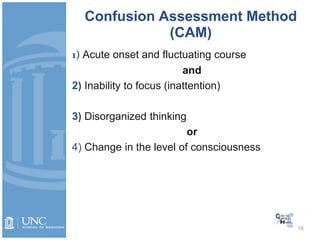
Confusion Assessment Method
(CAM)
1) Acute onset and fluctuating course
and
2) Inability to focus (inattention)
3) Disorganized thinking
or
4) Change in the level of consciousness
19
Folstein Mini-Mental State Exam
(MMSE)
• Orientation
• Registration/Recall (3 objects)
• Attention and Calculation
(WORLD  DLROW, serial 7s)
• Language (naming, repetition, 3 stage command,
reading, writing)
• Visual-Spatial (Copy Design)
20
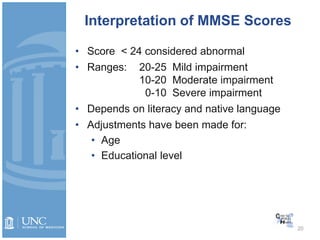
Interpretation of MMSE Scores
• Score < 24 considered abnormal
• Ranges: 20-25 Mild impairment
10-20 Moderate impairment
0-10 Severe impairment
• Depends on literacy and native language
• Adjustments have been made for:
• Age
• Educational level
21
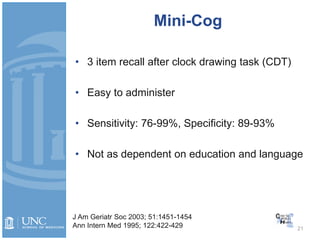
Mini-Cog
• 3 item recall after clock drawing task (CDT)
• Easy to administer
• Sensitivity: 76-99%, Specificity: 89-93%
• Not as dependent on education and language
J Am Geriatr Soc 2003; 51:1451-1454
Ann Intern Med 1995; 122:422-429
22
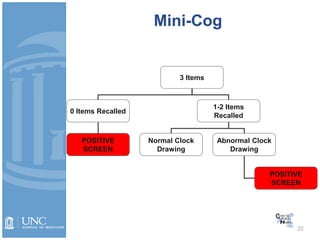
Mini-Cog
3 Items
0 Items Recalled
1-2 Items
Recalled
Normal Clock
Drawing
Abnormal Clock
Drawing
POSITIVE
SCREEN
POSITIVE
SCREEN
23
Clock Drawing Test: “10 Minutes After 11”
24
Clock Drawing Test: Mild Impairment
25
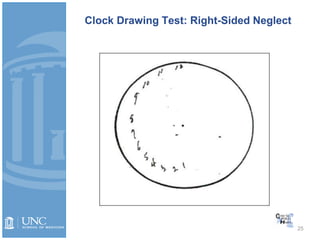
Clock Drawing Test: Right-Sided Neglect
26
Severely Impaired Clock Drawing
27
At the End of an Encounter…
Teach-back method:
“We discussed a lot of things today and I want
to make sure that I explained things well, can
you summarize what we talked about today?”
“So let’s review our plan. What will you do
when you get home today? What will you do
before our next visit? How will you take this
medication?”
28
Psychological Assessment
• Prevalence of major depression
• Outpatient primary care: 6% - 10%
• Inpatient : 11% - 45%
• Persons aged ≥65
• <13% of the populations
• 25% of suicides
29
Screening for Depression
• Single Question: “Do you often feel sad or
depressed?”
• Sensitivity 69-85%
• Specificity 65-90%
• 2-Item Screening
• Depressed Mood:
"During the past month, have you often been bothered
by feeling down, depressed, or hopeless?"
• Anhedonia:
"During the past month, have you often been bothered
by little interest or pleasure in doing things?“
• Test is negative for patients who respond "no" to both
questions
30
Geriatric Depression Scale (GDS)
• Long (30-item) and short forms (15 or 5 items)
• GDS 15-Item Screen:
Score > 5 points suggests depression
• Sensitivity 97%
• Specificity 85%
31
Case 1
• 86 yo female presents to the emergency
department with a two-day history of nausea,
vomiting, and unsteadiness.
• She lives independently in the community.
• Her ECG shows atrial tachycardia (rate=150)
with AV block.
• Patient’s medication list includes digoxin
0.125mg po daily.
• Labs show normal renal function but a
critically high digoxin level.
32
Case 2
• 88 yo male is admitted for elective surgery.
• He had an unremarkable pre-op evaluation one week
prior to admission. He was considered low risk for the
planned surgical procedure.
• The surgery was uneventful, but in the PACU, the
patient is very agitated and confused. He is trying to
get out of bed to “catch a train”.
• His nurse calls the resident because she is concerned
that he may have had a stroke during the procedure.
A stat head CT is negative for an acute process.
33
Case 3
• 78 yo female sustained a mechanical fall at home with
a left foot fracture and right wrist fracture.
• She is given a walking boot for her foot and a splint for
her wrist. No surgical intervention is indicated.
• She lives alone and insists that she will be just fine at
home.
• Her daughter lives about an hour away but will check
on her on the weekends and help with grocery
shopping.
34
Basic Geriatric Assessment
1) Functional Impairments
 Activities of Daily Living (ADLs)
 Instrumental Activities of Daily Living (IADLs)
2) Gait and Fall Risk Assessment
 Timed “Get Up and Go” Test
 Chair Rise
3) Cognitive Assessment
 Confusion Assessment Method (CAM)
 Mini-Cog
 Teach-back method
4) Depression Screen
 One or Two-item questions
 Geriatric Depression Scale (GDS)
35
Acknowledgments and Disclaimers
This project was supported by funds from The
Donald W. Reynolds Foundation. This
information or content and conclusions are
those of the author and should not be construed
as the official position or policy of, nor should
any endorsements be inferred by The Donald W.
Reynolds Foundation.
The UNC Center for Aging and the UNC Division
of Geriatric Medicine also provided support for this
activity. This work was compiled and edited through
the efforts of Carol Julian.
36
© The University of North Carolina at Chapel Hill,
Center for Aging and Health. All Rights Reserved.

Geriatric-Assessment_Caprio-Revised-01-07-12.ppt

  • 1.
    Anthony J. Caprio,MD Ellen Roberts, PhD, MPH Jan Busby-Whitehead, MD The University of North Carolina at Chapel Hill With Support from The Donald W. Reynolds Foundation Geriatric Assessment © The University of North Carolina at Chapel Hill, Center for Aging and Health. All Rights Reserved.
  • 2.
    2 Objectives 1) To illustratethe importance of physical, cognitive, and psychosocial assessments for older adults 2) To describe Activities of Daily Living (ADLs) and Instrumental Activities of Daily Living (IADLs) 3) To demonstrate gait assessment and falls risk assessment with an older adult 4) To demonstrate cognitive and depression screening with an older adult
  • 3.
    3 Function, Function, Function •In real estate it’s “location,” in geriatric assessment the focus is on function • Physical Functioning •Gait and balance •Ability to perform daily self-care activities • Cognitive Functioning •Memory, reasoning, and judgment •Ability to perform “life-maintenance” activities • Psychosocial Functioning •Depression and mental health •Adequate caregiver support •Financial resources
  • 4.
    4 What Does EveryPractitioner Need to Know? • Overall functional assessment or impression: Big Picture • Ask questions, but.. • Don’t just tell me, show me. (performance-based testing) • Make careful observations! • Trust your gut, if something doesn’t look right, it probably isn’t • Screen and know when to refer for further evaluation
  • 5.
    5 Asking About Function "Canyou tell me what your typical day is like?” • When do you get up? • What do you do in the morning? • Do prepare your own meals? • How many meals do you usually eat? • Do you get out of the house? Shopping? Church? • How do you spend the rest of the day? • Do you watch TV? Read? • When do you go to bed? • Are you generally satisfied with how you spend your days?
  • 6.
    6 Activities of DailyLiving (ADLs) Dressing Eating (feeding) Ambulating (transferring) Toileting (continence) Hygiene (bathing) Independent Partially Dependent Dependent • Transferring • Walking • Toileting • Bathing • Dressing • Eating (feeding) • Continence
  • 7.
    7 Instrumental Activities of DailyLiving (IADLs) Shopping Housekeeping Accounting Food preparation Transportation • Driving or using the bus (transportation) • Using the telephone • Managing medications • Buying groceries • Preparing meals • Housework, laundry • Paying bills, managing money Independent Partially Dependent Dependent
  • 8.
    8 Why are ADLs/IADLsImportant? • ADL impairment is a stronger predictor of hospital outcomes than admitting diagnoses, Diagnosis Related Group (DRG), or other physiologic indices of illness burden • Functional decline • Length of stay • Institutionalization (nursing home placement) • Death • Approximately 25% to 35% of older patients admitted to the hospital for treatment of acute medical illness lose independence in one or more ADLs • Implications for discharge planning and post-acute care
  • 9.
    9 Best Test isa “Real World” Performance Test • Easy to perform in an office/clinic/hospital room • Easy to evaluate (can do, can’t do, or time to completion) • Can be integrated into what you do already • Provide objective information about a person’s actual function in daily living • Assessment starts the minute you start observing the patient.
  • 10.
    10 • Perform atask • Walk over to the exam table • Get on/off the exam table • Unbutton sleeve, take shirt off • Put shirt back on, button sleeve, tie shoes • Standardized tests Assessing Function
  • 11.
    11 Assessing Physical Functioning: Gaitand Risk for Falling • 35-40% of community-dwelling older adults fall each year • 10 to 15% of falls result in a fracture or other serious injury • 72% of all fall-related deaths are in the age 65+ population • Approximately 40-70% of fallers develop fear of falling Risk Factor Relative Risk (RR) for Falls Leg Weakness 4.4 Gait Deficit 2.9 Impaired ADL 2.3 Depression 2.2 Cognitive Impairment 1.8
  • 12.
    12 Timed “Get Upand Go" Test • Patient sits in a chair, rises and walks ten feet (3 meters), turns, and returns to the chair • Should be able to do this in <20 seconds, if >30 seconds functionally dependent (higher risk for falls) • Identifying fallers: Sensitivity and Specificity = 87% • Abnormalities in mobility should prompt referral for physical therapy or a further diagnostic work-up • Predicts ADL disability and nursing home admission Phys Ther. 2000;80:896 –903. J Am Geriatr Soc 2010;58:844–852. J Am Geriatr Soc 2004;52:1343–1348.
  • 13.
    13 Timed “Get Upand Go” Shortcut (2) to TUG Good.lnk Video courtesy of the Tiffany Shubert, PhD, MPT, UNC School of Medicine.
  • 14.
    14 Chair Rise • Usea standard chair with arms • Ask the subject to rise from the chair • If they are able to do that, then ask them to rise from the chair without the assistance of pushing-off of the arms of the chair with their hands • It may be helpful to have the subject fold their arms across their chest during the maneuver • Proximal muscle weakness, including trunk and proximal thighs, makes this maneuver difficult and is a risk factor for falls • Can be timed (should take <15 seconds for 5 repetitions) Picture of chair
  • 15.
    15 Video courtesy ofthe Tiffany Shubert, PhD, MPT, UNC School of Medicine.
  • 16.
    16 Cognitive Evaluation • Prevalenceof cognitive impairment • 3% among persons ≥65 years of age • Doubles every 5 years • 40-50% among persons ≥90 years of age • Unrecognized cognitive impairment • Adherence to medications or treatment plans • Difficulty navigating the health care system • Caregiver stress • Most common causes of cognitive impairment • Delirium • Dementia • Depression
  • 17.
    17 Delirium: More Than“Confusion” • Sudden and fluctuating change in cognition • Altered way of perceiving the world • Hallucinations or delusions • Might be disoriented • Agitated or excessively sleepy • Conversations don’t make sense
  • 18.
    18 Confusion Assessment Method (CAM) 1)Acute onset and fluctuating course and 2) Inability to focus (inattention) 3) Disorganized thinking or 4) Change in the level of consciousness
  • 19.
    19 Folstein Mini-Mental StateExam (MMSE) • Orientation • Registration/Recall (3 objects) • Attention and Calculation (WORLD  DLROW, serial 7s) • Language (naming, repetition, 3 stage command, reading, writing) • Visual-Spatial (Copy Design)
  • 20.
    20 Interpretation of MMSEScores • Score < 24 considered abnormal • Ranges: 20-25 Mild impairment 10-20 Moderate impairment 0-10 Severe impairment • Depends on literacy and native language • Adjustments have been made for: • Age • Educational level
  • 21.
    21 Mini-Cog • 3 itemrecall after clock drawing task (CDT) • Easy to administer • Sensitivity: 76-99%, Specificity: 89-93% • Not as dependent on education and language J Am Geriatr Soc 2003; 51:1451-1454 Ann Intern Med 1995; 122:422-429
  • 22.
    22 Mini-Cog 3 Items 0 ItemsRecalled 1-2 Items Recalled Normal Clock Drawing Abnormal Clock Drawing POSITIVE SCREEN POSITIVE SCREEN
  • 23.
    23 Clock Drawing Test:“10 Minutes After 11”
  • 24.
    24 Clock Drawing Test:Mild Impairment
  • 25.
    25 Clock Drawing Test:Right-Sided Neglect
  • 26.
  • 27.
    27 At the Endof an Encounter… Teach-back method: “We discussed a lot of things today and I want to make sure that I explained things well, can you summarize what we talked about today?” “So let’s review our plan. What will you do when you get home today? What will you do before our next visit? How will you take this medication?”
  • 28.
    28 Psychological Assessment • Prevalenceof major depression • Outpatient primary care: 6% - 10% • Inpatient : 11% - 45% • Persons aged ≥65 • <13% of the populations • 25% of suicides
  • 29.
    29 Screening for Depression •Single Question: “Do you often feel sad or depressed?” • Sensitivity 69-85% • Specificity 65-90% • 2-Item Screening • Depressed Mood: "During the past month, have you often been bothered by feeling down, depressed, or hopeless?" • Anhedonia: "During the past month, have you often been bothered by little interest or pleasure in doing things?“ • Test is negative for patients who respond "no" to both questions
  • 30.
    30 Geriatric Depression Scale(GDS) • Long (30-item) and short forms (15 or 5 items) • GDS 15-Item Screen: Score > 5 points suggests depression • Sensitivity 97% • Specificity 85%
  • 31.
    31 Case 1 • 86yo female presents to the emergency department with a two-day history of nausea, vomiting, and unsteadiness. • She lives independently in the community. • Her ECG shows atrial tachycardia (rate=150) with AV block. • Patient’s medication list includes digoxin 0.125mg po daily. • Labs show normal renal function but a critically high digoxin level.
  • 32.
    32 Case 2 • 88yo male is admitted for elective surgery. • He had an unremarkable pre-op evaluation one week prior to admission. He was considered low risk for the planned surgical procedure. • The surgery was uneventful, but in the PACU, the patient is very agitated and confused. He is trying to get out of bed to “catch a train”. • His nurse calls the resident because she is concerned that he may have had a stroke during the procedure. A stat head CT is negative for an acute process.
  • 33.
    33 Case 3 • 78yo female sustained a mechanical fall at home with a left foot fracture and right wrist fracture. • She is given a walking boot for her foot and a splint for her wrist. No surgical intervention is indicated. • She lives alone and insists that she will be just fine at home. • Her daughter lives about an hour away but will check on her on the weekends and help with grocery shopping.
  • 34.
    34 Basic Geriatric Assessment 1)Functional Impairments  Activities of Daily Living (ADLs)  Instrumental Activities of Daily Living (IADLs) 2) Gait and Fall Risk Assessment  Timed “Get Up and Go” Test  Chair Rise 3) Cognitive Assessment  Confusion Assessment Method (CAM)  Mini-Cog  Teach-back method 4) Depression Screen  One or Two-item questions  Geriatric Depression Scale (GDS)
  • 35.
    35 Acknowledgments and Disclaimers Thisproject was supported by funds from The Donald W. Reynolds Foundation. This information or content and conclusions are those of the author and should not be construed as the official position or policy of, nor should any endorsements be inferred by The Donald W. Reynolds Foundation. The UNC Center for Aging and the UNC Division of Geriatric Medicine also provided support for this activity. This work was compiled and edited through the efforts of Carol Julian.
  • 36.
    36 © The Universityof North Carolina at Chapel Hill, Center for Aging and Health. All Rights Reserved.

Editor's Notes

  • #2 Geriatric Assessment Author: Anthony J. Caprio, MD Support from the Donald W. Reynolds Foundation
  • #3 At the conclusion of this lecture the learner should be able to: To illustrate the importance of physical, cognitive, and psychosocial assessments for older adults. To describe Activities of Daily Living (ADLs) and Instrumental Activities of Daily Living (IADLs). To demonstrate gait assessment and falls risk assessment with an older adult. To demonstrate cognitive and depression screening with an older adult.
  • #4 Assessing function is the key to the evaluation of a geriatric patient. Much like the saying in real estate, “location, location, location,” is key to selling a house. “Function, Function, Function” is the key to geriatric assessment. This functional assessment can be grouped into three main domains: Physical Functioning (including gait and balance and the ability to perform important self-care activities) Cognitive Functioning (including memory, reasoning, and judgment; as well as the ability to perform higher order “life maintenance” activities like managing finances and medications) Psychosocial functioning (including assessments for depression and mental health evaluations, assessing the adequacy of caregiver support for those with impairments, and sufficient financial resources for food, clothing, shelter and medications)
  • #5 What does every practitioner need to know? It is true that physicians in every discipline and specialty will be caring for more older patients than in any other generation of health care providers. So what does every practitioner need to know, regardless of specialty or practice? First, you need to appreciate the overall functional assessment or clinical impression. You need to see the big picture. Identifying impairments are as important as identifying adaptive behaviors which allow a person to continue functioning with a certain degree of independence. It is important to ask questions about what a person can do, but “don’t just tell me, show me.” Performance-based testing (where the clinician observes the individual performing a task) yields the best (and most objective) information. Functional assessment should be based on careful observations. You should also use good clinical judgment. Trust your gut, if something doesn’t look right, it probably isn’t. If you have concerns about a patient’s ability to keep track of medications at an office visit, they probably struggle to keep track at home. If a patient has difficulty getting onto the exam table, they may have difficulty using stairs or getting out of bed. Not every physician is a specialist in geriatric evaluation. That’s OK. Screening evaluations are important ways to identify those individuals in need of further evaluation. Good geriatric care is interdisciplinary care. You should utilize others to help with more detailed evaluations when appropriate. Perhaps a geriatrician, or physical therapist, or occupational therapist, social worker, nurse specialist, or pharmacist.
  • #6 Sometimes you can not make direct observations of a patient performing a task. You must rely on patient or proxy report. Although not ideal, asking about function may be the only reasonable way of performing a functional screen. One approach to capture multiple domains of function is to ask the individual about how they spend a typical day. “Can you tell me what your typical day is like”? You may need to prompt them to lead you through a typical day, “when do you get up?” etc.
  • #7 When we talk about basic functioning, we usually talk about the Activities of Daily Living, or ADLs. Although the acronym “DEATH” has been used to help remember the ADLs, I prefer a more practical (and visually oriented) approach. Imagine all of the things that you do to get ready for work in the morning. Start with getting out of bed (transferring), you walk to the bathroom (walking), use the toilet (toileting), take a shower (bathing), get dressed (dressing), and hopefully have breakfast (the most important meal of the day). Ideally, you also maintain urinary and fecal incontinence after using the toilet. These are the ADLs…all of the basic self-care tasks that gets you out of the house and on your way to work in the morning. Often, I simply grade a patient’s ability to perform a specific ADL as “Independent, Partially Dependent, or (completely) Dependent.” For example, if you use a walker to ambulate, then you are partially dependent with walking (ambulating). If you need someone to push your wheelchair, then you are dependent in walking (ambulating).
  • #8 The higher order activities are called Instrumental Activities of Daily Living (AIDLs). These are the more complex life maintenance activities that keep a household running. The acronym “SHAFT” has been used to help remember the IADLs, but I find it easier to take a more practical approach. The IADLs are all the activities that you do AFTER you leave your house in the morning. You drive your car to work or take the bus (transportation); you talk on your cell phone, but hopefully not while you are driving (using telephone); take medications or refill your prescription at the pharmacy (managing medications); stop at the grocery store to pick-up dinner (buying groceries); come home and fix dinner (preparing meals); do some laundry or clean-up the house (housework, laundry); pay your bills or stop at the ATM (managing money). Again, you could grade performance as “Independent, Partially Dependent, or Dependent.” For example, if a patient’s daughter sets medications out in a pill box, but the patient correctly takes the medications throughout the day, you might consider the patient to be “partially dependent” for managing medications. In contrast, if the daughter has to give her mother each medication at the appropriate time or gives her the insulin injections, you might consider the patient to be “dependent.”
  • #9 OK, so we spent a lot of time talking about ADLs and IADLs. Why are they so important? They are important because ADL impairment is a stronger predictor of hospital outcomes than admitting diagnoses…. In other words, functional impairment is a predictor of important clinical outcomes. In addition, patients lose functional independence when they are sick and hospitalized. Approximately 25% to 35% of older patients admitted to the hospital for treatment of acute medical illness lose independence in one or more ADLS. This is significant because a patient’s level of function has important implications for discharge planning and post-acute care. Loss of independence in one or more ADLs might be the difference between going home after a hospitalization and going to a nursing home.
  • #10 As I mentioned before, performance-based testing is best, but we also need to utilize tests that both work well in the real world and approximate real world situations. The best test is a “real world” performance test. It should be easy to perform…regardless of the location (office, clinic, or hospital room). It should be easy to evaluate…(can they do it? How long does it take?). It should be easy to integrate into the evaluations that you already do with patients. Is should provide objective information. Since observation is the key to geriatric assessment, your assessment should start the minute you start observing the patient.
  • #11 So let’s start simple. Have them perform a task and observe. Walk over to the exam table. Get on/off the exam table. Unbutton sleeve, take shirt off. Put shirt back on, button sleeve, tie shoes. You could also use standardized tests to assess functioning. For example the MMSE for cognitive evaluation.
  • #12 First, let’s focus on assessing physical functioning. A critically important part of assessing physical functioning is assessing a patient for their risk of falling. It is alarming to see these statistics (see slide). Falling is a major health event for an older adult and sometimes the fear of falling can be just as devastating as a fall with an injury. Fear of falling can lead to social isolation and deconditioning because the older person limits their activity. This can be a self-fulfilling prophecy since leg weakness (a consequence of aging and inactivity) is a major risk factor for falling. It is also important to note that gait impairment, ADL impairment, depression, and cognitive impairment are all significant risk factor for falls. Comprehensive geriatric assessments should evaluate for all of these risk factors because nearly all may be modified.
  • #13 One very good test for evaluating leg strength, gait, and balance is the Timed “Get Up and Go” Test. It is a brief, real world, performance-based, test. It has been validated and standardized. (See slide for description of the test). Abnormalities in mobility should prompt referral for physical therapy for strengthening, balance, gait training; or perhaps further diagnostic work-up for neuropathy or orthopedic abnormalities. Poor performance on the Timed “Get Up and Go” Test predicts ADL disability and risk for nursing home admission.
  • #14 This video demonstrates an older women performing the Timed “Get Up and Go” Test. As you can see, her physical functioning is excellent and she performs this task without difficulty. She get’s up quickly (please note: it is OK that she used her arms to get out of the chair, this test does not preclude using your arms to get out of the chair), she walks briskly, she has a normal stance/stride length, and step height, she maintains good balance, turns without difficulty, and returns to the chair well under 30 seconds. This test has given you valuable information about her balance, neuromuscular function, joint function, and sensory function. I would argue that gait assessment (and in particular the “Get Up and Go”) is one of the highest yield physical exam maneuvers and provides more valuable functional information than isolated manual motor and sensory neurological exams. The Timed “Get Up and Go” is a quick, real-world test. All you need is a chair and a marked distance of 3 meters (10 feet). This could be done in many offices and even in the inpatient setting. Note: Patient safety is important during this test. The examiner or an assistant should walk next to the patient in case the patient should stumble or lose balance.
  • #15 Another valuable and simple test is the Chair Rise. The only equipment you need is a standard chair with arms. You simply ask the subject to rise from the chair. If they are able to do that, then ask them to rise from the chair without the assistance of pushing off the arms of the chair with their hands. It may be helpful to have the subject fold their arms across their chest during the maneuver in order to avoid cheating. It is notable that proximal muscle weakness, including trunk and proximal thigh weakness, makes this maneuver difficult and indicates a risk factor for falls. You can also time this test and have the subject repeat the chair rise several times. It should take <15 seconds to complete 5 repetitions. Again, this is a quick and easy real-world test which provides valuable functional information.
  • #16 Here are some video examples of the chair rise. The first subject performs this task very well. This is an example of a timed chair rise. She completes 5 repetitions within 15 seconds. As mentioned previously, you might suggest that the subject cross their arms over their chest to avoid cheating by pushing off on their thighs. However, this patient performed very well. The second subject is able to rise from the chair using the arms of the chair for leverage. However, when asked to rise without using her arms to push-off, she is unable to perform the task. Note how she pushes off the seat of the chair in order to rise. This indicates some proximal muscle weakness and is potentially reversible with strength training. In fact, a home exercise program which involves repeated chair rising could help improve her strength and reduce the risk of falls. The third subject really struggles to get out of the chair even with the use of her arms pushing-off from the chair. You would not predict that she would be able to perform 5 repetitions in 15 seconds without the use of her arms. This subject is at risk for falling and may be dependent in one or more ADLs. The final subject is our superstar from the previous video. As you might guess, she performs 5 repetitions quickly and without difficulty. This is consistent with her excellent performance on the Timed “Get Up and Go”. However, you might notice that she does brace herself by pushing her knees together during the test. Although she is at low risk for falls and is likely independent with her ADLs, this subtle observations might prompt advice to work on leg and core strengthening exercises to her regular exercise regimen.
  • #17 Next, let’s move on to Cognitive Evaluation. First, it is important to acknowledge that the prevalence of cognitive impairment increases with age. Although 3% of persons aged 65 or older have cognitive impairment, the prevalence doubles every 5 years. Between 40% and 50% of persons aged 90 or older have evidence of cognitive impairment. Unfortunately, cognitive impairment may go unrecognized during routine clinical encounters and it may have significant impact on a patient’s adherence to medications or treatment plans, lead to difficulty navigating the health care system, and increased caregiver stress. The most common causes of cognitive impairment are the so-called “3 D’s”: Delirium, Dementia, and Depression.
  • #18 To review, Delirium is “More than Confusion”. It is a sudden onset and fluctuating change in cognition, characterized by an altered way of perceiving the world and integrating information. It may be associated with hallucinations or delusions. Patients with delirium may be disoriented to time or place. They can be very agitated or excessively sleepy (hyperactive vs. hypoactive delirium). It can be very difficult to communicate with patients when they are delirious. The conversations may be disorganized and not make sense.
  • #19 You may recall the Confusion Assessment Method, or CAM. This is a useful screening tool for delirium and relies on your observations of the patient or reports from caregivers. The first 2 criteria are always present when a patient has delirium: acute onset/fluctuating course and an inability to focus (inattention). Either one of the remaining two criteria must be met in order to have a positive screen for delirium: disorganized thinking or a change in the level of consciousness (either agitated or hypervigilant or excessively somnolent; the idea again of hyperactive vs. hypoactive delirium).
  • #20 Now let’s talk about Dementia. The Folstein Mini-Mental State Exam (or MMSE) is a standardized and commonly used assessment tool for identifying patients with dementia. It has 5 major domains and tests orientation, registration/recall, attention and calculation, language, and visual-spatial abilities.
  • #21 In general, a score of less than 24 is considered abnormal. Mild, Moderate, and Severe impairment can be roughly categorized in these ranges, however MMSE scores need to be interpreted with caution. Although the MMSE is a validated instrument and frequently cited in the literature, it is dependent on literacy and language skills. It should also be adjusted for age and the subject’s level of education. Furthermore, the MMSE is not a brief screening test and often is best administered with a standardized (copyright) paper form. I would argue that it is not the best screening test for dementia, especially given the nuances in establishing a cut-off for normal/abnormal and the difficulty in incorporating the test into a busy clinical practice.
  • #22 A much simpler screening test for cognitive impairment is the Mini-Cog. Essentially, it involves two tasks: a 3-item recall and a clock drawing task. It is very easy to administer. It’s sensitivity and specificity are quite good and it is not as dependent on education level or language compared to the MMSE. You ask the patient to repeat the names of three items. Then you ask them to construct a clock face and set a specified time. After the clock drawing task is completed, you ask them to recall the three items.
  • #23 There scoring for the Mini-Cog is fairly simple. If the subject is unable to recall any of the 3 items, it is considered a positive screen for cognitive impairment (dementia), regardless of the clock-drawing task. If they are able to recall only 1-2 items, then you exam their clock drawing. If it is abnormal, then it is also considered a positive screen.
  • #24 When asking the subject to draw the clock, you should instruct them to construct a clock face with all the numbers. It is best to ask them to set a time which requires some abstract thinking. For example, setting the clock for “10 minutes after 11” requires the subject to identify the “2” on the clock as indicating “10 minutes after the hour.” Although scoring systems for the clock-drawing task have been devised, for purposes of the mini-cog, you simply score it as normal or abnormal. This would be considered a normal clock. It has all of the number in the correct order and appropriately spaced around the clock face. The short and long hands of the clock are in the appropriate position to indicate “10 minutes after 11.”
  • #25 This is an example of an abnormal clock. Although the face of the clock is correct, the time is not correct. “10 minutes after 11” was interpreted as putting the hands on both 10 and 11.
  • #26 This is also an abnormal clock, probably resulting from right-sided neglect, possibly after a stroke.
  • #27 Finally, this is a severely abnormal clock and shows severe dysfunction in executive functioning.
  • #28 Another way of evaluating cognitive functioning is to utilize the end of a clinical encounter for a summary of the visit. However, you should utilize the “Teach-back method” approach in which you ask the patient to summarize the discussion or plan developed during the visit. This is a much more effective way of not only assuring understanding but on evaluating a patient’s cognitive abilities. Since it may be embarrassing for a patient to do this, it may be helpful to shift the focus away from the patient…”We discussed a lot of things today and I want to make sure that I explained things well, can you summarize what we talked about today?” You might also use this closing segment to elicit action steps: “What will you do when you get home today?” or “What will you do before your next visit.”
  • #29 Next, let’s talk about psychological assessments. Depression is the 3rd “D” for the most common causes of cognitive impairment (Dementia, Delirium, Depression). The prevalence of major depression from 6-10% in the outpatient primary care setting and 11-45% in the inpatient setting. It is important to remember that although older adults (those aged ≥65) represent only about 13% of the U.S. population, they are disproportionately represented in their rate of suicides (25%). Depression is an important health issue for older adults.
  • #30 Screening for depression doesn’t need to be complicated. In fact, just asking a single question, “Do you often feel sad or depressed,” is associated with reasonably high sensitivity and specificity for identifying major depression. The 2-item screen is also a good screening tool and evaluates two major criteria for depression: depressed mood and anhedonia. “During the past month, have you often been bothered by feeling down, depressed, or hopeless?” “During the past month, have you often been bothered by little interest or pleasure in doing things?” The 2-item screen is considered negative for patients who respond “no” to both questions. You can see that screening for depression does not have to be time-consuming. If a patient has a positive screen you might further explore the issue or refer to a mental health specialist.
  • #31 The Geriatric Depression Screen (GDS) is an standardized screening tool for depression in older adults. It has both a long form (30 items) and a short form (15 items) and a really short form (5 items). The 15-item short form is easy to administer and has high sensitivity and specificity for detecting depression if an individual scores more than 5 points on the screening instrument. However, I believe that the GDS is not a convenient screening test. It usually requires a printed form with the items and the scoring is not intuitive. The one or 2-item screening questions can be more easily integrated into routine clinical practice. Although the GDS is well known, many psychiatrists would favor using other validated instruments, such as the PHQ-9 instrument, to assess for depression.
  • #32 Now for some cases. Case 1: Teaching Points: Nausea and vomiting could be associated with volume depletion and orthostatic hypotension (check orthostatic blood pressures). Likely has a high premorbid level of functioning (lives independently in community). Our goal would be to keep her in the community, not a nursing home. Atrial tachycardia could be secondary to volume depletion or arrhythmia; further contributing to risk of falls. Digoxin (a Beer’s criteria medication) and digoxin toxicity can be associated with nausea, vomiting, and atrial tachycardia. Digoxin is renally cleared, but her renal function is normal (assuming we calculated an estimated Creatinine Clearance, not just based on her Creatinine level). This raises an important question about medication adherence. Is she taking too much digoxin? She might need assistance with medication management (an IADL) and remain in the community, instead of a nursing home.
  • #33 Case 2 Teaching Points: 1.) “Unremarkable” pre-op evaluation may indicate normal physiologic parameters, but not necessarily functional parameters. 2.) Patient develops post-operative delirium (agitated delirium characterized by acute onset, confusion, disorganized thinking). 3.) Although a perioperative CVA is possible, the head CT is negative. This patient has delirium and is now at risk for a variety of adverse health outcomes including prolonged length of stay, nursing home admission, and even death. 4.) This patient may have had an underlying dementia which was not detected in the perioperative evaluation. Patients with dementia are at higher risk of developing delirium when they have surgery or are hospitalized. There are strategies to prevent delirium in the hospital setting including the use of eye glasses and hearing aids, avoiding dehydration and electrolyte disturbance, promoting health sleep patterns, and avoiding anticholinergic medications.
  • #34 Case 3 Teaching Points: 1.) Falls are common for community-dwelling older adults. Falls may be prevented with careful geriatric assessment and the identification or remediable risk factors. 2.) Although the patient may have been independent with ambulation at baseline, she now has a walking boot which might increase her risk of falls. Furthermore, she has a splint for her wrist, making it more difficult to use an assistive device for ambulation, such as a cane or walker. 3.) The patient may no longer be fully independent with ambulation. She lives alone and may need more assistance for the immediate future. 4.) Careful assessment of her function will help guide the discharge plan. At a minimum, she will need physical and occupational therapy referrals. She may need a short stay in a rehabilitation facility. 5.) Socioeconomic evaluations are important to identify caregivers and resources to hire help or pay for a rehabilitation stay.
  • #35 To Review: Physical Functioning is assessed in a variety of ways. Functional impairments are identified by observing or self-report of an individuals’ ability to perform Activities of Daily Living (ADLs) and Instrumental Activities of Daily Living (IADLs). Gait and fall risk assessments can include the Timed “Get Up and Go” Test and the Chair Rise. Cognitive Functioning can be assessed with the Confusion Assessment Method (CAM) for detecting delirium and the Mini-Cog (3-item recall and clock-drawing task) for dementia. The teach-back method may also be helpful. Depression can be detected by using the one or two-item screen, or by a more formal instrument like the Geriatric Depression Scale (GDS)
  • #36 Supported by the Donald W. Reynolds Foundation.