Are you frail?
Frailty screening tool
Mohammad-Sajjad Lotfi
Ph.D student in gerontology
In the Name of GOD
• (Frailty[Title]) AND tool[Title]=23
• (Frailty[Title]) AND Diagnostic[Title]=7
• (Frailty[Title]) AND screening[Title]= 65
• (Frailty[Title]) AND instrument[Title]=18
• ((validation[Title/Abstract]) AND index[Title]) AND
Frailty[Title]=18
•
Longitudinal Aging Study Amsterdam
Frailty index (LASA-FI)
LASA-FI
the
newest
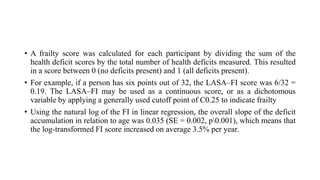
• A frailty score was calculated for each participant by dividing the sum of the
health deficit scores by the total number of health deficits measured. This resulted
in a score between 0 (no deficits present) and 1 (all deficits present).
• For example, if a person has six points out of 32, the LASA–FI score was 6/32 =
0.19. The LASA–FI may be used as a continuous score, or as a dichotomous
variable by applying a generally used cutoff point of C0.25 to indicate frailty
• Using the natural log of the FI in linear regression, the overall slope of the deficit
accumulation in relation to age was 0.035 (SE = 0.002, p0.001), which means that
the log-transformed FI score increased on average 3.5% per year.
Frailty index (FI)
A standard
procedure
for creating a
frailty index
Kenneth Rockwood*
• the value of the variable at which, on average people had a frailty
score of 0.2 or higher, was denoted as that deficit's cut-point. The
value 0.2 on the frailty index is recognized by multiple frailty
measures as approaching a frail state
Clinical Frailty Scale (CFS)
CFS
It’s an
excellen
t tool
K. Rockwood
The Edmonton Frailty
Scale (EFS)
Cognition
Functional
performance
Sensitivity corresponded to 82.6% and specificity 36.9%.
Gérontopôle Frailty
Screening Tool (GFST)
GF
ST
Psycholog
ical
functionin
g
Exhaustio
n
sedentary
behavior
slow gait
speed
poor
handgrip
strengthPatients aged 65 years and older without both
functional disability (Activities of Daily
Living score ≥5/6) and current acute disease.
Individuals presenting three or more of these criteria are onsidered as frail, those
with one or two are pre-frail, and those having no criterion robust.
• The GFST showed a sensitivity of 71.0%, a specificity of 70.2%, a
positive predictive value of 75.9% and a negative predictive value of
64.7% at the identification of non-disabled frail elders. The positive
and negative likelihood ratios were 2.38 and 0.41, respectively. In
logistic regression models only slow gait speed (odds ratio [OR]:
19.65, 95% confidence interval [95% CI]: 4.69–82.35) and mobility
issues (OR: 18.04, 95% CI: 3.11–104.78) were significantly
associated with the condition of frailty in the absence of disability
Groningen Frailty Index
(GFI)
Cognition Nutrition
Rapidly Diagnose
Sarcopenia (SARC-F)
SARC-
F
Strength
Rise
from a
chair
Climb
stairs
Falls
walking
• The scores range from 0 to 10, with 0 to 2 points for each
component. Our preliminary studies have suggested that a
score equal to or greater than 4 is predictive of sarcopenia and
pooroutcomes.
Vulnerable Elders.
Survey-13 (VES-13)
VES-13
Age
General
health
Physical
activity
physical
condition
• The cut-off point of 3 on the VES-13 had:
• 72.7% sensitivity
• 85.7% specificity
• highly predictive in identifying impairment (ROC AUC 0.8977) when
compared to the CGA.
Frailty GIR Evaluation
(FRAGIRE )
FRAGIRE
Age
GLOBAL
HEALTH
STATUS
Psychologi
cal
COGNITI
VE
SOCIO-
CULTURA
L
BURDEN
OF HELP
EXAMINE
R
MOBILIT
Y
NUTRITI
ONAL
SEXUAL
ENVIRON
MENTAL
Dimension GLOBAL HEALTH STATUS – Physiological well-being
How you describe your health status? (Q1)
0 1 2 3 4 5 6 7 8 9 10
(0 -the worst health you can imagine,10 - the best health you can imagine)
How many times have you been hospitalized within the last 6 months? (Q4)
0 / 1-2 times / more than 2 / I don’t know
• The FRAGIRE prognostic score, calculated for each subject,
was normalized on a 0 to 100 scale with the highest score
representing the most frail.
• You should 𝐍𝐨𝐫𝐦𝐚𝐥𝐢𝐳𝐞𝐝 𝐏𝐫𝐨𝐠𝐧𝐨𝐬𝐭𝐢𝐜 𝐬𝐜𝐨𝐫𝐞
𝐑𝐚𝐰 𝐏𝐫𝐨𝐠𝐧𝐨𝐬𝐭𝐢𝐜 𝐬𝐜𝐨𝐫𝐞logistic model=
6.4420 +
𝑸1 × −0.0484 + 𝑸4 × +0.0832 +
𝑸5 × −0.2624 + 𝑸8 × −0.0839 + 𝑸16 × (0.0114) +
𝑸24 × 0.5412 + 𝑸30 × (−0.5680) +
𝑸31 × −0.8464 + 𝑸32 × (−0.4330) +
𝑸37 − 38 ∗ (−0.0762) +
𝑸40 × +0.2703 + 𝑸44 × (−0.4621) +
𝑸54 × 0.2741 + 𝑸56 × 0.1038 + 𝑸55 × 0.0367 +
)𝑸63 × (−0.1550
𝐍𝐨𝐫𝐦𝐚𝐥𝐢𝐳𝐞𝐝 𝐏𝐫𝐨𝐠𝐧𝐨𝐬𝐭𝐢𝐜 𝐬𝐜𝐨𝐫𝐞𝐥𝐨𝐠𝐢𝐬𝐭𝐢𝐜 𝐦𝐨𝐝𝐞𝐥
=
100 − 0 × Raw Prognostic scorelogistic model− −6.1236
8.4415 − −6.1236
+ 0
• The final grid showed fair discrimination ability to predict frailty
(area under the curve (AUC) = 0.85) and good calibration
(Hosmer-Lemeshow P-value = 0.580), reflecting a good
agreement between the prediction by the final model and actual
observation.
• The Cronbach's alpha for the developed tool scored as high as
0.69 (95% Confidence Interval: 0.64 to 0.74). The final
prognostic score was excellent, with an AUC of 0.756.
• sensitivity of 81%, specificity of 61%, positive predictive value of
93%, negative predictive value of 34%, and a global predictive
value of 78%.
Postal Screening Tool For
Frailty
Red Flag
• This is because ‘yes’ answers to Q6–Q10
would be classed as red flags yet often
very little could be done to change this.
• The ability of the questionnaire summary score to predict frailty
was adequate, with an AUC of 0.695, a sensitivity of 71%, and a
specificity of 58%.
Frailty Index for Physical
Activity Questionnaire (EFIP)
EFIP
Physical
functioning
Psychologi
cal
functioning
Social
functioning
General
health
Other
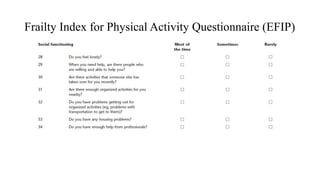
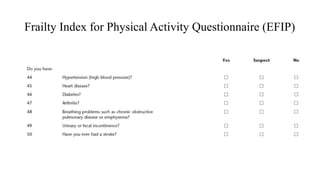
Frailty Index for Physical Activity Questionnaire (EFIP)
• Calculation method:
• Questions 1–19 and 38–43: each Yes1 point, except in question 8, 9,
18, and 19; then No1 point.
• Questions 20–34: Most of the time1 point, Sometimes0.5 points, and
Rarely0 points, except in questions 22, 25, 29, 31, and 34 for which
Rarely
• 1 point and Most of the time0 points.
• Questions 35 and 36: Poor1 point, Fair0.75 points, Good0.5 points,
Very good0.25 points, and Excellent0 points.
• Questions 44–50: Yes1 point, Suspect0.5 points, and No0 points.
Frailty Index for Physical Activity Questionnaire (EFIP)
• Interrater reliability (Cohen kappa0.72, ICC.96) and intrarater reliability
(Cohen kappa0.77 and 0.80, ICC.93 and .98) were good.
• Considering validity, a significant Spearman correlation with the EFIP of
.61 (P.00), .70 (P.00), and 0.66 (P.00) was found with the TUG, the POMA,
and the CIRS-G, respectively.
SHARE-FI
SHARE-FI
EXHAUSTION
LOSS OF
APPETITE
WALKING
DIFFICULTIE
S
LOW
PHYSICAL
ACTIVITY
WEAKNESS
• It’s a good tools.
• Its internet base.
• SHARE-FI CALCULATOR for male:
• file:///C:/Users/sadra/Desktop/frail/SHARE-
FI%20calculator%20-%20females/SHARE-
FI%20calculator%20-%20females.htm
• file:///C:/Users/sadra/Desktop/frail/SHARE-
FI%20calculator%20-%20males/SHARE-FI%20calculator%20-
%20males.htm
• In females, relative to the non-frail class, the unadjusted OR
was 3.7 (2.7 - 5.0) in the pre-frail and 14.1 (10.4 - 19.2) in the
frail. The age-adjusted OR was 2.5 (1.9 - 3.5) in the pre-frail
and 6.9 (4.9 - 9.7) in the frail.
• In males, relative to the non-frail class, the unadjusted OR was
4.8 (3.9 - 5.9) in the pre-frail and 14.4 (11.0 - 18.9) in the frail.
The age-adjusted OR was 3.8 (3.1 - 4.8) in the pre-frail and
10.0 (7.4 - 13.4) in the frail.
• In women, SHARE-FI had an area under the curve (AUC) of
0.77 (95% confidence interval, CI: 0.73 – 0.81; standard error,
SE = 0.02; P < 0.001). Ncriteria had an AUC of 0.75 (95% CI:
0.71 – 0.79; SE = 0.02; P < 0.001).
• In men, the SHARE-FI had an AUC of 0.76 (95% CI: 0.73 –
0.79; SE = 0.02; P < 0.001), and Ncriteria had an AUC of 0.72
(95% CI: 0.69 – 0.76; SE = 0.02; P < 0.001).
Frail Non-Disabled (FiND)
Questionnaire
FiND
Disability
Frailty
• The FiND questionnaire presented a 95% specificity (95%CI
75.1–99.2%) and 76% (95%CI 54.9–90.6%) in the identification
of non-disabled frail participants.
Score:
• If A+B ≥1, the individual is considered as "disabled".
• If A+B=0 and C+D+E ≥1, the individual is considered as “frail”.
• If A+B+C+D+E=0, the individual is considered as “robust".
PRISMA 7
PRISMA
7
• Quick
• Easy
• If Score was 3 or
more person is
frailSe
= 0.78=pS/0.74
Geriatric 8 (G8)
G8
• Quick
• Easy
Short screening instrument
(FRESH-screening)
FRE
SH• Quick
• Easy
1) “Do you get tired when taking a short (15–20 min) walk outside?”
(positive answers included both “yes,” and “can’t do it”)
2) “Have you suffered any general fatigue or tiredness over the last
3 months?”
3) “Have you fallen these last 3 months?” and “Are you afraid of falling?”
(positive answers included “yes, a bit,” “yes,” and “yes, very afraid”); and
4) “Do you need assistance in either getting to the store, managing
obstacles (such as staircases) to and from the store, or in choosing, paying
for, or bringing home groceries?”
5) having three or more emergency department (ED) visits over the last
12 months?
Subjects were considered to be at risk of frailty by answering “yes” to two or
more of these five questions.
Thanks a lot

Frailty screening tool

  • 1.
    Are you frail? Frailtyscreening tool Mohammad-Sajjad Lotfi Ph.D student in gerontology In the Name of GOD
  • 2.
    • (Frailty[Title]) ANDtool[Title]=23 • (Frailty[Title]) AND Diagnostic[Title]=7 • (Frailty[Title]) AND screening[Title]= 65 • (Frailty[Title]) AND instrument[Title]=18 • ((validation[Title/Abstract]) AND index[Title]) AND Frailty[Title]=18 •
  • 3.
    Longitudinal Aging StudyAmsterdam Frailty index (LASA-FI) LASA-FI the newest
  • 8.
    • A frailtyscore was calculated for each participant by dividing the sum of the health deficit scores by the total number of health deficits measured. This resulted in a score between 0 (no deficits present) and 1 (all deficits present). • For example, if a person has six points out of 32, the LASA–FI score was 6/32 = 0.19. The LASA–FI may be used as a continuous score, or as a dichotomous variable by applying a generally used cutoff point of C0.25 to indicate frailty • Using the natural log of the FI in linear regression, the overall slope of the deficit accumulation in relation to age was 0.035 (SE = 0.002, p0.001), which means that the log-transformed FI score increased on average 3.5% per year.
  • 9.
    Frailty index (FI) Astandard procedure for creating a frailty index Kenneth Rockwood*
  • 12.
    • the valueof the variable at which, on average people had a frailty score of 0.2 or higher, was denoted as that deficit's cut-point. The value 0.2 on the frailty index is recognized by multiple frailty measures as approaching a frail state
  • 13.
    Clinical Frailty Scale(CFS) CFS It’s an excellen t tool K. Rockwood
  • 15.
    The Edmonton Frailty Scale(EFS) Cognition Functional performance
  • 18.
    Sensitivity corresponded to82.6% and specificity 36.9%.
  • 19.
    Gérontopôle Frailty Screening Tool(GFST) GF ST Psycholog ical functionin g Exhaustio n sedentary behavior slow gait speed poor handgrip strengthPatients aged 65 years and older without both functional disability (Activities of Daily Living score ≥5/6) and current acute disease.
  • 20.
    Individuals presenting threeor more of these criteria are onsidered as frail, those with one or two are pre-frail, and those having no criterion robust.
  • 21.
    • The GFSTshowed a sensitivity of 71.0%, a specificity of 70.2%, a positive predictive value of 75.9% and a negative predictive value of 64.7% at the identification of non-disabled frail elders. The positive and negative likelihood ratios were 2.38 and 0.41, respectively. In logistic regression models only slow gait speed (odds ratio [OR]: 19.65, 95% confidence interval [95% CI]: 4.69–82.35) and mobility issues (OR: 18.04, 95% CI: 3.11–104.78) were significantly associated with the condition of frailty in the absence of disability
  • 22.
  • 27.
  • 29.
    • The scoresrange from 0 to 10, with 0 to 2 points for each component. Our preliminary studies have suggested that a score equal to or greater than 4 is predictive of sarcopenia and pooroutcomes.
  • 30.
  • 35.
    • The cut-offpoint of 3 on the VES-13 had: • 72.7% sensitivity • 85.7% specificity • highly predictive in identifying impairment (ROC AUC 0.8977) when compared to the CGA.
  • 37.
    Frailty GIR Evaluation (FRAGIRE) FRAGIRE Age GLOBAL HEALTH STATUS Psychologi cal COGNITI VE SOCIO- CULTURA L BURDEN OF HELP EXAMINE R MOBILIT Y NUTRITI ONAL SEXUAL ENVIRON MENTAL
  • 38.
    Dimension GLOBAL HEALTHSTATUS – Physiological well-being How you describe your health status? (Q1) 0 1 2 3 4 5 6 7 8 9 10 (0 -the worst health you can imagine,10 - the best health you can imagine) How many times have you been hospitalized within the last 6 months? (Q4) 0 / 1-2 times / more than 2 / I don’t know
  • 45.
    • The FRAGIREprognostic score, calculated for each subject, was normalized on a 0 to 100 scale with the highest score representing the most frail. • You should 𝐍𝐨𝐫𝐦𝐚𝐥𝐢𝐳𝐞𝐝 𝐏𝐫𝐨𝐠𝐧𝐨𝐬𝐭𝐢𝐜 𝐬𝐜𝐨𝐫𝐞
  • 46.
    𝐑𝐚𝐰 𝐏𝐫𝐨𝐠𝐧𝐨𝐬𝐭𝐢𝐜 𝐬𝐜𝐨𝐫𝐞logisticmodel= 6.4420 + 𝑸1 × −0.0484 + 𝑸4 × +0.0832 + 𝑸5 × −0.2624 + 𝑸8 × −0.0839 + 𝑸16 × (0.0114) + 𝑸24 × 0.5412 + 𝑸30 × (−0.5680) + 𝑸31 × −0.8464 + 𝑸32 × (−0.4330) + 𝑸37 − 38 ∗ (−0.0762) + 𝑸40 × +0.2703 + 𝑸44 × (−0.4621) + 𝑸54 × 0.2741 + 𝑸56 × 0.1038 + 𝑸55 × 0.0367 + )𝑸63 × (−0.1550 𝐍𝐨𝐫𝐦𝐚𝐥𝐢𝐳𝐞𝐝 𝐏𝐫𝐨𝐠𝐧𝐨𝐬𝐭𝐢𝐜 𝐬𝐜𝐨𝐫𝐞𝐥𝐨𝐠𝐢𝐬𝐭𝐢𝐜 𝐦𝐨𝐝𝐞𝐥 = 100 − 0 × Raw Prognostic scorelogistic model− −6.1236 8.4415 − −6.1236 + 0
  • 47.
    • The finalgrid showed fair discrimination ability to predict frailty (area under the curve (AUC) = 0.85) and good calibration (Hosmer-Lemeshow P-value = 0.580), reflecting a good agreement between the prediction by the final model and actual observation. • The Cronbach's alpha for the developed tool scored as high as 0.69 (95% Confidence Interval: 0.64 to 0.74). The final prognostic score was excellent, with an AUC of 0.756. • sensitivity of 81%, specificity of 61%, positive predictive value of 93%, negative predictive value of 34%, and a global predictive value of 78%.
  • 48.
    Postal Screening ToolFor Frailty Red Flag • This is because ‘yes’ answers to Q6–Q10 would be classed as red flags yet often very little could be done to change this.
  • 52.
    • The abilityof the questionnaire summary score to predict frailty was adequate, with an AUC of 0.695, a sensitivity of 71%, and a specificity of 58%.
  • 53.
    Frailty Index forPhysical Activity Questionnaire (EFIP) EFIP Physical functioning Psychologi cal functioning Social functioning General health Other
  • 54.
    Frailty Index forPhysical Activity Questionnaire (EFIP)
  • 55.
    Frailty Index forPhysical Activity Questionnaire (EFIP)
  • 56.
    Frailty Index forPhysical Activity Questionnaire (EFIP)
  • 57.
    Frailty Index forPhysical Activity Questionnaire (EFIP)
  • 58.
    Frailty Index forPhysical Activity Questionnaire (EFIP)
  • 59.
    Frailty Index forPhysical Activity Questionnaire (EFIP) • Calculation method: • Questions 1–19 and 38–43: each Yes1 point, except in question 8, 9, 18, and 19; then No1 point. • Questions 20–34: Most of the time1 point, Sometimes0.5 points, and Rarely0 points, except in questions 22, 25, 29, 31, and 34 for which Rarely • 1 point and Most of the time0 points. • Questions 35 and 36: Poor1 point, Fair0.75 points, Good0.5 points, Very good0.25 points, and Excellent0 points. • Questions 44–50: Yes1 point, Suspect0.5 points, and No0 points.
  • 60.
    Frailty Index forPhysical Activity Questionnaire (EFIP) • Interrater reliability (Cohen kappa0.72, ICC.96) and intrarater reliability (Cohen kappa0.77 and 0.80, ICC.93 and .98) were good. • Considering validity, a significant Spearman correlation with the EFIP of .61 (P.00), .70 (P.00), and 0.66 (P.00) was found with the TUG, the POMA, and the CIRS-G, respectively.
  • 61.
  • 64.
    • It’s agood tools. • Its internet base. • SHARE-FI CALCULATOR for male: • file:///C:/Users/sadra/Desktop/frail/SHARE- FI%20calculator%20-%20females/SHARE- FI%20calculator%20-%20females.htm • file:///C:/Users/sadra/Desktop/frail/SHARE- FI%20calculator%20-%20males/SHARE-FI%20calculator%20- %20males.htm
  • 65.
    • In females,relative to the non-frail class, the unadjusted OR was 3.7 (2.7 - 5.0) in the pre-frail and 14.1 (10.4 - 19.2) in the frail. The age-adjusted OR was 2.5 (1.9 - 3.5) in the pre-frail and 6.9 (4.9 - 9.7) in the frail. • In males, relative to the non-frail class, the unadjusted OR was 4.8 (3.9 - 5.9) in the pre-frail and 14.4 (11.0 - 18.9) in the frail. The age-adjusted OR was 3.8 (3.1 - 4.8) in the pre-frail and 10.0 (7.4 - 13.4) in the frail.
  • 66.
    • In women,SHARE-FI had an area under the curve (AUC) of 0.77 (95% confidence interval, CI: 0.73 – 0.81; standard error, SE = 0.02; P < 0.001). Ncriteria had an AUC of 0.75 (95% CI: 0.71 – 0.79; SE = 0.02; P < 0.001). • In men, the SHARE-FI had an AUC of 0.76 (95% CI: 0.73 – 0.79; SE = 0.02; P < 0.001), and Ncriteria had an AUC of 0.72 (95% CI: 0.69 – 0.76; SE = 0.02; P < 0.001).
  • 67.
  • 69.
    • The FiNDquestionnaire presented a 95% specificity (95%CI 75.1–99.2%) and 76% (95%CI 54.9–90.6%) in the identification of non-disabled frail participants.
  • 70.
    Score: • If A+B≥1, the individual is considered as "disabled". • If A+B=0 and C+D+E ≥1, the individual is considered as “frail”. • If A+B+C+D+E=0, the individual is considered as “robust".
  • 71.
  • 72.
    • If Scorewas 3 or more person is frailSe = 0.78=pS/0.74
  • 73.
  • 76.
  • 77.
    1) “Do youget tired when taking a short (15–20 min) walk outside?” (positive answers included both “yes,” and “can’t do it”) 2) “Have you suffered any general fatigue or tiredness over the last 3 months?” 3) “Have you fallen these last 3 months?” and “Are you afraid of falling?” (positive answers included “yes, a bit,” “yes,” and “yes, very afraid”); and 4) “Do you need assistance in either getting to the store, managing obstacles (such as staircases) to and from the store, or in choosing, paying for, or bringing home groceries?” 5) having three or more emergency department (ED) visits over the last 12 months? Subjects were considered to be at risk of frailty by answering “yes” to two or more of these five questions.
  • 79.