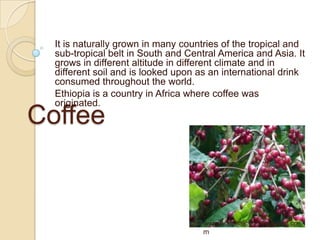
It is naturally grown in many countries of the tropical and
  sub-tropical belt in South and Central America and Asia. It
  grows in different altitude in different climate and in
  different soil and is looked upon as an international drink
  consumed throughout the world.
  Ethiopia is a country in Africa where coffee was
  originated.
Coffee


                                     www.hospitalitynu.blogspot.co
                                     m
Coffee plant
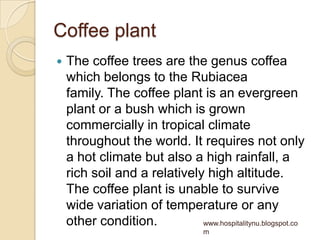
   The coffee trees are the genus coffea
    which belongs to the Rubiacea
    family. The coffee plant is an evergreen
    plant or a bush which is grown
    commercially in tropical climate
    throughout the world. It requires not only
    a hot climate but also a high rainfall, a
    rich soil and a relatively high altitude.
    The coffee plant is unable to survive
    wide variation of temperature or any
    other condition.          www.hospitalitynu.blogspot.co
                                   m
Coffee seed


              www.hospitalitynu.blogspot.co
              m
Types of coffee
 1. Coffea Arabica- it is one of the best quality coffees.
  Its beans are uniform, bold, regular sized and have
  good flavor. It is grown in india, brazil, Colombia, coata
  rica, Kenya and Jamaica.
 2. Coffea Canephora-(coffee robusta) it is the second
  best type of coffee. The beans from the plant are
  usually smaller of a lower quality with neutral flavor. It
  gives higher yield than Arabica. It is grown in east and
  west Africa.
 3. Coffea Liberica- produces third main type of coffee.
  The beans are arge in size but lack in quality. It is grown
  in Malaysia and Guyana.
 Processing of coffee- there are two types of coffee
  processing depending on the country in which
  processing is carried out, those countries which has
  abundant water uses wet method of processing coffee
  beans and those who have scarcity of water uses dry
  method of coffee processing. www.hospitalitynu.blogspot.c
                                   om
Wet method of coffee processing
Dry method of coffee processing


                    www.hospitalitynu.blogspot.co
                    m
Coffee brewing methods

Instant method As the name
  suggests, it is the quickest and easiest
  method of making coffee in this
  method, the soluble coffee solids are
  easily mixed with hot water. It can be
  made just before it is served by
  pouring freshly boiled water over the
  measured instant coffee powder. The
  coffee dissolves instantly, it can be
  served with milk. Sugar is offered
  separately. This method is suitable for
  making coffee in small and large
  quantities. Regular and decaffeinated
  styles are available.
                           www.hospitalitynu.blogspot.com
Saucepan or jug method
   This method can be adopted for the
    preparation of small and large quantity
    of coffee. A measured quantity of
    coarsely ground coffee is placed in a
    saucepan or jug, and freshly boiled
    water is poured over it and covered
    with a lid. it is allowed to infuse for few
    minutes and then strained, it is served
    with hot or cold milk. Sugar is offered
    separately.
                            www.hospitalitynu.blogspot.com
La cafetiere method (plunger)
This method is simple and most suitable for
  making small quantity. The cafetiere
  equipment has a glass container with a lip
  and a lid with a plunger unit. The lid holds
  the plunger in a position. In this method,
  measured quantity of medium coffee grind is
  placed and freshly boiled water added to the
  coffee. It is then stirred and covered with the
  lid and plunger unit and allowed to infuse.
  During this time the coffee grains will rise to
  the top of the liquid. After this, if the plunger
  is moved slightly, the coffee grains will fall to
  the bottom of the container. The plunger unit
  is pushed down the glass container before
  serving. The infusion time is normally 3-5
  minutes which depends on the temperature
  of water. It is served with or without milk.
  Sugar is offered separately.
                                                  www.hospitalitynu.blogspot.c
                                                  om
Percolator method
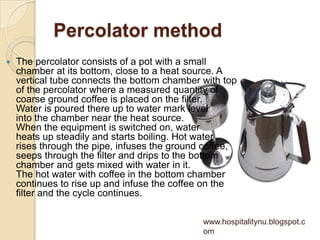
   The percolator consists of a pot with a small
    chamber at its bottom, close to a heat source. A
    vertical tube connects the bottom chamber with top
    of the percolator where a measured quantity of
    coarse ground coffee is placed on the filter.
    Water is poured there up to water mark level
    into the chamber near the heat source.
    When the equipment is switched on, water
    heats up steadily and starts boiling. Hot water
    rises through the pipe, infuses the ground coffee,
    seeps through the filter and drips to the bottom
    chamber and gets mixed with water in it.
    The hot water with coffee in the bottom chamber
    continues to rise up and infuse the coffee on the
    filter and the cycle continues.

                                              www.hospitalitynu.blogspot.c
                                              om
Vacuum infusion method
       (cona)
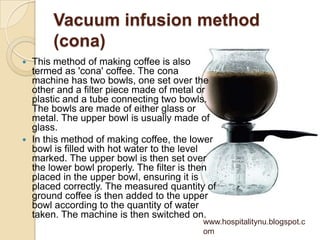
 This method of making coffee is also
  termed as 'cona' coffee. The cona
  machine has two bowls, one set over the
  other and a filter piece made of metal or
  plastic and a tube connecting two bowls.
  The bowls are made of either glass or
  metal. The upper bowl is usually made of
  glass.
 In this method of making coffee, the lower
  bowl is filled with hot water to the level
  marked. The upper bowl is then set over
  the lower bowl properly. The filter is then
  placed in the upper bowl, ensuring it is
  placed correctly. The measured quantity of
  ground coffee is then added to the upper
  bowl according to the quantity of water
  taken. The machine is then switched on.
                                          www.hospitalitynu.blogspot.c
                                          om
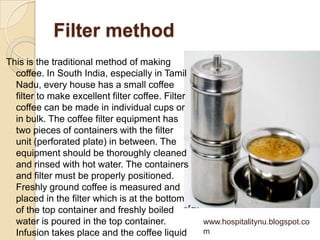
Filter method
This is the traditional method of making
  coffee. In South India, especially in Tamil
  Nadu, every house has a small coffee
  filter to make excellent filter coffee. Filter
  coffee can be made in individual cups or
  in bulk. The coffee filter equipment has
  two pieces of containers with the filter
  unit (perforated plate) in between. The
  equipment should be thoroughly cleaned
  and rinsed with hot water. The containers
  and filter must be properly positioned.
  Freshly ground coffee is measured and
  placed in the filter which is at the bottom
  of the top container and freshly boiled
  water is poured in the top container.            www.hospitalitynu.blogspot.co
  Infusion takes place and the coffee liquid       m
'Pour through filter method
   This method is suitable in commercial
    operations. Most coffee houses and popular
    restaurants use electric filter coffee machine
    to make coffee. Before the filter machine is
    used, one should ensure that the filter is
    thoroughly cleaned/ new filter paper is
    placed. Freshly drawn water is poured to the
    level indicated on the jar. Fresh ground
    coffee, which normally comes in vacant
    sealed packet sufficient for a single brew, is
    added when the machine is switched on. The
    hot water infuses with the coffee powder and
    filters into the serving container. It takes
    approximately 3 minutes for each brew.
                              www.hospitalitynu.blogspot.c
                              om
Individual filter method
   When making a cup of coffee by this
    method, an individual filter is placed in
    a cup. Freshly boiled water is then
    poured into the individual filter to the
    required level. The liquid then infuses
    with the ground coffee and drips into
    the cup. A lid should be placed over
    the water in the filter to help retain the
    temperature. Time of making is
    approximately 3-4 minutes.
                             www.hospitalitynu.blogspot.c
                                  om
Espresso method
 An espresso machine is used to make this type
  of coffee. Hot steam is passed through very fine
  ground coffee and is allowed to infuse under
  pressure. It makes excellent coffee quickly in
  individual cups. This method of making coffee is
  quicker compared to any other method and
  individual cup of coffee are made in seconds.
  Some machines have capacity of making 300-
  400 cups of coffee/ hour. This method is
  originated in Italy.
 If the coffee is served black, it is called
  expresso. It is served in a small cup.if piping hot
  milk is added to the black coffee, the expresso
  becomes cappucino. The operator must follow
  the manufacturer’s instruction.
                               www.hospitalitynu.blogspot.c
                               om
FAULTS in coffee

Bitter coffee: Coffee tastes bitter if —
 The quantity of coffee grind used is
  more than required
 Infusion temperature is too high and
  preparation time too long.
 There are sediments in the coffee
  making equipment.


                        www.hospitalitynu.blogspot.c
                        om
Weak Coffee: coffee is weak and lacks
  taste if-
 Insufficient quantity of coffee grind is
  used
 Incorrect coffee grind is used
 Water has not reached the right
  temperature
 Infusion temperature is low and the
  preparation time is too short
 Poorly stored or old coffee is used
                         www.hospitalitynu.blogspot.com
Flat coffee: Coffee becomes flat if-
• All points mentioned for weak coffee
  are present
• It is prepared beforehand and left in
  the container for long time
• It is prepared and stored in dirty
  equipment
• It is reheated
                        www.hospitalitynu.blogspot.c
                        om
Thank you
   www.hospitalitynu.blogspot.co
    m


                    www.hospitalitynu.blogspot.co
                    m

Coffee

  • 1.
    It is naturallygrown in many countries of the tropical and sub-tropical belt in South and Central America and Asia. It grows in different altitude in different climate and in different soil and is looked upon as an international drink consumed throughout the world. Ethiopia is a country in Africa where coffee was originated. Coffee www.hospitalitynu.blogspot.co m
  • 2.
    Coffee plant  The coffee trees are the genus coffea which belongs to the Rubiacea family. The coffee plant is an evergreen plant or a bush which is grown commercially in tropical climate throughout the world. It requires not only a hot climate but also a high rainfall, a rich soil and a relatively high altitude. The coffee plant is unable to survive wide variation of temperature or any other condition. www.hospitalitynu.blogspot.co m
  • 3.
    Coffee seed www.hospitalitynu.blogspot.co m
  • 4.
    Types of coffee 1. Coffea Arabica- it is one of the best quality coffees. Its beans are uniform, bold, regular sized and have good flavor. It is grown in india, brazil, Colombia, coata rica, Kenya and Jamaica.  2. Coffea Canephora-(coffee robusta) it is the second best type of coffee. The beans from the plant are usually smaller of a lower quality with neutral flavor. It gives higher yield than Arabica. It is grown in east and west Africa.  3. Coffea Liberica- produces third main type of coffee. The beans are arge in size but lack in quality. It is grown in Malaysia and Guyana.  Processing of coffee- there are two types of coffee processing depending on the country in which processing is carried out, those countries which has abundant water uses wet method of processing coffee beans and those who have scarcity of water uses dry method of coffee processing. www.hospitalitynu.blogspot.c om
  • 5.
    Wet method ofcoffee processing
  • 6.
    Dry method ofcoffee processing www.hospitalitynu.blogspot.co m
  • 7.
    Coffee brewing methods Instantmethod As the name suggests, it is the quickest and easiest method of making coffee in this method, the soluble coffee solids are easily mixed with hot water. It can be made just before it is served by pouring freshly boiled water over the measured instant coffee powder. The coffee dissolves instantly, it can be served with milk. Sugar is offered separately. This method is suitable for making coffee in small and large quantities. Regular and decaffeinated styles are available. www.hospitalitynu.blogspot.com
  • 8.
    Saucepan or jugmethod  This method can be adopted for the preparation of small and large quantity of coffee. A measured quantity of coarsely ground coffee is placed in a saucepan or jug, and freshly boiled water is poured over it and covered with a lid. it is allowed to infuse for few minutes and then strained, it is served with hot or cold milk. Sugar is offered separately. www.hospitalitynu.blogspot.com
  • 9.
    La cafetiere method(plunger) This method is simple and most suitable for making small quantity. The cafetiere equipment has a glass container with a lip and a lid with a plunger unit. The lid holds the plunger in a position. In this method, measured quantity of medium coffee grind is placed and freshly boiled water added to the coffee. It is then stirred and covered with the lid and plunger unit and allowed to infuse. During this time the coffee grains will rise to the top of the liquid. After this, if the plunger is moved slightly, the coffee grains will fall to the bottom of the container. The plunger unit is pushed down the glass container before serving. The infusion time is normally 3-5 minutes which depends on the temperature of water. It is served with or without milk. Sugar is offered separately. www.hospitalitynu.blogspot.c om
  • 10.
    Percolator method  The percolator consists of a pot with a small chamber at its bottom, close to a heat source. A vertical tube connects the bottom chamber with top of the percolator where a measured quantity of coarse ground coffee is placed on the filter. Water is poured there up to water mark level into the chamber near the heat source. When the equipment is switched on, water heats up steadily and starts boiling. Hot water rises through the pipe, infuses the ground coffee, seeps through the filter and drips to the bottom chamber and gets mixed with water in it. The hot water with coffee in the bottom chamber continues to rise up and infuse the coffee on the filter and the cycle continues. www.hospitalitynu.blogspot.c om
  • 11.
    Vacuum infusion method (cona)  This method of making coffee is also termed as 'cona' coffee. The cona machine has two bowls, one set over the other and a filter piece made of metal or plastic and a tube connecting two bowls. The bowls are made of either glass or metal. The upper bowl is usually made of glass.  In this method of making coffee, the lower bowl is filled with hot water to the level marked. The upper bowl is then set over the lower bowl properly. The filter is then placed in the upper bowl, ensuring it is placed correctly. The measured quantity of ground coffee is then added to the upper bowl according to the quantity of water taken. The machine is then switched on. www.hospitalitynu.blogspot.c om
  • 12.
    Filter method This isthe traditional method of making coffee. In South India, especially in Tamil Nadu, every house has a small coffee filter to make excellent filter coffee. Filter coffee can be made in individual cups or in bulk. The coffee filter equipment has two pieces of containers with the filter unit (perforated plate) in between. The equipment should be thoroughly cleaned and rinsed with hot water. The containers and filter must be properly positioned. Freshly ground coffee is measured and placed in the filter which is at the bottom of the top container and freshly boiled water is poured in the top container. www.hospitalitynu.blogspot.co Infusion takes place and the coffee liquid m
  • 13.
    'Pour through filtermethod  This method is suitable in commercial operations. Most coffee houses and popular restaurants use electric filter coffee machine to make coffee. Before the filter machine is used, one should ensure that the filter is thoroughly cleaned/ new filter paper is placed. Freshly drawn water is poured to the level indicated on the jar. Fresh ground coffee, which normally comes in vacant sealed packet sufficient for a single brew, is added when the machine is switched on. The hot water infuses with the coffee powder and filters into the serving container. It takes approximately 3 minutes for each brew. www.hospitalitynu.blogspot.c om
  • 14.
    Individual filter method  When making a cup of coffee by this method, an individual filter is placed in a cup. Freshly boiled water is then poured into the individual filter to the required level. The liquid then infuses with the ground coffee and drips into the cup. A lid should be placed over the water in the filter to help retain the temperature. Time of making is approximately 3-4 minutes. www.hospitalitynu.blogspot.c om
  • 15.
    Espresso method  Anespresso machine is used to make this type of coffee. Hot steam is passed through very fine ground coffee and is allowed to infuse under pressure. It makes excellent coffee quickly in individual cups. This method of making coffee is quicker compared to any other method and individual cup of coffee are made in seconds. Some machines have capacity of making 300- 400 cups of coffee/ hour. This method is originated in Italy.  If the coffee is served black, it is called expresso. It is served in a small cup.if piping hot milk is added to the black coffee, the expresso becomes cappucino. The operator must follow the manufacturer’s instruction. www.hospitalitynu.blogspot.c om
  • 16.
    FAULTS in coffee Bittercoffee: Coffee tastes bitter if —  The quantity of coffee grind used is more than required  Infusion temperature is too high and preparation time too long.  There are sediments in the coffee making equipment. www.hospitalitynu.blogspot.c om
  • 17.
    Weak Coffee: coffeeis weak and lacks taste if-  Insufficient quantity of coffee grind is used  Incorrect coffee grind is used  Water has not reached the right temperature  Infusion temperature is low and the preparation time is too short  Poorly stored or old coffee is used www.hospitalitynu.blogspot.com
  • 18.
    Flat coffee: Coffeebecomes flat if- • All points mentioned for weak coffee are present • It is prepared beforehand and left in the container for long time • It is prepared and stored in dirty equipment • It is reheated www.hospitalitynu.blogspot.c om
  • 19.
    Thank you www.hospitalitynu.blogspot.co m www.hospitalitynu.blogspot.co m