presented BY :Pratik gupta (eee 4TH SEM )
Description of Chocolate
Chocolate is made from cocoa beans
found on the cacao tree.
•The cacao tree was first discovered in
the South American rainforest.

The three main ingredients in chocolate
are chocolate liquor, cocoa powder, and
cocoa butter.
Different kinds of chocolate use varying
amounts of these 3 ingredients.
About the Cacao Tree
How Chocolate is Made
•The cacao tree is cultivated in many
countries, but today the leading suppliers
are
Ivory
Coast, Ghana, Indonesia, Nigeria, Brazil, Came
roon, Ecuador, Dominican Republic and Papua
New Guinea.
History of Chocolate
How Chocolate is Made
 Dates back to about 1,500 years ago.
 First found in Mayan and Aztec Civilizations.
• Mayans used cacao beans to create a
cold, unsweetened, spicy chocolate beverage. This was
the first form of chocolate.
• Aztecs came across cacao beans through trade. They
named the spicy drink xocolatl (bitter water).
• Cacao beans played important roles in both Mayan and
Aztec Civilizations.
History of Chocolate
How Chocolate is Made
•The cocoa bean was introduced to Spain in the 16th
century.
•The chocolate drink was first brought to Europe by Spanish
conquistador, Hernan Cortes.
The drink was sweetened to match European tastes.
The drink was also prescribed to people for depression and used in love
and death potions.

•In the late 18th century French and Dutch processors
experimented with chocolate liquid.
The first chocolate bar was made in Switzerland in 1819, and in 1875 the
milk chocolate was invented.
Harvesting Cocoa & Cocoa processing

How Chocolate is Made

Step #1: Plucking and opening the Pods
Cocoa beans grow in pods that sprout off of the trunk and branches of
cocoa trees.
The pods start out green and turn orange when they are ripe.
After the cocoa pods are collected into baskets, they are split open
and the cocoa beans are removed
Fresh cocoa beans are not brown at all, they do not taste at all like
the sweet chocolate they will eventually produce.
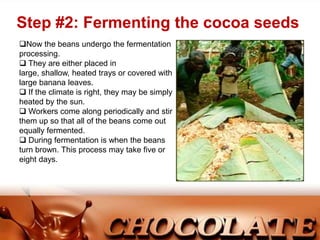
Step #2: Fermenting the cocoa seeds
Now the beans undergo the fermentation
processing.
 They are either placed in
large, shallow, heated trays or covered with
large banana leaves.
 If the climate is right, they may be simply
heated by the sun.
 Workers come along periodically and stir
them up so that all of the beans come out
equally fermented.
 During fermentation is when the beans
turn brown. This process may take five or
eight days.
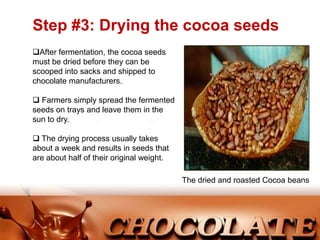
Step #3: Drying the cocoa seeds
After fermentation, the cocoa seeds
must be dried before they can be
scooped into sacks and shipped to
chocolate manufacturers.
 Farmers simply spread the fermented
seeds on trays and leave them in the
sun to dry.

 The drying process usually takes
about a week and results in seeds that
are about half of their original weight.
The dried and roasted Cocoa beans
Manufacturing Chocolate
Step #1: Roasting and Winnowing the Cocoa
The first thing that chocolate manufacturers
do with cocoa beans is roast them(develops
the colour and flavour).
 The outer shell of the beans is removed,
and the inner cocoa bean meat is broken into
small pieces called "cocoa nibs.“
The roasting process makes the shells of
the cocoa brittle, and cocoa nibs pass
through a series of sieves, which strain and
sort the nibs according to size in a process
called "winnowing".
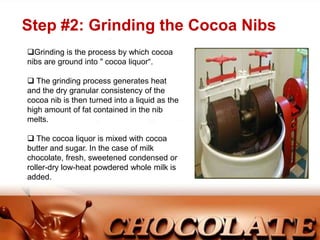
Step #2: Grinding the Cocoa Nibs
Grinding is the process by which cocoa
nibs are ground into " cocoa liquor“.

 The grinding process generates heat
and the dry granular consistency of the
cocoa nib is then turned into a liquid as the
high amount of fat contained in the nib
melts.
 The cocoa liquor is mixed with cocoa
butter and sugar. In the case of milk
chocolate, fresh, sweetened condensed or
roller-dry low-heat powdered whole milk is
added.
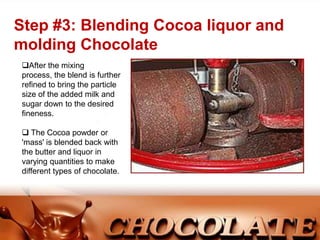
Step #3: Blending Cocoa liquor and
molding Chocolate
After the mixing
process, the blend is further
refined to bring the particle
size of the added milk and
sugar down to the desired
fineness.
 The Cocoa powder or
'mass' is blended back with
the butter and liquor in
varying quantities to make
different types of chocolate.
Chocolate Facts
Chocolate Consumption:

•Americans consume over 3.1 billion pounds of chocolate every
year, which is about 11.7 pounds per person.
•Milk Chocolate is the most popular among Americans, followed by
dark chocolate and then white chocolate.

Chocolate contains more than 300 known chemicals.
•Flavanols
•Theobromine
•Caffeine
•Tyramine
•Pehnyletylamine
•Anandamide
Chocolate Facts
Chocolate is considered a mood food.

•Contains an amino acid called L-tryptophan. This increases
serotonin in the brain, which is a calming hormone.
•Said to be nature’s own “antidepressant.”
Chocolate Myths and Truths
Myth: High in
cholesterol.

Truth: Chocolate is low in
cholesterol and low in animal fat.

Myth: Causes tooth
decay.

Truth: Studies found that tooth
decay is not as big of a problem
as once thought. Tooth decay is
mostly caused by poor hygiene.

Myth: High in
caffeine.

Truth: Chocolate is not high in
caffeine and contains less caffeine
than coffee.
Truth: When eaten in
moderation, chocolate does not
cause weight gain.

Myth: Causes weight
gain.
Chocolate Myths and Truths
Myth: Is addictive.

Truth: People who say they
are addicted are just
experiencing strong
cravings. The
characteristics of an
addiction such as tolerance
and withdrawal and
chemical changes in the
brain are not associated with
eating chocolate
Potential Health Benefits
Chocolate may be good for the heart.
 Chocolate contains chemicals like those found in red
wine and green tea.
 Helps improve circulation
 Helps cut down blood pressure

 Chocolate contains flavanols.
 Helps in preventing the oxidations of “bad” cholesterol, which
reduces the stickiness of blood platelets and improve blood
vessel elasticity.

Theobromine, found in chocolate, was found to
treat coughs better than codeine.
Types of Chocolate
•White chocolate

•Milk chocolate
•Dark chocolate

•Sweet dark chocolate
•Semi-sweet chocolate
•Unsweetened chocolate
•Bittersweet chocolate
World's most expensive chocolate
Le Chocolate Box

Price: $1.5 million
Generally women are overwhelmed with two types of gifts, one is
jewelry and other is chocolate. But, if the chocolate box costs 1.5
million, I think later is a better choice .
Reference
• internet
chocolate

chocolate

  • 1.
    presented BY :Pratikgupta (eee 4TH SEM )
  • 3.
    Description of Chocolate Chocolateis made from cocoa beans found on the cacao tree. •The cacao tree was first discovered in the South American rainforest. The three main ingredients in chocolate are chocolate liquor, cocoa powder, and cocoa butter. Different kinds of chocolate use varying amounts of these 3 ingredients.
  • 4.
    About the CacaoTree How Chocolate is Made •The cacao tree is cultivated in many countries, but today the leading suppliers are Ivory Coast, Ghana, Indonesia, Nigeria, Brazil, Came roon, Ecuador, Dominican Republic and Papua New Guinea.
  • 5.
    History of Chocolate HowChocolate is Made  Dates back to about 1,500 years ago.  First found in Mayan and Aztec Civilizations. • Mayans used cacao beans to create a cold, unsweetened, spicy chocolate beverage. This was the first form of chocolate. • Aztecs came across cacao beans through trade. They named the spicy drink xocolatl (bitter water). • Cacao beans played important roles in both Mayan and Aztec Civilizations.
  • 6.
    History of Chocolate HowChocolate is Made •The cocoa bean was introduced to Spain in the 16th century. •The chocolate drink was first brought to Europe by Spanish conquistador, Hernan Cortes. The drink was sweetened to match European tastes. The drink was also prescribed to people for depression and used in love and death potions. •In the late 18th century French and Dutch processors experimented with chocolate liquid. The first chocolate bar was made in Switzerland in 1819, and in 1875 the milk chocolate was invented.
  • 7.
    Harvesting Cocoa &Cocoa processing How Chocolate is Made Step #1: Plucking and opening the Pods Cocoa beans grow in pods that sprout off of the trunk and branches of cocoa trees. The pods start out green and turn orange when they are ripe. After the cocoa pods are collected into baskets, they are split open and the cocoa beans are removed Fresh cocoa beans are not brown at all, they do not taste at all like the sweet chocolate they will eventually produce.
  • 8.
    Step #2: Fermentingthe cocoa seeds Now the beans undergo the fermentation processing.  They are either placed in large, shallow, heated trays or covered with large banana leaves.  If the climate is right, they may be simply heated by the sun.  Workers come along periodically and stir them up so that all of the beans come out equally fermented.  During fermentation is when the beans turn brown. This process may take five or eight days.
  • 9.
    Step #3: Dryingthe cocoa seeds After fermentation, the cocoa seeds must be dried before they can be scooped into sacks and shipped to chocolate manufacturers.  Farmers simply spread the fermented seeds on trays and leave them in the sun to dry.  The drying process usually takes about a week and results in seeds that are about half of their original weight. The dried and roasted Cocoa beans
  • 10.
    Manufacturing Chocolate Step #1:Roasting and Winnowing the Cocoa The first thing that chocolate manufacturers do with cocoa beans is roast them(develops the colour and flavour).  The outer shell of the beans is removed, and the inner cocoa bean meat is broken into small pieces called "cocoa nibs.“ The roasting process makes the shells of the cocoa brittle, and cocoa nibs pass through a series of sieves, which strain and sort the nibs according to size in a process called "winnowing".
  • 11.
    Step #2: Grindingthe Cocoa Nibs Grinding is the process by which cocoa nibs are ground into " cocoa liquor“.  The grinding process generates heat and the dry granular consistency of the cocoa nib is then turned into a liquid as the high amount of fat contained in the nib melts.  The cocoa liquor is mixed with cocoa butter and sugar. In the case of milk chocolate, fresh, sweetened condensed or roller-dry low-heat powdered whole milk is added.
  • 12.
    Step #3: BlendingCocoa liquor and molding Chocolate After the mixing process, the blend is further refined to bring the particle size of the added milk and sugar down to the desired fineness.  The Cocoa powder or 'mass' is blended back with the butter and liquor in varying quantities to make different types of chocolate.
  • 13.
    Chocolate Facts Chocolate Consumption: •Americansconsume over 3.1 billion pounds of chocolate every year, which is about 11.7 pounds per person. •Milk Chocolate is the most popular among Americans, followed by dark chocolate and then white chocolate. Chocolate contains more than 300 known chemicals. •Flavanols •Theobromine •Caffeine •Tyramine •Pehnyletylamine •Anandamide
  • 14.
    Chocolate Facts Chocolate isconsidered a mood food. •Contains an amino acid called L-tryptophan. This increases serotonin in the brain, which is a calming hormone. •Said to be nature’s own “antidepressant.”
  • 15.
    Chocolate Myths andTruths Myth: High in cholesterol. Truth: Chocolate is low in cholesterol and low in animal fat. Myth: Causes tooth decay. Truth: Studies found that tooth decay is not as big of a problem as once thought. Tooth decay is mostly caused by poor hygiene. Myth: High in caffeine. Truth: Chocolate is not high in caffeine and contains less caffeine than coffee. Truth: When eaten in moderation, chocolate does not cause weight gain. Myth: Causes weight gain.
  • 16.
    Chocolate Myths andTruths Myth: Is addictive. Truth: People who say they are addicted are just experiencing strong cravings. The characteristics of an addiction such as tolerance and withdrawal and chemical changes in the brain are not associated with eating chocolate
  • 17.
    Potential Health Benefits Chocolatemay be good for the heart.  Chocolate contains chemicals like those found in red wine and green tea.  Helps improve circulation  Helps cut down blood pressure  Chocolate contains flavanols.  Helps in preventing the oxidations of “bad” cholesterol, which reduces the stickiness of blood platelets and improve blood vessel elasticity. Theobromine, found in chocolate, was found to treat coughs better than codeine.
  • 18.
    Types of Chocolate •Whitechocolate •Milk chocolate •Dark chocolate •Sweet dark chocolate •Semi-sweet chocolate •Unsweetened chocolate •Bittersweet chocolate
  • 19.
    World's most expensivechocolate Le Chocolate Box Price: $1.5 million Generally women are overwhelmed with two types of gifts, one is jewelry and other is chocolate. But, if the chocolate box costs 1.5 million, I think later is a better choice .
  • 21.