WELCOME
Seminar
On
Physico-chemical changes during roasting of coffee beans
Advisor:
Dr. Anamika Das
Assistant Professor
WCDT, SHUATS.
Kovid Kumar Singh
Submitted by:
I.D. 16MSFT010
Sem. - IIIrd
Warner College of Dairy Technology
Sam Higginbottom University of Agriculture Technology And Sciences
• Introduction
• Plant selection and harvesting
• Longitudinal section of coffee fruit
• Coffee varieties
• Coffee processing methods
• Coffee roasting
• Roasting techniques
• Changes during roasting
• Composition of roasted coffee
• Decaffeination of coffee
• Conclusion
• References
Contents
 Coffee is native to Africa (Ethiopia). Coffee tree or
shrub belongs to family Rubiaceae. Depending on
the species, it can grow from 3-12 m in height.
Shrubs are pruned to keep them at 2-2.5 m height.
 One of the main characteristics of good quality
coffee is good organoleptic properties which
depend on the specie, and on the processing steps
involved.
Introduction:
 Coffee plant selection is done according to the
growing conditions, planting, germination and
development.
 Coffee beans from Arabica species are ideal for
obtaining fine quality coffee.
 Harvesting can be done manually or
mechanically and it should only start after
careful examination of the level of maturation
achieved.
Plant Selection and Harvesting:
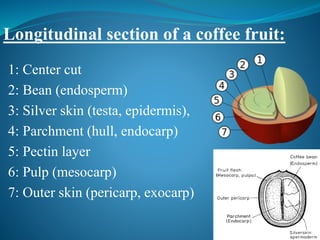
1: Center cut
2: Bean (endosperm)
3: Silver skin (testa, epidermis),
4: Parchment (hull, endocarp)
5: Pectin layer
6: Pulp (mesocarp)
7: Outer skin (pericarp, exocarp)
Longitudinal section of a coffee fruit:
Only 3 of the 70 species of coffee are cultivated:
1. Coffea arabica - 75% of the world’s production
2. C. canephora (C. robusta) - About 25%;
3. C. liberica and others - less than 1%.
Coffee varieties:
 Processing is a critical step in the preparation of
coffee,
 There are four methods used for processing coffee.
 Dry processing: This method consists of drying
the coffee cherries as a whole; the cherries with
the bean, mucilage and pulp are sun dried on open
patios, or dried mechanically.
Coffee Processing Methods:
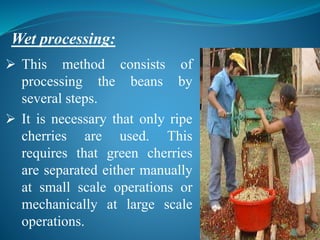
 This method consists of
processing the beans by
several steps.
 It is necessary that only ripe
cherries are used. This
requires that green cherries
are separated either manually
at small scale operations or
mechanically at large scale
operations.
Wet processing:
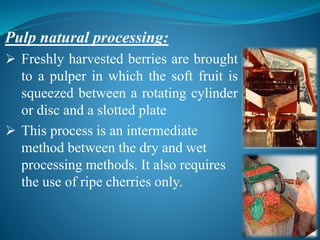
 Freshly harvested berries are brought
to a pulper in which the soft fruit is
squeezed between a rotating cylinder
or disc and a slotted plate
 This process is an intermediate
method between the dry and wet
processing methods. It also requires
the use of ripe cherries only.
Pulp natural processing:
 This is a new processing method developed to
reduce the volume of waste water involved in wet
processing while maintaining the characteristics of
the wet processed coffee.
 This method involves the use of an “ecological
processing” machine, which pulps the cherries and
later removes the mucilage surrounding the
parchment by friction.
A B C
Ecological coffee processing machine. A) The machine as a whole. B) The pulper.
C) Friction drums for mucilage removal
Ecological process:
 Roasting is one of the most important steps in coffee
processing.
 It applies heat to the green beans until they reach the
proper color and smell.
 Roasting involves many different physical and
chemical reactions that will determine the final coffee
cup quality.
 During roasting it is very important to reach the
correct temperatures at the right moment, and then
stop the process when the aroma has fully developed
and the color of the coffee is homogenous throughout
the bean.
Coffee Roasting:
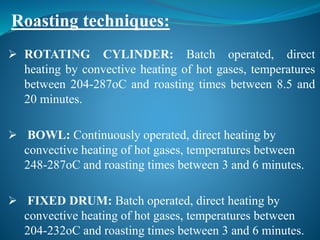
 ROTATING CYLINDER: Batch operated, direct
heating by convective heating of hot gases, temperatures
between 204-287oC and roasting times between 8.5 and
20 minutes.
 BOWL: Continuously operated, direct heating by
convective heating of hot gases, temperatures between
248-287oC and roasting times between 3 and 6 minutes.
 FIXED DRUM: Batch operated, direct heating by
convective heating of hot gases, temperatures between
204-232oC and roasting times between 3 and 6 minutes.
Roasting techniques:
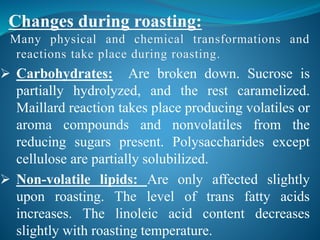
Many physical and chemical transformations and
reactions take place during roasting.
 Carbohydrates: Are broken down. Sucrose is
partially hydrolyzed, and the rest caramelized.
Maillard reaction takes place producing volatiles or
aroma compounds and nonvolatiles from the
reducing sugars present. Polysaccharides except
cellulose are partially solubilized.
 Non-volatile lipids: Are only affected slightly
upon roasting. The level of trans fatty acids
increases. The linoleic acid content decreases
slightly with roasting temperature.
Changes during roasting:
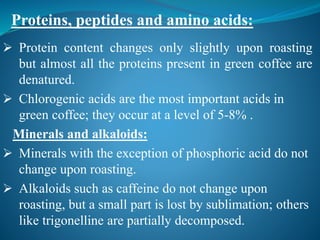
 Protein content changes only slightly upon roasting
but almost all the proteins present in green coffee are
denatured.
 Chlorogenic acids are the most important acids in
green coffee; they occur at a level of 5-8% .
Minerals and alkaloids:
 Minerals with the exception of phosphoric acid do not
change upon roasting.
 Alkaloids such as caffeine do not change upon
roasting, but a small part is lost by sublimation; others
like trigonelline are partially decomposed.
Proteins, peptides and amino acids:
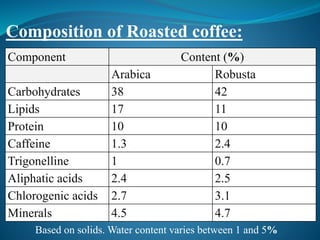
Component Content (%)
Arabica Robusta
Carbohydrates 38 42
Lipids 17 11
Protein 10 10
Caffeine 1.3 2.4
Trigonelline 1 0.7
Aliphatic acids 2.4 2.5
Chlorogenic acids 2.7 3.1
Minerals 4.5 4.7
Based on solids. Water content varies between 1 and 5%
Composition of Roasted coffee:
Grinding:
Grinding should be considered in two phases:
 First the crushing of the beans
 second the grinding of the fragments to the desired
fineness.
Coffee Aroma:
 Green coffee is known to contain approximately 300
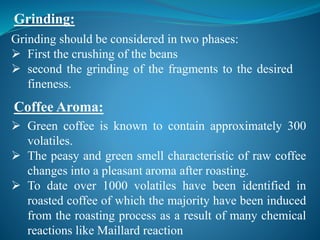
volatiles.
 The peasy and green smell characteristic of raw coffee
changes into a pleasant aroma after roasting.
 To date over 1000 volatiles have been identified in
roasted coffee of which the majority have been induced
from the roasting process as a result of many chemical
reactions like Maillard reaction
Decaffeination of coffee:
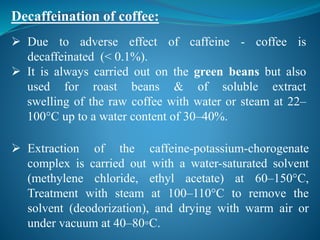
 Due to adverse effect of caffeine - coffee is
decaffeinated (< 0.1%).
 It is always carried out on the green beans but also
used for roast beans & of soluble extract
swelling of the raw coffee with water or steam at 22–
100°C up to a water content of 30–40%.
 Extraction of the caffeine-potassium-chorogenate
complex is carried out with a water-saturated solvent
(methylene chloride, ethyl acetate) at 60–150°C,
Treatment with steam at 100–110°C to remove the
solvent (deodorization), and drying with warm air or
under vacuum at 40–80◦C.
Conclusions:
There are many physico-chemical changes that
takes place in coffee beans which basically imparts
the coffee flavour. Physically, the coffee beans
became larger, lighter with lower bulk and true
density and also brighter in colour. Chemically, the
coffee beans became drier due to a loss of moisture
but increased in ash content. In addition, the
sweetness was lowered due to a loss of sucrose and
increased in chlorogenic acid content.
References:
 Cepeda, E.; Ortiz De Latierro, R.; San Jose, M.; Olazar,
M.(1999). Water sorption isotherms of roasted coffee and coffee
roasted with sugar. Int. J. Food Sci. Technol., 34:287–290.
 Calligaris, S.; Munari, M.; Arrighetti, G.; Barba L. (2009).
Insight into the physicochemical properties of coffee oil. Eur. J.
Lipid Sci. Techno., 111: 1270–1277.
 Franca, A.S., Mendonca, J.C.F. and Oliveira, S.D. (2005).
Composition of green and roasted coffees of different cup
qualities. LWT., 38: 709-715.
 Geiger, R.; Perren, R.; Schenker, S.; Escher, F. (2002).
Mechanism of volume expansion in coffee beans during
roasting. In Proceedings of the 19th International Conference on
Coffee Science; ASIC: Paris, France.
 Leite da Silveira, T.M., Tavares, E. and Gloria, M.B.A.
(2007). Profile and levels of bioactive amines in instant coffee.
Journal of Food Composition and Anal., 20: 451-457.
 Mateus, M. L.; Champion, D.; Liardon, R.; Voilley,
T.(2007). A Characterization of water mobility in dry and
wetted roasted coffee using low field proton nuclear magnetic
resonance. J. Food Eng., 81: 572–579.
 Pomeranz, D. and Meloan, C.E. (1978). Lipids in food
analysis. Theory and practice, 618-667. Connecticut, USA: AVI
Publishing Co.
 Pittia, P.; Dalla Rosa, M.; Lerici, C.R. (2001) Textural
changes of coffee beans as affected by roasting conditions.
Food Sci. Techno., 34: 168–175.
roasting cofee beans

roasting cofee beans

  • 1.
  • 2.
    Seminar On Physico-chemical changes duringroasting of coffee beans Advisor: Dr. Anamika Das Assistant Professor WCDT, SHUATS. Kovid Kumar Singh Submitted by: I.D. 16MSFT010 Sem. - IIIrd Warner College of Dairy Technology Sam Higginbottom University of Agriculture Technology And Sciences
  • 3.
    • Introduction • Plantselection and harvesting • Longitudinal section of coffee fruit • Coffee varieties • Coffee processing methods • Coffee roasting • Roasting techniques • Changes during roasting • Composition of roasted coffee • Decaffeination of coffee • Conclusion • References Contents
  • 4.
     Coffee isnative to Africa (Ethiopia). Coffee tree or shrub belongs to family Rubiaceae. Depending on the species, it can grow from 3-12 m in height. Shrubs are pruned to keep them at 2-2.5 m height.  One of the main characteristics of good quality coffee is good organoleptic properties which depend on the specie, and on the processing steps involved. Introduction:
  • 5.
     Coffee plantselection is done according to the growing conditions, planting, germination and development.  Coffee beans from Arabica species are ideal for obtaining fine quality coffee.  Harvesting can be done manually or mechanically and it should only start after careful examination of the level of maturation achieved. Plant Selection and Harvesting:
  • 6.
    1: Center cut 2:Bean (endosperm) 3: Silver skin (testa, epidermis), 4: Parchment (hull, endocarp) 5: Pectin layer 6: Pulp (mesocarp) 7: Outer skin (pericarp, exocarp) Longitudinal section of a coffee fruit:
  • 7.
    Only 3 ofthe 70 species of coffee are cultivated: 1. Coffea arabica - 75% of the world’s production 2. C. canephora (C. robusta) - About 25%; 3. C. liberica and others - less than 1%. Coffee varieties:
  • 8.
     Processing isa critical step in the preparation of coffee,  There are four methods used for processing coffee.  Dry processing: This method consists of drying the coffee cherries as a whole; the cherries with the bean, mucilage and pulp are sun dried on open patios, or dried mechanically. Coffee Processing Methods:
  • 9.
     This methodconsists of processing the beans by several steps.  It is necessary that only ripe cherries are used. This requires that green cherries are separated either manually at small scale operations or mechanically at large scale operations. Wet processing:
  • 10.
     Freshly harvestedberries are brought to a pulper in which the soft fruit is squeezed between a rotating cylinder or disc and a slotted plate  This process is an intermediate method between the dry and wet processing methods. It also requires the use of ripe cherries only. Pulp natural processing:
  • 11.
     This isa new processing method developed to reduce the volume of waste water involved in wet processing while maintaining the characteristics of the wet processed coffee.  This method involves the use of an “ecological processing” machine, which pulps the cherries and later removes the mucilage surrounding the parchment by friction. A B C Ecological coffee processing machine. A) The machine as a whole. B) The pulper. C) Friction drums for mucilage removal Ecological process:
  • 12.
     Roasting isone of the most important steps in coffee processing.  It applies heat to the green beans until they reach the proper color and smell.  Roasting involves many different physical and chemical reactions that will determine the final coffee cup quality.  During roasting it is very important to reach the correct temperatures at the right moment, and then stop the process when the aroma has fully developed and the color of the coffee is homogenous throughout the bean. Coffee Roasting:
  • 13.
     ROTATING CYLINDER:Batch operated, direct heating by convective heating of hot gases, temperatures between 204-287oC and roasting times between 8.5 and 20 minutes.  BOWL: Continuously operated, direct heating by convective heating of hot gases, temperatures between 248-287oC and roasting times between 3 and 6 minutes.  FIXED DRUM: Batch operated, direct heating by convective heating of hot gases, temperatures between 204-232oC and roasting times between 3 and 6 minutes. Roasting techniques:
  • 14.
    Many physical andchemical transformations and reactions take place during roasting.  Carbohydrates: Are broken down. Sucrose is partially hydrolyzed, and the rest caramelized. Maillard reaction takes place producing volatiles or aroma compounds and nonvolatiles from the reducing sugars present. Polysaccharides except cellulose are partially solubilized.  Non-volatile lipids: Are only affected slightly upon roasting. The level of trans fatty acids increases. The linoleic acid content decreases slightly with roasting temperature. Changes during roasting:
  • 15.
     Protein contentchanges only slightly upon roasting but almost all the proteins present in green coffee are denatured.  Chlorogenic acids are the most important acids in green coffee; they occur at a level of 5-8% . Minerals and alkaloids:  Minerals with the exception of phosphoric acid do not change upon roasting.  Alkaloids such as caffeine do not change upon roasting, but a small part is lost by sublimation; others like trigonelline are partially decomposed. Proteins, peptides and amino acids:
  • 16.
    Component Content (%) ArabicaRobusta Carbohydrates 38 42 Lipids 17 11 Protein 10 10 Caffeine 1.3 2.4 Trigonelline 1 0.7 Aliphatic acids 2.4 2.5 Chlorogenic acids 2.7 3.1 Minerals 4.5 4.7 Based on solids. Water content varies between 1 and 5% Composition of Roasted coffee:
  • 17.
    Grinding: Grinding should beconsidered in two phases:  First the crushing of the beans  second the grinding of the fragments to the desired fineness. Coffee Aroma:  Green coffee is known to contain approximately 300 volatiles.  The peasy and green smell characteristic of raw coffee changes into a pleasant aroma after roasting.  To date over 1000 volatiles have been identified in roasted coffee of which the majority have been induced from the roasting process as a result of many chemical reactions like Maillard reaction
  • 18.
    Decaffeination of coffee: Due to adverse effect of caffeine - coffee is decaffeinated (< 0.1%).  It is always carried out on the green beans but also used for roast beans & of soluble extract swelling of the raw coffee with water or steam at 22– 100°C up to a water content of 30–40%.  Extraction of the caffeine-potassium-chorogenate complex is carried out with a water-saturated solvent (methylene chloride, ethyl acetate) at 60–150°C, Treatment with steam at 100–110°C to remove the solvent (deodorization), and drying with warm air or under vacuum at 40–80◦C.
  • 19.
    Conclusions: There are manyphysico-chemical changes that takes place in coffee beans which basically imparts the coffee flavour. Physically, the coffee beans became larger, lighter with lower bulk and true density and also brighter in colour. Chemically, the coffee beans became drier due to a loss of moisture but increased in ash content. In addition, the sweetness was lowered due to a loss of sucrose and increased in chlorogenic acid content.
  • 20.
    References:  Cepeda, E.;Ortiz De Latierro, R.; San Jose, M.; Olazar, M.(1999). Water sorption isotherms of roasted coffee and coffee roasted with sugar. Int. J. Food Sci. Technol., 34:287–290.  Calligaris, S.; Munari, M.; Arrighetti, G.; Barba L. (2009). Insight into the physicochemical properties of coffee oil. Eur. J. Lipid Sci. Techno., 111: 1270–1277.  Franca, A.S., Mendonca, J.C.F. and Oliveira, S.D. (2005). Composition of green and roasted coffees of different cup qualities. LWT., 38: 709-715.  Geiger, R.; Perren, R.; Schenker, S.; Escher, F. (2002). Mechanism of volume expansion in coffee beans during roasting. In Proceedings of the 19th International Conference on Coffee Science; ASIC: Paris, France.
  • 21.
     Leite daSilveira, T.M., Tavares, E. and Gloria, M.B.A. (2007). Profile and levels of bioactive amines in instant coffee. Journal of Food Composition and Anal., 20: 451-457.  Mateus, M. L.; Champion, D.; Liardon, R.; Voilley, T.(2007). A Characterization of water mobility in dry and wetted roasted coffee using low field proton nuclear magnetic resonance. J. Food Eng., 81: 572–579.  Pomeranz, D. and Meloan, C.E. (1978). Lipids in food analysis. Theory and practice, 618-667. Connecticut, USA: AVI Publishing Co.  Pittia, P.; Dalla Rosa, M.; Lerici, C.R. (2001) Textural changes of coffee beans as affected by roasting conditions. Food Sci. Techno., 34: 168–175.