Coffee sector in India
 Objective of the study
 Coffee Industry Classification
Pricing Strategy
Export of coffee
Import of Coffee
Top ten exporters in the world
 Relative Comparative Advantages analysis
 Market Access
Government of India’s promotion in coffee
sector
 Conclusion
Reference
India is the 6th largest producer of the coffee in
the world.
Domestic consumption is expected to rise by 5.5-6
per cent.
Arabica coffee from India is also well received in
international market.
Coffee production is expected to rise by higher
Robusta production assuming normal rainfall.
The main coffee growing state in India is
Karnataka, Tamil Nadu, Orissa.
Which contributes about 80%of total coffee
production.
Coffee playing most important role in the
livelihoods of millions of rural household across
the developing world.
Coffee production growing interest in the
economic, social and environmental aspect.
Coffee production give opportunities for
employment and infrastructure development in
more than 50 developing countries including
India.
it explore the potential new market .
of existing imports markets of Indian coffee to
enhance the primary source of income .
Indian small farmers as well as earning of
foreign exchange.
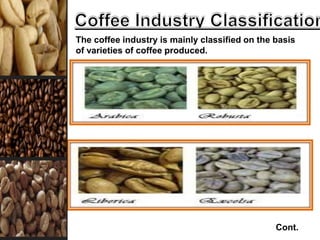
The coffee industry is mainly classified on the basis
of varieties of coffee produced.
Cont.
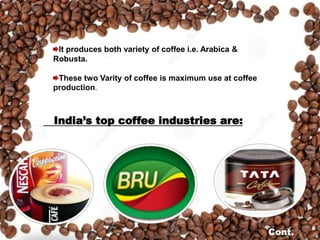
It produces both variety of coffee i.e. Arabica &
Robusta.
These two Varity of coffee is maximum use at coffee
production.
India’s top coffee industries are:
Cont.
These players are primarily present in
the branded segment. For instance, Tata
Coffee Ltd's (TCL) production of 19.1
million kgs in 2013-14 accounted for only
6 per cent of the country's total coffee
production.
HUL had the highest share of about 50
per cent in value terms, while Nestle and
Tata Coffee accounts for about 40 per
cent.
Nescafe is the only brand in pure instant
coffee.
HUL, on the other hand, manufactures
only mixed instant coffee and markets it
via its brand Bru.
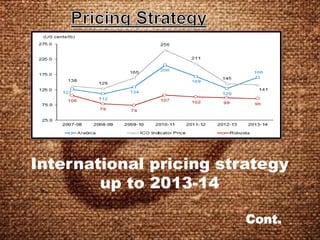
International coffee prices from 2007 to 2014...
International pricing strategy
up to 2013-14
Cont.
International coffee prices are determined by the
production levels in Brazil, Colombia and other Latin
American countries, and the consumption levels in
countries such as the US, Germany and Japan.
2012-13 (October-September), Brazil coffee
production rising by 7 per cent while consumption
grew by only 2per cent.
Average international coffee prices declined by 25
per cent to 128 US Cents per pound in CS 2012-13.
2014-15, production growth on account of faster
demand growth is expected to drive up average
coffee prices by 12 per cent to US cents 155-160 per
pound.
Arabica coffee prices are expected to rise further
by 15 percent to US cents 190-200 per pound.
Robusta prices are estimated to increase by 2.5-3.5
per cent to US cents 98-103 per pound.(2012-13)
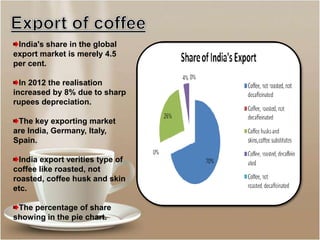
India's share in the global
export market is merely 4.5
per cent.
In 2012 the realisation
increased by 8% due to sharp
rupees depreciation.
The key exporting market
are India, Germany, Italy,
Spain.
India export verities type of
coffee like roasted, not
roasted, coffee husk and skin
etc.
The percentage of share
showing in the pie chart.
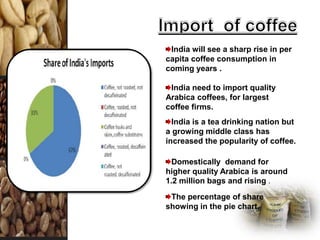
India will see a sharp rise in per
capita coffee consumption in
coming years .
India need to import quality
Arabica coffees, for largest
coffee firms.
India is a tea drinking nation but
a growing middle class has
increased the popularity of coffee.
Domestically demand for
higher quality Arabica is around
1.2 million bags and rising .
The percentage of share
showing in the pie chart.
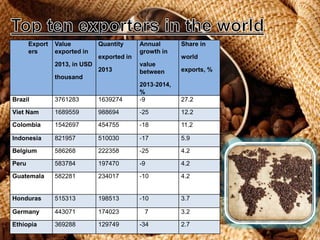
Export
ers
Value
exported in
2013, in USD
thousand
Quantity
exported in
2013
Annual
growth in
value
between
2013‐2014,
%
Share in
world
exports, %
Brazil 3761283 1639274 ‐9 27.2
Viet Nam 1689559 988694 ‐25 12.2
Colombia 1542697 454755 ‐18 11.2
Indonesia 821957 510030 ‐17 5.9
Belgium 586268 222358 ‐25 4.2
Peru 583784 197470 -9 4.2
Guatemala 582281 234017 ‐10 4.2
Honduras 515313 198513 ‐10 3.7
Germany 443071 174023 7 3.2
Ethiopia 369288 129749 -34 2.7
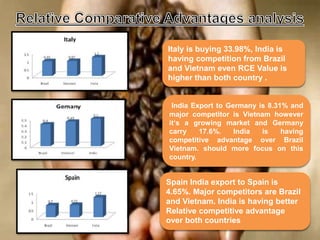
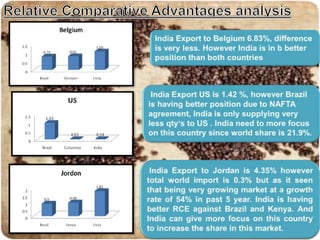
Italy is buying 33.98%, India is
having competition from Brazil
and Vietnam even RCE Value is
higher than both country .
India Export to Germany is 8.31% and
major competitor is Vietnam however
it‘s a growing market and Germany
carry 17.6%. India is having
competitive advantage over Brazil
Vietnam. should more focus on this
country.
Spain India export to Spain is
4.65%. Major competitors are Brazil
and Vietnam. India is having better
Relative competitive advantage
over both countries
.
.
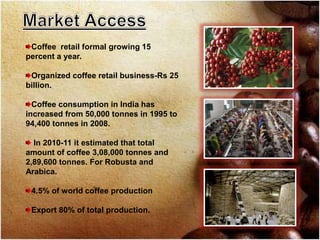
Coffee retail formal growing 15
percent a year.
Organized coffee retail business-Rs 25
billion.
Coffee consumption in India has
increased from 50,000 tonnes in 1995 to
94,400 tonnes in 2008.
In 2010-11 it estimated that total
amount of coffee 3,08,000 tonnes and
2,89,600 tonnes. For Robusta and
Arabica.
4.5% of world coffee production
Export 80% of total production.
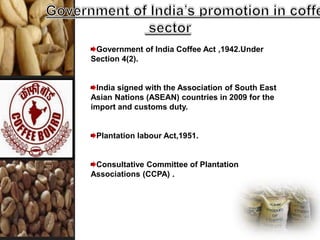
Government of India Coffee Act ,1942.Under
Section 4(2).
India signed with the Association of South East
Asian Nations (ASEAN) countries in 2009 for the
import and customs duty.
Plantation labour Act,1951.
Consultative Committee of Plantation
Associations (CCPA) .
Due to growing consumer recognition for differentiated coffees, has
put the coffee sector at a crossroads.
Relative comparative advantage data it was observed that as per
their annual growth rate and their share in world imports these six
countries namely Italy, Germany, Belgium, Spain, Jordan and USA has
the potential markets for exports of Indian coffee through use of best
practices followed in the global supply chain and put effective
monitoring mechanism as this provides a critical tool towards efforts
to cost‐internalization.
Product diversification through value added products like specialty
coffees, estate branded coffees (single origin coffees), High grown
coffees, different certified coffees, instant/soluble coffees, R&G
coffees, decaffeinated coffees etc.
Market diversification to capture the high value markets like Japan,
USA, Canada, Australia, New Zealand.
Crisil Research
Coffee Board of India
Department of Commerce
Trade map
Foreign trade performance of India
Crisil Research
Coffee Board of India
Department of Commerce
Trade map
Foreign trade performance of
India
Coffee presentation

Coffee presentation

  • 2.
    Coffee sector inIndia  Objective of the study  Coffee Industry Classification Pricing Strategy Export of coffee Import of Coffee Top ten exporters in the world  Relative Comparative Advantages analysis  Market Access Government of India’s promotion in coffee sector  Conclusion Reference
  • 3.
    India is the6th largest producer of the coffee in the world. Domestic consumption is expected to rise by 5.5-6 per cent. Arabica coffee from India is also well received in international market. Coffee production is expected to rise by higher Robusta production assuming normal rainfall. The main coffee growing state in India is Karnataka, Tamil Nadu, Orissa. Which contributes about 80%of total coffee production.
  • 4.
    Coffee playing mostimportant role in the livelihoods of millions of rural household across the developing world. Coffee production growing interest in the economic, social and environmental aspect. Coffee production give opportunities for employment and infrastructure development in more than 50 developing countries including India. it explore the potential new market . of existing imports markets of Indian coffee to enhance the primary source of income . Indian small farmers as well as earning of foreign exchange.
  • 5.
    The coffee industryis mainly classified on the basis of varieties of coffee produced. Cont.
  • 6.
    It produces bothvariety of coffee i.e. Arabica & Robusta. These two Varity of coffee is maximum use at coffee production. India’s top coffee industries are: Cont.
  • 7.
    These players areprimarily present in the branded segment. For instance, Tata Coffee Ltd's (TCL) production of 19.1 million kgs in 2013-14 accounted for only 6 per cent of the country's total coffee production. HUL had the highest share of about 50 per cent in value terms, while Nestle and Tata Coffee accounts for about 40 per cent. Nescafe is the only brand in pure instant coffee. HUL, on the other hand, manufactures only mixed instant coffee and markets it via its brand Bru.
  • 8.
    International coffee pricesfrom 2007 to 2014... International pricing strategy up to 2013-14 Cont.
  • 9.
    International coffee pricesare determined by the production levels in Brazil, Colombia and other Latin American countries, and the consumption levels in countries such as the US, Germany and Japan. 2012-13 (October-September), Brazil coffee production rising by 7 per cent while consumption grew by only 2per cent. Average international coffee prices declined by 25 per cent to 128 US Cents per pound in CS 2012-13. 2014-15, production growth on account of faster demand growth is expected to drive up average coffee prices by 12 per cent to US cents 155-160 per pound. Arabica coffee prices are expected to rise further by 15 percent to US cents 190-200 per pound. Robusta prices are estimated to increase by 2.5-3.5 per cent to US cents 98-103 per pound.(2012-13)
  • 10.
    India's share inthe global export market is merely 4.5 per cent. In 2012 the realisation increased by 8% due to sharp rupees depreciation. The key exporting market are India, Germany, Italy, Spain. India export verities type of coffee like roasted, not roasted, coffee husk and skin etc. The percentage of share showing in the pie chart.
  • 11.
    India will seea sharp rise in per capita coffee consumption in coming years . India need to import quality Arabica coffees, for largest coffee firms. India is a tea drinking nation but a growing middle class has increased the popularity of coffee. Domestically demand for higher quality Arabica is around 1.2 million bags and rising . The percentage of share showing in the pie chart.
  • 12.
    Export ers Value exported in 2013, inUSD thousand Quantity exported in 2013 Annual growth in value between 2013‐2014, % Share in world exports, % Brazil 3761283 1639274 ‐9 27.2 Viet Nam 1689559 988694 ‐25 12.2 Colombia 1542697 454755 ‐18 11.2 Indonesia 821957 510030 ‐17 5.9 Belgium 586268 222358 ‐25 4.2 Peru 583784 197470 -9 4.2 Guatemala 582281 234017 ‐10 4.2 Honduras 515313 198513 ‐10 3.7 Germany 443071 174023 7 3.2 Ethiopia 369288 129749 -34 2.7
  • 13.
    Italy is buying33.98%, India is having competition from Brazil and Vietnam even RCE Value is higher than both country . India Export to Germany is 8.31% and major competitor is Vietnam however it‘s a growing market and Germany carry 17.6%. India is having competitive advantage over Brazil Vietnam. should more focus on this country. Spain India export to Spain is 4.65%. Major competitors are Brazil and Vietnam. India is having better Relative competitive advantage over both countries
  • 14.
  • 15.
    Coffee retail formalgrowing 15 percent a year. Organized coffee retail business-Rs 25 billion. Coffee consumption in India has increased from 50,000 tonnes in 1995 to 94,400 tonnes in 2008. In 2010-11 it estimated that total amount of coffee 3,08,000 tonnes and 2,89,600 tonnes. For Robusta and Arabica. 4.5% of world coffee production Export 80% of total production.
  • 16.
    Government of IndiaCoffee Act ,1942.Under Section 4(2). India signed with the Association of South East Asian Nations (ASEAN) countries in 2009 for the import and customs duty. Plantation labour Act,1951. Consultative Committee of Plantation Associations (CCPA) .
  • 17.
    Due to growingconsumer recognition for differentiated coffees, has put the coffee sector at a crossroads. Relative comparative advantage data it was observed that as per their annual growth rate and their share in world imports these six countries namely Italy, Germany, Belgium, Spain, Jordan and USA has the potential markets for exports of Indian coffee through use of best practices followed in the global supply chain and put effective monitoring mechanism as this provides a critical tool towards efforts to cost‐internalization. Product diversification through value added products like specialty coffees, estate branded coffees (single origin coffees), High grown coffees, different certified coffees, instant/soluble coffees, R&G coffees, decaffeinated coffees etc. Market diversification to capture the high value markets like Japan, USA, Canada, Australia, New Zealand.
  • 18.
    Crisil Research Coffee Boardof India Department of Commerce Trade map Foreign trade performance of India Crisil Research Coffee Board of India Department of Commerce Trade map Foreign trade performance of India