UNIVERSITATEA DE ȘTIINȚE
AGRONOMICE ȘI MEDICINĂ
VETERINARĂ,BUCUREȘTI
FACULTATEA DE
MANAGEMENT,INGINERIE
ECONOMICĂ ÎN AGRICULTURĂ ȘI
DEZVOLTARE RURALĂ
SPECIALIZARE:IMAPA
Coffee
Students : Robe Andreea
Nicolae Ciprian
Marcu Marius-Razvan
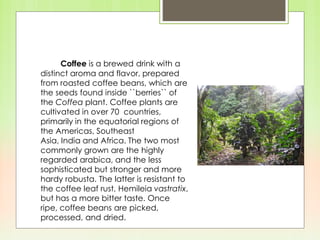
Coffee is a brewed drink with a
distinct aroma and flavor, prepared
from roasted coffee beans, which are
the seeds found inside ``berries`` of
the Coffea plant. Coffee plants are
cultivated in over 70 countries,
primarily in the equatorial regions of
the Americas, Southeast
Asia, India and Africa. The two most
commonly grown are the highly
regarded arabica, and the less
sophisticated but stronger and more
hardy robusta. The latter is resistant to
the coffee leaf rust, Hemileia vastratix,
but has a more bitter taste. Once
ripe, coffee beans are picked,
processed, and dried.
Legendary accounts
According to legend, ancestors of
today's Oromo people were believed to
have been the first to recognize the
energizing effect of the coffee
plant, though no direct evidence has been
found indicating where in Africa coffee
grew or who among the native populations
might have used it as a stimulant or even
known about it, earlier than the 17th
century.
Biology
 Several species of shrub of the
genus Coffea produce the
berries from which coffee is
extracted. The two main
species commercially
cultivated are
Coffea canephora
(predominantly a form known
as 'robusta') and C.arabica. C.
arabica, the most highly
regarded species, is native to
the southwestern highlands of
Ethiopia and the Boma
Plateau in southeastern Sudan
and possibly Mount Marsabit in
northern Kenya.
World production
 In 2011 Brazil was the world leader in
production of green coffee, followed
by Vietnam, Indonesia and Colombia.Ara
bica coffee seeds are cultivated in Latin
America,Eastern Africa, Arabia, or Asia.
Robusta coffee seeds are grown in
western and Central Africa,
throughout Southeast Asia, and to some
extent in Brazil.
Processing
.
Coffee berries and their seeds undergo several
processes before they become the familiar roasted
coffee. Berries have been traditionally selectively
picked by hand; a labor-intensive method, it involves
the selection of only the berries at the peak of
ripeness. More commonly, crops are strip picked,
where all berries are harvested simultaneously
regardless of ripeness by person or machine. After
picking, green coffee is processed by one of two
methods—the dry process method, simpler and less
labor-intensive as the berries can be strip picked,
and the wet process method, which incorporates
fermentation into the process and yields a mild
coffee.
Roasting The next step in the process
is the roasting of the green
coffee. Coffee is usually sold in a
roasted state, and with rare
exceptions all coffee is roasted
before it is consumed. It can be
sold roasted by the supplier, or it
can be home roasted.The
roasting process influences the
taste of the beverage by
changing the coffee bean both
physically and chemically. The
bean decreases in weight as
moisture is lost and increases in
volume, causing it to become
less dense. The density of the
bean also influences the
strength of the coffee and
requirements for packaging.
Grading the roasted
beans
Depending on the color of
the roasted beans as
perceived by the human
eye, they will be labeled as
light, medium light, medium,
medium dark, dark, or very
dark. A more accurate
method of discerning the
degree of roast involves
measuring the reflected light
from roasted seeds
illuminated with a light
source in the near-infrared
spectrum.
Storage
 Coffee is best stored in an airtight container made
of ceramic, glass, or non-reactive metal. Higher
quality prepackaged coffee usually has a one-
way valve which prevents air from entering while
allowing the coffee to release gases. Coffee
freshness and flavor is preserved when it is stored
away from moisture, heat, and light. The ability of
coffee to absorb strong smells from food means
that it should be kept away from such
smells. Storage of coffee in the refrigerator is not
recommended due to the presence of moisture
which can cause deterioration. Exterior walls of
buildings which face the sun may heat the interior
of a home, and this heat may damage coffee
stored near such a wall.
Method of action
 The primary psychoactive chemical in
coffee is caffeine, an adenosine
antagonist that is known for
its stimulant effects. Coffee also contains
the monoamine oxidase inhibitors β-
carboline and harmane, which may
contribute to its psychoactivity.
Potential benefits
 Coffee is no longer thought to be a risk
factor for coronary heart disease.A 2012
meta-analysis concluded that people
who drank moderate amounts of coffee
had a lower rate of heart failure, with the
biggest effect found for those who drank
more than four cups a day. Moreover, in
one study, habitual coffee consumption
was associated with improved vascular
function.
Potential risks
Coffee's adverse
effects are more
common when taken
in excess, with
potential health risks
due mainly to
its caffeine content
and can therefore be
avoided by drinking
less coffee or
using decaffeinated
coffee.
Oily components
called diterpenes
are present in
unfiltered coffee
and coffee brewed
using metal filters,
but not in coffee
brewed using
paper filters.
Social and culture
Coffee is often
consumed alongside (or
instead of) breakfast by
many at home. It is often
served at the end of a
meal, normally with a
dessert, and at times with
an after-dinner mint
especially when
consumed at a restaurant
or dinner party.
Bibliography
 http://en.wikipedia.org/wiki/Coffee
 https://www.google.ro

Coffee

  • 1.
    UNIVERSITATEA DE ȘTIINȚE AGRONOMICEȘI MEDICINĂ VETERINARĂ,BUCUREȘTI FACULTATEA DE MANAGEMENT,INGINERIE ECONOMICĂ ÎN AGRICULTURĂ ȘI DEZVOLTARE RURALĂ SPECIALIZARE:IMAPA Coffee Students : Robe Andreea Nicolae Ciprian Marcu Marius-Razvan
  • 2.
    Coffee is abrewed drink with a distinct aroma and flavor, prepared from roasted coffee beans, which are the seeds found inside ``berries`` of the Coffea plant. Coffee plants are cultivated in over 70 countries, primarily in the equatorial regions of the Americas, Southeast Asia, India and Africa. The two most commonly grown are the highly regarded arabica, and the less sophisticated but stronger and more hardy robusta. The latter is resistant to the coffee leaf rust, Hemileia vastratix, but has a more bitter taste. Once ripe, coffee beans are picked, processed, and dried.
  • 3.
    Legendary accounts According tolegend, ancestors of today's Oromo people were believed to have been the first to recognize the energizing effect of the coffee plant, though no direct evidence has been found indicating where in Africa coffee grew or who among the native populations might have used it as a stimulant or even known about it, earlier than the 17th century.
  • 4.
    Biology  Several speciesof shrub of the genus Coffea produce the berries from which coffee is extracted. The two main species commercially cultivated are Coffea canephora (predominantly a form known as 'robusta') and C.arabica. C. arabica, the most highly regarded species, is native to the southwestern highlands of Ethiopia and the Boma Plateau in southeastern Sudan and possibly Mount Marsabit in northern Kenya.
  • 5.
    World production  In2011 Brazil was the world leader in production of green coffee, followed by Vietnam, Indonesia and Colombia.Ara bica coffee seeds are cultivated in Latin America,Eastern Africa, Arabia, or Asia. Robusta coffee seeds are grown in western and Central Africa, throughout Southeast Asia, and to some extent in Brazil.
  • 6.
    Processing . Coffee berries andtheir seeds undergo several processes before they become the familiar roasted coffee. Berries have been traditionally selectively picked by hand; a labor-intensive method, it involves the selection of only the berries at the peak of ripeness. More commonly, crops are strip picked, where all berries are harvested simultaneously regardless of ripeness by person or machine. After picking, green coffee is processed by one of two methods—the dry process method, simpler and less labor-intensive as the berries can be strip picked, and the wet process method, which incorporates fermentation into the process and yields a mild coffee.
  • 7.
    Roasting The nextstep in the process is the roasting of the green coffee. Coffee is usually sold in a roasted state, and with rare exceptions all coffee is roasted before it is consumed. It can be sold roasted by the supplier, or it can be home roasted.The roasting process influences the taste of the beverage by changing the coffee bean both physically and chemically. The bean decreases in weight as moisture is lost and increases in volume, causing it to become less dense. The density of the bean also influences the strength of the coffee and requirements for packaging.
  • 8.
    Grading the roasted beans Dependingon the color of the roasted beans as perceived by the human eye, they will be labeled as light, medium light, medium, medium dark, dark, or very dark. A more accurate method of discerning the degree of roast involves measuring the reflected light from roasted seeds illuminated with a light source in the near-infrared spectrum.
  • 10.
    Storage  Coffee isbest stored in an airtight container made of ceramic, glass, or non-reactive metal. Higher quality prepackaged coffee usually has a one- way valve which prevents air from entering while allowing the coffee to release gases. Coffee freshness and flavor is preserved when it is stored away from moisture, heat, and light. The ability of coffee to absorb strong smells from food means that it should be kept away from such smells. Storage of coffee in the refrigerator is not recommended due to the presence of moisture which can cause deterioration. Exterior walls of buildings which face the sun may heat the interior of a home, and this heat may damage coffee stored near such a wall.
  • 11.
    Method of action The primary psychoactive chemical in coffee is caffeine, an adenosine antagonist that is known for its stimulant effects. Coffee also contains the monoamine oxidase inhibitors β- carboline and harmane, which may contribute to its psychoactivity.
  • 12.
    Potential benefits  Coffeeis no longer thought to be a risk factor for coronary heart disease.A 2012 meta-analysis concluded that people who drank moderate amounts of coffee had a lower rate of heart failure, with the biggest effect found for those who drank more than four cups a day. Moreover, in one study, habitual coffee consumption was associated with improved vascular function.
  • 13.
    Potential risks Coffee's adverse effectsare more common when taken in excess, with potential health risks due mainly to its caffeine content and can therefore be avoided by drinking less coffee or using decaffeinated coffee. Oily components called diterpenes are present in unfiltered coffee and coffee brewed using metal filters, but not in coffee brewed using paper filters.
  • 14.
    Social and culture Coffeeis often consumed alongside (or instead of) breakfast by many at home. It is often served at the end of a meal, normally with a dessert, and at times with an after-dinner mint especially when consumed at a restaurant or dinner party.
  • 15.