CNIT 141
Cryptography for Computer Networks
13. TLS
Topics
• Target Applications and Requirements
• The TLS Protocol Suite
• TLS 1.3 Improvements Over TLS 1.2
• The Strengths of TLS Security
• How Things Can Go Wrong
TLS
• Protects communications at layer 4
• Can carry any type of content
• Email, Web traffic, mobile apps, ...
• Machine-to-machine comms for IoT
TLS Vulnerabilities
• TLS grew too big and bloated
• Many attacks
• Heartbleed
• BEAST
• CRIME
• POODLE
TLS 1.3
• Overhaul of protocol
• Removed unnecessary features
• Replaced old algorithms
• Simpler, faster, and more secure
Target Applications and
Requirements
Secure Channel
• TLS ensures that data is confidential,
authenticated, and unmodified
• Prevents MiTM attacks
• By authenticating servers with trusted
Certificate Authorities
Four Requirements
• Efficient
• Compare CPU to unencrypted comms
• Interoperable
• Work on any hardware or OS
• Extensible
• Support additional features & algorithms
• Versatile
• Not bound to any specific application
The TLS Protocol Suite
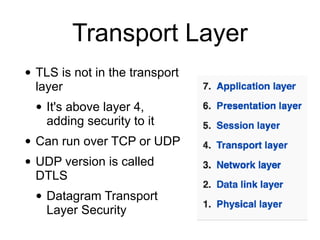
Transport Layer
• TLS is not in the transport
layer
• It's above layer 4,
adding security to it
• Can run over TCP or UDP
• UDP version is called
DTLS
• Datagram Transport
Layer Security
History
• SSL: began in 1995, from Netscape
• SSL 2.0 and SSL 3.0 had security flaws
• Should no longer be used
• TLS
• TLS 1.0 (1999): least secure
• TLS 1.1 (2006): better but contains weak
algorithms
TLS 1.2
• From 2008
• Better than previous versions
• Complex and hard to configure
• Supports AES-CBC, vulnerable to padding
oracle attacks
• Inherited dozens of features and design
choices from earlier versions
• TLS 1.3 is a major overhaul and improvement
TLS in a Nutshell
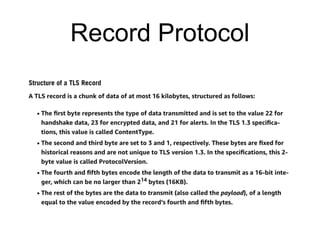
• Record protocol
• Data encapsulation
• Handshake protocol
• Key agreement
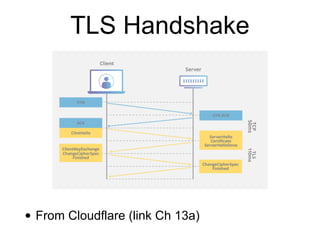
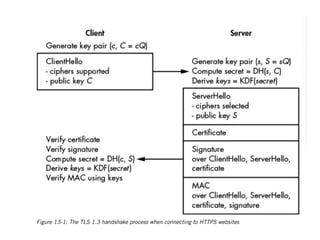
TLS Handshake
• From Cloudflare (link Ch 13a)
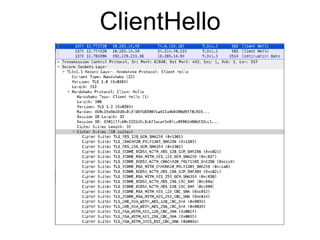
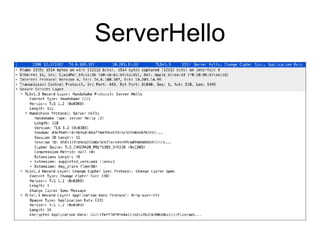
Hello
• ClientHello
• Lists ciphers available
• ServerHello
• Selects a cipher to use
ClientHello
ServerHello
Certificates and
Certificate Authorities (CA)
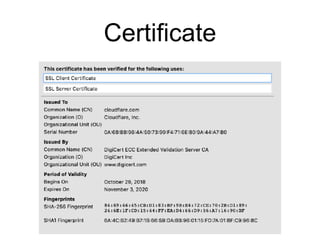
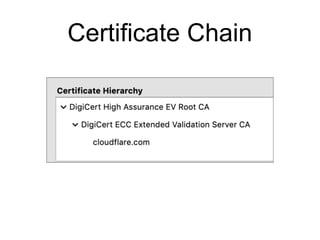
• Server uses a certificate to authenticate itself
• Verified by a CA
• CA's public keys hard-coded into browsers
• Trusted third party
Certificate
Certificate Chain
Record Protocol
Zero Padding
• Adds zeroes to plaintext for short messages
• Mitigates traffic analysis
• Deducing contents from message size
TLS 1.3 Cryptographic
Algorithms
• Three types of algorithms are used
• Authenticated encryption
• Key derivation function
• Hash function that derives secret keys
from a shared secret
• A Diffie-Hellman function
Authenticated Ciphers
• TLS 1.3 supports only three algorithms
• AES-GCM
• AES-CCM
• Slightly less efficient than AES-GCM
• ChaCha20 stream cipher
• Combined with Poly1305 MAC
• Secret key can be 128 or 256 bits
• Unsafe 64-bit or 80-bit keys not allowed
Key Derivation Function
(KDF)
• HKDF, based on HMAC
• Uses SHA-256 or SHA-384
Diffie-Hellman
Two Options
• Elliptic Curve
• With the three NIST curves, or
• Curve25519, or Curve448
• Group of integers modulo a prime number
• Traditional Diffie-Hellman
• 2048 - 8192 bits
• Security of 2048-bit group is weak length
• Less than 100 bits
TLS 1.3 Improvements
Over TLS 1.2
Removed Weak
Algorithms
• MD5, SHA-1
• RC4, AES-CBC
• MAC-then-Encrypt alorithms
• Like HMAC-SHA-1
• Replaces with authenticated ciphers
• More efficient and secure
Removed Insecure
Feature
• Optional data compression
• Enabled the CRIME attack
• Length of the compressed message
leaked information about contents
New Features
• That make TLS 1.3 more secure
• Downgrade protection
• Single round-trip handshake
• Session resumption
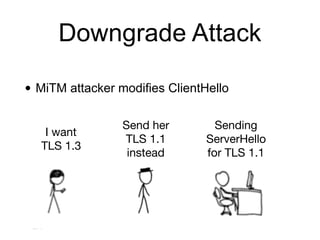
Downgrade Attack
• MiTM attacker modifies ClientHello
I want 

TLS 1.3
Sending

ServerHello

for TLS 1.1
Send her

TLS 1.1

instead
Downgrade Protection
• To prevent this, 8 bytes in the ServerHello
denote the TLS version
• They are cryptographically signed so the
MiTM can't change them
• The client can check them to see what TLS
version is being provided
Single Round-Trip
Handshake
• In TLS 1.2
• Client sends some data, waits for response
• Client sends more data, waits for response
• TLS 1.3 combines it all into one round-trip
• Saves time
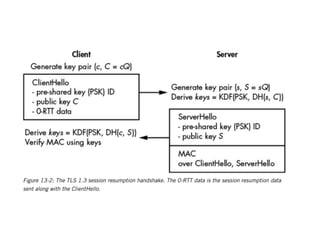
Session Resumption
• Leverages the pre-shared key exchanged in a
previous session
• To bootstrap a new session
• Two benefits
• Client can start encrypting immediately
• No need for certificates
The Strengths of TLS
Security
Authentication
• TLS 1.3 handshake authenticates the server
with a certificate and CA
• Client is not authenticated, but can use:
• Username & password in a TLS record
• Secure cookie over TLS
• A client certificate (rarely used)
Forward Secrecy
• TLS 1.3 provides forward secrecy in both a
data leak and a breach
• If an attacker can steal a client's RAM
• Exposes keys and secrets for the current
session
• And any old sessions still stored in RAM
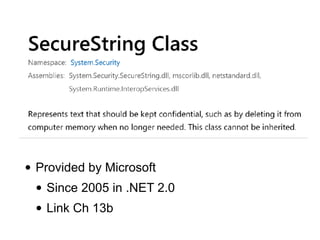
• Solution: use Secure Strings
• Provided by Microsoft
• Since 2005 in .NET 2.0
• Link Ch 13b
How Things Can Go
Wrong
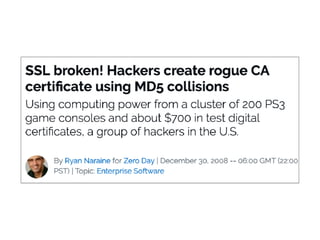
Compromised CA
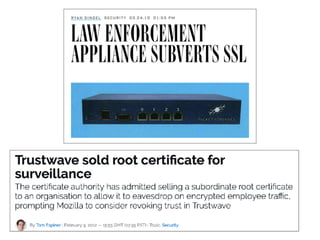
• Happened in 2011 to DigiNotar
• CA's private key compromised
• Attacker created fake certificates for Google
services
Compromised Client
• Attacker who controls client can
• Capture session keys
• Read decrypted data
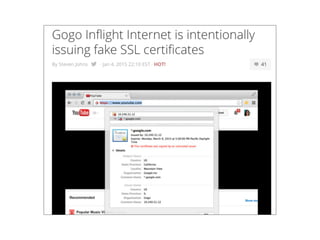
• Or install a rogue CA certificate
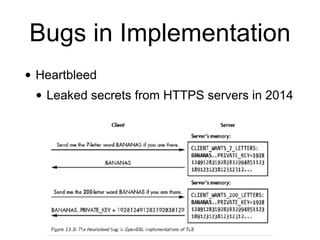
Bugs in Implementation
• Heartbleed
• Leaked secrets from HTTPS servers in 2014
Improving TLS
• SSL Labs TLS test
• Lets you test any site's certificate
• Or a browser's TLS configuration
• Let's Encrypt
• Free TLS certificates for everyone
CNIT 141: 13. TLS
CNIT 141: 13. TLS
CNIT 141: 13. TLS
CNIT 141: 13. TLS

CNIT 141: 13. TLS

  • 1.
    CNIT 141 Cryptography forComputer Networks 13. TLS
  • 2.
    Topics • Target Applicationsand Requirements • The TLS Protocol Suite • TLS 1.3 Improvements Over TLS 1.2 • The Strengths of TLS Security • How Things Can Go Wrong
  • 3.
    TLS • Protects communicationsat layer 4 • Can carry any type of content • Email, Web traffic, mobile apps, ... • Machine-to-machine comms for IoT
  • 4.
    TLS Vulnerabilities • TLSgrew too big and bloated • Many attacks • Heartbleed • BEAST • CRIME • POODLE
  • 5.
    TLS 1.3 • Overhaulof protocol • Removed unnecessary features • Replaced old algorithms • Simpler, faster, and more secure
  • 6.
  • 7.
    Secure Channel • TLSensures that data is confidential, authenticated, and unmodified • Prevents MiTM attacks • By authenticating servers with trusted Certificate Authorities
  • 8.
    Four Requirements • Efficient •Compare CPU to unencrypted comms • Interoperable • Work on any hardware or OS • Extensible • Support additional features & algorithms • Versatile • Not bound to any specific application
  • 9.
  • 10.
    Transport Layer • TLSis not in the transport layer • It's above layer 4, adding security to it • Can run over TCP or UDP • UDP version is called DTLS • Datagram Transport Layer Security
  • 11.
    History • SSL: beganin 1995, from Netscape • SSL 2.0 and SSL 3.0 had security flaws • Should no longer be used • TLS • TLS 1.0 (1999): least secure • TLS 1.1 (2006): better but contains weak algorithms
  • 12.
    TLS 1.2 • From2008 • Better than previous versions • Complex and hard to configure • Supports AES-CBC, vulnerable to padding oracle attacks • Inherited dozens of features and design choices from earlier versions • TLS 1.3 is a major overhaul and improvement
  • 13.
    TLS in aNutshell • Record protocol • Data encapsulation • Handshake protocol • Key agreement
  • 14.
    TLS Handshake • FromCloudflare (link Ch 13a)
  • 15.
    Hello • ClientHello • Listsciphers available • ServerHello • Selects a cipher to use
  • 16.
  • 17.
  • 19.
    Certificates and Certificate Authorities(CA) • Server uses a certificate to authenticate itself • Verified by a CA • CA's public keys hard-coded into browsers • Trusted third party
  • 20.
  • 21.
  • 22.
  • 23.
    Zero Padding • Addszeroes to plaintext for short messages • Mitigates traffic analysis • Deducing contents from message size
  • 24.
    TLS 1.3 Cryptographic Algorithms •Three types of algorithms are used • Authenticated encryption • Key derivation function • Hash function that derives secret keys from a shared secret • A Diffie-Hellman function
  • 25.
    Authenticated Ciphers • TLS1.3 supports only three algorithms • AES-GCM • AES-CCM • Slightly less efficient than AES-GCM • ChaCha20 stream cipher • Combined with Poly1305 MAC • Secret key can be 128 or 256 bits • Unsafe 64-bit or 80-bit keys not allowed
  • 26.
    Key Derivation Function (KDF) •HKDF, based on HMAC • Uses SHA-256 or SHA-384
  • 27.
    Diffie-Hellman Two Options • EllipticCurve • With the three NIST curves, or • Curve25519, or Curve448 • Group of integers modulo a prime number • Traditional Diffie-Hellman • 2048 - 8192 bits • Security of 2048-bit group is weak length • Less than 100 bits
  • 28.
  • 29.
    Removed Weak Algorithms • MD5,SHA-1 • RC4, AES-CBC • MAC-then-Encrypt alorithms • Like HMAC-SHA-1 • Replaces with authenticated ciphers • More efficient and secure
  • 30.
    Removed Insecure Feature • Optionaldata compression • Enabled the CRIME attack • Length of the compressed message leaked information about contents
  • 31.
    New Features • Thatmake TLS 1.3 more secure • Downgrade protection • Single round-trip handshake • Session resumption
  • 32.
    Downgrade Attack • MiTMattacker modifies ClientHello I want TLS 1.3 Sending ServerHello for TLS 1.1 Send her TLS 1.1 instead
  • 33.
    Downgrade Protection • Toprevent this, 8 bytes in the ServerHello denote the TLS version • They are cryptographically signed so the MiTM can't change them • The client can check them to see what TLS version is being provided
  • 34.
    Single Round-Trip Handshake • InTLS 1.2 • Client sends some data, waits for response • Client sends more data, waits for response • TLS 1.3 combines it all into one round-trip • Saves time
  • 35.
    Session Resumption • Leveragesthe pre-shared key exchanged in a previous session • To bootstrap a new session • Two benefits • Client can start encrypting immediately • No need for certificates
  • 37.
    The Strengths ofTLS Security
  • 38.
    Authentication • TLS 1.3handshake authenticates the server with a certificate and CA • Client is not authenticated, but can use: • Username & password in a TLS record • Secure cookie over TLS • A client certificate (rarely used)
  • 39.
    Forward Secrecy • TLS1.3 provides forward secrecy in both a data leak and a breach • If an attacker can steal a client's RAM • Exposes keys and secrets for the current session • And any old sessions still stored in RAM • Solution: use Secure Strings
  • 40.
    • Provided byMicrosoft • Since 2005 in .NET 2.0 • Link Ch 13b
  • 41.
  • 42.
    Compromised CA • Happenedin 2011 to DigiNotar • CA's private key compromised • Attacker created fake certificates for Google services
  • 46.
    Compromised Client • Attackerwho controls client can • Capture session keys • Read decrypted data • Or install a rogue CA certificate
  • 47.
    Bugs in Implementation •Heartbleed • Leaked secrets from HTTPS servers in 2014
  • 48.
    Improving TLS • SSLLabs TLS test • Lets you test any site's certificate • Or a browser's TLS configuration • Let's Encrypt • Free TLS certificates for everyone