CNIT 141
Cryptography for Computer Networks
7. Keyed Hashing
Topics
• Message Authentication Codes (MACs)
• Pseudorandom Functions (PRFs)
• Creating Keyed Hashes from Unkeyed Hashes
• Creating Keyed Hashes from Block Ciphers:
CMAC
• Dedicated MAC Designs
• How Things Can Go Wrong
Keyed Hashing
• Anyone can calculate the SHA hash of a
message
• No secret value involved
• Keyed hashing forms the basis for two
algorithms
• Message Authentication Code (MAC)
• Pseudorandom Function (PRF)
Message Authentication
Codes (MACs)
MACs
• A MAC protects a message's integrity and
authenticity with a tag T
• T = MAC(K, M)
• Verifying the MAC proves both that the
message wasn't altered, and that it came from
the sender holding the key
MACs in Secure
Communication
• MACs are used in
• IPSec, SSH, and TLS
• 3G & 4G telephony encrypt packets but don't
use a MAC
• An attacker can modify the packets
• Causing static on the line
Forgery
• Attacker shouldn't be able to create a tag
without knowing the key
• Such a M, T pair is called a forgery
• A system is unforgeable if forgeries are
impossible to find
Chosen-Message Attacks
• An attacker can choose messages that get
authenticated
• The standard model to test MAC algoroithms
Replay Attacks
• MACs are not safe from replay attacks
• To detect them, protocols include a message
number in each message
• A replayed message will have an out-of-
order message number
Pseudorandom Functions
(PRFs)
PRFs
• Use a secret key to return PRF(K, M)
• Output looks random
• Key Derivation schemes use PDFs
• To generate cryptographic keys from a
master key or password
• Identification schemes use PDFs
• To generate a response from a random
challenge
Uses of PRFs
• 4G telephony uses PRFs
• To authenticate a SIM card
• To generate the encryption key and MAC
used during a phone call
• TLS uses a PRF
• To generate key material from a master
secret and a session-speciifc random value
PRF Security
• Has no pattern, looks random
• Indistinguishable from random bits
• Fundamentally stronger than MACs
• MACs are secure if they can't be forged
• But may not appear random
Creating Keyed Hashes
from Unkeyed Hashes
The Secret-Prefix
Construction
• Prepend key to the message, and return
• Hash(K || M)
• May be vulnerable to length-extension attacks
• Calculating Hash(K || M1 || M2) from 

Hash(K || M1)
• SHA-1 & SHA-2 are vulnerable to this, but not
SHA-3
Insecurity with Different
Key Lengths
• No way to tell key from message
• If K is 123abc and M is def00
• If K is 123a and M is bcdef00
• Result is Hash(123abcdef00)
• To fix this, BLAKE2 and SHA-3 include a
keyed mode
• Another fix is to include the key's length in
the hash: Hash(L || K || M)
Secret-Suffix Construction
• Tag is Hash(M || K)
• Prevents length-extension attack
• If you know Hash(M1 || K)
• You can calculate Hash(M1 || K || M2)
• But not Hash(M1 || M2 || K)
Secret-Suffix Construction
• But if there's a hash collision
• Hash(M1) = Hash(M2)
• The tags can collide too
• Hash(M1 || K) = Hash(M2 || K)
HMAC Construction
• More secure than secret prefix or secret suffix
• Used by IPSec, SSH, and TLS
• Specifed in NIST's FIPS 198-6 standard
• And RFC 2104
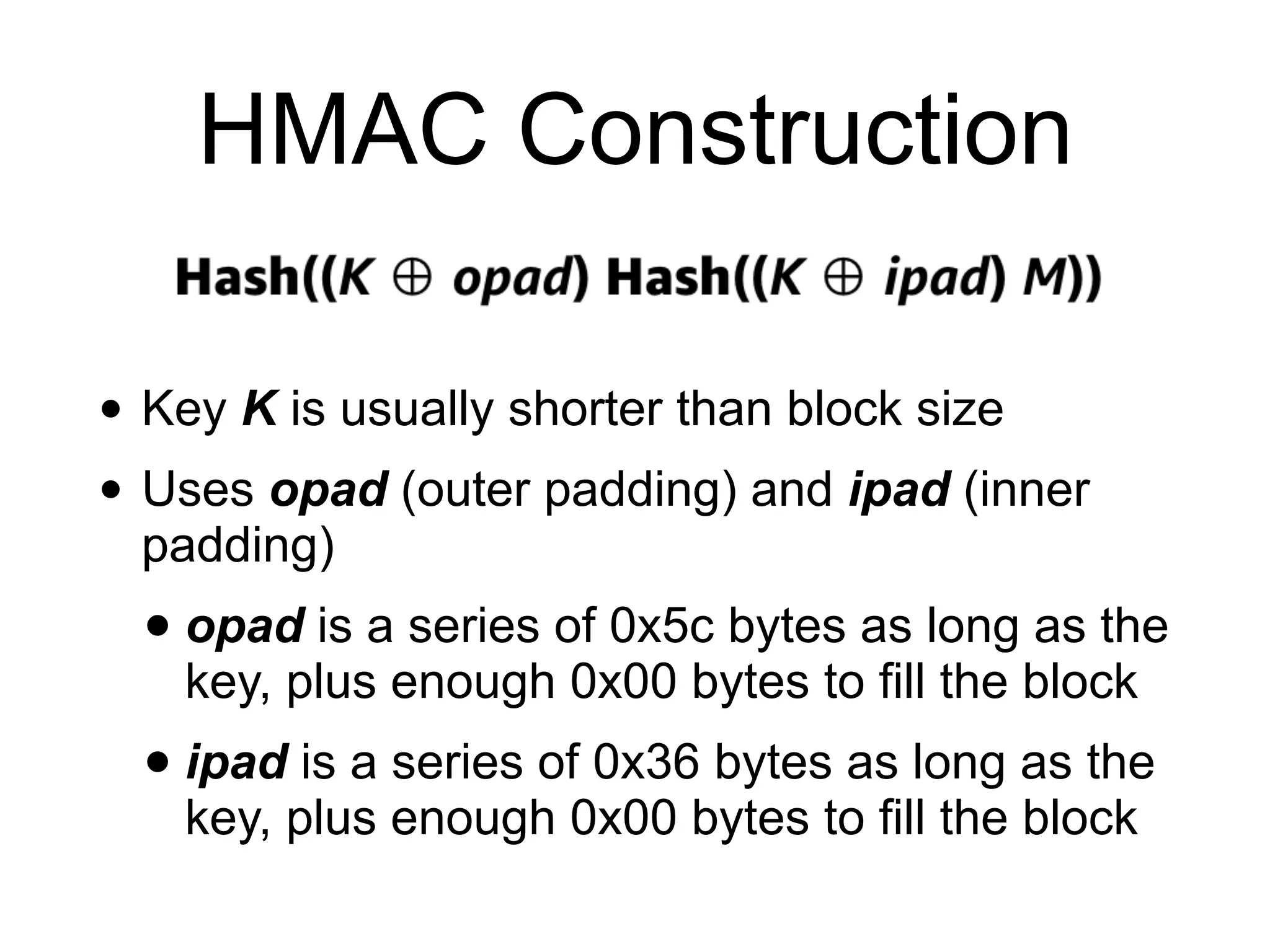
HMAC Construction
• Key K is usually shorter than block size
• Uses opad (outer padding) and ipad (inner
padding)
• opad is a series of 0x5c bytes as long as the
key, plus enough 0x00 bytes to fill the block
• ipad is a series of 0x36 bytes as long as the
key, plus enough 0x00 bytes to fill the block
Specifying Hash Function
• Must specify, as in HMAC-SHA256
A Generic Attack Against
Hash-Based MACs
• Can forge a HMAC tag from a hash collision
• Requires 2n/2 calculations
• n is length of digest
• Doesn't depend on a hash length extension
attack
• Works on all MACs based on an iterated hash
function
A Generic Attack Against
Hash-Based MACs
• Infeasible for n larger than 128 bits
Creating Keyed Hashes
from Block Ciphers: CMAC
CMAC and Block Ciphers
• The compression function in many hash
functions is built on a block cipher
• Ex: HMAC-SHA-256
• CMAC uses only a block cipher
• Less popular than HMAC
• Used in IKE (part of IPSec)
CBC-MAC
• CMAC was designed in 2005
• As an improved version of CBC-MAC
• CBC-MAC:
• Encrypt M with IV=0
• Discard all but the last ciphertext block
IV = 0
Breaking CBC-MAC
• Suppose attacker knows the tags T1 and T2
• For two single-block messages M1 and M2
M1
T1
IV = 0
M2
T2
IV = 0
Breaking CBC-MAC
• T2 is also the tag of this message:
• M1 || (M2 ^ T1)
• For two single-block messages M1 and M2
• Attacker can forge a message and tag
M1 M2 ^ T1
T1 T2
IV = 0
Fixing CBC-MAC
• Use key K to create K1 and K2
• Encrypt last block with a different key
K K K1
IV = 0
CBC-MAC
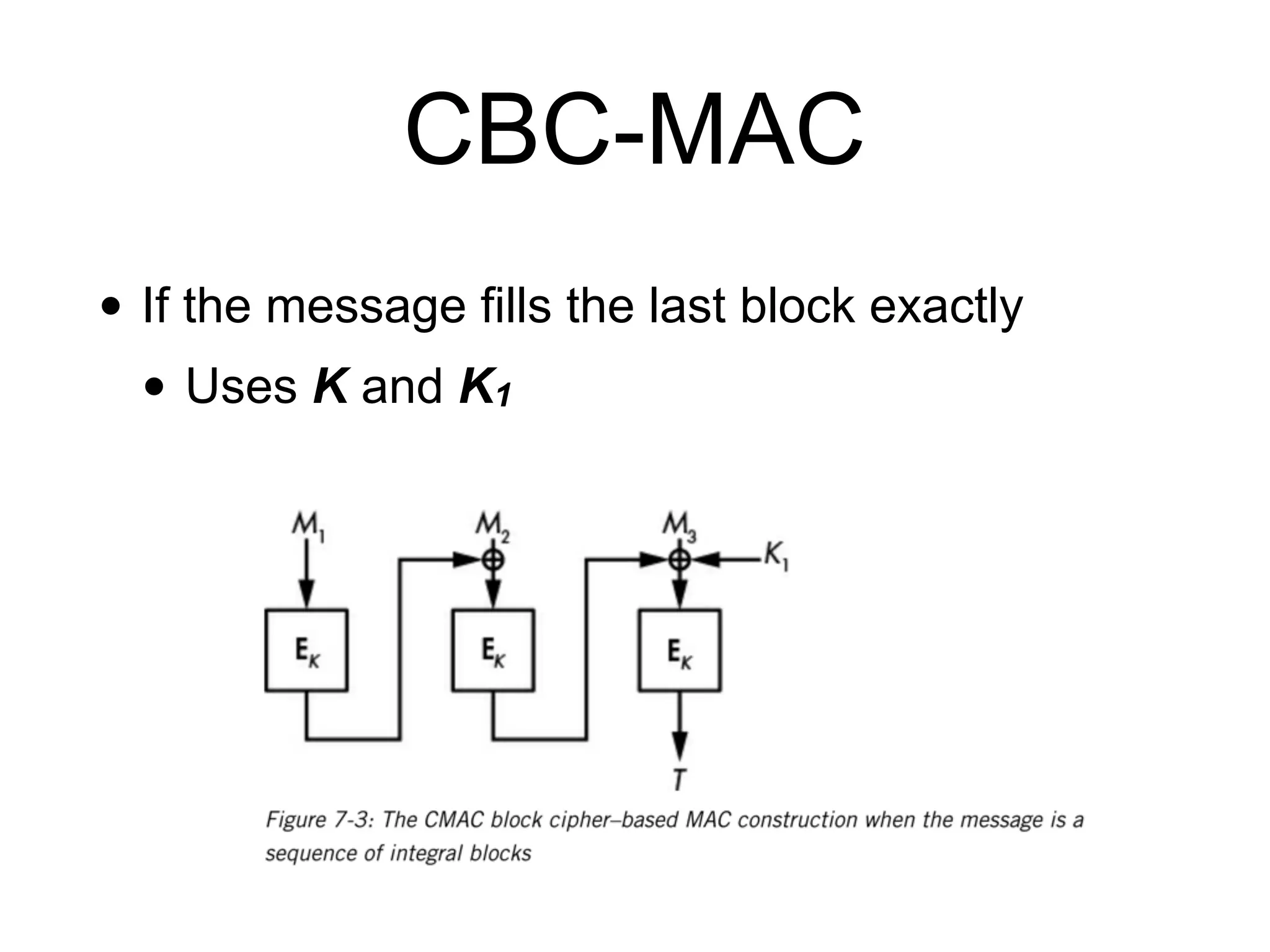
• If the message fills the last block exactly
• Uses K and K1
CBC-MAC
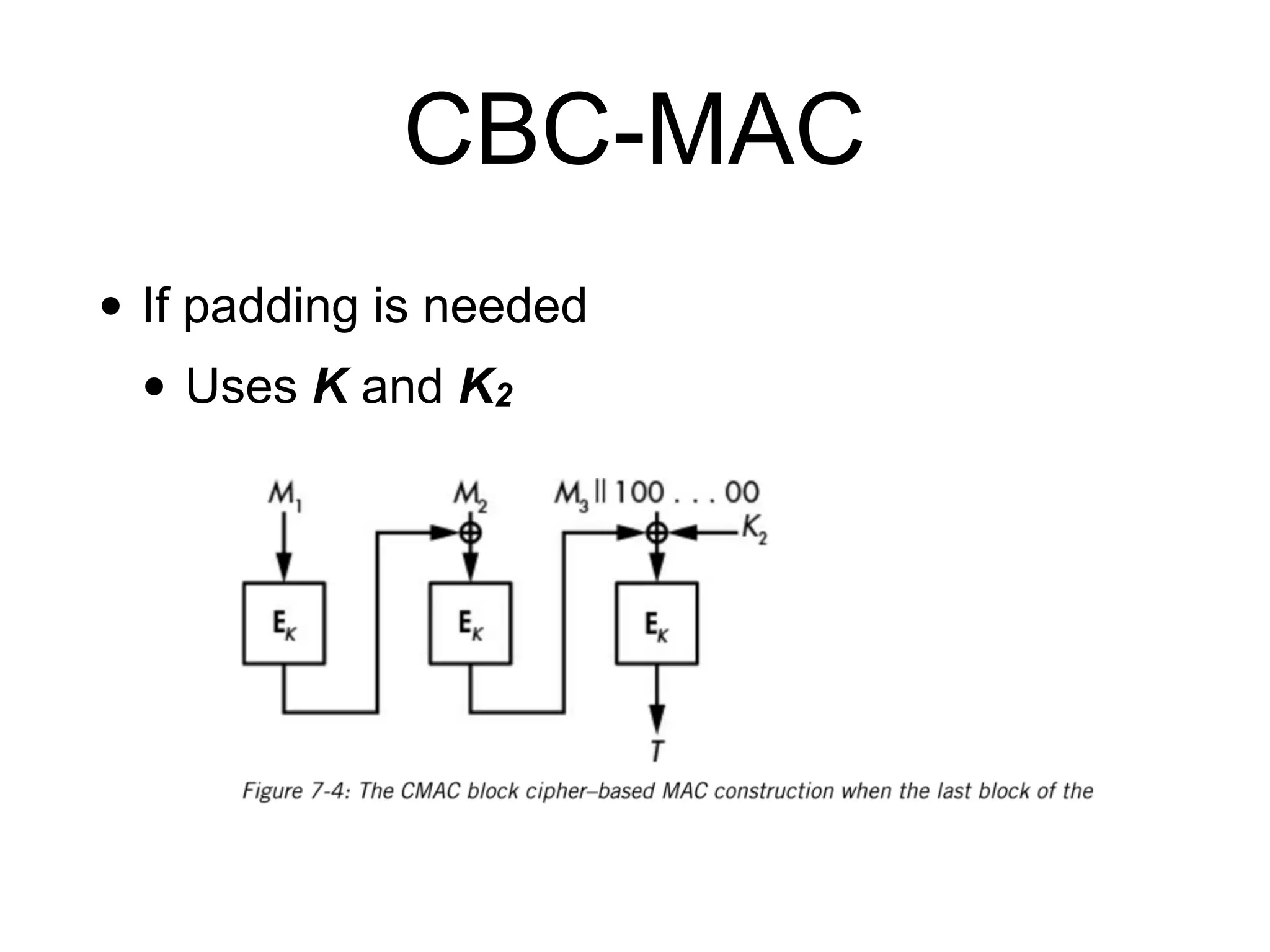
• If padding is needed
• Uses K and K2
Dedicated MAC Designs
Dedicated Design
• The preceding systems use hash functions
and block ciphers to build PRFs
• Convenient but inefficient
• Could be made faster by designing specifically
for MAC use case
Poly1305
• Designed in 2005
• Optimized to run fast on modern CPUs
• Used by Google for HTTPS and OpenSSH
Universal Hash Functions
• UHF is much weaker than a cryptographic
hash function
• But much faster
• Not collision-resistant
• Uses a secret key K
• UH(K, M)
• Only one security requirement
• For two messages M1 and M2
• Neglible probability that
• UH(K, M1) = UH(K, M2)
• For a random K
• Doesn't need to be pseudorandom
Universal Hash Functions
• Weakness:
• K can only be used once
• Otherwise an attacker can solve two equations
like this and gain information about the key
Universal Hash Functions
Wegman-Carter MACs
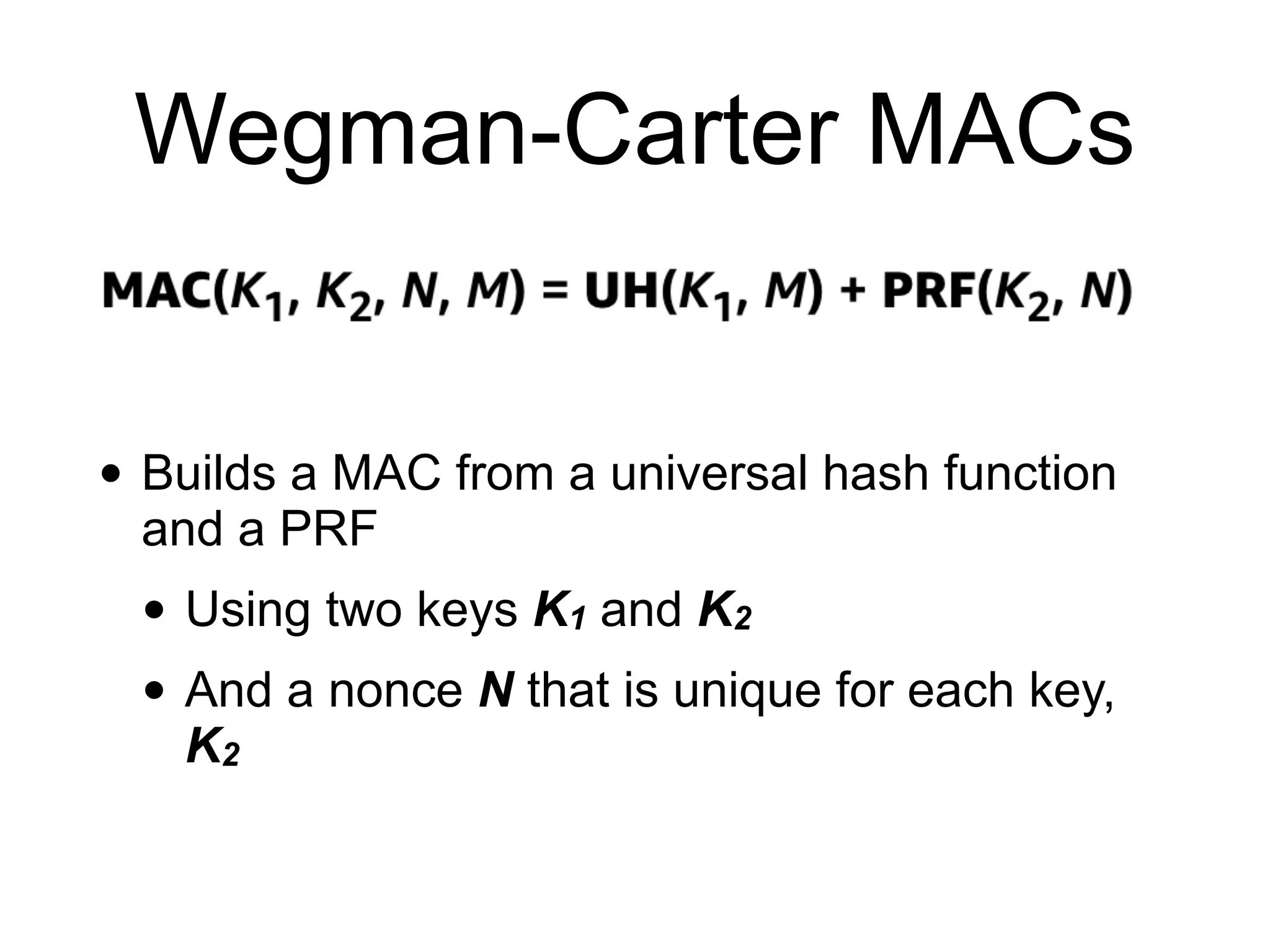
• Builds a MAC from a universal hash function
and a PRF
• Using two keys K1 and K2
• And a nonce N that is unique for each key,
K2
• Secure if
Wegman-Carter MACs
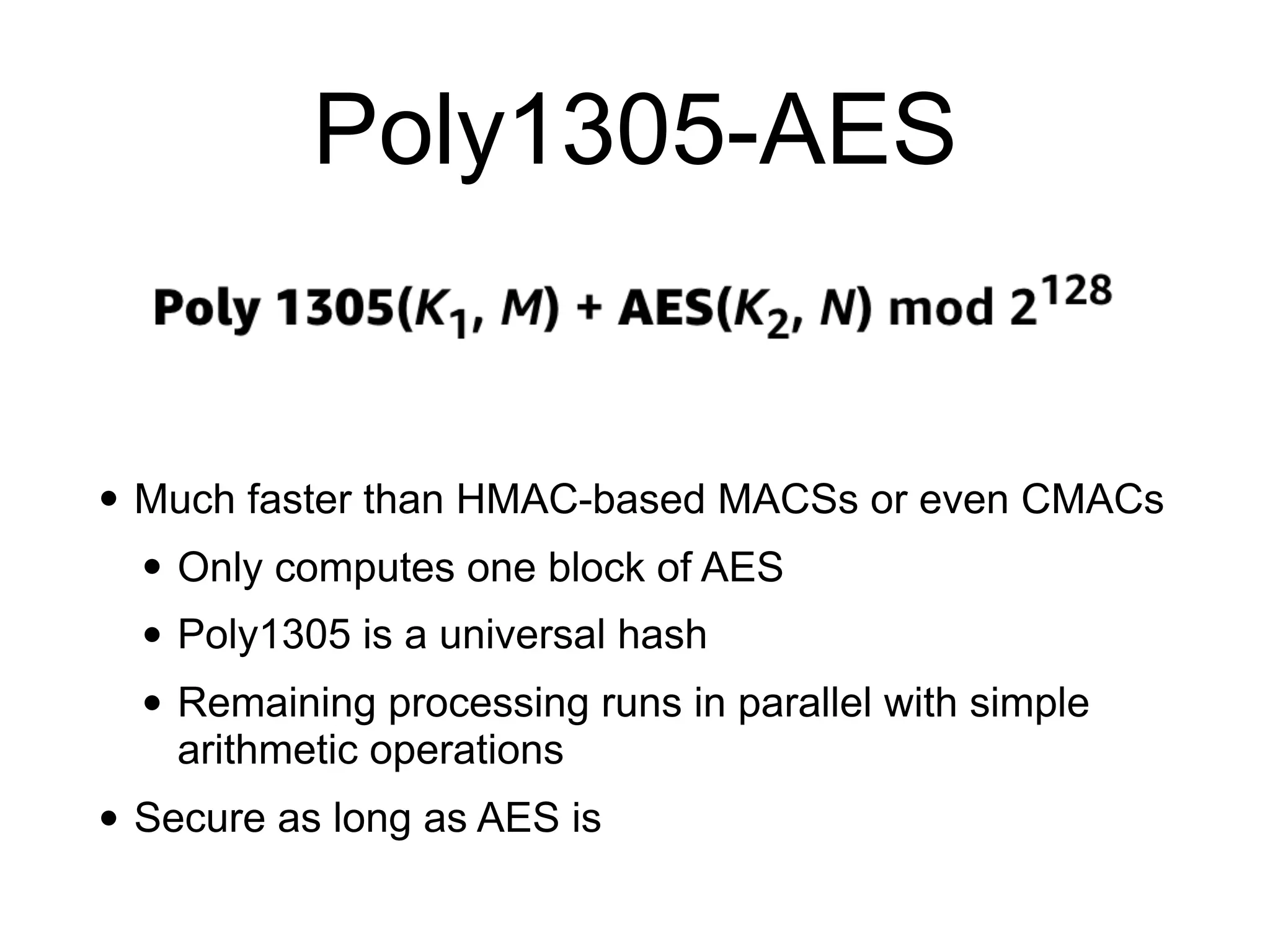
Poly1305-AES
• Much faster than HMAC-based MACSs or even CMACs
• Only computes one block of AES
• Poly1305 is a universal hash
• Remaining processing runs in parallel with simple
arithmetic operations
• Secure as long as AES is
SipHash
• Poly1305 is optimized for long messages
• Requires nonce, which must not be repeated
• For small messages, Poly1305 is overkill
• SipHash is best for short messages
• Less than 128 bytes
• Designed to resist DoS attacks on hash tables
• Uses XORs, additions, and word rotations
SipHash
How Things Can Go
Wrong
Timing Attacks on MAC
Verficiation
• Side-channel attacks
• Target the implementation
• Not the algorithm
• This code will return 

faster if the first byte 

is incorrect
• Solution: write 

constant-time code
When Sponges Leak
• If attacker gets the internal state
• Through a side-channel attack
• Permutation-based algorithms fail
• Allowing forgery
• Applies to SHA-3 and SipHash
• But not compression-function-based MACs
• Like HMAC-SHA-256 and BLAKE2
CNIT 141: 7. Keyed Hashing

CNIT 141: 7. Keyed Hashing

  • 1.
    CNIT 141 Cryptography forComputer Networks 7. Keyed Hashing
  • 2.
    Topics • Message AuthenticationCodes (MACs) • Pseudorandom Functions (PRFs) • Creating Keyed Hashes from Unkeyed Hashes • Creating Keyed Hashes from Block Ciphers: CMAC • Dedicated MAC Designs • How Things Can Go Wrong
  • 3.
    Keyed Hashing • Anyonecan calculate the SHA hash of a message • No secret value involved • Keyed hashing forms the basis for two algorithms • Message Authentication Code (MAC) • Pseudorandom Function (PRF)
  • 4.
  • 5.
    MACs • A MACprotects a message's integrity and authenticity with a tag T • T = MAC(K, M) • Verifying the MAC proves both that the message wasn't altered, and that it came from the sender holding the key
  • 6.
    MACs in Secure Communication •MACs are used in • IPSec, SSH, and TLS • 3G & 4G telephony encrypt packets but don't use a MAC • An attacker can modify the packets • Causing static on the line
  • 7.
    Forgery • Attacker shouldn'tbe able to create a tag without knowing the key • Such a M, T pair is called a forgery • A system is unforgeable if forgeries are impossible to find
  • 8.
    Chosen-Message Attacks • Anattacker can choose messages that get authenticated • The standard model to test MAC algoroithms
  • 9.
    Replay Attacks • MACsare not safe from replay attacks • To detect them, protocols include a message number in each message • A replayed message will have an out-of- order message number
  • 10.
  • 11.
    PRFs • Use asecret key to return PRF(K, M) • Output looks random • Key Derivation schemes use PDFs • To generate cryptographic keys from a master key or password • Identification schemes use PDFs • To generate a response from a random challenge
  • 12.
    Uses of PRFs •4G telephony uses PRFs • To authenticate a SIM card • To generate the encryption key and MAC used during a phone call • TLS uses a PRF • To generate key material from a master secret and a session-speciifc random value
  • 13.
    PRF Security • Hasno pattern, looks random • Indistinguishable from random bits • Fundamentally stronger than MACs • MACs are secure if they can't be forged • But may not appear random
  • 14.
  • 15.
    The Secret-Prefix Construction • Prependkey to the message, and return • Hash(K || M) • May be vulnerable to length-extension attacks • Calculating Hash(K || M1 || M2) from 
 Hash(K || M1) • SHA-1 & SHA-2 are vulnerable to this, but not SHA-3
  • 16.
    Insecurity with Different KeyLengths • No way to tell key from message • If K is 123abc and M is def00 • If K is 123a and M is bcdef00 • Result is Hash(123abcdef00) • To fix this, BLAKE2 and SHA-3 include a keyed mode • Another fix is to include the key's length in the hash: Hash(L || K || M)
  • 17.
    Secret-Suffix Construction • Tagis Hash(M || K) • Prevents length-extension attack • If you know Hash(M1 || K) • You can calculate Hash(M1 || K || M2) • But not Hash(M1 || M2 || K)
  • 18.
    Secret-Suffix Construction • Butif there's a hash collision • Hash(M1) = Hash(M2) • The tags can collide too • Hash(M1 || K) = Hash(M2 || K)
  • 19.
    HMAC Construction • Moresecure than secret prefix or secret suffix • Used by IPSec, SSH, and TLS • Specifed in NIST's FIPS 198-6 standard • And RFC 2104
  • 20.
    HMAC Construction • KeyK is usually shorter than block size • Uses opad (outer padding) and ipad (inner padding) • opad is a series of 0x5c bytes as long as the key, plus enough 0x00 bytes to fill the block • ipad is a series of 0x36 bytes as long as the key, plus enough 0x00 bytes to fill the block
  • 21.
    Specifying Hash Function •Must specify, as in HMAC-SHA256
  • 22.
    A Generic AttackAgainst Hash-Based MACs • Can forge a HMAC tag from a hash collision • Requires 2n/2 calculations • n is length of digest • Doesn't depend on a hash length extension attack • Works on all MACs based on an iterated hash function
  • 23.
    A Generic AttackAgainst Hash-Based MACs • Infeasible for n larger than 128 bits
  • 25.
    Creating Keyed Hashes fromBlock Ciphers: CMAC
  • 26.
    CMAC and BlockCiphers • The compression function in many hash functions is built on a block cipher • Ex: HMAC-SHA-256 • CMAC uses only a block cipher • Less popular than HMAC • Used in IKE (part of IPSec)
  • 27.
    CBC-MAC • CMAC wasdesigned in 2005 • As an improved version of CBC-MAC • CBC-MAC: • Encrypt M with IV=0 • Discard all but the last ciphertext block IV = 0
  • 28.
    Breaking CBC-MAC • Supposeattacker knows the tags T1 and T2 • For two single-block messages M1 and M2 M1 T1 IV = 0 M2 T2 IV = 0
  • 29.
    Breaking CBC-MAC • T2is also the tag of this message: • M1 || (M2 ^ T1) • For two single-block messages M1 and M2 • Attacker can forge a message and tag M1 M2 ^ T1 T1 T2 IV = 0
  • 30.
    Fixing CBC-MAC • Usekey K to create K1 and K2 • Encrypt last block with a different key K K K1 IV = 0
  • 31.
    CBC-MAC • If themessage fills the last block exactly • Uses K and K1
  • 32.
    CBC-MAC • If paddingis needed • Uses K and K2
  • 33.
  • 34.
    Dedicated Design • Thepreceding systems use hash functions and block ciphers to build PRFs • Convenient but inefficient • Could be made faster by designing specifically for MAC use case
  • 35.
    Poly1305 • Designed in2005 • Optimized to run fast on modern CPUs • Used by Google for HTTPS and OpenSSH
  • 36.
    Universal Hash Functions •UHF is much weaker than a cryptographic hash function • But much faster • Not collision-resistant • Uses a secret key K • UH(K, M)
  • 37.
    • Only onesecurity requirement • For two messages M1 and M2 • Neglible probability that • UH(K, M1) = UH(K, M2) • For a random K • Doesn't need to be pseudorandom Universal Hash Functions
  • 38.
    • Weakness: • Kcan only be used once • Otherwise an attacker can solve two equations like this and gain information about the key Universal Hash Functions
  • 39.
    Wegman-Carter MACs • Buildsa MAC from a universal hash function and a PRF • Using two keys K1 and K2 • And a nonce N that is unique for each key, K2
  • 40.
  • 41.
    Poly1305-AES • Much fasterthan HMAC-based MACSs or even CMACs • Only computes one block of AES • Poly1305 is a universal hash • Remaining processing runs in parallel with simple arithmetic operations • Secure as long as AES is
  • 42.
    SipHash • Poly1305 isoptimized for long messages • Requires nonce, which must not be repeated • For small messages, Poly1305 is overkill • SipHash is best for short messages • Less than 128 bytes
  • 43.
    • Designed toresist DoS attacks on hash tables • Uses XORs, additions, and word rotations SipHash
  • 44.
  • 45.
    Timing Attacks onMAC Verficiation • Side-channel attacks • Target the implementation • Not the algorithm • This code will return 
 faster if the first byte 
 is incorrect • Solution: write 
 constant-time code
  • 46.
    When Sponges Leak •If attacker gets the internal state • Through a side-channel attack • Permutation-based algorithms fail • Allowing forgery • Applies to SHA-3 and SipHash • But not compression-function-based MACs • Like HMAC-SHA-256 and BLAKE2