• CNC Milling
• Repurposing/Recycling
@omega.teched
@omega_teched
Prototyping The
Physical Design
CNC Milling
OMega TechEd
• CNC (Computer Numerical Control)
milling is a manufacturing process in
which a computer controls the movement
of a cutting tool (typically a rotary cutter)
to precisely remove material from a
workpiece.
• This method is widely used to create
complex shapes and features with high
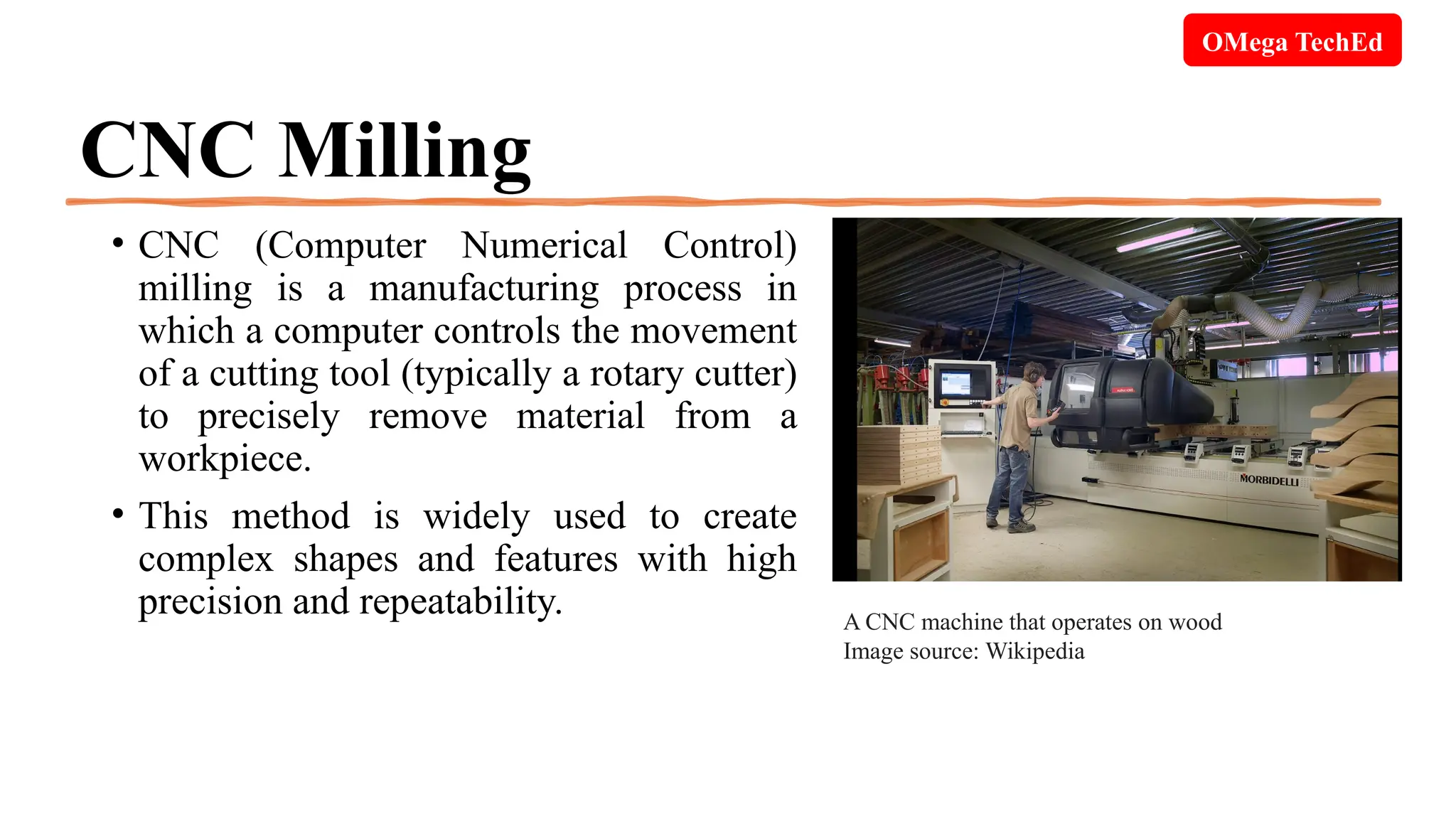
precision and repeatability. A CNC machine that operates on wood
Image source: Wikipedia
CNC Milling
• Subtractive Manufacturing: CNC milling removes
material from a solid block to create parts, unlike 3D
printing, which adds material layer by layer.
• Computer-Controlled Precision: A computer directs
the cutting tool to follow exact paths, creating highly
detailed and precise parts.
• Wide Material Range: CNC milling can work with
metals, plastics, wood, and more, allowing greater
material flexibility compared to 3D printing.
OMega TechEd
Continue…
• Specialized Applications: It’s commonly used for tasks like creating
custom printed circuit boards (PCBs), as it can carve conductive paths and
drill holes simultaneously.
• Machine Size Variety: CNC mills come in different sizes, from compact
desktop models to large industrial machines.
• Efficiency: CNC mills can perform multiple operations in a single setup,
reducing the need for additional manual work.
• In CNC milling, the number of axes refers to the directions in which the
cutting tool and the workpiece can move or rotate, which increases the
machine's versatility and the complexity of parts it can create.
OMega TechEd
Continue…
• 2.5-Axis CNC Mill: Axes: X, Y, and Z.
• Movement: The machine can move in all three directions but can only
move two axes simultaneously.
• 3-Axis CNC Mill: Axes: X, Y, and Z.
• Movement: Can move all three axes at the same time.
• 4-Axis CNC Mill: Axes: X, Y, Z, and an additional rotary axis (often called
the A axis).
• Movement: Adds a rotational axis around the X-axis, enabling the
workpiece to rotate.
OMega TechEd
Continue…
• 5-Axis CNC Mill: Axes: X, Y, Z, A (rotary around X), and B (rotary around Y).
Movement: Enables both the workpiece and the cutting tool to move in five
directions.
• 6-Axis CNC Mill: Axes: X, Y, Z, A (rotary around X), B (rotary around Y), and
C (rotary around Z).
• Movement: Includes a third rotary axis, usually allowing the tool or workpiece
to rotate around the Z-axis.
Each additional axis increases the machine’s capability, enabling it to handle more
complex shapes and reducing the need for manual repositioning of the workpiece.
OMega TechEd
Software
In CNC milling, two main types of software are essential for the workflow:
• CAD Software: Used to design the 3D model of the part.
• CAM Software: Converts the model into a toolpath (G-code) that directs
the CNC machine on how to cut the material.
• These work together to turn digital designs into physical parts.
OMega TechEd
Repurposing/Recycling
• Repurposing is the process of taking an item or material and using it for a
new purpose, different from its original intended function. For example,
using an old smartphone as a security camera or reprogramming a
previously used microcontroller for a new IoT project.
• Recycling is the process of converting waste materials back into raw
materials that can be used to create new products. For example, breaking
down outdated or non-functional IoT devices and reclaiming parts like
sensors, batteries, and circuit boards.
Both practices aim to extend the life cycle of materials, reduce waste, and
conserve resources, but repurposing keeps items in their existing form with a
new function, while recycling breaks them down to create something entirely
new.
OMega TechEd
Repurposing/Recycling
When building a connected device, you can choose between creating
everything from scratch or reusing existing components.
Reasons to Reuse Components:
Cost Savings
Design Efficiency
Flexibility with Existing Designs
Reusing components can save time, reduce costs, and simplify complex
projects.
OMega TechEd
Thank You!
@omega.teched
LIKE,SHARE & SUBSCRIBE
@omega_teched

CNC Milling, Software, Repurposing and Recycling.

  • 1.
    • CNC Milling •Repurposing/Recycling @omega.teched @omega_teched Prototyping The Physical Design
  • 2.
    CNC Milling OMega TechEd •CNC (Computer Numerical Control) milling is a manufacturing process in which a computer controls the movement of a cutting tool (typically a rotary cutter) to precisely remove material from a workpiece. • This method is widely used to create complex shapes and features with high precision and repeatability. A CNC machine that operates on wood Image source: Wikipedia
  • 3.
    CNC Milling • SubtractiveManufacturing: CNC milling removes material from a solid block to create parts, unlike 3D printing, which adds material layer by layer. • Computer-Controlled Precision: A computer directs the cutting tool to follow exact paths, creating highly detailed and precise parts. • Wide Material Range: CNC milling can work with metals, plastics, wood, and more, allowing greater material flexibility compared to 3D printing. OMega TechEd
  • 4.
    Continue… • Specialized Applications:It’s commonly used for tasks like creating custom printed circuit boards (PCBs), as it can carve conductive paths and drill holes simultaneously. • Machine Size Variety: CNC mills come in different sizes, from compact desktop models to large industrial machines. • Efficiency: CNC mills can perform multiple operations in a single setup, reducing the need for additional manual work. • In CNC milling, the number of axes refers to the directions in which the cutting tool and the workpiece can move or rotate, which increases the machine's versatility and the complexity of parts it can create. OMega TechEd
  • 5.
    Continue… • 2.5-Axis CNCMill: Axes: X, Y, and Z. • Movement: The machine can move in all three directions but can only move two axes simultaneously. • 3-Axis CNC Mill: Axes: X, Y, and Z. • Movement: Can move all three axes at the same time. • 4-Axis CNC Mill: Axes: X, Y, Z, and an additional rotary axis (often called the A axis). • Movement: Adds a rotational axis around the X-axis, enabling the workpiece to rotate. OMega TechEd
  • 6.
    Continue… • 5-Axis CNCMill: Axes: X, Y, Z, A (rotary around X), and B (rotary around Y). Movement: Enables both the workpiece and the cutting tool to move in five directions. • 6-Axis CNC Mill: Axes: X, Y, Z, A (rotary around X), B (rotary around Y), and C (rotary around Z). • Movement: Includes a third rotary axis, usually allowing the tool or workpiece to rotate around the Z-axis. Each additional axis increases the machine’s capability, enabling it to handle more complex shapes and reducing the need for manual repositioning of the workpiece. OMega TechEd
  • 7.
    Software In CNC milling,two main types of software are essential for the workflow: • CAD Software: Used to design the 3D model of the part. • CAM Software: Converts the model into a toolpath (G-code) that directs the CNC machine on how to cut the material. • These work together to turn digital designs into physical parts. OMega TechEd
  • 8.
    Repurposing/Recycling • Repurposing isthe process of taking an item or material and using it for a new purpose, different from its original intended function. For example, using an old smartphone as a security camera or reprogramming a previously used microcontroller for a new IoT project. • Recycling is the process of converting waste materials back into raw materials that can be used to create new products. For example, breaking down outdated or non-functional IoT devices and reclaiming parts like sensors, batteries, and circuit boards. Both practices aim to extend the life cycle of materials, reduce waste, and conserve resources, but repurposing keeps items in their existing form with a new function, while recycling breaks them down to create something entirely new. OMega TechEd
  • 9.
    Repurposing/Recycling When building aconnected device, you can choose between creating everything from scratch or reusing existing components. Reasons to Reuse Components: Cost Savings Design Efficiency Flexibility with Existing Designs Reusing components can save time, reduce costs, and simplify complex projects. OMega TechEd
  • 10.