• Sketch, Iterate and Explore
• Nondigital Methods
@omega.teched
@omega_teched
Prototyping The
Physical Design
Sketch, Iterate and Explore
1.Focus on Speed: Prioritize quick iterations over
perfecting the prototype early on.
2.Use Simple Tools: Start with pen, paper, or basic
sketches for fast idea generation.
3.Experiment with Dimensions: Test different sizes and
forms to refine the design.
4.Get User Feedback: Involve users to see how they
interact with the design.
5.Learn and Iterate: Use feedback and testing to
improve the design with each iteration.
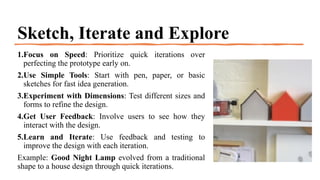
Example: Good Night Lamp evolved from a traditional
shape to a house design through quick iterations.
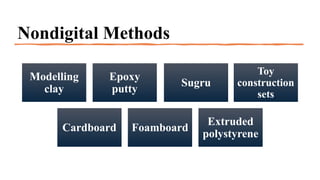
Nondigital Methods
Modelling
clay
Epoxy
putty
Sugru
Toy
construction
sets
Cardboard Foamboard
Extruded
polystyrene
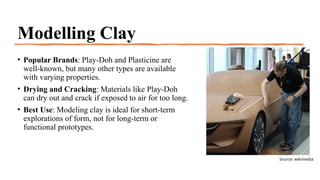
Modelling Clay
• Popular Brands: Play-Doh and Plasticine are
well-known, but many other types are available
with varying properties.
• Drying and Cracking: Materials like Play-Doh
can dry out and crack if exposed to air for too long.
• Best Use: Modeling clay is ideal for short-term
explorations of form, not for long-term or
functional prototypes.
Source: wikimedia
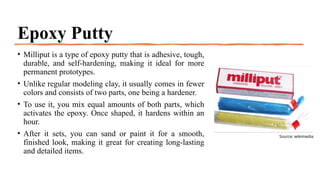
Epoxy Putty
• Milliput is a type of epoxy putty that is adhesive, tough,
durable, and self-hardening, making it ideal for more
permanent prototypes.
• Unlike regular modeling clay, it usually comes in fewer
colors and consists of two parts, one being a hardener.
• To use it, you mix equal amounts of both parts, which
activates the epoxy. Once shaped, it hardens within an
hour.
• After it sets, you can sand or paint it for a smooth,
finished look, making it great for creating long-lasting
and detailed items.
Source: wikimedia
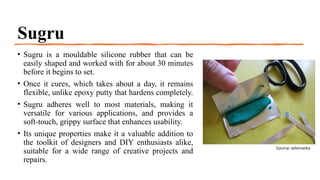
Sugru
• Sugru is a mouldable silicone rubber that can be
easily shaped and worked with for about 30 minutes
before it begins to set.
• Once it cures, which takes about a day, it remains
flexible, unlike epoxy putty that hardens completely.
• Sugru adheres well to most materials, making it
versatile for various applications, and provides a
soft-touch, grippy surface that enhances usability.
• Its unique properties make it a valuable addition to
the toolkit of designers and DIY enthusiasts alike,
suitable for a wide range of creative projects and
repairs.
Source: wikimedia
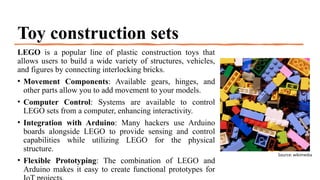
Toy construction sets
LEGO is a popular line of plastic construction toys that
allows users to build a wide variety of structures, vehicles,
and figures by connecting interlocking bricks.
• Movement Components: Available gears, hinges, and
other parts allow you to add movement to your models.
• Computer Control: Systems are available to control
LEGO sets from a computer, enhancing interactivity.
• Integration with Arduino: Many hackers use Arduino
boards alongside LEGO to provide sensing and control
capabilities while utilizing LEGO for the physical
structure.
• Flexible Prototyping: The combination of LEGO and
Arduino makes it easy to create functional prototypes for
Source: wikimedia
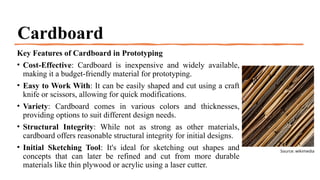
Cardboard
Key Features of Cardboard in Prototyping
• Cost-Effective: Cardboard is inexpensive and widely available,
making it a budget-friendly material for prototyping.
• Easy to Work With: It can be easily shaped and cut using a craft
knife or scissors, allowing for quick modifications.
• Variety: Cardboard comes in various colors and thicknesses,
providing options to suit different design needs.
• Structural Integrity: While not as strong as other materials,
cardboard offers reasonable structural integrity for initial designs.
• Initial Sketching Tool: It's ideal for sketching out shapes and
concepts that can later be refined and cut from more durable
materials like thin plywood or acrylic using a laser cutter.
Source: wikimedia
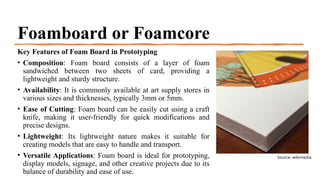
Foamboard or Foamcore
Key Features of Foam Board in Prototyping
• Composition: Foam board consists of a layer of foam
sandwiched between two sheets of card, providing a
lightweight and sturdy structure.
• Availability: It is commonly available at art supply stores in
various sizes and thicknesses, typically 3mm or 5mm.
• Ease of Cutting: Foam board can be easily cut using a craft
knife, making it user-friendly for quick modifications and
precise designs.
• Lightweight: Its lightweight nature makes it suitable for
creating models that are easy to handle and transport.
• Versatile Applications: Foam board is ideal for prototyping,
display models, signage, and other creative projects due to its
balance of durability and ease of use.
Source: wikimedia
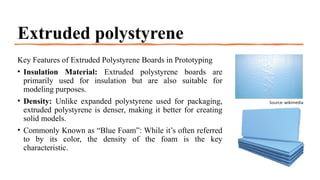
Extruded polystyrene
Key Features of Extruded Polystyrene Boards in Prototyping
• Insulation Material: Extruded polystyrene boards are
primarily used for insulation but are also suitable for
modeling purposes.
• Density: Unlike expanded polystyrene used for packaging,
extruded polystyrene is denser, making it better for creating
solid models.
• Commonly Known as “Blue Foam”: While it’s often referred
to by its color, the density of the foam is the key
characteristic.
Source: wikimedia
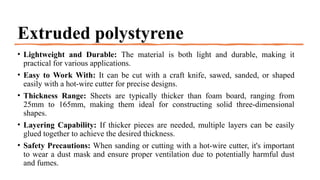
Extruded polystyrene
• Lightweight and Durable: The material is both light and durable, making it
practical for various applications.
• Easy to Work With: It can be cut with a craft knife, sawed, sanded, or shaped
easily with a hot-wire cutter for precise designs.
• Thickness Range: Sheets are typically thicker than foam board, ranging from
25mm to 165mm, making them ideal for constructing solid three-dimensional
shapes.
• Layering Capability: If thicker pieces are needed, multiple layers can be easily
glued together to achieve the desired thickness.
• Safety Precautions: When sanding or cutting with a hot-wire cutter, it's important
to wear a dust mask and ensure proper ventilation due to potentially harmful dust
and fumes.
Thank You!
@omega.teched
LIKE,SHARE & SUBSCRIBE
@omega_teched

Sketch, Iterate and Explore, Nondigital Methods.

  • 1.
    • Sketch, Iterateand Explore • Nondigital Methods @omega.teched @omega_teched Prototyping The Physical Design
  • 2.
    Sketch, Iterate andExplore 1.Focus on Speed: Prioritize quick iterations over perfecting the prototype early on. 2.Use Simple Tools: Start with pen, paper, or basic sketches for fast idea generation. 3.Experiment with Dimensions: Test different sizes and forms to refine the design. 4.Get User Feedback: Involve users to see how they interact with the design. 5.Learn and Iterate: Use feedback and testing to improve the design with each iteration. Example: Good Night Lamp evolved from a traditional shape to a house design through quick iterations.
  • 3.
  • 4.
    Modelling Clay • PopularBrands: Play-Doh and Plasticine are well-known, but many other types are available with varying properties. • Drying and Cracking: Materials like Play-Doh can dry out and crack if exposed to air for too long. • Best Use: Modeling clay is ideal for short-term explorations of form, not for long-term or functional prototypes. Source: wikimedia
  • 5.
    Epoxy Putty • Milliputis a type of epoxy putty that is adhesive, tough, durable, and self-hardening, making it ideal for more permanent prototypes. • Unlike regular modeling clay, it usually comes in fewer colors and consists of two parts, one being a hardener. • To use it, you mix equal amounts of both parts, which activates the epoxy. Once shaped, it hardens within an hour. • After it sets, you can sand or paint it for a smooth, finished look, making it great for creating long-lasting and detailed items. Source: wikimedia
  • 6.
    Sugru • Sugru isa mouldable silicone rubber that can be easily shaped and worked with for about 30 minutes before it begins to set. • Once it cures, which takes about a day, it remains flexible, unlike epoxy putty that hardens completely. • Sugru adheres well to most materials, making it versatile for various applications, and provides a soft-touch, grippy surface that enhances usability. • Its unique properties make it a valuable addition to the toolkit of designers and DIY enthusiasts alike, suitable for a wide range of creative projects and repairs. Source: wikimedia
  • 7.
    Toy construction sets LEGOis a popular line of plastic construction toys that allows users to build a wide variety of structures, vehicles, and figures by connecting interlocking bricks. • Movement Components: Available gears, hinges, and other parts allow you to add movement to your models. • Computer Control: Systems are available to control LEGO sets from a computer, enhancing interactivity. • Integration with Arduino: Many hackers use Arduino boards alongside LEGO to provide sensing and control capabilities while utilizing LEGO for the physical structure. • Flexible Prototyping: The combination of LEGO and Arduino makes it easy to create functional prototypes for Source: wikimedia
  • 8.
    Cardboard Key Features ofCardboard in Prototyping • Cost-Effective: Cardboard is inexpensive and widely available, making it a budget-friendly material for prototyping. • Easy to Work With: It can be easily shaped and cut using a craft knife or scissors, allowing for quick modifications. • Variety: Cardboard comes in various colors and thicknesses, providing options to suit different design needs. • Structural Integrity: While not as strong as other materials, cardboard offers reasonable structural integrity for initial designs. • Initial Sketching Tool: It's ideal for sketching out shapes and concepts that can later be refined and cut from more durable materials like thin plywood or acrylic using a laser cutter. Source: wikimedia
  • 9.
    Foamboard or Foamcore KeyFeatures of Foam Board in Prototyping • Composition: Foam board consists of a layer of foam sandwiched between two sheets of card, providing a lightweight and sturdy structure. • Availability: It is commonly available at art supply stores in various sizes and thicknesses, typically 3mm or 5mm. • Ease of Cutting: Foam board can be easily cut using a craft knife, making it user-friendly for quick modifications and precise designs. • Lightweight: Its lightweight nature makes it suitable for creating models that are easy to handle and transport. • Versatile Applications: Foam board is ideal for prototyping, display models, signage, and other creative projects due to its balance of durability and ease of use. Source: wikimedia
  • 10.
    Extruded polystyrene Key Featuresof Extruded Polystyrene Boards in Prototyping • Insulation Material: Extruded polystyrene boards are primarily used for insulation but are also suitable for modeling purposes. • Density: Unlike expanded polystyrene used for packaging, extruded polystyrene is denser, making it better for creating solid models. • Commonly Known as “Blue Foam”: While it’s often referred to by its color, the density of the foam is the key characteristic. Source: wikimedia
  • 11.
    Extruded polystyrene • Lightweightand Durable: The material is both light and durable, making it practical for various applications. • Easy to Work With: It can be cut with a craft knife, sawed, sanded, or shaped easily with a hot-wire cutter for precise designs. • Thickness Range: Sheets are typically thicker than foam board, ranging from 25mm to 165mm, making them ideal for constructing solid three-dimensional shapes. • Layering Capability: If thicker pieces are needed, multiple layers can be easily glued together to achieve the desired thickness. • Safety Precautions: When sanding or cutting with a hot-wire cutter, it's important to wear a dust mask and ensure proper ventilation due to potentially harmful dust and fumes.
  • 12.