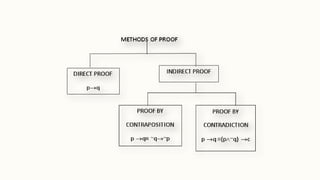
DIRECT PROOF
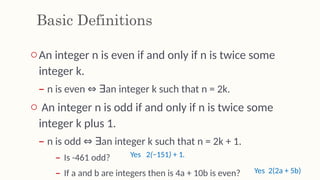
Basic Definitions
oAn integer n is even if and only if n is twice some
integer k.
– n is even an integer k such that n = 2k.
⇔ ∃
o An integer n is odd if and only if n is twice some
integer k plus 1.
– n is odd an integer k such that n = 2k + 1.
⇔ ∃
– Is -461 odd?
– If a and b are integers then is 4a + 10b is even? Yes 2(2a + 5b)
Yes 2(−151) + 1.
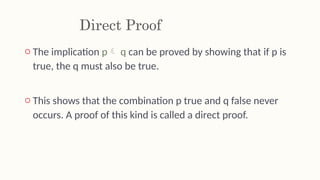
Direct Proof
o The implication p q can be proved by showing that if p is
true, the q must also be true.
o This shows that the combination p true and q false never
occurs. A proof of this kind is called a direct proof.
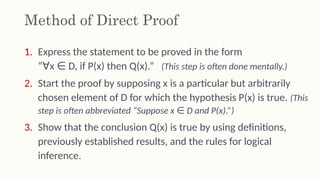
Method of Direct Proof
1. Express the statement to be proved in the form
“ x D, if P(x) then Q(x).”
∀ ∈ (This step is often done mentally.)
2. Start the proof by supposing x is a particular but arbitrarily
chosen element of D for which the hypothesis P(x) is true. (This
step is often abbreviated “Suppose x D and P(x).”)
∈
3. Show that the conclusion Q(x) is true by using definitions,
previously established results, and the rules for logical
inference.
A Direct Proof of a Theorem
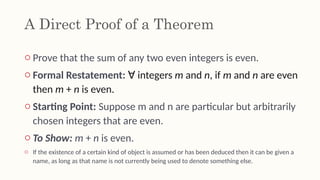
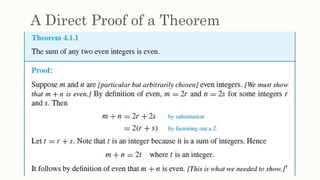
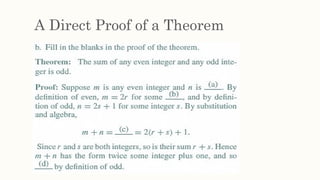
o Prove that the sum of any two even integers is even.
o Formal Restatement: integers
∀ m and n, if m and n are even
then m + n is even.
o Starting Point: Suppose m and n are particular but arbitrarily
chosen integers that are even.
o To Show: m + n is even.
o If the existence of a certain kind of object is assumed or has been deduced then it can be given a
name, as long as that name is not currently being used to denote something else.
A Direct Proof of a Theorem
Direct Proof and Counterexample
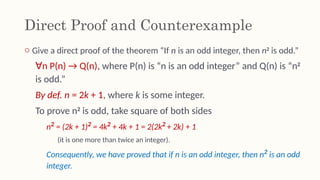
o Give a direct proof of the theorem “If n is an odd integer, then n2
is odd.”
∀n P(n) → Q(n), where P(n) is “n is an odd integer” and Q(n) is “n2
is odd.”
By def. n = 2k + 1, where k is some integer.
To prove n2
is odd, take square of both sides
n2
= (2k + 1)2
= 4k2
+ 4k + 1 = 2(2k2
+ 2k) + 1
(it is one more than twice an integer).
Consequently, we have proved that if n is an odd integer, then n2
is an odd
integer.
A Direct Proof of a Theorem
Direct Proof and Counterexample
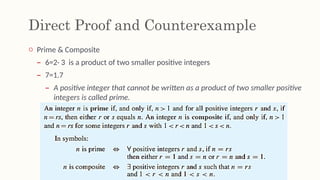
o Prime & Composite
– 6=2· 3 is a product of two smaller positive integers
– 7=1.7
– A positive integer that cannot be written as a product of two smaller positive
integers is called prime.

report in Discrete structure for college.pptx

  • 1.
  • 3.
    Basic Definitions oAn integern is even if and only if n is twice some integer k. – n is even an integer k such that n = 2k. ⇔ ∃ o An integer n is odd if and only if n is twice some integer k plus 1. – n is odd an integer k such that n = 2k + 1. ⇔ ∃ – Is -461 odd? – If a and b are integers then is 4a + 10b is even? Yes 2(2a + 5b) Yes 2(−151) + 1.
  • 4.
    Direct Proof o Theimplication p q can be proved by showing that if p is true, the q must also be true. o This shows that the combination p true and q false never occurs. A proof of this kind is called a direct proof.
  • 5.
    Method of DirectProof 1. Express the statement to be proved in the form “ x D, if P(x) then Q(x).” ∀ ∈ (This step is often done mentally.) 2. Start the proof by supposing x is a particular but arbitrarily chosen element of D for which the hypothesis P(x) is true. (This step is often abbreviated “Suppose x D and P(x).”) ∈ 3. Show that the conclusion Q(x) is true by using definitions, previously established results, and the rules for logical inference.
  • 6.
    A Direct Proofof a Theorem o Prove that the sum of any two even integers is even. o Formal Restatement: integers ∀ m and n, if m and n are even then m + n is even. o Starting Point: Suppose m and n are particular but arbitrarily chosen integers that are even. o To Show: m + n is even. o If the existence of a certain kind of object is assumed or has been deduced then it can be given a name, as long as that name is not currently being used to denote something else.
  • 7.
    A Direct Proofof a Theorem
  • 8.
    Direct Proof andCounterexample o Give a direct proof of the theorem “If n is an odd integer, then n2 is odd.” ∀n P(n) → Q(n), where P(n) is “n is an odd integer” and Q(n) is “n2 is odd.” By def. n = 2k + 1, where k is some integer. To prove n2 is odd, take square of both sides n2 = (2k + 1)2 = 4k2 + 4k + 1 = 2(2k2 + 2k) + 1 (it is one more than twice an integer). Consequently, we have proved that if n is an odd integer, then n2 is an odd integer.
  • 9.
    A Direct Proofof a Theorem
  • 10.
    Direct Proof andCounterexample o Prime & Composite – 6=2· 3 is a product of two smaller positive integers – 7=1.7 – A positive integer that cannot be written as a product of two smaller positive integers is called prime.