Chronic Leukemia By Dr.Abdulrazzak
Alagbary 2009-2010
Developed by Dr. Abdulrazzaq Alagbare - Lecturer of hematology
Chronic Myeloid Leukemia
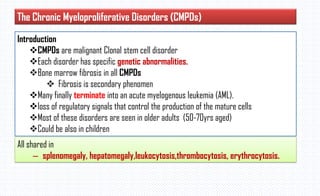
The Chronic Myeloproliferative Disorders (CMPDs)
Introduction
CMPDs are malignant Clonal stem cell disorder
Each disorder has specific genetic abnormalities.
Bone marrow fibrosis in all CMPDs
 Fibrosis is secondary phenomen
Many finally terminate into an acute myelogenous leukemia (AML).
loss of regulatory signals that control the production of the mature cells
Most of these disorders are seen in older adults (50-70yrs aged)
Could be also in children
All shared in
– splenomegaly, hepatomegaly,leukocytosis,thrombocytosis, erythrocytosis.
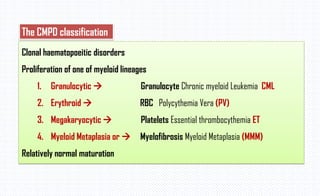
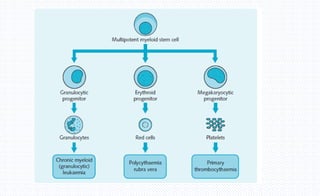
Clonal haematopoeitic disorders
Proliferation of one of myeloid lineages
1. Granulocytic  Granulocyte Chronic myeloid Leukemia CML
2. Erythroid  RBC Polycythemia Vera (PV)
3. Megakaryocytic  Platelets Essential thrombocythemia ET
4. Myeloid Metaplasia or  Myelofibrosis Myeloid Metaplasia (MMM)
Relatively normal maturation
The CMPD classification
Chronic Leukemia By Dr.Abdulrazzak
Alagbary 2009-2010
Chronic Myeloid Leukemia
Chronic Leukemia By Dr.Abdulrazzak
Alagbary 2009-2010
Chronic Myeloid Leukemia
• Chronic myelogenous leukemia (CML), also known as chronic myeloid leukemia,
• Definition: is a myeloproliferative disorder characterized by increased
proliferation of the granulocytic cell line without the loss of their capacity to
differentiate.
• associated with a characteristic chromosomal translocation called
the Philadelphia chromosome.
• It accounts for 20% of all leukemias affecting adults..
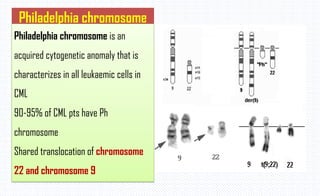
Philadelphia chromosome
Philadelphia chromosome is an
acquired cytogenetic anomaly that is
characterizes in all leukaemic cells in
CML
90-95% of CML pts have Ph
chromosome
Shared translocation of chromosome
22 and chromosome 9
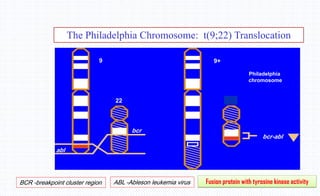
• BCR (breakpoint cluster region) gene on chromosome 22 fused to the
ABL (Ableson leukemia virus) gene on chromosome 9
• Ph chromosome is found on
– myeloid, monocytic, erythroid, megakaryocytic,
– B-cells and sometimes T-cell proof that CML derived from pluripotent
stem cell
Philadelphia chromosome BCR / ABL
The Philadelphia Chromosome: t(9;22) Translocation
bcr-abl
Fusion protein with tyrosine kinase activity
22
bcr
abl
Ph
9 9+
Philadelphia
chromosome
BCR -breakpoint cluster region ABL -Ableson leukemia virus
CML- phases
Chronic Leukemia By Dr.Abdulrazzak Alagbary 2009-2010
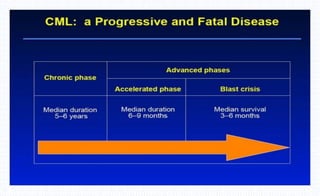
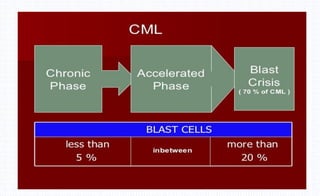
Disease Course of Chronic myelogenous leukemia classically occurs in
three phases:
1-A chronic phase (last 3-4 years up to 15 years)
2-An accelerated phase
3-Termination in blast crisis.
Chronic Leukemia By
Dr.Abdulrazzak Alagbary 2009-
2010
1-Chronic phase:
 Approximately 85% of patients with CML are in the chronic phase at the time of
diagnosis.
 During this phase, patients are usually asymptomatic or have only mild symptoms
of fatigue, left side pain, joint and/or hip pain, or abdominal fullness.
 The chronic phase lasts a median of 3 to 4 years but can vary from a few months to
>15 years.
 Approximately 5% of patients transform within the first year after diagnosis,
Chronic Leukemia By
Dr.Abdulrazzak Alagbary 2009-
2010
Chronic Phase
Accumulation of myeloid cells
 Bone marrow
 Peripheral blood
 Spleen and liver
 Rare accumulate in lymphonodes
 Others
CML must be distinguished from a leukemoid reaction, which can have a
similar appearance on blood smear
Chronic Leukemia By
Dr.Abdulrazzak Alagbary 2009-
2010
2-Accelerated phase:
 Definition: a gradual increase in blasts in the blood or bone marrow
Accelerated phase can be difficult to define and diagnose.
 Patients may have a gradual increase in blasts in the blood or bone marrow,
 The accelerated phase tends to be short; patients either transform to
unequivocal blast crisis within a few months or die during the accelerated
phase.
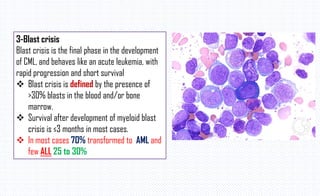
3-Blast crisis
Blast crisis is the final phase in the development
of CML, and behaves like an acute leukemia, with
rapid progression and short survival
 Blast crisis is defined by the presence of
>30% blasts in the blood and/or bone
marrow.
 Survival after development of myeloid blast
crisis is ≤3 months in most cases.
 In most cases 70% transformed to AML and
few ALL 25 to 30%
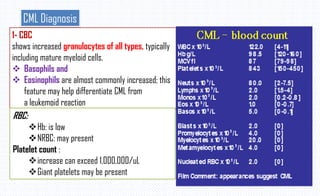
1- CBC
shows increased granulocytes of all types, typically
including mature myeloid cells.
 Basophils and
 Eosinophils are almost commonly increased; this
feature may help differentiate CML from
a leukemoid reaction
CML Diagnosis
RBC:
Hb: is low
NRBC: may present
Platelet count :
increase can exceed 1,000,000/uL
Giant platelets may be present
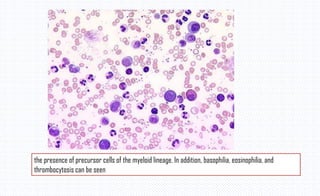
the presence of precursor cells of the myeloid lineage. In addition, basophilia, eosinophilia, and
thrombocytosis can be seen
2-Bone Marrow study :
1-Cellularity: Hypercellular, Increase
reticulin fibrosis in 30-40%
2-Granulocytic hyperplasia blasts less
10%
3-Increase the M:E ratio
Myeloid:erythroid ratio – 10:1 to 30:1 (N :
2:1)
5-Ph.chromsome test: positive
[t(9;22)]
clear dominance of granulopoiesis. The number of eosinophils and
megakaryocytes is increased
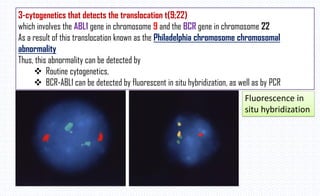
3-cytogenetics that detects the translocation t(9;22)
which involves the ABL1 gene in chromosome 9 and the BCR gene in chromosome 22
As a result of this translocation known as the Philadelphia chromosome chromosomal
abnormality
Thus, this abnormality can be detected by
 Routine cytogenetics,
 BCR-ABL1 can be detected by fluorescent in situ hybridization, as well as by PCR
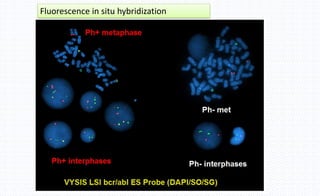
Fluorescence in
situ hybridization
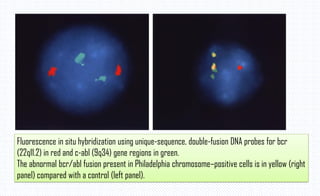
Fluorescence in situ hybridization using unique-sequence, double-fusion DNA probes for bcr
(22q11.2) in red and c-abl (9q34) gene regions in green.
The abnormal bcr/abl fusion present in Philadelphia chromosome–positive cells is in yellow (right
panel) compared with a control (left panel).
Fluorescence in situ hybridization
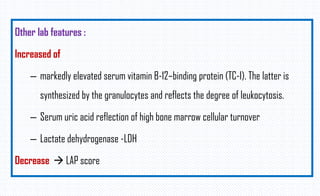
Other lab features :
Increased of
– markedly elevated serum vitamin B-12–binding protein (TC-I). The latter is
synthesized by the granulocytes and reflects the degree of leukocytosis.
– Serum uric acid reflection of high bone marrow cellular turnover
– Lactate dehydrogenase -LDH
Decrease  LAP score
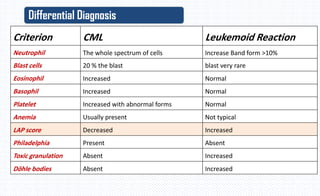
Criterion CML Leukemoid Reaction
Neutrophil The whole spectrum of cells Increase Band form >10%
Blast cells 20 % the blast blast very rare
Eosinophil Increased Normal
Basophil Increased Normal
Platelet Increased with abnormal forms Normal
Anemia Usually present Not typical
LAP score Decreased Increased
Philadelphia Present Absent
Toxic granulation Absent Increased
Döhle bodies Absent Increased
Differential Diagnosis
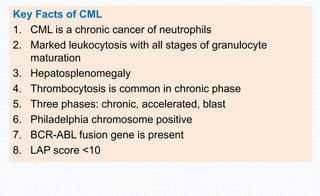
Key Facts of CML
1. CML is a chronic cancer of neutrophils
2. Marked leukocytosis with all stages of granulocyte
maturation
3. Hepatosplenomegaly
4. Thrombocytosis is common in chronic phase
5. Three phases: chronic, accelerated, blast
6. Philadelphia chromosome positive
7. BCR-ABL fusion gene is present
8. LAP score <10
END OF THE
LESSON

CML دكتو.عبدالرزاق الاغبري.pdf

  • 1.
    Chronic Leukemia ByDr.Abdulrazzak Alagbary 2009-2010 Developed by Dr. Abdulrazzaq Alagbare - Lecturer of hematology Chronic Myeloid Leukemia
  • 2.
    The Chronic MyeloproliferativeDisorders (CMPDs) Introduction CMPDs are malignant Clonal stem cell disorder Each disorder has specific genetic abnormalities. Bone marrow fibrosis in all CMPDs  Fibrosis is secondary phenomen Many finally terminate into an acute myelogenous leukemia (AML). loss of regulatory signals that control the production of the mature cells Most of these disorders are seen in older adults (50-70yrs aged) Could be also in children All shared in – splenomegaly, hepatomegaly,leukocytosis,thrombocytosis, erythrocytosis.
  • 3.
    Clonal haematopoeitic disorders Proliferationof one of myeloid lineages 1. Granulocytic  Granulocyte Chronic myeloid Leukemia CML 2. Erythroid  RBC Polycythemia Vera (PV) 3. Megakaryocytic  Platelets Essential thrombocythemia ET 4. Myeloid Metaplasia or  Myelofibrosis Myeloid Metaplasia (MMM) Relatively normal maturation The CMPD classification
  • 5.
    Chronic Leukemia ByDr.Abdulrazzak Alagbary 2009-2010 Chronic Myeloid Leukemia
  • 6.
    Chronic Leukemia ByDr.Abdulrazzak Alagbary 2009-2010 Chronic Myeloid Leukemia • Chronic myelogenous leukemia (CML), also known as chronic myeloid leukemia, • Definition: is a myeloproliferative disorder characterized by increased proliferation of the granulocytic cell line without the loss of their capacity to differentiate. • associated with a characteristic chromosomal translocation called the Philadelphia chromosome. • It accounts for 20% of all leukemias affecting adults..
  • 7.
    Philadelphia chromosome Philadelphia chromosomeis an acquired cytogenetic anomaly that is characterizes in all leukaemic cells in CML 90-95% of CML pts have Ph chromosome Shared translocation of chromosome 22 and chromosome 9
  • 8.
    • BCR (breakpointcluster region) gene on chromosome 22 fused to the ABL (Ableson leukemia virus) gene on chromosome 9 • Ph chromosome is found on – myeloid, monocytic, erythroid, megakaryocytic, – B-cells and sometimes T-cell proof that CML derived from pluripotent stem cell Philadelphia chromosome BCR / ABL
  • 9.
    The Philadelphia Chromosome:t(9;22) Translocation bcr-abl Fusion protein with tyrosine kinase activity 22 bcr abl Ph 9 9+ Philadelphia chromosome BCR -breakpoint cluster region ABL -Ableson leukemia virus
  • 10.
    CML- phases Chronic LeukemiaBy Dr.Abdulrazzak Alagbary 2009-2010 Disease Course of Chronic myelogenous leukemia classically occurs in three phases: 1-A chronic phase (last 3-4 years up to 15 years) 2-An accelerated phase 3-Termination in blast crisis.
  • 11.
    Chronic Leukemia By Dr.AbdulrazzakAlagbary 2009- 2010 1-Chronic phase:  Approximately 85% of patients with CML are in the chronic phase at the time of diagnosis.  During this phase, patients are usually asymptomatic or have only mild symptoms of fatigue, left side pain, joint and/or hip pain, or abdominal fullness.  The chronic phase lasts a median of 3 to 4 years but can vary from a few months to >15 years.  Approximately 5% of patients transform within the first year after diagnosis,
  • 12.
    Chronic Leukemia By Dr.AbdulrazzakAlagbary 2009- 2010 Chronic Phase Accumulation of myeloid cells  Bone marrow  Peripheral blood  Spleen and liver  Rare accumulate in lymphonodes  Others CML must be distinguished from a leukemoid reaction, which can have a similar appearance on blood smear
  • 13.
    Chronic Leukemia By Dr.AbdulrazzakAlagbary 2009- 2010 2-Accelerated phase:  Definition: a gradual increase in blasts in the blood or bone marrow Accelerated phase can be difficult to define and diagnose.  Patients may have a gradual increase in blasts in the blood or bone marrow,  The accelerated phase tends to be short; patients either transform to unequivocal blast crisis within a few months or die during the accelerated phase.
  • 14.
    3-Blast crisis Blast crisisis the final phase in the development of CML, and behaves like an acute leukemia, with rapid progression and short survival  Blast crisis is defined by the presence of >30% blasts in the blood and/or bone marrow.  Survival after development of myeloid blast crisis is ≤3 months in most cases.  In most cases 70% transformed to AML and few ALL 25 to 30%
  • 17.
    1- CBC shows increasedgranulocytes of all types, typically including mature myeloid cells.  Basophils and  Eosinophils are almost commonly increased; this feature may help differentiate CML from a leukemoid reaction CML Diagnosis RBC: Hb: is low NRBC: may present Platelet count : increase can exceed 1,000,000/uL Giant platelets may be present
  • 18.
    the presence ofprecursor cells of the myeloid lineage. In addition, basophilia, eosinophilia, and thrombocytosis can be seen
  • 19.
    2-Bone Marrow study: 1-Cellularity: Hypercellular, Increase reticulin fibrosis in 30-40% 2-Granulocytic hyperplasia blasts less 10% 3-Increase the M:E ratio Myeloid:erythroid ratio – 10:1 to 30:1 (N : 2:1) 5-Ph.chromsome test: positive [t(9;22)] clear dominance of granulopoiesis. The number of eosinophils and megakaryocytes is increased
  • 20.
    3-cytogenetics that detectsthe translocation t(9;22) which involves the ABL1 gene in chromosome 9 and the BCR gene in chromosome 22 As a result of this translocation known as the Philadelphia chromosome chromosomal abnormality Thus, this abnormality can be detected by  Routine cytogenetics,  BCR-ABL1 can be detected by fluorescent in situ hybridization, as well as by PCR Fluorescence in situ hybridization
  • 21.
    Fluorescence in situhybridization using unique-sequence, double-fusion DNA probes for bcr (22q11.2) in red and c-abl (9q34) gene regions in green. The abnormal bcr/abl fusion present in Philadelphia chromosome–positive cells is in yellow (right panel) compared with a control (left panel).
  • 22.
    Fluorescence in situhybridization
  • 23.
    Other lab features: Increased of – markedly elevated serum vitamin B-12–binding protein (TC-I). The latter is synthesized by the granulocytes and reflects the degree of leukocytosis. – Serum uric acid reflection of high bone marrow cellular turnover – Lactate dehydrogenase -LDH Decrease  LAP score
  • 24.
    Criterion CML LeukemoidReaction Neutrophil The whole spectrum of cells Increase Band form >10% Blast cells 20 % the blast blast very rare Eosinophil Increased Normal Basophil Increased Normal Platelet Increased with abnormal forms Normal Anemia Usually present Not typical LAP score Decreased Increased Philadelphia Present Absent Toxic granulation Absent Increased Döhle bodies Absent Increased Differential Diagnosis
  • 25.
    Key Facts ofCML 1. CML is a chronic cancer of neutrophils 2. Marked leukocytosis with all stages of granulocyte maturation 3. Hepatosplenomegaly 4. Thrombocytosis is common in chronic phase 5. Three phases: chronic, accelerated, blast 6. Philadelphia chromosome positive 7. BCR-ABL fusion gene is present 8. LAP score <10
  • 26.