CLUSTERING
REFERENCES: DATA MINING TECHNIQUES BY ARUN K. PUJARI
MRS.SOWMYA JYOTHI
SDMCBM
MANGALORE
Introduction:
Clustering is a useful technique for the discovery of data
distribution and patterns in the underlying data.
The goal of clustering is to discover both the dense and sparse
regions (Dense= All data are closely associated together;
Sparse= Data is tingly scattered).
Example:
Consider a market-basket database typically a number of
items and thus the number of attributes in such a database
is very large, while the size of an average transaction is
much smaller.
Furthermore, customers with similar buying patterns,
who belong to a single cluster, may buy a small subset of
items from a much larger set that defines the cluster.
Thus, conventional clustering methods that handle only
numerical data are not suitable for data mining purpose.
There are two main approaches to clustering:
Hierarchical clustering
Partitioning clustering
PARTITIONING CLUSTERING
The partition clustering techniques, partition the database into
predefined number of clusters.
They attempt to determine K partitions that optimize a certain
criterion function.
Partition clustering algorithms are of two types:
K- MEANS ALGORITHM
K- MEDIOD ALGORITHM
K- MODE ALGORITHM- is another type.
HIERARCHICAL CLUSTERING
The hierarchical clustering techniques do a sequence of
partitions, in which each partition is nested into the next
partition in the sequence. They create a hierarchy of clusters
from small to big or big to small.
The hierarchical techniques are of 2 types:
Agglomerative clustering
Divisive clustering technique
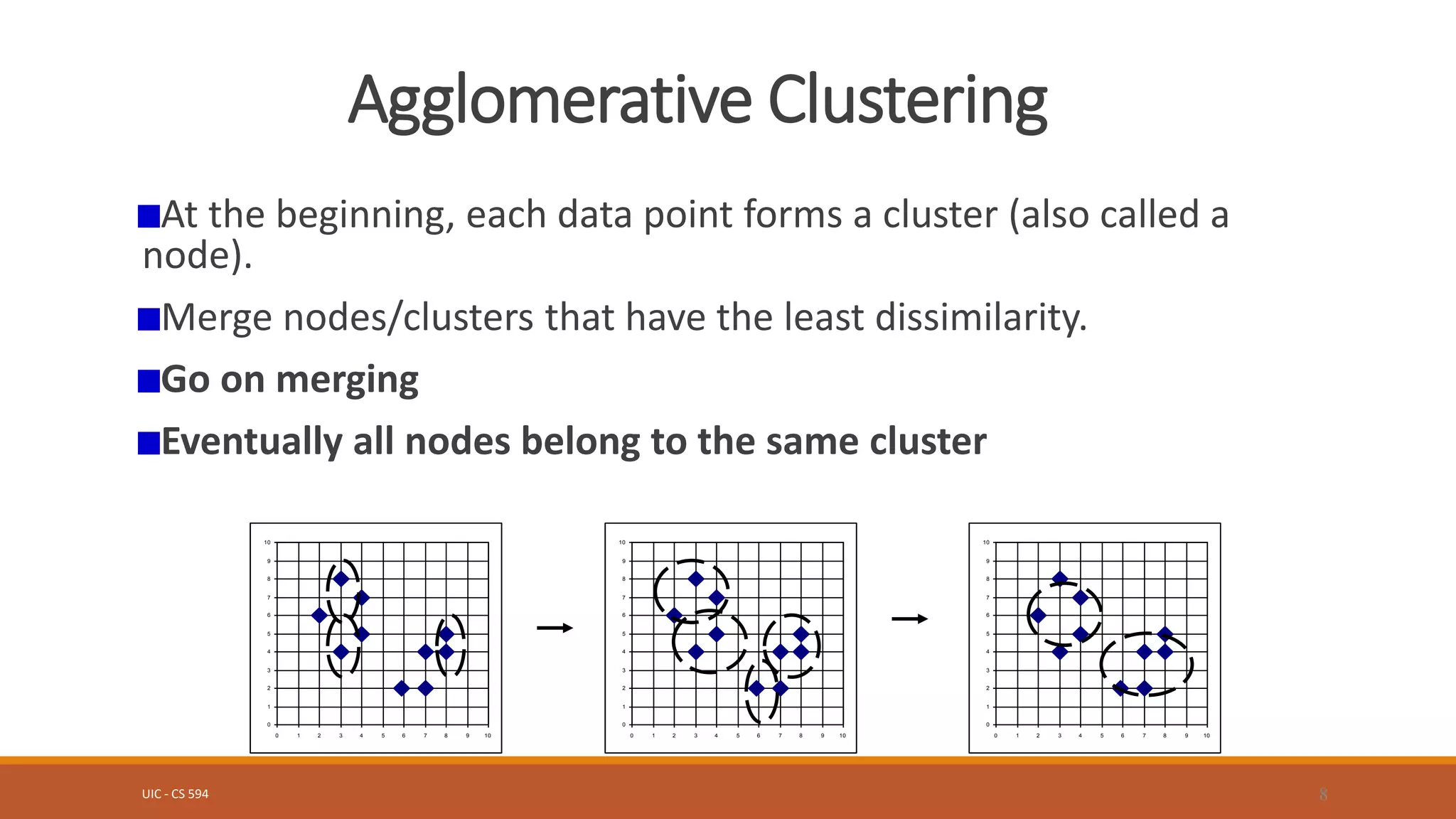
Agglomerative clustering techniques starts with as many clusters as
there are records, with each cluster having one record.
Then pairs of clusters are successively merged until the numbers of
clusters reduces to k. This is also called Bottom-up approach.
At each stage, the pairs of the clusters merged are the ones that are
nearest to each other.
If merging is continued, it terminates in a hierarchy of clusters which is
built with just a single cluster containing all the records, at the top of
the hierarchy.
Example: Small –> Big = Week->Month->Year
UIC - CS 594 8
Agglomerative Clustering
At the beginning, each data point forms a cluster (also called a
node).
Merge nodes/clusters that have the least dissimilarity.
Go on merging
Eventually all nodes belong to the same cluster
0
1
2
3
4
5
6
7
8
9
10
0 1 2 3 4 5 6 7 8 9 10
0
1
2
3
4
5
6
7
8
9
10
0 1 2 3 4 5 6 7 8 9 10
0
1
2
3
4
5
6
7
8
9
10
0 1 2 3 4 5 6 7 8 9 10
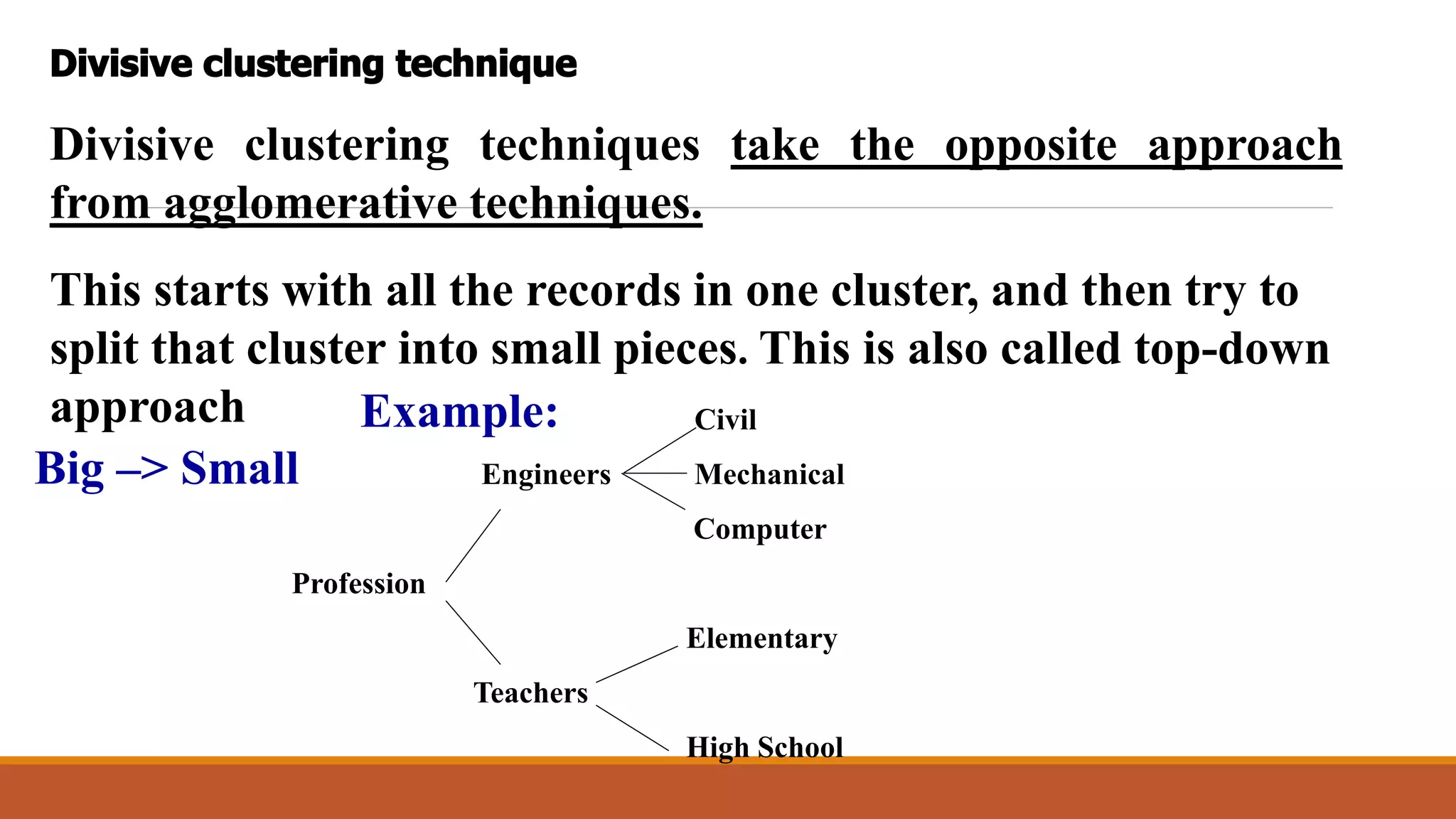
Divisive clustering techniques take the opposite approach
from agglomerative techniques.
This starts with all the records in one cluster, and then try to
split that cluster into small pieces. This is also called top-down
approach Example:
Big –> Small
Civil
Engineers Mechanical
Computer
Profession
Elementary
Teachers
High School
UIC - CS 594 10
Divisive Clustering
Inverse order of agglomerative clustering
Eventually each node forms a cluster on its own
0
1
2
3
4
5
6
7
8
9
10
0 1 2 3 4 5 6 7 8 9 10
0
1
2
3
4
5
6
7
8
9
10
0 1 2 3 4 5 6 7 8 9 10
0
1
2
3
4
5
6
7
8
9
10
0 1 2 3 4 5 6 7 8 9 10
Clustering can be performed on both numerical and categorical
data.
For clustering of numerical data, the inherit geometric properties
can be used to define the distance between points.
But for the clustering of categorical data such a criterion does
not exist and many data sets also consists of categorical attributes on
which distance functions are not naturally defined.
Some more examples are :
Quantitative:
•Weight in pounds
•Length in inches
•Time in seconds
•Number of questions correct on a quiz
Categorical
•Model of car
•Gender
•Yes or No
•Pass or Fail
Partitioning Algorithms constructs partitions of a database of N objects into a set of k
clusters (N objects = N database).
There are approximately kN/k! of partitioning a set of N data points into ‘k’ subsets.
This algorithm usually adopts the iterative optimization paradigm (IOP).
It starts with an initial partition and use an iterative control strategy.
It tries swapping data points to see if such a swapping improves quality of clustering.
When swapping does not yield any improvements in clustering, it finds a locally optimal
partition.
There are two main categories of partitioning algorithms.
They are:-
1. K-mediod algorithm :-
where each cluster is represented by one of objects of the
clusters located near the centre. Most data mining technique
use K-mediod algorithm.
2. K-mean algorithm :-
where each cluster is represented by the center of gravity of the
cluster.
PAM (Partition Around Medoids, 1987)
oFind representative objects, called medoids, in clusters
◦ PAM uses a k-medoid method to identify the clusters.
◦ PAM selects k objects arbitrarily from the data as medoids.
◦ Each of these k objects are representatives of k classes.
◦ It starts from an initial set of medoids and iteratively replaces one of the
medoids by one of the non-medoids, if it improves the total distance of the
resulting clustering. PAM works effectively for small data sets, but does not scale
well for large data sets
Partition Around Medoids (PAM)
•The algorithm starts with arbitrarily selected k-medoids and
iteratively improves upon the selection.
•In each step, a swap between a selected object Oi and a non-
selected object Oh is made, as long as such a swap results in an
improvement in the quality of clustering.
•To calculate the effect of such a swap between Oi and Oh, a cost Cih
is computed.
•The algorithm has 2 important modules
1. Partitioning of the database for a given set of mediods
2. Iterative selection of medoids.
Partitioning
If Oj is a non-selected object and Oi is a medoid, then we say
that Oj belongs to the cluster represented by Oi,
if d(Oi, Oj)= Min oe(Oj, Oe), where the minimum is taken
over all medoids Oe and
d(Oa, Ob) determines the distance or dissimilarity between
objects Oa and Ob.
CLARA: (Clustering LARge Applications)
(Kaufman & Rousseeuw 1990) reduces the computational complexity
by drawing multiple samples of the objects and applying the PAM
algorithm on each sample. CLARA accepts only the actual
measurements.
Compared to PAM, CLARA can deal with much larger data sets.
Like PAM, CLARA also finds objects that are centrally located in
the clusters.
The main problem with PAM that it
finds the entire dissimilarity matrix at a time.
DBSCAN:-
Density Based Spatial Clustering of Applications of Noise
Uses a density-based notion of clusters to discover clusters of arbitrary shapes.
The idea of DBSCAN is that, for each object of a cluster, the neighborhood of a
given radius has to contain at least a minimum number of data objects.
In other words, the density of the neighborhood must exceed a threshold.
The critical parameter is the distance function for the data objects.
Although algorithms like BIRCH, CURE, CLARANS are suitable
for large dataset. These are designed primarily for numeric data.
The important algorithms which are used for a categorical data
set are CACTUS, ROCK, STIRR.
One important common feature of these three algorithms is that they
attempt to model the similarity of categorical attributes in more or less
similar manner.
ROCK (Robust hierarchical-clustering with links) tries to introduce
a concept called neighbor and link.
STIRR(Sieving Through Iterated Relational Reinforcement).
CACTUS (Clustering Categorical Data Using Summaries) also makes
use of occurrences as the similarity measure.
STIRR(Sieving Through Iterated Relational Reinforcement)
Proposed by Gibson, Kleinberg and Raghavan, is an iterative algorithm based
on non-linear dynamical systems.
The database is represented as a graph, where each distinct value in the domain
of each attribute is represented by a weighted node. Thus, if there are N
attributes and the domain size of the ith attribute is di, then the number of
nodes in the graph is
For each tuple in the database, an edge represents a set of nodes which
participate in that tuple. Thus, a tuple is represented as a collection of nodes,
one from each attribute type. We assign a weight to each node. The set of
weights of all the nodes define the configuration of this structure. The
algorithm proceeds iteratively to update the weight of each node, based on the
weights of other nodes to which it is connected. Thus, it moves from one
configuration to the other till it reaches a stable point.

CLUSTERING IN DATA MINING.pdf

  • 1.
    CLUSTERING REFERENCES: DATA MININGTECHNIQUES BY ARUN K. PUJARI MRS.SOWMYA JYOTHI SDMCBM MANGALORE
  • 2.
    Introduction: Clustering is auseful technique for the discovery of data distribution and patterns in the underlying data. The goal of clustering is to discover both the dense and sparse regions (Dense= All data are closely associated together; Sparse= Data is tingly scattered).
  • 3.
    Example: Consider a market-basketdatabase typically a number of items and thus the number of attributes in such a database is very large, while the size of an average transaction is much smaller. Furthermore, customers with similar buying patterns, who belong to a single cluster, may buy a small subset of items from a much larger set that defines the cluster. Thus, conventional clustering methods that handle only numerical data are not suitable for data mining purpose.
  • 4.
    There are twomain approaches to clustering: Hierarchical clustering Partitioning clustering
  • 5.
    PARTITIONING CLUSTERING The partitionclustering techniques, partition the database into predefined number of clusters. They attempt to determine K partitions that optimize a certain criterion function. Partition clustering algorithms are of two types: K- MEANS ALGORITHM K- MEDIOD ALGORITHM K- MODE ALGORITHM- is another type.
  • 6.
    HIERARCHICAL CLUSTERING The hierarchicalclustering techniques do a sequence of partitions, in which each partition is nested into the next partition in the sequence. They create a hierarchy of clusters from small to big or big to small. The hierarchical techniques are of 2 types: Agglomerative clustering Divisive clustering technique
  • 7.
    Agglomerative clustering techniquesstarts with as many clusters as there are records, with each cluster having one record. Then pairs of clusters are successively merged until the numbers of clusters reduces to k. This is also called Bottom-up approach. At each stage, the pairs of the clusters merged are the ones that are nearest to each other. If merging is continued, it terminates in a hierarchy of clusters which is built with just a single cluster containing all the records, at the top of the hierarchy. Example: Small –> Big = Week->Month->Year
  • 8.
    UIC - CS594 8 Agglomerative Clustering At the beginning, each data point forms a cluster (also called a node). Merge nodes/clusters that have the least dissimilarity. Go on merging Eventually all nodes belong to the same cluster 0 1 2 3 4 5 6 7 8 9 10 0 1 2 3 4 5 6 7 8 9 10 0 1 2 3 4 5 6 7 8 9 10 0 1 2 3 4 5 6 7 8 9 10 0 1 2 3 4 5 6 7 8 9 10 0 1 2 3 4 5 6 7 8 9 10
  • 9.
    Divisive clustering techniquestake the opposite approach from agglomerative techniques. This starts with all the records in one cluster, and then try to split that cluster into small pieces. This is also called top-down approach Example: Big –> Small Civil Engineers Mechanical Computer Profession Elementary Teachers High School
  • 10.
    UIC - CS594 10 Divisive Clustering Inverse order of agglomerative clustering Eventually each node forms a cluster on its own 0 1 2 3 4 5 6 7 8 9 10 0 1 2 3 4 5 6 7 8 9 10 0 1 2 3 4 5 6 7 8 9 10 0 1 2 3 4 5 6 7 8 9 10 0 1 2 3 4 5 6 7 8 9 10 0 1 2 3 4 5 6 7 8 9 10
  • 11.
    Clustering can beperformed on both numerical and categorical data. For clustering of numerical data, the inherit geometric properties can be used to define the distance between points. But for the clustering of categorical data such a criterion does not exist and many data sets also consists of categorical attributes on which distance functions are not naturally defined.
  • 12.
    Some more examplesare : Quantitative: •Weight in pounds •Length in inches •Time in seconds •Number of questions correct on a quiz Categorical •Model of car •Gender •Yes or No •Pass or Fail
  • 13.
    Partitioning Algorithms constructspartitions of a database of N objects into a set of k clusters (N objects = N database). There are approximately kN/k! of partitioning a set of N data points into ‘k’ subsets. This algorithm usually adopts the iterative optimization paradigm (IOP). It starts with an initial partition and use an iterative control strategy. It tries swapping data points to see if such a swapping improves quality of clustering. When swapping does not yield any improvements in clustering, it finds a locally optimal partition.
  • 14.
    There are twomain categories of partitioning algorithms. They are:- 1. K-mediod algorithm :- where each cluster is represented by one of objects of the clusters located near the centre. Most data mining technique use K-mediod algorithm. 2. K-mean algorithm :- where each cluster is represented by the center of gravity of the cluster.
  • 15.
    PAM (Partition AroundMedoids, 1987) oFind representative objects, called medoids, in clusters ◦ PAM uses a k-medoid method to identify the clusters. ◦ PAM selects k objects arbitrarily from the data as medoids. ◦ Each of these k objects are representatives of k classes. ◦ It starts from an initial set of medoids and iteratively replaces one of the medoids by one of the non-medoids, if it improves the total distance of the resulting clustering. PAM works effectively for small data sets, but does not scale well for large data sets
  • 16.
    Partition Around Medoids(PAM) •The algorithm starts with arbitrarily selected k-medoids and iteratively improves upon the selection. •In each step, a swap between a selected object Oi and a non- selected object Oh is made, as long as such a swap results in an improvement in the quality of clustering. •To calculate the effect of such a swap between Oi and Oh, a cost Cih is computed. •The algorithm has 2 important modules 1. Partitioning of the database for a given set of mediods 2. Iterative selection of medoids.
  • 17.
    Partitioning If Oj isa non-selected object and Oi is a medoid, then we say that Oj belongs to the cluster represented by Oi, if d(Oi, Oj)= Min oe(Oj, Oe), where the minimum is taken over all medoids Oe and d(Oa, Ob) determines the distance or dissimilarity between objects Oa and Ob.
  • 18.
    CLARA: (Clustering LARgeApplications) (Kaufman & Rousseeuw 1990) reduces the computational complexity by drawing multiple samples of the objects and applying the PAM algorithm on each sample. CLARA accepts only the actual measurements. Compared to PAM, CLARA can deal with much larger data sets. Like PAM, CLARA also finds objects that are centrally located in the clusters. The main problem with PAM that it finds the entire dissimilarity matrix at a time.
  • 19.
    DBSCAN:- Density Based SpatialClustering of Applications of Noise Uses a density-based notion of clusters to discover clusters of arbitrary shapes. The idea of DBSCAN is that, for each object of a cluster, the neighborhood of a given radius has to contain at least a minimum number of data objects. In other words, the density of the neighborhood must exceed a threshold. The critical parameter is the distance function for the data objects.
  • 20.
    Although algorithms likeBIRCH, CURE, CLARANS are suitable for large dataset. These are designed primarily for numeric data. The important algorithms which are used for a categorical data set are CACTUS, ROCK, STIRR. One important common feature of these three algorithms is that they attempt to model the similarity of categorical attributes in more or less similar manner.
  • 21.
    ROCK (Robust hierarchical-clusteringwith links) tries to introduce a concept called neighbor and link. STIRR(Sieving Through Iterated Relational Reinforcement). CACTUS (Clustering Categorical Data Using Summaries) also makes use of occurrences as the similarity measure.
  • 22.
    STIRR(Sieving Through IteratedRelational Reinforcement) Proposed by Gibson, Kleinberg and Raghavan, is an iterative algorithm based on non-linear dynamical systems. The database is represented as a graph, where each distinct value in the domain of each attribute is represented by a weighted node. Thus, if there are N attributes and the domain size of the ith attribute is di, then the number of nodes in the graph is For each tuple in the database, an edge represents a set of nodes which participate in that tuple. Thus, a tuple is represented as a collection of nodes, one from each attribute type. We assign a weight to each node. The set of weights of all the nodes define the configuration of this structure. The algorithm proceeds iteratively to update the weight of each node, based on the weights of other nodes to which it is connected. Thus, it moves from one configuration to the other till it reaches a stable point.