
Lauren Dreghorn-carver
Meteorology
Mrs.Joseph/mrs.Neisen
Adiabatic temperature changes
and expansion and cooling
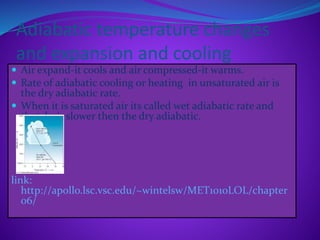
 Air expand-it cools and air compressed-it warms.
 Rate of adiabatic cooling or heating in unsaturated air is
the dry adiabatic rate.
 When it is saturated air its called wet adiabatic rate and
that dry's slower then the dry adiabatic.
link:
http://apollo.lsc.vsc.edu/~wintelsw/MET1010LOL/chapter
06/
Orographic lifting
facts
http://www.crh.noaa.gov/unr
/?n=weather
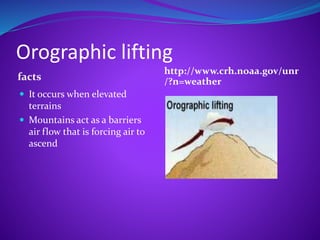
 It occurs when elevated
terrains
 Mountains act as a barriers
air flow that is forcing air to
ascend
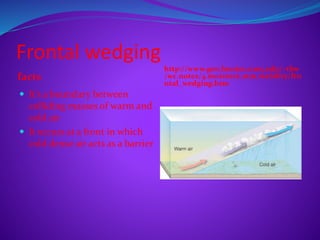
Frontal wedging
facts
http://www.geo.hunter.cuny.edu/~tbw
/wc.notes/4.moisture.atm.stability/fro
ntal_wedging.htm
 It’s a boundary between
colliding masses of warm and
cold air
 It occurs at a front in which
cold dense air acts as a barrier
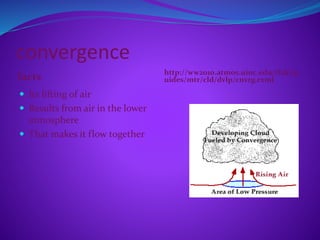
convergence
facts http://ww2010.atmos.uiuc.edu/(Gh)/g
uides/mtr/cld/dvlp/cnvrg.rxml
 Its lifting of air
 Results from air in the lower
atmosphere
 That makes it flow together
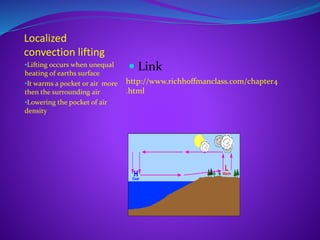
Localized
convection lifting
•Lifting occurs when unequal
heating of earths surface
•It warms a pocket or air more
then the surrounding air
•Lowering the pocket of air
density
 Link
http://www.richhoffmanclass.com/chapter4
.html
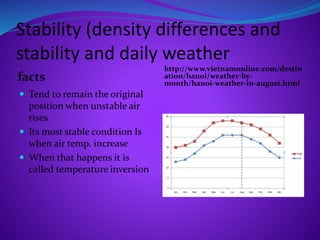
Stability (density differences and
stability and daily weather
facts
http://www.vietnamonline.com/destin
ation/hanoi/weather-by-
month/hanoi-weather-in-august.html
 Tend to remain the original
position when unstable air
rises
 Its most stable condition Is
when air temp. increase
 When that happens it is
called temperature inversion
Condensation
facts
http://keep3.sjfc.edu/students/kes00898/e-
port/condensation%20page%20for%20unit.
html
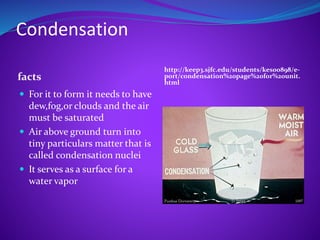
 For it to form it needs to have
dew,fog,or clouds and the air
must be saturated
 Air above ground turn into
tiny particulars matter that is
called condensation nuclei
 It serves as a surface for a
water vapor
Types of clouds
facts
http://eo.ucar.edu/webweath
er/cloud3.html
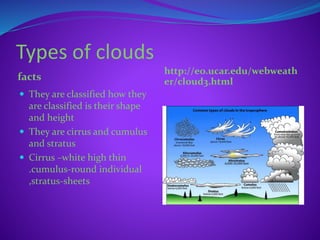
 They are classified how they
are classified is their shape
and height
 They are cirrus and cumulus
and stratus
 Cirrus –white high thin
.cumulus-round individual
,stratus-sheets
High clouds
fact
http://eo.ucar.edu/kids/sky/c
louds3.htm
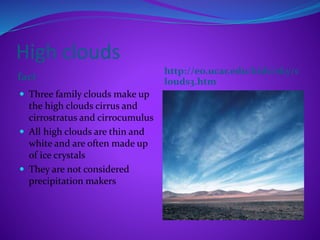
 Three family clouds make up
the high clouds cirrus and
cirrostratus and cirrocumulus
 All high clouds are thin and
white and are often made up
of ice crystals
 They are not considered
precipitation makers
Middle clouds
fact
http://www.bigbranch.net/mi
ddle%20clouds.htm
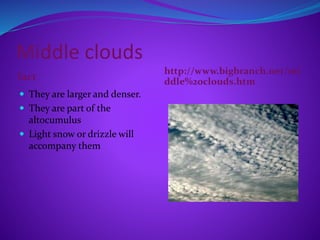
 They are larger and denser.
 They are part of the
altocumulus
 Light snow or drizzle will
accompany them
Low clouds
facts
http://eo.ucar.edu/kids/sky/c
louds1.htm
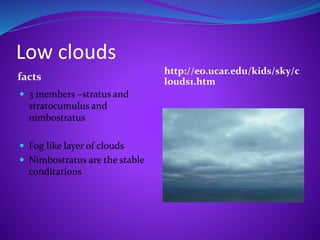
 3 members –stratus and
stratocumulus and
nimbostratus
 Fog like layer of clouds
 Nimbostratus are the stable
conditations
Clouds of vertical development
facts
http://www.free-online-private-pilot-
ground-school.com/Aviation-Weather-
Principles.html
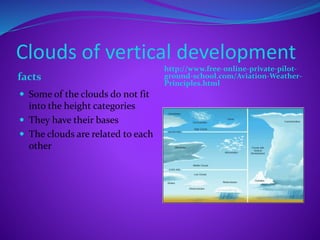
 Some of the clouds do not fit
into the height categories
 They have their bases
 The clouds are related to each
other
Fog (by cooling and by
evaporation)
facts http://epod.usra.edu/blog/2006/03/ad
vection-fog-in-new-hampshire.html
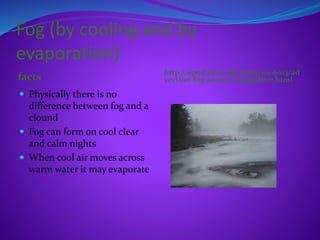
 Physically there is no
difference between fog and a
clound
 Fog can form on cool clear
and calm nights
 When cool air moves across
warm water it may evaporate
Cold cloud precipitation(bergeron
process)
facts
http://nanopatentsandinnovations.bl
ogspot.com/2010/06/amount-of-dust-
pollen-matters-for-cloud.html
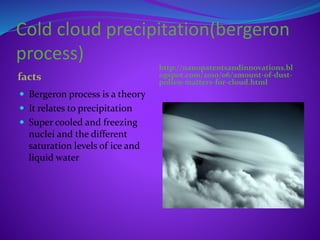
 Bergeron process is a theory
 It relates to precipitation
 Super cooled and freezing
nuclei and the different
saturation levels of ice and
liquid water
Warm cloud
Fact http://www.frangardino.com/clouds/index.
html
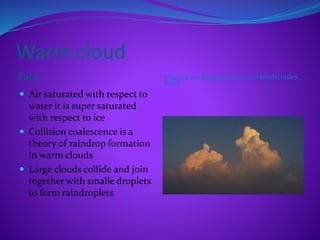
 Air saturated with respect to
water it is super saturated
with respect to ice
 Collision coalescence is a
theory of raindrop formation
in warm clouds
 Large clouds collide and join
together with smalle droplets
to form raindroplets
Rain and snow
Facts http://fineartamerica.com/featured/la
ke-rain-and-snow-darryl-kravitz.html
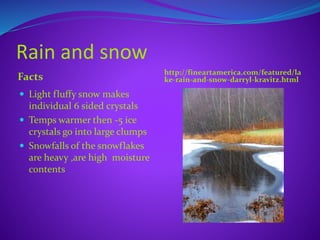
 Light fluffy snow makes
individual 6 sided crystals
 Temps warmer then -5 ice
crystals go into large clumps
 Snowfalls of the snowflakes
are heavy ,are high moisture
contents
Sleet glaze and hail
facts
http://scienceray.com/earth-
sciences/the-mysteries-of-earth-
science-rain-snow-and-hail/
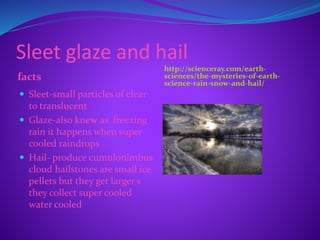
 Sleet-small particles of clear
to translucent
 Glaze-also knew as freezing
rain it happens when super
cooled raindrops
 Hail- produce cumulonimbus
cloud hailstones are small ice
pellets but they get larger s
they collect super cooled
water cooled
Thanks for watching it and grading it !hope you
enjoyed it

Clouds and precipitation