Cloud Computing Security
Muhammad Adeel Javaid,
(Microsoft Certified Partner)
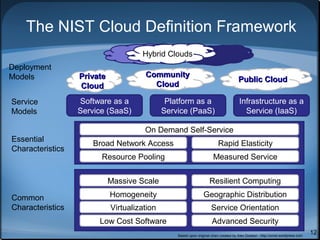
Cloud Service
Models
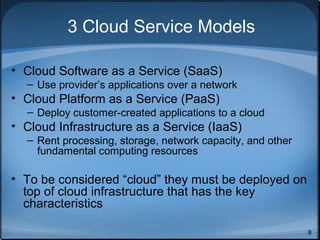
• Software as a Service (SaaS)
• We use the provider apps
• User doesn’t manage or control the
network, servers, OS, storage or
applications
• Platform as a Service (PaaS)
• User deploys their apps on the cloud
• Controls their apps
• User doesn’t manage servers, IS,
storage
2
Cloud Service
Models
• Infrastructure as a
Service (IaaS)
• Consumers gets access to
the infrastructure to deploy
their stuff
• Doesn’t manage or control
the infrastructure
• Does manage or control the
OS, storage, apps, selected
network components3
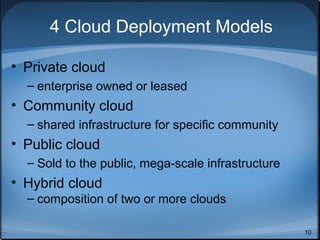
Deployment Models
• Public
• Cloud infrastructure is
available to the general
public, owned by org
selling cloud services
• Private
• Cloud infrastructure for
single org only, may be
managed by the org or a 3rd
party, on or off premise4
Deployment Models
• Community
• Cloud infrastructure shared by
several orgs that have shared
concerns, managed by org or 3rd
party
• Hybrid
• Combo of >=2 clouds bound by
standard or proprietary technology
5
Security Pitfalls
• How cloud services are
provided confused with where
they are provided
• Well demarcated network
security border is not fixed
• Cloud computing implies loss of
control
6
Cloud Computing –
Service Provider
Priorities
 Ensure confidentiality, integrity, and
availability in a multi-tenant
environment.
 Effectively meet the advertised SLA,
while optimizing cloud resource
utilization.
 Offer tenants capabilities for self-
service, and achieve scaling through
automation and simplification.
Cloud Security-Responsibility
Model
Governance
• Identify, implement
process, controls to
maintain effective
governance, risk mgt,
compliance
• Provider security
governance should be
assessed for sufficiency,
maturity, consistency
with user ITSEC process9
3rd
Party Governance
• Request clear docs on
how facility & services
are assessed
• Require definition of what
provider considers
critical services, info
• Perform full contract,
terms of use due
diligence to determine
roles, accountability10
Legal, e-Discovery
• Functional: which
functions & services in the
Cloud have legal
implications for both
parties
• Jurisdictional: which
governments administer
laws and regs impacting
services, stakeholders,
data assets11
Legal, e-Discovery
• Both parties must understand
each other’s roles
− Litigation hold, Discovery searches
− Expert testimony
• Provider must save primary and
secondary (logs) data
• Where is the data stored?
• laws for cross border data flows
12
Legal, e-Discovery
• Plan for unexpected contract
termination and orderly return
or secure disposal of assets
• You should ensure you retain
ownership of your data in its
original form
13
Compliance & Audit
• Hard to maintain with your
sec/reg requirements, harder
to demonstrate to auditors
• Right to Audit clause
• Analyze compliance scope
• Regulatory impact on data
security
• Evidence requirements are met
• Do Provider have SAS 70 Type
II, ISO 27001/2 audit
statements?14
Info Lifecycle Mgt
• Data security (CIA)
• Data Location
• All copies, backups stored only at
location allowed by contract, SLA
and/or regulation
• Compliant storage (EU mandate)
for storing e-health records
15
Portability,
Interoperability
• When you have to switch cloud
providers
• Contract price increase
• Provider bankruptcy
• Provider service shutdown
• Decrease in service quality
• Business dispute
16
Security, BC, DR
• Centralization of data = greater
insider threat from within the
provider
• Require onsite inspections of
provider facilities
• Disaster recover, Business
continuity, etc
17
Data Center Ops
• How does provider do:
• On-demand self service
• Broad network access
• Resource pooling
• Rapid elasticity
• Measured service
18
Incident Response
•Cloud apps aren’t always
designed with data integrity,
security in mind
•Provider keep app, firewall,
IDS logs?
•Provider deliver snapshots of
your virtual environment?
•Sensitive data must be
encrypted for data breach regs
19
Application Security
• Different trust boundaries for
IaaS, PaaS, Saas
• Provider web application
security?
• Secure inter-host
communication channel
20
Encryption, Key Mgt
• Encrypt data in transit, at rest,
backup media
• Secure key store
• Protect encryption keys
• Ensure encryption is based
on industry/govt standards.
• NO proprietary standard
• Limit access to key stores
• Key backup & recoverability
• Test these procedures
21
ID, Access Mgt
• Determine how provider
handles:
• Provisioning, deprovisioning
• Authentication
• Federation
• Authorization, user profile mgt
22
Virtualization
• What type of virtualization is
used by the provider?
• What 3rd
party security
technology augments the virtual
OS?
• Which controls protect admin
interfaces exposed to users?
23
Cloud Security
Responsibilities
by Providers and Users
Source: Reference [4]
Cloud Security Control Model
25
Conclusions:
• Computing clouds are changing the whole IT ,
service industry, and global economy. Clearly,
cloud computing demands ubiquity, efficiency,
security, and trustworthiness.
• Cloud computing has become a common
practice in business, government, education,
and entertainment leveraging 50 millions of
servers globally installed at thousands of
datacenters today.
• Private clouds will become widespread in
addition to using a few public clouds, that are
under heavy competition among Google, MS,
Amazon, Intel, EMC, IBM, SGI, VMWare,
Saleforce.com, etc.
• Effective trust management, guaranteed
security, user privacy, data integrity, mobility
support, and copyright protection are crucial
to the universal acceptance of cloud as a
References
• All material from “Security Guidance for
Critical Areas of Focus in Cloud Computing
v2.1”, http://www.cloudsecurityalliance.org
• All figures in this talk taken from this paper
• NIST Cloud Model:
www.csrc.nist.gov/groups/SNS/cloud-computing/inde
• Various cloud working groups
• Open Cloud Computing Interface Working Group,
Amazon EC2 API, Sun Open Cloud API,
Rackspace API, GoGrid API, DMTF Open
Virtualization Format (OVF)
27

Cloud security

  • 1.
    Cloud Computing Security MuhammadAdeel Javaid, (Microsoft Certified Partner)
  • 2.
    Cloud Service Models • Softwareas a Service (SaaS) • We use the provider apps • User doesn’t manage or control the network, servers, OS, storage or applications • Platform as a Service (PaaS) • User deploys their apps on the cloud • Controls their apps • User doesn’t manage servers, IS, storage 2
  • 3.
    Cloud Service Models • Infrastructureas a Service (IaaS) • Consumers gets access to the infrastructure to deploy their stuff • Doesn’t manage or control the infrastructure • Does manage or control the OS, storage, apps, selected network components3
  • 4.
    Deployment Models • Public •Cloud infrastructure is available to the general public, owned by org selling cloud services • Private • Cloud infrastructure for single org only, may be managed by the org or a 3rd party, on or off premise4
  • 5.
    Deployment Models • Community •Cloud infrastructure shared by several orgs that have shared concerns, managed by org or 3rd party • Hybrid • Combo of >=2 clouds bound by standard or proprietary technology 5
  • 6.
    Security Pitfalls • Howcloud services are provided confused with where they are provided • Well demarcated network security border is not fixed • Cloud computing implies loss of control 6
  • 7.
    Cloud Computing – ServiceProvider Priorities  Ensure confidentiality, integrity, and availability in a multi-tenant environment.  Effectively meet the advertised SLA, while optimizing cloud resource utilization.  Offer tenants capabilities for self- service, and achieve scaling through automation and simplification.
  • 8.
  • 9.
    Governance • Identify, implement process,controls to maintain effective governance, risk mgt, compliance • Provider security governance should be assessed for sufficiency, maturity, consistency with user ITSEC process9
  • 10.
    3rd Party Governance • Requestclear docs on how facility & services are assessed • Require definition of what provider considers critical services, info • Perform full contract, terms of use due diligence to determine roles, accountability10
  • 11.
    Legal, e-Discovery • Functional:which functions & services in the Cloud have legal implications for both parties • Jurisdictional: which governments administer laws and regs impacting services, stakeholders, data assets11
  • 12.
    Legal, e-Discovery • Bothparties must understand each other’s roles − Litigation hold, Discovery searches − Expert testimony • Provider must save primary and secondary (logs) data • Where is the data stored? • laws for cross border data flows 12
  • 13.
    Legal, e-Discovery • Planfor unexpected contract termination and orderly return or secure disposal of assets • You should ensure you retain ownership of your data in its original form 13
  • 14.
    Compliance & Audit •Hard to maintain with your sec/reg requirements, harder to demonstrate to auditors • Right to Audit clause • Analyze compliance scope • Regulatory impact on data security • Evidence requirements are met • Do Provider have SAS 70 Type II, ISO 27001/2 audit statements?14
  • 15.
    Info Lifecycle Mgt •Data security (CIA) • Data Location • All copies, backups stored only at location allowed by contract, SLA and/or regulation • Compliant storage (EU mandate) for storing e-health records 15
  • 16.
    Portability, Interoperability • When youhave to switch cloud providers • Contract price increase • Provider bankruptcy • Provider service shutdown • Decrease in service quality • Business dispute 16
  • 17.
    Security, BC, DR •Centralization of data = greater insider threat from within the provider • Require onsite inspections of provider facilities • Disaster recover, Business continuity, etc 17
  • 18.
    Data Center Ops •How does provider do: • On-demand self service • Broad network access • Resource pooling • Rapid elasticity • Measured service 18
  • 19.
    Incident Response •Cloud appsaren’t always designed with data integrity, security in mind •Provider keep app, firewall, IDS logs? •Provider deliver snapshots of your virtual environment? •Sensitive data must be encrypted for data breach regs 19
  • 20.
    Application Security • Differenttrust boundaries for IaaS, PaaS, Saas • Provider web application security? • Secure inter-host communication channel 20
  • 21.
    Encryption, Key Mgt •Encrypt data in transit, at rest, backup media • Secure key store • Protect encryption keys • Ensure encryption is based on industry/govt standards. • NO proprietary standard • Limit access to key stores • Key backup & recoverability • Test these procedures 21
  • 22.
    ID, Access Mgt •Determine how provider handles: • Provisioning, deprovisioning • Authentication • Federation • Authorization, user profile mgt 22
  • 23.
    Virtualization • What typeof virtualization is used by the provider? • What 3rd party security technology augments the virtual OS? • Which controls protect admin interfaces exposed to users? 23
  • 24.
    Cloud Security Responsibilities by Providersand Users Source: Reference [4]
  • 25.
  • 26.
    Conclusions: • Computing cloudsare changing the whole IT , service industry, and global economy. Clearly, cloud computing demands ubiquity, efficiency, security, and trustworthiness. • Cloud computing has become a common practice in business, government, education, and entertainment leveraging 50 millions of servers globally installed at thousands of datacenters today. • Private clouds will become widespread in addition to using a few public clouds, that are under heavy competition among Google, MS, Amazon, Intel, EMC, IBM, SGI, VMWare, Saleforce.com, etc. • Effective trust management, guaranteed security, user privacy, data integrity, mobility support, and copyright protection are crucial to the universal acceptance of cloud as a
  • 27.
    References • All materialfrom “Security Guidance for Critical Areas of Focus in Cloud Computing v2.1”, http://www.cloudsecurityalliance.org • All figures in this talk taken from this paper • NIST Cloud Model: www.csrc.nist.gov/groups/SNS/cloud-computing/inde • Various cloud working groups • Open Cloud Computing Interface Working Group, Amazon EC2 API, Sun Open Cloud API, Rackspace API, GoGrid API, DMTF Open Virtualization Format (OVF) 27