1
Cloud Computing
- The news buzzword
By: CA Anand Prakash Jangid
2
Agenda
Check in
Cloud computing defined
Service models & Types
Chartered accountants and cloud computing
Check out
4
The Future is not, What it used to
be
5
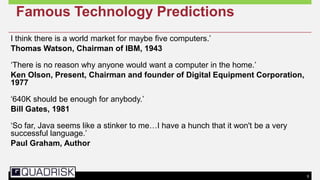
Famous Technology Predictions
I think there is a world market for maybe five computers.‘
Thomas Watson, Chairman of IBM, 1943
‗There is no reason why anyone would want a computer in the home.‘
Ken Olson, Present, Chairman and founder of Digital Equipment Corporation,
1977
‗640K should be enough for anybody.‘
Bill Gates, 1981
‗So far, Java seems like a stinker to me…I have a hunch that it won't be a very
successful language.‘
Paul Graham, Author
6
Check in
Cloud Computing has
the potential to disrupt IT
as we know it today.
7
Agenda
Check in
Cloud computing defined
Service models & Types
Chartered accountants and cloud computing
Check out
8
9
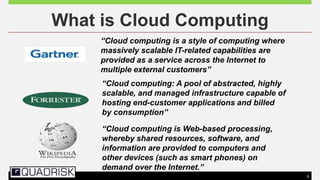
What is Cloud Computing
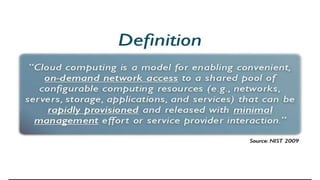
“Cloud computing is a style of computing where
massively scalable IT-related capabilities are
provided as a service across the Internet to
multiple external customers”
“Cloud computing: A pool of abstracted, highly
scalable, and managed infrastructure capable of
hosting end-customer applications and billed
by consumption”
“Cloud computing is Web-based processing,
whereby shared resources, software, and
information are provided to computers and
other devices (such as smart phones) on
demand over the Internet.”
10
11
12
13
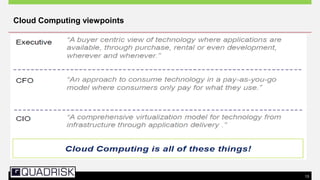
Cloud Computing viewpoints
14
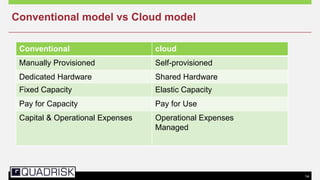
Conventional
Conventional cloud
Manually Provisioned Self-provisioned
Dedicated Hardware Shared Hardware
Fixed Capacity Elastic Capacity
Pay for Capacity Pay for Use
Capital & Operational Expenses Operational Expenses
Managed
Conventional model vs Cloud model
15
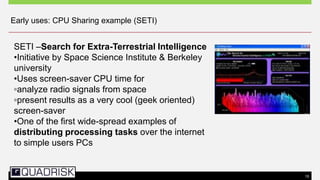
Early uses: CPU Sharing example (SETI)
SETI –Search for Extra-Terrestrial Intelligence
•Initiative by Space Science Institute & Berkeley
university
•Uses screen-saver CPU time for
▫analyze radio signals from space
▫present results as a very cool (geek oriented)
screen-saver
•One of the first wide-spread examples of
distributing processing tasks over the internet
to simple users PCs
16
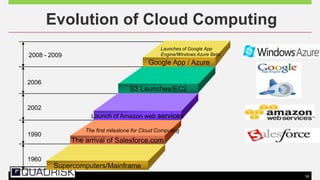
S3 Launches/EC2
Launch of Amazon web services
The arrival of Salesforce.com
Supercomputers/Mainframe
2006
2002
1990
1960
Google App / Azure
2008 - 2009
The first milestone for Cloud Computing
Launches of Google App
Engine/Windows Azure Beta
Evolution of Cloud Computing
17
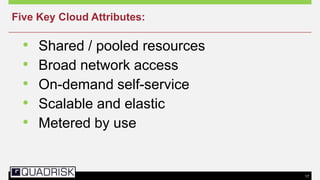
• Shared / pooled resources
• Broad network access
• On-demand self-service
• Scalable and elastic
• Metered by use
Five Key Cloud Attributes:
18
• Resources are drawn from a common pool
• Common resources build economies of scale
• Common infrastructure runs at high efficiency
Shared / Pooled Resources:
19
• Open standards and APIs
• Almost always IP, HTTP, and REST
• Available from anywhere with an internet connection
Broad Network Access:
20
• Completely automated
• Users abstracted from the implementation
• Near real-time delivery (seconds or minutes)
• Services accessed through a self-serve
• web interface
On-Demand Self-Service:
21
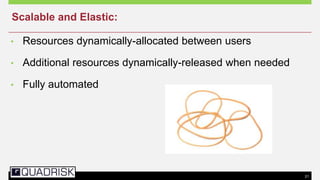
• Resources dynamically-allocated between users
• Additional resources dynamically-released when needed
• Fully automated
Scalable and Elastic:
22
Services are metered, like a utility
Users pay only for services used
Services can be cancelled at any time
Metered by Use:
23
Some success stories
GE:
Global procurement hosting 500k suppliers and 100k users in six languages on SaaS
platform to manage $55B/yr in spend
Eli Lilly :
Using Amazon Web Services can deploy a new server in 3min vs 50days and a 64-node
Linux cluster in 5min vs 100days
Nasdaq:
Using Amazon Storage to store 30-80GB/day of trading activity
24
Agenda
Check in
Cloud computing defined
Service models & Types
Chartered accountants and cloud computing
Check out
25
26
27
28
29
30
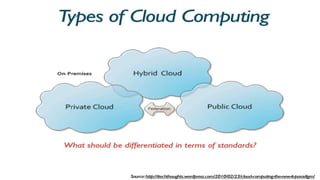
• Owned and managed by the enterprise
• Limits access to enterprise and partner network
• Retains high degree of control, privacy and security
• Enables business to more easily customize service
• Accessed from "inside" the firewall
Private Cloud
31
Public Cloud
• Owned and managed by service provider
• Delivers select set business process, application or
infrastructure services on a ―pay per use‖ basis
• Highly standardized
• Limited customization options
• Accessed from "outside" the firewall
32
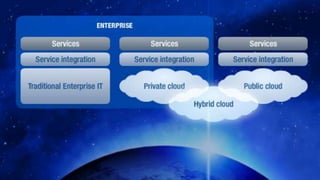
Hybrid Cloud
• A hybrid infrastructure takes advantage of both public and private clouds:
• Services provided over the Internet—the public cloud
• Services provided by the enterprise data center—the private cloud
33
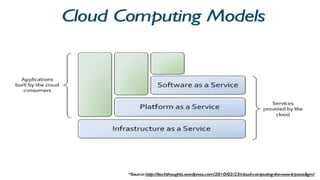
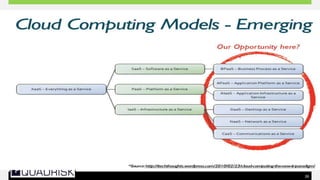
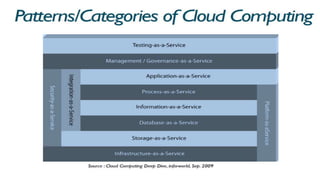
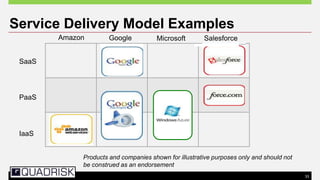
SaaS
PaaS
IaaS
Amazon Google Microsoft Salesforce
Service Delivery Model Examples
Products and companies shown for illustrative purposes only and should not
be construed as an endorsement
34
Agenda
Check in
Cloud computing defined
Service models & Types
Chartered accountants and cloud computing
Check out
35
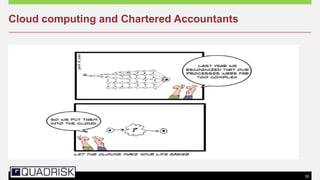
Cloud computing and Chartered Accountants
36
• Regulatory compliance
• Conflicts with international privacy laws,
• Data ownership & location
• Data Segregation
• Service guarantees & lack of control
• Contingency planning / disaster recovery for clouds
• Investigative support
• Privilege user access
• Long term viability(going concern for Service provider)
• IT general controls
Why should we worry
37
New role envisaged for Internal audit/Risk
management team
38
• Business case for moving to cloud
• How does this align to business need
• Understanding the current state of system and
data
Being part of the cloud strategy
39
• Who manages the vendor relationship
• How the asset are protected
• How is the responsibility divided
• Impact on the present disaster recovery plan
• How the vendor manage multi client environment
• Where is the data physically stored
• Impact of change in technology
• Gap in the risk & controls of the vendors
Evaluating vendors
40
• Defining and managing the SLA and OLA
• What are your and cloud service provider compliance
responsibility
• How are incident managed
• How often are the data backed up
• Who determine the user access right to data(BBMP
example)
Implementation of cloud computing model
41
• Process of managing the SLA and OLA with the
vendor
• How are the contractual control requirement are
managed
• Other related issue
Last but not least …Monitoring the vendor
42
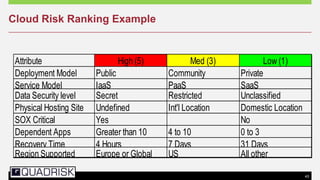
Some illustration of the cloud risk ranking
43
Attribute High (5) Med (3) Low (1)
Deployment Model Public Community Private
Service Model IaaS PaaS SaaS
Data Security level Secret Restricted Unclassified
Physical Hosting Site Undefined Int'l Location Domestic Location
SOX Critical Yes No
Dependent Apps Greater than 10 4 to 10 0 to 3
Recovery Time 4 Hours 7 Days 31 Days
Region Supported Europe or Global US All other
Cloud Risk Ranking Example
44
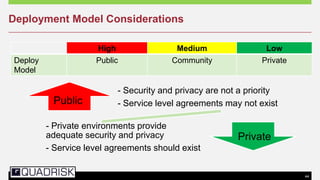
Deployment Model Considerations
High Medium Low
Deploy
Model
Public Community Private
- Security and privacy are not a priority
- Service level agreements may not exist
- Private environments provide
adequate security and privacy
- Service level agreements should exist
Public
Private
45
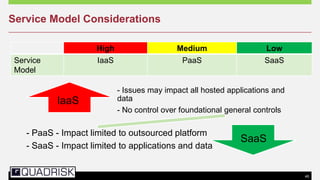
Service Model Considerations
High Medium Low
Service
Model
IaaS PaaS SaaS
- Issues may impact all hosted applications and
data
- No control over foundational general controls
- PaaS - Impact limited to outsourced platform
- SaaS - Impact limited to applications and data
IaaS
SaaS
46
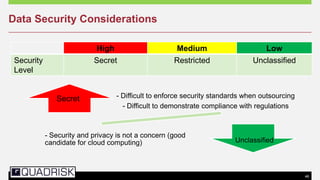
Data Security Considerations
High Medium Low
Security
Level
Secret Restricted Unclassified
- Difficult to enforce security standards when outsourcing
- Difficult to demonstrate compliance with regulations
- Security and privacy is not a concern (good
candidate for cloud computing)
Secret
Unclassified
47
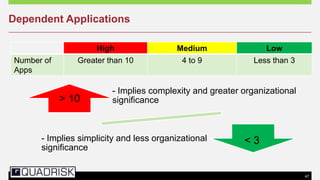
Dependent Applications
High Medium Low
Number of
Apps
Greater than 10 4 to 9 Less than 3
- Implies complexity and greater organizational
significance
- Implies simplicity and less organizational
significance
> 10
< 3
48
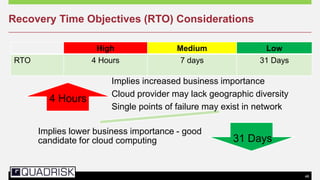
Recovery Time Objectives (RTO) Considerations
High Medium Low
RTO 4 Hours 7 days 31 Days
Implies increased business importance
Cloud provider may lack geographic diversity
Single points of failure may exist in network
Implies lower business importance - good
candidate for cloud computing
4 Hours
31 Days
49
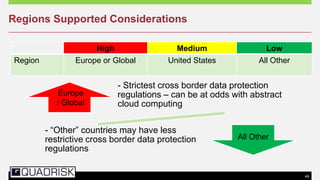
Regions Supported Considerations
High Medium Low
Region Europe or Global United States All Other
- Strictest cross border data protection
regulations – can be at odds with abstract
cloud computing
- ―Other‖ countries may have less
restrictive cross border data protection
regulations
Europe
/ Global
All Other
50
Agenda
Check in
Cloud computing defined
Service models & Types
Chartered accountants and cloud computing
Check out
51
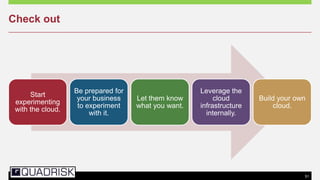
Check out
Start
experimenting
with the cloud.
Be prepared for
your business
to experiment
with it.
Let them know
what you want.
Leverage the
cloud
infrastructure
internally.
Build your own
cloud.
52
Questions???
53
Reference
www.Cloudsecurityalliance.com
www.NIST.gov
www.opencloudconsortium.org
www.csoonline.com
54
Thank you
anand@quadrisk.com
+91-9620233516

Cloud Computing - The new buzz word

  • 1.
    1 Cloud Computing - Thenews buzzword By: CA Anand Prakash Jangid
  • 2.
    2 Agenda Check in Cloud computingdefined Service models & Types Chartered accountants and cloud computing Check out
  • 4.
    4 The Future isnot, What it used to be
  • 5.
    5 Famous Technology Predictions Ithink there is a world market for maybe five computers.‘ Thomas Watson, Chairman of IBM, 1943 ‗There is no reason why anyone would want a computer in the home.‘ Ken Olson, Present, Chairman and founder of Digital Equipment Corporation, 1977 ‗640K should be enough for anybody.‘ Bill Gates, 1981 ‗So far, Java seems like a stinker to me…I have a hunch that it won't be a very successful language.‘ Paul Graham, Author
  • 6.
    6 Check in Cloud Computinghas the potential to disrupt IT as we know it today.
  • 7.
    7 Agenda Check in Cloud computingdefined Service models & Types Chartered accountants and cloud computing Check out
  • 8.
  • 9.
    9 What is CloudComputing “Cloud computing is a style of computing where massively scalable IT-related capabilities are provided as a service across the Internet to multiple external customers” “Cloud computing: A pool of abstracted, highly scalable, and managed infrastructure capable of hosting end-customer applications and billed by consumption” “Cloud computing is Web-based processing, whereby shared resources, software, and information are provided to computers and other devices (such as smart phones) on demand over the Internet.”
  • 10.
  • 11.
  • 12.
  • 13.
  • 14.
    14 Conventional Conventional cloud Manually ProvisionedSelf-provisioned Dedicated Hardware Shared Hardware Fixed Capacity Elastic Capacity Pay for Capacity Pay for Use Capital & Operational Expenses Operational Expenses Managed Conventional model vs Cloud model
  • 15.
    15 Early uses: CPUSharing example (SETI) SETI –Search for Extra-Terrestrial Intelligence •Initiative by Space Science Institute & Berkeley university •Uses screen-saver CPU time for ▫analyze radio signals from space ▫present results as a very cool (geek oriented) screen-saver •One of the first wide-spread examples of distributing processing tasks over the internet to simple users PCs
  • 16.
    16 S3 Launches/EC2 Launch ofAmazon web services The arrival of Salesforce.com Supercomputers/Mainframe 2006 2002 1990 1960 Google App / Azure 2008 - 2009 The first milestone for Cloud Computing Launches of Google App Engine/Windows Azure Beta Evolution of Cloud Computing
  • 17.
    17 • Shared /pooled resources • Broad network access • On-demand self-service • Scalable and elastic • Metered by use Five Key Cloud Attributes:
  • 18.
    18 • Resources aredrawn from a common pool • Common resources build economies of scale • Common infrastructure runs at high efficiency Shared / Pooled Resources:
  • 19.
    19 • Open standardsand APIs • Almost always IP, HTTP, and REST • Available from anywhere with an internet connection Broad Network Access:
  • 20.
    20 • Completely automated •Users abstracted from the implementation • Near real-time delivery (seconds or minutes) • Services accessed through a self-serve • web interface On-Demand Self-Service:
  • 21.
    21 • Resources dynamically-allocatedbetween users • Additional resources dynamically-released when needed • Fully automated Scalable and Elastic:
  • 22.
    22 Services are metered,like a utility Users pay only for services used Services can be cancelled at any time Metered by Use:
  • 23.
    23 Some success stories GE: Globalprocurement hosting 500k suppliers and 100k users in six languages on SaaS platform to manage $55B/yr in spend Eli Lilly : Using Amazon Web Services can deploy a new server in 3min vs 50days and a 64-node Linux cluster in 5min vs 100days Nasdaq: Using Amazon Storage to store 30-80GB/day of trading activity
  • 24.
    24 Agenda Check in Cloud computingdefined Service models & Types Chartered accountants and cloud computing Check out
  • 25.
  • 26.
  • 27.
  • 28.
  • 29.
  • 30.
    30 • Owned andmanaged by the enterprise • Limits access to enterprise and partner network • Retains high degree of control, privacy and security • Enables business to more easily customize service • Accessed from "inside" the firewall Private Cloud
  • 31.
    31 Public Cloud • Ownedand managed by service provider • Delivers select set business process, application or infrastructure services on a ―pay per use‖ basis • Highly standardized • Limited customization options • Accessed from "outside" the firewall
  • 32.
    32 Hybrid Cloud • Ahybrid infrastructure takes advantage of both public and private clouds: • Services provided over the Internet—the public cloud • Services provided by the enterprise data center—the private cloud
  • 33.
    33 SaaS PaaS IaaS Amazon Google MicrosoftSalesforce Service Delivery Model Examples Products and companies shown for illustrative purposes only and should not be construed as an endorsement
  • 34.
    34 Agenda Check in Cloud computingdefined Service models & Types Chartered accountants and cloud computing Check out
  • 35.
    35 Cloud computing andChartered Accountants
  • 36.
    36 • Regulatory compliance •Conflicts with international privacy laws, • Data ownership & location • Data Segregation • Service guarantees & lack of control • Contingency planning / disaster recovery for clouds • Investigative support • Privilege user access • Long term viability(going concern for Service provider) • IT general controls Why should we worry
  • 37.
    37 New role envisagedfor Internal audit/Risk management team
  • 38.
    38 • Business casefor moving to cloud • How does this align to business need • Understanding the current state of system and data Being part of the cloud strategy
  • 39.
    39 • Who managesthe vendor relationship • How the asset are protected • How is the responsibility divided • Impact on the present disaster recovery plan • How the vendor manage multi client environment • Where is the data physically stored • Impact of change in technology • Gap in the risk & controls of the vendors Evaluating vendors
  • 40.
    40 • Defining andmanaging the SLA and OLA • What are your and cloud service provider compliance responsibility • How are incident managed • How often are the data backed up • Who determine the user access right to data(BBMP example) Implementation of cloud computing model
  • 41.
    41 • Process ofmanaging the SLA and OLA with the vendor • How are the contractual control requirement are managed • Other related issue Last but not least …Monitoring the vendor
  • 42.
    42 Some illustration ofthe cloud risk ranking
  • 43.
    43 Attribute High (5)Med (3) Low (1) Deployment Model Public Community Private Service Model IaaS PaaS SaaS Data Security level Secret Restricted Unclassified Physical Hosting Site Undefined Int'l Location Domestic Location SOX Critical Yes No Dependent Apps Greater than 10 4 to 10 0 to 3 Recovery Time 4 Hours 7 Days 31 Days Region Supported Europe or Global US All other Cloud Risk Ranking Example
  • 44.
    44 Deployment Model Considerations HighMedium Low Deploy Model Public Community Private - Security and privacy are not a priority - Service level agreements may not exist - Private environments provide adequate security and privacy - Service level agreements should exist Public Private
  • 45.
    45 Service Model Considerations HighMedium Low Service Model IaaS PaaS SaaS - Issues may impact all hosted applications and data - No control over foundational general controls - PaaS - Impact limited to outsourced platform - SaaS - Impact limited to applications and data IaaS SaaS
  • 46.
    46 Data Security Considerations HighMedium Low Security Level Secret Restricted Unclassified - Difficult to enforce security standards when outsourcing - Difficult to demonstrate compliance with regulations - Security and privacy is not a concern (good candidate for cloud computing) Secret Unclassified
  • 47.
    47 Dependent Applications High MediumLow Number of Apps Greater than 10 4 to 9 Less than 3 - Implies complexity and greater organizational significance - Implies simplicity and less organizational significance > 10 < 3
  • 48.
    48 Recovery Time Objectives(RTO) Considerations High Medium Low RTO 4 Hours 7 days 31 Days Implies increased business importance Cloud provider may lack geographic diversity Single points of failure may exist in network Implies lower business importance - good candidate for cloud computing 4 Hours 31 Days
  • 49.
    49 Regions Supported Considerations HighMedium Low Region Europe or Global United States All Other - Strictest cross border data protection regulations – can be at odds with abstract cloud computing - ―Other‖ countries may have less restrictive cross border data protection regulations Europe / Global All Other
  • 50.
    50 Agenda Check in Cloud computingdefined Service models & Types Chartered accountants and cloud computing Check out
  • 51.
    51 Check out Start experimenting with thecloud. Be prepared for your business to experiment with it. Let them know what you want. Leverage the cloud infrastructure internally. Build your own cloud.
  • 52.
  • 53.
  • 54.