
Channel MarketingChannel Marketing
A Strategic Tool of Growing
Importance for the Next Millennium
by Muhammad Adeel Javaid
A: Over the past three decades, theA: Over the past three decades, the
overwhelming emphasis in theoverwhelming emphasis in the
Marketing Mix has been on:Marketing Mix has been on:
Product StrategyProduct Strategy withwith
Pricing StrategyPricing Strategy
andand Promotional StrategyPromotional Strategy
also being stressed.also being stressed.
But.....But.....
Channel Marketing StrategyChannel Marketing Strategy
(Place); the fourth “P” in the(Place); the fourth “P” in the
Marketing Mix hasMarketing Mix has
been largely neglectedbeen largely neglected
But this is changing....But this is changing....
Channel Marketing Strategy isChannel Marketing Strategy is
Growing in Importance. Why?Growing in Importance. Why?
Five ReasonsFive Reasons
(1)(1) Search for Sustainable CompetitiveSearch for Sustainable Competitive
AdvantageAdvantage
(2)(2) Growing Power of Retailers in MarketingGrowing Power of Retailers in Marketing
ChannelsChannels
(3)(3) The Need to Reduce Distribution CostsThe Need to Reduce Distribution Costs
(4)(4) The Increased Role and Power of TechnologyThe Increased Role and Power of Technology
(5)(5) The New Stress on GrowthThe New Stress on Growth
I. The Search for SustainableI. The Search for Sustainable
Competitive AdvantageCompetitive Advantage
Sustainable CompetitiveSustainable Competitive
Advantage:Advantage:
A competitive advantage thatA competitive advantage that
cannot be quickly and easilycannot be quickly and easily
copied by competitorscopied by competitors
A sustainable competitiveA sustainable competitive
advantage is becoming moreadvantage is becoming more
difficult to attain through:difficult to attain through:
Product StrategyProduct Strategy- rapid technology transferrapid technology transfer
enables competitors to quickly produce similarenables competitors to quickly produce similar
productsproducts
Pricing StrategyPricing Strategy- global economy allowsglobal economy allows
competitors to find low cost production to matchcompetitors to find low cost production to match
pricesprices
Promotion StrategyPromotion Strategy- high cost, clutter, and shorthigh cost, clutter, and short
life promotional campaigns limit competitivelife promotional campaigns limit competitive
advantageadvantage
Competitive Advantage BasedCompetitive Advantage Based
onon
Superior Channel MarketingSuperior Channel Marketing
Strategy is More Difficult forStrategy is More Difficult for
Competitors to CopyCompetitors to Copy
Because:Because:
Channel Strategy is Long TermChannel Strategy is Long Term
Requires a Channel StructureRequires a Channel Structure
Depends on Relationships and PeopleDepends on Relationships and People
Requires Effective InterorganizationalRequires Effective Interorganizational
ManagementManagement
II. Growing Power of RetailersII. Growing Power of Retailers
in Channel Marketingin Channel Marketing
RetailersRetailers
Retailers....Retailers....
Are Growing LargerAre Growing Larger
Enjoy Substantial Channel PowerEnjoy Substantial Channel Power
Act as Buying Agents for Customers RatherAct as Buying Agents for Customers Rather
than Selling Agents for Suppliersthan Selling Agents for Suppliers
Often Operate on Low Price / Low MarginOften Operate on Low Price / Low Margin
ModelModel
Operate in Saturated Markets and Fight forOperate in Saturated Markets and Fight for
Market ShareMarket Share
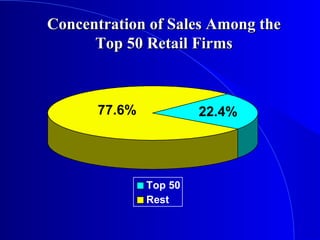
•Retailers Are Growing LargerRetailers Are Growing Larger
77.6% 22.4%
Top 50
Rest
Concentration of Sales Among theConcentration of Sales Among the
Top 50 Retail FirmsTop 50 Retail Firms
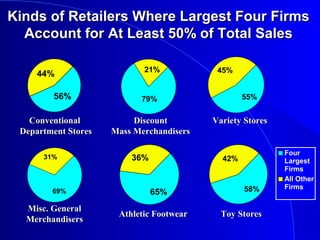
69%
31%
56%
44%
79%
21%
55%
45%
58%
42%
Four
Largest
Firms
All Other
Firms
65%
36%
Kinds of Retailers Where Largest Four FirmsKinds of Retailers Where Largest Four Firms
Account for At Least 50% of Total SalesAccount for At Least 50% of Total Sales
ConventionalConventional
Department StoresDepartment Stores
DiscountDiscount
Mass MerchandisersMass Merchandisers
Variety StoresVariety Stores
Misc. GeneralMisc. General
MerchandisersMerchandisers
Athletic FootwearAthletic Footwear Toy StoresToy Stores
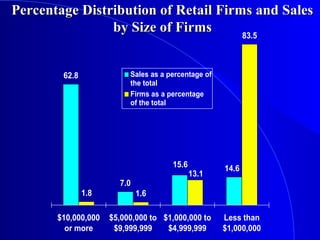
62.8
7.0
1.8 1.6
83.5
14.615.6
13.1
$10,000,000
or more
$5,000,000 to
$9,999,999
$1,000,000 to
$4,999,999
Less than
$1,000,000
Sales as a percentage of
the total
Firms as a percentage
of the total
Percentage Distribution of Retail Firms and SalesPercentage Distribution of Retail Firms and Sales
by Size of Firmsby Size of Firms
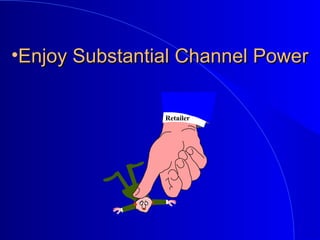
•Enjoy Substantial Channel PowerEnjoy Substantial Channel Power
Retailer
Retailers Act as Buying Agents forRetailers Act as Buying Agents for
Customers Rather than as SellingCustomers Rather than as Selling
Agents for SuppliersAgents for Suppliers
Retailers Often Operate on LowRetailers Often Operate on Low
Price / LowPrice / Low
Margin ModelMargin Model
Retailers Operate in SaturatedRetailers Operate in Saturated
Markets and Fight for MarketMarkets and Fight for Market
ShareShare
Power or Dominant Retailers arePower or Dominant Retailers are
therefore thetherefore the “Gatekeepers”“Gatekeepers” intointo
the Consumer Marketplacethe Consumer Marketplace
Thus, Effective Channel StrategyThus, Effective Channel Strategy
for Dealing withfor Dealing with
Power Retailers is CrucialPower Retailers is Crucial
III. The Need to ReduceIII. The Need to Reduce
Distribution CostsDistribution Costs
DistributionDistribution
CostsCosts
Distribution Costs Often AccountDistribution Costs Often Account
for a Significant Percentage of thefor a Significant Percentage of the
Final Price of ProductsFinal Price of Products
Sometimes Distribution CostsSometimes Distribution Costs
areare HigherHigher than the Manufacturingthan the Manufacturing
Cost or the Costs of RawCost or the Costs of Raw
Materials and Component PartsMaterials and Component Parts
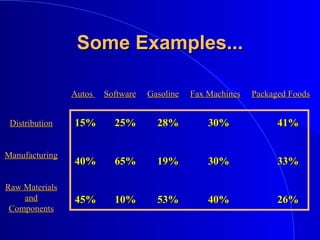
Some Examples...Some Examples...
AutosAutos SoftwareSoftware GasolineGasoline Fax MachinesFax Machines Packaged FoodsPackaged Foods
DistributionDistribution
ManufacturingManufacturing
Raw MaterialsRaw Materials
andand
ComponentsComponents
15%15%
40%40%
45%45%
25%25%
65%65%
10%10%
28%28%
19%19%
53%53%
30%30%
30%30%
40%40%
41%41%
33%33%
26%26%
While terms such as “restructuring”,While terms such as “restructuring”,
“flattening out”, “downsizing”, and“flattening out”, “downsizing”, and
“rightsizing” have usually been“rightsizing” have usually been
mentioned in the context ofmentioned in the context of
corporate organizations, they alsocorporate organizations, they also
apply to Marketing Channels.apply to Marketing Channels.
The latest term....The latest term....
DisintermediationDisintermediation
IV. Increasing Role andIV. Increasing Role and
Usefulness of TechnologyUsefulness of Technology
Technology has the power toTechnology has the power to
greatly enhance thegreatly enhance the
effectiveness and efficiency ofeffectiveness and efficiency of
Marketing Channels and couldMarketing Channels and could
potentially change the entirepotentially change the entire
structure of distribution aroundstructure of distribution around
the world.the world.
Some Examples...Some Examples...
The InternetThe Internet
Wireless CommunicationsWireless Communications
B2C and B2B E-CommerceB2C and B2B E-Commerce
Cell PhonesCell Phones
Global TelecommunicationsGlobal Telecommunications
Robotics & Automated WarehousingRobotics & Automated Warehousing
Computerized “Salespeople”Computerized “Salespeople”
Firms that make effective use ofFirms that make effective use of
these technologies in their channelthese technologies in their channel
strategy can gain astrategy can gain a substantialsubstantial
competitive advantagecompetitive advantage
CompetitionCompetition
V. The New Stress on GrowthV. The New Stress on Growth
StrategyStrategy
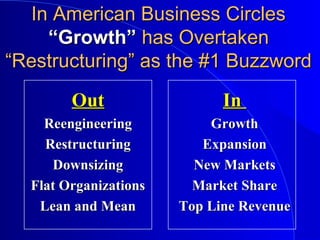
In American Business CirclesIn American Business Circles
“Growth”“Growth” has Overtakenhas Overtaken
“Restructuring” as the #1 Buzzword“Restructuring” as the #1 Buzzword
OutOut
ReengineeringReengineering
RestructuringRestructuring
DownsizingDownsizing
Flat OrganizationsFlat Organizations
Lean and MeanLean and Mean
InIn
GrowthGrowth
ExpansionExpansion
New MarketsNew Markets
Market ShareMarket Share
Top Line RevenueTop Line Revenue
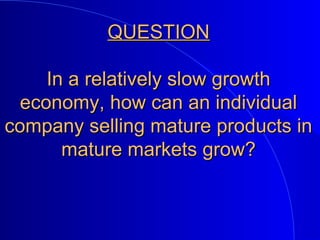
QUESTIONQUESTION
In a relatively slow growthIn a relatively slow growth
economy, how can an individualeconomy, how can an individual
company selling mature products incompany selling mature products in
mature markets grow?mature markets grow?
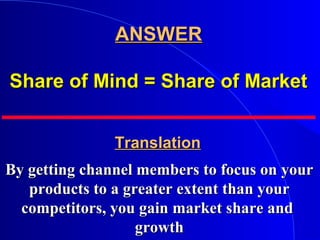
ANSWERANSWER
Share of Mind = Share of MarketShare of Mind = Share of Market
TranslationTranslation
By getting channel members to focus on yourBy getting channel members to focus on your
products to a greater extent than yourproducts to a greater extent than your
competitors, you gain market share andcompetitors, you gain market share and
growthgrowth
SummarySummary
(1)(1) Search For Competitive AdvantageSearch For Competitive Advantage
(2)(2) Growing Size and Power ofGrowing Size and Power of
RetailersRetailers
(3)(3) Need to Reduce Distribution CostsNeed to Reduce Distribution Costs
(4)(4) Power and Potential of TechnologyPower and Potential of Technology
(5)(5) Stress on Growth Instead ofStress on Growth Instead of
DownsizingDownsizing
Bottom LineBottom Line
Marketing Channel Strategy HasMarketing Channel Strategy Has
Become Critically ImportantBecome Critically Important
For Most BusinessesFor Most Businesses
Strategy in Channel MarketingStrategy in Channel Marketing
Channel StrategyChannel Strategy
The broad principles by which aThe broad principles by which a
firm expects to achieve itsfirm expects to achieve its
distribution objectives fordistribution objectives for
satisfying its customerssatisfying its customers
Basic Strategic QuestionsBasic Strategic Questions
(1)(1) What role should distribution play in the firm’sWhat role should distribution play in the firm’s
overall objectives and strategies?overall objectives and strategies?
(2)(2) What role should distribution play in theWhat role should distribution play in the
marketing mix?marketing mix?
(3)(3) How should the firm’s marketing channels beHow should the firm’s marketing channels be
designed to achieve its distribution objectives?designed to achieve its distribution objectives?
(4)(4) What kinds of channel members should beWhat kinds of channel members should be
selected to meet the firm’s distribution objectives?selected to meet the firm’s distribution objectives?
(5)(5) How can the marketing channel be managed toHow can the marketing channel be managed to
implement the firm’s channel design effectively andimplement the firm’s channel design effectively and
efficiently on a continuing basis?efficiently on a continuing basis?
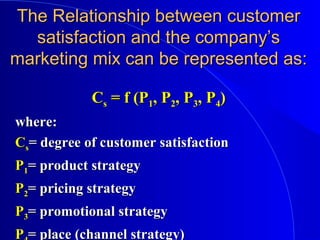
The Relationship between customerThe Relationship between customer
satisfaction and the company’ssatisfaction and the company’s
marketing mix can be represented as:marketing mix can be represented as:
CCss = f (P= f (P11, P, P22, P, P33, P, P44))
where:where:
CCss= degree of customer satisfaction= degree of customer satisfaction
PP11= product strategy= product strategy
PP22= pricing strategy= pricing strategy
PP33= promotional strategy= promotional strategy
PP = place (channel strategy)= place (channel strategy)
Distribution Channel Strategy shouldDistribution Channel Strategy should
receive especially heavy emphasis if one orreceive especially heavy emphasis if one or
more of the following conditions prevails:more of the following conditions prevails:
Distribution appears to be the most relevantDistribution appears to be the most relevant
variable for satisfying customersvariable for satisfying customers
Parity exists among competitors in the otherParity exists among competitors in the other
three marketing mix variablesthree marketing mix variables
High degree of vulnerability exists because ofHigh degree of vulnerability exists because of
competitors’ neglect of distributioncompetitors’ neglect of distribution
Distribution channel strategy can fosterDistribution channel strategy can foster
synergiessynergies
Classic Channel MarketingClassic Channel Marketing
Strategies Still Relevant TodayStrategies Still Relevant Today
Dual DistributionDual Distribution
Exclusive DealingExclusive Dealing
Full-Line ForcingFull-Line Forcing
Price DifferentiationPrice Differentiation
Price MaintenancePrice Maintenance
Refusal to DealRefusal to Deal
Resale RestrictionsResale Restrictions
Tying AgreementsTying Agreements
The Most Basic Questions in theThe Most Basic Questions in the
Design of Marketing ChannelsDesign of Marketing Channels
When Do Customers Buy?When Do Customers Buy?
Where Do Customers Buy?Where Do Customers Buy?
How Do Customers Buy?How Do Customers Buy?
Who Buys?Who Buys?
Who makes the actual purchase?Who makes the actual purchase?
Who uses the product?Who uses the product?
Who takes part in the buying decision?Who takes part in the buying decision?
Supply Chain ManagementSupply Chain Management
QUESTIONQUESTION
Is this just another “buzzword”Is this just another “buzzword”
for logistics - getting the rightfor logistics - getting the right
product in the right quantity, atproduct in the right quantity, at
the right time and right place?the right time and right place?
OROR
Is there something moreIs there something more
substantive to this term?substantive to this term?
ANSWERANSWER
ThereThere isis something more thansomething more than
semantics here:semantics here:
Supply Chain Management takes aSupply Chain Management takes a
broader perspective by viewingbroader perspective by viewing
logistics as an integral part of thelogistics as an integral part of the
marketing channelmarketing channel relationshiprelationship
Supply Chain Management CanSupply Chain Management Can
Therefore be Defined as:Therefore be Defined as:
A long-term “partnership” among marketingA long-term “partnership” among marketing
channel participants aimed at reducingchannel participants aimed at reducing
inefficiencies, costs, and redundancies in theinefficiencies, costs, and redundancies in the
logistical system in order to provide high levelslogistical system in order to provide high levels
of customer serviceof customer service
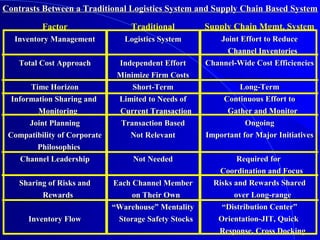
Factor
Inventory ManagementInventory Management
Total Cost ApproachTotal Cost Approach
Time HorizonTime Horizon
Information Sharing andInformation Sharing and
MonitoringMonitoring
Joint PlanningJoint Planning
Compatibility of CorporateCompatibility of Corporate
PhilosophiesPhilosophies
Channel LeadershipChannel Leadership
Sharing of Risks andSharing of Risks and
RewardsRewards
Inventory FlowInventory Flow
Traditional
Logistics SystemLogistics System
Independent EffortIndependent Effort
Minimize Firm CostsMinimize Firm Costs
Short-TermShort-Term
Limited to Needs ofLimited to Needs of
Current TransactionCurrent Transaction
Transaction BasedTransaction Based
Not RelevantNot Relevant
Not NeededNot Needed
Each Channel MemberEach Channel Member
on Their Ownon Their Own
““Warehouse” MentalityWarehouse” Mentality
Storage Safety StocksStorage Safety Stocks
Supply Chain Mgmt. System
Joint Effort to ReduceJoint Effort to Reduce
Channel InventoriesChannel Inventories
Channel-Wide Cost EfficienciesChannel-Wide Cost Efficiencies
Long-TermLong-Term
Continuous Effort toContinuous Effort to
Gather and MonitorGather and Monitor
OngoingOngoing
Important for Major InitiativesImportant for Major Initiatives
Required forRequired for
Coordination and FocusCoordination and Focus
Risks and Rewards SharedRisks and Rewards Shared
over Long-rangeover Long-range
““Distribution Center”Distribution Center”
Orientation-JIT, QuickOrientation-JIT, Quick
Response, Cross DockingResponse, Cross Docking
Contrasts Between a Traditional Logistics System and Supply Chain Based SystemContrasts Between a Traditional Logistics System and Supply Chain Based System
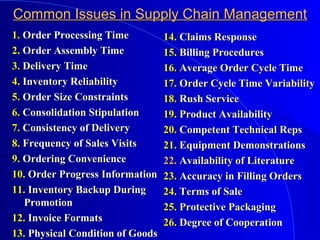
Common Issues in Supply Chain ManagementCommon Issues in Supply Chain Management
1.1. Order Processing TimeOrder Processing Time
2.2. Order Assembly TimeOrder Assembly Time
3.3. Delivery TimeDelivery Time
4.4. Inventory ReliabilityInventory Reliability
5.5. Order Size ConstraintsOrder Size Constraints
6.6. Consolidation StipulationConsolidation Stipulation
7.7. Consistency of DeliveryConsistency of Delivery
8.8. Frequency of Sales VisitsFrequency of Sales Visits
9.9. Ordering ConvenienceOrdering Convenience
10.10. Order Progress InformationOrder Progress Information
11.11. Inventory Backup DuringInventory Backup During
PromotionPromotion
12.12. Invoice FormatsInvoice Formats
13.13. Physical Condition of GoodsPhysical Condition of Goods
14.14. Claims ResponseClaims Response
15.15. Billing ProceduresBilling Procedures
16.16. Average Order Cycle TimeAverage Order Cycle Time
17.17. Order Cycle Time VariabilityOrder Cycle Time Variability
18.18. Rush ServiceRush Service
19.19. Product AvailabilityProduct Availability
20.20. Competent Technical RepsCompetent Technical Reps
21.21. Equipment DemonstrationsEquipment Demonstrations
22.22. Availability of LiteratureAvailability of Literature
23.23. Accuracy in Filling OrdersAccuracy in Filling Orders
24.24. Terms of SaleTerms of Sale
25.25. Protective PackagingProtective Packaging
26.26. Degree of CooperationDegree of Cooperation
Strategic Alliances andStrategic Alliances and
Partnerships in MarketingPartnerships in Marketing
ChannelsChannels
Definition:Definition:
Continuing and mutually supportiveContinuing and mutually supportive
relationship between the manufacturer andrelationship between the manufacturer and
its channel members in an effort to provideits channel members in an effort to provide
a more highly motivated team, network,a more highly motivated team, network,
and alliance of channel partnersand alliance of channel partners
Traditional “us-against-them”Traditional “us-against-them”
mentality is replaced with a newmentality is replaced with a new
cooperative perception of “us” incooperative perception of “us” in
an effective channel partnershipan effective channel partnership
or strategic allianceor strategic alliance
Thus, partnerships or strategicThus, partnerships or strategic
alliances go well beyond the ad-alliances go well beyond the ad-
hoc, on-again / off-againhoc, on-again / off-again
interactions typical of traditionalinteractions typical of traditional
relationships among channelrelationships among channel
membersmembers
Requirements for Partnerships orRequirements for Partnerships or
Strategic Alliances in MarketingStrategic Alliances in Marketing
ChannelsChannels
(1)(1) Recognition of interdependence of channelRecognition of interdependence of channel
membersmembers
(2)(2) Close cooperation between channel membersClose cooperation between channel members
(3)(3) Careful specification of roles, rights, andCareful specification of roles, rights, and
responsibilities in the relationshipresponsibilities in the relationship
(4)(4) Coordinated effort focused on common goalsCoordinated effort focused on common goals
(5)(5) Good communications and trust betweenGood communications and trust between
channel memberschannel members
Relationship MarketingRelationship Marketing
via the Marketing Channelvia the Marketing Channel
Relationship MarketingRelationship Marketing
The practice of building long-term relationsThe practice of building long-term relations
with key parties - customers, suppliers,with key parties - customers, suppliers,
distributors- in order to retain their long-distributors- in order to retain their long-
term preference and businessterm preference and business
Because of the importance of channels ofBecause of the importance of channels of
distribution, building good relationships indistribution, building good relationships in
the marketing channel is key to successfulthe marketing channel is key to successful
relationship marketingrelationship marketing
Building Relationships with ChannelBuilding Relationships with Channel
MembersMembers
Find Out the Needs and Problems of ChannelFind Out the Needs and Problems of Channel
MembersMembers
-informal information system (“grapevine”)-informal information system (“grapevine”)
-research studies of channel members-research studies of channel members
-research studies by outside parties-research studies by outside parties
-marketing channel audit-marketing channel audit
-distributor advisory councils-distributor advisory councils
Offer Support to Channel Members thatOffer Support to Channel Members that
is Consistent with Their Needs and Helpsis Consistent with Their Needs and Helps
Solve their ProblemsSolve their Problems
-cooperative arrangements-cooperative arrangements
-partnerships and strategic alliances-partnerships and strategic alliances
-distribution programming-distribution programming
Provide Leadership to Motivate ChannelProvide Leadership to Motivate Channel
MembersMembers
-use power effectively-use power effectively
-recognize causes of conflict-recognize causes of conflict
-resolve conflicts-resolve conflicts
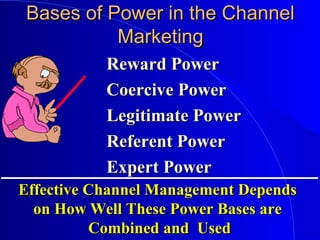
Bases of Power in the ChannelBases of Power in the Channel
MarketingMarketing
Reward PowerReward Power
Coercive PowerCoercive Power
Legitimate PowerLegitimate Power
Referent PowerReferent Power
Expert PowerExpert Power
Effective Channel Management DependsEffective Channel Management Depends
on How Well These Power Bases areon How Well These Power Bases are
Combined and UsedCombined and Used
Causes of Channel MarketingCauses of Channel Marketing
ConflictConflict
Role IncongruitiesRole Incongruities
Resource ScarcitiesResource Scarcities
Perceptual DivergenciesPerceptual Divergencies
Expectational DifferencesExpectational Differences
Decision Domain DisagreementsDecision Domain Disagreements
Goal IncompatabilitiesGoal Incompatabilities
Communication DifficultiesCommunication Difficulties
Ten Trends in Marketing ChannelsTen Trends in Marketing Channels
as We Move into the Next Millenniumas We Move into the Next Millennium
1.1. Growing Emphasis on Marketing ChannelGrowing Emphasis on Marketing Channel
StrategyStrategy
2.2. More and More Stress on TechnologyMore and More Stress on Technology
3.3. Focus on Efficiency and Reducing DistributionFocus on Efficiency and Reducing Distribution
CostsCosts
4.4. Shortening and Flattening of DistributionShortening and Flattening of Distribution
Channels (Disintermediation)Channels (Disintermediation)
5.5. Development of New Types of IntermediariesDevelopment of New Types of Intermediaries
in Channels (Reintermediation)in Channels (Reintermediation)
Trends Continued...Trends Continued...
6.6. Continued Growth in Partnerships andContinued Growth in Partnerships and
Alliances (Relationship Marketing)Alliances (Relationship Marketing)
7.7. Increasing Power for Retailers andIncreasing Power for Retailers and
Wholesalers (Gatekeepers)Wholesalers (Gatekeepers)
8.8. Mergers and Acquisitions to GainMergers and Acquisitions to Gain
Distribution CloutDistribution Clout
9.9. Flexible and Focused Distribution to MatchFlexible and Focused Distribution to Match
Micro, Niche, and Database MarketingMicro, Niche, and Database Marketing
10.10. Attention to the Behavioral Dimensions ofAttention to the Behavioral Dimensions of
Distribution to Augment TechnologyDistribution to Augment Technology

Channel marketing

  • 1.
    Channel MarketingChannel Marketing AStrategic Tool of Growing Importance for the Next Millennium by Muhammad Adeel Javaid
  • 2.
    A: Over thepast three decades, theA: Over the past three decades, the overwhelming emphasis in theoverwhelming emphasis in the Marketing Mix has been on:Marketing Mix has been on: Product StrategyProduct Strategy withwith Pricing StrategyPricing Strategy andand Promotional StrategyPromotional Strategy also being stressed.also being stressed. But.....But.....
  • 3.
    Channel Marketing StrategyChannelMarketing Strategy (Place); the fourth “P” in the(Place); the fourth “P” in the Marketing Mix hasMarketing Mix has been largely neglectedbeen largely neglected But this is changing....But this is changing....
  • 4.
    Channel Marketing StrategyisChannel Marketing Strategy is Growing in Importance. Why?Growing in Importance. Why? Five ReasonsFive Reasons (1)(1) Search for Sustainable CompetitiveSearch for Sustainable Competitive AdvantageAdvantage (2)(2) Growing Power of Retailers in MarketingGrowing Power of Retailers in Marketing ChannelsChannels (3)(3) The Need to Reduce Distribution CostsThe Need to Reduce Distribution Costs (4)(4) The Increased Role and Power of TechnologyThe Increased Role and Power of Technology (5)(5) The New Stress on GrowthThe New Stress on Growth
  • 5.
    I. The Searchfor SustainableI. The Search for Sustainable Competitive AdvantageCompetitive Advantage
  • 6.
    Sustainable CompetitiveSustainable Competitive Advantage:Advantage: Acompetitive advantage thatA competitive advantage that cannot be quickly and easilycannot be quickly and easily copied by competitorscopied by competitors
  • 7.
    A sustainable competitiveAsustainable competitive advantage is becoming moreadvantage is becoming more difficult to attain through:difficult to attain through: Product StrategyProduct Strategy- rapid technology transferrapid technology transfer enables competitors to quickly produce similarenables competitors to quickly produce similar productsproducts Pricing StrategyPricing Strategy- global economy allowsglobal economy allows competitors to find low cost production to matchcompetitors to find low cost production to match pricesprices Promotion StrategyPromotion Strategy- high cost, clutter, and shorthigh cost, clutter, and short life promotional campaigns limit competitivelife promotional campaigns limit competitive advantageadvantage
  • 8.
    Competitive Advantage BasedCompetitiveAdvantage Based onon Superior Channel MarketingSuperior Channel Marketing Strategy is More Difficult forStrategy is More Difficult for Competitors to CopyCompetitors to Copy Because:Because:
  • 9.
    Channel Strategy isLong TermChannel Strategy is Long Term Requires a Channel StructureRequires a Channel Structure Depends on Relationships and PeopleDepends on Relationships and People Requires Effective InterorganizationalRequires Effective Interorganizational ManagementManagement
  • 10.
    II. Growing Powerof RetailersII. Growing Power of Retailers in Channel Marketingin Channel Marketing RetailersRetailers
  • 11.
    Retailers....Retailers.... Are Growing LargerAreGrowing Larger Enjoy Substantial Channel PowerEnjoy Substantial Channel Power Act as Buying Agents for Customers RatherAct as Buying Agents for Customers Rather than Selling Agents for Suppliersthan Selling Agents for Suppliers Often Operate on Low Price / Low MarginOften Operate on Low Price / Low Margin ModelModel Operate in Saturated Markets and Fight forOperate in Saturated Markets and Fight for Market ShareMarket Share
  • 12.
    •Retailers Are GrowingLargerRetailers Are Growing Larger
  • 13.
    77.6% 22.4% Top 50 Rest Concentrationof Sales Among theConcentration of Sales Among the Top 50 Retail FirmsTop 50 Retail Firms
  • 14.
    69% 31% 56% 44% 79% 21% 55% 45% 58% 42% Four Largest Firms All Other Firms 65% 36% Kinds ofRetailers Where Largest Four FirmsKinds of Retailers Where Largest Four Firms Account for At Least 50% of Total SalesAccount for At Least 50% of Total Sales ConventionalConventional Department StoresDepartment Stores DiscountDiscount Mass MerchandisersMass Merchandisers Variety StoresVariety Stores Misc. GeneralMisc. General MerchandisersMerchandisers Athletic FootwearAthletic Footwear Toy StoresToy Stores
  • 15.
    62.8 7.0 1.8 1.6 83.5 14.615.6 13.1 $10,000,000 or more $5,000,000to $9,999,999 $1,000,000 to $4,999,999 Less than $1,000,000 Sales as a percentage of the total Firms as a percentage of the total Percentage Distribution of Retail Firms and SalesPercentage Distribution of Retail Firms and Sales by Size of Firmsby Size of Firms
  • 16.
    •Enjoy Substantial ChannelPowerEnjoy Substantial Channel Power Retailer
  • 17.
    Retailers Act asBuying Agents forRetailers Act as Buying Agents for Customers Rather than as SellingCustomers Rather than as Selling Agents for SuppliersAgents for Suppliers
  • 18.
    Retailers Often Operateon LowRetailers Often Operate on Low Price / LowPrice / Low Margin ModelMargin Model
  • 19.
    Retailers Operate inSaturatedRetailers Operate in Saturated Markets and Fight for MarketMarkets and Fight for Market ShareShare
  • 20.
    Power or DominantRetailers arePower or Dominant Retailers are therefore thetherefore the “Gatekeepers”“Gatekeepers” intointo the Consumer Marketplacethe Consumer Marketplace Thus, Effective Channel StrategyThus, Effective Channel Strategy for Dealing withfor Dealing with Power Retailers is CrucialPower Retailers is Crucial
  • 21.
    III. The Needto ReduceIII. The Need to Reduce Distribution CostsDistribution Costs DistributionDistribution CostsCosts
  • 22.
    Distribution Costs OftenAccountDistribution Costs Often Account for a Significant Percentage of thefor a Significant Percentage of the Final Price of ProductsFinal Price of Products Sometimes Distribution CostsSometimes Distribution Costs areare HigherHigher than the Manufacturingthan the Manufacturing Cost or the Costs of RawCost or the Costs of Raw Materials and Component PartsMaterials and Component Parts
  • 23.
    Some Examples...Some Examples... AutosAutosSoftwareSoftware GasolineGasoline Fax MachinesFax Machines Packaged FoodsPackaged Foods DistributionDistribution ManufacturingManufacturing Raw MaterialsRaw Materials andand ComponentsComponents 15%15% 40%40% 45%45% 25%25% 65%65% 10%10% 28%28% 19%19% 53%53% 30%30% 30%30% 40%40% 41%41% 33%33% 26%26%
  • 24.
    While terms suchas “restructuring”,While terms such as “restructuring”, “flattening out”, “downsizing”, and“flattening out”, “downsizing”, and “rightsizing” have usually been“rightsizing” have usually been mentioned in the context ofmentioned in the context of corporate organizations, they alsocorporate organizations, they also apply to Marketing Channels.apply to Marketing Channels. The latest term....The latest term.... DisintermediationDisintermediation
  • 25.
    IV. Increasing RoleandIV. Increasing Role and Usefulness of TechnologyUsefulness of Technology
  • 26.
    Technology has thepower toTechnology has the power to greatly enhance thegreatly enhance the effectiveness and efficiency ofeffectiveness and efficiency of Marketing Channels and couldMarketing Channels and could potentially change the entirepotentially change the entire structure of distribution aroundstructure of distribution around the world.the world.
  • 27.
    Some Examples...Some Examples... TheInternetThe Internet Wireless CommunicationsWireless Communications B2C and B2B E-CommerceB2C and B2B E-Commerce Cell PhonesCell Phones Global TelecommunicationsGlobal Telecommunications Robotics & Automated WarehousingRobotics & Automated Warehousing Computerized “Salespeople”Computerized “Salespeople”
  • 28.
    Firms that makeeffective use ofFirms that make effective use of these technologies in their channelthese technologies in their channel strategy can gain astrategy can gain a substantialsubstantial competitive advantagecompetitive advantage CompetitionCompetition
  • 29.
    V. The NewStress on GrowthV. The New Stress on Growth StrategyStrategy
  • 30.
    In American BusinessCirclesIn American Business Circles “Growth”“Growth” has Overtakenhas Overtaken “Restructuring” as the #1 Buzzword“Restructuring” as the #1 Buzzword OutOut ReengineeringReengineering RestructuringRestructuring DownsizingDownsizing Flat OrganizationsFlat Organizations Lean and MeanLean and Mean InIn GrowthGrowth ExpansionExpansion New MarketsNew Markets Market ShareMarket Share Top Line RevenueTop Line Revenue
  • 31.
    QUESTIONQUESTION In a relativelyslow growthIn a relatively slow growth economy, how can an individualeconomy, how can an individual company selling mature products incompany selling mature products in mature markets grow?mature markets grow?
  • 32.
    ANSWERANSWER Share of Mind= Share of MarketShare of Mind = Share of Market TranslationTranslation By getting channel members to focus on yourBy getting channel members to focus on your products to a greater extent than yourproducts to a greater extent than your competitors, you gain market share andcompetitors, you gain market share and growthgrowth
  • 33.
    SummarySummary (1)(1) Search ForCompetitive AdvantageSearch For Competitive Advantage (2)(2) Growing Size and Power ofGrowing Size and Power of RetailersRetailers (3)(3) Need to Reduce Distribution CostsNeed to Reduce Distribution Costs (4)(4) Power and Potential of TechnologyPower and Potential of Technology (5)(5) Stress on Growth Instead ofStress on Growth Instead of DownsizingDownsizing
  • 34.
    Bottom LineBottom Line MarketingChannel Strategy HasMarketing Channel Strategy Has Become Critically ImportantBecome Critically Important For Most BusinessesFor Most Businesses
  • 35.
    Strategy in ChannelMarketingStrategy in Channel Marketing
  • 36.
    Channel StrategyChannel Strategy Thebroad principles by which aThe broad principles by which a firm expects to achieve itsfirm expects to achieve its distribution objectives fordistribution objectives for satisfying its customerssatisfying its customers
  • 37.
    Basic Strategic QuestionsBasicStrategic Questions (1)(1) What role should distribution play in the firm’sWhat role should distribution play in the firm’s overall objectives and strategies?overall objectives and strategies? (2)(2) What role should distribution play in theWhat role should distribution play in the marketing mix?marketing mix? (3)(3) How should the firm’s marketing channels beHow should the firm’s marketing channels be designed to achieve its distribution objectives?designed to achieve its distribution objectives? (4)(4) What kinds of channel members should beWhat kinds of channel members should be selected to meet the firm’s distribution objectives?selected to meet the firm’s distribution objectives? (5)(5) How can the marketing channel be managed toHow can the marketing channel be managed to implement the firm’s channel design effectively andimplement the firm’s channel design effectively and efficiently on a continuing basis?efficiently on a continuing basis?
  • 38.
    The Relationship betweencustomerThe Relationship between customer satisfaction and the company’ssatisfaction and the company’s marketing mix can be represented as:marketing mix can be represented as: CCss = f (P= f (P11, P, P22, P, P33, P, P44)) where:where: CCss= degree of customer satisfaction= degree of customer satisfaction PP11= product strategy= product strategy PP22= pricing strategy= pricing strategy PP33= promotional strategy= promotional strategy PP = place (channel strategy)= place (channel strategy)
  • 39.
    Distribution Channel StrategyshouldDistribution Channel Strategy should receive especially heavy emphasis if one orreceive especially heavy emphasis if one or more of the following conditions prevails:more of the following conditions prevails: Distribution appears to be the most relevantDistribution appears to be the most relevant variable for satisfying customersvariable for satisfying customers Parity exists among competitors in the otherParity exists among competitors in the other three marketing mix variablesthree marketing mix variables High degree of vulnerability exists because ofHigh degree of vulnerability exists because of competitors’ neglect of distributioncompetitors’ neglect of distribution Distribution channel strategy can fosterDistribution channel strategy can foster synergiessynergies
  • 40.
    Classic Channel MarketingClassicChannel Marketing Strategies Still Relevant TodayStrategies Still Relevant Today Dual DistributionDual Distribution Exclusive DealingExclusive Dealing Full-Line ForcingFull-Line Forcing Price DifferentiationPrice Differentiation Price MaintenancePrice Maintenance Refusal to DealRefusal to Deal Resale RestrictionsResale Restrictions Tying AgreementsTying Agreements
  • 41.
    The Most BasicQuestions in theThe Most Basic Questions in the Design of Marketing ChannelsDesign of Marketing Channels When Do Customers Buy?When Do Customers Buy? Where Do Customers Buy?Where Do Customers Buy? How Do Customers Buy?How Do Customers Buy? Who Buys?Who Buys? Who makes the actual purchase?Who makes the actual purchase? Who uses the product?Who uses the product? Who takes part in the buying decision?Who takes part in the buying decision?
  • 42.
  • 43.
    QUESTIONQUESTION Is this justanother “buzzword”Is this just another “buzzword” for logistics - getting the rightfor logistics - getting the right product in the right quantity, atproduct in the right quantity, at the right time and right place?the right time and right place? OROR Is there something moreIs there something more substantive to this term?substantive to this term?
  • 44.
    ANSWERANSWER ThereThere isis somethingmore thansomething more than semantics here:semantics here: Supply Chain Management takes aSupply Chain Management takes a broader perspective by viewingbroader perspective by viewing logistics as an integral part of thelogistics as an integral part of the marketing channelmarketing channel relationshiprelationship
  • 45.
    Supply Chain ManagementCanSupply Chain Management Can Therefore be Defined as:Therefore be Defined as: A long-term “partnership” among marketingA long-term “partnership” among marketing channel participants aimed at reducingchannel participants aimed at reducing inefficiencies, costs, and redundancies in theinefficiencies, costs, and redundancies in the logistical system in order to provide high levelslogistical system in order to provide high levels of customer serviceof customer service
  • 46.
    Factor Inventory ManagementInventory Management TotalCost ApproachTotal Cost Approach Time HorizonTime Horizon Information Sharing andInformation Sharing and MonitoringMonitoring Joint PlanningJoint Planning Compatibility of CorporateCompatibility of Corporate PhilosophiesPhilosophies Channel LeadershipChannel Leadership Sharing of Risks andSharing of Risks and RewardsRewards Inventory FlowInventory Flow Traditional Logistics SystemLogistics System Independent EffortIndependent Effort Minimize Firm CostsMinimize Firm Costs Short-TermShort-Term Limited to Needs ofLimited to Needs of Current TransactionCurrent Transaction Transaction BasedTransaction Based Not RelevantNot Relevant Not NeededNot Needed Each Channel MemberEach Channel Member on Their Ownon Their Own ““Warehouse” MentalityWarehouse” Mentality Storage Safety StocksStorage Safety Stocks Supply Chain Mgmt. System Joint Effort to ReduceJoint Effort to Reduce Channel InventoriesChannel Inventories Channel-Wide Cost EfficienciesChannel-Wide Cost Efficiencies Long-TermLong-Term Continuous Effort toContinuous Effort to Gather and MonitorGather and Monitor OngoingOngoing Important for Major InitiativesImportant for Major Initiatives Required forRequired for Coordination and FocusCoordination and Focus Risks and Rewards SharedRisks and Rewards Shared over Long-rangeover Long-range ““Distribution Center”Distribution Center” Orientation-JIT, QuickOrientation-JIT, Quick Response, Cross DockingResponse, Cross Docking Contrasts Between a Traditional Logistics System and Supply Chain Based SystemContrasts Between a Traditional Logistics System and Supply Chain Based System
  • 47.
    Common Issues inSupply Chain ManagementCommon Issues in Supply Chain Management 1.1. Order Processing TimeOrder Processing Time 2.2. Order Assembly TimeOrder Assembly Time 3.3. Delivery TimeDelivery Time 4.4. Inventory ReliabilityInventory Reliability 5.5. Order Size ConstraintsOrder Size Constraints 6.6. Consolidation StipulationConsolidation Stipulation 7.7. Consistency of DeliveryConsistency of Delivery 8.8. Frequency of Sales VisitsFrequency of Sales Visits 9.9. Ordering ConvenienceOrdering Convenience 10.10. Order Progress InformationOrder Progress Information 11.11. Inventory Backup DuringInventory Backup During PromotionPromotion 12.12. Invoice FormatsInvoice Formats 13.13. Physical Condition of GoodsPhysical Condition of Goods 14.14. Claims ResponseClaims Response 15.15. Billing ProceduresBilling Procedures 16.16. Average Order Cycle TimeAverage Order Cycle Time 17.17. Order Cycle Time VariabilityOrder Cycle Time Variability 18.18. Rush ServiceRush Service 19.19. Product AvailabilityProduct Availability 20.20. Competent Technical RepsCompetent Technical Reps 21.21. Equipment DemonstrationsEquipment Demonstrations 22.22. Availability of LiteratureAvailability of Literature 23.23. Accuracy in Filling OrdersAccuracy in Filling Orders 24.24. Terms of SaleTerms of Sale 25.25. Protective PackagingProtective Packaging 26.26. Degree of CooperationDegree of Cooperation
  • 48.
    Strategic Alliances andStrategicAlliances and Partnerships in MarketingPartnerships in Marketing ChannelsChannels
  • 49.
    Definition:Definition: Continuing and mutuallysupportiveContinuing and mutually supportive relationship between the manufacturer andrelationship between the manufacturer and its channel members in an effort to provideits channel members in an effort to provide a more highly motivated team, network,a more highly motivated team, network, and alliance of channel partnersand alliance of channel partners
  • 50.
    Traditional “us-against-them”Traditional “us-against-them” mentalityis replaced with a newmentality is replaced with a new cooperative perception of “us” incooperative perception of “us” in an effective channel partnershipan effective channel partnership or strategic allianceor strategic alliance Thus, partnerships or strategicThus, partnerships or strategic alliances go well beyond the ad-alliances go well beyond the ad- hoc, on-again / off-againhoc, on-again / off-again interactions typical of traditionalinteractions typical of traditional relationships among channelrelationships among channel membersmembers
  • 51.
    Requirements for PartnershipsorRequirements for Partnerships or Strategic Alliances in MarketingStrategic Alliances in Marketing ChannelsChannels (1)(1) Recognition of interdependence of channelRecognition of interdependence of channel membersmembers (2)(2) Close cooperation between channel membersClose cooperation between channel members (3)(3) Careful specification of roles, rights, andCareful specification of roles, rights, and responsibilities in the relationshipresponsibilities in the relationship (4)(4) Coordinated effort focused on common goalsCoordinated effort focused on common goals (5)(5) Good communications and trust betweenGood communications and trust between channel memberschannel members
  • 52.
    Relationship MarketingRelationship Marketing viathe Marketing Channelvia the Marketing Channel
  • 53.
    Relationship MarketingRelationship Marketing Thepractice of building long-term relationsThe practice of building long-term relations with key parties - customers, suppliers,with key parties - customers, suppliers, distributors- in order to retain their long-distributors- in order to retain their long- term preference and businessterm preference and business Because of the importance of channels ofBecause of the importance of channels of distribution, building good relationships indistribution, building good relationships in the marketing channel is key to successfulthe marketing channel is key to successful relationship marketingrelationship marketing
  • 54.
    Building Relationships withChannelBuilding Relationships with Channel MembersMembers Find Out the Needs and Problems of ChannelFind Out the Needs and Problems of Channel MembersMembers -informal information system (“grapevine”)-informal information system (“grapevine”) -research studies of channel members-research studies of channel members -research studies by outside parties-research studies by outside parties -marketing channel audit-marketing channel audit -distributor advisory councils-distributor advisory councils
  • 55.
    Offer Support toChannel Members thatOffer Support to Channel Members that is Consistent with Their Needs and Helpsis Consistent with Their Needs and Helps Solve their ProblemsSolve their Problems -cooperative arrangements-cooperative arrangements -partnerships and strategic alliances-partnerships and strategic alliances -distribution programming-distribution programming Provide Leadership to Motivate ChannelProvide Leadership to Motivate Channel MembersMembers -use power effectively-use power effectively -recognize causes of conflict-recognize causes of conflict -resolve conflicts-resolve conflicts
  • 56.
    Bases of Powerin the ChannelBases of Power in the Channel MarketingMarketing Reward PowerReward Power Coercive PowerCoercive Power Legitimate PowerLegitimate Power Referent PowerReferent Power Expert PowerExpert Power Effective Channel Management DependsEffective Channel Management Depends on How Well These Power Bases areon How Well These Power Bases are Combined and UsedCombined and Used
  • 57.
    Causes of ChannelMarketingCauses of Channel Marketing ConflictConflict Role IncongruitiesRole Incongruities Resource ScarcitiesResource Scarcities Perceptual DivergenciesPerceptual Divergencies Expectational DifferencesExpectational Differences Decision Domain DisagreementsDecision Domain Disagreements Goal IncompatabilitiesGoal Incompatabilities Communication DifficultiesCommunication Difficulties
  • 58.
    Ten Trends inMarketing ChannelsTen Trends in Marketing Channels as We Move into the Next Millenniumas We Move into the Next Millennium 1.1. Growing Emphasis on Marketing ChannelGrowing Emphasis on Marketing Channel StrategyStrategy 2.2. More and More Stress on TechnologyMore and More Stress on Technology 3.3. Focus on Efficiency and Reducing DistributionFocus on Efficiency and Reducing Distribution CostsCosts 4.4. Shortening and Flattening of DistributionShortening and Flattening of Distribution Channels (Disintermediation)Channels (Disintermediation) 5.5. Development of New Types of IntermediariesDevelopment of New Types of Intermediaries in Channels (Reintermediation)in Channels (Reintermediation)
  • 59.
    Trends Continued...Trends Continued... 6.6.Continued Growth in Partnerships andContinued Growth in Partnerships and Alliances (Relationship Marketing)Alliances (Relationship Marketing) 7.7. Increasing Power for Retailers andIncreasing Power for Retailers and Wholesalers (Gatekeepers)Wholesalers (Gatekeepers) 8.8. Mergers and Acquisitions to GainMergers and Acquisitions to Gain Distribution CloutDistribution Clout 9.9. Flexible and Focused Distribution to MatchFlexible and Focused Distribution to Match Micro, Niche, and Database MarketingMicro, Niche, and Database Marketing 10.10. Attention to the Behavioral Dimensions ofAttention to the Behavioral Dimensions of Distribution to Augment TechnologyDistribution to Augment Technology