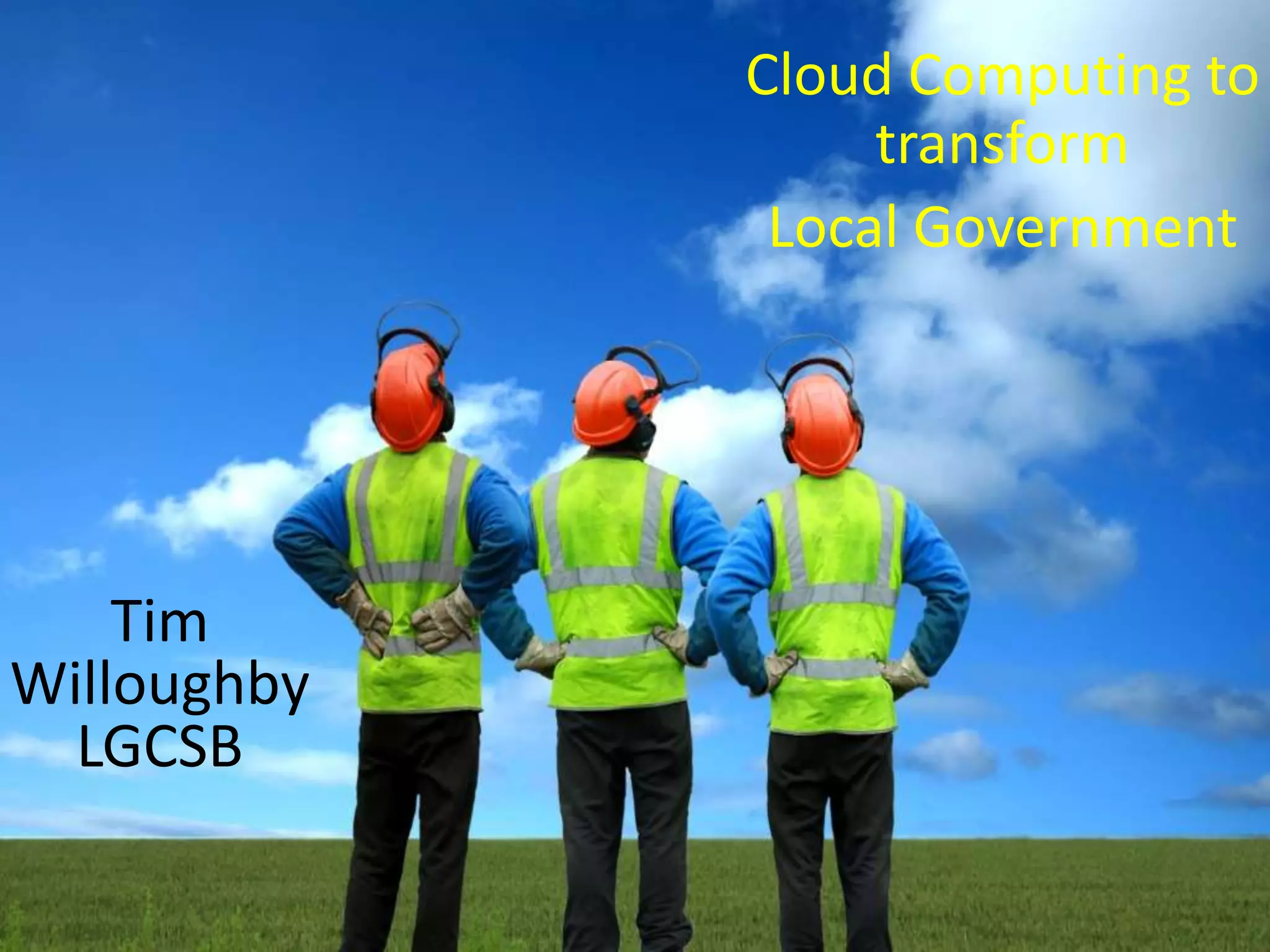


Cloud Computing to
                  transform
              Local Government


    Tim
Willoughby
  LGCSB
Not all Clouds are good!
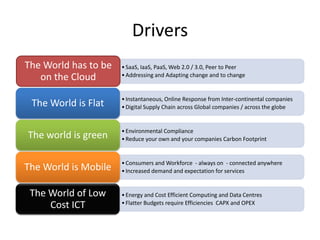
Drivers
The World has to be   • SaaS, IaaS, PaaS, Web 2.0 / 3.0, Peer to Peer
   on the Cloud       • Addressing and Adapting change and to change


                      • Instantaneous, Online Response from Inter-continental companies
 The World is Flat    • Digital Supply Chain across Global companies / across the globe


                      • Environmental Compliance
The world is green    • Reduce your own and your companies Carbon Footprint


                      • Consumers and Workforce - always on - connected anywhere
The World is Mobile   • Increased demand and expectation for services


 The World of Low     • Energy and Cost Efficient Computing and Data Centres
     Cost ICT         • Flatter Budgets require Efficiencies CAPX and OPEX
Security is changing
• Security has to be appropriate
• Security has to be measured
• Can have things so secure that they are
  unusable.
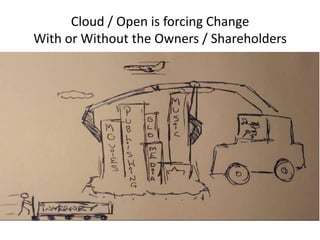
Cloud / Open is forcing Change
With or Without the Owners / Shareholders
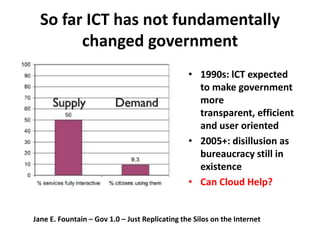
So far ICT has not fundamentally
        changed government
                                                • 1990s: lCT expected
                                                  to make government
                                                  more
                                                  transparent, efficient
                                                  and user oriented
                                                • 2005+: disillusion as
                                                  bureaucracy still in
                                                  existence
                                                • Can Cloud Help?


Jane E. Fountain – Gov 1.0 – Just Replicating the Silos on the Internet
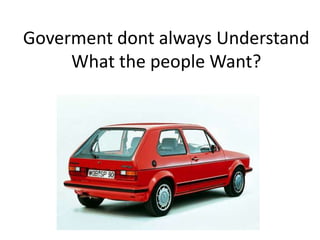
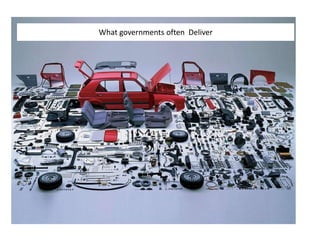
Goverment dont always Understand
     What the people Want?
What governments often Deliver
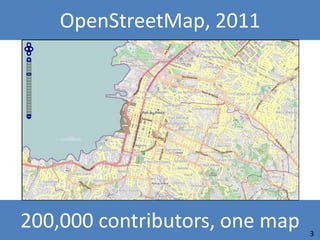
why is crowd sourcing important?

   Crowd Source –
   Group Collaboration is
   more powerful than
   individual achievement


                               1
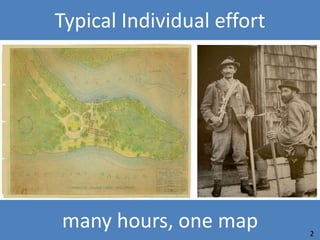
Typical Individual effort


many hours, one map         2
OpenStreetMap, 2011


200,000 contributors, one map   3
why is open source important?

      "Given enough eyeballs, all
      bugs are shallow."

      - Eric S.
      Raymond,         co-
      founder of the Open Source
      Initiative


                                    7
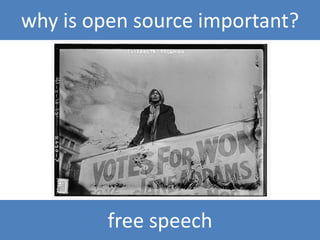
why is open source important?


         free speech
why is open source important?

      “Think free as in free
      speech, not free beer.”

      - Richard Stallman, founder
      of the Free Software
      Foundation


                                    10
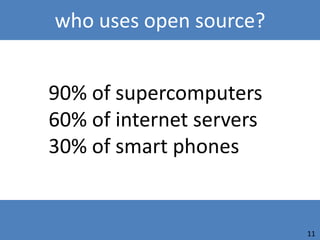
who uses open source?


90% of supercomputers
60% of internet servers
30% of smart phones


                          11
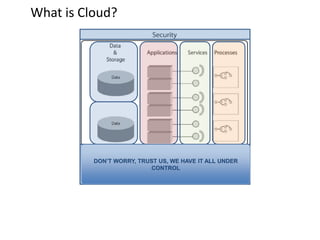
What is Cloud?


          DON’T WORRY, TRUST US, WE HAVE IT ALL UNDER
                          CONTROL
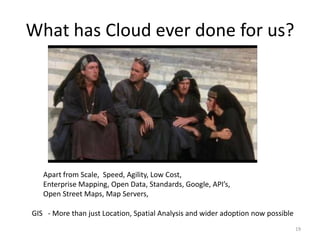
What has Cloud ever done for us?


   Apart from Scale, Speed, Agility, Low Cost,
   Enterprise Mapping, Open Data, Standards, Google, API’s,
   Open Street Maps, Map Servers,

GIS - More than just Location, Spatial Analysis and wider adoption now possible
                                                                                  19
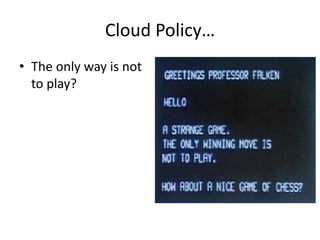
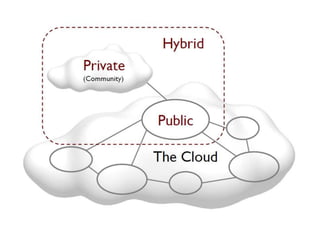
Cloud Policy…
• The only way is not
  to play?
Mashup
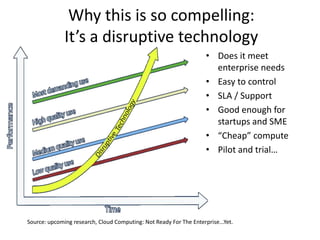
Why this is so compelling:
              It’s a disruptive technology
                                                                    • Does it meet
                                                                      enterprise needs
                                                                    • Easy to control
                                                                    • SLA / Support
                                                                    • Good enough for
                                                                      startups and SME
                                                                    • “Cheap” compute
                                                                    • Pilot and trial…


Source: upcoming research, Cloud Computing: Not Ready For The Enterprise...Yet.
In how many years…
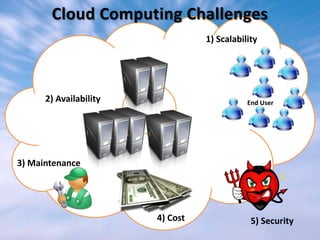
Cloud Computing Challenges
                                  1) Scalability


      2) Availability                        End User


3) Maintenance


                        4) Cost               5) Security
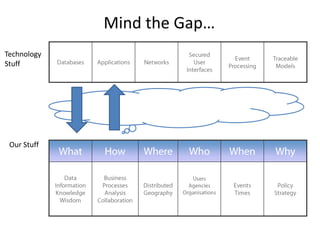
Mind the Gap…
Technology
Stuff


 Our Stuff
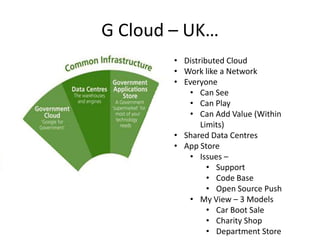
G Cloud – UK…
        • Distributed Cloud
        • Work like a Network
        • Everyone
           • Can See
           • Can Play
           • Can Add Value (Within
               Limits)
        • Shared Data Centres
        • App Store
           • Issues –
                 • Support
                 • Code Base
                 • Open Source Push
           • My View – 3 Models
                 • Car Boot Sale
                 • Charity Shop
                 • Department Store
Smart Cities
Gartner: “networked sensors in everything we own will form a
new Web (the Internet of Things). But it will only be of value if
the ‘terabyte torrent’ of data it generates could be
collected, analysed and interpreted”


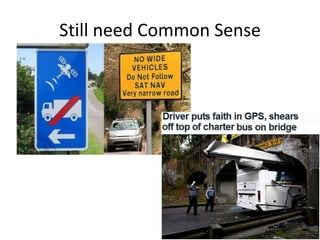
                                        … and .. just because we can….
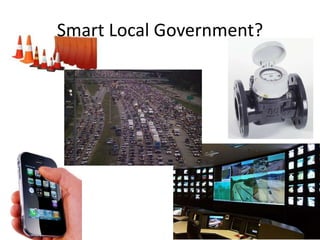
Smart Local Government?
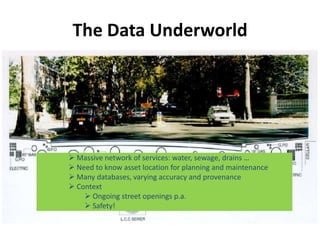
The Data Underworld


 Massive network of services: water, sewage, drains …
 Need to know asset location for planning and maintenance
 Many databases, varying accuracy and provenance
 Context
     Ongoing street openings p.a.
     Safety!
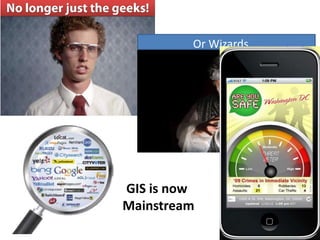
Or Wizards


GIS is now
Mainstream
Still need Common Sense
Open Data
• Smart City – Living Lab – Access to “all” the
  data captured
• Linked Open Data
• Open Data Formats
• Standards
The Currency of your data
• Automating Change
  Management
• Information where and when it
  is required
• Flexible digital delivery
• Data Accuracy Improvement
• Do you trust your Data enough
  to share it?
Data Standards
• Cannot Adopt Standards from software
  Suppliers.
• Have to move away from this position!
• Need Open Standards
• Standards for Everything, even the Location of
  Public Toilets…
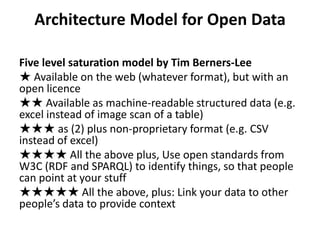
Architecture Model for Open Data

Five level saturation model by Tim Berners-Lee
★ Available on the web (whatever format), but with an
open licence
★★ Available as machine-readable structured data (e.g.
excel instead of image scan of a table)
★★★ as (2) plus non-proprietary format (e.g. CSV
instead of excel)
★★★★ All the above plus, Use open standards from
W3C (RDF and SPARQL) to identify things, so that people
can point at your stuff
★★★★★ All the above, plus: Link your data to other
people’s data to provide context
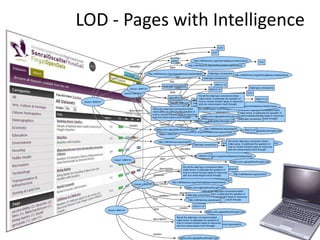
LOD - Pages with Intelligence
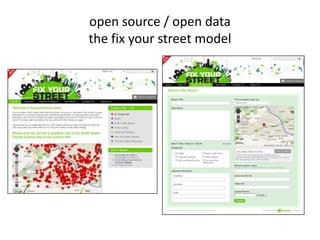
open source / open data
the fix your street model
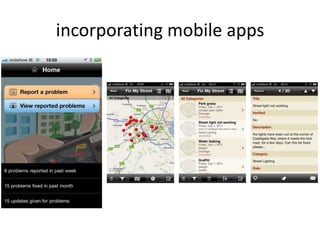
incorporating mobile apps
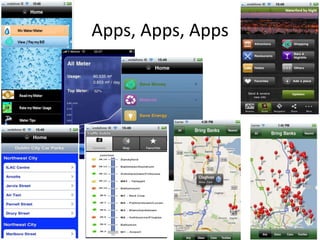
Apps, Apps, Apps
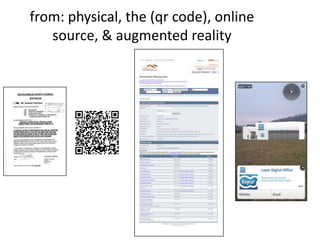
from: physical, the (qr code), online
   source, & augmented reality
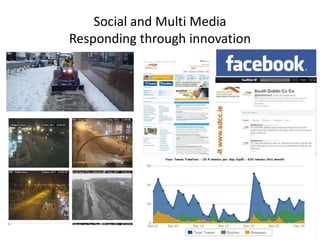
Social and Multi Media
Responding through innovation
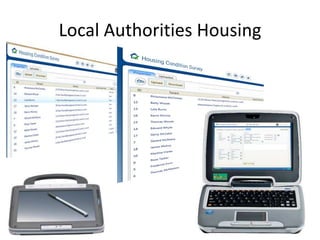
Local Authorities Housing
What have we done so far…

• Virtualisation savings
  – Over 750 servers virtualised in sector
  – Savings of over €7.50m over five-year period
  – Further savings through licence consolidation may
    be possible
• Government Networks
  – Shared data network for public sector
  – Huge Savings for LG sector
What do Clouds currently not do?
• Anything subject to compliancy
  – Includes PCI-compliant applications
• Apps that call back to performance sensitive
  services in your data centre
• Apps that require tight coupling between
  instances
• Sensitive Data
• Large applications that don’t fit inside VMs
Cloud conclusions
•   Government cannot ignore cloud
•   Public Cloud and Big Data
•   Public Cloud and Open Data
•   SLA needs to be more Open
•   Future is Cloudy

Cloud Opportunities for Local Governmen

  • 1.
    Cloud Computing to transform Local Government Tim Willoughby LGCSB
  • 2.
    Not all Cloudsare good!
  • 3.
    Drivers The World hasto be • SaaS, IaaS, PaaS, Web 2.0 / 3.0, Peer to Peer on the Cloud • Addressing and Adapting change and to change • Instantaneous, Online Response from Inter-continental companies The World is Flat • Digital Supply Chain across Global companies / across the globe • Environmental Compliance The world is green • Reduce your own and your companies Carbon Footprint • Consumers and Workforce - always on - connected anywhere The World is Mobile • Increased demand and expectation for services The World of Low • Energy and Cost Efficient Computing and Data Centres Cost ICT • Flatter Budgets require Efficiencies CAPX and OPEX
  • 5.
    Security is changing •Security has to be appropriate • Security has to be measured • Can have things so secure that they are unusable.
  • 6.
    Cloud / Openis forcing Change With or Without the Owners / Shareholders
  • 8.
    So far ICThas not fundamentally changed government • 1990s: lCT expected to make government more transparent, efficient and user oriented • 2005+: disillusion as bureaucracy still in existence • Can Cloud Help? Jane E. Fountain – Gov 1.0 – Just Replicating the Silos on the Internet
  • 9.
    Goverment dont alwaysUnderstand What the people Want?
  • 10.
  • 11.
    why is crowdsourcing important? Crowd Source – Group Collaboration is more powerful than individual achievement 1
  • 12.
  • 13.
  • 14.
    why is opensource important? "Given enough eyeballs, all bugs are shallow." - Eric S. Raymond, co- founder of the Open Source Initiative 7
  • 15.
    why is opensource important? free speech
  • 16.
    why is opensource important? “Think free as in free speech, not free beer.” - Richard Stallman, founder of the Free Software Foundation 10
  • 17.
    who uses opensource? 90% of supercomputers 60% of internet servers 30% of smart phones 11
  • 18.
    What is Cloud? DON’T WORRY, TRUST US, WE HAVE IT ALL UNDER CONTROL
  • 19.
    What has Cloudever done for us? Apart from Scale, Speed, Agility, Low Cost, Enterprise Mapping, Open Data, Standards, Google, API’s, Open Street Maps, Map Servers, GIS - More than just Location, Spatial Analysis and wider adoption now possible 19
  • 20.
    Cloud Policy… • Theonly way is not to play?
  • 21.
  • 22.
    Why this isso compelling: It’s a disruptive technology • Does it meet enterprise needs • Easy to control • SLA / Support • Good enough for startups and SME • “Cheap” compute • Pilot and trial… Source: upcoming research, Cloud Computing: Not Ready For The Enterprise...Yet.
  • 24.
    In how manyyears…
  • 25.
    Cloud Computing Challenges 1) Scalability 2) Availability End User 3) Maintenance 4) Cost 5) Security
  • 26.
  • 27.
    G Cloud –UK… • Distributed Cloud • Work like a Network • Everyone • Can See • Can Play • Can Add Value (Within Limits) • Shared Data Centres • App Store • Issues – • Support • Code Base • Open Source Push • My View – 3 Models • Car Boot Sale • Charity Shop • Department Store
  • 29.
    Smart Cities Gartner: “networkedsensors in everything we own will form a new Web (the Internet of Things). But it will only be of value if the ‘terabyte torrent’ of data it generates could be collected, analysed and interpreted” … and .. just because we can….
  • 30.
  • 31.
    The Data Underworld Massive network of services: water, sewage, drains …  Need to know asset location for planning and maintenance  Many databases, varying accuracy and provenance  Context  Ongoing street openings p.a.  Safety!
  • 33.
    Or Wizards GIS isnow Mainstream
  • 34.
  • 35.
    Open Data • SmartCity – Living Lab – Access to “all” the data captured • Linked Open Data • Open Data Formats • Standards
  • 36.
    The Currency ofyour data • Automating Change Management • Information where and when it is required • Flexible digital delivery • Data Accuracy Improvement • Do you trust your Data enough to share it?
  • 37.
    Data Standards • CannotAdopt Standards from software Suppliers. • Have to move away from this position! • Need Open Standards • Standards for Everything, even the Location of Public Toilets…
  • 38.
    Architecture Model forOpen Data Five level saturation model by Tim Berners-Lee ★ Available on the web (whatever format), but with an open licence ★★ Available as machine-readable structured data (e.g. excel instead of image scan of a table) ★★★ as (2) plus non-proprietary format (e.g. CSV instead of excel) ★★★★ All the above plus, Use open standards from W3C (RDF and SPARQL) to identify things, so that people can point at your stuff ★★★★★ All the above, plus: Link your data to other people’s data to provide context
  • 39.
    LOD - Pageswith Intelligence
  • 40.
    open source /open data the fix your street model
  • 41.
  • 42.
  • 43.
    from: physical, the(qr code), online source, & augmented reality
  • 44.
    Social and MultiMedia Responding through innovation
  • 45.
  • 47.
    What have wedone so far… • Virtualisation savings – Over 750 servers virtualised in sector – Savings of over €7.50m over five-year period – Further savings through licence consolidation may be possible • Government Networks – Shared data network for public sector – Huge Savings for LG sector
  • 48.
    What do Cloudscurrently not do? • Anything subject to compliancy – Includes PCI-compliant applications • Apps that call back to performance sensitive services in your data centre • Apps that require tight coupling between instances • Sensitive Data • Large applications that don’t fit inside VMs
  • 49.
    Cloud conclusions • Government cannot ignore cloud • Public Cloud and Big Data • Public Cloud and Open Data • SLA needs to be more Open • Future is Cloudy

Editor's Notes

  • #16 http://loc.gov/pictures/resource/ggbain.12470/, US Library of Congress, Bain News Service,, publisher.
  • #17 http://www.gnu.org/philosophy/free-sw.html
  • #18 http://www.top500.org/stats/list/35/osfam, http://www.gartner.com/it/page.jsp?id=1466313, http://www.pcworld.com/businesscenter/article/151568/ballmer_still_searching_for_an_answer_to_google.html