Dr. Jochen Friedrich
Technical Relations Executive


Open Innovation –
The examples of Open Standards and
Open Source


                                © 2013 IBM Corporation
                                     © 2009 IBM Corporation
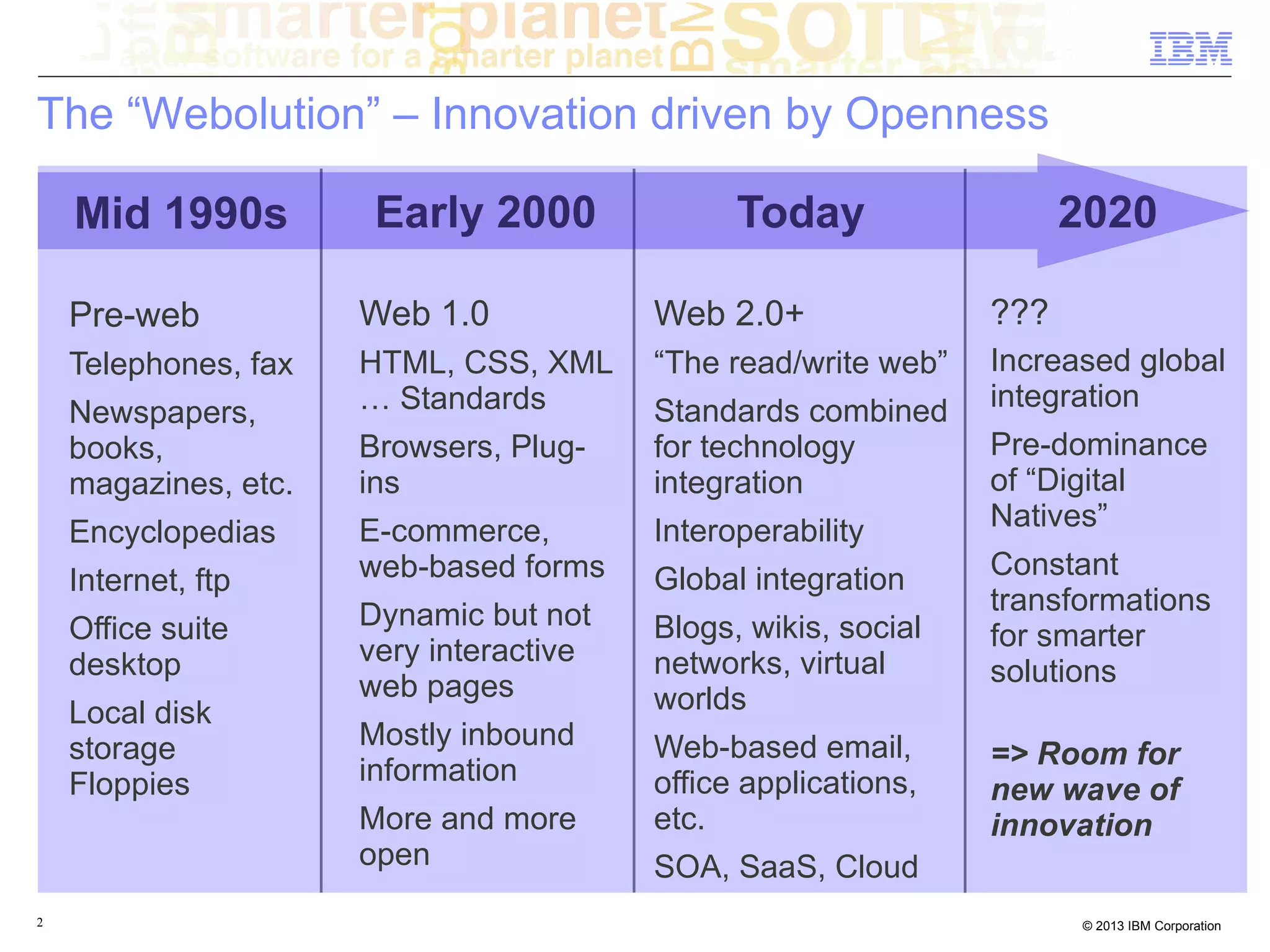
The “Webolution” – Innovation driven by Openness

    Mid 1990s          Early 2000              Today                  2020

    Pre-web           Web 1.0            Web 2.0+               ???
    Telephones, fax   HTML, CSS, XML     “The read/write web”   Increased global
                      … Standards        Standards combined     integration
    Newspapers,
    books,            Browsers, Plug-    for technology         Pre-dominance
    magazines, etc.   ins                integration            of “Digital
                      E-commerce,        Interoperability       Natives”
    Encyclopedias
                      web-based forms    Global integration     Constant
    Internet, ftp
                      Dynamic but not                           transformations
    Office suite                         Blogs, wikis, social   for smarter
    desktop           very interactive   networks, virtual
                      web pages                                 solutions
    Local disk                           worlds
    storage           Mostly inbound     Web-based email,       => Room for
    Floppies          information        office applications,   new wave of
                      More and more      etc.                   innovation
                      open               SOA, SaaS, Cloud
2                                                                     © 2013 IBM Corporation
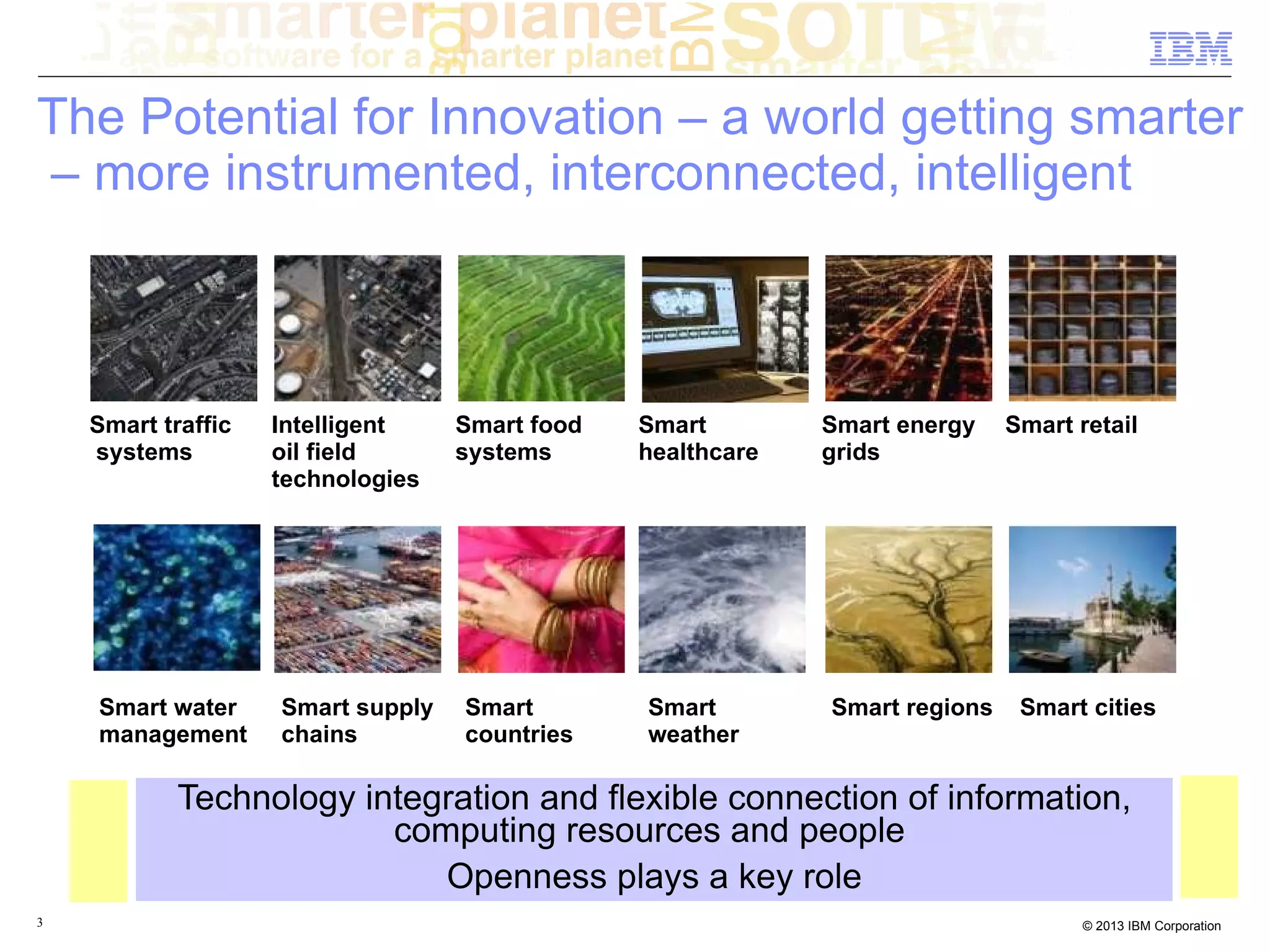
The Potential for Innovation – a world getting smarter
– more instrumented, interconnected, intelligent


    Smart traffic   Intelligent    Smart food   Smart        Smart energy    Smart retail
    systems         oil field      systems      healthcare   grids
                    technologies


    Smart water     Smart supply   Smart        Smart        Smart regions    Smart cities
    management      chains         countries    weather

            Technology integration and flexible connection of information,
                         computing resources and people
                            Openness plays a key role
3                                                                                   © 2013 IBM Corporation
Innovation – Technology and Process Integration
       • Business model – Innovation in the structure and/or financial model of
         the business
       • Operational – Innovation that improves the effectiveness and efficiency
         of core processes and functions
       • Products/services/markets – Innovation applied to products or services
         or “go-to-market” activities

                    “Ignite innovation through business and technology integration –
                    Use technology as an innovation catalyst by combining it with
                    business and market insights.”
                    [IBM Global CEO Study 2006, p 4. (Research with 765 CEOs worldwide)]


    “To innovate, High-growth CIOs actively integrate business and IT
    across the organization 94 percent more often than Low-growth
    CIOs. “There is no innovation in my organization without the
    involvement of IT,” said a Government CIO in Brazil.”
    [IBM Global CIO Study 2009, p. 14.(Research with 2,500 CIOs Worldwide)]
4                                                                                          © 2013 IBM Corporation
Open Standards Promote Innovations for a Smarter Planet

SMARTER IS … Insight                  SMARTER IS … Green                    SMARTER IS … Working
Enable innovative services in         Appliances, meters and                Reduce cost and
response to customer                  sensors adjusting consumption         development time, increase
requests and a changing               dynamically based on usage –          agility and flexibility and
business environment                  cutting cost and avoiding             improve access to design
                                      brown/black outs                      information


    “Leverage innovation to deliver "green" infrastructures that
    are highly efficient and overlay the physical infrastructure
    with digital intelligence. [...]
    Embrace intelligent systems that use open standards to
    provide near realtime information for better management of
    the infrastructure, water quantities, or, even, entire
    transportation systems.”
    [Results from the IBM Eco-efficiency Jam 2010. (51 hour Jam with 1600
    experts in lead roles from more than 60 countries)]


5                                                                                           © 2013 IBM Corporation
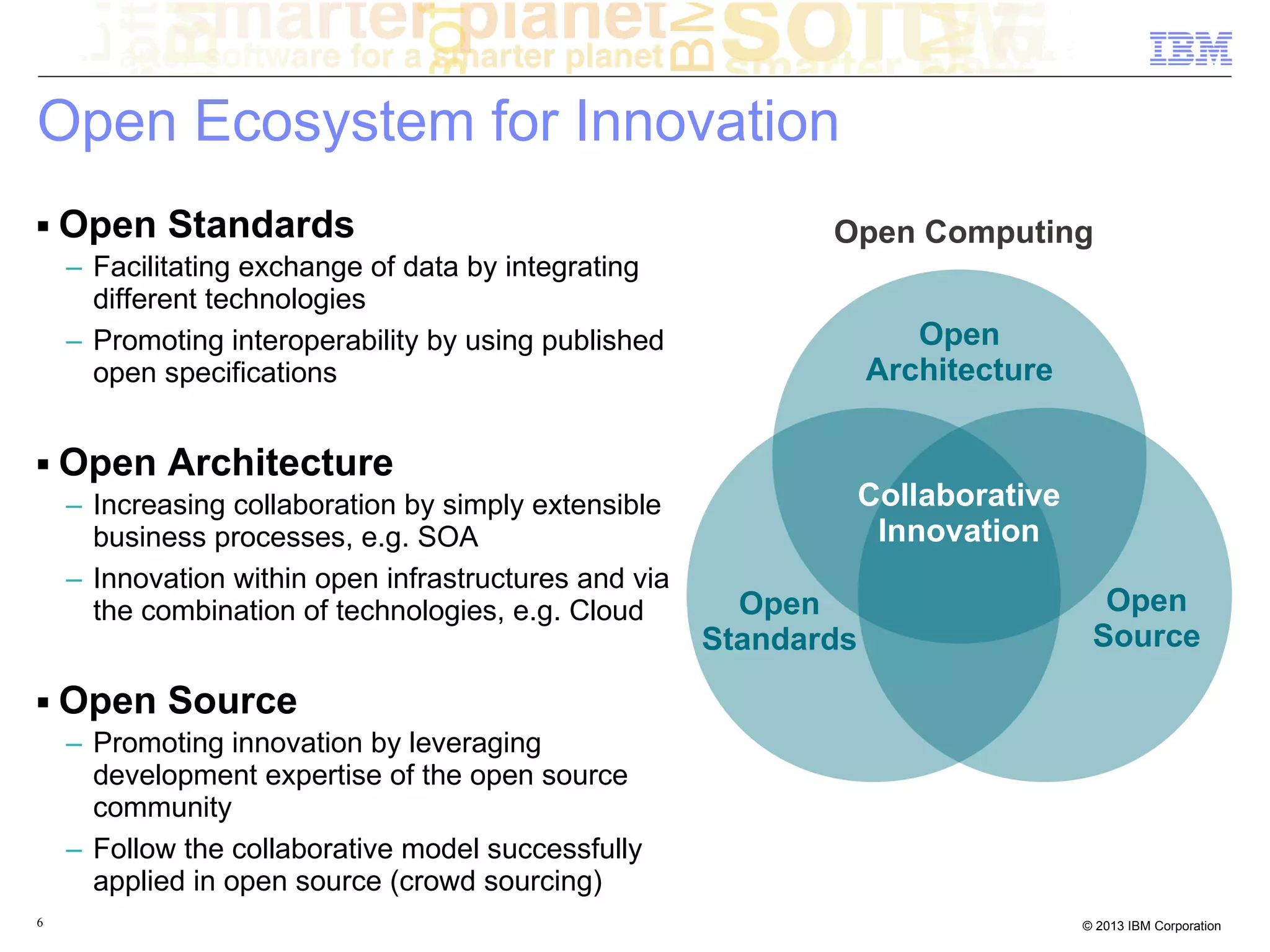
Open Ecosystem for Innovation
  ■   Open Standards                                            Open Computing
      – Facilitating exchange of data by integrating
        different technologies
      – Promoting interoperability by using published                   Open
        open specifications                                          Architecture

  ■   Open Architecture
      – Increasing collaboration by simply extensible                Collaborative
        business processes, e.g. SOA                                  Innovation
      – Innovation within open infrastructures and via
        the combination of technologies, e.g. Cloud        Open                        Open
                                                         Standards                    Source
  ■   Open Source
      – Promoting innovation by leveraging
        development expertise of the open source
        community
      – Follow the collaborative model successfully
        applied in open source (crowd sourcing)
6 6
                                                                                     © 2013 IBM Corporation
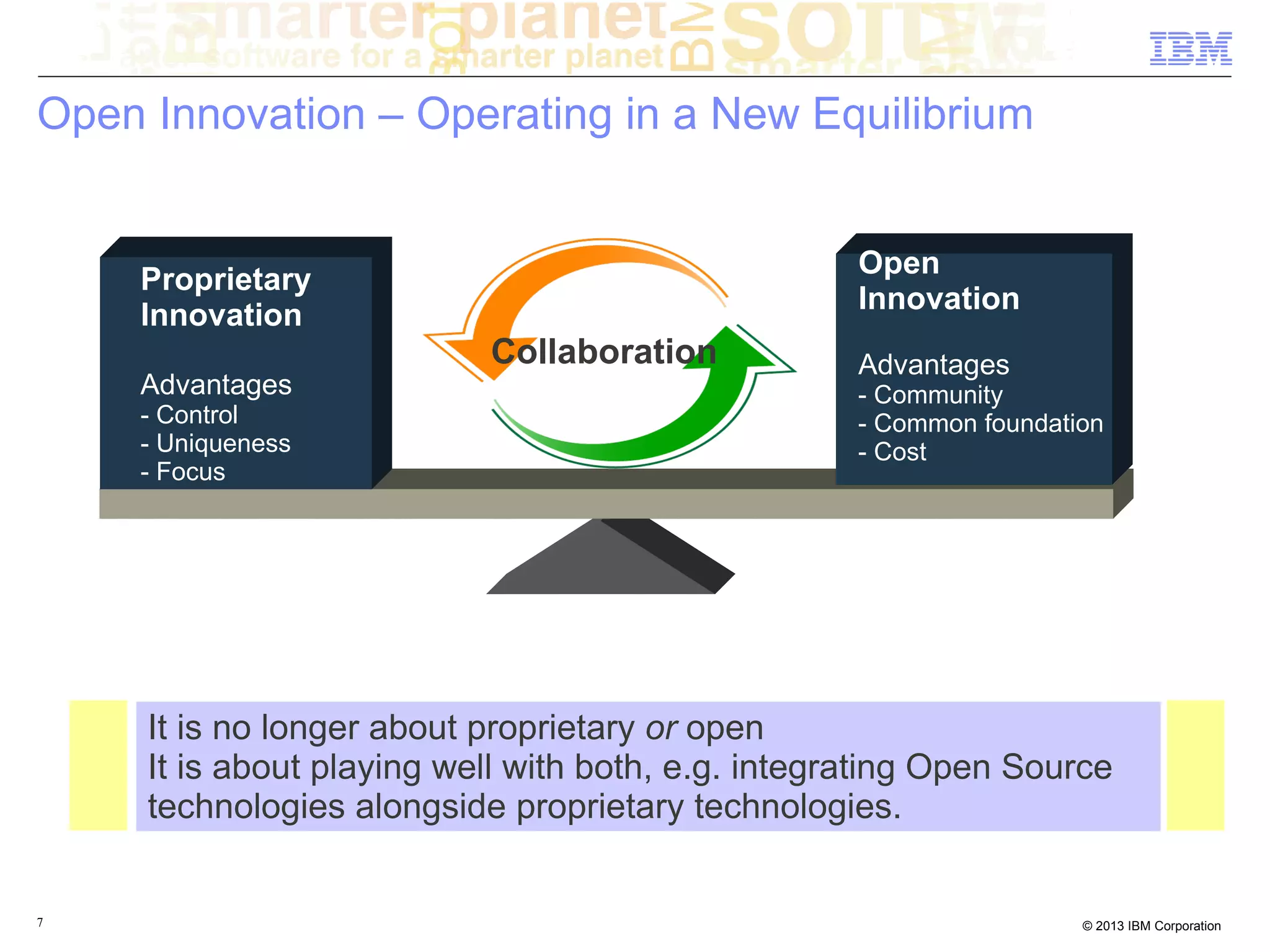
Open Innovation – Operating in a New Equilibrium


                                                    Open
    Proprietary
                                                    Innovation
    Innovation
                           Collaboration            Advantages
    Advantages                                      - Community
    - Control                                       - Common foundation
    - Uniqueness                                    - Cost
    - Focus


     It is no longer about proprietary or open
     It is about playing well with both, e.g. integrating Open Source
     technologies alongside proprietary technologies.


7                                                                    © 2013 IBM Corporation
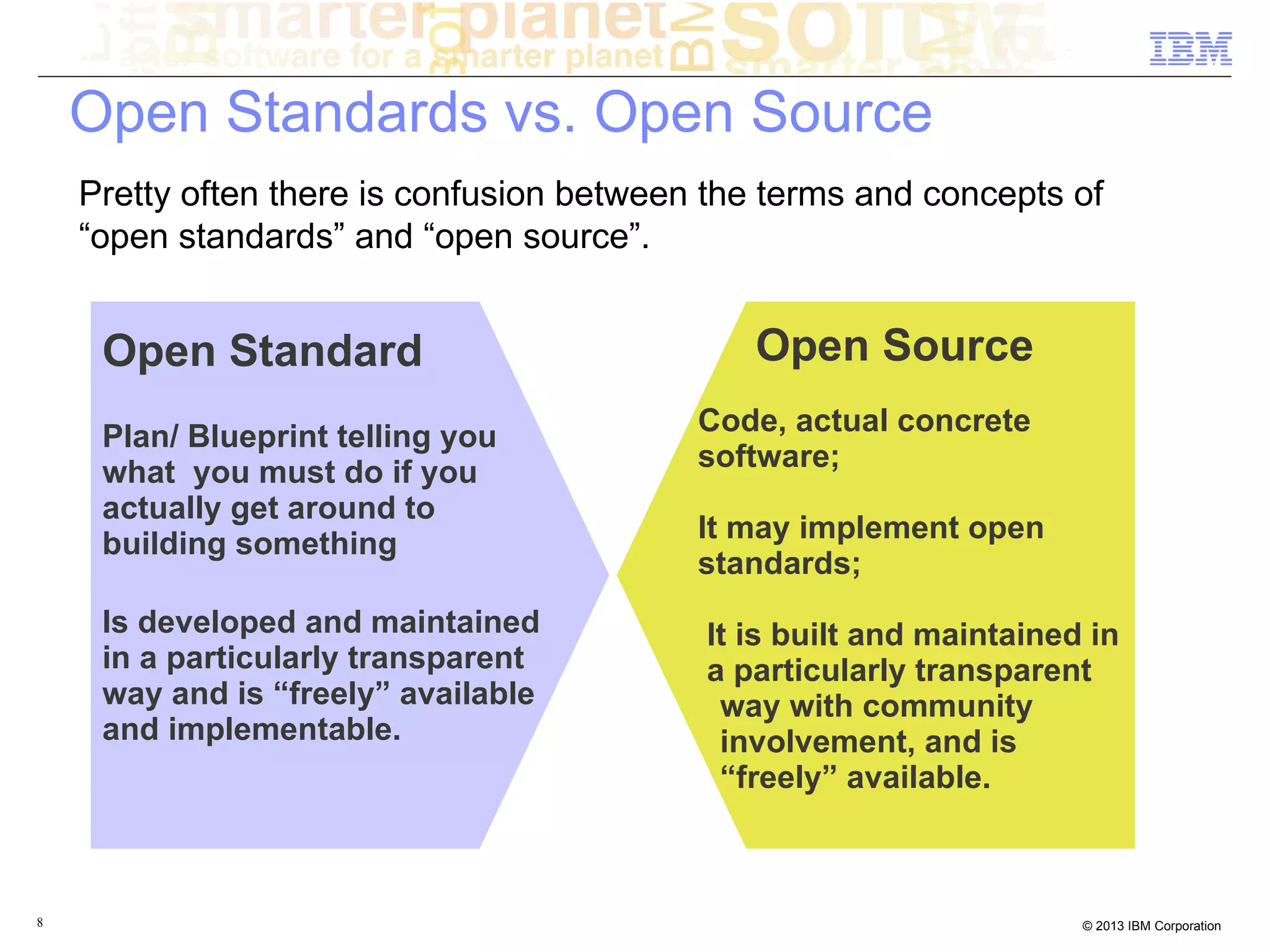
Open Standards vs. Open Source
    Pretty often there is confusion between the terms and concepts of
    “open standards” and “open source”.


     Open Standard                            Open Source
     Plan/ Blueprint telling you           Code, actual concrete
     what you must do if you               software;
     actually get around to
                                           It may implement open
     building something
                                           standards;
     Is developed and maintained           It is built and maintained in
     in a particularly transparent         a particularly transparent
     way and is “freely” available          way with community
     and implementable.                     involvement, and is
                                            “freely” available.


8                                                                    © 2013 IBM Corporation
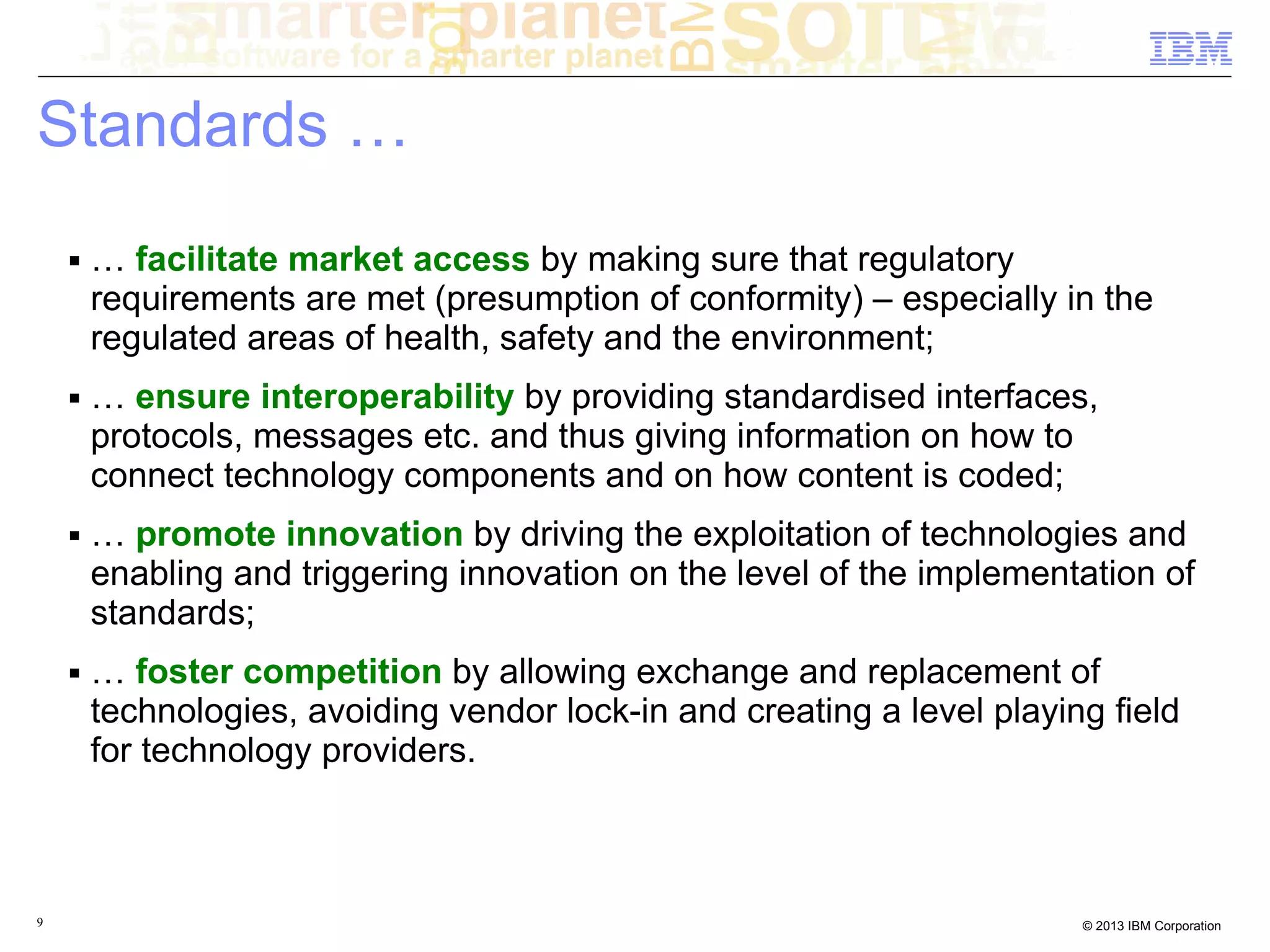
Standards …
    ■   … facilitate market access by making sure that regulatory
        requirements are met (presumption of conformity) – especially in the
        regulated areas of health, safety and the environment;
    ■   … ensure interoperability by providing standardised interfaces,
        protocols, messages etc. and thus giving information on how to
        connect technology components and on how content is coded;
    ■   … promote innovation by driving the exploitation of technologies and
        enabling and triggering innovation on the level of the implementation of
        standards;
    ■   … foster competition by allowing exchange and replacement of
        technologies, avoiding vendor lock-in and creating a level playing field
        for technology providers.


9                                                                        © 2013 IBM Corporation
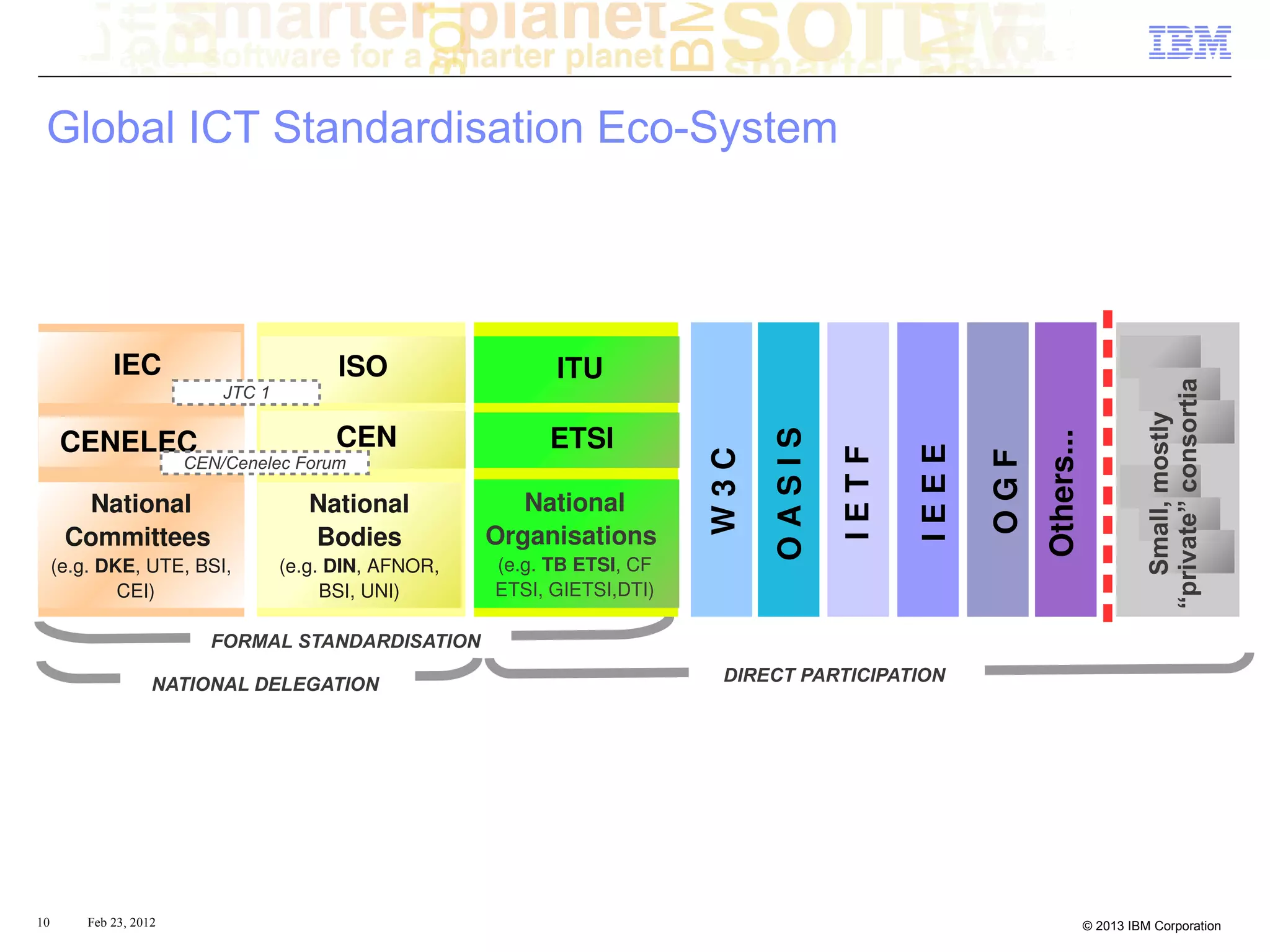
Global ICT Standardisation Eco-System


                IEC                     ISOISO                   ITU


                                                                                                                                      “private” consortia
                               JTC 1


                                                                                                                                         Small, mostly
         CENELEC                             CEN                ETSI


                                                                                     OASIS


                                                                                                                 Others...
                                                                                                    IEEE
                                                                                             IETF
                                                                               W3C


                                                                                                           OGF
                           CEN/Cenelec Forum

          National                        National            National
         Committees                       Bodies           Organisations
        (e.g. DKE, UTE, BSI,           (e.g. DIN, AFNOR,   (e.g. TB ETSI, CF
                CEI)                        BSI, UNI)      ETSI, GIETSI,DTI)

                             FORMAL STANDARDISATION

                       NATIONAL DELEGATION                                      DIRECT PARTICIPATION


10 10       Feb 23, 2012                                                                                                     © 2013 IBM Corporation
The debate about Open Standards
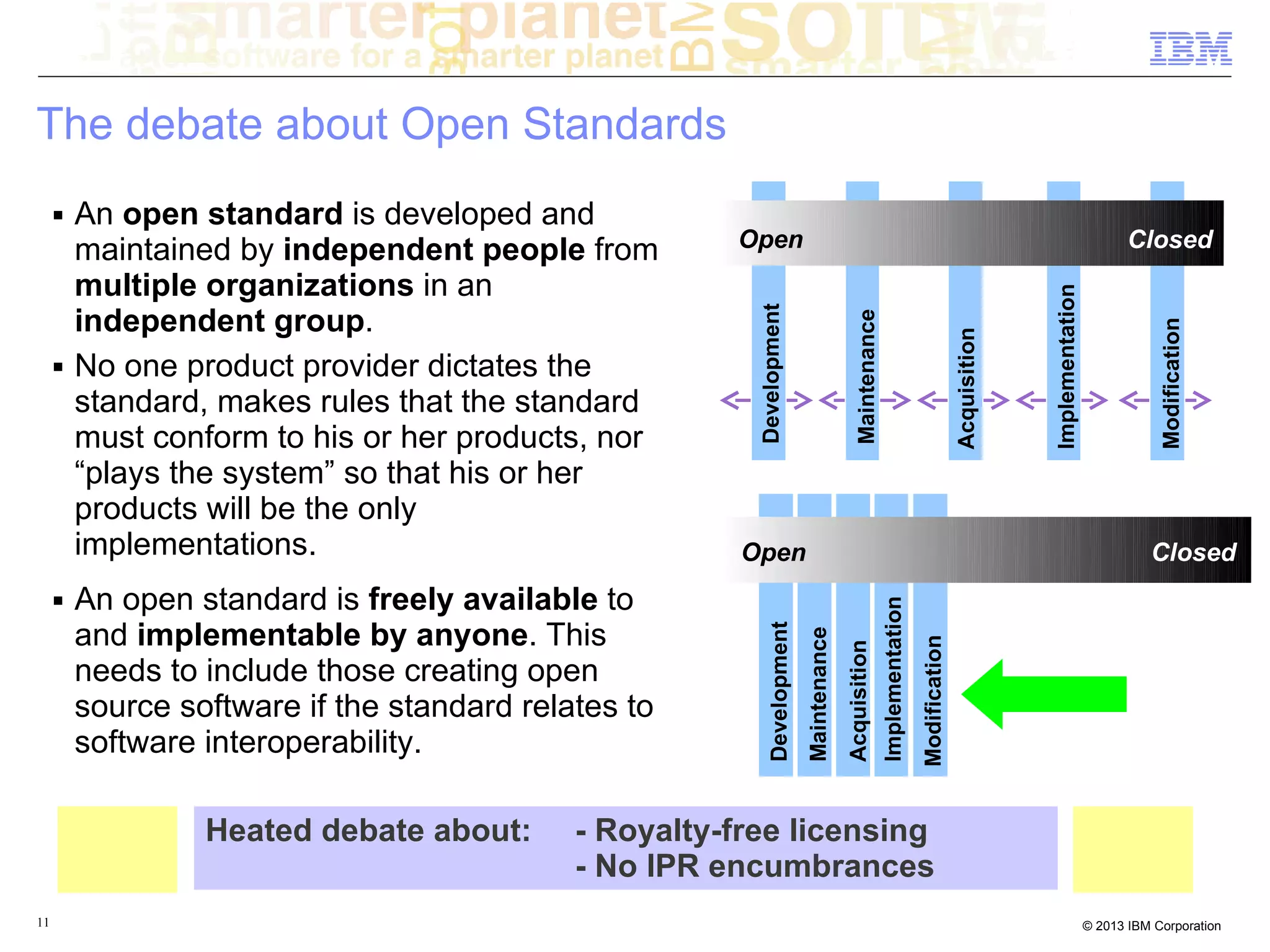
     ■   An open standard is developed and
         maintained by independent people from         Open                                                                                                                    Closed
         multiple organizations in an


                                                                                                                                                       Implementation
         independent group.


                                                         Development


                                                                                           Maintenance


                                                                                                                                                                                    Modification
                                                                                                                                         Acquisition
     ■   No one product provider dictates the
         standard, makes rules that the standard
         must conform to his or her products, nor
         “plays the system” so that his or her
         products will be the only
         implementations.                               Open                                                                                                                      Closed
     ■   An open standard is freely available to


                                                                                                         Implementation
         and implementable by anyone. This


                                                            Development
                                                                          Maintenance


                                                                                                                          Modification
                                                                                        Acquisition
         needs to include those creating open
         source software if the standard relates to
         software interoperability.

                  Heated debate about:       - Royalty-free licensing
                                             - No IPR encumbrances
11                                                                                                                                                                      © 2013 IBM Corporation
Open Standards in the Market Place

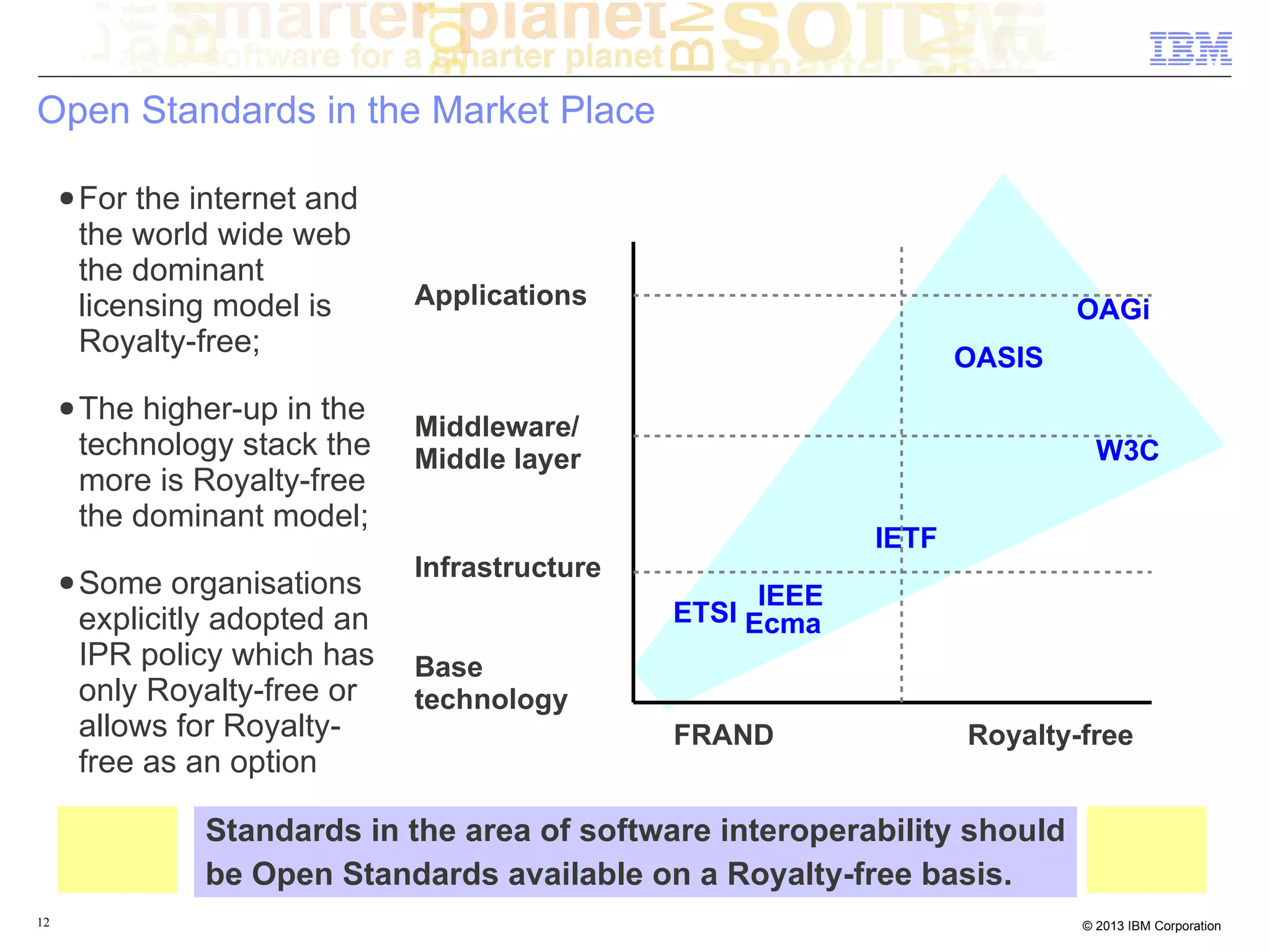
     ● Forthe internet and
      the world wide web
      the dominant
      licensing model is      Applications                                 OAGi
      Royalty-free;                                                OASIS
     ● The higher-up in the
                              Middleware/
      technology stack the    Middle layer                                   W3C
      more is Royalty-free
      the dominant model;
                                                            IETF
     ● Some
                              Infrastructure
             organisations                           IEEE
      explicitly adopted an                    ETSI Ecma
      IPR policy which has    Base
      only Royalty-free or    technology
      allows for Royalty-                      FRAND               Royalty-free
      free as an option

               Standards in the area of software interoperability should
               be Open Standards available on a Royalty-free basis.
12                                                                         © 2013 IBM Corporation
Open Innovation and Standards Strategy

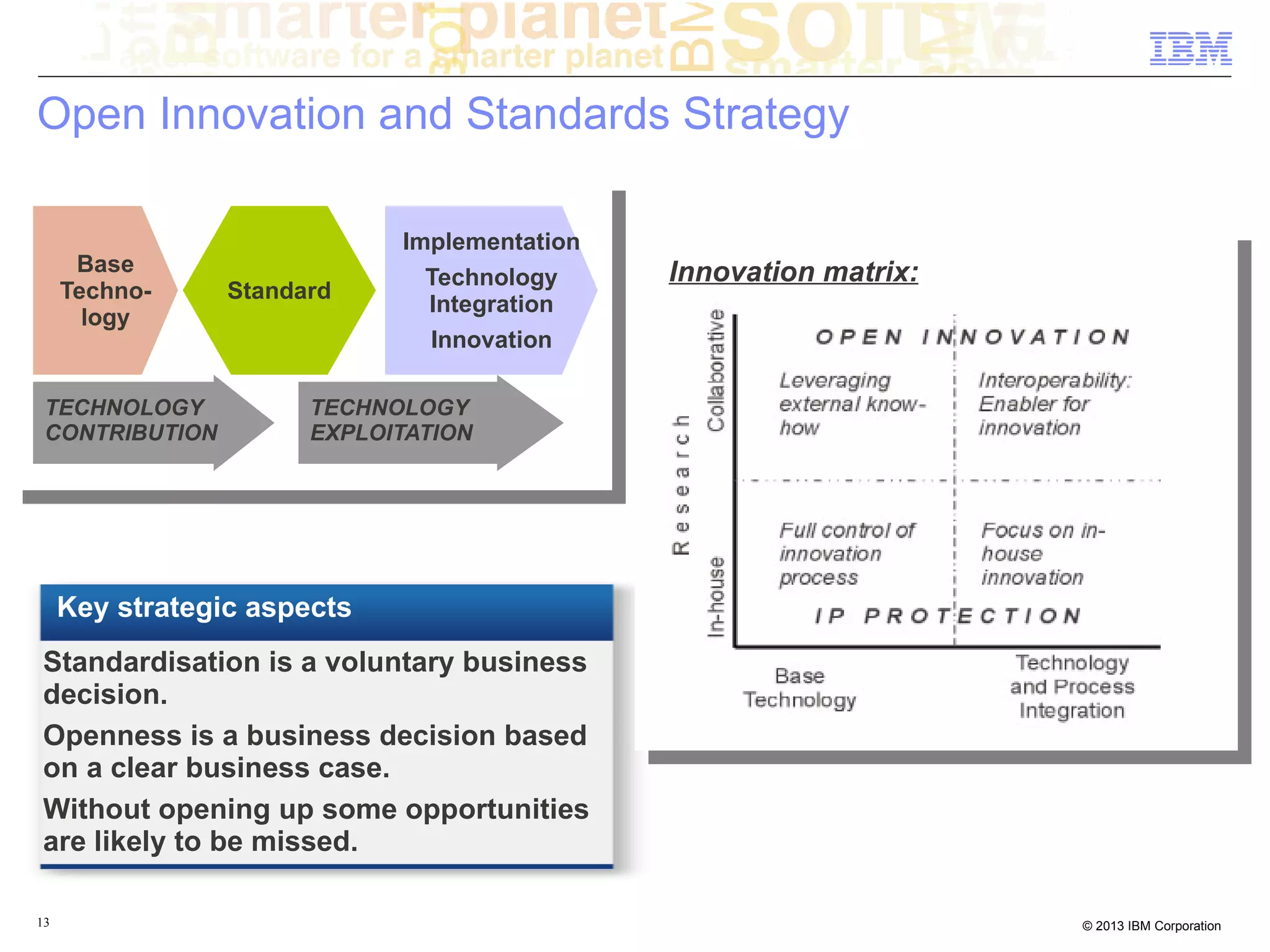
                             Implementation
      Base                                    Innovation matrix:
                               Technology
     Techno-     Standard
                               Integration
       logy
                               Innovation

 TECHNOLOGY            TECHNOLOGY
 CONTRIBUTION          EXPLOITATION


     Key strategic aspects
Standardisation is a voluntary business
decision.
Openness is a business decision based
on a clear business case.
Without opening up some opportunities
are likely to be missed.

13                                                                 © 2013 IBM Corporation
Open Source: Driver for Innovation

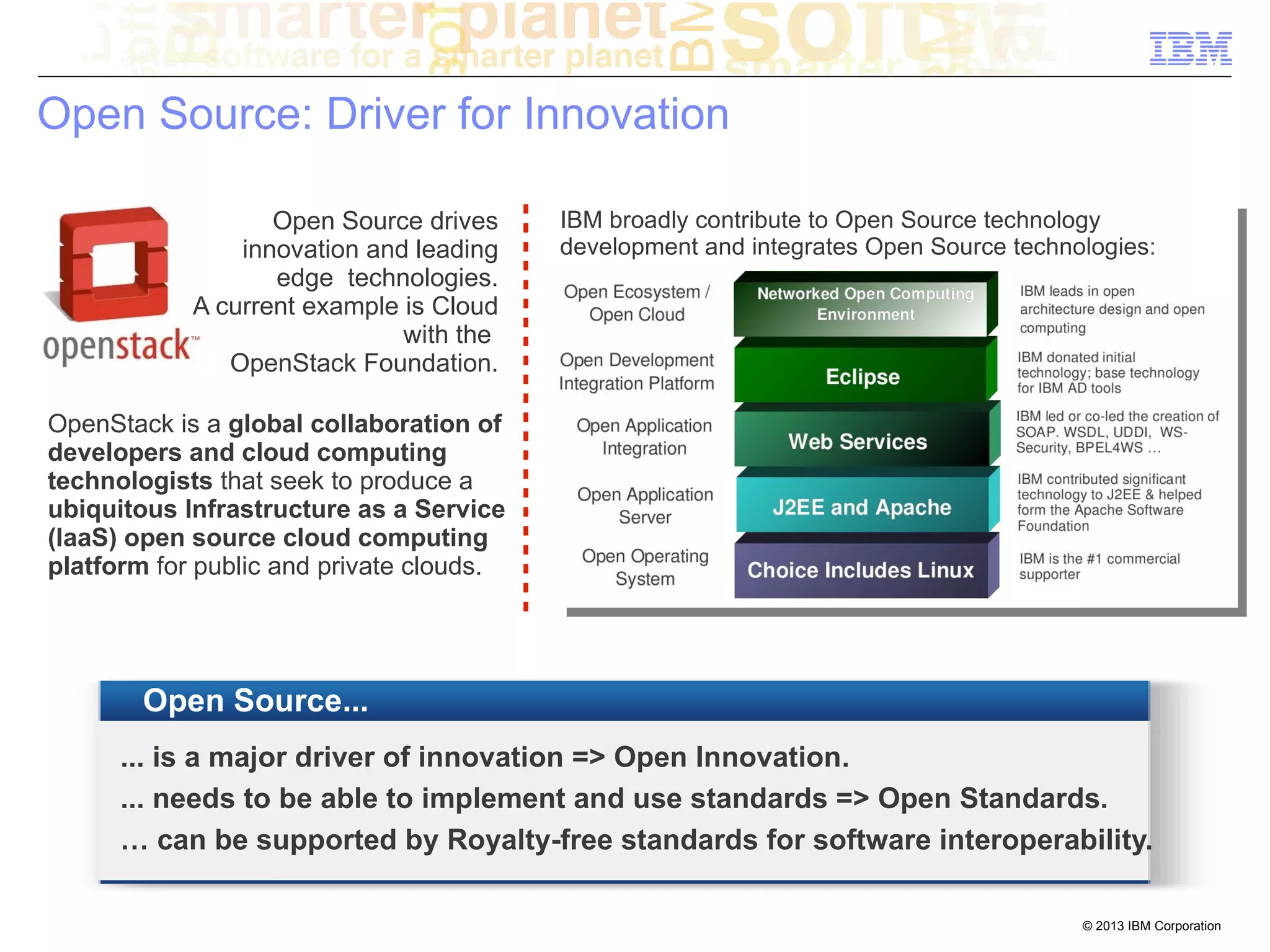
                   Open Source drives     IBM broadly contribute to Open Source technology
                innovation and leading    development and integrates Open Source technologies:
                   edge technologies.
            A current example is Cloud
                              with the
               OpenStack Foundation.

OpenStack is a global collaboration of
developers and cloud computing
technologists that seek to produce a
ubiquitous Infrastructure as a Service
(IaaS) open source cloud computing
platform for public and private clouds.


        Open Source...
      ... is a major driver of innovation => Open Innovation.
      ... needs to be able to implement and use standards => Open Standards.
      … can be supported by Royalty-free standards for software interoperability.

                                                                                       © 2013 IBM Corporation
Crowd sourcing – open data for open innovation
 DIGITAL AGENDA FOR EUROPE
 “[...] governments can stimulate content markets by making public sector
 information available on transparent, effective, nondiscriminatory terms.
 This is an important source of potential growth of innovative online                  Open
 services. The re-use of these information resources has been partly
 harmonised, but additionally public bodies must be obliged to open up                 Data
 data resources for cross-border applications and services.” (section 2.1.1,
 p. 5)


       ●  free, web-based platform (http://cityforward.org)
       ● enables users - city officials, researchers, academics and

          interested citizens world-wide - to view and interact with
          city data while engaging in an ongoing public dialogue about cities
     Users can explore and analyse data collected from numerous public sources featuring
     metropolitan areas, cities and smaller geographic areas
     City Forward’s exploration tools help identify patterns, trends and correlations in the data
     that may reveal new insights and point to new areas for further investigation.

15                                                                                     © 2013 IBM Corporation
Innovation and Openness – High on Political Agenda

                         “By the end of the Commission's next mandate, I want
                         Europe to have become not just a 'knowledge society', but
                         an 'innovation society.' I plan to make this one of my top
                         personal priorities. Indeed, I want it to be an important part
                         of my legacy.

                         […]

     “... the application of innovations like Web 2.0 to business and public life is
     changing the way in which innovation happens. It is becoming more open
     and collaborative. Once the preserve of a select elite, it now involves a
     much wider range of actors. […] crowd-sourcing and co-creation are now
     the order of the day!

     We need a new policy that reflects these changes. This means that we will
     have to, well, innovate!“
     [President Barroso, European Innovation Summit 2009. Source of photo: EU Commission: Audiovisual
     Services.]
16                                                                                            © 2013 IBM Corporation
Thanks very much for your attention ...


            … Happy to answer your questions...


17                                             © 2013 IBM Corporation

1301 open innovation j friedrich

  • 1.
    Dr. Jochen Friedrich TechnicalRelations Executive Open Innovation – The examples of Open Standards and Open Source © 2013 IBM Corporation © 2009 IBM Corporation
  • 2.
    The “Webolution” –Innovation driven by Openness Mid 1990s Early 2000 Today 2020 Pre-web Web 1.0 Web 2.0+ ??? Telephones, fax HTML, CSS, XML “The read/write web” Increased global … Standards Standards combined integration Newspapers, books, Browsers, Plug- for technology Pre-dominance magazines, etc. ins integration of “Digital E-commerce, Interoperability Natives” Encyclopedias web-based forms Global integration Constant Internet, ftp Dynamic but not transformations Office suite Blogs, wikis, social for smarter desktop very interactive networks, virtual web pages solutions Local disk worlds storage Mostly inbound Web-based email, => Room for Floppies information office applications, new wave of More and more etc. innovation open SOA, SaaS, Cloud 2 © 2013 IBM Corporation
  • 3.
    The Potential forInnovation – a world getting smarter – more instrumented, interconnected, intelligent Smart traffic Intelligent Smart food Smart Smart energy Smart retail systems oil field systems healthcare grids technologies Smart water Smart supply Smart Smart Smart regions Smart cities management chains countries weather Technology integration and flexible connection of information, computing resources and people Openness plays a key role 3 © 2013 IBM Corporation
  • 4.
    Innovation – Technologyand Process Integration • Business model – Innovation in the structure and/or financial model of the business • Operational – Innovation that improves the effectiveness and efficiency of core processes and functions • Products/services/markets – Innovation applied to products or services or “go-to-market” activities “Ignite innovation through business and technology integration – Use technology as an innovation catalyst by combining it with business and market insights.” [IBM Global CEO Study 2006, p 4. (Research with 765 CEOs worldwide)] “To innovate, High-growth CIOs actively integrate business and IT across the organization 94 percent more often than Low-growth CIOs. “There is no innovation in my organization without the involvement of IT,” said a Government CIO in Brazil.” [IBM Global CIO Study 2009, p. 14.(Research with 2,500 CIOs Worldwide)] 4 © 2013 IBM Corporation
  • 5.
    Open Standards PromoteInnovations for a Smarter Planet SMARTER IS … Insight SMARTER IS … Green SMARTER IS … Working Enable innovative services in Appliances, meters and Reduce cost and response to customer sensors adjusting consumption development time, increase requests and a changing dynamically based on usage – agility and flexibility and business environment cutting cost and avoiding improve access to design brown/black outs information “Leverage innovation to deliver "green" infrastructures that are highly efficient and overlay the physical infrastructure with digital intelligence. [...] Embrace intelligent systems that use open standards to provide near realtime information for better management of the infrastructure, water quantities, or, even, entire transportation systems.” [Results from the IBM Eco-efficiency Jam 2010. (51 hour Jam with 1600 experts in lead roles from more than 60 countries)] 5 © 2013 IBM Corporation
  • 6.
    Open Ecosystem forInnovation ■ Open Standards Open Computing – Facilitating exchange of data by integrating different technologies – Promoting interoperability by using published Open open specifications Architecture ■ Open Architecture – Increasing collaboration by simply extensible Collaborative business processes, e.g. SOA Innovation – Innovation within open infrastructures and via the combination of technologies, e.g. Cloud Open Open Standards Source ■ Open Source – Promoting innovation by leveraging development expertise of the open source community – Follow the collaborative model successfully applied in open source (crowd sourcing) 6 6 © 2013 IBM Corporation
  • 7.
    Open Innovation –Operating in a New Equilibrium Open Proprietary Innovation Innovation Collaboration Advantages Advantages - Community - Control - Common foundation - Uniqueness - Cost - Focus It is no longer about proprietary or open It is about playing well with both, e.g. integrating Open Source technologies alongside proprietary technologies. 7 © 2013 IBM Corporation
  • 8.
    Open Standards vs.Open Source Pretty often there is confusion between the terms and concepts of “open standards” and “open source”. Open Standard Open Source Plan/ Blueprint telling you Code, actual concrete what you must do if you software; actually get around to It may implement open building something standards; Is developed and maintained It is built and maintained in in a particularly transparent a particularly transparent way and is “freely” available way with community and implementable. involvement, and is “freely” available. 8 © 2013 IBM Corporation
  • 9.
    Standards … ■ … facilitate market access by making sure that regulatory requirements are met (presumption of conformity) – especially in the regulated areas of health, safety and the environment; ■ … ensure interoperability by providing standardised interfaces, protocols, messages etc. and thus giving information on how to connect technology components and on how content is coded; ■ … promote innovation by driving the exploitation of technologies and enabling and triggering innovation on the level of the implementation of standards; ■ … foster competition by allowing exchange and replacement of technologies, avoiding vendor lock-in and creating a level playing field for technology providers. 9 © 2013 IBM Corporation
  • 10.
    Global ICT StandardisationEco-System IEC ISOISO ITU “private” consortia JTC 1 Small, mostly CENELEC CEN ETSI OASIS Others... IEEE IETF W3C OGF CEN/Cenelec Forum National National National Committees Bodies Organisations (e.g. DKE, UTE, BSI, (e.g. DIN, AFNOR, (e.g. TB ETSI, CF CEI) BSI, UNI) ETSI, GIETSI,DTI) FORMAL STANDARDISATION NATIONAL DELEGATION DIRECT PARTICIPATION 10 10 Feb 23, 2012 © 2013 IBM Corporation
  • 11.
    The debate aboutOpen Standards ■ An open standard is developed and maintained by independent people from Open Closed multiple organizations in an Implementation independent group. Development Maintenance Modification Acquisition ■ No one product provider dictates the standard, makes rules that the standard must conform to his or her products, nor “plays the system” so that his or her products will be the only implementations. Open Closed ■ An open standard is freely available to Implementation and implementable by anyone. This Development Maintenance Modification Acquisition needs to include those creating open source software if the standard relates to software interoperability. Heated debate about: - Royalty-free licensing - No IPR encumbrances 11 © 2013 IBM Corporation
  • 12.
    Open Standards inthe Market Place ● Forthe internet and the world wide web the dominant licensing model is Applications OAGi Royalty-free; OASIS ● The higher-up in the Middleware/ technology stack the Middle layer W3C more is Royalty-free the dominant model; IETF ● Some Infrastructure organisations IEEE explicitly adopted an ETSI Ecma IPR policy which has Base only Royalty-free or technology allows for Royalty- FRAND Royalty-free free as an option Standards in the area of software interoperability should be Open Standards available on a Royalty-free basis. 12 © 2013 IBM Corporation
  • 13.
    Open Innovation andStandards Strategy Implementation Base Innovation matrix: Technology Techno- Standard Integration logy Innovation TECHNOLOGY TECHNOLOGY CONTRIBUTION EXPLOITATION Key strategic aspects Standardisation is a voluntary business decision. Openness is a business decision based on a clear business case. Without opening up some opportunities are likely to be missed. 13 © 2013 IBM Corporation
  • 14.
    Open Source: Driverfor Innovation Open Source drives IBM broadly contribute to Open Source technology innovation and leading development and integrates Open Source technologies: edge technologies. A current example is Cloud with the OpenStack Foundation. OpenStack is a global collaboration of developers and cloud computing technologists that seek to produce a ubiquitous Infrastructure as a Service (IaaS) open source cloud computing platform for public and private clouds. Open Source... ... is a major driver of innovation => Open Innovation. ... needs to be able to implement and use standards => Open Standards. … can be supported by Royalty-free standards for software interoperability. © 2013 IBM Corporation
  • 15.
    Crowd sourcing –open data for open innovation DIGITAL AGENDA FOR EUROPE “[...] governments can stimulate content markets by making public sector information available on transparent, effective, nondiscriminatory terms. This is an important source of potential growth of innovative online Open services. The re-use of these information resources has been partly harmonised, but additionally public bodies must be obliged to open up Data data resources for cross-border applications and services.” (section 2.1.1, p. 5) ● free, web-based platform (http://cityforward.org) ● enables users - city officials, researchers, academics and interested citizens world-wide - to view and interact with city data while engaging in an ongoing public dialogue about cities Users can explore and analyse data collected from numerous public sources featuring metropolitan areas, cities and smaller geographic areas City Forward’s exploration tools help identify patterns, trends and correlations in the data that may reveal new insights and point to new areas for further investigation. 15 © 2013 IBM Corporation
  • 16.
    Innovation and Openness– High on Political Agenda “By the end of the Commission's next mandate, I want Europe to have become not just a 'knowledge society', but an 'innovation society.' I plan to make this one of my top personal priorities. Indeed, I want it to be an important part of my legacy. […] “... the application of innovations like Web 2.0 to business and public life is changing the way in which innovation happens. It is becoming more open and collaborative. Once the preserve of a select elite, it now involves a much wider range of actors. […] crowd-sourcing and co-creation are now the order of the day! We need a new policy that reflects these changes. This means that we will have to, well, innovate!“ [President Barroso, European Innovation Summit 2009. Source of photo: EU Commission: Audiovisual Services.] 16 © 2013 IBM Corporation
  • 17.
    Thanks very muchfor your attention ... … Happy to answer your questions... 17 © 2013 IBM Corporation