Shared Services and
    Data Sharing
      Thoughts
     on 20 years
in Local Government

   Tim Willoughby
Feedback – be very careful
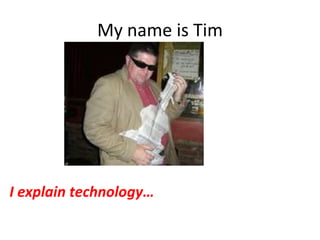
My name is Tim


I explain technology…
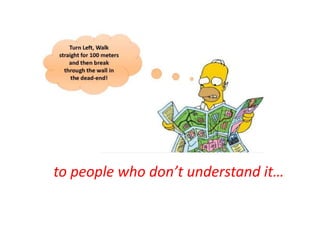
to people who don’t understand it…
people who think
they do understand it…
people who despise it…
and people who worship it.
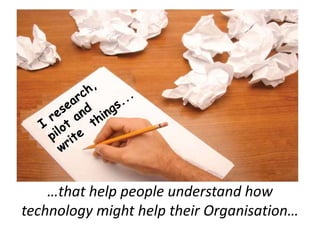
…that help people understand how
technology might help their Organisation…
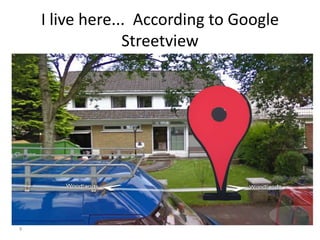
I live here... According to Google
                 Streetview


9
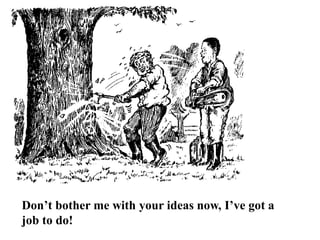
Don’t bother me with your ideas now, I’ve got a
job to do!
• my references!

• If only..
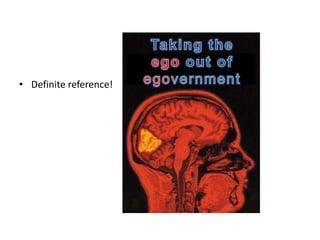
• Definite reference!
Shared Services
• Leadership
• Change Management
  – Business as Usual, Cultural Shift, Continuous
    Improvement, Responsibility and Service Mapping
• Measurement – Measuring the Right Things
  – Selection, Cost Savings, Growth, Delivery
• Governance
  – Managing expectations, Innovations and Supplier
    Push
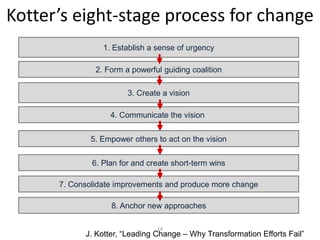
Kotter’s eight-stage process for change
                 1. Establish a sense of urgency

               2. Form a powerful guiding coalition

                        3. Create a vision

                   4. Communicate the vision

              5. Empower others to act on the vision


              6. Plan for and create short-term wins

      7. Consolidate improvements and produce more change

                   8. Anchor new approaches

                                14
            J. Kotter, “Leading Change – Why Transformation Efforts Fail”
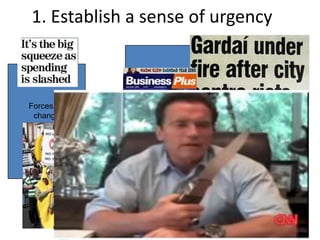
1. Establish a sense of urgency


Forces for   The status      Forces for
 change         quo           stability


                 16        Burnes 2004
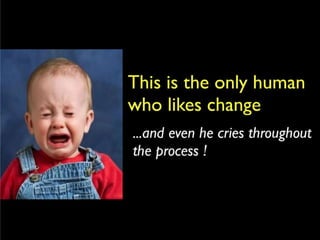
But I’m so comfortable…


            17
1. How to create a sense of urgency?

 • Create a crisis/rivalry
    – Just read the papers!!!!

 • Find/develop a “red hot” burning issue
    – NAMA

 • Revise existing or develop new standards
    – Income, profitability, effectiveness, efficiency,
      customer satisfaction

 • Get an outside opinion
    – Bring in consultants, customers, shareholders
                             18
Outside Opinion v’s Independence
• Independence from Suppliers?
• Can we get truly independent advice?
• Should Government employ independent
  thinkers within the Civil Service or contract
  with Independent Suppliers?
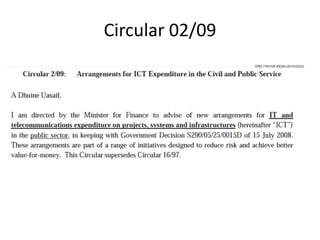
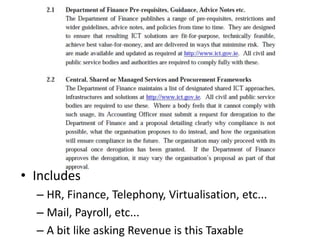
Circular 02/09
• Includes
  – HR, Finance, Telephony, Virtualisation, etc...
  – Mail, Payroll, etc...
  – A bit like asking Revenue is this Taxable
Sense of Urgency – Strategies…
– Public Sector Reform Plan
   • public services to be delivered faster, better and more
   • Intelligent, targeted use of ICT and eGovernment are key enablers
     for these improvements.
– eGovernment Strategy
   • services through multiple channels;
   • improve data sharing;
   • develop a more integrated approach within and across sectors
– Cloud Computing Strategy
   • data centre consolidation
   • adoption of cloud computing
Struggle with Shared Services
• Same Phrase – two meanings
• Shared Services- Reduce Headcount
  – Save Payroll, Efficient, savings
• Shared Services – ICT System
  – Cost Centre, Efficiencies, Long term savings
Shared Services
•   1. Shared Payroll
•   2. Shared HR transactions
•   3. Accounts Payable
•   4. ICT back office
•   5. Local Government portal
•   6. Treasury Management
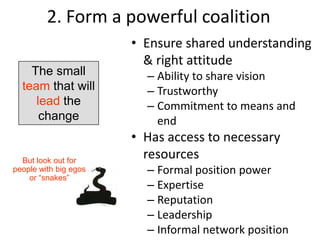
2. Form a powerful coalition
                       • Ensure shared understanding
                         & right attitude
    The small            – Ability to share vision
  team that will         – Trustworthy
     lead the            – Commitment to means and
      change               end
                       • Has access to necessary
  But look out for
                         resources
people with big egos     – Formal position power
    or “snakes”
                         – Expertise
                         – Reputation
                         – Leadership
                         – Informal network position
                           25
Each sector has powerful (NEW)
           Leadership Groups..
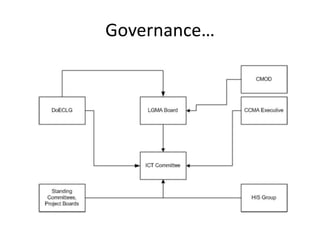
•   ICT Committee of the LGMA (New Powers)
•   Board of the LGMA
•   Local Government Efficiency Review Group (New)
•   Local Government Implementation Group (New)
•   Public Service Reform Oversight Group (New).
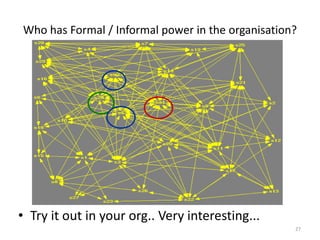
Who has Formal / Informal power in the organisation?


• Try it out in your org.. Very interesting...
                                                       27
                                       Teigland 2003
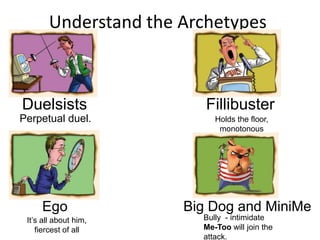
Understand the Archetypes


Duelsists                 Fillibuster
Perpetual duel.             Holds the floor,
                             monotonous
                              hectoring


     Ego               Big Dog and MiniMe
 It’s all about him,     Bully - intimidate
    fiercest of all      Me-Too will join the
                         attack.
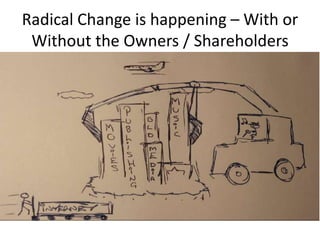
Radical Change is happening – With or
 Without the Owners / Shareholders
3. Create a vision

• Create the vision
  – To direct the change effort
  – To coordinate across and outside the
    organisation


• Develop a strategy to achieve the
  vision (operationalise)
  – To engage people through
    participation
  – To find their “passion”
  – To overcome forces for stability
            32
Local Government Vision
• New approach to the capture and use of data
• Building of teams across the sector that blurs
  county boundaries
• Centrally mandated architectural approach
  adopted
• Sourcing practices to achieve economies of
  scale
• Use procurement frameworks and maintain
  local enterprise.
Central Government Vision
• “As Public Bodies continue to reform their
  processes to improve business and citizen
  access to and interaction with Government
  services, the continued move to eGovernment
  and online delivery of services is inevitable”.
• “All public bodies will monitor and evaluate
  take-up of eGovernment services with a view
  to achieving the 50% (for citizens) and 80%
  (for businesses) targets set out in the EU
  eGovernment Action Plan (by 2015).”
4. Communicate the vision
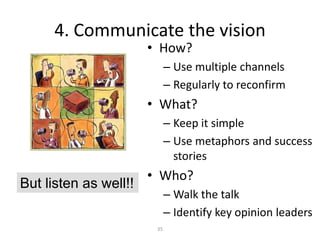
                       • How?
                             – Use multiple channels
                             – Regularly to reconfirm
                       • What?
                             – Keep it simple
                             – Use metaphors and success
                               stories
                       • Who?
But listen as well!!
                             – Walk the talk
                             – Identify key opinion leaders
                        35
When do people support the
              vision?
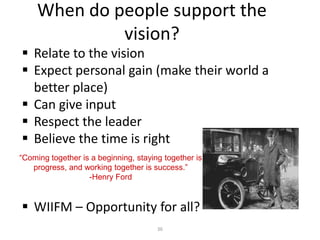
 Relate to the vision
 Expect personal gain (make their world a
  better place)
 Can give input
 Respect the leader
 Believe the time is right
“Coming together is a beginning, staying together is
   progress, and working together is success.”
                   -Henry Ford


 WIIFM – Opportunity for all?
                                       36
• "Unless you are prepared to give up something valuable you will never be
  able to truly change at all, because you'll be forever in the control of things
  you can't give up.“
     – Andy Law Creative Company
• "Only the wisest and stupidest of men never change.“
     – Confucius
• "Change is hard because people overestimate the value of what they
  have—and underestimate the value of what they may gain by giving that
  up.“
   – James Belasco and Ralph Stayer Flight of the Buffalo (1994)
• "There is nothing more difficult to take in hand, more perilous to conduct, or
  more uncertain in its success, than to take the lead in the introduction of a
  new order of things.“
     – Niccolo Machiavelli The Prince (1532)
•   "There is a certain relief in change, even though it be from bad to worse; as I
    have found in traveling in a stagecoach, that it often a comfort to shift one's
    position and be bruised in a new place.“
     – Washington Irving Tales of a Traveler (1824)
• "People don't resist change. They resist being changed!“
     – Peter Senge
• "Culture does not change because we desire to change it. Culture changes
  when the organization is transformed; the culture reflects the realities of
  people working together every day.“
   – Frances Hesselbein The Key to Cultural Transformation, Leader to Leader
       (Spring 1999)
• "It is a bad plan that admits of no modification.“
     – Publilius Syrus First Century BC
•    "Change is the law of life and those who look only to the past or present are
    certain to miss the future.“
     – John F. Kennedy
•   "The greatest danger in times of turbulence is not the turbulence; it is to act
    with yesterday’s logic.“
     – Peter Drucker
•   "Faced with the choice between changing one's mind and proving that there is
    no need to do so, almost everyone gets busy on the proof.“
     – John Kenneth Galbraith
New Measurement Metrics
• Citizen perspective – how is the quality of the ICT
  service perceived by citizens?
• Financial perspective – how attractive is the IS
  function and LGMA to the sector as a whole?
• Internal perspective – how effective and efficient are
  the processes in the IS functions and the LGMA?
• Learning & growth perspective – is the IS function
  and the LGMA capable of innovation and
  improvement?
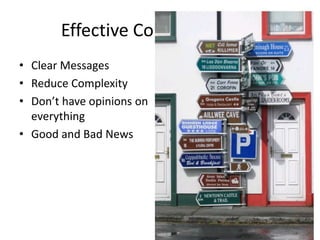
Effective Communication
• Clear Messages
• Reduce Complexity
• Don’t have opinions on
  everything
• Good and Bad News
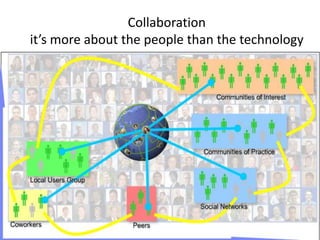
Collaboration
it’s more about the people than the technology
Communication – Social Media..
• Social and new media works..
  – Depending on the message
  – As to be a collaboration
  – It is not a One Way Environment – has to be two way
• Example – United Break Guitars.. Yes/No
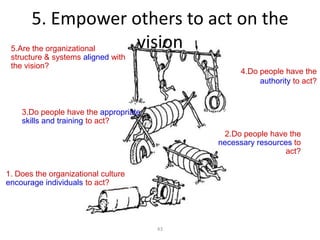
5. Empower others to act on the
 5.Are the organizational vision
 structure & systems aligned with
 the vision?
                                                  4.Do people have the
                                                       authority to act?


    3.Do people have the appropriate
    skills and training to act?
                                             2.Do people have the
                                            necessary resources to
                                                             act?

1. Does the organizational culture
encourage individuals to act?


                                       43
Civil Service Recruitment changed
• Civil service can now recruit outside the Civil
  Service…
• Croke Park
  – Croke Park and Shared Services… not natural
    partners…
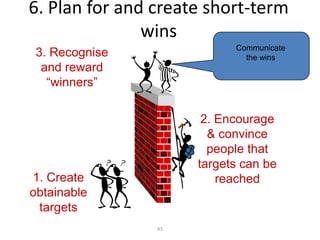
6. Plan for and create short-term
               wins
                           Communicate
 3. Recognise                the wins
  and reward
   “winners”

                      2. Encourage
                       & convince
                       people that
                     targets can be
1. Create                reached
obtainable
 targets
                45
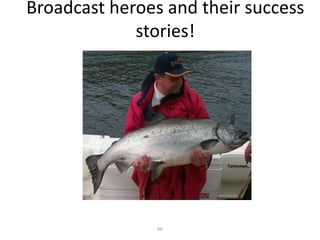
Broadcast heroes and their success
             stories!


                46
Wins…
• Household Charge
  – 1m Households pay new charge to website
  – Central Shared Service
• NPPR – Non Principal Private Residence
  – Web Based – 250,000 second homes
  – Central Service
• Shared HR Service
  – Central Service
How were wins achieved
• At all costs…
• Had to be seen to win..
• No option but to go with the central approach
Success - eProcurement
• General consent - no discussion
   – assumption that e-procurement has its benefits both in saving
     on public expenditure and preventing fraud.
• The main goals are:
   –   greater efficiency in public procurement
   –   administrative simplification of public procurement
   –   more transparent procedures
   –   better competition
• Discussion now about the “how” and the “when”.
• The European Commission has put forward a draft directive
  and a number of deadlines. European Parliament is
  reviewing the proposal and a parliamentary committee is
  doing great work.
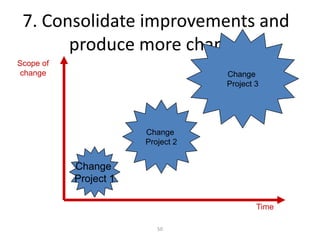
7. Consolidate improvements and
       produce more change
Scope of
 change                            Change
                                   Project 3


                       Change
                       Project 2


           Change
           Project 1

                                           Time

                          50
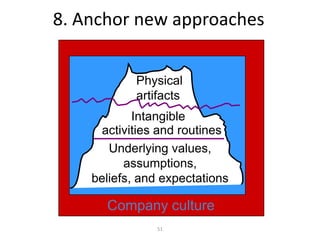
8. Anchor new approaches


            Physical
            artifacts
            Intangible
     activities and routines
       Underlying values,
          assumptions,
    beliefs, and expectations

      Company culture
                51
Governance…
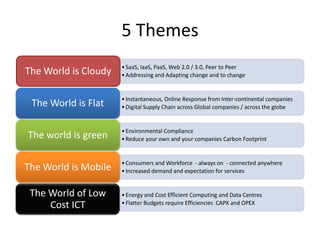
5 Themes
                      • SaaS, IaaS, PaaS, Web 2.0 / 3.0, Peer to Peer
The World is Cloudy   • Addressing and Adapting change and to change


                      • Instantaneous, Online Response from Inter-continental companies
 The World is Flat    • Digital Supply Chain across Global companies / across the globe


                      • Environmental Compliance
The world is green    • Reduce your own and your companies Carbon Footprint


                      • Consumers and Workforce - always on - connected anywhere
The World is Mobile   • Increased demand and expectation for services


 The World of Low     • Energy and Cost Efficient Computing and Data Centres
     Cost ICT         • Flatter Budgets require Efficiencies CAPX and OPEX
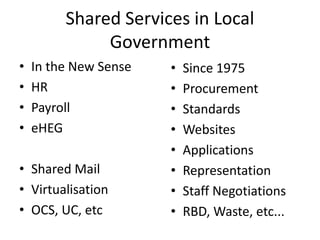
Shared Services in Local
              Government
•   In the New Sense   •   Since 1975
•   HR                 •   Procurement
•   Payroll            •   Standards
•   eHEG               •   Websites
                       •   Applications
• Shared Mail          •   Representation
• Virtualisation       •   Staff Negotiations
• OCS, UC, etc         •   RBD, Waste, etc...
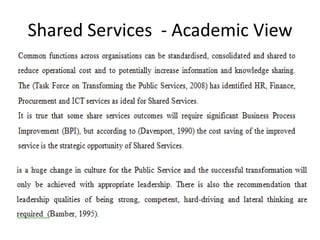
Shared Services - Academic View
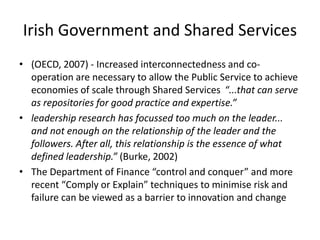
Irish Government and Shared Services
• (OECD, 2007) - Increased interconnectedness and co-
  operation are necessary to allow the Public Service to achieve
  economies of scale through Shared Services “...that can serve
  as repositories for good practice and expertise.”
• leadership research has focussed too much on the leader...
  and not enough on the relationship of the leader and the
  followers. After all, this relationship is the essence of what
  defined leadership.” (Burke, 2002)
• The Department of Finance “control and conquer” and more
  recent “Comply or Explain” techniques to minimise risk and
  failure can be viewed as a barrier to innovation and change
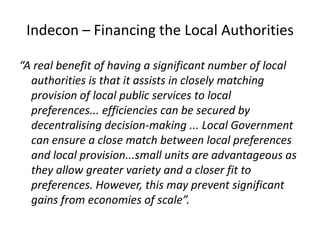
Indecon – Financing the Local Authorities

“A real benefit of having a significant number of local
  authorities is that it assists in closely matching
  provision of local public services to local
  preferences... efficiencies can be secured by
  decentralising decision-making ... Local Government
  can ensure a close match between local preferences
  and local provision...small units are advantageous as
  they allow greater variety and a closer fit to
  preferences. However, this may prevent significant
  gains from economies of scale”.
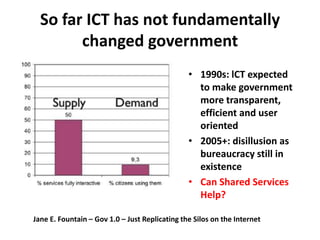
So far ICT has not fundamentally
        changed government
                                                • 1990s: lCT expected
                                                  to make government
                                                  more transparent,
                                                  efficient and user
                                                  oriented
                                                • 2005+: disillusion as
                                                  bureaucracy still in
                                                  existence
                                                • Can Shared Services
                                                  Help?

Jane E. Fountain – Gov 1.0 – Just Replicating the Silos on the Internet
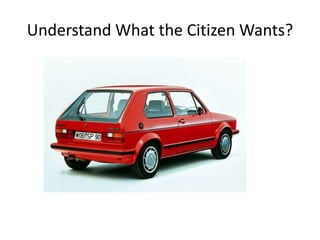
Understand What the Citizen Wants?
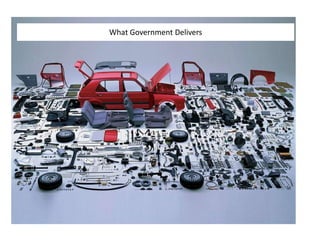
What Government Delivers
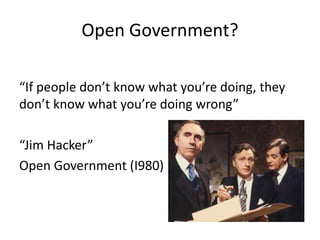
Open Government?

“If people don’t know what you’re doing, they
don’t know what you’re doing wrong”

“Jim Hacker”
Open Government (I980)
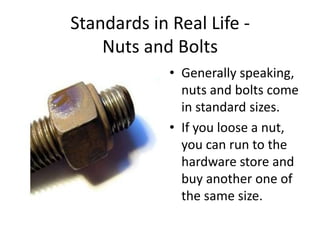
Standards in Real Life -
    Nuts and Bolts
             • Generally speaking,
               nuts and bolts come
               in standard sizes.
             • If you loose a nut,
               you can run to the
               hardware store and
               buy another one of
               the same size.
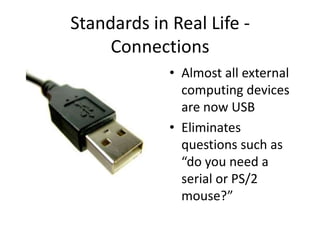
Standards in Real Life -
     Connections
             • Almost all external
               computing devices
               are now USB
             • Eliminates
               questions such as
               “do you need a
               serial or PS/2
               mouse?”
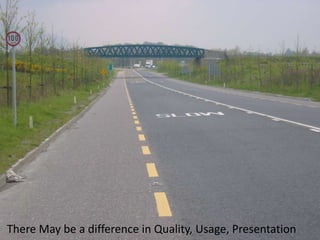
Standards


There May be a difference in Quality, Usage, Presentation
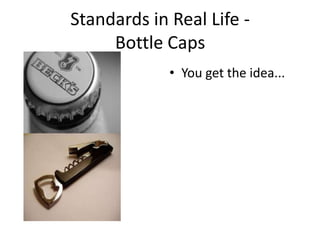
Standards in Real Life -
     Bottle Caps
             • You get the idea...
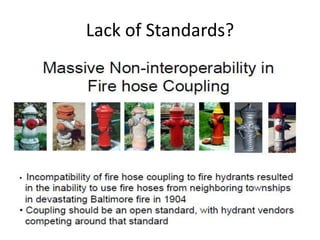
Lack of Standards?
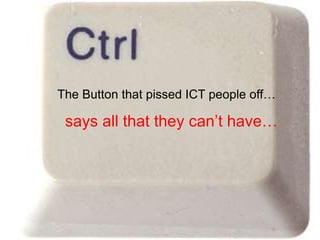
The Button that pissed ICT people off…

 says all that they can’t have…
live in a society obsessed with risk!
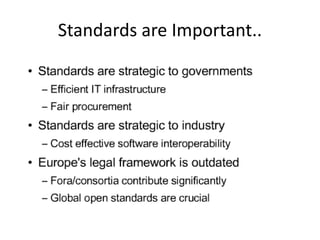
Standards are Important..
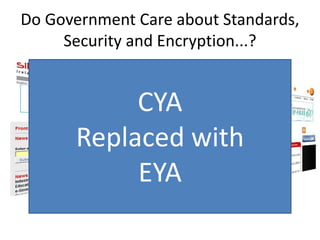
Do Government Care about Standards,
     Security and Encryption...?


           CYA
      Replaced with
           EYA
Data Privacy
• Audit functionality to capture access is not in place in
  many instances;
• Significant amount of data transfers taking place using
  unencrypted mail, file transfers, etc.;
• Secure disposal of media at end-of-life not addressed
  by most responses;
• Procedures for personal data held on paper not
  addressed by many responses.
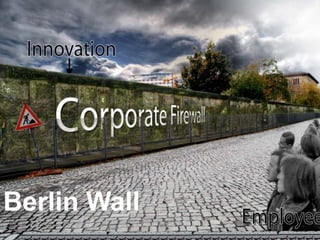
Berlin Wall
Even Security is changing
• Used to defend the edge of the network...
• Now looking at defending the middle and
  trusting the edges if they are trust-worthy...
  (Standards, Testing, Quality, Measurement)
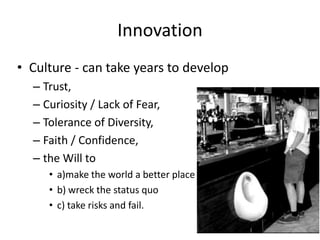
Innovation
• Culture - can take years to develop
  – Trust,
  – Curiosity / Lack of Fear,
  – Tolerance of Diversity,
  – Faith / Confidence,
  – the Will to
     • a)make the world a better place and
     • b) wreck the status quo
     • c) take risks and fail.
Data Sharing
• Barriers to Sharing
  – Not Technical
  – People
  – Leadership
  – Perceived rather than actual Issues
  – Don’t see the need or Relevance to others in using
    or having their data
  – Loss of Control / Power
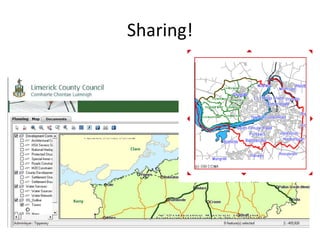
Sharing!
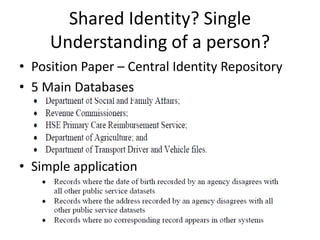
Shared Identity? Single
     Understanding of a person?
• Position Paper – Central Identity Repository
• 5 Main Databases


• Simple application
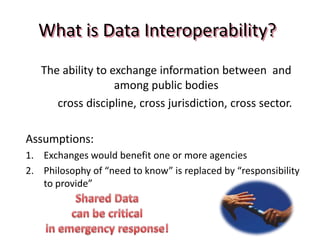
What is Data Interoperability?
   The ability to exchange information between and
                   among public bodies
      cross discipline, cross jurisdiction, cross sector.

Assumptions:
1. Exchanges would benefit one or more agencies
2. Philosophy of “need to know” is replaced by “responsibility
   to provide”
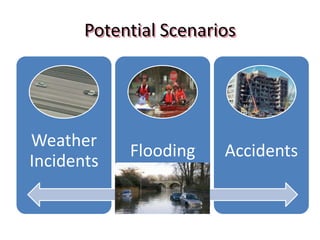
Potential Scenarios


Weather
            Flooding    Accidents
Incidents
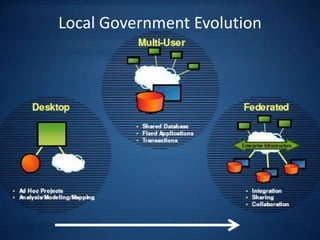
Local Government Evolution
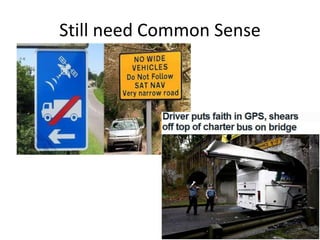
Still need Common Sense
Key disruptive forces

• Digitization of everything……
  – and exponential growth
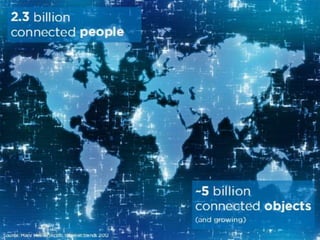
• Everything/one is getting connected……
  – and mobile
• Devices are getting smaller, smarter……
  – and cheaper
• Customer demand…
  – and an explosion of broadband
Work is also changing Rapidly
• Collaboration
  – Specialisation, optimisation, Just In Time
• Nature of Work
  – Anytime, Anywhere, Faster?, smarter, better?
• Human Capital is replacing Physical Capital as
  the Unit of Measurement
• More User Input, More Spontaneous,
• Collaboration with (Unknown) Partners
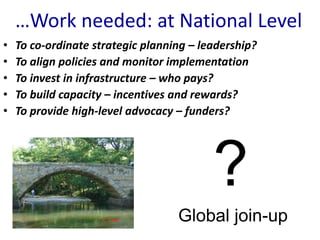
…Work needed: at National Level
•   To co-ordinate strategic planning – leadership?
•   To align policies and monitor implementation
•   To invest in infrastructure – who pays?
•   To build capacity – incentives and rewards?
•   To provide high-level advocacy – funders?


                                          ?
                                   Global join-up
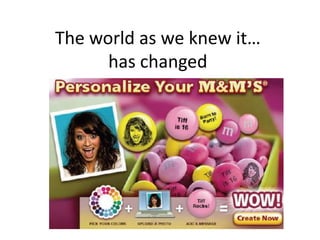
The world as we knew it…
      has changed
…We have come a long way...
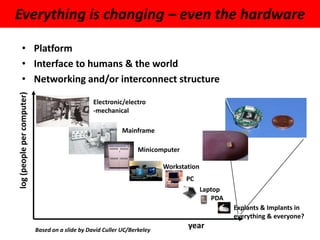
Everything is changing – even the hardware

       • Platform
       • Interface to humans & the world
       • Networking and/or interconnect structure
log (people per computer)


                                                  Electronic/electro
                                                  -mechanical

                                                             Mainframe

                                                                   Minicomputer

                                                                           Workstation
                                                                                  PC
                                                                                         Laptop
                                                                                            PDA
                                                                                                  Explants & Implants in
                                                                                                  everything & everyone?
                            Based on a slide by David Culler UC/Berkeley
                                                                                  year
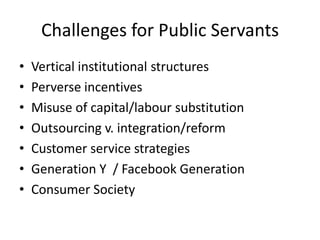
Challenges for Public Servants
•   Vertical institutional structures
•   Perverse incentives
•   Misuse of capital/labour substitution
•   Outsourcing v. integration/reform
•   Customer service strategies
•   Generation Y / Facebook Generation
•   Consumer Society
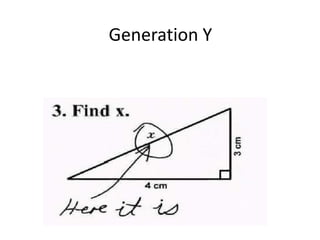
Generation Y


3. – Find x.
               X
                        3


                   4
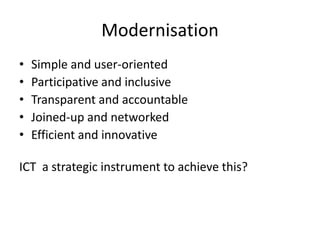
Modernisation
•   Simple and user-oriented
•   Participative and inclusive
•   Transparent and accountable
•   Joined-up and networked
•   Efficient and innovative

ICT a strategic instrument to achieve this?
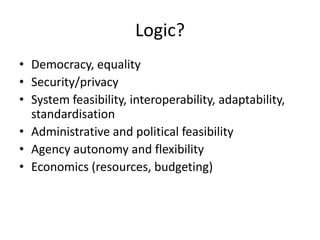
Logic?
• Democracy, equality
• Security/privacy
• System feasibility, interoperability, adaptability,
  standardisation
• Administrative and political feasibility
• Agency autonomy and flexibility
• Economics (resources, budgeting)
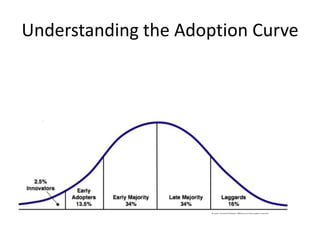
Understanding the Adoption Curve
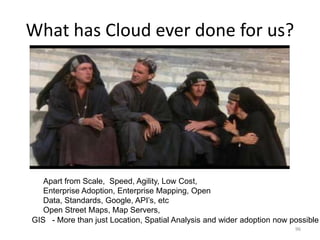
What has Cloud ever done for us?


   Apart from Scale, Speed, Agility, Low Cost,
   Enterprise Adoption, Enterprise Mapping, Open
   Data, Standards, Google, API’s, etc
   Open Street Maps, Map Servers,
GIS - More than just Location, Spatial Analysis and wider adoption now possible
                                                                        96
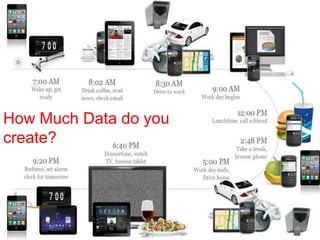
How Much Data do you
create?
Retailers..
• Assign each shopper a unique code - keeps tabs
  on everything they buy.
  –   If you use a credit card or a coupon,
  –   or fill out a survey,
  –   or mail in a refund,
  –   or call the customer help line,
  –   or open an e-mail we’ve sent you
  –   or visit our Web site,
  –   we’ll record it and link it to your ID,”
• “We want to know everything we can.”
• “Cool is one click away from Creepy” (Fjord)
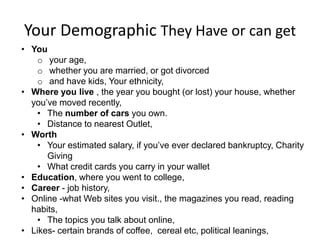
Your Demographic They Have or can get
• You
    o your age,
    o whether you are married, or got divorced
    o and have kids, Your ethnicity,
• Where you live , the year you bought (or lost) your house, whether
  you’ve moved recently,
    • The number of cars you own.
    • Distance to nearest Outlet,
• Worth
    • Your estimated salary, if you’ve ever declared bankruptcy, Charity
      Giving
    • What credit cards you carry in your wallet
• Education, where you went to college,
• Career - job history,
• Online -what Web sites you visit., the magazines you read, reading
  habits,
    • The topics you talk about online,
• Likes- certain brands of coffee, cereal etc, political leanings,
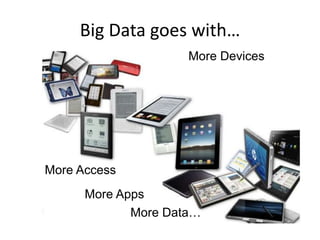
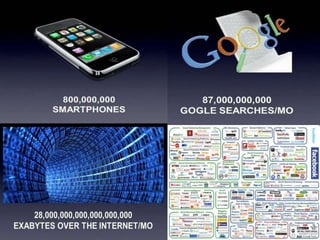
Big Data goes with…
                     More Devices


More Access
      More Apps
             More Data…
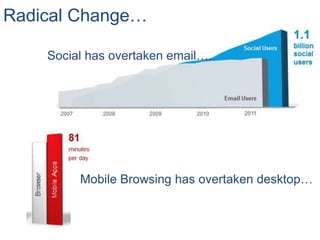
Radical Change…

    Social has overtaken email….


         Mobile Browsing has overtaken desktop…
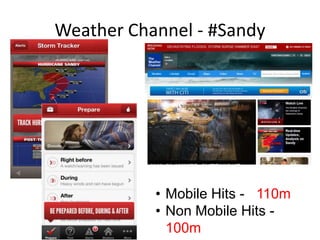
Weather Channel - #Sandy


           • Mobile Hits - 110m
           • Non Mobile Hits -
             100m
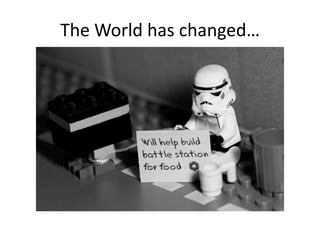
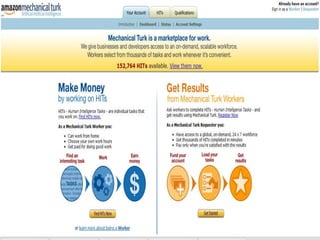
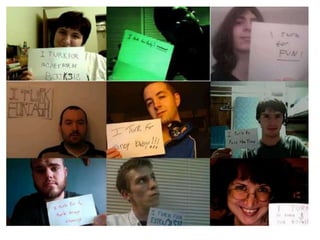
The World has changed…
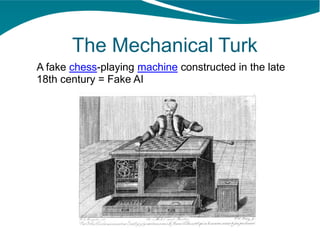
The Mechanical Turk
A fake chess-playing machine constructed in the late
18th century = Fake AI
Every day - you come across
                   multiple…
•   - Devices
•   - applications
•   - access points
•   - Networks
•   - Locations
•   - Servers
•   - Data types
•   - Data caches
•   - Service providers
•   - Operating systems
•   - Storage locations
•   - Encryption / security protocols..
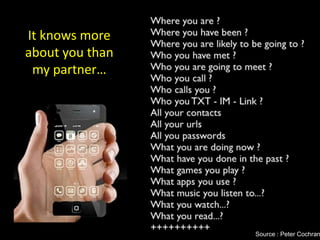
It knows more
about you than
 my partner…


                 Source : Peter Cochran
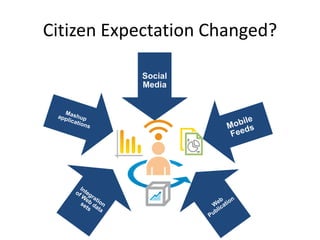
Citizen Expectation Changed?

           Social
           Media
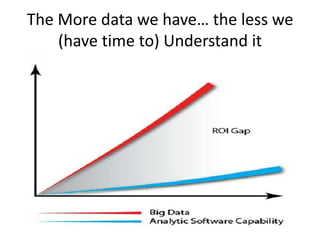
The More data we have… the less we
    (have time to) Understand it
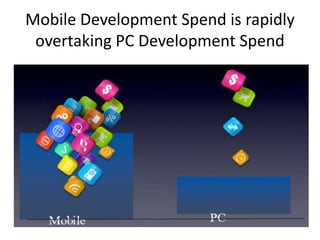
Mobile Development Spend is rapidly
 overtaking PC Development Spend
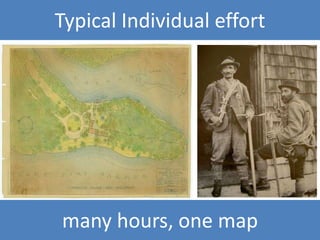
Typical Individual effort


many hours, one map
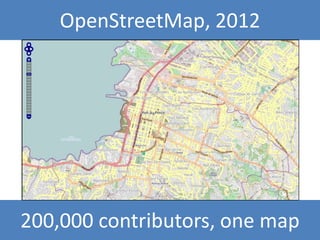
OpenStreetMap, 2012


200,000 contributors, one map
Our Lives are Different…
• We communicate on — Facebook, Chat, Twitter,
  MMS
• We Research Information — Blogs, eNews, Wiki,
  YouTube
• We Buy — eBay, Amazon, Dell, Deal Done, etc…
• We Travel - Tripadvisor, Flickr, RyanAir, Hotels,
• We Meet / Retate - Linkedln, FaceBook, Friends
• We Play – xBox, Playstation, Online games, ¡TV
• We expect the Government to fit into these
  paradigms too…
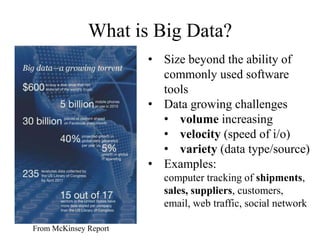
What is Big Data?
                       • Size beyond the ability of
                         commonly used software
                         tools
                       • Data growing challenges
                         • volume increasing
                         • velocity (speed of i/o)
                         • variety (data type/source)
                       • Examples:
                         computer tracking of shipments,
                         sales, suppliers, customers,
                         email, web traffic, social network

From McKinsey Report
Why Now?. What is the Catalyst?
• People
  – Web sites with 300+ million unique visitors/month
     • Facebook
     • Google
     • YouTube
• Access
  – 1.2 Billion active mobile broadband subscriptions
• Commodity (community) Hardware
  – possibility for cost effective processing
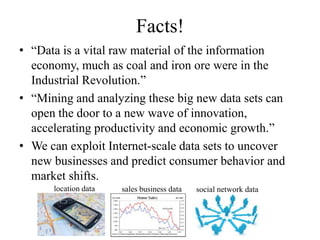
Facts!
• “Data is a vital raw material of the information
  economy, much as coal and iron ore were in the
  Industrial Revolution.”
• “Mining and analyzing these big new data sets can
  open the door to a new wave of innovation,
  accelerating productivity and economic growth.”
• We can exploit Internet-scale data sets to uncover
  new businesses and predict consumer behavior and
  market shifts.
      location data   sales business data   social network data
Think…
• NY Traffic
  – They have mountains of data
  – More Daily
  – Don’t Understand it, can’t use it
  – What is the True Cost of Data Mining
  – Systems, Software, Computers, Analysts, STORAGE
  – Are we collecting, collating, etc the Right Data
  – People being removed daily, replaced by machines
  – Need to Stand Back….
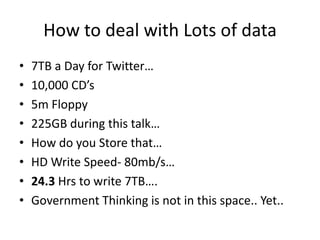
How to deal with Lots of data
•   7TB a Day for Twitter…
•   10,000 CD’s
•   5m Floppy
•   225GB during this talk…
•   How do you Store that…
•   HD Write Speed- 80mb/s…
•   24.3 Hrs to write 7TB….
•   Government Thinking is not in this space.. Yet..
Irish Government
• Decision – “All Government Invoices Published”
  – Election Manifesto
  – Election Promises
  – Programme for Government
• Action
  – None…
  – Fear, Bad Reactions, Data Quality,
Which Apps?
• Government – Do not try to second guess what
  are useful applications!
• No one can predict what data to make open
  based on potential Apps.
• There are a huge number of apps available for
  smartphones. Impossible to guess a few years
  back.
• Put Data out there. Data as a platform for others
  to build on, as infrastructure.
• Apps you will like and hate, but it’s not up to you.
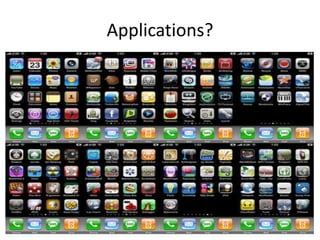
Applications?
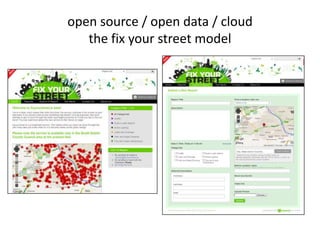
open source / open data / cloud
   the fix your street model
The Reality of
FixYourStreet
How do we measure Success?
•   Usage and Apps
•   Critical Mass of Companies
•   Search Results (Bing and Google Interested)
•   Business Committed to OD
•   Laws (Prison for breaking them)
•   If Open Data doesn’t cause difficulty for the
    Publisher to seek excellence then it isn’t
    working
Understand what are the Driving
                Forces…
• Government Focus
   – Understanding, Efficiency, Accountability
• Technology Innovation Focus
   – Data as a Platform, Semantic Web
• Reward Focus
   – Profit, Recognition
• Digitising Government Focus
   – Computerisation / Technology Drive
• Problem Solving Focus
   – New Skills needed to work on new Challenge
• Social / Public Sector / Enterprise
   – More Focussed Services
Conclusions
•   Change is constant
•   Cloud is the Future
•   Social is a Reality
•   Mobile is already taking over
•   Data has to keep up…
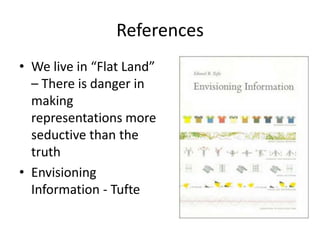
References
• We live in “Flat Land”
  – There is danger in
  making
  representations more
  seductive than the
  truth
• Envisioning
  Information - Tufte
Governance
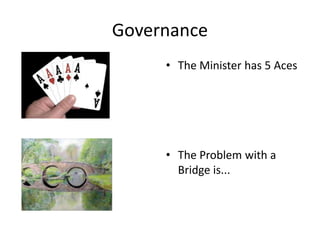
     • The Minister has 5 Aces


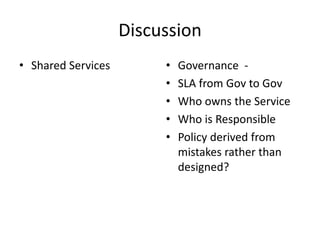
     • The Problem with a
       Bridge is...
Discussion
• Shared Services        •   Governance -
                         •   SLA from Gov to Gov
                         •   Who owns the Service
                         •   Who is Responsible
                         •   Policy derived from
                             mistakes rather than
                             designed?

Tim presentation to innovation masters november 2012

  • 1.
    Shared Services and Data Sharing Thoughts on 20 years in Local Government Tim Willoughby
  • 2.
    Feedback – bevery careful
  • 3.
    My name isTim I explain technology…
  • 4.
    to people whodon’t understand it…
  • 5.
    people who think theydo understand it…
  • 6.
  • 7.
    and people whoworship it.
  • 8.
    …that help peopleunderstand how technology might help their Organisation…
  • 9.
    I live here...According to Google Streetview 9
  • 10.
    Don’t bother mewith your ideas now, I’ve got a job to do!
  • 11.
  • 12.
  • 13.
    Shared Services • Leadership •Change Management – Business as Usual, Cultural Shift, Continuous Improvement, Responsibility and Service Mapping • Measurement – Measuring the Right Things – Selection, Cost Savings, Growth, Delivery • Governance – Managing expectations, Innovations and Supplier Push
  • 14.
    Kotter’s eight-stage processfor change 1. Establish a sense of urgency 2. Form a powerful guiding coalition 3. Create a vision 4. Communicate the vision 5. Empower others to act on the vision 6. Plan for and create short-term wins 7. Consolidate improvements and produce more change 8. Anchor new approaches 14 J. Kotter, “Leading Change – Why Transformation Efforts Fail”
  • 16.
    1. Establish asense of urgency Forces for The status Forces for change quo stability 16 Burnes 2004
  • 17.
    But I’m socomfortable… 17
  • 18.
    1. How tocreate a sense of urgency? • Create a crisis/rivalry – Just read the papers!!!! • Find/develop a “red hot” burning issue – NAMA • Revise existing or develop new standards – Income, profitability, effectiveness, efficiency, customer satisfaction • Get an outside opinion – Bring in consultants, customers, shareholders 18
  • 19.
    Outside Opinion v’sIndependence • Independence from Suppliers? • Can we get truly independent advice? • Should Government employ independent thinkers within the Civil Service or contract with Independent Suppliers?
  • 20.
  • 21.
    • Includes – HR, Finance, Telephony, Virtualisation, etc... – Mail, Payroll, etc... – A bit like asking Revenue is this Taxable
  • 22.
    Sense of Urgency– Strategies… – Public Sector Reform Plan • public services to be delivered faster, better and more • Intelligent, targeted use of ICT and eGovernment are key enablers for these improvements. – eGovernment Strategy • services through multiple channels; • improve data sharing; • develop a more integrated approach within and across sectors – Cloud Computing Strategy • data centre consolidation • adoption of cloud computing
  • 23.
    Struggle with SharedServices • Same Phrase – two meanings • Shared Services- Reduce Headcount – Save Payroll, Efficient, savings • Shared Services – ICT System – Cost Centre, Efficiencies, Long term savings
  • 24.
    Shared Services • 1. Shared Payroll • 2. Shared HR transactions • 3. Accounts Payable • 4. ICT back office • 5. Local Government portal • 6. Treasury Management
  • 25.
    2. Form apowerful coalition • Ensure shared understanding & right attitude The small – Ability to share vision team that will – Trustworthy lead the – Commitment to means and change end • Has access to necessary But look out for resources people with big egos – Formal position power or “snakes” – Expertise – Reputation – Leadership – Informal network position 25
  • 26.
    Each sector haspowerful (NEW) Leadership Groups.. • ICT Committee of the LGMA (New Powers) • Board of the LGMA • Local Government Efficiency Review Group (New) • Local Government Implementation Group (New) • Public Service Reform Oversight Group (New).
  • 27.
    Who has Formal/ Informal power in the organisation? • Try it out in your org.. Very interesting... 27 Teigland 2003
  • 28.
    Understand the Archetypes Duelsists Fillibuster Perpetual duel. Holds the floor, monotonous hectoring Ego Big Dog and MiniMe It’s all about him, Bully - intimidate fiercest of all Me-Too will join the attack.
  • 31.
    Radical Change ishappening – With or Without the Owners / Shareholders
  • 32.
    3. Create avision • Create the vision – To direct the change effort – To coordinate across and outside the organisation • Develop a strategy to achieve the vision (operationalise) – To engage people through participation – To find their “passion” – To overcome forces for stability 32
  • 33.
    Local Government Vision •New approach to the capture and use of data • Building of teams across the sector that blurs county boundaries • Centrally mandated architectural approach adopted • Sourcing practices to achieve economies of scale • Use procurement frameworks and maintain local enterprise.
  • 34.
    Central Government Vision •“As Public Bodies continue to reform their processes to improve business and citizen access to and interaction with Government services, the continued move to eGovernment and online delivery of services is inevitable”. • “All public bodies will monitor and evaluate take-up of eGovernment services with a view to achieving the 50% (for citizens) and 80% (for businesses) targets set out in the EU eGovernment Action Plan (by 2015).”
  • 35.
    4. Communicate thevision • How? – Use multiple channels – Regularly to reconfirm • What? – Keep it simple – Use metaphors and success stories • Who? But listen as well!! – Walk the talk – Identify key opinion leaders 35
  • 36.
    When do peoplesupport the vision?  Relate to the vision  Expect personal gain (make their world a better place)  Can give input  Respect the leader  Believe the time is right “Coming together is a beginning, staying together is progress, and working together is success.” -Henry Ford  WIIFM – Opportunity for all? 36
  • 37.
    • "Unless youare prepared to give up something valuable you will never be able to truly change at all, because you'll be forever in the control of things you can't give up.“ – Andy Law Creative Company • "Only the wisest and stupidest of men never change.“ – Confucius • "Change is hard because people overestimate the value of what they have—and underestimate the value of what they may gain by giving that up.“ – James Belasco and Ralph Stayer Flight of the Buffalo (1994) • "There is nothing more difficult to take in hand, more perilous to conduct, or more uncertain in its success, than to take the lead in the introduction of a new order of things.“ – Niccolo Machiavelli The Prince (1532) • "There is a certain relief in change, even though it be from bad to worse; as I have found in traveling in a stagecoach, that it often a comfort to shift one's position and be bruised in a new place.“ – Washington Irving Tales of a Traveler (1824)
  • 38.
    • "People don'tresist change. They resist being changed!“ – Peter Senge • "Culture does not change because we desire to change it. Culture changes when the organization is transformed; the culture reflects the realities of people working together every day.“ – Frances Hesselbein The Key to Cultural Transformation, Leader to Leader (Spring 1999) • "It is a bad plan that admits of no modification.“ – Publilius Syrus First Century BC • "Change is the law of life and those who look only to the past or present are certain to miss the future.“ – John F. Kennedy • "The greatest danger in times of turbulence is not the turbulence; it is to act with yesterday’s logic.“ – Peter Drucker • "Faced with the choice between changing one's mind and proving that there is no need to do so, almost everyone gets busy on the proof.“ – John Kenneth Galbraith
  • 39.
    New Measurement Metrics •Citizen perspective – how is the quality of the ICT service perceived by citizens? • Financial perspective – how attractive is the IS function and LGMA to the sector as a whole? • Internal perspective – how effective and efficient are the processes in the IS functions and the LGMA? • Learning & growth perspective – is the IS function and the LGMA capable of innovation and improvement?
  • 40.
    Effective Communication • ClearMessages • Reduce Complexity • Don’t have opinions on everything • Good and Bad News
  • 41.
    Collaboration it’s more aboutthe people than the technology
  • 42.
    Communication – SocialMedia.. • Social and new media works.. – Depending on the message – As to be a collaboration – It is not a One Way Environment – has to be two way • Example – United Break Guitars.. Yes/No
  • 43.
    5. Empower othersto act on the 5.Are the organizational vision structure & systems aligned with the vision? 4.Do people have the authority to act? 3.Do people have the appropriate skills and training to act? 2.Do people have the necessary resources to act? 1. Does the organizational culture encourage individuals to act? 43
  • 44.
    Civil Service Recruitmentchanged • Civil service can now recruit outside the Civil Service… • Croke Park – Croke Park and Shared Services… not natural partners…
  • 45.
    6. Plan forand create short-term wins Communicate 3. Recognise the wins and reward “winners” 2. Encourage & convince people that targets can be 1. Create reached obtainable targets 45
  • 46.
    Broadcast heroes andtheir success stories! 46
  • 47.
    Wins… • Household Charge – 1m Households pay new charge to website – Central Shared Service • NPPR – Non Principal Private Residence – Web Based – 250,000 second homes – Central Service • Shared HR Service – Central Service
  • 48.
    How were winsachieved • At all costs… • Had to be seen to win.. • No option but to go with the central approach
  • 49.
    Success - eProcurement •General consent - no discussion – assumption that e-procurement has its benefits both in saving on public expenditure and preventing fraud. • The main goals are: – greater efficiency in public procurement – administrative simplification of public procurement – more transparent procedures – better competition • Discussion now about the “how” and the “when”. • The European Commission has put forward a draft directive and a number of deadlines. European Parliament is reviewing the proposal and a parliamentary committee is doing great work.
  • 50.
    7. Consolidate improvementsand produce more change Scope of change Change Project 3 Change Project 2 Change Project 1 Time 50
  • 51.
    8. Anchor newapproaches Physical artifacts Intangible activities and routines Underlying values, assumptions, beliefs, and expectations Company culture 51
  • 52.
  • 53.
    5 Themes • SaaS, IaaS, PaaS, Web 2.0 / 3.0, Peer to Peer The World is Cloudy • Addressing and Adapting change and to change • Instantaneous, Online Response from Inter-continental companies The World is Flat • Digital Supply Chain across Global companies / across the globe • Environmental Compliance The world is green • Reduce your own and your companies Carbon Footprint • Consumers and Workforce - always on - connected anywhere The World is Mobile • Increased demand and expectation for services The World of Low • Energy and Cost Efficient Computing and Data Centres Cost ICT • Flatter Budgets require Efficiencies CAPX and OPEX
  • 55.
    Shared Services inLocal Government • In the New Sense • Since 1975 • HR • Procurement • Payroll • Standards • eHEG • Websites • Applications • Shared Mail • Representation • Virtualisation • Staff Negotiations • OCS, UC, etc • RBD, Waste, etc...
  • 56.
    Shared Services -Academic View
  • 57.
    Irish Government andShared Services • (OECD, 2007) - Increased interconnectedness and co- operation are necessary to allow the Public Service to achieve economies of scale through Shared Services “...that can serve as repositories for good practice and expertise.” • leadership research has focussed too much on the leader... and not enough on the relationship of the leader and the followers. After all, this relationship is the essence of what defined leadership.” (Burke, 2002) • The Department of Finance “control and conquer” and more recent “Comply or Explain” techniques to minimise risk and failure can be viewed as a barrier to innovation and change
  • 58.
    Indecon – Financingthe Local Authorities “A real benefit of having a significant number of local authorities is that it assists in closely matching provision of local public services to local preferences... efficiencies can be secured by decentralising decision-making ... Local Government can ensure a close match between local preferences and local provision...small units are advantageous as they allow greater variety and a closer fit to preferences. However, this may prevent significant gains from economies of scale”.
  • 59.
    So far ICThas not fundamentally changed government • 1990s: lCT expected to make government more transparent, efficient and user oriented • 2005+: disillusion as bureaucracy still in existence • Can Shared Services Help? Jane E. Fountain – Gov 1.0 – Just Replicating the Silos on the Internet
  • 61.
    Understand What theCitizen Wants?
  • 62.
  • 63.
    Open Government? “If peopledon’t know what you’re doing, they don’t know what you’re doing wrong” “Jim Hacker” Open Government (I980)
  • 64.
    Standards in RealLife - Nuts and Bolts • Generally speaking, nuts and bolts come in standard sizes. • If you loose a nut, you can run to the hardware store and buy another one of the same size.
  • 65.
    Standards in RealLife - Connections • Almost all external computing devices are now USB • Eliminates questions such as “do you need a serial or PS/2 mouse?”
  • 66.
    Standards There May bea difference in Quality, Usage, Presentation
  • 67.
    Standards in RealLife - Bottle Caps • You get the idea...
  • 68.
  • 69.
    The Button thatpissed ICT people off… says all that they can’t have…
  • 70.
    live in asociety obsessed with risk!
  • 71.
  • 72.
    Do Government Careabout Standards, Security and Encryption...? CYA Replaced with EYA
  • 73.
    Data Privacy • Auditfunctionality to capture access is not in place in many instances; • Significant amount of data transfers taking place using unencrypted mail, file transfers, etc.; • Secure disposal of media at end-of-life not addressed by most responses; • Procedures for personal data held on paper not addressed by many responses.
  • 74.
  • 75.
    Even Security ischanging • Used to defend the edge of the network... • Now looking at defending the middle and trusting the edges if they are trust-worthy... (Standards, Testing, Quality, Measurement)
  • 77.
    Innovation • Culture -can take years to develop – Trust, – Curiosity / Lack of Fear, – Tolerance of Diversity, – Faith / Confidence, – the Will to • a)make the world a better place and • b) wreck the status quo • c) take risks and fail.
  • 78.
    Data Sharing • Barriersto Sharing – Not Technical – People – Leadership – Perceived rather than actual Issues – Don’t see the need or Relevance to others in using or having their data – Loss of Control / Power
  • 79.
  • 80.
    Shared Identity? Single Understanding of a person? • Position Paper – Central Identity Repository • 5 Main Databases • Simple application
  • 81.
    What is DataInteroperability? The ability to exchange information between and among public bodies cross discipline, cross jurisdiction, cross sector. Assumptions: 1. Exchanges would benefit one or more agencies 2. Philosophy of “need to know” is replaced by “responsibility to provide”
  • 82.
    Potential Scenarios Weather Flooding Accidents Incidents
  • 83.
  • 84.
  • 85.
    Key disruptive forces •Digitization of everything…… – and exponential growth • Everything/one is getting connected…… – and mobile • Devices are getting smaller, smarter…… – and cheaper • Customer demand… – and an explosion of broadband
  • 86.
    Work is alsochanging Rapidly • Collaboration – Specialisation, optimisation, Just In Time • Nature of Work – Anytime, Anywhere, Faster?, smarter, better? • Human Capital is replacing Physical Capital as the Unit of Measurement • More User Input, More Spontaneous, • Collaboration with (Unknown) Partners
  • 87.
    …Work needed: atNational Level • To co-ordinate strategic planning – leadership? • To align policies and monitor implementation • To invest in infrastructure – who pays? • To build capacity – incentives and rewards? • To provide high-level advocacy – funders? ? Global join-up
  • 88.
    The world aswe knew it… has changed
  • 89.
    …We have comea long way...
  • 90.
    Everything is changing– even the hardware • Platform • Interface to humans & the world • Networking and/or interconnect structure log (people per computer) Electronic/electro -mechanical Mainframe Minicomputer Workstation PC Laptop PDA Explants & Implants in everything & everyone? Based on a slide by David Culler UC/Berkeley year
  • 91.
    Challenges for PublicServants • Vertical institutional structures • Perverse incentives • Misuse of capital/labour substitution • Outsourcing v. integration/reform • Customer service strategies • Generation Y / Facebook Generation • Consumer Society
  • 92.
    Generation Y 3. –Find x. X 3 4
  • 93.
    Modernisation • Simple and user-oriented • Participative and inclusive • Transparent and accountable • Joined-up and networked • Efficient and innovative ICT a strategic instrument to achieve this?
  • 94.
    Logic? • Democracy, equality •Security/privacy • System feasibility, interoperability, adaptability, standardisation • Administrative and political feasibility • Agency autonomy and flexibility • Economics (resources, budgeting)
  • 95.
  • 96.
    What has Cloudever done for us? Apart from Scale, Speed, Agility, Low Cost, Enterprise Adoption, Enterprise Mapping, Open Data, Standards, Google, API’s, etc Open Street Maps, Map Servers, GIS - More than just Location, Spatial Analysis and wider adoption now possible 96
  • 97.
    How Much Datado you create?
  • 98.
    Retailers.. • Assign eachshopper a unique code - keeps tabs on everything they buy. – If you use a credit card or a coupon, – or fill out a survey, – or mail in a refund, – or call the customer help line, – or open an e-mail we’ve sent you – or visit our Web site, – we’ll record it and link it to your ID,” • “We want to know everything we can.” • “Cool is one click away from Creepy” (Fjord)
  • 99.
    Your Demographic TheyHave or can get • You o your age, o whether you are married, or got divorced o and have kids, Your ethnicity, • Where you live , the year you bought (or lost) your house, whether you’ve moved recently, • The number of cars you own. • Distance to nearest Outlet, • Worth • Your estimated salary, if you’ve ever declared bankruptcy, Charity Giving • What credit cards you carry in your wallet • Education, where you went to college, • Career - job history, • Online -what Web sites you visit., the magazines you read, reading habits, • The topics you talk about online, • Likes- certain brands of coffee, cereal etc, political leanings,
  • 100.
    Big Data goeswith… More Devices More Access More Apps More Data…
  • 103.
    Radical Change… Social has overtaken email…. Mobile Browsing has overtaken desktop…
  • 104.
    Weather Channel -#Sandy • Mobile Hits - 110m • Non Mobile Hits - 100m
  • 105.
    The World haschanged…
  • 108.
    The Mechanical Turk Afake chess-playing machine constructed in the late 18th century = Fake AI
  • 110.
    Every day -you come across multiple… • - Devices • - applications • - access points • - Networks • - Locations • - Servers • - Data types • - Data caches • - Service providers • - Operating systems • - Storage locations • - Encryption / security protocols..
  • 111.
    It knows more aboutyou than my partner… Source : Peter Cochran
  • 112.
  • 113.
    The More datawe have… the less we (have time to) Understand it
  • 114.
    Mobile Development Spendis rapidly overtaking PC Development Spend
  • 115.
  • 116.
  • 117.
    Our Lives areDifferent… • We communicate on — Facebook, Chat, Twitter, MMS • We Research Information — Blogs, eNews, Wiki, YouTube • We Buy — eBay, Amazon, Dell, Deal Done, etc… • We Travel - Tripadvisor, Flickr, RyanAir, Hotels, • We Meet / Retate - Linkedln, FaceBook, Friends • We Play – xBox, Playstation, Online games, ¡TV • We expect the Government to fit into these paradigms too…
  • 118.
    What is BigData? • Size beyond the ability of commonly used software tools • Data growing challenges • volume increasing • velocity (speed of i/o) • variety (data type/source) • Examples: computer tracking of shipments, sales, suppliers, customers, email, web traffic, social network From McKinsey Report
  • 119.
    Why Now?. Whatis the Catalyst? • People – Web sites with 300+ million unique visitors/month • Facebook • Google • YouTube • Access – 1.2 Billion active mobile broadband subscriptions • Commodity (community) Hardware – possibility for cost effective processing
  • 120.
    Facts! • “Data isa vital raw material of the information economy, much as coal and iron ore were in the Industrial Revolution.” • “Mining and analyzing these big new data sets can open the door to a new wave of innovation, accelerating productivity and economic growth.” • We can exploit Internet-scale data sets to uncover new businesses and predict consumer behavior and market shifts. location data sales business data social network data
  • 121.
    Think… • NY Traffic – They have mountains of data – More Daily – Don’t Understand it, can’t use it – What is the True Cost of Data Mining – Systems, Software, Computers, Analysts, STORAGE – Are we collecting, collating, etc the Right Data – People being removed daily, replaced by machines – Need to Stand Back….
  • 122.
    How to dealwith Lots of data • 7TB a Day for Twitter… • 10,000 CD’s • 5m Floppy • 225GB during this talk… • How do you Store that… • HD Write Speed- 80mb/s… • 24.3 Hrs to write 7TB…. • Government Thinking is not in this space.. Yet..
  • 124.
    Irish Government • Decision– “All Government Invoices Published” – Election Manifesto – Election Promises – Programme for Government • Action – None… – Fear, Bad Reactions, Data Quality,
  • 127.
    Which Apps? • Government– Do not try to second guess what are useful applications! • No one can predict what data to make open based on potential Apps. • There are a huge number of apps available for smartphones. Impossible to guess a few years back. • Put Data out there. Data as a platform for others to build on, as infrastructure. • Apps you will like and hate, but it’s not up to you.
  • 128.
  • 129.
    open source /open data / cloud the fix your street model
  • 130.
  • 131.
    How do wemeasure Success? • Usage and Apps • Critical Mass of Companies • Search Results (Bing and Google Interested) • Business Committed to OD • Laws (Prison for breaking them) • If Open Data doesn’t cause difficulty for the Publisher to seek excellence then it isn’t working
  • 132.
    Understand what arethe Driving Forces… • Government Focus – Understanding, Efficiency, Accountability • Technology Innovation Focus – Data as a Platform, Semantic Web • Reward Focus – Profit, Recognition • Digitising Government Focus – Computerisation / Technology Drive • Problem Solving Focus – New Skills needed to work on new Challenge • Social / Public Sector / Enterprise – More Focussed Services
  • 133.
    Conclusions • Change is constant • Cloud is the Future • Social is a Reality • Mobile is already taking over • Data has to keep up…
  • 134.
    References • We livein “Flat Land” – There is danger in making representations more seductive than the truth • Envisioning Information - Tufte
  • 135.
    Governance • The Minister has 5 Aces • The Problem with a Bridge is...
  • 136.
    Discussion • Shared Services • Governance - • SLA from Gov to Gov • Who owns the Service • Who is Responsible • Policy derived from mistakes rather than designed?