Rituparna Nag
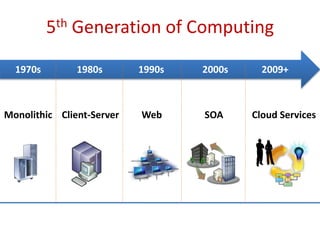
Monolithic Client-Server Web SOA Cloud Services
1970s 1980s 1990s 2000s 2009+
5th Generation of Computing
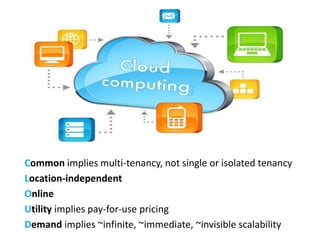
Common implies multi-tenancy, not single or isolated tenancy
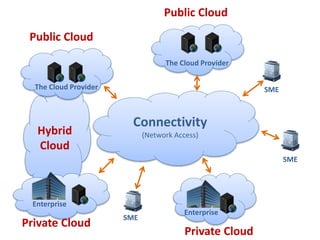
Location-independent
Online
Utility implies pay-for-use pricing
Demand implies ~infinite, ~immediate, ~invisible scalability
Cloud Computing Deployment Models
Hybrid
Cloud
Connectivity
(Network Access)
SME
SME
SME
Enterprise
Enterprise
Public Cloud
Public Cloud
Private Cloud
Private Cloud
The Cloud Provider
The Cloud Provider
Architectural Layers of Cloud Computing
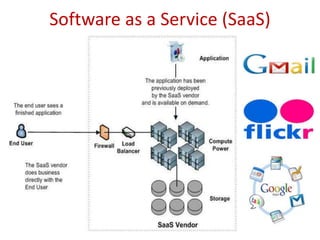
Software as a Service (SaaS)
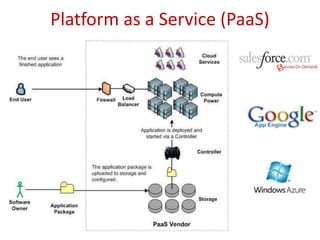
Platform as a Service (PaaS)
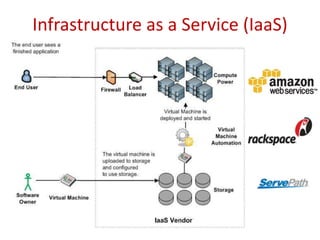
Infrastructure as a Service (IaaS)
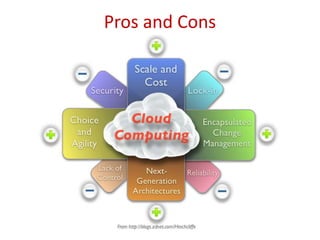
Pros and Cons
Security Issues
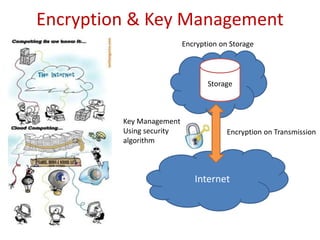
Encryption & Key Management
Storage
Internet
Encryption on Storage
Encryption on Transmission
Key Management
Using security
algorithm
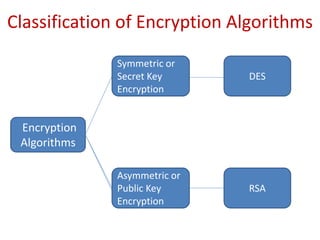
Classification of Encryption Algorithms
Encryption
Algorithms
Symmetric or
Secret Key
Encryption
Asymmetric or
Public Key
Encryption
DES
RSA
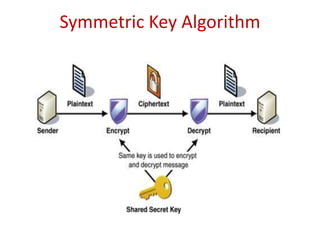
Symmetric Key Algorithm
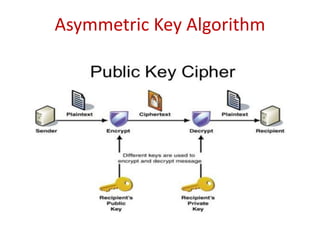
Asymmetric Key Algorithm
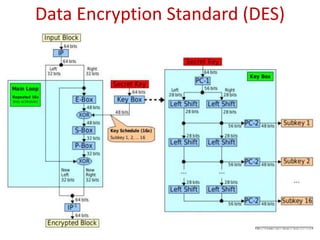
Data Encryption Standard (DES)
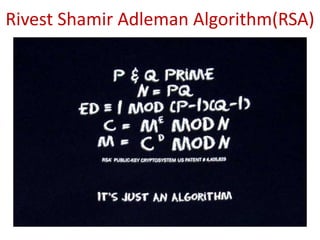
Rivest Shamir Adleman Algorithm(RSA)
RSA CRYPTOSYSTEM WITH EXAMPLE
SETUP
Step 1: Choose two primes:- p=3 , q=11 [for encrypting small message]
Step 2: n=p*q=3*11=33
Step 3: phi or ɸ(n)=(p-1)(q-1)=(3-1)(11-1)=2*10=20
Step 4: Choose e i.e., public exponent/encryption exponent
e must 1) be an integer
2) not be a factor of n
3) 1<e<ɸ (n)
Let, e=7
Step 5: Calculate d i.e., secret exponent/decryption exponent
(d*e)mod ɸ(n) = 1
(d*7)mod 20=1 => d=3
KEYS
Public Key: KE=( n, e)=(91,7)
Private Key: KD=d=3
ENCRYPTION
Let’s encrypt “BE” where B=2 and E=5 alphabetically.
1<M<n is a condition to encrypt messages within a range.
So, the plaintext, M=25.
Cipher text, C=M^e mod n= 25^7 mod 33=31
DECRYPTION
M=C^d mod n= 31^3 mod 33=25 = “BE”.
RECENT SCHEMES OF CLOUD ENCRYPTION
1. Rashmi Nigoti et. al[1] have surveyed different security issues to cloud and
different cryptographic algorithms adoptable to better security for the cloud and
the benefits of cloud storage viz. easy access , scalability, cost efficiency, and
high reliability of the data.
2. Brian Hay et. al [2] have focused on data authentication, data integrity,
querying and outsourcing the encrypted data.
3. Ashalatha R [3] discussed in her paper about the significance of data security
and the various existing security techniques for the cloud.
4. S.Monikandan et.al[4] proposed a new cloud cryptography technique . It
conveys that since the user has no control over the data once their session is
logged out, the encryption key acts as the primary authentication for the user.
By applying this encryption algorithm, user ensures that the data is stored only
on secured storage and it cannot be accessed by administrators or intruders.
5. Rajeev Bedi et.al[5] developed a retrieval system in which the data is retrieved
by the user in encrypted form and is decrypted by the user at its own site using
a public and private key encryption both the keys working at the user level.
CONCLUSION AND FUTURE SCOPE
Security is a major requirement in cloud computing while we talk
about data storage. There are number of existing techniques used to
implement security in cloud. So in this presentation, I have
discussed the popularly used symmetric and asymmetric algorithms
of cloud encryption techniques.
The future will focusing on –
More strong security algorithms and implement a better version
of DES, RSA , etc.
 New security techniques need to be developed and older security
techniques needed to be radically tweaked to be able to work with
the clouds architecture.
As the development of cloud computing technology is still under
R&D, there will be more better understanding of the design
challenges of cloud computing, and pave the way for further
research in this area.
BIBLIOGRAPHY
[1] Rashmi Nigoti et al., “ A Survey of Cryptographic Algorithms for Cloud
Computing” International Journal of Emerging Technologies in Computational and
Applied Sciences,4(2), March-May 2013.
[2] Brian Hay, Kara Nance, Matt Bishop, “Storm Clouds Rising: Security
Challenges f for IaaS Cloud Computing” Proceedings of the 44th Hawaii
International Conference on System Sciences -2011.
[3] Ashalatha R,Faculty of Computer Science, Dayananda Sagar College of
Engineering, Bangalore,” A Survey On Security As A Challenge In Cloud
Computing” International Journal of Advanced Technology & Engineering
Research (IJATER) National Conference on Emerging Trends in Technology (NCET-
Tech), Volume 2, Issue 4, July 2012.
[4] S. Monikandan et al., “Data Security and Privacy in Cloud Storage using Hybrid
Symmetric Encryption Algorithm” International Journal of Advanced Research in
Computer and Communication Engineering Vol. 2, Issue 8, August 2013.
[5] Rajeev Bedi et al., “Applying Encryption Algorithm for Data Security and Privacy
in Cloud Computing” Punjab Technical University, Beant College of Engineering
and Technology,Gurdaspur, Punjab, India, IJCSI International Journal of Computer
Science Issues, Vol. 10, Issue 1, No 1, January 2013.
JOURNALS
BOOKS
 Ankit Fadia and Jaya Bhattacharjee’s “Encryption-
Protecting your standard” .
 William Stalling’s “Cryptography and Data Security” .
WEB
 http://en.wikipedia.org/wiki/Cloud_Security
 http://apprenda.com/library/paas/iaas-paas-saas-
explained-compared/
 http://en.wikipedia.org/wiki/Cloud_Encryption_Algorit
hms
THANK YOU

Cloud Encryption

  • 1.
  • 2.
    Monolithic Client-Server WebSOA Cloud Services 1970s 1980s 1990s 2000s 2009+ 5th Generation of Computing
  • 3.
    Common implies multi-tenancy,not single or isolated tenancy Location-independent Online Utility implies pay-for-use pricing Demand implies ~infinite, ~immediate, ~invisible scalability
  • 4.
  • 5.
    Hybrid Cloud Connectivity (Network Access) SME SME SME Enterprise Enterprise Public Cloud PublicCloud Private Cloud Private Cloud The Cloud Provider The Cloud Provider
  • 6.
    Architectural Layers ofCloud Computing
  • 7.
    Software as aService (SaaS)
  • 8.
    Platform as aService (PaaS)
  • 9.
    Infrastructure as aService (IaaS)
  • 11.
  • 12.
  • 13.
    Encryption & KeyManagement Storage Internet Encryption on Storage Encryption on Transmission Key Management Using security algorithm
  • 14.
    Classification of EncryptionAlgorithms Encryption Algorithms Symmetric or Secret Key Encryption Asymmetric or Public Key Encryption DES RSA
  • 15.
  • 16.
  • 17.
  • 18.
    Rivest Shamir AdlemanAlgorithm(RSA)
  • 19.
    RSA CRYPTOSYSTEM WITHEXAMPLE SETUP Step 1: Choose two primes:- p=3 , q=11 [for encrypting small message] Step 2: n=p*q=3*11=33 Step 3: phi or ɸ(n)=(p-1)(q-1)=(3-1)(11-1)=2*10=20 Step 4: Choose e i.e., public exponent/encryption exponent e must 1) be an integer 2) not be a factor of n 3) 1<e<ɸ (n) Let, e=7 Step 5: Calculate d i.e., secret exponent/decryption exponent (d*e)mod ɸ(n) = 1 (d*7)mod 20=1 => d=3 KEYS Public Key: KE=( n, e)=(91,7) Private Key: KD=d=3 ENCRYPTION Let’s encrypt “BE” where B=2 and E=5 alphabetically. 1<M<n is a condition to encrypt messages within a range. So, the plaintext, M=25. Cipher text, C=M^e mod n= 25^7 mod 33=31 DECRYPTION M=C^d mod n= 31^3 mod 33=25 = “BE”.
  • 20.
    RECENT SCHEMES OFCLOUD ENCRYPTION 1. Rashmi Nigoti et. al[1] have surveyed different security issues to cloud and different cryptographic algorithms adoptable to better security for the cloud and the benefits of cloud storage viz. easy access , scalability, cost efficiency, and high reliability of the data. 2. Brian Hay et. al [2] have focused on data authentication, data integrity, querying and outsourcing the encrypted data. 3. Ashalatha R [3] discussed in her paper about the significance of data security and the various existing security techniques for the cloud. 4. S.Monikandan et.al[4] proposed a new cloud cryptography technique . It conveys that since the user has no control over the data once their session is logged out, the encryption key acts as the primary authentication for the user. By applying this encryption algorithm, user ensures that the data is stored only on secured storage and it cannot be accessed by administrators or intruders. 5. Rajeev Bedi et.al[5] developed a retrieval system in which the data is retrieved by the user in encrypted form and is decrypted by the user at its own site using a public and private key encryption both the keys working at the user level.
  • 21.
    CONCLUSION AND FUTURESCOPE Security is a major requirement in cloud computing while we talk about data storage. There are number of existing techniques used to implement security in cloud. So in this presentation, I have discussed the popularly used symmetric and asymmetric algorithms of cloud encryption techniques. The future will focusing on – More strong security algorithms and implement a better version of DES, RSA , etc.  New security techniques need to be developed and older security techniques needed to be radically tweaked to be able to work with the clouds architecture. As the development of cloud computing technology is still under R&D, there will be more better understanding of the design challenges of cloud computing, and pave the way for further research in this area.
  • 22.
    BIBLIOGRAPHY [1] Rashmi Nigotiet al., “ A Survey of Cryptographic Algorithms for Cloud Computing” International Journal of Emerging Technologies in Computational and Applied Sciences,4(2), March-May 2013. [2] Brian Hay, Kara Nance, Matt Bishop, “Storm Clouds Rising: Security Challenges f for IaaS Cloud Computing” Proceedings of the 44th Hawaii International Conference on System Sciences -2011. [3] Ashalatha R,Faculty of Computer Science, Dayananda Sagar College of Engineering, Bangalore,” A Survey On Security As A Challenge In Cloud Computing” International Journal of Advanced Technology & Engineering Research (IJATER) National Conference on Emerging Trends in Technology (NCET- Tech), Volume 2, Issue 4, July 2012. [4] S. Monikandan et al., “Data Security and Privacy in Cloud Storage using Hybrid Symmetric Encryption Algorithm” International Journal of Advanced Research in Computer and Communication Engineering Vol. 2, Issue 8, August 2013. [5] Rajeev Bedi et al., “Applying Encryption Algorithm for Data Security and Privacy in Cloud Computing” Punjab Technical University, Beant College of Engineering and Technology,Gurdaspur, Punjab, India, IJCSI International Journal of Computer Science Issues, Vol. 10, Issue 1, No 1, January 2013. JOURNALS
  • 23.
    BOOKS  Ankit Fadiaand Jaya Bhattacharjee’s “Encryption- Protecting your standard” .  William Stalling’s “Cryptography and Data Security” . WEB  http://en.wikipedia.org/wiki/Cloud_Security  http://apprenda.com/library/paas/iaas-paas-saas- explained-compared/  http://en.wikipedia.org/wiki/Cloud_Encryption_Algorit hms
  • 25.

Editor's Notes

  • #2 Good afternoon everyone, this is Rituparna Nag from 3rd yr cse going to present a seminar on Cloud Encryption; also known as Cloud Computing Security .
  • #3 Look at history, we can say Cloud Computing is the 5th generation of computing, after monolithic, client-server, web, service-oriented architecture and now it’s cloud service.
  • #4 Simply, I can summarize some characteristics of cloud computing. The first characters build up the word CLOUD and it’s very easy to remember. They’re Common, Location-independent, Online, Utility implies and Demand implies. The on-demand, self-service, pay-by-use model Infrastructure is programmable Applications are composed Services are delivered over the network
  • #5  I want to introduce about infrastructure models of cloud computing.
  • #6 Basically there are three types of models. Public Cloud, Private Cloud and another type that mixes of public cloud and private cloud is Hybrid Cloud. Sme- small and medium-sized enterprise Public clouds are run by third parties, and applications from different customers are likely to be mixed together on the cloud’s servers, storage systems, and networks. Public clouds are most often hosted away from customer premises, and they provide a way to reduce customer risk and cost by providing a flexible, even temporary extension to enterprise infrastructure. Private clouds are built for the exclusive use of one client, providing the utmost control over data, security, and quality of service. The company owns the infrastructure and has control over how applications are deployed on it. Private clouds may be deployed in an enterprise datacenter, and they also may be deployed at a co-location facility. Hybrid clouds combine both public and private cloud models. They can help to provide on-demand, externally provisioned scale. The ability to augment a private cloud with the resources of a public cloud can be used to maintain service levels in the face of rapid workload fluctuations.
  • #7 Now I will talk about architectural layers of cloud computing. There are also 3 types - SaaS (Software as a service) PaaS (Platform as a service) IaaS (Infrastructure as a service)
  • #8 Yahoo,gmail,hotmail,etc. On-demand service Software as a Service (SaaS) is a software distribution model in which applications are hosted by a vendor or service provider and made available to customers over a network, typically the Internet. SaaS (software as-a-service):- It offers application as a service on the internet. Benefits of the SaaS model include: easier administration automatic updates and patch management compatibility: All users will have the same version of software. easier collaboration, for the same reason global accessibility. Software as a service features a complete application offered as a service on demand. A single instance of the software runs on the cloud and services multiple end users or client organizations. SaaS (software as-a-service):- It offers application as a service on the internet.
  • #9 Platform as a service encapsulates a layer of software and provides it as a service that can be used to build higher-level services. PaaS (Platform as-a-service):- This is to be used by developers for developing new applications. Someone producing PaaS might produce a platform by integrating an OS, middleware, application software, and even a development environment that is then provided to a customer as a service Someone using PaaS would see an encapsulated service that is presented to them through an API. The customer interacts with the platform through the API, and the platform does what is necessary to manage and scale itself to provide a given level of service.
  • #10  Hardware as service. Infrastructure as a service delivers basic storage and compute capabilities as standardized services over the network. Servers, storage systems, switches, routers, and other systems are pooled and made available to handle workloads that range from application components to high-performance computing applications. IaaS (Infrastructure as-a-service):- It is basically deals by providers to provide features on-demand Utility.
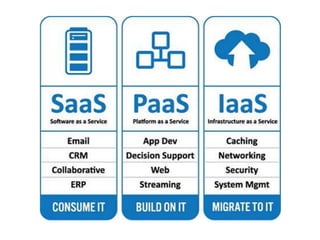
  • #11 To summarize, here is a diagram cover relationships among SaaS, PaaS, IaaS.
  • #12 And now I can sum up pros and cons of cloud computing. One of cons is Security which I will talk about right now.
  • #13 Now I will list here some security issues in cloud computing.
  • #14 Cloud computing changes the way we think about computing by removing the specification of location from its resources. In other word, it abstracts all computing and networking resources. However, in divorcing components from location, this creates security issues that result from this lack of any perimeter. In such a world, there is only one way to secure the computing resources: strong encryption and scalable key management From a risk management perspective, unencrypted data existence in the cloud may be considered “lost” by the customer. Application providers who are not controlling backend systems should assure that data is encrypted when being stored on the backend. Use encryption to separate data holding from data usage. Segregate the key management from the cloud provider hosting the data, creating a chain of separation. This protects both the cloud provider and customer from conflict when being compelled to provide data due to a legal mandate and can potentially solve some problems. When stipulating encryption in contract language, assure that the encryption is adhering to existing industry or government standards, as applicable.
  • #15 DES- Data Encryption Standard RC5- Rivest Cipher Algorithm version 5 RSA- Rivest Shamir Adleman Algorithm MD5- Message Digest Algorithm version 5 SHA- Secure Hash Algorithm
  • #18 Plaintext – 64 bits Key – 56 bits Cipher text – 64 bits
  • #19  RSA This algorithm is used for public-key cryptography. It is the first and still most commonly used asymmetric algorithm. It involves two keys- a public key and a private key. The public key is used for encrypting messages and known to all. Messages encrypted with the use of public key can only be decrypted by using the private key. In this authentication scheme, the server implements public key authentication by signing a unique message with its private key, thus creating what is called digital signature. The signature is then returned to the client. Then it verifies using the server’s known public key.
  • #21  Security in cloud is one of the major areas of research. The survey shows that, the researchers are focusing on efficient algorithms and encryption techniques to enhance the data security in cloud.
  • #25 Any queries???