This document presents a new lightweight cryptographic algorithm designed to enhance data security in cloud computing, utilizing a 16-byte block cipher and a 128-bit key inspired by Feistel and substitution-permutation methods. The proposed algorithm includes features such as flexible key lengths and operational turns, and shows promising experimental results in security levels and encryption efficiency compared to existing systems. It aims to address the growing security challenges faced by cloud computing due to rapid data growth and various external threats.
![Global Transitions Proceedings 2 (2021) 91–99
Contents lists available at ScienceDirect
Global Transitions Proceedings
journal homepage: www.elsevier.com/locate/gltp
A new lightweight cryptographic algorithm for enhancing data security in
cloud computing
Fursan Thabita,∗
, Associate Prof Sharaf Alhomdyb
, Abdulrazzaq H.A. Al-Ahdalc
,
Prof Dr Sudhir Jagtapa
a
School of Computational Sciences, S.R.T.M. University of organization, Nanded, India
b
Faculty of Computer and Information Technology (FCIT), Sana’a University, Yemen
c
Faculty Computer Science & Engineering, Hodeidah University, Yemen
a r t i c l e i n f o
Keywords:
cloud computing security
cryptography
feistel
lightweight algorithm
a b s t r a c t
Data has been pivotal to all facets of human life in the last decades. In recent years, the massive growth of data
as a result of the development of various applications. This data needs to be secured and stored in secure sites.
Cloud computing is the technology can be used to store those massive amounts of data. . The rapid development of
this technology makes it more critical. Therefore, it has become urgent to secure data from attackers to preserve
its integrity, confidentiality, protection, privacy and procedures required for handling it. This paper proposed a
New Lightweight Cryptographic Algorithm for Enhancing Data Security that can be used to secure applications on
cloud computing. The algorithm is a 16 bytes (128-bit) block cipher and wants 16 bytes (128-bit) key to encrypt
the data. It is inspired by feistal and substitution permutation architectural methods to improve the complexity
of the encryption. The algorithm achieves Shannon’s theory of diffusion and confusion by the involvement of
logical operations, such as (XOR, XNOR, shifting, swapping). It also features flexibility in the length of the secret
key and the number of turns. The experimental results of the proposed algorithm presented a strong security
level and an apparent enhancement in measures of cipher execution time and security forces compared to the
cryptographic systems widely used in cloud computing.
1. Introduction
The use of distributed computing systems and technologies has
evolved dramatically in recent years. A large number of distributed net-
work models, architectures and infrastructures, such as network, Perva-
sive, Autonomic, cloud, etc. have been created by this increase. Cloud
computing refers to a computing network, typically linked via the In-
ternet, which share a decentralized amount of services offered by a to
access the user needs [1]. The private publication NIST concept of cloud
computational is a framework for providing a common set of config-
urable computing resources (such as software) with omnipresent, fast,
and on-demand network access. The benefits of cloud computing in-
clude manageability, scalability, and affordability. Additionally, cloud
storage has infrastructure characteristics on demand, economy, univer-
sality, ease, leasing pluralism, reliability, and versatility.
A cloud client may use these tools on request to build, run and host
services and applications that can be adapted anywhere, and on any
device [2,3]. The NIST “concept emphasizes the three service mod-
els – Infrastructure-as-a-Service (IaaS), Platform-as-a-Service (PaaS),
Software-as-a-Service (SaaS) which presenting cloud services to the
∗
Corresponding author.
E-mail address: thabitfursan@gmail.com (F. Thabit).
client through a Cloud Service Provider (CSP) customers. It also briefs
the four deployment models — Public Cloud and Hybrid Cloud, Private
Cloud, Community Cloud, emphasizing the paradigm for distributing
computing assets to coordinate the cloud administration.
On the other hand, cloud infrastructure faces a range of problems
primarily related to interoperability, scalability, and multi-tenancy. But
the most critical issues apply to protection as cloud infrastructure is ex-
posed to a variety of threats as a system utilizing internet networks (such
as embedded networks, grid computing, etc.)” [4]. Cloud computing se-
curity problems will hold up its widespread acceptance. In reality, the
sharing of cloud computing services poses the difficulty of keeping these
services secure and secured against unauthorised access or usage. Mostly
the data outsourced to the cloud faces this challenge. Network security
is one of cloud computing’s key security issues, which relate to external
and internal attacks [5,6]. Provide a safe link between cloud providers
and users, and several systems and protocols have been developed to en-
sure data transfer security over networking, where cryptography is the
most effective. The translation of plaintext into cipher-text is involved
in cryptography. Generally, it is a tool used to securely transfer contents
by ensuring that they can be found only by the intended recipient [7].
https://doi.org/10.1016/j.gltp.2021.01.013
Available online 23 January 2021
2666-285X/© 2021 The Authors. Publishing Services by Elsevier B.V. on behalf of KeAi Communications Co. Ltd. This is an open access article under the CC
BY-NC-ND license (http://creativecommons.org/licenses/by-nc-nd/4.0/)](https://image.slidesharecdn.com/ncla-241113145910-42c80219/75/deep-dive-down-on-how-NCLA-works-in-IOTs-1-2048.jpg)
![F. Thabit, A.P.S. Alhomdy, A.H.A. Al-Ahdal et al. Global Transitions Proceedings 2 (2021) 91–99
Fig. 1. Major cloud security.
Fig. 2. Basic cloud security requirement.
In this paper, a new lightweight cryptographic algorithm has been
proposed. It called a New Lightweight Cryptographic Algorithm (NLCA)
for enhancing data security in a cloud computing environment. It en-
crypts data based on symmetric cryptography.
The rest of this paper is organized as follows. Section 2 provided a
simple understanding of the security of cloud computing. Related work
is given in Section 3. The robust encryption algorithm prerequisites are
given in Section 4. Section 5 describes the proposed algorithm. The
Implementation and results discussion is given in Section 6. Finally,
the paper is concluded with further recommendations in Section 7.
2. Cloud computing security overview
The cloud security incorporates all the methodologies intending to
safeguard, re-establish, and ensure the security of data in computer sys-
tems frameworks against various threats. The ElasticaQ2 2015 and CSA
further look at how to create a viable cloud application security engi-
neering, which gives control, deceivability, and remediation. Also, ac-
cording to (ISO), describes Data Security concerns which can likewise
be guided in regards to the cloud computing essential security require-
ments for a successful and secure innovation technology solution. Fig 1.
Shows the significant security of cloud computing. In a cloud world, the
truth of outsourcing data and software assigns their power to the service
provider from the direct control of the user. As a result, Trust relies on
the implementation model and the vendor of the cloud.
2.1. Key security requirements in cloud computing
According to NIST, confidentiality, availability and integrity are a
fundamental necessity for cloud computing, just as any other informa-
tion technology management system [2]. Further authorization, authen-
tication, accountability and privacy as cloud protection criteria are in-
troduced, as seen in Fig 2.
• Confidentiality means maintaining the information of customers
and allowing unique individuals exclusively for access to data.
• Integrity means a commitment to ensure that information is not
modulated or changed as it is processed or transmitted and that the
approach of consumers to change, amend, repeat or remove infor-
mation is merely allowed.
• Authentication involves ensuring the customer’s integrity when
providing access to details and this can be achievable with the use
of such insurances on their accounts.
• Availability means that the information listed by the customer or
the services it needs is continuously accessible wherever and wher-
ever it is needed.
• Authorization means to guarantee that the options to get to it are
allocated for clients who have submitted special details.
3. Related work
This section consists of two sub-sections; one presents cloud com-
puting security-related work, and the other presents the available
lightweight cryptographic systems related work.
3.1. Cloud computing security
There are many studies that have addressed the security issues of
cloud computing; however, this section provides some recent studies
which examined cloud computing cryptography. These are an advanced
encryption algorithm (AES), international data encryption algorithm
(IDEA), and data encryption standard (DES), it categorises common
cryptographic algorithms. Comparison of symmetric algorithms (e.g.
AES, DES, and 3DES) and asymmetric algorithms (e.g. RSA). The algo-
rithms implemented based on Block Size, Protection Rate, Key Length,
Rounds, and Execution Time was introduced. The results are more ef-
ficient in the cloud environment [8]. “The author Introduced the use
of hybrid encryption approaches to enhance the privacy of the informa-
tion stored on cloud servers such: Blowfish, RSA, AES, Eclipse IDA, DSA,
This study focuses on not using third parties to encrypt customer data,
but on allowing consumers the authority to decide ways of encrypting
their data” [9]. A cloud computing model based on data classification
at too has been proposed to decrease latency and processing time. The
data were classified into three layers [10]. “The study suggested the use
of hybrid encryption approaches to maximize the safety of cloud com-
puting data such as: RSA Digital Signature, RSA algorithm, Blowfish al-
gorithm encryption/decryption, Feistel, and XOR operating algorithms.
and The Symmetric Data Encryption Standard (DES) were described by”
[11]. Besides, demonstrated how to fuse two separate algorithms, such
as DES and RSA, to remove Cloud Storage’s security challenges. “The
authors identified previous studies devoted to cloud data security and
performed a survey. They suggested a hybrid protection encryption ap-
proach using Blowfish and MD5 to offer improved security on the cloud
server” [12]. Some of common cloud service providers, such as Google
(Google Drive), and Microsoft (Azure and One Drive) were studied by
[14]. Moreover, they studied cryptographic algorithms mainly used in
cloud computing: modern cryptography, searchable encryption, homo-
morphic encryption, and attribute-based encryption (e.g. DES, 3DES,
AES, RC6, and BLOWFISH), as a fusion of two or more cryptographic
techniques, they have also created a hybrid encryption concept to take
advantage of the potential of each system to protect cloud data. A com-
parison of IDAs, SHA-512, 3DES, and AES-256 made by [13]. It consists
of on premise data encoding and decoding. This algorithm achieves a
much higher level of protection and performance for large and small
data files [14]. The author investigated the classification of algorithms
by algorithms commonly classified as Signature Algorithms, Symmetric
Algorithms, Asymmetric Algorithms, and Hash Algorithms.
3.2. Lightweight cryptographic systems
There are many studied on symmetrical cryptographic algorithms for
a lightweight were built and develop for suitable applications, such as
L Block, LED. HIGHT, PRESENT, DESL, CLEFIA, TWINE, RECTANGLE,
SIT etc. “A lightweight 64-bit block size cryptosystem with 128-bit key
92](https://image.slidesharecdn.com/ncla-241113145910-42c80219/75/deep-dive-down-on-how-NCLA-works-in-IOTs-2-2048.jpg)
![F. Thabit, A.P.S. Alhomdy, A.H.A. Al-Ahdal et al. Global Transitions Proceedings 2 (2021) 91–99
was created, iterated in 32 rounds, and carried two types of operations;
XOR operation paired with left or right rotations. Its focus was to deploy
hardware on ubiquitous devices, such as wireless sensor nodes and RFID
tags, with about the same chip size as AES but running much faster”
[15].
In [15] “the authors described a symmetric block cipher named
CLEFIA-128, developed by Sony and built to be suitable for both soft-
ware and hardware, 128-bit block size encryption in 128-bit key length,
and 28 Feistel structure rounds. “The researcher constructed two differ-
ent types of Data Encryption Lightweight systems, i.e. DESXL. DESL y
DESL, on the other hand, in DESXL, instead of separate ones with no
initial and final permutations, a single S-Box u is used to improve pro-
tection by using a 184-bit key. No attack was displayed against DESL
and DESXL, as they said” [16]. The study identified the generalized
multi-platform cryptosystem Feistel structure termed “TWINE.” It is 64-
bit block size running 36 rounds of either 80 or 128-bit key length, and
each round contains a 4-bit S-box and 4-bit block permutation layer,
nonlinear substitution layer [17].
In [18] stated the "RECTANGLE" cryptosystem optimized for a block
size of 64 bits with a key length of either 80 or 128 bits, running just
25 rounds. In the [19] A Stable IoT (SIT) light-weight encryption al-
gorithm. It is a 64-bit block cipher and the data has to be encrypted
using a 64-bit address. A mixture of Feistel and a uniform substitution-
permutation network is the architecture of the algorithm. In [20] this ar-
ticle, lightweight encryption algorithm which consists of a 64-bit block
cipher and 80 bit key to encrypt data in IoT devices.
4. Powerful encryption algorithm prerequisites
Any encryption algorithm must satisfy some set of specifications to
provide high security. The following criteria have been defined, based
on the current literature that should be fulfilled by the newly developed
algorithm:
• Encryption of the entire character set
• Encrypting each plain-text character into a special sequence
• There should be strong encoding
• The encryption approach should be complex
5. The proposed algorithm
To improve cloud computing protection with low processing, and
high performance, a New Lightweight Cryptographic Algorithm (NLCA)
for enhancing data security in cloud computing environment is pro-
posed.
The algorithm is simple and highly secure encryption/decryption.
The proposed algorithm gives an easy structure effective for the cloud
environment. There are Some well-known popular ciphers including
“Camelia [21], SF [22], Blowfish [23] and DES [24] use the Feistel
structure”. The major benefit of applying Feistel architecture is that the
encryption and decryption operations are almost similar.
Also other popular block cipher including “3-Way [25], Grasshopper
[26], AES (Rijndael) [27], PRESENT [28], SAFER [29] Use the Network
SP” (Substitution-Permutation). The confusion is confronted with too
many overlapping rounds of substitution and transposition and diffusion
of Shannon’s Characteristics that ensure the cipher text being altered in
a Pseudo by a random manner. Therefore, the introduced algorithm is a
symmetric key block cipher and the idea is inspired by a combination of
Feistel and SP architectural methods to improve the complexity of the
encryption.
The main idea of the NLCA is to use is a 16 bytes (128-bit) block
cipher and want 16 bytes (128-bit) key for encrypt the data. The en-
cryption process requires encryption rounds in a symmetric-key algo-
rithm; each round always relies on mathematical functions to generate
diffusion and confusion. Encryption algorithms are usually configured
to take 10 to 20 rounds on average to keep the encryption process strong
Table 1
Notations.
Notation Function
⊕ XOR
ʘ XNOR
║,╫ Concatenation
enough to meet device specifications. However, the proposed algorithm
is limited to only five rounds to maximize energy efficiency results, as
each round requires crypto mathematical operations involving 4 bits
of data to work. It introduces mixed operations in multiple algebraic
classes, including XOR and Addition operations, to generate difficulty
for attackers. As follows the detailed steps of the procedures are de-
scribed
1) Key Generation Block.
2) Encryption Block.
3) Decryption Block.
In the following subsections, these blocks will be further clarified in
detail, and some of the essential notes followed in the interpretation are
presented in Table 1.
5.1. Key generation block
The key is the most important component of encryption and decryp-
tion methods. If this key is identified to an attacker, the confidentiality
of the data is compromised. It is this key on which the whole integrity
of the data rests. In order to generate confusion and diffusion, differ-
ent operations are carried out to prevent the possibility of weak key as
to strengthen key strength. The Feistel-based encryption algorithms de-
pend on various rounds, requiring a different key for each round. The
proposed algorithm has five rounds for encrypted/decrypted for such a
reason, we need five unique keys. The algorithm is a block cipher of 16
bytes (128-bit) which allows a 16 bytes (128-bit) key to be taken from
the user as an input, which is used as the input to the Generation Block
key. Each block will produce five separate keys.
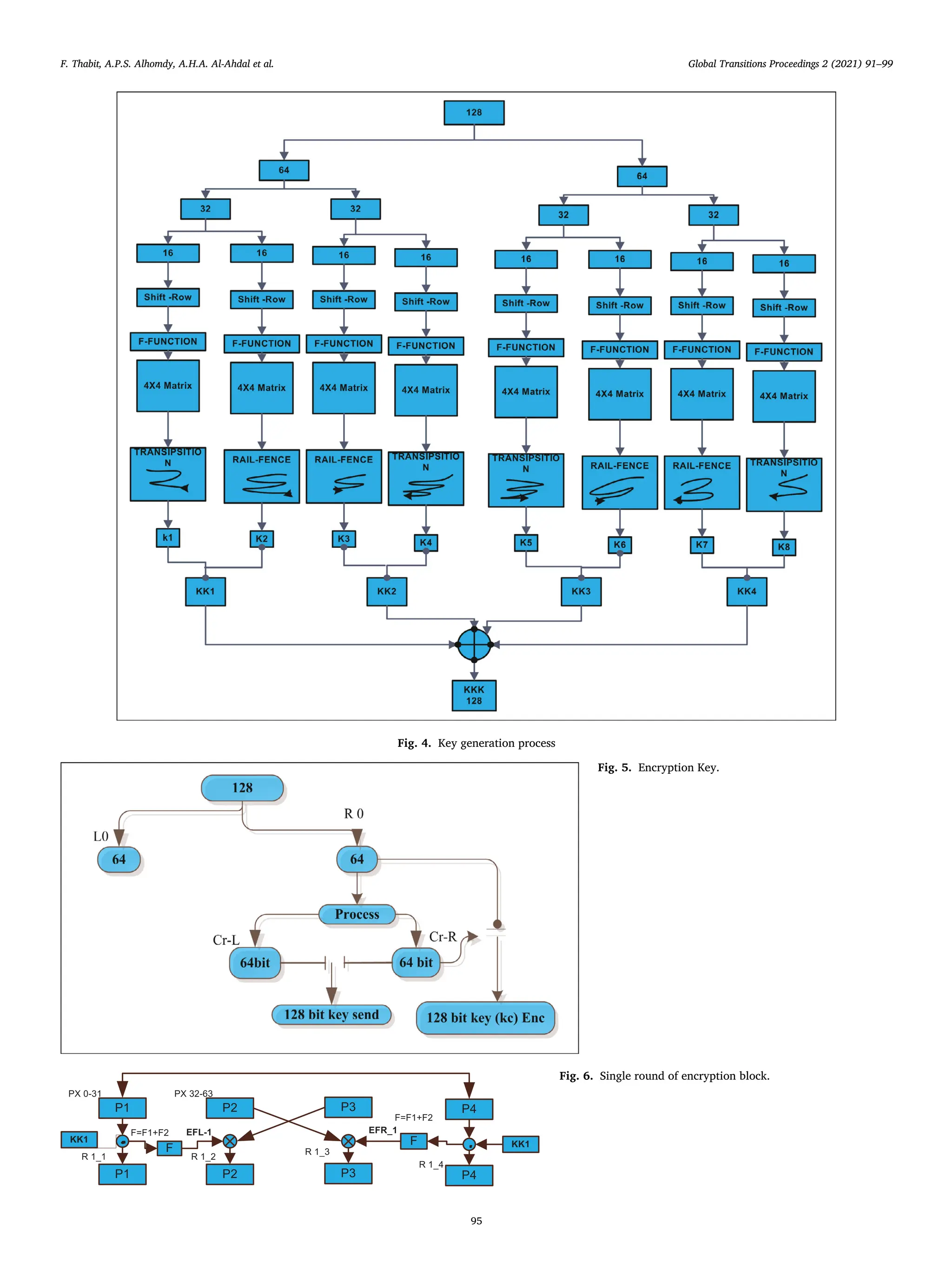
5.1.1. Key generation process
• The first step of key encryption, the128-bit cipher key ("Kc") is split
into two segments 64-bits right and 64-bits left.
• In the Second step the 64-bits right and 64-bits left is split into the
segments of 4-bits. After the split A shift row is made for every 4
bits, output of shifting to feed to f-function
• The f -function used 4 segments, each segment 4 bit (16 bit) as il-
lustrated in Fig. 4. Substitution can generate for cipher key (Kc) by
f-function as explain in Eq. (1).
𝐾𝑏𝑖𝑓 =
‖
‖
‖
5
𝑗=1
𝐾𝑐4(𝑗− 1)+𝑖 (1)
Where i = 5;
𝐾𝑎𝑖𝑓 is output from Eq. (2)
𝐾𝑎𝑖𝑓 = 𝑓
(
𝑏𝑖𝑓
)
(2)
𝑓 ∶Function. Linear and non-linear confusion and diffusion transforma-
tions composed of P and Q tables are seen in Tables 2 and 3, as seen in
Fig. 3.
• Output, every f-function is created from (16 bit) one matrix 4 ∗ 4.
Eight called arrays are therefore created key matrix (‘M1’, ‘M2’, ‘M3’,
‘M4’, ‘M5’ ‘M6’, ‘M7’, and ‘M8’).
• The arrays generated (“K1, K2, K3, K4, K5, k6, K7, K8”) are the round
keys.
• The result of the rotation of the arrays is KM1, KM2, KM3, KM4, KM5
KM6, KM7, and KM8 respectively the generated key combination ev-
ery two key to get the four public key (kk1=k1+k2, kk2=k3+k4,
93](https://image.slidesharecdn.com/ncla-241113145910-42c80219/75/deep-dive-down-on-how-NCLA-works-in-IOTs-3-2048.jpg)
![F. Thabit, A.P.S. Alhomdy, A.H.A. Al-Ahdal et al. Global Transitions Proceedings 2 (2021) 91–99
Table 2
P table.
Kci 0 1 2 3 4 5 6 7 8 9 A B C D E F
F 3 F E 0 5 4 B C D A 9 6 7 8 2 1
Table 3
Q table.
Kci 0 1 2 3 4 5 6 7 8 9 A B C D E F
Q(Kci) 9 E 5 6 A 2 3 C F 0 4 D 7 B 1 8
Fig. 3. F-Function of SIT algorithm.
kk3=k5+k6, kk4=k7+k8, Among the four round keys, an XOR op-
eration is performed to obtain the fifth key, as seen in Eq. (3).
5
𝑘𝑘𝑘 = ⊕ 𝑘𝑖
𝑖 = 1
(3)
Moreover, in this process two keys would be generated according to
the seed enter by user. The first one, is send by user for the decryption
process, as described in section 5.3. The other key will be completely
different from the first key which used to encrypt data as described in
section 5.2 and in Fig 5, and it will be discussed below:
The 128-bit cipher key (Kc) is split into R0 (64 bit) and L0 (64 bit).
For M = 1 to 64
If RM = 0 then—–Cr-R [M] = 1, Cr-L [M] = 1
Else Cr-R [M] = 0, Cr-L [M] = 1
To combine Cr-L, Cr-R to key send (Send Key 128 bit)
To combine R0, Cr-R to Kc (encryption Key 128 bit)
5.2. Encryption process
The encryption process takes place after producing the sub-keys
(KK1, KK2 … KKK) from the Key Generation Process It can start with
the purpose of creating cryptography as in Fig. 9, the encryption process
takes place. Easy processes, like, XOR, XNOR, AND, OR left shift (LS),
swapping and substitution (S boxes) methods, are conducted throughout
the encryption process to create confusion and diffusion. These opera-
tions increase complexity and create confusion for the attackers.
Encryption Process steps
The message to be encrypted is separated into blocks of plain-text
(each referred to as M) of 16 bytes (128-bit) length as shown in Fig. 9.
Then the following steps encrypt each block:
• The 128-bit block input is generally divided into four sub-blocks of
32 bits each, namely, P1, P2, P3, P4 (P0–31, P32–63, P64–95, P96–127)
This is to produce segments (Ro11, Ro12, Ro13, Ro14)
• (Initial state steps): Each sub-block is addressed using working key
sub-keys (KK1, KK2 … KKK) by combining operations from various
algebraic groups, which are AND, OR, XOR, XNOR operations. As
shown in Fig 9.
• Ro11 is the output of XNOR between P0–31 and K1, The product
(Ro11) feeds
F-Function to produce EFL1.
• Ro14 is the output of XNOR between P96–127 and K1, The product
(Ro14) feeds
F-Function to produce EFR1.
As well as the F-Function seen in Eq. (1), the F.Function contains the
activity of substitute (S boxes), AND, OR, and left shift (LS).
F = F1+F2; → 32 Bit
F1 = OR (S-boxes (AND (LS (16 bits/4) 16 Bit.
F2 = OR (S-boxes (AND (LS (16 bits/4)16 Bit.
The output from the F function is then XOR
• Ro12 is the output of XOR between P64–95, and EFL1.
• Ro13 is the output of XOR between P32–63, and EFR1.
• Process of switching takes place during the encryption process be-
tween the two internal halves. Then, the switches are between the
parts (Ro11, Ro12) and (Ro13, Ro14).
All the previous processes are to increase the complexity of the cod-
ing as shown in Fig. 9. The same steps for the rounds are repeated by
Eq. (4).
𝑅𝑜𝑖,𝑗 = {
𝑃 𝑥𝑖,𝑗 ⊙ 𝑘𝑖 ; 𝑗 = 1..4
𝑃 𝑥𝑖,𝑗+1 ⊕ 𝐸𝑓𝑙𝑖; 𝑗 = 2
𝑃 𝑥𝑖,𝑗−1 ⊕ 𝐸𝑓𝑟𝑖 ; 𝑗 = 3
(4)
After that, the encoded text is obtained by Eq. (5).
𝐶𝑡 = 𝑅51#𝑅52#𝑅53#𝑅54 (5)
A Transformation round
Also every round in NLCA algorithm includes numerous transforma-
tion tasks that involve XOR, XNOR, F, functions and swapping. In
Fig. 6, a single round of the NLCA algorithm is shown.
B Swapping function
This is the encryption portion in the left half 32 bits are swapped to
the right position and right half of 32 bits are swapped to half-place
left as shown in Fig. 7. The main goal of switching Role is to adjust
the initial data location to get the data a more complicated cipher.
C F Function: This is a central component of encryption the algorithm
that causes data diffusion. The S Boxes, is conducted processes of
AND & OR and left shifting (LS) Operations of 16 data bits, as seen
in Fig. 4.
D Left Shifting (LS): 16 bits of data are in the LS process divided into
4-bit blocks and left shifting Conducted on each block. Outcomes of
this activity full data Bit Mixing. The mechanism shown in Fig. 7
E Operations of XOR & XNOR: Simple logical logic Operations that is
appropriate to produce confusion and diffusion for results.
94](https://image.slidesharecdn.com/ncla-241113145910-42c80219/75/deep-dive-down-on-how-NCLA-works-in-IOTs-4-2048.jpg)
![F. Thabit, A.P.S. Alhomdy, A.H.A. Al-Ahdal et al. Global Transitions Proceedings 2 (2021) 91–99
P2
P1 P4
P3
P1 P2 P3 P4
Fig. 7. Swapping process.
128
64 64
128 bit key Receive
L0
R 0
64
Fig. 8. Decryption key.
5.3. Decryption
In the decryption process, the encrypted key will be extracted from
the key sent by the user. The process will be explained as in Fig 8. The
128-bit cipher key (send key), is divided into segment
R0 (46 bit)
L0 (64 bit).
K1 = R0⊕ L0
To combine R0 and K1 (decryption Key 128 bit).
Decryption process
The computational procedure used for the decryption of the Ci
cipher-text block is exactly the same as the Mi block encryption method.
The 128 -bit long Ci block is first split into 4 sub-blocks, and then han-
dled with the same working keys using mixed XOR and Sub operations.
And since they are the reverse of the encryption operation, the precise
steps for the procedure would not need to be written.
6. Implementation and results discussion
This section described the implementation and results discussion for
the proposed algorithm an d other algorithms.
6.1. Experimental environment
In order to analyze the efficiency of the proposed algorithm various
kinds of symmetric cryptographic algorithms are used. The experimental
setting consists of a cloud network consisting of the Xen Server hypervi-
sor (6.1an Open stack middleware and a client that uses Citrix Desktop
[30] to access the Xen-Server-hosted virtual machine). The cloud server
Details as Core I7 (4.8 GHz) with 8 GB of RAM, and the client computer
utilizes the Core I5 with 8 GB RAM.
6.2. Experimental results
This section, illustrates experimental studies are performed to dis-
play and check the feasibility of the NLCA algorithm. The experiment is
performed on a 128-bit key size text data type and128 bits is the block
size. The 128-bit key, which is expressed as a 4 × 4 matrix, is generated
based on the key generation procedure.
Example:
The inputs are:
1 Data block = Original
0A 0B 0C 0D 0F 01 02 03 04 05 06 07 08 09 1A 2B
1 Encryption key (K) = Key cipher
4F 29 4C 71 D3 AB 29 D0 AB 79 AC 69 A2 73 AC 7B
1 Number of rounds = 5
Table 4. as an example of the encryption method lists the obtained
values for encrypting a message block for four rounds. For all stages of
the four rounds, the table displays the message block bytes, from plain
text to cipher-text.
For the above example, the inverse method, i.e. the reproduction
of the plaintext of the message block from its cipher-text is shown in
Table 5.
Table 4
Example of NLCA encryption algorithm using 4 rounds.
State
Value
P1 P2 P3 P4 P5 P6 P7 P8 P9 P10 P11 P12 P13 P14 P15 P16
Original 0A 0B 0C 0D 0F 01 02 03 04 05 06 07 08 09 1A 2B
key 01 02 04 05 06 AA BB CC 44 DD EE 88 09 04 05 06
Key cipher 4F 29 4C 71 D3 AB 29 D0 AB 79 AC 69 A2 73 AC 7B
Round 1 BA DD BF 83 AF 5B FA 9A 2B 59 27 2P P8 DF A9 A5
Round 2 C3 0F 2C B1 41 5P 2E 1D F8 A1 E9 F0 01 0D FA 04
Round 3 D7 89 7F 27 39 A9 1C 1D A0 EB 00 D4 15 8B A2 92
Round 4 64 25 AF 99 81 32 9A 53 A6 0D A2 84 FD 67 53 50
Encrypted 64 25 AF 99 81 32 9A 53 A6 0D A2 84 FD 67 53 50
Table 5
Example of NLCA decryption algorithm using 4 rounds.
State
Value
P1 P2 P3 P4 P5 P6 P7 P8 P9 P10 P11 P12 P13 P14 P15 P16
Key cipher 4F 29 4C 71 D3 AB 29 D0 AB 79 AC 69 A2 73 AC 7B
Encrypted 64 25 AF 99 81 32 9A 53 A6 0D A2 84 FD 67 53 50
Round 4 64 25 AF 99 81 32 9A 53 A6 0D A2 84 FD 67 53 50
Round 3 D7 89 7F 27 39 A9 1C 1D A0 EB 00 D4 15 8B A2 92
Round 2 C3 0F 2C B1 41 5P 2E 1D F8 A1 E9 F0 01 0D FA 04
Round 1 BA DD BF 83 AF 5B FA 9A 2B 59 27 2P P8 DF A9 A5
Original 0A 0B 0C 0D 0F 01 02 03 04 05 06 07 08 09 1A 2B
96](https://image.slidesharecdn.com/ncla-241113145910-42c80219/75/deep-dive-down-on-how-NCLA-works-in-IOTs-6-2048.jpg)
![F. Thabit, A.P.S. Alhomdy, A.H.A. Al-Ahdal et al. Global Transitions Proceedings 2 (2021) 91–99
P1
P2
P2
P1
P3
P4
P4
P3
F
F
P1
P2
P2
P1
P3
P4
P4
P3
F F
P1
P2
P2
P1
P3
P4
P4
P3
F F
P1
P2
P2
P1
P3
P4
P4
P3
F F
KK1
KK2
KK3
KK4
P1
P2
P2
P1
P3
P4
P4
P3
F F
KKK
F=F1+F2
PX 0-31 PX 32-63 PX 64-95 PX-96-127
128
Plaintext
F=F1+F2
F=F1+F2
F=F1+F2
F=F1+F2 F=F1+F2
F=F1+F2 F=F1+F2
F=F1+F2 F=F1+F2
R 1_1 R 1_2
R 1_3
R 1_4
EFL-1 EFR_1
EFR_2
EFL-2
R 2_1 R 2_2
R 2_3
R 2_4
R 3_1 R 3_2
R 3_3
R 3_4
R 4_1 R 4_2
R 4_3
R 4_4
R 5_1 R 5_2
R 5_3
R 5_4
EFR_3
EFL-3
EFR_4
EFL-4
EFR_5
EFL-5
KK1
KK2
KK3
KK4
KKK
128 Cipher text
Fig. 9. Block diagram of encryption process.
6.3. Comparative analysis of parameters
This section describes analysed the differences between analysis
the proposed algorithm namely (NLCA) and others symmetric algo-
rithms.That are namely DES [31], AES [32], HIGHT [33], Blowfish
[34], and LED [35], by executing them in the same cloud environment
using the Block Size, Key Length, Possible Key, Mathematical Opera-
tions, Cipher Type and Security Power parameters as shown in Table 6.
The results observe that the NLCA algorithm is high security strength
with a highly flexible. The NLCA algorithm gives lowers computational
complexity and decreases the power of processing by having a clear
architecture which includes five rounds for encryption; each round re-
quires simple mathematical procedures. In order to decrease the encryp-
tion strain, the dynamic key generation procedure is carried out at the
encryption. AES, HIGHT, DES, on the other hand, consists (“12, 32, 32,
and 20”) rounds of encryption respectively.
In addition, the NLCA algorithm has been based on lightweight
round functions. In such a way that computationally -complex multi-
plication is not used, Variable rotation as in Blowfish, S-boxes of large
scale such in “AES”, and variable rounds in “HIGHT”. While mathemat-
ical operations number per round and S boxes used in NLCA is higher,
the whole complexity is smaller. This is because most mathematical op-
97](https://image.slidesharecdn.com/ncla-241113145910-42c80219/75/deep-dive-down-on-how-NCLA-works-in-IOTs-7-2048.jpg)
![F. Thabit, A.P.S. Alhomdy, A.H.A. Al-Ahdal et al. Global Transitions Proceedings 2 (2021) 91–99
Table 6
Some symmetric key algorithms’ comparison in terms of flexibility, architecture, security & limitation.
DES [29] AES [30] HIGHT [31] Blowfish [32] LED [33] Proposed algorithm
Structure Feistel Substitution-
Permutation
Festial Festial Festial Festial+SP
Block size 64 bits 128 bit 64 bits 64 bits 64 or 128 128 , or 256
Key size 56 bits 128, 192, 256 bits 128 bits 32–448 bits 64 or 128 128,256
No. of Round 16 10, 12, 14 32 16 Variable 4
Possible key 256
bits 2128
, 2192
Or 2256
bits
2128
bits 232
–2448
bits 264
,2128
bits 2128
,2256
bits
Mathematical Operations Permutation, XOR,
Shifting,
Substitution. (6
bits input 4
output bits)
XOR, Mixing,
Substitution,
Shifting,
Multiplication,
Addition. (16 bits)
Modular Addition,
XOR, Modular
subtraction,
Shifting. (8 bits)
XOR, Mixing,
Substitution,
Shifting ,the
S-boxes accept
8-bit input and
produce 32-bit
output
XOR, rotations,
2n mod addition,
substitution (6
bits)
XOR, XNOR,
Shifting,
Substitution
(4 bits)
S-P Structure 8 S-Box 1 S-Box N/A 4 S- Boxes 4 S- Boxes 4 S- Boxes
S-Box Size 16 ∗
16 (16 bits) 16 ∗
16 (16 bits) N/A 8 × 4(32 bits) 4 × 4 (4 bits) 4 × 4 (4 bits)
Security rate Proven inadequate. Secure Secure Secure Secure Highly Secure
Table 7
Some symmetric key algorithms’ comparison in terms of process-
ing time.
Key
Size
DES 3DES AES Blow fish LED
56 192 256 256 64
Possible key 256
2192
2256
2256
264
File
Size
256KB 0.007 0.022 0.007 0.007 0.015
512KB 0.015 0.046 0.015 0.015 0.03
1MB 0.03 0.09 0.03 0.03 0.06
10MB 0.32 0.87 0.32 0.26 0.64
50MB 1.89 4.5 1.61 2.13 2.9
Table 8
Processing time of the new hybrid technique (NLCA).
File
Size
256 512 1 10 50
KB KB MB MB MB
Time
(s)
0.008 0.016 0.03 0.3 1.6
0.01 0.021 0.04 0.4 2.11
0.013 0.026 0.053 0.5 2.6
0.015 0.03 0.061 0.62 3.058
Average t (s) 0.0115 0.02325 0.046 0.455 2.342
erations are based on (4-bit) data and (S boxes) are only 4 × 4 sizes. This
differs from other mathematical schemes that operate on 8 or 16 bits of
data.
The NLCA algorithm offers data size consistency in such a way that
it allows various block and key lengths that are not provided by most
other schemes mentioned and any of the other methods mentioned do
not support it such in "AES" and "RC6″ the block length is fixed, while
both block and key lengths are set in "HIGHT" in the NLCA algorithm
flexibility feature aims to increase cloud storage security performance.
All these symmetric algorithms, such as (“AES, LED, DES, 3DES,
Blowfish”) were also implemented and checked in Table 7 using var-
ious sizes of input text files: 256 KB, 512 KB 1 MB, 10 MB, and 50 MB.
The results described in Table 7 are the average encryption time esti-
mated three times after the experiments were conducted. Also Key size
of different cryptographic algorithms was Shown Fig 10.
The data processing time generated by the encryption and the key
generation time for the new algorithm are also faster than other algo-
rithms with secure key generation described in table.
As you have seen in Table 8 and Fig. 11 Using the proposed algo-
rithm, we can achieve fast data processing efficiency and an acceptable
level of protection through this methodology. This NLCA improves the
confidentiality and integrity of cloud-saved data while making it acces-
Fig. 10. Key size of different cryptographic algorithms.
Fig. 11. Processing time of the new technique.
sible on request. In terms of security the most known Threats such as
Weak key attacks, Symmetric properties, Related-key attacks and Dif-
ferential & Linear cryptanalysis [19,20] can be resisted by the NLCA
algorithm.
Finally, on the basis data encryption enforcement properties of cloud
storage, a brief description of NLCA algorithm is given.
98](https://image.slidesharecdn.com/ncla-241113145910-42c80219/75/deep-dive-down-on-how-NCLA-works-in-IOTs-8-2048.jpg)
![F. Thabit, A.P.S. Alhomdy, A.H.A. Al-Ahdal et al. Global Transitions Proceedings 2 (2021) 91–99
• Security: Because of the use of a complex structure and a mixture of
Feistel and SP architectural approaches, NLCA is a secure algorithm.
• Key Generation Process NLCA provides an efficient key process
that helps to avoid brute-force attacks due to the matrix and f-
function extension of a key rather than a single extension key. NLCA
since the Key Generation method is used, the security level will be
increased.
• Time Complexity: There is no greater difficulty in time owing to
the reduction of the demands of further rounds.
• Storage: The proposed algorithm is suitable for a distributed stor-
age system in the context of cloud computing because it uses the
principle of hidden sharing to provide secure access to data through
insecure nodes independently
• Reliability: the algorithm more reliable and secure.
• Integrity: A minor shift in input data can bring a dramatic change
in the ciphered output due to the use of the transpose and swap
procedures.
7. Conclusion
The security of cloud computing has become the main of the core
issues of cloud computing. Various processes and techniques have been
proposed including cryptography, which is the most effective.
In this paper a new lightweight cryptographic algorithm has been
proposed. It called a New Lightweight Cryptographic Algorithm (NLCA)
for enhancing data security in cloud computing environment. It en-
crypts data based on symmetric cryptography. The algorithm is a 16
bytes (128-bit) block cipher and wants 16 bytes (128-bit) key to en-
crypt the data. The algorithm is simple and highly secure encryption-
decryption. It is inspired by Feistel and SP architectural methods to im-
prove the complexity of the encryption. The proposed algorithm com-
pared the performance with some frequently cryptographic algorithms
namely DES, AES, HIGHT, Blowfish, LED using various parameters that
are block size, key length, possible key, mathematical operations, cipher
type, and security power.
Experimental results show that the NLCA algorithm has demon-
strated a powerful security level and a clear improvement in the encryp-
tion/decryption providing high security, and low computation cost. It
is even more effective for the world of cloud computing, concerning its
fast data collection and processing time. In future the NLCA algorithm
can be implemented in hardware that may produce much better results.
Conflict of Interest
The authors declare that they have no known competing financial
interests or personal relationships that could have appeared to influence
the work reported in this paper.
Acknowledgments
This research was Partial supported by the Ministry of Higher Edu-
cation – Yemen additionally; the authors would like to thank the anony-
mous reviewers for their comments and suggestions to enhance the qual-
ity of this manuscript. Also, I need to thank my guide to Prof. Dr. Sudhir
B. Jagtap. For his guidance to my work.
References
[1] M. Köhler and S. Benkner, “VCE - A Versatile Cloud Environment for Scientific Ap-
plications,” 2011.
[2] P. Mell, T. Grance, The NIST definition of cloud computing - SP 800-145, NIST Spec.
Publ. (2011), doi:10.1136/emj.2010.096966.
[3] B.D. Parameshachari, H.T. Panduranga, S. liberata Ullo, Analysis and Computation
of Encryption Technique to Enhance Security of Medical Images, IOP Conference
Series: Materials Science and Engineering, 925, IOP Publishing, 2020.
[4] W. Du, Y.S. Han, J. Deng, and P.K. Varshney, “A pairwise key pre-distribution
scheme for wireless sensor networks,” 2003, doi: 10.1145/948117.948118.
[5] G.S. Pavithra, N.V. Babu, Energy efficient hierarchical clustering using HACOPSO in
wireless sensor networks, Int. J. Innovat. Technol. Explor. Eng. 8 (12) (2019).
[6] S. Singh, Y.S. Jeong, J.H. Park, A survey on cloud computing security: issues, threats,
and solutions, J. Netw. Comput. Appl. (2016), doi:10.1016/j.jnca.2016.09.002.
[7] A.N. Jaber and M.F. Bin Zolkipli, “Use of cryptography in cloud computing,” 2013,
doi: 10.1109/ICCSCE.2013.6719955.
[8] D.S. Abd Elminaam, H.M.A. Kader, M.M. Hadhoud, Evaluating the performance of
symmetric encryption algorithms, Int. J. Netw. Secur. (2010).
[9] M. Panda, “Performance analysis of encryption algorithms for security,” 2017, doi:
10.1109/SCOPES.2016.7955835.
[10] L. Tawalbeh, N.S. Darwazeh, R.S. Al-Qassas, and F. AlDosari, “A secure cloud com-
puting model based on data classification,” 2015, doi: 10.1016/j.procs.2015.05.150.
[11] R. Arora, A. Parashar, Secure user data in cloud computing using encryption algo-
rithms, Int. J. Eng. Res. Appl. (2013).
[12] S.S. Khan, P.R. Tuteja, Security in cloud computing using cryptographic algo-
rithms, Int. J. Innov. Res. Comput. Commun. Eng. (2015), doi:10.15680/ijir-
cce.2015.0301035.
[13] D.P. Timothy, A.K. Santra, A hybrid cryptography algorithm for cloud computing se-
curity, 2017 International conference on Microelectronic Devices, Circuits and Sys-
tems (ICMDCS), Vellore (2017) 1–5, doi:10.1109/ICMDCS.2017.8211728.
[14] J.R.N. Sighom, P. Zhang, L. You, Security enhancement for datamigration in the
cloud, Futur. Internet (2017), doi:10.3390/fi9030023.
[15] Z. Gong, S. Nikova, and Y.W. Law, “KLEIN: a new family of lightweight block ci-
phers,” 2012, doi: 10.1007/978-3-642-25286-0_1.
[16] G. Leander, C. Paar, A. Poschmann, and K. Schramm, “New lightweight des variants,”
2007, doi: 10.1007/978-3-540-74619-5_13.
[17] T.P. Berger, J. Francq, M. Minier, G. Thomas, Extended generalized feistel networks
using matrix representation to propose a new lightweight block cipher: lilliput, IEEE
Trans. Comput. (2016), doi:10.1109/TC.2015.2468218.
[18] W. Zhang, Z. Bao, D. Lin, V. Rijmen, B. Yang, I. Verbauwhede, RECTANGLE: a bit-
slice lightweight block cipher suitable for multiple platforms, Sci. China Inf. Sci.
(2015), doi:10.1007/s11432-015-5459-7.
[19] M. Usman, I. Ahmed, M. Imran, S. Khan, U. Ali, SIT: a lightweight encryption
algorithm for secure internet of things, Int. J. Adv. Comput. Sci. Appl. (2017),
doi:10.14569/ijacsa.2017.080151.
[20] A.H.A. Al-ahdal, G.A. Al-rummana, G.N. Shinde, N.K. Deshmukh, A Robust
Lightweight Algorithm for Securing Data in Internet of Things Networks, ustain-
able Communication Networks and Application. Lecture Notes on Data Engineering
and Communications Technologies, vol 55. Springer, (2021) In press.
[21] K. Aoki et al., “Camellia: a 128-Bit block cipher suitable for multiple platforms –
design and analysis,” 2001, doi: 10.1007/3-540-44983-3_4.
[22] M. Ebrahim and C.W. Chong, “Secure Force: a low-complexity cryptographic
algorithm for Wireless Sensor Network (WSN),” 2013, doi: 10.1109/ICC-
SCE.2013.6720027.
[23] B. Schneier, “Description of a new variable-length key, 64-bit block cipher (Blow-
fish),” 1994, doi: 10.1007/3-540-58108-1_24.
[24] D. Coppersmith, Data encryption standard (DES) and its strength against attacks,
IBM J. Res. Dev. (1994), doi:10.1147/rd.383.0243.
[25] J. Daemen, R. Govaerts, and J. Vandewalle, “A new approach to block cipher de-
sign,” 1994, doi: 10.1007/3-540-58108-1_2.
[26] A. Biryukov, L. Perrin, and A. Udovenko, “Reverse-engineering the S-box of streebog,
Kuznyechik and STRIBOBr1,” 2016, doi: 10.1007/978-3-662-49890-3_15.
[27] Federal Information Processing Standards, National bureau of standards, fed-
eral information processing standards publication 197: announcing the ad-
vanced encryption standard (AES), Fed. Inf. Process. Stand. Publ. (2001),
doi:10.1016/S1353-4858(10)70006-4.
[28] A. Bogdanov et al., “PRESENT: an ultra-lightweight block cipher,” 2007, doi:
10.1007/978-3-540-74735-2_31.
[29] J.L. Massey, “SAFER K-64: a byte-oriented block-ciphering algorithm,” 1994, doi:
10.1007/3-540-58108-1_1.
[30] D. Basak, R. Toshniwal, S. Maskalik, A. Sequeira, Virtualizing networking and secu-
rity in the cloud, Oper. Syst. Rev. (2010), doi:10.1145/1899928.1899939.
[31] A.U. Rahman, S.U. Miah, S. Azad, Advanced encryption standard, Practical Cryptog-
raphy: Algorithms and Implementations Using C++, 2014.
[32] M.A. Wright, The advanced encryption standard, Netw. Secur. (2001),
doi:10.1016/S1353-4858(01)01018-2.
[33] D. Hong et al., “HIGHT: a new block cipher suitable for low-resource device,” 2006,
doi: 10.1007/11894063_4.
[34] M.N. Valmik, P.V.K. Kshirsagar, Blowfish algorithm, IOSR J. Comput. Eng. (2014),
doi:10.9790/0661-162108083.
[35] G. Bansod, N. Raval, N. Pisharoty, Implementation of a new lightweight en-
cryption design for embedded security, IEEE Trans. Inf. Forensics Secur. (2015),
doi:10.1109/TIFS.2014.2365734.
99](https://image.slidesharecdn.com/ncla-241113145910-42c80219/75/deep-dive-down-on-how-NCLA-works-in-IOTs-9-2048.jpg)


![5.[40 44]enhancing security in cloud computing](https://cdn.slidesharecdn.com/ss_thumbnails/5-40-44enhancingsecurityincloudcomputing-111118182103-phpapp01-thumbnail.jpg?width=640&height=640&fit=bounds)
![5.[40 44]enhancing security in cloud computing](https://cdn.slidesharecdn.com/ss_thumbnails/5-40-44enhancingsecurityincloudcomputing-111203185114-phpapp01-thumbnail.jpg?width=640&height=640&fit=bounds)


![BERDAMAI_DENGAN_DIRI_SKebaktian SYUKURAN SIDI (NGAWAN PERPULUNGEN).pptxI[1].pptx](https://cdn.slidesharecdn.com/ss_thumbnails/berdamaidengandirisendiri1-250804122519-d0ab2fe2-thumbnail.jpg?width=640&height=640&fit=bounds)


