By
Roja
Mallikarjun
Shivashankar
Arun
Amani
Rajiv
Agenda
•What is cloud computing?
•Service types
•Patterns For Cloud Computing
•Evolution & Market Drivers
•Global Perspective
•Pro’s & Con’s
•Conclusion
“A buyer centric view of technology where applications are
available, through purchase, rental or even development,
wherever and whenever.”
What is cloud computing?
Cloud Computing is ……..
“An approach to consume technology in a pay-as-you-go
model where consumers only pay for what they use.”
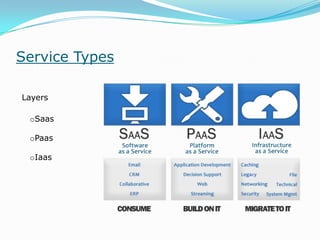
Service Types
oSaas
oPaas
oIaas
Layers
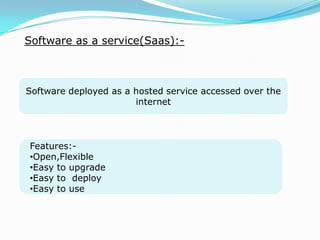
Software as a service(Saas):-
Software deployed as a hosted service accessed over the
internet
Features:-
•Open,Flexible
•Easy to upgrade
•Easy to deploy
•Easy to use
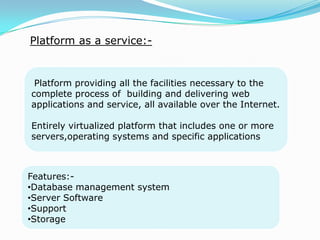
Platform as a service:-
Platform providing all the facilities necessary to the
complete process of building and delivering web
applications and service, all available over the Internet.
Entirely virtualized platform that includes one or more
servers,operating systems and specific applications
Features:-
•Database management system
•Server Software
•Support
•Storage
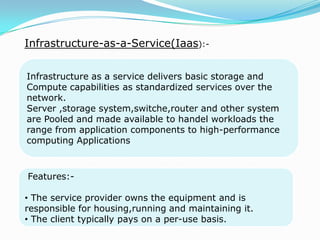
Infrastructure-as-a-Service(Iaas):-
Infrastructure as a service delivers basic storage and
Compute capabilities as standardized services over the
network.
Server ,storage system,switche,router and other system
are Pooled and made available to handel workloads the
range from application components to high-performance
computing Applications.
Features:-
• The service provider owns the equipment and is
responsible for housing,running and maintaining it.
• The client typically pays on a per-use basis.
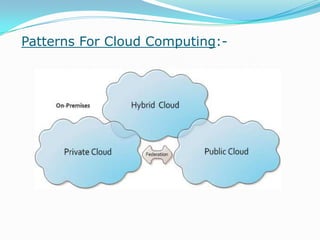
Patterns For Cloud Computing:-
Public Cloud:-
•A single or combination of SaaS,IaaS,PaaS offerings
shall be shared between multiple companies to reduce
costs and enable a dynamic resource usage following a
pay-per-use pricing model.
•Additional security mechanisms are implemented to
isolate customers from each other.
Private Cloud:-
•A single or combination of SaaS,IaaS,PaaS
offerings shall be used internally of a company
since privacy requirements or restrictions by law
render the usage of public clouds impossible.
•A private cloud is established in a dedicated data
center by the company itself or by an external
provider. The services offered by this cloud are
only accessible by one company.
Hybrid Cloud:-
•A single or combination of SaaS,IaaS,PaaS offerings
shall be offered exclusively to companies with high
privacy and security requirements while others shall
be shared between multiple companies to reduce costs
of the offerings and enable a dynamic resource usage
following a pay-per-use pricing model.
•A hybrid cloud integrates services
of public and private clouds and establishes common
management functionality.
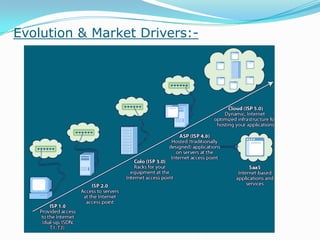
Evolution & Market Drivers:-
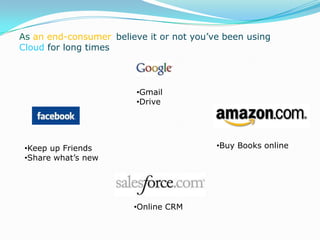
As an end-consumer, believe it or not you’ve been using
Cloud for long times
•Keep up Friends
•Share what’s new
•Gmail
•Drive
•Online CRM
•Buy Books online
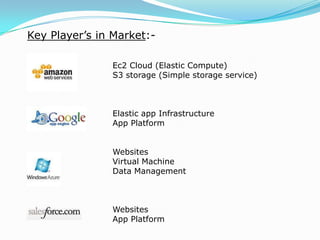
Key Player’s in Market:-
Ec2 Cloud (Elastic Compute)
S3 storage (Simple storage service)
Elastic app Infrastructure
App Platform
Websites
Virtual Machine
Data Management
Websites
App Platform
Private Cloud vendors (Data Centers):-
▫IBM
▫Vmware
▫Sun/Oracle
▫3Tera
Hosting players
Hundreds of them around
the world
Ex-Godady.com
Hostgator.com
Global Perspective:-
•A Market survey says the cloud market will reach 270 billion
dollars in 2020 estimating that it will hit 143 billion dollars by
2013.
•The top five rankings for markets with the most robust cloud
policies went to Japan, Australia, Germany, the United States, and
France.
•Today there are 100 cloud companies ,in two years there will be
5000.
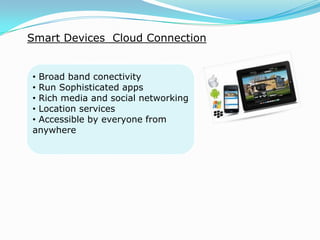
Smart Devices Cloud Connection
• Broad band conectivity
• Run Sophisticated apps
• Rich media and social networking
• Location services
• Accessible by everyone from
anywhere
Green IT Strategy via Cloud:-
•In theory, a shared resource like Amazon or Google's
public clouds can have higher utilization and thus
greater power efficiency.
•Cloud-based enterprise mobility ! It reduces the
significance of device operating systems, providing
easier multi-vendor support and enabling access to
applications from mass-market handsets; it reduces
the amount of data stored on the device
Pro’s & Con’s:-
Pro’s
•Cost reduction
•It’s scalable
•Easier collaboration
•Increased Storage Capacity
•Backup and Recovery
•Cloud is environmentally friendly
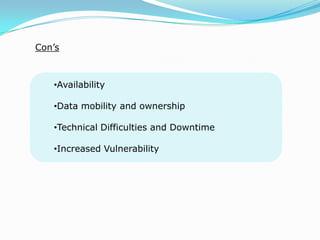
Con’s
•Availability
•Data mobility and ownership
•Technical Difficulties and Downtime
•Increased Vulnerability
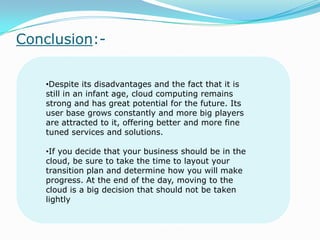
Conclusion:-
•Despite its disadvantages and the fact that it is
still in an infant age, cloud computing remains
strong and has great potential for the future. Its
user base grows constantly and more big players
are attracted to it, offering better and more fine
tuned services and solutions.
•If you decide that your business should be in the
cloud, be sure to take the time to layout your
transition plan and determine how you will make
progress. At the end of the day, moving to the
cloud is a big decision that should not be taken
lightly
Cloud computing ppt

Cloud computing ppt

  • 1.
  • 2.
    Agenda •What is cloudcomputing? •Service types •Patterns For Cloud Computing •Evolution & Market Drivers •Global Perspective •Pro’s & Con’s •Conclusion
  • 3.
    “A buyer centricview of technology where applications are available, through purchase, rental or even development, wherever and whenever.” What is cloud computing? Cloud Computing is …….. “An approach to consume technology in a pay-as-you-go model where consumers only pay for what they use.”
  • 5.
  • 6.
    Software as aservice(Saas):- Software deployed as a hosted service accessed over the internet Features:- •Open,Flexible •Easy to upgrade •Easy to deploy •Easy to use
  • 7.
    Platform as aservice:- Platform providing all the facilities necessary to the complete process of building and delivering web applications and service, all available over the Internet. Entirely virtualized platform that includes one or more servers,operating systems and specific applications Features:- •Database management system •Server Software •Support •Storage
  • 8.
    Infrastructure-as-a-Service(Iaas):- Infrastructure as aservice delivers basic storage and Compute capabilities as standardized services over the network. Server ,storage system,switche,router and other system are Pooled and made available to handel workloads the range from application components to high-performance computing Applications. Features:- • The service provider owns the equipment and is responsible for housing,running and maintaining it. • The client typically pays on a per-use basis.
  • 9.
    Patterns For CloudComputing:-
  • 10.
    Public Cloud:- •A singleor combination of SaaS,IaaS,PaaS offerings shall be shared between multiple companies to reduce costs and enable a dynamic resource usage following a pay-per-use pricing model. •Additional security mechanisms are implemented to isolate customers from each other.
  • 11.
    Private Cloud:- •A singleor combination of SaaS,IaaS,PaaS offerings shall be used internally of a company since privacy requirements or restrictions by law render the usage of public clouds impossible. •A private cloud is established in a dedicated data center by the company itself or by an external provider. The services offered by this cloud are only accessible by one company.
  • 12.
    Hybrid Cloud:- •A singleor combination of SaaS,IaaS,PaaS offerings shall be offered exclusively to companies with high privacy and security requirements while others shall be shared between multiple companies to reduce costs of the offerings and enable a dynamic resource usage following a pay-per-use pricing model. •A hybrid cloud integrates services of public and private clouds and establishes common management functionality.
  • 13.
  • 14.
    As an end-consumer,believe it or not you’ve been using Cloud for long times •Keep up Friends •Share what’s new •Gmail •Drive •Online CRM •Buy Books online
  • 15.
    Key Player’s inMarket:- Ec2 Cloud (Elastic Compute) S3 storage (Simple storage service) Elastic app Infrastructure App Platform Websites Virtual Machine Data Management Websites App Platform
  • 16.
    Private Cloud vendors(Data Centers):- ▫IBM ▫Vmware ▫Sun/Oracle ▫3Tera Hosting players Hundreds of them around the world Ex-Godady.com Hostgator.com
  • 17.
    Global Perspective:- •A Marketsurvey says the cloud market will reach 270 billion dollars in 2020 estimating that it will hit 143 billion dollars by 2013. •The top five rankings for markets with the most robust cloud policies went to Japan, Australia, Germany, the United States, and France. •Today there are 100 cloud companies ,in two years there will be 5000.
  • 18.
    Smart Devices CloudConnection • Broad band conectivity • Run Sophisticated apps • Rich media and social networking • Location services • Accessible by everyone from anywhere
  • 19.
    Green IT Strategyvia Cloud:- •In theory, a shared resource like Amazon or Google's public clouds can have higher utilization and thus greater power efficiency. •Cloud-based enterprise mobility ! It reduces the significance of device operating systems, providing easier multi-vendor support and enabling access to applications from mass-market handsets; it reduces the amount of data stored on the device
  • 20.
    Pro’s & Con’s:- Pro’s •Costreduction •It’s scalable •Easier collaboration •Increased Storage Capacity •Backup and Recovery •Cloud is environmentally friendly
  • 21.
    Con’s •Availability •Data mobility andownership •Technical Difficulties and Downtime •Increased Vulnerability
  • 22.
    Conclusion:- •Despite its disadvantagesand the fact that it is still in an infant age, cloud computing remains strong and has great potential for the future. Its user base grows constantly and more big players are attracted to it, offering better and more fine tuned services and solutions. •If you decide that your business should be in the cloud, be sure to take the time to layout your transition plan and determine how you will make progress. At the end of the day, moving to the cloud is a big decision that should not be taken lightly