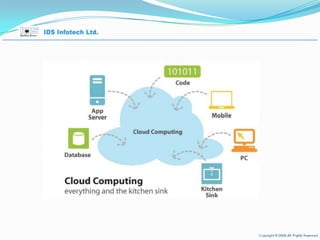
Cloud Computing
Topics Introduction Techincal Key Points Timeline Cloud Computing Architecture Cloud Service Taxonomy Layers Saas PaaS IaaS DaaS CaaS HaaS Type Public cloud Private cloud Hybrid-cloud April 26, 2010 Page
Introduction Internet computing Computation done through the Internet No concern about any maintenance or management of actual resources Shared computing resources Large pool of easily usable and accessible virtualized resources Pay-per-use model April 26, 2010 Page
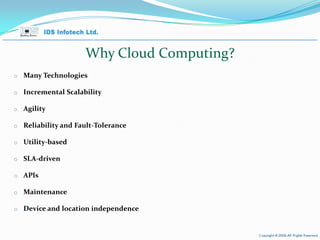
Why Cloud Computing? Many Technologies Incremental Scalability Agility Reliability and Fault-Tolerance Utility-based SLA-driven APIs Maintenance Device and location independence April 26, 2010 Page
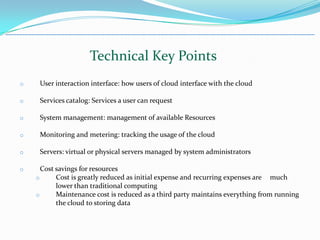
Technical Key Points User interaction interface: how users of cloud interface with the cloud Services catalog: Services a user can request System management: management of available Resources Monitoring and metering: tracking the usage of the cloud Servers: virtual or physical servers managed by system administrators Cost savings for resources Cost is greatly reduced as initial expense and recurring expenses are  much lower than traditional computing Maintenance cost is reduced as a third party maintains everything from running the cloud to storing data April 26, 2010 Page
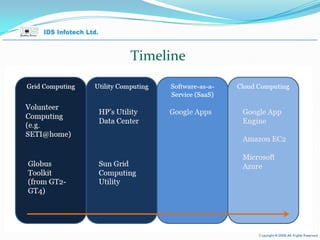
Timeline April 26, 2010 Page
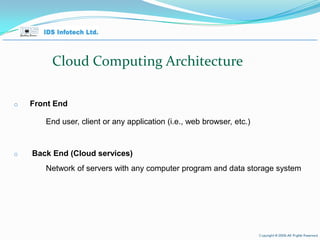
Cloud Computing Architecture Front End End user, client or any application (i.e., web browser, etc.) Back End (Cloud services) Network of servers with any computer program and data storage system April 26, 2010 Page
April 26, 2010 Page
Cloud  Service  Taxonomy Layers Software-as-a-Service (SaaS) Platform-as-a-Service (PaaS) Infrastructure-as-a-Service (IaaS) Data Storage-as-a-Service (DaaS) Communication-as-a-Service (CaaS) Hardware-as-a-Service(HaaS) Type Public cloud Private cloud Inter-cloud April 26, 2010 Page
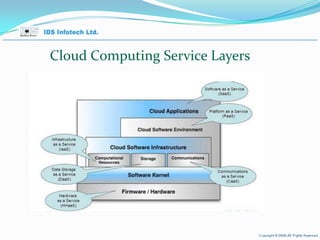
Cloud Computing Service Layers April 26, 2010 Page
Software-as-a-service (SaaS) Definition Software deployed as a hosted service and accessed over the Internet Features Open, Flexible Easy to Use Easy to Upgrade Easy to Deploy April 26, 2010 Page
Platform-as-a-Service (PaaS) Definition Platform providing all the facilities necessary to support the complete process of building and delivering web applications and services, all available over the Internet Entirely virtualized platform that includes one or more servers, operating systems and specific applications April 26, 2010 Page
Infrastructure-as-a-Service (Iaas) Definition Infrastructure as a service delivers basic storage and compute capabilities as standardized services over the network. Servers, storage systems, switches, routers, and other systems are pooled and made available to handle workloads that range from application components to high-performance computing applications. Important Points Infrastructure as a Service is sometimes referred to as Hardware as a Service (HaaS) The service provider owns the equipment and is responsible for housing, running and maintaining it The client typically pays on a per-use basis April 26, 2010 Page
Data Storage as a Service (DaaS) Definition Delivery of data storage as a service, including database-like services, often billed on a utility computing basis Important Points Database (Amazon SimpleDB & Google App Engine's BigTable datastore) Network attached storage (iDrive, MobileMe iDisk & Nirvanix CloudNAS) Synchronization (Live Mesh Live Desktop component & MobileMe push functions) Web service (Amazon Simple Storage Service (S3) & Nirvanix SDN) April 26, 2010 Page
Communications as a Service (CaaS)  Definition Responsible for the management of hardware and software required for delivering Voice over IP(also known as Voice as a Service), Instant messaging, and video conferencing applications  Important Point CaaS model has evolved in the telecommunication industry in a similar manner to the SaaS model in the field of software delivery  April 26, 2010 Page
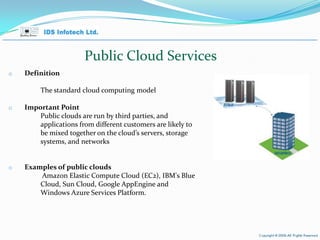
Public Cloud Services Definition The standard cloud computing model Important Point Public clouds are run by third parties, and applications from different customers are likely to be mixed together on the cloud’s servers, storage systems, and networks Examples of public clouds Amazon Elastic Compute Cloud (EC2), IBM's Blue Cloud, Sun Cloud, Google AppEngine and Windows Azure Services Platform. April 26, 2010 Page
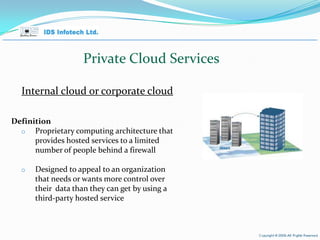
Private Cloud Services Internal cloud or corporate cloud Definition Proprietary computing architecture that provides hosted services to a limited number of people behind a firewall Designed to appeal to an organization that needs or wants more control over their  data than they can get by using a third-party hosted service April 26, 2010 Page
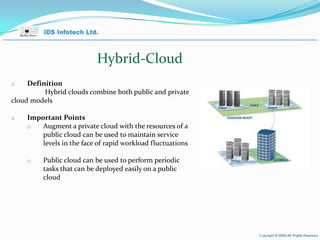
Hybrid-Caloud Definition   Hybrid clouds combine both public and private cloud models Important Points Augment a private cloud with the resources of a public cloud can be used to maintain service levels in the face of rapid workload fluctuations Public cloud can be used to perform periodic tasks that can be deployed easily on a public cloud April 26, 2010 Page
Cloud Vendors Amazon (Amazon EC2) Google (Google App Engine) GAE IBM AT&T Enomaly  Microsoft   NetSuite  April 26, 2010 Page
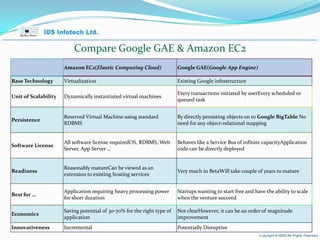
Compare Google GAE & Amazon EC2 April 26, 2010 Page
Please feel free to have us contacted: Abhishek Kapoor IDS Infotech Email:abhishek.k@idsil.com www.idsil.com Q & A || Contact Us April 26, 2010 Page

Everything about Cloud Computing

  • 1.
  • 2.
    Topics Introduction TechincalKey Points Timeline Cloud Computing Architecture Cloud Service Taxonomy Layers Saas PaaS IaaS DaaS CaaS HaaS Type Public cloud Private cloud Hybrid-cloud April 26, 2010 Page
  • 3.
    Introduction Internet computingComputation done through the Internet No concern about any maintenance or management of actual resources Shared computing resources Large pool of easily usable and accessible virtualized resources Pay-per-use model April 26, 2010 Page
  • 4.
    Why Cloud Computing?Many Technologies Incremental Scalability Agility Reliability and Fault-Tolerance Utility-based SLA-driven APIs Maintenance Device and location independence April 26, 2010 Page
  • 5.
    Technical Key PointsUser interaction interface: how users of cloud interface with the cloud Services catalog: Services a user can request System management: management of available Resources Monitoring and metering: tracking the usage of the cloud Servers: virtual or physical servers managed by system administrators Cost savings for resources Cost is greatly reduced as initial expense and recurring expenses are much lower than traditional computing Maintenance cost is reduced as a third party maintains everything from running the cloud to storing data April 26, 2010 Page
  • 6.
  • 7.
    Cloud Computing ArchitectureFront End End user, client or any application (i.e., web browser, etc.) Back End (Cloud services) Network of servers with any computer program and data storage system April 26, 2010 Page
  • 8.
  • 9.
    Cloud Service Taxonomy Layers Software-as-a-Service (SaaS) Platform-as-a-Service (PaaS) Infrastructure-as-a-Service (IaaS) Data Storage-as-a-Service (DaaS) Communication-as-a-Service (CaaS) Hardware-as-a-Service(HaaS) Type Public cloud Private cloud Inter-cloud April 26, 2010 Page
  • 10.
    Cloud Computing ServiceLayers April 26, 2010 Page
  • 11.
    Software-as-a-service (SaaS) DefinitionSoftware deployed as a hosted service and accessed over the Internet Features Open, Flexible Easy to Use Easy to Upgrade Easy to Deploy April 26, 2010 Page
  • 12.
    Platform-as-a-Service (PaaS) DefinitionPlatform providing all the facilities necessary to support the complete process of building and delivering web applications and services, all available over the Internet Entirely virtualized platform that includes one or more servers, operating systems and specific applications April 26, 2010 Page
  • 13.
    Infrastructure-as-a-Service (Iaas) DefinitionInfrastructure as a service delivers basic storage and compute capabilities as standardized services over the network. Servers, storage systems, switches, routers, and other systems are pooled and made available to handle workloads that range from application components to high-performance computing applications. Important Points Infrastructure as a Service is sometimes referred to as Hardware as a Service (HaaS) The service provider owns the equipment and is responsible for housing, running and maintaining it The client typically pays on a per-use basis April 26, 2010 Page
  • 14.
    Data Storage asa Service (DaaS) Definition Delivery of data storage as a service, including database-like services, often billed on a utility computing basis Important Points Database (Amazon SimpleDB & Google App Engine's BigTable datastore) Network attached storage (iDrive, MobileMe iDisk & Nirvanix CloudNAS) Synchronization (Live Mesh Live Desktop component & MobileMe push functions) Web service (Amazon Simple Storage Service (S3) & Nirvanix SDN) April 26, 2010 Page
  • 15.
    Communications as aService (CaaS) Definition Responsible for the management of hardware and software required for delivering Voice over IP(also known as Voice as a Service), Instant messaging, and video conferencing applications Important Point CaaS model has evolved in the telecommunication industry in a similar manner to the SaaS model in the field of software delivery April 26, 2010 Page
  • 16.
    Public Cloud ServicesDefinition The standard cloud computing model Important Point Public clouds are run by third parties, and applications from different customers are likely to be mixed together on the cloud’s servers, storage systems, and networks Examples of public clouds Amazon Elastic Compute Cloud (EC2), IBM's Blue Cloud, Sun Cloud, Google AppEngine and Windows Azure Services Platform. April 26, 2010 Page
  • 17.
    Private Cloud ServicesInternal cloud or corporate cloud Definition Proprietary computing architecture that provides hosted services to a limited number of people behind a firewall Designed to appeal to an organization that needs or wants more control over their data than they can get by using a third-party hosted service April 26, 2010 Page
  • 18.
    Hybrid-Caloud Definition Hybrid clouds combine both public and private cloud models Important Points Augment a private cloud with the resources of a public cloud can be used to maintain service levels in the face of rapid workload fluctuations Public cloud can be used to perform periodic tasks that can be deployed easily on a public cloud April 26, 2010 Page
  • 19.
    Cloud Vendors Amazon(Amazon EC2) Google (Google App Engine) GAE IBM AT&T Enomaly Microsoft  NetSuite April 26, 2010 Page
  • 20.
    Compare Google GAE& Amazon EC2 April 26, 2010 Page
  • 21.
    Please feel freeto have us contacted: Abhishek Kapoor IDS Infotech Email:abhishek.k@idsil.com www.idsil.com Q & A || Contact Us April 26, 2010 Page