Cloud Computing Presented by Nhan Nguyen
Outline Cloud Terms Comparisons Many Flavors of Cloud Computing Key Characteristics Architecture Type Who’s using Clouds today? Example: Eli Lilly Legal Issues 1
What is “Cloud”? There is no clear definition of the term “Cloud” or “Cloud Computing” No Official Definition Term takes on the definition of the user Overuse the term “cloud” by eager marketer 2
What is “Cloud”? There are two popular uses of the term “cloud” in today’s I.T. conversation Cloud Services -  consumer and business products, services and solutions that are delivered and consumed in real-time over the internet Cloud Computing -  an emerging IT development, deployment, and delivery model that enables real-time delivery of a broad range of IT products, services and solutions over the internet 3
Cloud Computing is an Evolution in IT 4
Comparisons Grid Computing –  a form of distributed computing, acting in concert to perform very large tasks Utility Computing –  a metered service similar to a traditional public utility such as electricity Autonomic Computing –  capable of self-management Cloud Computing –  deployments  as of 2009 depend on grids, have autonomic characteristics and bill like utilities 5
Cloud Formation 6 Cloud Computing is  an  emerging  IT development, deployment and delivery model,  enabling  real-time delivery of products, services and solutions (i.e., enabling cloud services) over the  Internet  (IDC) Cloud computing is  Internet  based development and use of computer technology.  It  is a style of computing in which typically  real-time   scalable  resources are provided  as a service  over the internet (Wikipedia) Cloud:  the new home and business network
Many Flavors of Cloud Computing SaaS – Software as a Service Network-hosted application PaaS– Platform as a Service Network-hosted software development platform IaaS – Infrastructure as a Service Provider hosts customer VMs or provides network storage 7
Many Flavors of Cloud Computing  (cont’d) DaaS – Data as a Service Customer queries against provider’s database IPMaaS – Identity and Policy Management as a Service Provider manages identity and/or access control policy for customer NaaS – Network as a Service Provider offers virtualized networks (e.g. VPNs) 8
Cloud Computing Providers 9
The Cloud’s “Snowball Effect” Maturation of Virtualization Technology Virtualization enables  Compute  Clouds Compute Clouds create demand for  Storage  Clouds Storage + Compute Clouds create Cloud  Infrastructure Cloud Infrastructure enables Cloud  Platforms  &  Applications 10
Cloud “Applications” SaaS  resides here Most common Cloud / Many providers of different services Examples:  SalesForce, Gmail, Yahoo! Mail, Quicken Online Advantages:   Free, Easy, Consumer Adoption Disadvantages:  Limited functionality, no control or access to underlying technology 11
Cloud “Platforms” “ Containers”, “Closed”  environments Examples :  Google App Engine, Heroku, Mosso, Engine Yard, Joyent or Force.com (SalesForce Dev Platform) Advantages:   Good for developers, more control than “Application” Clouds, tightly configured Disadvantages:   Restricted to what is available, other dependencies 12
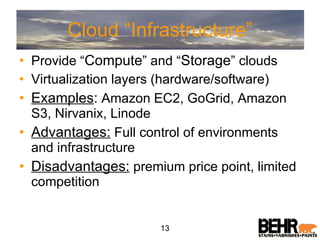
Cloud “Infrastructure” Provide “ Compute ” and “ Storage ” clouds Virtualization layers (hardware/software) Examples :  Amazon EC2, GoGrid, Amazon S3, Nirvanix, Linode Advantages:  Full control of environments and infrastructure Disadvantages:  premium price point, limited competition 13
Key Characteristics 14
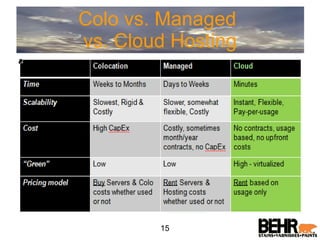
Colo vs. Managed  vs. Cloud Hosting 15
Architecture Types 16
Single-Tenant vs. Multi-Tenant Architecture 17 Single tenancy gives each customer a dedicated software stack – and each layer in each stack still requires configuration, monitoring, upgrades, security updates, patches, tuning and disaster recovery. On a multi-tenant platform, all applications run in a single logical environment: faster, more secure, more available, automatically upgraded and maintained. Any improvement appears to all customers at once. Shared infrastructure Other apps Server OS Database App Server Storage Network App 1 Server OS Database App Server Storage Network App 2 Server OS Database App Server Storage Network App 3
Who’s using Clouds today? Startups & Small businesses Can use clouds for everything Mid-Size Enterprises Can use clouds for many things Large Enterprises More likely to have hybrid models where they keep some things in house 18
Example: Eli Lilly Reduced costs Global access to R&D applications Rapid transition due to VM hosting Time to deliver new services greatly reduced: New server: 7.5 weeks down to 3 minutes New collaboration: 8 weeks down to 5 minutes 64 node linux cluster: 12 weeks down to 5 minutes 19
Legal Issues March 2007, Dell applied trademark “cloud computing”. September 2008, Cgactive LLC received trademard “CloudOS” November 2007, Affero GPL open source code April 2009, FBI raided a data center 20
The End 5 minutes of question time starts now!
Questions 4 minutes left!
Questions 3 minutes left!
Questions 2 minutes left!
Questions 1 minute left!
Questions 30 seconds left!
Questions TIME IS UP!

Cloud Computing Introduction

  • 1.
  • 2.
    Outline Cloud TermsComparisons Many Flavors of Cloud Computing Key Characteristics Architecture Type Who’s using Clouds today? Example: Eli Lilly Legal Issues 1
  • 3.
    What is “Cloud”?There is no clear definition of the term “Cloud” or “Cloud Computing” No Official Definition Term takes on the definition of the user Overuse the term “cloud” by eager marketer 2
  • 4.
    What is “Cloud”?There are two popular uses of the term “cloud” in today’s I.T. conversation Cloud Services - consumer and business products, services and solutions that are delivered and consumed in real-time over the internet Cloud Computing - an emerging IT development, deployment, and delivery model that enables real-time delivery of a broad range of IT products, services and solutions over the internet 3
  • 5.
    Cloud Computing isan Evolution in IT 4
  • 6.
    Comparisons Grid Computing– a form of distributed computing, acting in concert to perform very large tasks Utility Computing – a metered service similar to a traditional public utility such as electricity Autonomic Computing – capable of self-management Cloud Computing – deployments as of 2009 depend on grids, have autonomic characteristics and bill like utilities 5
  • 7.
    Cloud Formation 6Cloud Computing is an emerging IT development, deployment and delivery model,  enabling real-time delivery of products, services and solutions (i.e., enabling cloud services) over the Internet (IDC) Cloud computing is Internet based development and use of computer technology. It is a style of computing in which typically real-time scalable resources are provided as a service over the internet (Wikipedia) Cloud: the new home and business network
  • 8.
    Many Flavors ofCloud Computing SaaS – Software as a Service Network-hosted application PaaS– Platform as a Service Network-hosted software development platform IaaS – Infrastructure as a Service Provider hosts customer VMs or provides network storage 7
  • 9.
    Many Flavors ofCloud Computing (cont’d) DaaS – Data as a Service Customer queries against provider’s database IPMaaS – Identity and Policy Management as a Service Provider manages identity and/or access control policy for customer NaaS – Network as a Service Provider offers virtualized networks (e.g. VPNs) 8
  • 10.
  • 11.
    The Cloud’s “SnowballEffect” Maturation of Virtualization Technology Virtualization enables Compute Clouds Compute Clouds create demand for Storage Clouds Storage + Compute Clouds create Cloud Infrastructure Cloud Infrastructure enables Cloud Platforms & Applications 10
  • 12.
    Cloud “Applications” SaaS resides here Most common Cloud / Many providers of different services Examples: SalesForce, Gmail, Yahoo! Mail, Quicken Online Advantages: Free, Easy, Consumer Adoption Disadvantages: Limited functionality, no control or access to underlying technology 11
  • 13.
    Cloud “Platforms” “Containers”, “Closed” environments Examples : Google App Engine, Heroku, Mosso, Engine Yard, Joyent or Force.com (SalesForce Dev Platform) Advantages: Good for developers, more control than “Application” Clouds, tightly configured Disadvantages: Restricted to what is available, other dependencies 12
  • 14.
    Cloud “Infrastructure” Provide“ Compute ” and “ Storage ” clouds Virtualization layers (hardware/software) Examples : Amazon EC2, GoGrid, Amazon S3, Nirvanix, Linode Advantages: Full control of environments and infrastructure Disadvantages: premium price point, limited competition 13
  • 15.
  • 16.
    Colo vs. Managed vs. Cloud Hosting 15
  • 17.
  • 18.
    Single-Tenant vs. Multi-TenantArchitecture 17 Single tenancy gives each customer a dedicated software stack – and each layer in each stack still requires configuration, monitoring, upgrades, security updates, patches, tuning and disaster recovery. On a multi-tenant platform, all applications run in a single logical environment: faster, more secure, more available, automatically upgraded and maintained. Any improvement appears to all customers at once. Shared infrastructure Other apps Server OS Database App Server Storage Network App 1 Server OS Database App Server Storage Network App 2 Server OS Database App Server Storage Network App 3
  • 19.
    Who’s using Cloudstoday? Startups & Small businesses Can use clouds for everything Mid-Size Enterprises Can use clouds for many things Large Enterprises More likely to have hybrid models where they keep some things in house 18
  • 20.
    Example: Eli LillyReduced costs Global access to R&D applications Rapid transition due to VM hosting Time to deliver new services greatly reduced: New server: 7.5 weeks down to 3 minutes New collaboration: 8 weeks down to 5 minutes 64 node linux cluster: 12 weeks down to 5 minutes 19
  • 21.
    Legal Issues March2007, Dell applied trademark “cloud computing”. September 2008, Cgactive LLC received trademard “CloudOS” November 2007, Affero GPL open source code April 2009, FBI raided a data center 20
  • 22.
    The End 5minutes of question time starts now!
  • 23.
  • 24.
  • 25.
  • 26.
  • 27.
  • 28.