Cloud Computing
Cl d C     ti
           An overview
          + a case study

                Babak Hosseinzadeh
        babak@newbridgestrategy.com
                  +1-206-612-7350
Some observations…
S     b     ti


                     2
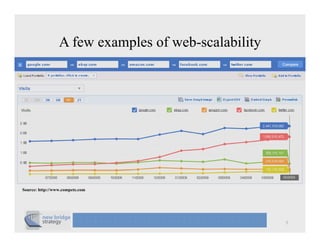
A few examples of web-scalability
                                   web scalability


Source: http://www.compete.com


                                                     3
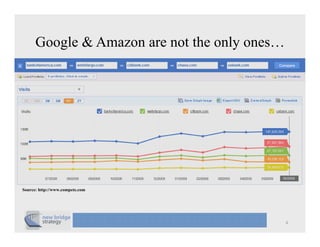
Google & Amazon are not the only ones…


Source: http://www.compete.com


                                               4
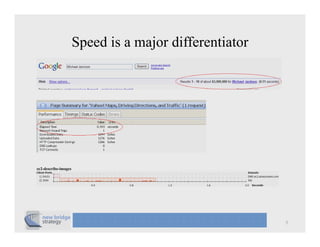
Speed is a major differentiator


ec2-describe-images
                g


                                                        5
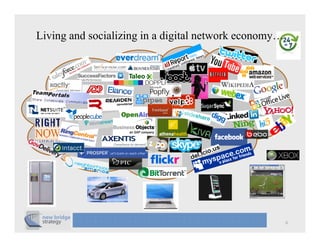
Living and socializing in a digital network economy…


                                                       6
A l k at the enterprise…
  look t th    t    i


                           7
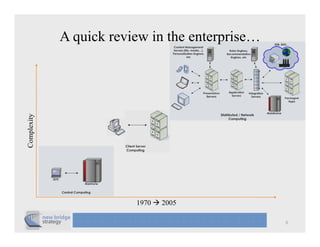
A quick review in the enterprise…
  mplexity
Com


                         1970   2005

                                                 8
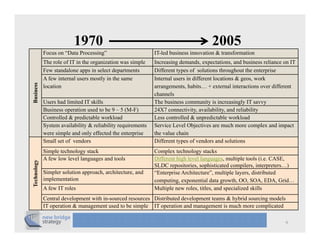
1970                                                        2005
             Focus on “Data Processing”                       IT-led business innovation & transformation
             The role of IT in the organization was simple    Increasing demands, expectations, and business reliance on IT
             Few standalone apps in select departments        Different types of solutions throughout the enterprise
             Af i
               few internal users mostly in the same
                           l           l i h                  Internal users i different locations & geos, work
                                                              I      l       in diff     l     i               k
Business


             location                                         arrangements, habits… + external interactions over different
                                                              channels
             Users had limited IT skills                      The business community is increasingly IT savvy
             Business operation used to be 9 – 5 (M-F)
             B i            i       d b           (M F)       24X7 connectivity, availability, and reliability
                                                                             i i      il bili    d li bili
             Controlled & predictable workload                Less controlled & unpredictable workload
             System availability & reliability requirements   Service Level Objectives are much more complex and impact
             were simple and only effected the enterprise     the value chain
             Small
             S ll set of vendors
                        f     d                               Different types of vendors and solutions
                                                              Diff               f   d        d l i
             Simple technology stack                          Complex technology stacks
             A few low level languages and tools              Different high level languages, multiple tools (i.e. CASE,
     ology


                                                              SLDC repositories, sophisticated compilers, interpreters…)
Techno


             Simpler solution approach, architecture, and
              i l      l i           h     hi           d     “Enterprise Architecture”, multiple layers, distributed
             implementation                                   computing, exponential data growth, OO, SOA, EDA, Grid…
             A few IT roles                                   Multiple new roles, titles, and specialized skills
             Central development with in-sourced resources Distributed development teams & hybrid sourcing models
                           p                                                 p              y            g
             IT operation & management used to be simple IT operation and management is much more complicated

                                                                                                                      9
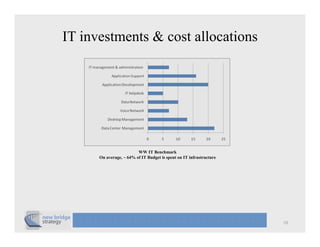
IT investments & cost allocations


                         WW IT Benchmark
      On average, ~ 64% of IT Budget is spent on IT infrastructure


                                                                     10
Cloud C
Cl d Computing
          ti


                 11
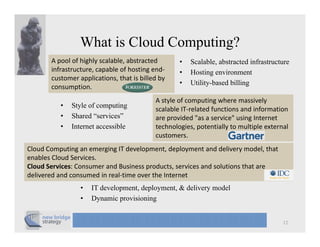
What is Cloud Computing?
       A pool of highly scalable, abstracted        •   Scalable, abstracted infrastructure
       infrastructure, capable of hosting end‐      •   Hosting environment
       customer applications, that is billed by 
           t         li ti      th t i bill d b
                                                    •   Utility-based billing
       consumption.            
                                            A style of computing where massively 
          •   Style of computing
                y          p    g
                                            scalable IT‐related functions and information 
                                               l bl IT l t d f ti           di f      ti
          •   Shared “services”             are provided "as a service" using Internet
          •   Internet accessible           technologies, potentially to multiple external 
                                            customers.
Cloud Computing an emerging IT development, deployment and delivery model, that 
enables Cloud Services. 
Cloud Services: Consumer and Business products, services and solutions that are 
delivered and consumed in real‐time over the Internet
                 •   IT development, deployment, & delivery model
                 •   Dynamic p
                       y      provisioning
                                         g


                                                                                        12
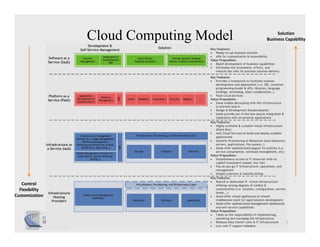
Cloud Computing Model        Solution
                                        Business Capability


   Control
  Flexibility
Customization


                                                13
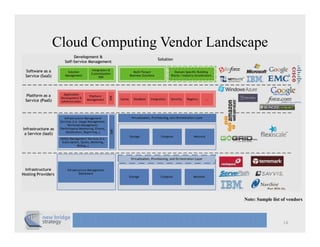
Cloud Computing Vendor Landscape


                            Note: Sample list of vendors
                                     p


                                              14
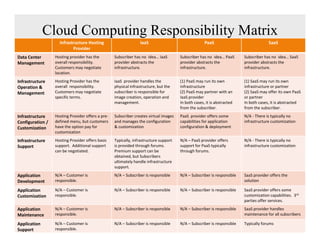
Cloud Computing Responsibility Matrix
                     Infrastructure Hosting                        IaaS                                PaaS                               SaaS
                            Provider
Data Center        Hosting provider has the         Subscriber has no  idea… IaaS        Subscriber has no  idea… PaaS      Subscriber has no  idea… SaaS 
Management         overall responsibility.          provider abstracts the               provider abstracts the             provider abstracts the 
                   Customers may negotiate          infrastructure.                      infrastructure.                    infrastructure.
                   location.
Infrastructure     Hosting Provider has the         IaaS provider handles the            (1) PaaS may run its own           (1) SaaS may run its own 
Operation &        overall  responsibility.         physical infrastructure, but the     infrastructure                     infrastructure or partner
Management         Customers may negotiate          subscriber is responsible for        (2) PaaS may partner with an       (2) SaaS may offer its own PaaS
                   specific terms.                  image creation, operation and        IaaS provider                      or partner
                                                    management.                          In both cases, it is abstracted    In both cases, it is abstracted 
                                                                                         from the subscriber.
                                                                                         from the subscriber                from the subscriber.
                                                                                                                            from the subscriber
Infrastructure     Hosting Provider offers a pre‐   Subscriber creates virtual images    PaaS provider offers some          N/A ‐ There is typically no 
Configuration /    defined menu, but customers      and manages the configuration        capabilities for application       infrastructure customization
Customization      have the option pay for          & customization                      configuration & deployment
                   customization
Infrastructure 
I f                Hosting Provider ff b i
                   H i P id offers basic            Typically, infrastructure support 
                                                    T i ll i f                           N/A – PaaS
                                                                                         N/A P S provider offers 
                                                                                                         id    ff           N/A ‐ Th
                                                                                                                                  There iis typically no 
                                                                                                                                               i ll
Support            support.  Additional support     is provided through forums.          support for PaaS typically         infrastructure customization
                   can be negotiated.               Premium support can be               through forums.
                                                    obtained, but Subscribers 
                                                    ultimately handle infrastructure 
                                                    support.
Application        N/A – Customer is                N/A – Subscriber is responsible      N/A – Subscriber is responsible    SaaS provider offers the 
Development        responsible.                                                                                             solution

Application        N/A – Customer is                N/A – Subscriber is responsible      N/A – Subscriber is responsible    SaaS provider offers some 
Customization      responsible.                                                                                             customization capabilities.  3rd
                                                                                                                            parties offer services.
                                                                                                                            parties offer services
Application        N/A – Customer is                N/A – Subscriber is responsible      N/A – Subscriber is responsible    SaaS provider handles 
Maintenance        responsible.                                                                                             maintenance for all subscribers

Application        N/A – Customer is                N/A – Subscriber is responsible      N/A – Subscriber is responsible    Typically forums      15
Support            responsible.
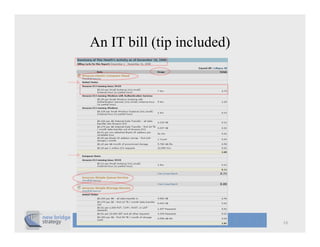
An IT bill (tip included)


                            16
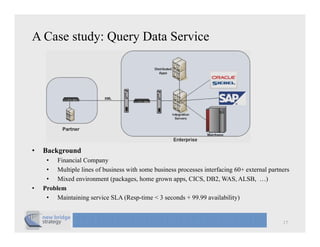
A Case study: Query Data Service


•   Background
     • Financial Company
     • Multiple lines of business with some business processes interfacing 60+ external partners
     • Mixed environment (packages, home grown apps, CICS, DB2, WAS, ALSB, …)
•   Problem
     • Maintaining service SLA (Resp-time < 3 seconds + 99.99 availability)


                                                                                             17
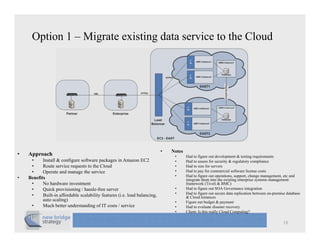
Option 1 – Migrate existing data service to the Cloud


                                                                            •   Notes
•   Approach                                                                     •      Had to figure out development & testing requirements
     •     Install & configure software packages in Amazon EC2                   •      Had to assess for security & regulatory compliance
     •     Route service requests to the Cloud                                   •      Had to size for servers
     •     Operate and manage the service
           O           d         h        i                                      •      Had t
                                                                                        H d to pay for commercial software license costs
                                                                                                     f            i l ft      li         t
                                                                                 •      Had to figure out operations, support, change management, etc and
•   Benefits                                                                            integrate them into the existing enterprise systems management
     •     No hardware investment                                                       framework (Tivoli & BMC)
     •     Quick provisioning / hassle-free server                               •      Had to figure out SOA Governance integration
                                                                                 •      Had to figure out secure data replication between on-premise database
     •     Built-in affordable scalability features (i.e. load balancing,               & Cloud instances
           auto scaling)
                sca g)                                                           •      Figure out budget & payment
                                                                                        Fi         tb d t             t
     •     Much better understanding of IT costs / service                       •      Had to evaluate disaster recovery
                                                                                 •      Client: Is this really Cloud Computing?

                                                                                                                                                  18
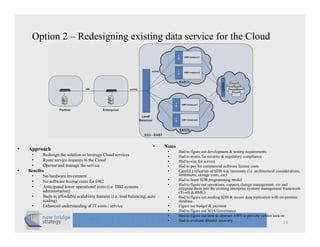
Option 2 – Redesigning existing data service for the Cloud


                                                                             •    Notes
•   Approach                                                                       •      Had to figure out development & testing requirements
     •      Redesign the solution to leverage Cloud services                       •      Had to assess for security & regulatory compliance
     •      Route service requests to the Cloud                                    •      Had to size for servers
     •      Operate and manage the service                                         •      Had to pay for commercial software license costs
•   Benefits                                                                       •      Careful
                                                                                          C f l evaluation of SDB was necessary (i.e. architectural considerations,
                                                                                                       l ti     f                     (i     hit t l     id ti
     •      No hardware investment                                                        limitations, storage costs, etc)
     •      No software license costs for DB2                                      •      Had to learn SDB programming model
                                                                                   •      Had to figure out operations, support, change management, etc and
     •      Anticipated lower operational costs (i.e. DB2 systems                         integrate them into the existing enterprise systems management framework
            administration)                                                               (Tivoli & BMC)
     •      Built-in affordable scalability features (i.e. load balancing, auto    •      Had to figure out seeding SDB & secure data replication with on-premise
            scaling)                                                                      database
     •      Enhanced understanding of IT costs / service                           •      Figure out budget & payment
                                                                                   •      Had to figure out SOA Governance
                                                                                   •      Had to figure out how to abstract AWS to prevent vendor lock-in
                                                                                   •      Had to evaluate disaster recovery
                                                                                                                                                        19
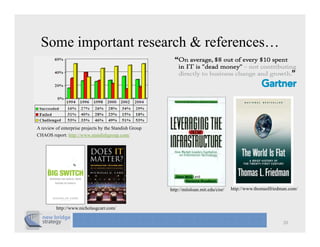
Some important research & references…


A review of enterprise projects by the Standish Group
CHAOS report: http://www.standishgroup.com/


                                                        http://mitsloan.mit.edu/cisr/   http://www.thomaslfriedman.com/


         http://www.nicholasgcarr.com/


                                                                                                                20
Summary
•   Be careful in workload selection & analysis – Architectural decisions have to be analyzed
    (i.e. transactionality)
•   Beware of the hype and misinformation – (i.e. don t expect to just throw the application
                                                     don’t
    into the cloud and be done…Technology issues are relatively minor compared to business
    integration issues.)
•   Understand and evaluate both on-premise & public cloud options - (i.e. Lots going on in
    the app server space including gridification and virtualization – Talk to your vendor to learn
    about roadmap and future plans).
     b t       d        df t      l )
•   Should you move the particular app to the cloud or redesign it? Can it be cloud-sourced? --
    relatively straight-forward and simple, but best to strike an agreement with the inner circle
    quickly (i.e. an EA decision) to avoid continuing discussions, endless debates, etc…
•   Assess impact/gaps on existing development, testing, deployment, operation, and
                                      development testing deployment operation
    maintenance processes – Tooling is critical for productivity and mandatory for cost-saving.
•   A lot of the public cloud services have been in beta since a year ago or so…Before you
    dismiss too quickly, let’s put things in perspective. Beta in Cloud Services != beta in
    enterprise software.
           p
•   Finally, irrespective of the business motivation, it is important to establish a baseline (i.e.
    avg transaction cost) for the existing workload and measure and compare thereafter to
    communicate the benefits using financial terms.


                                                                                              21
Thank you


            22

Cloud Computing overview and case study

  • 1.
    Cloud Computing Cl dC ti An overview + a case study Babak Hosseinzadeh babak@newbridgestrategy.com +1-206-612-7350
  • 2.
  • 3.
    A few examplesof web-scalability web scalability Source: http://www.compete.com 3
  • 4.
    Google & Amazonare not the only ones… Source: http://www.compete.com 4
  • 5.
    Speed is amajor differentiator ec2-describe-images g 5
  • 6.
    Living and socializingin a digital network economy… 6
  • 7.
    A l kat the enterprise… look t th t i 7
  • 8.
    A quick reviewin the enterprise… mplexity Com 1970 2005 8
  • 9.
    1970 2005 Focus on “Data Processing” IT-led business innovation & transformation The role of IT in the organization was simple Increasing demands, expectations, and business reliance on IT Few standalone apps in select departments Different types of solutions throughout the enterprise Af i few internal users mostly in the same l l i h Internal users i different locations & geos, work I l in diff l i k Business location arrangements, habits… + external interactions over different channels Users had limited IT skills The business community is increasingly IT savvy Business operation used to be 9 – 5 (M-F) B i i d b (M F) 24X7 connectivity, availability, and reliability i i il bili d li bili Controlled & predictable workload Less controlled & unpredictable workload System availability & reliability requirements Service Level Objectives are much more complex and impact were simple and only effected the enterprise the value chain Small S ll set of vendors f d Different types of vendors and solutions Diff f d d l i Simple technology stack Complex technology stacks A few low level languages and tools Different high level languages, multiple tools (i.e. CASE, ology SLDC repositories, sophisticated compilers, interpreters…) Techno Simpler solution approach, architecture, and i l l i h hi d “Enterprise Architecture”, multiple layers, distributed implementation computing, exponential data growth, OO, SOA, EDA, Grid… A few IT roles Multiple new roles, titles, and specialized skills Central development with in-sourced resources Distributed development teams & hybrid sourcing models p p y g IT operation & management used to be simple IT operation and management is much more complicated 9
  • 10.
    IT investments &cost allocations WW IT Benchmark On average, ~ 64% of IT Budget is spent on IT infrastructure 10
  • 11.
    Cloud C Cl dComputing ti 11
  • 12.
    What is CloudComputing? A pool of highly scalable, abstracted  • Scalable, abstracted infrastructure infrastructure, capable of hosting end‐ • Hosting environment customer applications, that is billed by  t li ti th t i bill d b • Utility-based billing consumption.             A style of computing where massively  • Style of computing y p g scalable IT‐related functions and information  l bl IT l t d f ti di f ti • Shared “services” are provided "as a service" using Internet • Internet accessible technologies, potentially to multiple external  customers. Cloud Computing an emerging IT development, deployment and delivery model, that  enables Cloud Services.  Cloud Services: Consumer and Business products, services and solutions that are  delivered and consumed in real‐time over the Internet • IT development, deployment, & delivery model • Dynamic p y provisioning g 12
  • 13.
    Cloud Computing Model Solution Business Capability Control Flexibility Customization 13
  • 14.
    Cloud Computing VendorLandscape Note: Sample list of vendors p 14
  • 15.
    Cloud Computing ResponsibilityMatrix Infrastructure Hosting  IaaS PaaS SaaS Provider Data Center  Hosting provider has the  Subscriber has no  idea… IaaS Subscriber has no  idea… PaaS Subscriber has no  idea… SaaS  Management overall responsibility.   provider abstracts the  provider abstracts the  provider abstracts the  Customers may negotiate  infrastructure. infrastructure. infrastructure. location. Infrastructure Hosting Provider has the  IaaS provider handles the  (1) PaaS may run its own  (1) SaaS may run its own  Operation &  overall  responsibility.  physical infrastructure, but the  infrastructure infrastructure or partner Management Customers may negotiate  subscriber is responsible for  (2) PaaS may partner with an  (2) SaaS may offer its own PaaS specific terms. image creation, operation and  IaaS provider or partner management. In both cases, it is abstracted  In both cases, it is abstracted  from the subscriber. from the subscriber from the subscriber. from the subscriber Infrastructure Hosting Provider offers a pre‐ Subscriber creates virtual images  PaaS provider offers some N/A ‐ There is typically no  Configuration /  defined menu, but customers  and manages the configuration  capabilities for application  infrastructure customization Customization have the option pay for  & customization configuration & deployment customization Infrastructure  I f Hosting Provider ff b i H i P id offers basic  Typically, infrastructure support  T i ll i f N/A – PaaS N/A P S provider offers  id ff N/A ‐ Th There iis typically no  i ll Support support.  Additional support  is provided through forums.   support for PaaS typically infrastructure customization can be negotiated. Premium support can be  through forums. obtained, but Subscribers  ultimately handle infrastructure  support. Application  N/A – Customer is  N/A – Subscriber is responsible N/A – Subscriber is responsible SaaS provider offers the  Development responsible. solution Application  N/A – Customer is  N/A – Subscriber is responsible N/A – Subscriber is responsible SaaS provider offers some  Customization responsible. customization capabilities.  3rd parties offer services. parties offer services Application  N/A – Customer is  N/A – Subscriber is responsible N/A – Subscriber is responsible SaaS provider handles  Maintenance responsible. maintenance for all subscribers Application  N/A – Customer is  N/A – Subscriber is responsible N/A – Subscriber is responsible Typically forums 15 Support responsible.
  • 16.
    An IT bill(tip included) 16
  • 17.
    A Case study:Query Data Service • Background • Financial Company • Multiple lines of business with some business processes interfacing 60+ external partners • Mixed environment (packages, home grown apps, CICS, DB2, WAS, ALSB, …) • Problem • Maintaining service SLA (Resp-time < 3 seconds + 99.99 availability) 17
  • 18.
    Option 1 –Migrate existing data service to the Cloud • Notes • Approach • Had to figure out development & testing requirements • Install & configure software packages in Amazon EC2 • Had to assess for security & regulatory compliance • Route service requests to the Cloud • Had to size for servers • Operate and manage the service O d h i • Had t H d to pay for commercial software license costs f i l ft li t • Had to figure out operations, support, change management, etc and • Benefits integrate them into the existing enterprise systems management • No hardware investment framework (Tivoli & BMC) • Quick provisioning / hassle-free server • Had to figure out SOA Governance integration • Had to figure out secure data replication between on-premise database • Built-in affordable scalability features (i.e. load balancing, & Cloud instances auto scaling) sca g) • Figure out budget & payment Fi tb d t t • Much better understanding of IT costs / service • Had to evaluate disaster recovery • Client: Is this really Cloud Computing? 18
  • 19.
    Option 2 –Redesigning existing data service for the Cloud • Notes • Approach • Had to figure out development & testing requirements • Redesign the solution to leverage Cloud services • Had to assess for security & regulatory compliance • Route service requests to the Cloud • Had to size for servers • Operate and manage the service • Had to pay for commercial software license costs • Benefits • Careful C f l evaluation of SDB was necessary (i.e. architectural considerations, l ti f (i hit t l id ti • No hardware investment limitations, storage costs, etc) • No software license costs for DB2 • Had to learn SDB programming model • Had to figure out operations, support, change management, etc and • Anticipated lower operational costs (i.e. DB2 systems integrate them into the existing enterprise systems management framework administration) (Tivoli & BMC) • Built-in affordable scalability features (i.e. load balancing, auto • Had to figure out seeding SDB & secure data replication with on-premise scaling) database • Enhanced understanding of IT costs / service • Figure out budget & payment • Had to figure out SOA Governance • Had to figure out how to abstract AWS to prevent vendor lock-in • Had to evaluate disaster recovery 19
  • 20.
    Some important research& references… A review of enterprise projects by the Standish Group CHAOS report: http://www.standishgroup.com/ http://mitsloan.mit.edu/cisr/ http://www.thomaslfriedman.com/ http://www.nicholasgcarr.com/ 20
  • 21.
    Summary • Be careful in workload selection & analysis – Architectural decisions have to be analyzed (i.e. transactionality) • Beware of the hype and misinformation – (i.e. don t expect to just throw the application don’t into the cloud and be done…Technology issues are relatively minor compared to business integration issues.) • Understand and evaluate both on-premise & public cloud options - (i.e. Lots going on in the app server space including gridification and virtualization – Talk to your vendor to learn about roadmap and future plans). b t d df t l ) • Should you move the particular app to the cloud or redesign it? Can it be cloud-sourced? -- relatively straight-forward and simple, but best to strike an agreement with the inner circle quickly (i.e. an EA decision) to avoid continuing discussions, endless debates, etc… • Assess impact/gaps on existing development, testing, deployment, operation, and development testing deployment operation maintenance processes – Tooling is critical for productivity and mandatory for cost-saving. • A lot of the public cloud services have been in beta since a year ago or so…Before you dismiss too quickly, let’s put things in perspective. Beta in Cloud Services != beta in enterprise software. p • Finally, irrespective of the business motivation, it is important to establish a baseline (i.e. avg transaction cost) for the existing workload and measure and compare thereafter to communicate the benefits using financial terms. 21
  • 22.