<Insert Picture Here>


Enterprise Cloud Computing: What, Why & How
The Transformation
Case
                                                                               Study

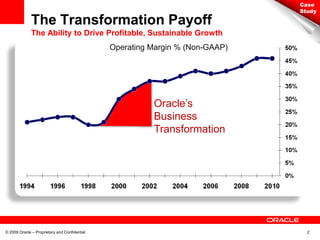
              The Transformation Payoff
              The Ability to Drive Profitable, Sustainable Growth
                                               Operating Margin % (Non-GAAP)


                                                         Oracle’s
                                                         Business
                                                         Transformation


© 2009 Oracle – Proprietary and Confidential                                     2
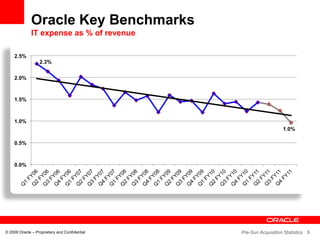
Oracle Key Benchmarks
              IT expense as % of revenue


© 2009 Oracle – Proprietary and Confidential   Pre-Sun Acquisition Statistics   3
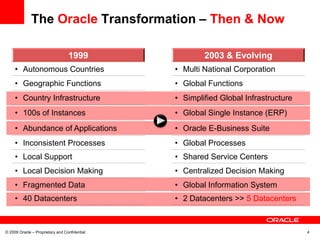
The Oracle Transformation – Then & Now

                                  1999                 2003 & Evolving
     • Autonomous Countries                    • Multi National Corporation
     • Geographic Functions                    • Global Functions
     • Country Infrastructure                  • Simplified Global Infrastructure
     • 100s of Instances                       • Global Single Instance (ERP)
     • Abundance of Applications               • Oracle E-Business Suite
     • Inconsistent Processes                  • Global Processes
     • Local Support                           • Shared Service Centers
     • Local Decision Making                   • Centralized Decision Making
     • Fragmented Data                         • Global Information System
     • 40 Datacenters                          • 2 Datacenters >> 5 Datacenters


© 2009 Oracle – Proprietary and Confidential                                        4
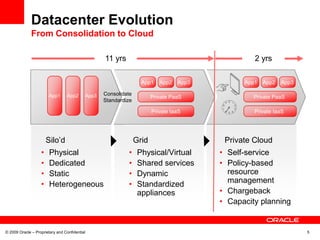
Datacenter Evolution
              From Consolidation to Cloud

                                                      11 yrs                                         2 yrs

                                                                      App1    App2   App3         App1   App2   App3

                       App1      App2          App3   Consolidate
                                                                           Private PaaS              Private PaaS
                                                      Standardize

                                                                           Private IaaS              Private IaaS


                       Silo’d                                       Grid                     Private Cloud
                   •    Physical                               •     Physical/Virtual       • Self-service
                   •    Dedicated                              •     Shared services        • Policy-based
                   •    Static                                 •     Dynamic                  resource
                   •    Heterogeneous                          •     Standardized             management
                                                                     appliances             • Chargeback
                                                                                            • Capacity planning


© 2009 Oracle – Proprietary and Confidential                                                                           5
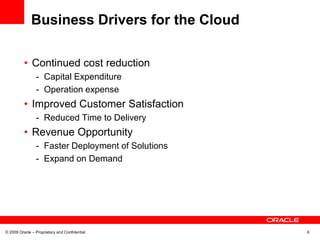
Business Drivers for the Cloud

          • Continued cost reduction
                - Capital Expenditure
                - Operation expense
          • Improved Customer Satisfaction
                - Reduced Time to Delivery
          • Revenue Opportunity
                - Faster Deployment of Solutions
                - Expand on Demand


© 2009 Oracle – Proprietary and Confidential       6
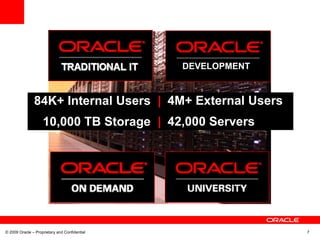
DEVELOPMENT


               84K+ Internal Users | 4M+ External Users
                    10,000 TB Storage | 42,000 Servers


© 2009 Oracle – Proprietary and Confidential                 7
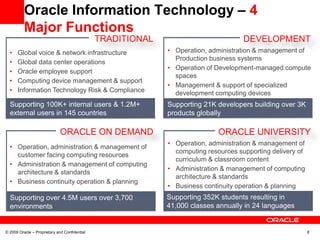
Oracle Information Technology – 4
          Major Functions
                                               TRADITIONAL                           DEVELOPMENT
  •   Global voice & network infrastructure                  • Operation, administration & management of
                                                               Production business systems
  •   Global data center operations
                                                             • Operation of Development-managed compute
  •   Oracle employee support
                                                               spaces
  •   Computing device management & support
                                                             • Management & support of specialized
  •   Information Technology Risk & Compliance                 development computing devices
  Supporting 100K+ internal users & 1.2M+                    Supporting 21K developers building over 3K
  external users in 145 countries                            products globally

                              ORACLE ON DEMAND                               ORACLE UNIVERSITY
                                                             • Operation, administration & management of
  • Operation, administration & management of
                                                               computing resources supporting delivery of
    customer facing computing resources
                                                               curriculum & classroom content
  • Administration & management of computing
                                                             • Administration & management of computing
    architecture & standards
                                                               architecture & standards
  • Business continuity operation & planning
                                                             • Business continuity operation & planning
  Supporting over 4.5M users over 3,700                      Supporting 352K students resulting in
  environments                                               41,000 classes annually in 24 languages


© 2009 Oracle – Proprietary and Confidential                                                                8
Case
                                                                                                          Study

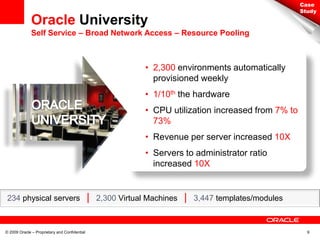
              Oracle University
              Self Service – Broad Network Access – Resource Pooling


                                                                • 2,300 environments automatically
                                                                  provisioned weekly
                                                                • 1/10th the hardware
                                                                • CPU utilization increased from 7% to
                                                                  73%
                                                                • Revenue per server increased 10X
                                                                • Servers to administrator ratio
                                                                  increased 10X


 234 physical servers                          |   2,300 Virtual Machines   |   3,447 templates/modules


© 2009 Oracle – Proprietary and Confidential                                                                9
Case
                                                                                                                        Study

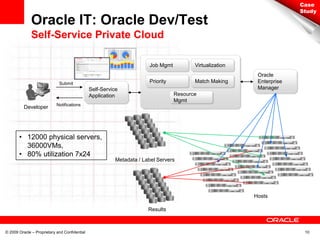
              Oracle IT: Oracle Dev/Test
              Self-Service Private Cloud

                                                                       Job Mgmt          Virtualization
                                                                                                           Oracle
                             Submit                                    Priority          Match Making      Enterprise
                                               Self-Service                                                Manager
                                               Application                        Resource
                                                                                  Mgmt
                            Notifications
          Developer


       • 12000 physical servers,
         36000VMs,
       • 80% utilization 7x24
                                                          Metadata / Label Servers


                                                                                                          Hosts

                                                                       Results


© 2009 Oracle – Proprietary and Confidential                                                                             10
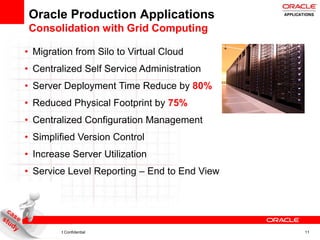
Oracle Production Applications
            Consolidation with Grid Computing

          • Migration from Silo to Virtual Cloud
          • Centralized Self Service Administration
          • Server Deployment Time Reduce by 80%
          • Reduced Physical Footprint by 75%
          • Centralized Configuration Management
          • Simplified Version Control
          • Increase Server Utilization
          • Service Level Reporting – End to End View


© 2009 Oracle – Proprietary and Confidential            11
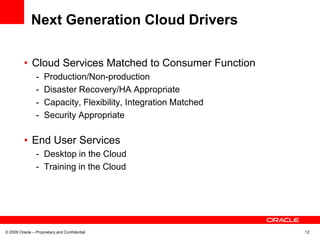
Next Generation Cloud Drivers

          • Cloud Services Matched to Consumer Function
                -    Production/Non-production
                -    Disaster Recovery/HA Appropriate
                -    Capacity, Flexibility, Integration Matched
                -    Security Appropriate

          • End User Services
                - Desktop in the Cloud
                - Training in the Cloud


© 2009 Oracle – Proprietary and Confidential                      12
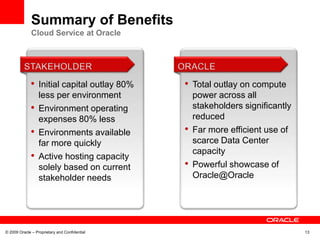
Summary of Benefits
              Cloud Service at Oracle


             • Initial capital outlay 80%      • Total outlay on compute
                  less per environment             power across all
             •    Environment operating            stakeholders significantly
                  expenses 80% less                reduced
             •    Environments available       •   Far more efficient use of
                  far more quickly                 scarce Data Center
                                                   capacity
             •    Active hosting capacity
                  solely based on current      •   Powerful showcase of
                  stakeholder needs                Oracle@Oracle


© 2009 Oracle – Proprietary and Confidential                                    13
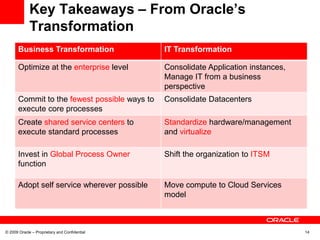
Key Takeaways – From Oracle’s
             Transformation
       Business Transformation                 IT Transformation

       Optimize at the enterprise level        Consolidate Application instances,
                                               Manage IT from a business
                                               perspective
       Commit to the fewest possible ways to   Consolidate Datacenters
       execute core processes
       Create shared service centers to        Standardize hardware/management
       execute standard processes              and virtualize

       Invest in Global Process Owner          Shift the organization to ITSM
       function

       Adopt self service wherever possible    Move compute to Cloud Services
                                               model


© 2009 Oracle – Proprietary and Confidential                                        14
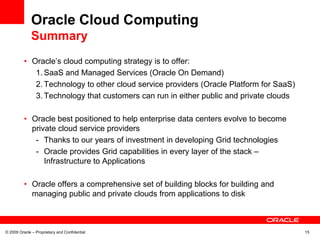
Oracle Cloud Computing
              Summary
          • Oracle’s cloud computing strategy is to offer:
             1. SaaS and Managed Services (Oracle On Demand)
             2. Technology to other cloud service providers (Oracle Platform for SaaS)
             3. Technology that customers can run in either public and private clouds

          • Oracle best positioned to help enterprise data centers evolve to become
            private cloud service providers
             - Thanks to our years of investment in developing Grid technologies
             - Oracle provides Grid capabilities in every layer of the stack –
                Infrastructure to Applications

          • Oracle offers a comprehensive set of building blocks for building and
            managing public and private clouds from applications to disk


© 2009 Oracle – Proprietary and Confidential                                             15

Oracle cloud story short

  • 1.
    <Insert Picture Here> EnterpriseCloud Computing: What, Why & How The Transformation
  • 2.
    Case Study The Transformation Payoff The Ability to Drive Profitable, Sustainable Growth Operating Margin % (Non-GAAP) Oracle’s Business Transformation © 2009 Oracle – Proprietary and Confidential 2
  • 3.
    Oracle Key Benchmarks IT expense as % of revenue © 2009 Oracle – Proprietary and Confidential Pre-Sun Acquisition Statistics 3
  • 4.
    The Oracle Transformation– Then & Now 1999 2003 & Evolving • Autonomous Countries • Multi National Corporation • Geographic Functions • Global Functions • Country Infrastructure • Simplified Global Infrastructure • 100s of Instances • Global Single Instance (ERP) • Abundance of Applications • Oracle E-Business Suite • Inconsistent Processes • Global Processes • Local Support • Shared Service Centers • Local Decision Making • Centralized Decision Making • Fragmented Data • Global Information System • 40 Datacenters • 2 Datacenters >> 5 Datacenters © 2009 Oracle – Proprietary and Confidential 4
  • 5.
    Datacenter Evolution From Consolidation to Cloud 11 yrs 2 yrs App1 App2 App3 App1 App2 App3 App1 App2 App3 Consolidate Private PaaS Private PaaS Standardize Private IaaS Private IaaS Silo’d Grid Private Cloud • Physical • Physical/Virtual • Self-service • Dedicated • Shared services • Policy-based • Static • Dynamic resource • Heterogeneous • Standardized management appliances • Chargeback • Capacity planning © 2009 Oracle – Proprietary and Confidential 5
  • 6.
    Business Drivers forthe Cloud • Continued cost reduction - Capital Expenditure - Operation expense • Improved Customer Satisfaction - Reduced Time to Delivery • Revenue Opportunity - Faster Deployment of Solutions - Expand on Demand © 2009 Oracle – Proprietary and Confidential 6
  • 7.
    DEVELOPMENT 84K+ Internal Users | 4M+ External Users 10,000 TB Storage | 42,000 Servers © 2009 Oracle – Proprietary and Confidential 7
  • 8.
    Oracle Information Technology– 4 Major Functions TRADITIONAL DEVELOPMENT • Global voice & network infrastructure • Operation, administration & management of Production business systems • Global data center operations • Operation of Development-managed compute • Oracle employee support spaces • Computing device management & support • Management & support of specialized • Information Technology Risk & Compliance development computing devices Supporting 100K+ internal users & 1.2M+ Supporting 21K developers building over 3K external users in 145 countries products globally ORACLE ON DEMAND ORACLE UNIVERSITY • Operation, administration & management of • Operation, administration & management of computing resources supporting delivery of customer facing computing resources curriculum & classroom content • Administration & management of computing • Administration & management of computing architecture & standards architecture & standards • Business continuity operation & planning • Business continuity operation & planning Supporting over 4.5M users over 3,700 Supporting 352K students resulting in environments 41,000 classes annually in 24 languages © 2009 Oracle – Proprietary and Confidential 8
  • 9.
    Case Study Oracle University Self Service – Broad Network Access – Resource Pooling • 2,300 environments automatically provisioned weekly • 1/10th the hardware • CPU utilization increased from 7% to 73% • Revenue per server increased 10X • Servers to administrator ratio increased 10X 234 physical servers | 2,300 Virtual Machines | 3,447 templates/modules © 2009 Oracle – Proprietary and Confidential 9
  • 10.
    Case Study Oracle IT: Oracle Dev/Test Self-Service Private Cloud Job Mgmt Virtualization Oracle Submit Priority Match Making Enterprise Self-Service Manager Application Resource Mgmt Notifications Developer • 12000 physical servers, 36000VMs, • 80% utilization 7x24 Metadata / Label Servers Hosts Results © 2009 Oracle – Proprietary and Confidential 10
  • 11.
    Oracle Production Applications Consolidation with Grid Computing • Migration from Silo to Virtual Cloud • Centralized Self Service Administration • Server Deployment Time Reduce by 80% • Reduced Physical Footprint by 75% • Centralized Configuration Management • Simplified Version Control • Increase Server Utilization • Service Level Reporting – End to End View © 2009 Oracle – Proprietary and Confidential 11
  • 12.
    Next Generation CloudDrivers • Cloud Services Matched to Consumer Function - Production/Non-production - Disaster Recovery/HA Appropriate - Capacity, Flexibility, Integration Matched - Security Appropriate • End User Services - Desktop in the Cloud - Training in the Cloud © 2009 Oracle – Proprietary and Confidential 12
  • 13.
    Summary of Benefits Cloud Service at Oracle • Initial capital outlay 80% • Total outlay on compute less per environment power across all • Environment operating stakeholders significantly expenses 80% less reduced • Environments available • Far more efficient use of far more quickly scarce Data Center capacity • Active hosting capacity solely based on current • Powerful showcase of stakeholder needs Oracle@Oracle © 2009 Oracle – Proprietary and Confidential 13
  • 14.
    Key Takeaways –From Oracle’s Transformation Business Transformation IT Transformation Optimize at the enterprise level Consolidate Application instances, Manage IT from a business perspective Commit to the fewest possible ways to Consolidate Datacenters execute core processes Create shared service centers to Standardize hardware/management execute standard processes and virtualize Invest in Global Process Owner Shift the organization to ITSM function Adopt self service wherever possible Move compute to Cloud Services model © 2009 Oracle – Proprietary and Confidential 14
  • 15.
    Oracle Cloud Computing Summary • Oracle’s cloud computing strategy is to offer: 1. SaaS and Managed Services (Oracle On Demand) 2. Technology to other cloud service providers (Oracle Platform for SaaS) 3. Technology that customers can run in either public and private clouds • Oracle best positioned to help enterprise data centers evolve to become private cloud service providers - Thanks to our years of investment in developing Grid technologies - Oracle provides Grid capabilities in every layer of the stack – Infrastructure to Applications • Oracle offers a comprehensive set of building blocks for building and managing public and private clouds from applications to disk © 2009 Oracle – Proprietary and Confidential 15

Editor's Notes

  • #5 Still need an entry here or on the previous slide.Something like “ I usually like to start this type of discussion with a little background … “Back in …..”Entry message for IT organizations is that it’s as much a business directive as it is a technological capability. Cloud initiatives will be successful if organizations take the time to recognize that changes to business processes and approaches go hand in hand with technology deployments. The entry slide establishes that these issues have been around for a long time .. In fact, Oracle recognized the need way back in 1999 and has been steadily progressing on this front leveraging new and improved technologies along the way.First stage was in fact App/Infra consolidation: A brute force effort driven by a business need.Second stage was commodity hardware deployment supported by automation and consolidated processes. This commodity approach though had the side affect of increasing capitol and operational expenses (space, power, …)Third stage is to leverage next generation strategies around capacity management, automation and infrastructure compressionThis is where the Cloud comes in… The goal is simple:Reduce capitol expenditure by leveraging existing compute/storage resources more effectivelyReduce operating expenditure by lowering effective support per compute unit and reducing power and a space needs
  • #6 We believe that enterprises are on a JOURNEY to cloud computing. Most will EVOLVE their current IT infrastructure to become more “cloud-like” – to become a better internal service provider to the lines of business, BUs, departments – to provide greater agility and responsiveness to business needs, higher quality of service in terms of latency &amp; availability, and lower costs and higher utilization. This evolution will take time. Not only is the available technology evolving and advancing, but enterprises are also working on the new policies and processes needed. In many cases, the technical building blocks for cloud computing are available in advance of enterprise readiness, so we think that enterprises will evolve towards the right at different rates. The first step that many enterprises are taking is to move from a “Silo’ed” environment to a “Grid” or virtualized environment. Most datacenters still have dedicated silo’s where each application runs on its own middleware, database, servers and storage. Each silo is sized for peak load, so there’s inherently a lot of excess capacity built in. Each silo is also different, leading to complexity and high costs to manage. Many organizations are moving from these silos to a virtual environment with shared services, dynamic provisioning and standardized configurations or appliances. This trend is very strong right now. Probably 80-90% of the companies I talk to are doing some form of consolidation right now, but they may be doing in only a portion of their datacenter, maybe 20-30%, so there’s more to do.From here, enterprises can evolve to a self-service private cloud with automated scaling (called policy-based resource management on the chart) and chargeback. Not every application benefits from self-service and elastic scalability, but some do, so enterprise are figuring that out and moving those first. Some organizations are not ready to implement full self-service, since that requires new policies and processes to be defined, and they may prefer allocation to pay-per-use chargeback models. There may be other challenges including gaining cross-organizational support, creating the business case and funding model, and various cultural issues.For these reasons, each organization needs to create its own roadmap plan, and to decide what to move where and when. For many, the first step in the path to cloud computing is Consolidation.
  • #10 Slide Reference Data2009 CIO Agenda Deck: SourceKen/Mark: ObtainedSource Notes: N/AMark Sunday Notes: TBD