Going to the Cloud

                  Keys to achieving 'the Cloud'.  

               From Virtualization to Orchestration.


Presenter: Jim Lepianka
Session Number: 307
Code PaLOUsa 2011 Sponsors
Going to the Cloud

Keys to achieving 'the Cloud'. 
From Virtualization to Orchestration. 
Getting to the cloud is as much a mystery as what
 to do once there. We will discuss the types of
 clouds, the 4 steps to get there and what we can
 do now to prepare your enterprise for the leap.


4
Agenda

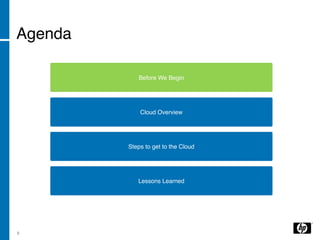
            Before We Begin


             Cloud Overview


         Steps to get to the Cloud


            Lessons Learned


5
Cloud Definition
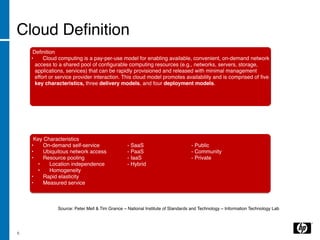
     Definition
    •     Cloud computing is a pay-per-use model for enabling available, convenient, on-demand network
      access to a shared pool of configurable computing resources (e.g., networks, servers, storage,
      applications, services) that can be rapidly provisioned and released with minimal management
      effort or service provider interaction. This cloud model promotes availability and is comprised of five
      key characteristics, three delivery models, and four deployment models.


     Key Characteristics
    •    On-demand self-service 
                - SaaS
        
               - Public
    •    Ubiquitous network access
              - PaaS
        
               - Community
    •    Resource pooling
    
                  - IaaS
        
               - Private
      •    Location independence
                - Hybrid
      •    Homogeneity
    •    Rapid elasticity
    •    Measured service


               Source: Peter Mell & Tim Grance – National Institute of Standards and Technology – Information Technology Lab


6
XaaS, the concepts included in the
Cloud
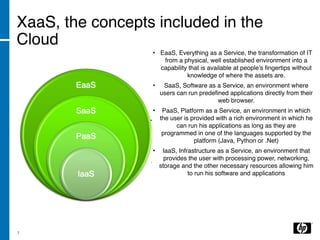
                  • EaaS, Everything as a Service, the transformation of IT
                     from a physical, well established environment into a
                    capability that is available at people’s fingertips without
                              knowledge of where the assets are.
                  •    SaaS, Software as a Service, an environment where
                      users can run predefined applications directly from their
                                          web browser.
                  •    PaaS, Platform as a Service, an environment in which
                      the user is provided with a rich environment in which he
                            can run his applications as long as they are
                       programmed in one of the languages supported by the
                                   platform (Java, Python or .Net)
                  •    IaaS, Infrastructure as a Service, an environment that
                        provides the user with processing power, networking,
                      storage and the other necessary resources allowing him
                                 to run his software and applications


7
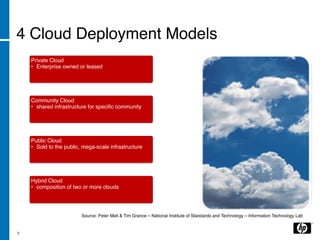
4 Cloud Deployment Models
    Private Cloud
    • Enterprise owned or leased


    Community Cloud
    • shared infrastructure for specific community


    Public Cloud
    • Sold to the public, mega-scale infrastructure


    Hybrid Cloud
    • composition of two or more clouds


                         Source: Peter Mell & Tim Grance – National Institute of Standards and Technology – Information Technology Lab


8
Before We Begin


        Cloud Overview


    Steps to get to the Cloud


       Lessons Learned


9
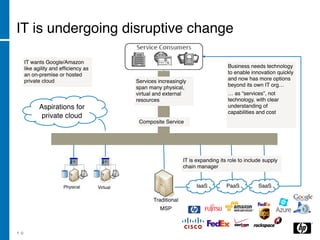
IT is undergoing disruptive change

      IT wants Google/Amazon
      like agility and efficiency as                                                     Business needs technology
      an on-premise or hosted                                                           to enable innovation quickly
      private cloud                             Services increasingly                   and now has more options
                                                span many physical,                     beyond its own IT org…
                                                virtual and external                    … as “services”, not
                                                resources                               technology, with clear
            Aspirations for                                                             understanding of
                                                                                        capabilities and cost
             private cloud
                                                 Composite Service


                                                                     IT is expanding its role to include supply
                                                                     chain manager


                       Physical       Virtual                             IaaS          PaaS          SaaS

                                                       Traditional
                                                          MSP


1 0
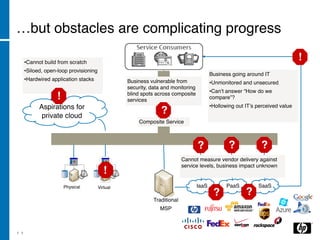
…but obstacles are complicating progress

      •Cannot build from scratch
                                                                                                                               !
      •Siloed, open-loop provisioning
                                                                                         Business going around IT
      •Hardwired application stacks               Business vulnerable from               •Unmonitored and unsecured
                                                  security, data and monitoring
                                                                                         •Can’t answer “How do we
                   !                              blind spots across composite
                                                  services                               compare”?
            Aspirations for                                                              •Hollowing out IT’s perceived value
             private cloud
                                                                ?
                                                      Composite Service


                                                                                  ?              ?             ?
                                                                           Cannot measure vendor delivery against
                                                                           service levels, business impact unknown
                                           !
                       Physical         Virtual                                   IaaS          PaaS         SaaS
                                                                                          ?             ?
                                                             Traditional
                                                               MSP


1 1
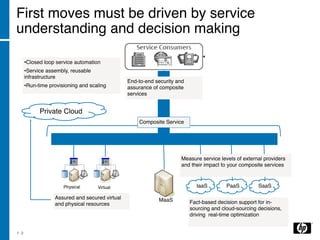
First moves must be driven by service
understanding and decision making

      •Closed loop service automation
      •Service assembly, reusable
      infrastructure
                                                End-to-end security and
      •Run-time provisioning and scaling        assurance of composite
                                                services


            Private Cloud
                                                    Composite Service


                                                                     Measure service levels of external providers
                                                                     and their impact to your composite services


                      Physical      Virtual                                 IaaS         PaaS         SaaS

                  Assured and secured virtual               MaaS
                  and physical resources                                  Fact-based decision support for in-
                                                                          sourcing and cloud-sourcing decisions,
                                                                          driving real-time optimization


1 2
Before We Begin


          Cloud Overview


      Steps to get to the Cloud


         Lessons Learned


1 3
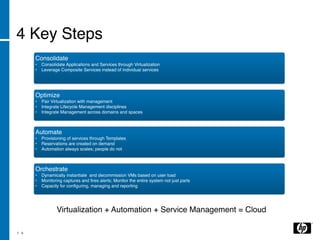
4 Key Steps
      Consolidate
      •   Consolidate Applications and Services through Virtualization
      •   Leverage Composite Services instead of individual services


      Optimize
      •   Pair Virtualization with management
      •   Integrate Lifecycle Management disciplines
      •   Integrate Management across domains and spaces


      Automate
      •   Provisioning of services through Templates
      •   Reservations are created on demand
      •   Automation always scales; people do not


      Orchestrate
      •   Dynamically instantiate and decommission VMs based on user load
      •   Monitoring captures and fires alerts; Monitor the entire system not just parts
      •   Capacity for configuring, managing and reporting


                 Virtualization + Automation + Service Management = Cloud

1 4
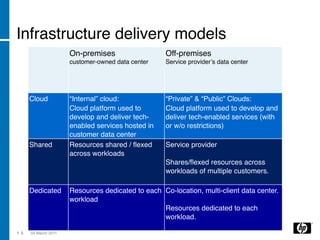
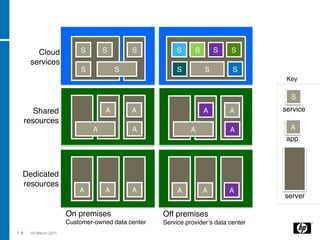
Infrastructure delivery models
                      On-premises
                  Off-premises
                      customer-owned data center    Service provider’s data center


      Cloud           “Internal” cloud:             “Private” & “Public” Clouds:
                      Cloud platform used to        Cloud platform used to develop and
                      develop and deliver tech-     deliver tech-enabled services (with
                      enabled services hosted in    or w/o restrictions)
                      customer data center
      Shared          Resources shared / flexed      Service provider
                      across workloads              

                                                    Shares/flexed resources across
                                                    workloads of multiple customers.

      Dedicated       Resources dedicated to each Co-location, multi-client data center.
                      workload                    

                                                    Resources dedicated to each
                                                    workload.

1 5   04 March 2011
Cloud             S       S        S            S     S       S    S
       services
                           S           S                 S         S         S
                                                                                      Key

                                                                                       S
         Shared
                   A        A                      A        A        service
      resources
                               A            A                 A             A          A
                                                                                      app


  Dedicated

  resources
                           A       A        A            A         A        A
                                                                                     server

                       On premises
                 Off premises

                       Customer-owned data center   Service provider’s data center
1 6    04 March 2011
•


             Before We Begin


              Cloud Overview


•         Steps to get to the Cloud


             Lessons Learned


    1 7
•

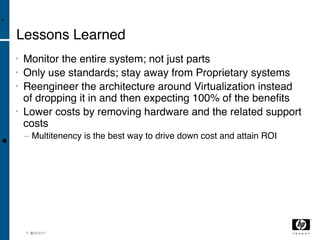
    Lessons Learned
    •   Monitor the entire system; not just parts
    •   Only use standards; stay away from Proprietary systems
    •   Reengineer the architecture around Virtualization instead
        of dropping it in and then expecting 100% of the benefits
    •   Lower costs by removing hardware and the related support
        costs
        − Multitenency is the best way to drive down cost and attain ROI
•


        1 8 3/04/11
          0
•

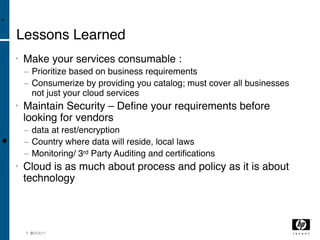
    Lessons Learned
    •   Make your services consumable :
        − Prioritize based on business requirements
        − Consumerize by providing you catalog; must cover all businesses
          not just your cloud services
    •   Maintain Security – Define your requirements before
        looking for vendors
        − data at rest/encryption
•       − Country where data will reside, local laws
        − Monitoring/ 3rd Party Auditing and certifications
    •   Cloud is as much about process and policy as it is about
        technology


        1 9 3/04/11
          0
•

    Lessons Learned
    •   Organizations struggle to maintain low to no value
        applications; perform Application Rationalization and
        define your Service Catalog
    •   You cannot control things you do not know about; Catalog
        your offerings
    •   Ensure you can point to every server in the Datacenter and
        you know:
•       − What is running on it
        − Who is responsible
        − What happens when it fails


        2 003/04/11
•

    Lessons Learned
    •   There is no big bang approach to get to the cloud; start
        small and grow
    •   Metrics will need to be tested, refined, implemented,
        refined further and re-implemented long after the
        implementation phase closes
    •   A knowledgeable partner can reduce time loss due to
        forgotten steps (like implementing technology only to be
•       forbidden by policy)


        2 103/04/11
•

    Questions


•


     2 2

Going to the Cloud

  • 1.
    Going to theCloud
 Keys to achieving 'the Cloud'.  
 From Virtualization to Orchestration. Presenter: Jim Lepianka Session Number: 307
  • 2.
  • 3.
  • 4.
    Going to theCloud Keys to achieving 'the Cloud'.  From Virtualization to Orchestration.  Getting to the cloud is as much a mystery as what to do once there. We will discuss the types of clouds, the 4 steps to get there and what we can do now to prepare your enterprise for the leap. 4
  • 5.
    Agenda Before We Begin Cloud Overview Steps to get to the Cloud Lessons Learned 5
  • 6.
    Cloud Definition Definition • Cloud computing is a pay-per-use model for enabling available, convenient, on-demand network access to a shared pool of configurable computing resources (e.g., networks, servers, storage, applications, services) that can be rapidly provisioned and released with minimal management effort or service provider interaction. This cloud model promotes availability and is comprised of five key characteristics, three delivery models, and four deployment models. Key Characteristics • On-demand self-service - SaaS - Public • Ubiquitous network access - PaaS - Community • Resource pooling - IaaS - Private • Location independence - Hybrid • Homogeneity • Rapid elasticity • Measured service Source: Peter Mell & Tim Grance – National Institute of Standards and Technology – Information Technology Lab 6
  • 7.
    XaaS, the conceptsincluded in the Cloud • EaaS, Everything as a Service, the transformation of IT from a physical, well established environment into a capability that is available at people’s fingertips without knowledge of where the assets are. • SaaS, Software as a Service, an environment where users can run predefined applications directly from their web browser. • PaaS, Platform as a Service, an environment in which the user is provided with a rich environment in which he can run his applications as long as they are programmed in one of the languages supported by the platform (Java, Python or .Net) • IaaS, Infrastructure as a Service, an environment that provides the user with processing power, networking, storage and the other necessary resources allowing him to run his software and applications 7
  • 8.
    4 Cloud DeploymentModels Private Cloud • Enterprise owned or leased Community Cloud • shared infrastructure for specific community Public Cloud • Sold to the public, mega-scale infrastructure Hybrid Cloud • composition of two or more clouds Source: Peter Mell & Tim Grance – National Institute of Standards and Technology – Information Technology Lab 8
  • 9.
    Before We Begin Cloud Overview Steps to get to the Cloud Lessons Learned 9
  • 10.
    IT is undergoingdisruptive change IT wants Google/Amazon like agility and efficiency as Business needs technology an on-premise or hosted to enable innovation quickly private cloud Services increasingly and now has more options span many physical, beyond its own IT org… virtual and external … as “services”, not resources technology, with clear Aspirations for understanding of capabilities and cost private cloud Composite Service IT is expanding its role to include supply chain manager Physical Virtual IaaS PaaS SaaS Traditional MSP 1 0
  • 11.
    …but obstacles arecomplicating progress •Cannot build from scratch ! •Siloed, open-loop provisioning Business going around IT •Hardwired application stacks Business vulnerable from •Unmonitored and unsecured security, data and monitoring •Can’t answer “How do we ! blind spots across composite services compare”? Aspirations for •Hollowing out IT’s perceived value private cloud ? Composite Service ? ? ? Cannot measure vendor delivery against service levels, business impact unknown ! Physical Virtual IaaS PaaS SaaS ? ? Traditional MSP 1 1
  • 12.
    First moves mustbe driven by service understanding and decision making •Closed loop service automation •Service assembly, reusable infrastructure End-to-end security and •Run-time provisioning and scaling assurance of composite services Private Cloud Composite Service Measure service levels of external providers and their impact to your composite services Physical Virtual IaaS PaaS SaaS Assured and secured virtual MaaS and physical resources Fact-based decision support for in- sourcing and cloud-sourcing decisions, driving real-time optimization 1 2
  • 13.
    Before We Begin Cloud Overview Steps to get to the Cloud Lessons Learned 1 3
  • 14.
    4 Key Steps Consolidate • Consolidate Applications and Services through Virtualization • Leverage Composite Services instead of individual services Optimize • Pair Virtualization with management • Integrate Lifecycle Management disciplines • Integrate Management across domains and spaces Automate • Provisioning of services through Templates • Reservations are created on demand • Automation always scales; people do not Orchestrate • Dynamically instantiate and decommission VMs based on user load • Monitoring captures and fires alerts; Monitor the entire system not just parts • Capacity for configuring, managing and reporting Virtualization + Automation + Service Management = Cloud 1 4
  • 15.
    Infrastructure delivery models On-premises
 Off-premises customer-owned data center Service provider’s data center Cloud “Internal” cloud: “Private” & “Public” Clouds: Cloud platform used to Cloud platform used to develop and develop and deliver tech- deliver tech-enabled services (with enabled services hosted in or w/o restrictions) customer data center Shared Resources shared / flexed Service provider across workloads 
 Shares/flexed resources across workloads of multiple customers. Dedicated Resources dedicated to each Co-location, multi-client data center. workload 
 Resources dedicated to each workload. 1 5 04 March 2011
  • 16.
    Cloud S S S S S S S services S S S S S Key S Shared
 A A A A service resources A A A A A app Dedicated
 resources A A A A A A server On premises
 Off premises
 Customer-owned data center Service provider’s data center 1 6 04 March 2011
  • 17.
    Before We Begin Cloud Overview • Steps to get to the Cloud Lessons Learned 1 7
  • 18.
    Lessons Learned • Monitor the entire system; not just parts • Only use standards; stay away from Proprietary systems • Reengineer the architecture around Virtualization instead of dropping it in and then expecting 100% of the benefits • Lower costs by removing hardware and the related support costs − Multitenency is the best way to drive down cost and attain ROI • 1 8 3/04/11 0
  • 19.
    Lessons Learned • Make your services consumable : − Prioritize based on business requirements − Consumerize by providing you catalog; must cover all businesses not just your cloud services • Maintain Security – Define your requirements before looking for vendors − data at rest/encryption • − Country where data will reside, local laws − Monitoring/ 3rd Party Auditing and certifications • Cloud is as much about process and policy as it is about technology 1 9 3/04/11 0
  • 20.
    Lessons Learned • Organizations struggle to maintain low to no value applications; perform Application Rationalization and define your Service Catalog • You cannot control things you do not know about; Catalog your offerings • Ensure you can point to every server in the Datacenter and you know: • − What is running on it − Who is responsible − What happens when it fails 2 003/04/11
  • 21.
    Lessons Learned • There is no big bang approach to get to the cloud; start small and grow • Metrics will need to be tested, refined, implemented, refined further and re-implemented long after the implementation phase closes • A knowledgeable partner can reduce time loss due to forgotten steps (like implementing technology only to be • forbidden by policy) 2 103/04/11
  • 22.
    Questions • 2 2