ANKLE FRACTURES
ROCKWOOD AND GREEN'S
FRACTURES IN ADULTS, 7TH
EDITION 2010
BY : DR HAMID HEJRATI
RESIDENT OF ORTHOPEADIC SURGERY
MEDICAL UNIVESITY OF MASHAD
SURGICAL AND APPLIED ANATOMY
• Ankle Joint
• Tibia
• Fibula
• Talus articulates with…...
• This wedge-shaped footprint of the talar dome creates a situation whereby
the dorsiflexed position creates a stable bony articulation while the
plantarflexed position is more mobile and is stabilized by ligamentous
structures.
• The tibiotalar articulation is considered to be highly congruent
• 1-mm lateral talar shift within the mortise decreases the joint
contact area by 42%
• 6-mm lateral displacement of the lateral malleolus, there was
no significant change on the contact area of the ankle as long
as it was axially loaded. However, once the deltoid ligament
was sectioned, all ankles showed a significant decrease in
tibiotalar contact area.
• This study confirmed that in an axially loaded, isolated lateral
fibula fracture without medial malleolus or deltoid ligament
disruption, there was no appreciable loss of tibiotalar contact and
that the deltoid ligament, specifically the deep portion, served as a
main checkrein to anterolateral rotation of the ankle.
• In another study the medial malleolar osteoligamentous complex
is show the single most important contributor to ankle stability in
Weber C fracture patterns.+
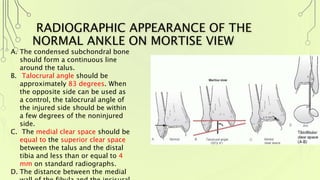
RADIOGRAPHIC APPEARANCE OF THE
NORMAL ANKLE ON MORTISE VIEW
A. The condensed subchondral bone
should form a continuous line
around the talus.
B. Talocrural angle should be
approximately 83 degrees. When
the opposite side can be used as
a control, the talocrural angle of
the injured side should be within
a few degrees of the noninjured
side.
C. The medial clear space should be
equal to the superior clear space
between the talus and the distal
tibia and less than or equal to 4
mm on standard radiographs.
D. The distance between the medial
A. The “ball” or “dime sign” is
described on the AP view as an
unbroken curve connecting the
recess in the distal tip of the
fibula and the lateral process of
the talus when the fibula is out
to length.
B. Fibula malreduced in a
shortened position, ball sign is
absent.
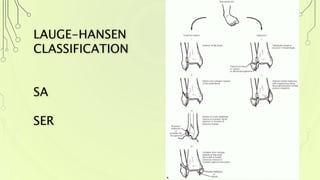
LAUGE-HANSEN CLASSIFICATION
• The Lauge-Hansen classification system is based on a rotational
mechanism of injury. It is perhaps the recognition that the
fracture pattern is associated with a rotational injury, as opposed
to an axial load type of injury, which must be ascertained before
assigning the injury a classification system. The first part of the
name in the classification system describes the position of the
foot at the time of injury, while the second part of the name
describes the direction of force applied to the foot. Four injury
patterns are described: supination-adduction (SA), supination-
external rotation (SER), pronation-abduction (PA), and pronation-
external rotation (PER).
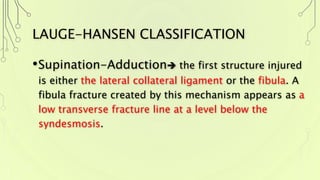
LAUGE-HANSEN CLASSIFICATION
•Supination-Adduction the first structure injured
is either the lateral collateral ligament or the fibula. A
fibula fracture created by this mechanism appears as a
low transverse fracture line at a level below the
syndesmosis.
•As the severity of the adduction moment
increases, the talus gets displaced toward the
medial malleolus and a vertical fracture line is
created extending from the medial axilla of the
joint and proximally into the metaphyseal cortex
of the tibia. This tends to be a large shear
fragment and is rarely associated with
comminution at the medial malleolus. Frequently,
the medial tibial plafond will present an impaction
injury, which is not always easily recognized on
LAUGE-HANSEN CLASSIFICATION
•Supination-External Rotation  The SER pattern
is the most prevalent ankle fracture pattern, with a
prevalence of 40% to 75%.
• SER 1 The injury begins laterally at the anterior tibial-
fibular ligament (ATFL) and, when present as an isolated
injury, represents an SER1 pattern.
• SER 2 Injury is an oblique fracture line of the fibula
associated with either a midsubstance rupture of the
ATFL or an avulsion fracture of the ATFL insertion into
the tibia (Chaput tubercle) or its origin on the fibula
• SER2 fibula fractures share three common
characteristics:
. minimal displacement
. fracture at the level of the syndesmosis but
not affecting the syndesmosis
. fracture line proceeding from distal anterior
to proximal posterior
LAUGE-HANSEN CLASSIFICATION
• SER 3  Injuries share all the characteristics of
the SER2 injuries with the addition of either a
posterior tibial-fibular ligament rupture or
fracture of the posterior malleolus.
•SER 4  the injury progresses to the medial-
sided structures where the medial malleolus
osteoligamentous complex (MMOLC) is injured.
The injury may be an isolated medial malleolus
fracture (an oblique fracture line at the level of
the axilla in the majority of cases), or an
isolated deltoid ligament injury (the deep and
superficial portions of the deltoid are ruptured)
representing an SER4 “equivalent” lesion.
LAUGE-HANSEN CLASSIFICATION
•More recently, a combination of both a medial
malleolus and deltoid injury has been
characterized . In this fracture pattern, the
anterior colliculus of the medial malleolus is
fractured; while the posterior colliculus remains
intact, the injury passes through the deep
fibers of the deltoid ligament that are attached
to the posterior colliculus of the medial
LAUGE-HANSEN CLASSIFICATION
• It has therefore been suggested that the size of the
medial malleolar fragment was the most important
variable in predicting deltoid competence. When the
medial malleolus fragment is greater than 2.8 cm wide
(supracollicular fracture), the deltoid ligament is likely
intact and stress view is negative. When the fragment
is less than 1.7 cm wide (anterior collicular or
intercollicular fracture), the deltoid may be
incompetent and the stress view should be performed.
•Other indicators that should be used to
differentiate an SER2 injury from an SER4
equivalent injury is evidence of anterior or
posterior subluxation of the talus, significant
shortening (greater than 2 mm) of the fibula,
and mild lateral subluxation without any stress.
LAUGE-HANSEN
CLASSIFICATION
SA
SER
LAUGE-HANSEN CLASSIFICATION
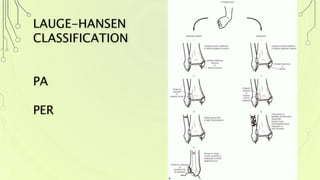
•Pronation-Abduction  PA injuries occur via an
abduction force while the ankle is in a relatively
pronated position and make up 5% to 21% of ankle
fractures.
• The typical appearance is an avulsion-type medial
malleolus fracture while bending forces at the fibula
create a relatively transverse fracture or commonly
have either lateral butterfly or comminution related to
the bending failure. The fibula usually fractures 5 to 7
• An anterolateral tibial plafond fracture may be
present and may contribute to residual talar tilt
or subluxation.
•Stress radiographs are important to assess the
integrity of the syndesmosis and help
differentiate direct blow injuries (stable) from
indirect injuries (unstable).
LAUGE-HANSEN CLASSIFICATION
•Isolated medial malleolar fractures are
differentiated from higher-grade PA of PER
injuries with the stress radiograph as well.
•Intraoperatively, manual stress examination
should be performed following fibular fixation to
assess integrity of the syndesmosis.
LAUGE-HANSEN CLASSIFICATION
•Pronation External-Rotation  the medial
osteoligamentous complex is the first injured via either a direct
deltoid ligament rupture or a transverse medial malleolar fracture.
The next structure injured is the anterior inferior tibial-fibular
ligament (AITFL), followed by a fibular fracture.
• The characteristic fibular lesion is a fracture at a level above the
syndesmosis that is typically spiral in nature. The fibula fracture
progresses in a direction opposite from its SER4 counterpart as the
fracture line progresses from distal posterior to proximal and
anterior.
• The last structure injured in this rotational mechanism is
the posterior tibial-fibular ligament or the posterior
tubercle of the distal tibia. Since the fibula fracture is
typically in the area proximal to the syndesmosis,
evaluation of the syndesmosis intraoperatively is critical
since it may be ruptured.
• The clinician should be aware that although the PER injury
is the most commonly seen injury that is associated with a
syndesmosis injury, SER and PA mechanisms can also be
associated with a syndesmosis disruption and should be
evaluated accordingly.
LAUGE-HANSEN CLASSIFICATION
•A PER variant known as the Maisonneuve fracture
is characterized by a proximal fibula shaft fracture.
•A Maisonneuve fracture should always be
suspected when an isolated medial malleolus
fracture is seen and is best screened for by
palpation of the proximal fibula and assessing for
tenderness followed by a tibial-fibular radiograph.
LAUGE-HANSEN
CLASSIFICATION
PA
PER
Ankle fractures

Ankle fractures

  • 1.
    ANKLE FRACTURES ROCKWOOD ANDGREEN'S FRACTURES IN ADULTS, 7TH EDITION 2010 BY : DR HAMID HEJRATI RESIDENT OF ORTHOPEADIC SURGERY MEDICAL UNIVESITY OF MASHAD
  • 2.
    SURGICAL AND APPLIEDANATOMY • Ankle Joint • Tibia • Fibula • Talus articulates with…... • This wedge-shaped footprint of the talar dome creates a situation whereby the dorsiflexed position creates a stable bony articulation while the plantarflexed position is more mobile and is stabilized by ligamentous structures.
  • 3.
    • The tibiotalararticulation is considered to be highly congruent • 1-mm lateral talar shift within the mortise decreases the joint contact area by 42% • 6-mm lateral displacement of the lateral malleolus, there was no significant change on the contact area of the ankle as long as it was axially loaded. However, once the deltoid ligament was sectioned, all ankles showed a significant decrease in tibiotalar contact area.
  • 4.
    • This studyconfirmed that in an axially loaded, isolated lateral fibula fracture without medial malleolus or deltoid ligament disruption, there was no appreciable loss of tibiotalar contact and that the deltoid ligament, specifically the deep portion, served as a main checkrein to anterolateral rotation of the ankle. • In another study the medial malleolar osteoligamentous complex is show the single most important contributor to ankle stability in Weber C fracture patterns.+
  • 6.
    RADIOGRAPHIC APPEARANCE OFTHE NORMAL ANKLE ON MORTISE VIEW A. The condensed subchondral bone should form a continuous line around the talus. B. Talocrural angle should be approximately 83 degrees. When the opposite side can be used as a control, the talocrural angle of the injured side should be within a few degrees of the noninjured side. C. The medial clear space should be equal to the superior clear space between the talus and the distal tibia and less than or equal to 4 mm on standard radiographs. D. The distance between the medial
  • 7.
    A. The “ball”or “dime sign” is described on the AP view as an unbroken curve connecting the recess in the distal tip of the fibula and the lateral process of the talus when the fibula is out to length. B. Fibula malreduced in a shortened position, ball sign is absent.
  • 8.
    LAUGE-HANSEN CLASSIFICATION • TheLauge-Hansen classification system is based on a rotational mechanism of injury. It is perhaps the recognition that the fracture pattern is associated with a rotational injury, as opposed to an axial load type of injury, which must be ascertained before assigning the injury a classification system. The first part of the name in the classification system describes the position of the foot at the time of injury, while the second part of the name describes the direction of force applied to the foot. Four injury patterns are described: supination-adduction (SA), supination- external rotation (SER), pronation-abduction (PA), and pronation- external rotation (PER).
  • 9.
    LAUGE-HANSEN CLASSIFICATION •Supination-Adduction thefirst structure injured is either the lateral collateral ligament or the fibula. A fibula fracture created by this mechanism appears as a low transverse fracture line at a level below the syndesmosis.
  • 10.
    •As the severityof the adduction moment increases, the talus gets displaced toward the medial malleolus and a vertical fracture line is created extending from the medial axilla of the joint and proximally into the metaphyseal cortex of the tibia. This tends to be a large shear fragment and is rarely associated with comminution at the medial malleolus. Frequently, the medial tibial plafond will present an impaction injury, which is not always easily recognized on
  • 11.
    LAUGE-HANSEN CLASSIFICATION •Supination-External Rotation The SER pattern is the most prevalent ankle fracture pattern, with a prevalence of 40% to 75%. • SER 1 The injury begins laterally at the anterior tibial- fibular ligament (ATFL) and, when present as an isolated injury, represents an SER1 pattern. • SER 2 Injury is an oblique fracture line of the fibula associated with either a midsubstance rupture of the ATFL or an avulsion fracture of the ATFL insertion into the tibia (Chaput tubercle) or its origin on the fibula
  • 12.
    • SER2 fibulafractures share three common characteristics: . minimal displacement . fracture at the level of the syndesmosis but not affecting the syndesmosis . fracture line proceeding from distal anterior to proximal posterior
  • 13.
    LAUGE-HANSEN CLASSIFICATION • SER3  Injuries share all the characteristics of the SER2 injuries with the addition of either a posterior tibial-fibular ligament rupture or fracture of the posterior malleolus.
  • 14.
    •SER 4 the injury progresses to the medial- sided structures where the medial malleolus osteoligamentous complex (MMOLC) is injured. The injury may be an isolated medial malleolus fracture (an oblique fracture line at the level of the axilla in the majority of cases), or an isolated deltoid ligament injury (the deep and superficial portions of the deltoid are ruptured) representing an SER4 “equivalent” lesion.
  • 15.
    LAUGE-HANSEN CLASSIFICATION •More recently,a combination of both a medial malleolus and deltoid injury has been characterized . In this fracture pattern, the anterior colliculus of the medial malleolus is fractured; while the posterior colliculus remains intact, the injury passes through the deep fibers of the deltoid ligament that are attached to the posterior colliculus of the medial
  • 16.
    LAUGE-HANSEN CLASSIFICATION • Ithas therefore been suggested that the size of the medial malleolar fragment was the most important variable in predicting deltoid competence. When the medial malleolus fragment is greater than 2.8 cm wide (supracollicular fracture), the deltoid ligament is likely intact and stress view is negative. When the fragment is less than 1.7 cm wide (anterior collicular or intercollicular fracture), the deltoid may be incompetent and the stress view should be performed.
  • 17.
    •Other indicators thatshould be used to differentiate an SER2 injury from an SER4 equivalent injury is evidence of anterior or posterior subluxation of the talus, significant shortening (greater than 2 mm) of the fibula, and mild lateral subluxation without any stress.
  • 18.
  • 19.
    LAUGE-HANSEN CLASSIFICATION •Pronation-Abduction PA injuries occur via an abduction force while the ankle is in a relatively pronated position and make up 5% to 21% of ankle fractures. • The typical appearance is an avulsion-type medial malleolus fracture while bending forces at the fibula create a relatively transverse fracture or commonly have either lateral butterfly or comminution related to the bending failure. The fibula usually fractures 5 to 7
  • 20.
    • An anterolateraltibial plafond fracture may be present and may contribute to residual talar tilt or subluxation. •Stress radiographs are important to assess the integrity of the syndesmosis and help differentiate direct blow injuries (stable) from indirect injuries (unstable).
  • 21.
    LAUGE-HANSEN CLASSIFICATION •Isolated medialmalleolar fractures are differentiated from higher-grade PA of PER injuries with the stress radiograph as well. •Intraoperatively, manual stress examination should be performed following fibular fixation to assess integrity of the syndesmosis.
  • 22.
    LAUGE-HANSEN CLASSIFICATION •Pronation External-Rotation the medial osteoligamentous complex is the first injured via either a direct deltoid ligament rupture or a transverse medial malleolar fracture. The next structure injured is the anterior inferior tibial-fibular ligament (AITFL), followed by a fibular fracture. • The characteristic fibular lesion is a fracture at a level above the syndesmosis that is typically spiral in nature. The fibula fracture progresses in a direction opposite from its SER4 counterpart as the fracture line progresses from distal posterior to proximal and anterior.
  • 23.
    • The laststructure injured in this rotational mechanism is the posterior tibial-fibular ligament or the posterior tubercle of the distal tibia. Since the fibula fracture is typically in the area proximal to the syndesmosis, evaluation of the syndesmosis intraoperatively is critical since it may be ruptured. • The clinician should be aware that although the PER injury is the most commonly seen injury that is associated with a syndesmosis injury, SER and PA mechanisms can also be associated with a syndesmosis disruption and should be evaluated accordingly.
  • 24.
    LAUGE-HANSEN CLASSIFICATION •A PERvariant known as the Maisonneuve fracture is characterized by a proximal fibula shaft fracture. •A Maisonneuve fracture should always be suspected when an isolated medial malleolus fracture is seen and is best screened for by palpation of the proximal fibula and assessing for tenderness followed by a tibial-fibular radiograph.
  • 25.