CLONING
‘Impact of Biotechnology’
Presented By: AHMAD BUKHARI
MS Bio-Sciences
Centre for Interdisciplinary Research in Basic Sciences (CIRBS), IIUI Pakistan.
CONTENT OUTLINE
 INTRODUCTION
 HISTORY
 CLASSIFICATION OF CLONING
 PROCEDURES
 APPLICATIONS
 SCIENTIFIC CONCERNS INVOLVED IN CLONING
 ETHICALASPECTS
 VIDEO ANIMATION
Cloning
• The process of producing similar
populations of genetically identical
individuals
Cloning & Biotechnology
• Processes used to create copies
of DNA fragments, cells,
or organisms.
History
• 1952: Scientists cloned frogs from blastula cells, but fail to produce tadpoles from
differentiated cells.
• 1962: John Gurdon claimed to clone frogs using the nucleus of an adult intestinal cell.
Others were unable to reproduce his results, his findings were called into question.
• 1966: Discovery of which codons specify the amino acids.
• 1973: E. coli turned into first recombinant DNA organism.
• 1977-1979: Illmensee claims to have cloned mice. Others fail to clone mammals, deem his
work “scientifically worthless.”
• 1983-1986: Various mammals are successfully cloned from embryonic cells.
• 1990: Human Genome Project begins.
• 1996: Dolly is born.
• 2004: Dr. Hwang Woo Suk claimed to have cloned human embryos. His work is not able
to be replicated.
• 2006: Dr. Hwang fired from Seoul University as evidence arises he faked some of his
work on stem cells
Classes of Cloning
• Natural Cloning
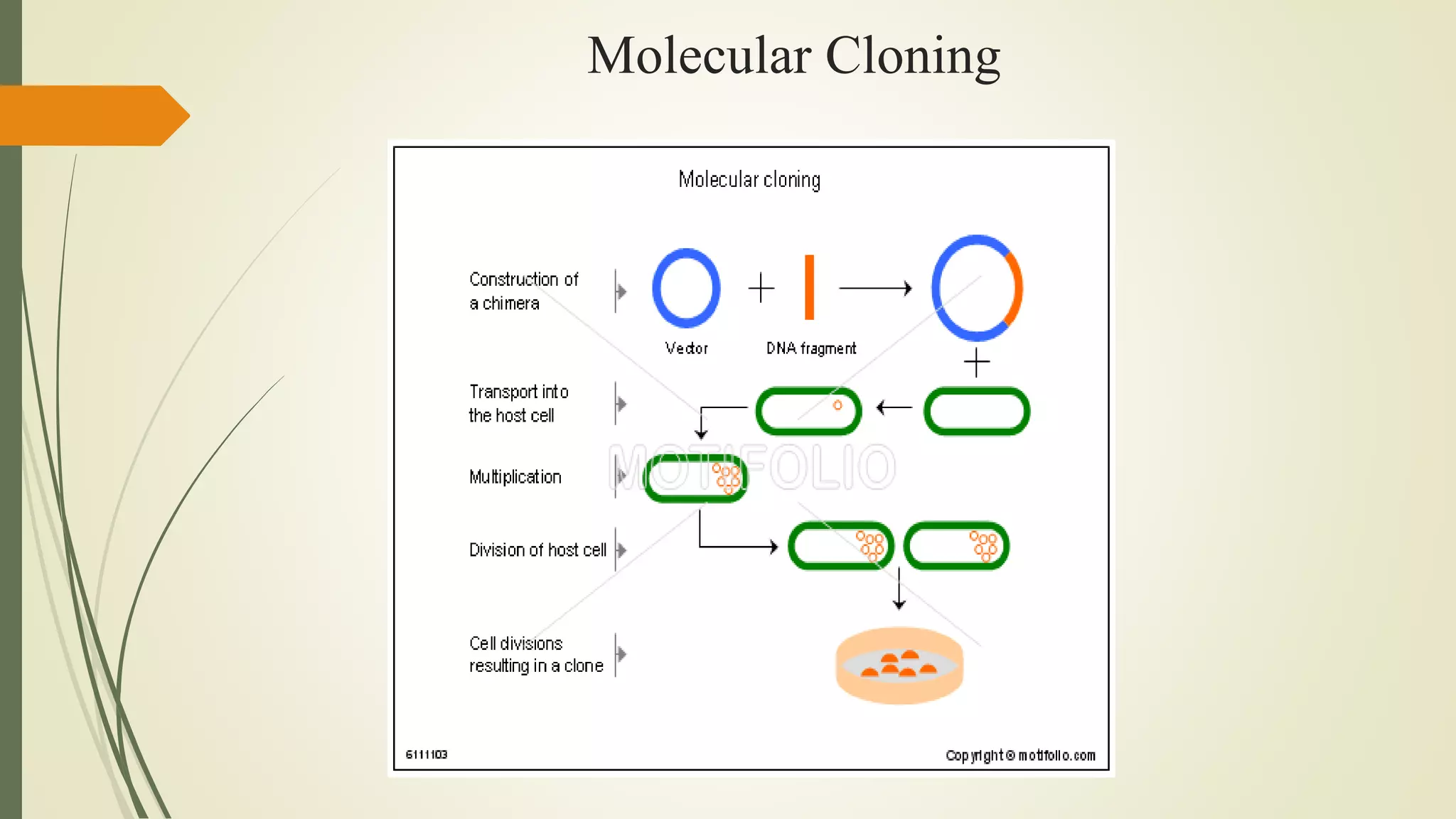
• Molecular Cloning
• Cell Cloning
• Organism Cloning
Natural Cloning
Molecular Cloning
Cell Cloning
o Unicellular/Multicellular cloning
o Embryonic Stem Cells cloning
Organism Cloning
Ex: Dolly Sheep
Procedures
 Therapeutic cloning
 Reproductive cloning
 Replacement cloning
Therapeutic Cloning
Reproductive Cloning
Replacement Cloning
APPLICATIONS OF CLONING
 Genetically-Modified
Organisms
 Transgenic Animals & Plants
 Infertility Patients
 Cosmetic Surgery
 Organ Transplants
 Rejuvenation
 Health Improvement
Genetically Modified Organisms
 The possibility of xenotransplantation
 Disease-resistant Farm Animals
 Herbicide resistant crops
 Drought resistant crops
Transgenic Animals
 Animal modeling
 Research & treatments
 Gene knock-in/knock-out
 Gene Expressions
Infertility Patients
 Will allow infertility patients to have their own
biological child (current infertility treatments are
only about 10% effective and very costly)
 Will allow parents to have offspring that are free
of genetic disease (cystic fibrosis, Sickle-cell
etc…)
Cosmetic Surgery
 Doctors will be able to manufacture bone, fat,
connective tissue, or cartilage that matches the
patients tissues exactly
 This would prevent problems with silicone leaking
or immune disease associated with plastic surgery
 Plastic surgeries, breast augmentations,
reconstructive surgeries would be much safer
New Possibilities for Organ Transplants
 Organs, such as livers and kidneys,
could be cloned
 These clones would be more
successful than current transplants
because they are created from the
patient’s body and would be free of
immune disease reactions
Rejuvenation
 Some researchers believe that
some of the effects of aging could
be reversed in the future with the
use of cloning
Health Improvement Opportunities
 Heart Disease
 Defective Genes
 Spinal Cord Injury Victims
 Genetic Testing
Extremely High Failure Rate
Problems During Later Development
Health Concerns
SCIENTIFIC CONCERNS/RISKS
INVOLVED IN CLONING
ASPECTS OF ETHICS
• Decline in genetic diversity.
• Taking nature into our own hands.
• Religious and moral reasons.
• Physical problems, such as birth defects.
• Possibility of mental and emotional problems of
the clone.
Thank you!

Cloning

  • 1.
    CLONING ‘Impact of Biotechnology’ PresentedBy: AHMAD BUKHARI MS Bio-Sciences Centre for Interdisciplinary Research in Basic Sciences (CIRBS), IIUI Pakistan.
  • 2.
    CONTENT OUTLINE  INTRODUCTION HISTORY  CLASSIFICATION OF CLONING  PROCEDURES  APPLICATIONS  SCIENTIFIC CONCERNS INVOLVED IN CLONING  ETHICALASPECTS  VIDEO ANIMATION
  • 3.
    Cloning • The processof producing similar populations of genetically identical individuals
  • 4.
    Cloning & Biotechnology •Processes used to create copies of DNA fragments, cells, or organisms.
  • 5.
    History • 1952: Scientistscloned frogs from blastula cells, but fail to produce tadpoles from differentiated cells. • 1962: John Gurdon claimed to clone frogs using the nucleus of an adult intestinal cell. Others were unable to reproduce his results, his findings were called into question. • 1966: Discovery of which codons specify the amino acids. • 1973: E. coli turned into first recombinant DNA organism. • 1977-1979: Illmensee claims to have cloned mice. Others fail to clone mammals, deem his work “scientifically worthless.” • 1983-1986: Various mammals are successfully cloned from embryonic cells. • 1990: Human Genome Project begins. • 1996: Dolly is born. • 2004: Dr. Hwang Woo Suk claimed to have cloned human embryos. His work is not able to be replicated. • 2006: Dr. Hwang fired from Seoul University as evidence arises he faked some of his work on stem cells
  • 6.
    Classes of Cloning •Natural Cloning • Molecular Cloning • Cell Cloning • Organism Cloning
  • 7.
  • 8.
  • 9.
    Cell Cloning o Unicellular/Multicellularcloning o Embryonic Stem Cells cloning
  • 10.
  • 11.
    Procedures  Therapeutic cloning Reproductive cloning  Replacement cloning
  • 12.
  • 13.
  • 14.
  • 16.
    APPLICATIONS OF CLONING Genetically-Modified Organisms  Transgenic Animals & Plants  Infertility Patients  Cosmetic Surgery  Organ Transplants  Rejuvenation  Health Improvement
  • 17.
    Genetically Modified Organisms The possibility of xenotransplantation  Disease-resistant Farm Animals  Herbicide resistant crops  Drought resistant crops
  • 18.
    Transgenic Animals  Animalmodeling  Research & treatments  Gene knock-in/knock-out  Gene Expressions
  • 19.
    Infertility Patients  Willallow infertility patients to have their own biological child (current infertility treatments are only about 10% effective and very costly)  Will allow parents to have offspring that are free of genetic disease (cystic fibrosis, Sickle-cell etc…)
  • 20.
    Cosmetic Surgery  Doctorswill be able to manufacture bone, fat, connective tissue, or cartilage that matches the patients tissues exactly  This would prevent problems with silicone leaking or immune disease associated with plastic surgery  Plastic surgeries, breast augmentations, reconstructive surgeries would be much safer
  • 21.
    New Possibilities forOrgan Transplants  Organs, such as livers and kidneys, could be cloned  These clones would be more successful than current transplants because they are created from the patient’s body and would be free of immune disease reactions
  • 22.
    Rejuvenation  Some researchersbelieve that some of the effects of aging could be reversed in the future with the use of cloning
  • 23.
    Health Improvement Opportunities Heart Disease  Defective Genes  Spinal Cord Injury Victims  Genetic Testing
  • 24.
    Extremely High FailureRate Problems During Later Development Health Concerns SCIENTIFIC CONCERNS/RISKS INVOLVED IN CLONING
  • 25.
    ASPECTS OF ETHICS •Decline in genetic diversity. • Taking nature into our own hands. • Religious and moral reasons. • Physical problems, such as birth defects. • Possibility of mental and emotional problems of the clone.
  • 26.