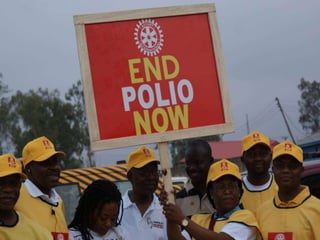
AFP Surveillance & Polio
Eradication Program
By FCT EPI/PEI Team
Sensitization of Nurses during their
Annual conference
The Global Polio Eradication Initiative
Background:
• In 1988, the forty-first World Health Assembly,
consisting then of delegates from 166
Member States, adopted a resolution for the
worldwide eradication of polio. It marked the
launch of the Global Polio Eradication
Initiative, spearheaded by WHO, Rotary
International, the US Centers for Disease
Control and Prevention (CDC) and the United
Nations Children’s Fund (UNICEF).
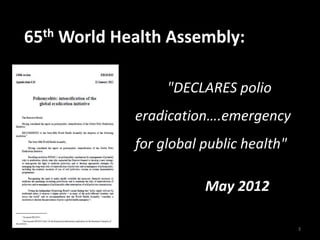
65th World Health Assembly:
"DECLARES polio
eradication….emergency
for global public health"
May 2012
3
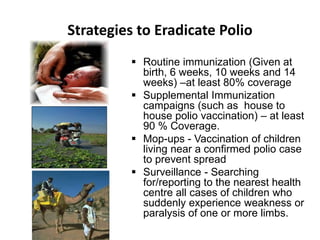
Strategies to Eradicate Polio
 Routine immunization (Given at
birth, 6 weeks, 10 weeks and 14
weeks) –at least 80% coverage
 Supplemental Immunization
campaigns (such as house to
house polio vaccination) – at least
90 % Coverage.
 Mop-ups - Vaccination of children
living near a confirmed polio case
to prevent spread
 Surveillance - Searching
for/reporting to the nearest health
centre all cases of children who
suddenly experience weakness or
paralysis of one or more limbs.
2013 NIGERIA POLIO ERADICATION
EMERGENCY PLAN
• Goal:
The overall goal of the plan is to achieve
interruption of poliovirus transmission in Nigeria
by December 2013
• Focus
• Best people in worst places
• Improve access in zero dose communities
• Sanctuaries
• Early detection and rapid response
Strategic Priorities for 2014
1. Containing transmission in the breakthrough LGAs /
States
2. Increasing reach in the security compromised areas
3. Improving quality in persistently poor performing LGAs /
wards
4. Timely and adequate outbreak response
5. Reaching children in underserved populations
6. Intensifying advocacy, community demand and trust
7. Intensifying surveillance
8. Expanding use of technologies
9. Intensifying in-between round activities
2015 Nigeria Polio Eradication Emergency Plan
Target 1: Interruption of WPV transmission by
3rd quarter 2015
Target 2: Zero cVDPV cases in AFP and the
environment by 2nd quarter 2015 and
interruption of cVDPV transmission by end 2015
7
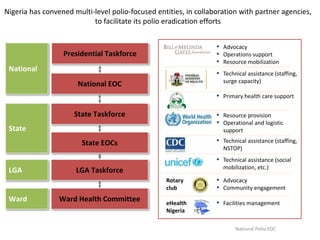
Nigeria has convened multi-level polio-focused entities, in collaboration with partner agencies,
to facilitate its polio eradication efforts
Presidential Taskforce
National EOC
State Taskforce
State EOCs
LGA Taskforce
Ward Health CommitteeWard
LGA
State
National
National Polio EOC
▪ Technical assistance (social
mobilization, etc.)
▪ Resource provision
▪ Operational and logistic
support
▪ Advocacy
▪ Community engagement
▪ Advocacy
▪ Operations support
▪ Resource mobilization
▪ Technical assistance (staffing,
NSTOP)
▪ Facilities management
Rotary
club
eHealth
Nigeria
▪ Primary health care support
▪ Technical assistance (staffing,
surge capacity)
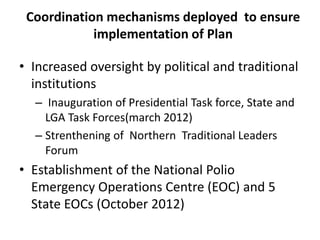
Coordination mechanisms deployed to ensure
implementation of Plan
• Increased oversight by political and traditional
institutions
– Inauguration of Presidential Task force, State and
LGA Task Forces(march 2012)
– Strenthening of Northern Traditional Leaders
Forum
• Establishment of the National Polio
Emergency Operations Centre (EOC) and 5
State EOCs (October 2012)
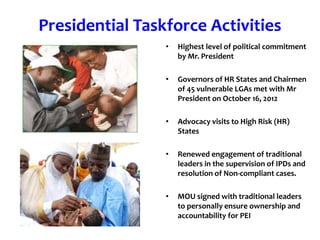
• Highest level of political commitment
by Mr. President
• Governors of HR States and Chairmen
of 45 vulnerable LGAs met with Mr
President on October 16, 2012
• Advocacy visits to High Risk (HR)
States
• Renewed engagement of traditional
leaders in the supervision of IPDs and
resolution of Non-compliant cases.
• MOU signed with traditional leaders
to personally ensure ownership and
accountability for PEI
Presidential Taskforce Activities
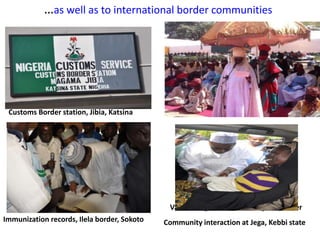
…as well as to international border communities
Customs Border station, Jibia, Katsina
Immunization records, Ilela border, Sokoto
Vaccinating children crossing the border
Community interaction at Jega, Kebbi state
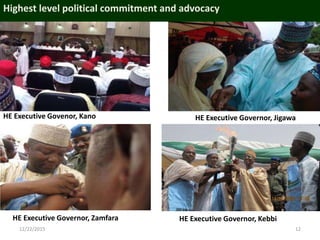
HE Executive Govenor, Kano HE Executive Governor, Jigawa
12/22/2015 12
Highest level political commitment and advocacy
HE Executive Governor, KebbiHE Executive Governor, Zamfara
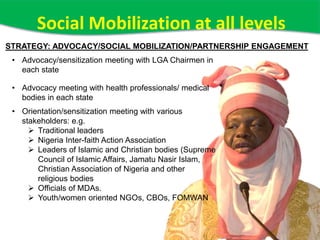
Social Mobilization at all levels
• Advocacy/sensitization meeting with LGA Chairmen in
each state
• Advocacy meeting with health professionals/ medical
bodies in each state
• Orientation/sensitization meeting with various
stakeholders: e.g.
 Traditional leaders
 Nigeria Inter-faith Action Association
 Leaders of Islamic and Christian bodies (Supreme
Council of Islamic Affairs, Jamatu Nasir Islam,
Christian Association of Nigeria and other
religious bodies
 Officials of MDAs.
 Youth/women oriented NGOs, CBOs, FOMWAN
STRATEGY: ADVOCACY/SOCIAL MOBILIZATION/PARTNERSHIP ENGAGEMENT
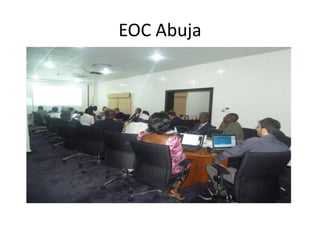
EOC Abuja
Data analysts
Data analysts
Data analysts
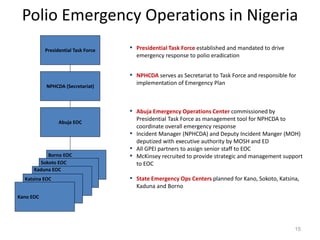
Polio Emergency Operations in Nigeria
Abuja EOC
Data analysts
Kano EOC
Presidential Task Force
NPHCDA (Secretariat)
Katsina EOC
Kaduna EOC
Sokoto EOC
Borno EOC
▪ Presidential Task Force established and mandated to drive
emergency response to polio eradication
▪ NPHCDA serves as Secretariat to Task Force and responsible for
implementation of Emergency Plan
▪ Abuja Emergency Operations Center commissioned by
Presidential Task Force as management tool for NPHCDA to
coordinate overall emergency response
▪ Incident Manager (NPHCDA) and Deputy Incident Manger (MOH)
deputized with executive authority by MOSH and ED
▪ All GPEI partners to assign senior staff to EOC
▪ McKinsey recruited to provide strategic and management support
to EOC
▪ State Emergency Ops Centers planned for Kano, Sokoto, Katsina,
Kaduna and Borno
15
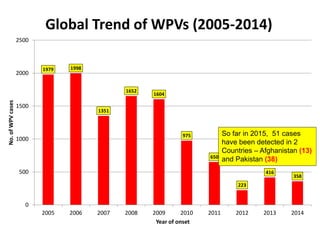
1979 1998
1351
1652
1604
975
650
223
416
358
0
500
1000
1500
2000
2500
2005 2006 2007 2008 2009 2010 2011 2012 2013 2014
No.ofWPVcases
Year of onset
Global Trend of WPVs (2005-2014)
So far in 2015, 51 cases
have been detected in 2
Countries – Afghanistan (13)
and Pakistan (38)
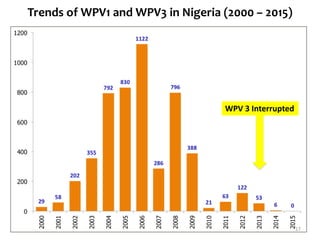
Trends of WPV1 and WPV3 in Nigeria (2000 – 2015)
17
WPV 3 Interrupted
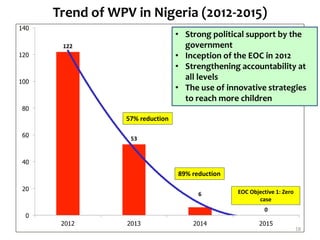
Trend of WPV in Nigeria (2012-2015)
• Strong political support by the
government
• Inception of the EOC in 2012
• Strengthening accountability at
all levels
• The use of innovative strategies
to reach more children
57% reduction
89% reduction
EOC Objective 1: Zero
case
18
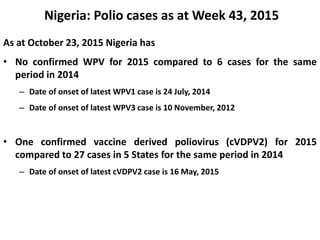
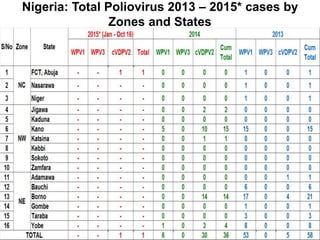
As at October 23, 2015 Nigeria has
• No confirmed WPV for 2015 compared to 6 cases for the same
period in 2014
– Date of onset of latest WPV1 case is 24 July, 2014
– Date of onset of latest WPV3 case is 10 November, 2012
• One confirmed vaccine derived poliovirus (cVDPV2) for 2015
compared to 27 cases in 5 States for the same period in 2014
– Date of onset of latest cVDPV2 case is 16 May, 2015
Nigeria: Polio cases as at Week 43, 2015
Latest onset of confirmed WPV was 24-Jul-2014 from Sumaila LGA, Kano State.
Nigeria: Total Poliovirus 2013 – 2015* cases by
Zones and States
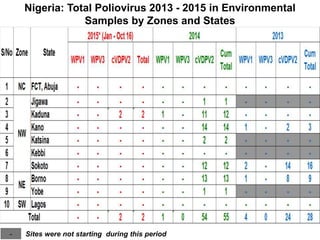
Nigeria: Total Poliovirus 2013 - 2015 in Environmental
Samples by Zones and States
Sites were not starting during this period-
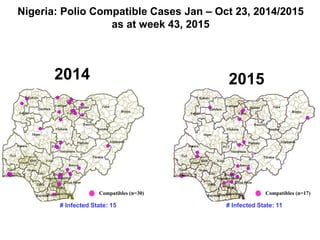
Nigeria: Polio Compatible Cases Jan – Oct 23, 2014/2015
as at week 43, 2015
2014 2015
Compatibles (n=17)
# Infected State: 11
Compatibles (n=30)
# Infected State: 15
Challenges
• Insecurity is the major challenge
• Operational gaps in worse performing LGAs
(poor team performance, supervision)
• Anti polio campaigns
• Accountability at the operational levels
• Unmet needs of the populace
24
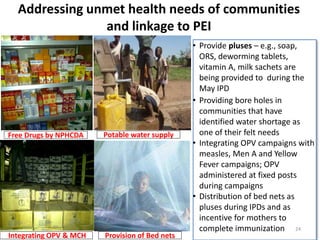
• Provide pluses – e.g., soap,
ORS, deworming tablets,
vitamin A, milk sachets are
being provided to during the
May IPD
• Providing bore holes in
communities that have
identified water shortage as
one of their felt needs
• Integrating OPV campaigns with
measles, Men A and Yellow
Fever campaigns; OPV
administered at fixed posts
during campaigns
• Distribution of bed nets as
pluses during IPDs and as
incentive for mothers to
complete immunization
Addressing unmet health needs of communities
and linkage to PEI
Free Drugs by NPHCDA
Provision of Bed netsIntegrating OPV & MCH
Potable water supply
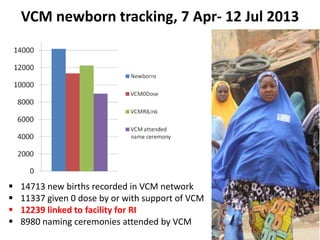
VCM newborn tracking, 7 Apr- 12 Jul 2013
 14713 new births recorded in VCM network
 11337 given 0 dose by or with support of VCM
 12239 linked to facility for RI
 8980 naming ceremonies attended by VCM
Disease Surveillance
Ongoing, systematic collection, analysis,
and interpretation of health-related data
essential for the planning,
implementation, and evaluation of
health practice, closely integrated with
the timely dissemination of these data
to those responsible for prevention and
control.
AFP surveillance
What is it?
• detect any case of AFP < 15 years of age and
any case of any age in which a clinician suspects polio
• collect 2 stool specimens at 24 hours interval < 14 days of paralysis onset
• perform virus isolation in a WHO-accredited laboratory
• classify cases according to WHO scheme
Acute Flaccid Paralysis
• Acute: sudden onset of new/recent paralysis
– as opposed to chronic (e.g., from birth) or very
gradual onset
• Flaccid: loss of muscle tone, “floppy” (as
opposed to spastic or rigid)
• Paralysis: weakness, loss or diminution of
motion of one or more limbs
• Any case of sudden onset of weakness of one
or more limbs in a child <15 years of age
or
• Any case of paralytic illness (regardless of
age) in which a clinician suspects polio
Case Definition for Acute Flaccid Paralysis
(AFP) Surveillance
AFP Surveillance Cntd.
•It should be stressed that surveillance is
carried out for all cases of AFP, regardless of
cause.
•Note that it is acute onset of flaccid paralysis
for which no obvious cause (such as severe
injury or birth trauma) is found.
•When in doubt, the case should be reported,
and surveillance officers will investigate and
verify them.
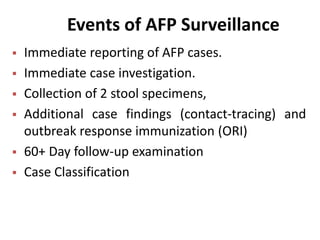
Events of AFP Surveillance
 Immediate reporting of AFP cases.
 Immediate case investigation.
 Collection of 2 stool specimens,
 Additional case findings (contact-tracing) and
outbreak response immunization (ORI)
 60+ Day follow-up examination
 Case Classification
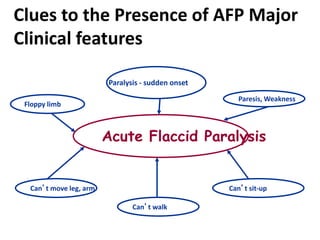
Acute Flaccid Paralysis
Paresis, Weakness
Floppy limb
Can’t move leg, arm
Can’t walk
Can’t sit-up
Paralysis - sudden onset
Clues to the Presence of AFP Major
Clinical features
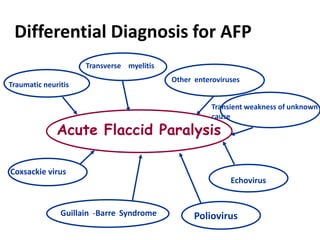
Acute Flaccid Paralysis
Transverse myelitis
Traumatic neuritis
Guillain -Barre Syndrome
Other enteroviruses
Coxsackie virus
Echovirus
Poliovirus
Differential Diagnosis for AFP
Transient weakness of unknown
cause
Overview of Poliomyelitis
Definition of Poliomyelitis:
 An endemic virus infection which attacks the motor neurons
of the anterior horns in the brain stem and spinal cord.
An attack may or may not lead to paralysis with loss of
muscular power and flaccidity i.e acute flaccid paralysis
(AFP).
 Sensory neurons are not affected so there is still a sense of
feeling in the limb.
 When it occurs within two days of vaccination the term
provocative paralytic poliomyelitis is used. This is also known
as Vaccine Activated Paralytic Poliomyelitis (VAPP) and it
occurs in less than 1 in 3 million cases.
 Suspected polio is:
Any case of acute flaccid paralysis in a child aged less than
15yrs, including Gullian-Barre syndrome, for which no other
obvious cause such as trauma is evident at onset.
AFP = Sudden loss of strength, tone and/or reflexes in a limb
or limbs – is the indicator of surveillance for Poliomyelitis.
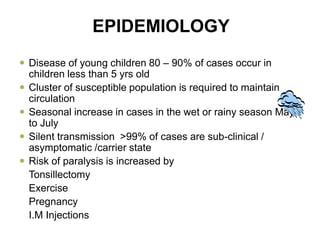
EPIDEMIOLOGY
 Disease of young children 80 – 90% of cases occur in
children less than 5 yrs old
 Cluster of susceptible population is required to maintain
circulation
 Seasonal increase in cases in the wet or rainy season May
to July
 Silent transmission >99% of cases are sub-clinical /
asymptomatic /carrier state
 Risk of paralysis is increased by
Tonsillectomy
Exercise
Pregnancy
I.M Injections
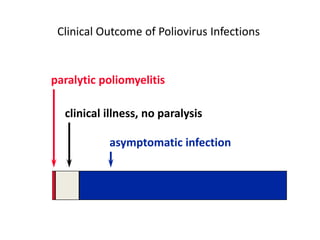
Clinical Outcome of Poliovirus Infections
asymptomatic infection
clinical illness, no paralysis
paralytic poliomyelitis
CLINICAL FEATURES OF POLIOMYELITIS
 Acute onset of flaccid paralysis
 Fever, sneezing, runny nose,+/- loose motions
 Fatigue, headache, vomiting, and pain in the
limbs
 Asymmetric
 Legs affected most often
 Mortality rate 5 – 10%
 Paralysis is permanent
NB: Poliomyelitis is a highly communicable
disease which must be eradicated.
What Makes Polio Eradication
Possible
 It is found only in human beings. No extra
human reservoir.
 Poliovirus is heat sensitive and does not
survive long in the environment, especially
tropical climates like Nigeria
 There is no long term carrier state
 Fewer than 1% of polio infections ever result
in paralysis
 Permanent immunity following infection
 OPV is a proven vaccine for eradication
POLIO VACCINE
• Protective immunity against polio infection develops by
immunization or natural infection.
• Immunity to one polio virus type (as occurs by natural
immunity) does not protect against infection from other polio
virus types, this is why trivalent vaccination is vital.
• Immunity conferred is lifelong .
• Infants born to mothers with high antibody levels against the
polio virus are protected for the first few days of life but this
is highly inadequate.
• There are two types:
ORAL POLIO VACCINE (OPV)
INACTIVATED POLIO VACCINE(IPV)
Some Drawbacks in Polio Eradication
• Poor RI coverage (routine immunization and primary
health care systems are weak).
• Failure to reach enough children during polio
immunization campaigns (missed children – child
absent, non-compliance and households not visited)
• Religious beliefs – Some Muslims do not believe in
disease prevention; some Christians don’t take
medicines.
• Lack of awareness by health care providers on polio
eradication process with particular reference to SIAs
and necessity for multiple/several OPV doses.
• Lack of trust in polio immunization by some sections of
the public – including health workers.
• Lack of commitment some political/traditional leaders
and policy makers at both federal, state and LGAs.
FAQ
• What is polio?
• Polio is a highly infectious disease caused by a
virus.
• The virus invades the nervous system, and can
cause total paralysis in a matter of hours.
• In some cases, the poliovirus can even cause death.
• Poliovirus is a communicable disease which cannot
be controlled and therefore must be eradicated.
42
Why are there so many rounds of Polio Campaigns in
Nigeria?
• Multiple rounds are necessary to eradicate polio; every child
under 5 years must receive the polio vaccine multiple times,
regardless of previous immunization status.
• The strategy is to immunize children who are either not
immunized, or only partially protected (ie who have not received
sufficient doses of OPV), as well as to boost immunity levels in
those children who have already been immunized.
• It is important to note that these strategies only work if each and
every child is immunized during each and every immunization
campaign. It is the only way to stop the transmission and
circulation of wild poliovirus, and to eradicate the disease once
and for all.
43
Key facts
• Polio (poliomyelitis) mainly affects children under five years of age.
• One in 200 infections leads to irreversible paralysis. Among those paralysed,
5% to 10% die when their breathing muscles become immobilized.
• Polio cases have decreased by over 99% since 1988. The reduction is the
result of the global effort to eradicate the disease.
• In 2012, only three countries (Afghanistan, Nigeria and Pakistan) remain
polio-endemic, down from more than 125 in 1988.
• Persistent pockets of polio transmission in northern Nigeria and the border
between Afghanistan and Pakistan are the current focus of the polio
eradication initiative.
• As long as a single child remains infected, children in all countries are at risk
of contracting polio. In 2009-2010, 23 previously polio-free countries were
re-infected due to imports of the virus.
• In most countries, the global effort has expanded capacities to tackle
infectious diseases by building effective surveillance and immunization
systems.
• These efforts can only work if all hands are on deck.
Conclusion
What are Nurses required to do?
• Immediately report any case(s) of AFP to HF focal person,
DSNO for the Area Council, FCT State DSNO or WHO
Surveillance officers for prompt case investigation and
verification.
• Support clinicians in diagnosis and complete (traceable)
address of the AFP case in the record book.
• As much as possible, admit all AFP cases immediately.
• Keep the Patient (if possible) until 2 stool specimens are
collected.
• Support the DSNO to collect two stool specimens, 24-48
hours apart; Specimen should reach NPL within 72 hrs of
collection.
• Support the Polio Eradication Initiative by also encouraging
your clients to present eligible children for RI (<1yr) and
SIAs/IPDs (<5yrs).
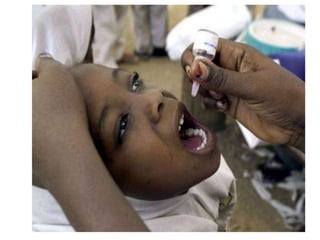
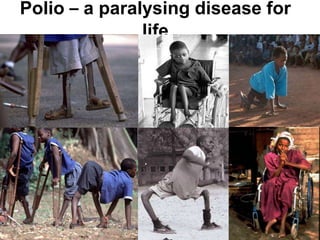
Polio – a paralysing disease for
life
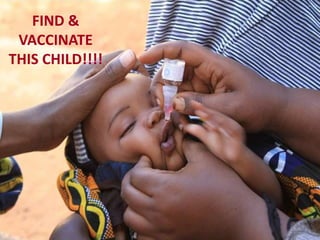
FIND &
VACCINATE
THIS CHILD!!!!
47
Thank You

Clinician sensitization on afp surveillance & polio eradication program

  • 1.
    AFP Surveillance &Polio Eradication Program By FCT EPI/PEI Team Sensitization of Nurses during their Annual conference
  • 2.
    The Global PolioEradication Initiative Background: • In 1988, the forty-first World Health Assembly, consisting then of delegates from 166 Member States, adopted a resolution for the worldwide eradication of polio. It marked the launch of the Global Polio Eradication Initiative, spearheaded by WHO, Rotary International, the US Centers for Disease Control and Prevention (CDC) and the United Nations Children’s Fund (UNICEF).
  • 3.
    65th World HealthAssembly: "DECLARES polio eradication….emergency for global public health" May 2012 3
  • 4.
    Strategies to EradicatePolio  Routine immunization (Given at birth, 6 weeks, 10 weeks and 14 weeks) –at least 80% coverage  Supplemental Immunization campaigns (such as house to house polio vaccination) – at least 90 % Coverage.  Mop-ups - Vaccination of children living near a confirmed polio case to prevent spread  Surveillance - Searching for/reporting to the nearest health centre all cases of children who suddenly experience weakness or paralysis of one or more limbs.
  • 5.
    2013 NIGERIA POLIOERADICATION EMERGENCY PLAN • Goal: The overall goal of the plan is to achieve interruption of poliovirus transmission in Nigeria by December 2013 • Focus • Best people in worst places • Improve access in zero dose communities • Sanctuaries • Early detection and rapid response
  • 6.
    Strategic Priorities for2014 1. Containing transmission in the breakthrough LGAs / States 2. Increasing reach in the security compromised areas 3. Improving quality in persistently poor performing LGAs / wards 4. Timely and adequate outbreak response 5. Reaching children in underserved populations 6. Intensifying advocacy, community demand and trust 7. Intensifying surveillance 8. Expanding use of technologies 9. Intensifying in-between round activities
  • 7.
    2015 Nigeria PolioEradication Emergency Plan Target 1: Interruption of WPV transmission by 3rd quarter 2015 Target 2: Zero cVDPV cases in AFP and the environment by 2nd quarter 2015 and interruption of cVDPV transmission by end 2015 7
  • 8.
    Nigeria has convenedmulti-level polio-focused entities, in collaboration with partner agencies, to facilitate its polio eradication efforts Presidential Taskforce National EOC State Taskforce State EOCs LGA Taskforce Ward Health CommitteeWard LGA State National National Polio EOC ▪ Technical assistance (social mobilization, etc.) ▪ Resource provision ▪ Operational and logistic support ▪ Advocacy ▪ Community engagement ▪ Advocacy ▪ Operations support ▪ Resource mobilization ▪ Technical assistance (staffing, NSTOP) ▪ Facilities management Rotary club eHealth Nigeria ▪ Primary health care support ▪ Technical assistance (staffing, surge capacity)
  • 9.
    Coordination mechanisms deployedto ensure implementation of Plan • Increased oversight by political and traditional institutions – Inauguration of Presidential Task force, State and LGA Task Forces(march 2012) – Strenthening of Northern Traditional Leaders Forum • Establishment of the National Polio Emergency Operations Centre (EOC) and 5 State EOCs (October 2012)
  • 10.
    • Highest levelof political commitment by Mr. President • Governors of HR States and Chairmen of 45 vulnerable LGAs met with Mr President on October 16, 2012 • Advocacy visits to High Risk (HR) States • Renewed engagement of traditional leaders in the supervision of IPDs and resolution of Non-compliant cases. • MOU signed with traditional leaders to personally ensure ownership and accountability for PEI Presidential Taskforce Activities
  • 11.
    …as well asto international border communities Customs Border station, Jibia, Katsina Immunization records, Ilela border, Sokoto Vaccinating children crossing the border Community interaction at Jega, Kebbi state
  • 12.
    HE Executive Govenor,Kano HE Executive Governor, Jigawa 12/22/2015 12 Highest level political commitment and advocacy HE Executive Governor, KebbiHE Executive Governor, Zamfara
  • 13.
    Social Mobilization atall levels • Advocacy/sensitization meeting with LGA Chairmen in each state • Advocacy meeting with health professionals/ medical bodies in each state • Orientation/sensitization meeting with various stakeholders: e.g.  Traditional leaders  Nigeria Inter-faith Action Association  Leaders of Islamic and Christian bodies (Supreme Council of Islamic Affairs, Jamatu Nasir Islam, Christian Association of Nigeria and other religious bodies  Officials of MDAs.  Youth/women oriented NGOs, CBOs, FOMWAN STRATEGY: ADVOCACY/SOCIAL MOBILIZATION/PARTNERSHIP ENGAGEMENT
  • 14.
  • 15.
    Data analysts Data analysts Dataanalysts Polio Emergency Operations in Nigeria Abuja EOC Data analysts Kano EOC Presidential Task Force NPHCDA (Secretariat) Katsina EOC Kaduna EOC Sokoto EOC Borno EOC ▪ Presidential Task Force established and mandated to drive emergency response to polio eradication ▪ NPHCDA serves as Secretariat to Task Force and responsible for implementation of Emergency Plan ▪ Abuja Emergency Operations Center commissioned by Presidential Task Force as management tool for NPHCDA to coordinate overall emergency response ▪ Incident Manager (NPHCDA) and Deputy Incident Manger (MOH) deputized with executive authority by MOSH and ED ▪ All GPEI partners to assign senior staff to EOC ▪ McKinsey recruited to provide strategic and management support to EOC ▪ State Emergency Ops Centers planned for Kano, Sokoto, Katsina, Kaduna and Borno 15
  • 16.
    1979 1998 1351 1652 1604 975 650 223 416 358 0 500 1000 1500 2000 2500 2005 20062007 2008 2009 2010 2011 2012 2013 2014 No.ofWPVcases Year of onset Global Trend of WPVs (2005-2014) So far in 2015, 51 cases have been detected in 2 Countries – Afghanistan (13) and Pakistan (38)
  • 17.
    Trends of WPV1and WPV3 in Nigeria (2000 – 2015) 17 WPV 3 Interrupted
  • 18.
    Trend of WPVin Nigeria (2012-2015) • Strong political support by the government • Inception of the EOC in 2012 • Strengthening accountability at all levels • The use of innovative strategies to reach more children 57% reduction 89% reduction EOC Objective 1: Zero case 18
  • 19.
    As at October23, 2015 Nigeria has • No confirmed WPV for 2015 compared to 6 cases for the same period in 2014 – Date of onset of latest WPV1 case is 24 July, 2014 – Date of onset of latest WPV3 case is 10 November, 2012 • One confirmed vaccine derived poliovirus (cVDPV2) for 2015 compared to 27 cases in 5 States for the same period in 2014 – Date of onset of latest cVDPV2 case is 16 May, 2015 Nigeria: Polio cases as at Week 43, 2015
  • 20.
    Latest onset ofconfirmed WPV was 24-Jul-2014 from Sumaila LGA, Kano State. Nigeria: Total Poliovirus 2013 – 2015* cases by Zones and States
  • 21.
    Nigeria: Total Poliovirus2013 - 2015 in Environmental Samples by Zones and States Sites were not starting during this period-
  • 22.
    Nigeria: Polio CompatibleCases Jan – Oct 23, 2014/2015 as at week 43, 2015 2014 2015 Compatibles (n=17) # Infected State: 11 Compatibles (n=30) # Infected State: 15
  • 23.
    Challenges • Insecurity isthe major challenge • Operational gaps in worse performing LGAs (poor team performance, supervision) • Anti polio campaigns • Accountability at the operational levels • Unmet needs of the populace
  • 24.
    24 • Provide pluses– e.g., soap, ORS, deworming tablets, vitamin A, milk sachets are being provided to during the May IPD • Providing bore holes in communities that have identified water shortage as one of their felt needs • Integrating OPV campaigns with measles, Men A and Yellow Fever campaigns; OPV administered at fixed posts during campaigns • Distribution of bed nets as pluses during IPDs and as incentive for mothers to complete immunization Addressing unmet health needs of communities and linkage to PEI Free Drugs by NPHCDA Provision of Bed netsIntegrating OPV & MCH Potable water supply
  • 25.
    VCM newborn tracking,7 Apr- 12 Jul 2013  14713 new births recorded in VCM network  11337 given 0 dose by or with support of VCM  12239 linked to facility for RI  8980 naming ceremonies attended by VCM
  • 26.
    Disease Surveillance Ongoing, systematiccollection, analysis, and interpretation of health-related data essential for the planning, implementation, and evaluation of health practice, closely integrated with the timely dissemination of these data to those responsible for prevention and control.
  • 27.
    AFP surveillance What isit? • detect any case of AFP < 15 years of age and any case of any age in which a clinician suspects polio • collect 2 stool specimens at 24 hours interval < 14 days of paralysis onset • perform virus isolation in a WHO-accredited laboratory • classify cases according to WHO scheme
  • 28.
    Acute Flaccid Paralysis •Acute: sudden onset of new/recent paralysis – as opposed to chronic (e.g., from birth) or very gradual onset • Flaccid: loss of muscle tone, “floppy” (as opposed to spastic or rigid) • Paralysis: weakness, loss or diminution of motion of one or more limbs
  • 29.
    • Any caseof sudden onset of weakness of one or more limbs in a child <15 years of age or • Any case of paralytic illness (regardless of age) in which a clinician suspects polio Case Definition for Acute Flaccid Paralysis (AFP) Surveillance
  • 30.
    AFP Surveillance Cntd. •Itshould be stressed that surveillance is carried out for all cases of AFP, regardless of cause. •Note that it is acute onset of flaccid paralysis for which no obvious cause (such as severe injury or birth trauma) is found. •When in doubt, the case should be reported, and surveillance officers will investigate and verify them.
  • 31.
    Events of AFPSurveillance  Immediate reporting of AFP cases.  Immediate case investigation.  Collection of 2 stool specimens,  Additional case findings (contact-tracing) and outbreak response immunization (ORI)  60+ Day follow-up examination  Case Classification
  • 32.
    Acute Flaccid Paralysis Paresis,Weakness Floppy limb Can’t move leg, arm Can’t walk Can’t sit-up Paralysis - sudden onset Clues to the Presence of AFP Major Clinical features
  • 33.
    Acute Flaccid Paralysis Transversemyelitis Traumatic neuritis Guillain -Barre Syndrome Other enteroviruses Coxsackie virus Echovirus Poliovirus Differential Diagnosis for AFP Transient weakness of unknown cause
  • 34.
    Overview of Poliomyelitis Definitionof Poliomyelitis:  An endemic virus infection which attacks the motor neurons of the anterior horns in the brain stem and spinal cord. An attack may or may not lead to paralysis with loss of muscular power and flaccidity i.e acute flaccid paralysis (AFP).  Sensory neurons are not affected so there is still a sense of feeling in the limb.  When it occurs within two days of vaccination the term provocative paralytic poliomyelitis is used. This is also known as Vaccine Activated Paralytic Poliomyelitis (VAPP) and it occurs in less than 1 in 3 million cases.  Suspected polio is: Any case of acute flaccid paralysis in a child aged less than 15yrs, including Gullian-Barre syndrome, for which no other obvious cause such as trauma is evident at onset. AFP = Sudden loss of strength, tone and/or reflexes in a limb or limbs – is the indicator of surveillance for Poliomyelitis.
  • 35.
    EPIDEMIOLOGY  Disease ofyoung children 80 – 90% of cases occur in children less than 5 yrs old  Cluster of susceptible population is required to maintain circulation  Seasonal increase in cases in the wet or rainy season May to July  Silent transmission >99% of cases are sub-clinical / asymptomatic /carrier state  Risk of paralysis is increased by Tonsillectomy Exercise Pregnancy I.M Injections
  • 36.
    Clinical Outcome ofPoliovirus Infections asymptomatic infection clinical illness, no paralysis paralytic poliomyelitis
  • 37.
    CLINICAL FEATURES OFPOLIOMYELITIS  Acute onset of flaccid paralysis  Fever, sneezing, runny nose,+/- loose motions  Fatigue, headache, vomiting, and pain in the limbs  Asymmetric  Legs affected most often  Mortality rate 5 – 10%  Paralysis is permanent NB: Poliomyelitis is a highly communicable disease which must be eradicated.
  • 38.
    What Makes PolioEradication Possible  It is found only in human beings. No extra human reservoir.  Poliovirus is heat sensitive and does not survive long in the environment, especially tropical climates like Nigeria  There is no long term carrier state  Fewer than 1% of polio infections ever result in paralysis  Permanent immunity following infection  OPV is a proven vaccine for eradication
  • 39.
    POLIO VACCINE • Protectiveimmunity against polio infection develops by immunization or natural infection. • Immunity to one polio virus type (as occurs by natural immunity) does not protect against infection from other polio virus types, this is why trivalent vaccination is vital. • Immunity conferred is lifelong . • Infants born to mothers with high antibody levels against the polio virus are protected for the first few days of life but this is highly inadequate. • There are two types: ORAL POLIO VACCINE (OPV) INACTIVATED POLIO VACCINE(IPV)
  • 41.
    Some Drawbacks inPolio Eradication • Poor RI coverage (routine immunization and primary health care systems are weak). • Failure to reach enough children during polio immunization campaigns (missed children – child absent, non-compliance and households not visited) • Religious beliefs – Some Muslims do not believe in disease prevention; some Christians don’t take medicines. • Lack of awareness by health care providers on polio eradication process with particular reference to SIAs and necessity for multiple/several OPV doses. • Lack of trust in polio immunization by some sections of the public – including health workers. • Lack of commitment some political/traditional leaders and policy makers at both federal, state and LGAs.
  • 42.
    FAQ • What ispolio? • Polio is a highly infectious disease caused by a virus. • The virus invades the nervous system, and can cause total paralysis in a matter of hours. • In some cases, the poliovirus can even cause death. • Poliovirus is a communicable disease which cannot be controlled and therefore must be eradicated. 42
  • 43.
    Why are thereso many rounds of Polio Campaigns in Nigeria? • Multiple rounds are necessary to eradicate polio; every child under 5 years must receive the polio vaccine multiple times, regardless of previous immunization status. • The strategy is to immunize children who are either not immunized, or only partially protected (ie who have not received sufficient doses of OPV), as well as to boost immunity levels in those children who have already been immunized. • It is important to note that these strategies only work if each and every child is immunized during each and every immunization campaign. It is the only way to stop the transmission and circulation of wild poliovirus, and to eradicate the disease once and for all. 43
  • 44.
    Key facts • Polio(poliomyelitis) mainly affects children under five years of age. • One in 200 infections leads to irreversible paralysis. Among those paralysed, 5% to 10% die when their breathing muscles become immobilized. • Polio cases have decreased by over 99% since 1988. The reduction is the result of the global effort to eradicate the disease. • In 2012, only three countries (Afghanistan, Nigeria and Pakistan) remain polio-endemic, down from more than 125 in 1988. • Persistent pockets of polio transmission in northern Nigeria and the border between Afghanistan and Pakistan are the current focus of the polio eradication initiative. • As long as a single child remains infected, children in all countries are at risk of contracting polio. In 2009-2010, 23 previously polio-free countries were re-infected due to imports of the virus. • In most countries, the global effort has expanded capacities to tackle infectious diseases by building effective surveillance and immunization systems. • These efforts can only work if all hands are on deck.
  • 45.
    Conclusion What are Nursesrequired to do? • Immediately report any case(s) of AFP to HF focal person, DSNO for the Area Council, FCT State DSNO or WHO Surveillance officers for prompt case investigation and verification. • Support clinicians in diagnosis and complete (traceable) address of the AFP case in the record book. • As much as possible, admit all AFP cases immediately. • Keep the Patient (if possible) until 2 stool specimens are collected. • Support the DSNO to collect two stool specimens, 24-48 hours apart; Specimen should reach NPL within 72 hrs of collection. • Support the Polio Eradication Initiative by also encouraging your clients to present eligible children for RI (<1yr) and SIAs/IPDs (<5yrs).
  • 46.
    Polio – aparalysing disease for life
  • 47.
  • 49.