National Workshop for Medical Colleges Task Force to
Accelerate Ending TB in India
NTEP Policy updates and plans for Ending TB - 2025
Dr Rajendra P Joshi
Deputy Director General ( TB )
Central TB Division, MoHFW, GOI
Outline
• National commitment towards TB Mukt Bharat
• What is our SDG and Where are we?
• Bending the curve – Know how?
• Strategies/Interventions by the programme (DTPB)
• Newer initiatives – SNC, PMTBMBA
• Role of medical college
National Commitment: TB Mukt Bharat
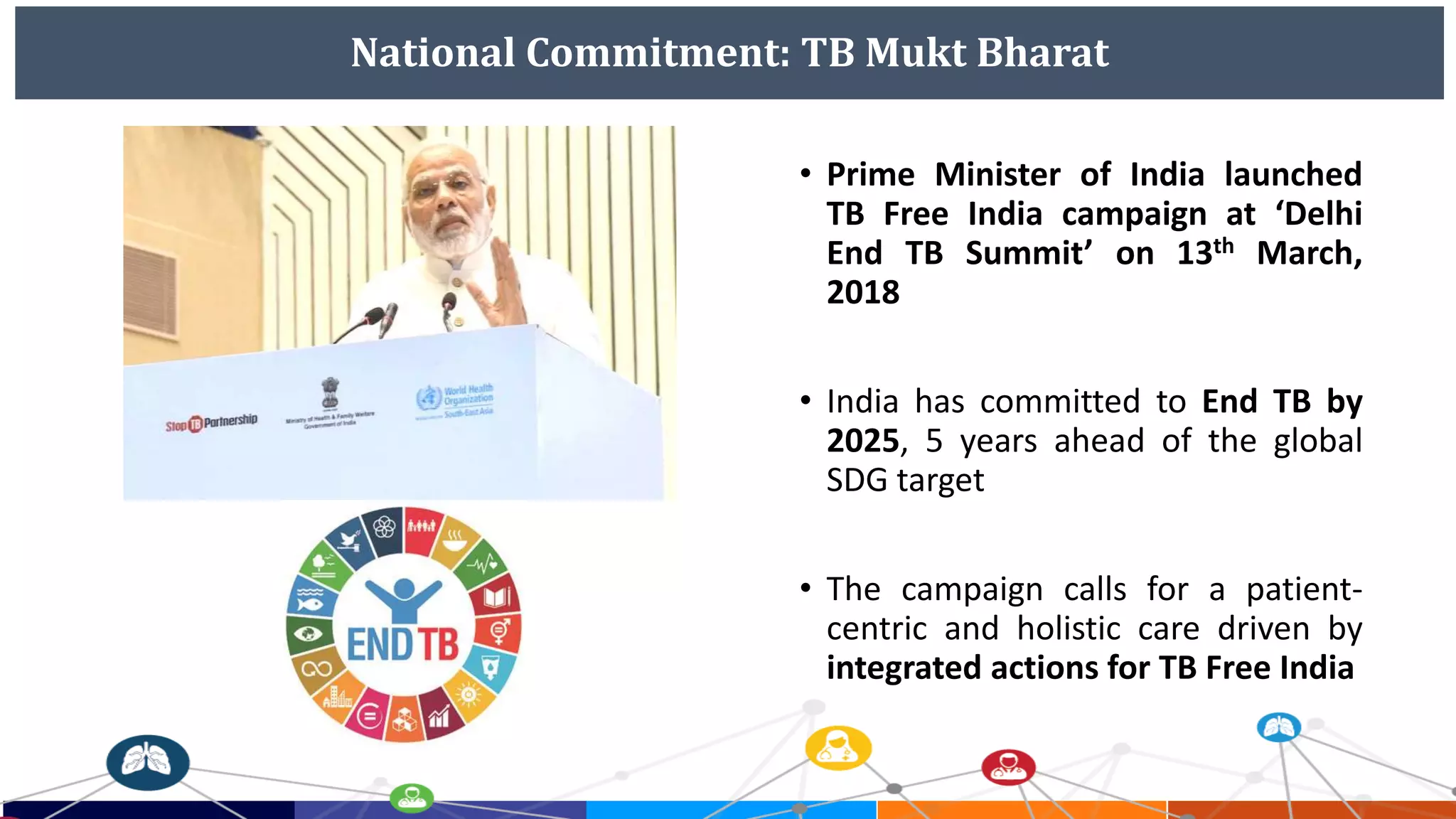
• Prime Minister of India launched
TB Free India campaign at ‘Delhi
End TB Summit’ on 13th March,
2018
• India has committed to End TB by
2025, 5 years ahead of the global
SDG target
• The campaign calls for a patient-
centric and holistic care driven by
integrated actions for TB Free India
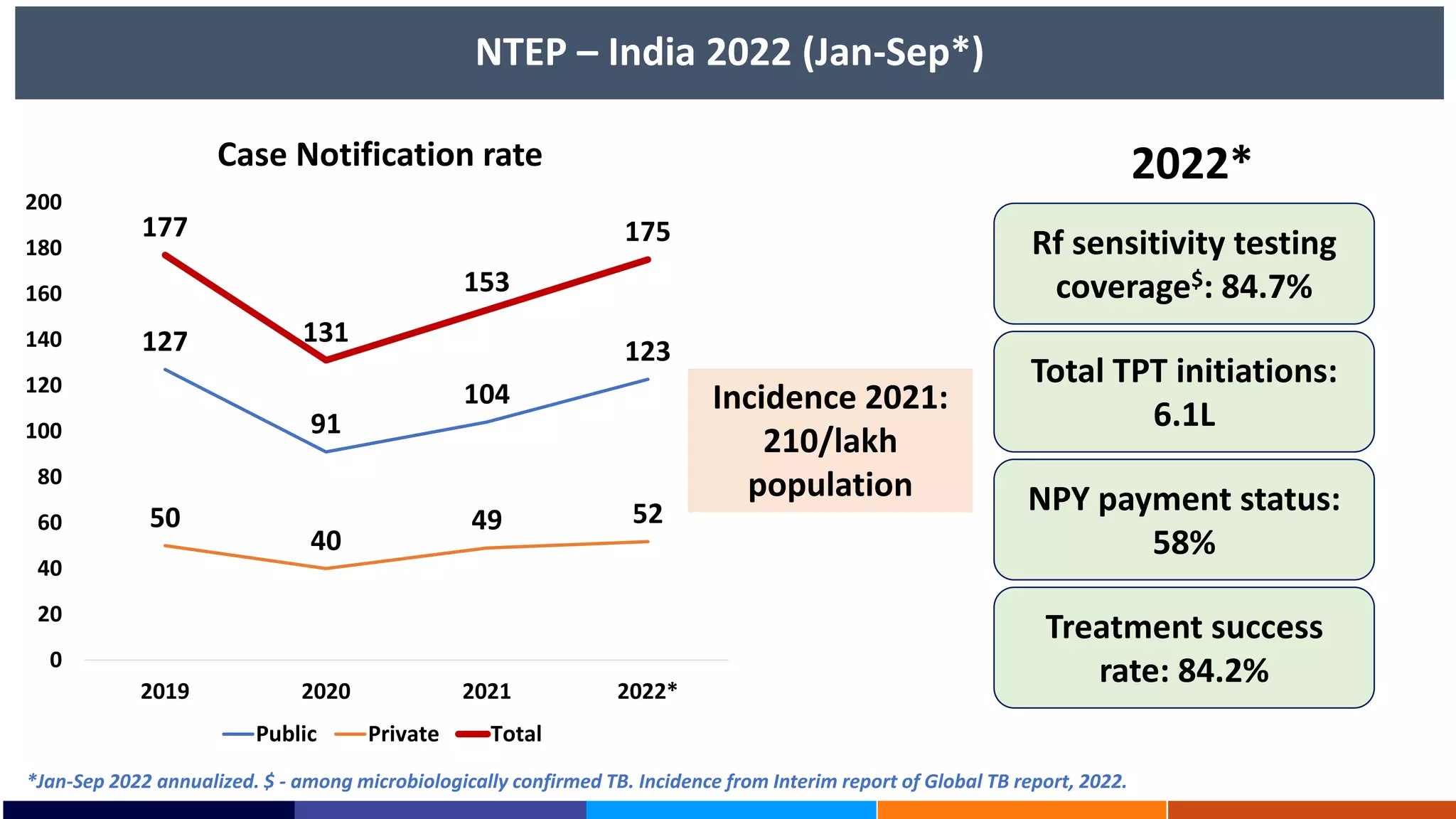
NTEP – India 2022 (Jan-Sep*)
127
91
104
123
50
40
49 52
177
131
153
175
0
20
40
60
80
100
120
140
160
180
200
2019 2020 2021 2022*
Public Private Total
*Jan-Sep 2022 annualized. $ - among microbiologically confirmed TB. Incidence from Interim report of Global TB report, 2022.
Rf sensitivity testing
coverage$: 84.7%
Total TPT initiations:
6.1L
NPY payment status:
58%
2022*
Treatment success
rate: 84.2%
Case Notification rate
Incidence 2021:
210/lakh
population
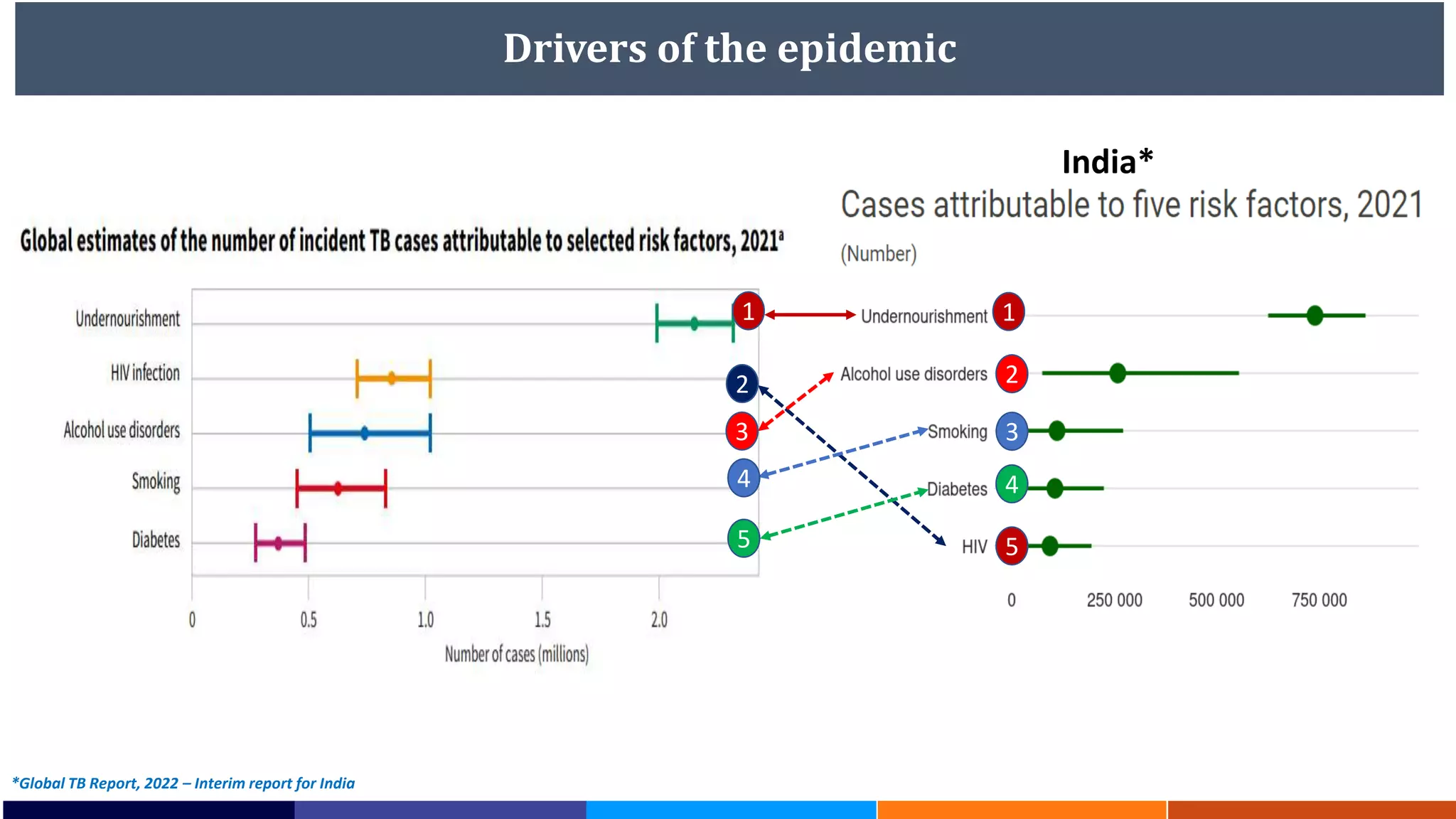
Drivers of the epidemic
India*
1
2
3
2
5 5
4
3
4
1
*Global TB Report, 2022 – Interim report for India
Burden – Current
Scenario
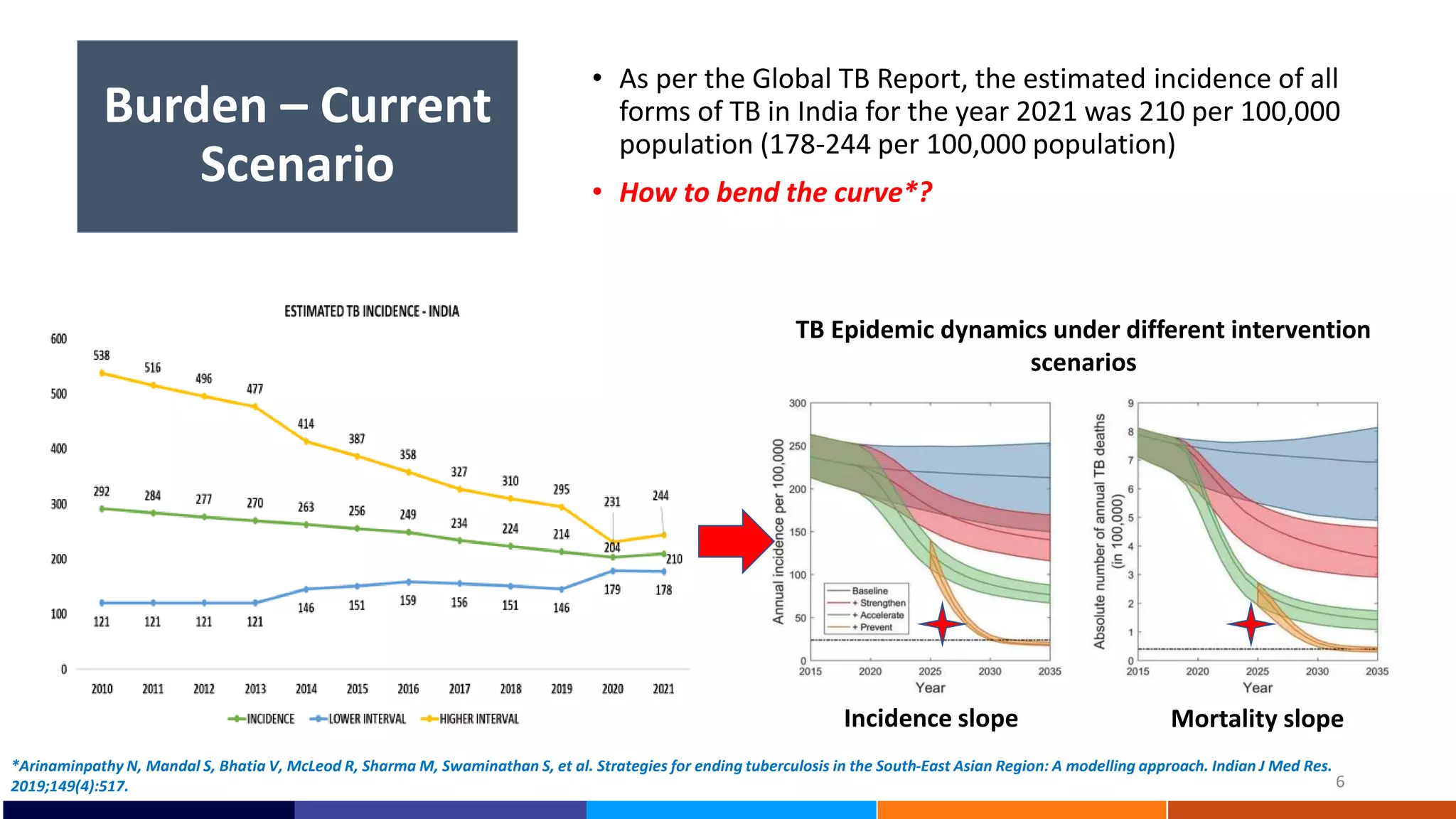
• As per the Global TB Report, the estimated incidence of all
forms of TB in India for the year 2021 was 210 per 100,000
population (178-244 per 100,000 population)
• How to bend the curve*?
TB Epidemic dynamics under different intervention
scenarios
Incidence slope Mortality slope
6
*Arinaminpathy N, Mandal S, Bhatia V, McLeod R, Sharma M, Swaminathan S, et al. Strategies for ending tuberculosis in the South-East Asian Region: A modelling approach. Indian J Med Res.
2019;149(4):517.
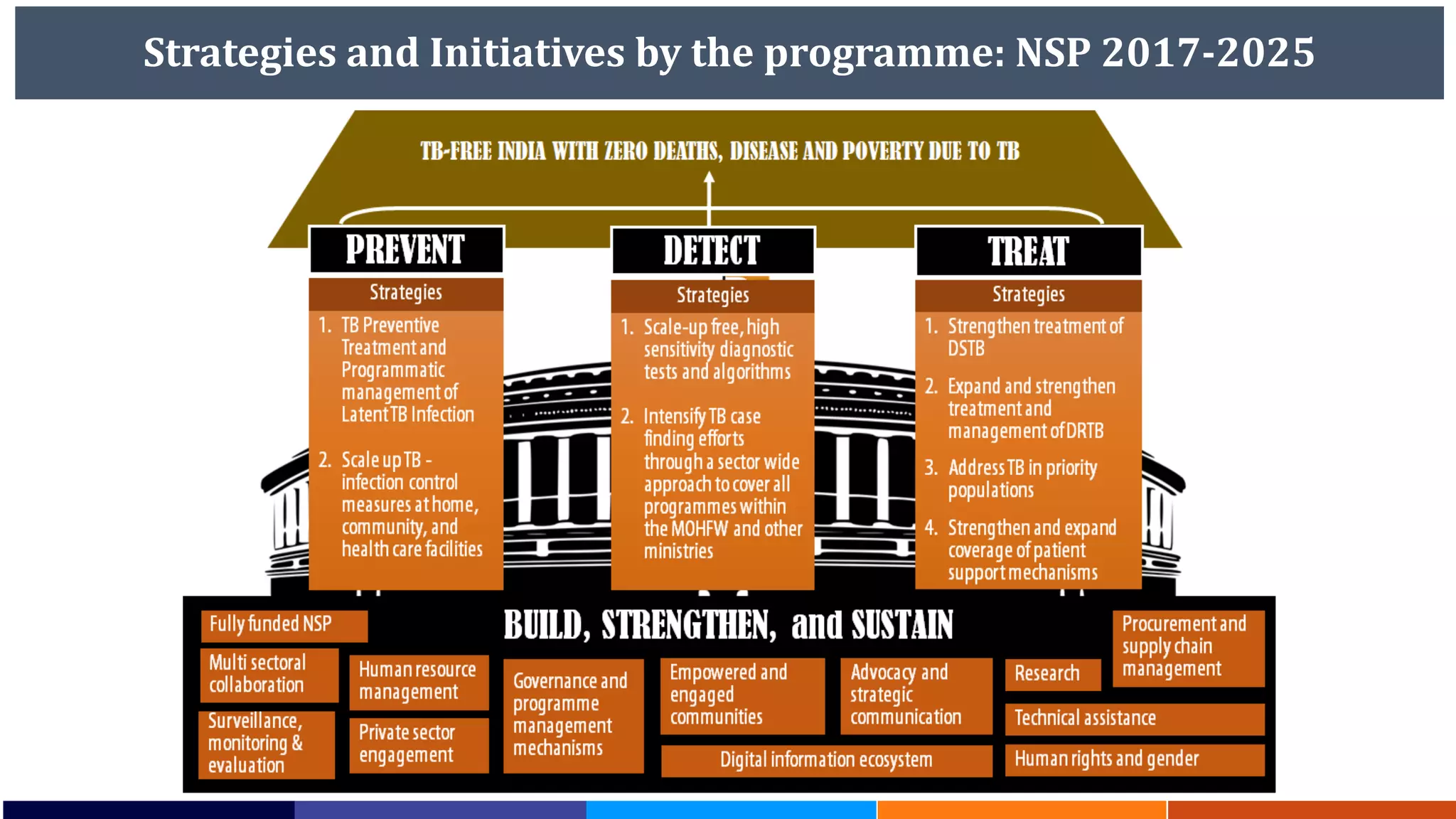
Strategies and Initiatives by the programme: NSP 2017-2025
Build - updates
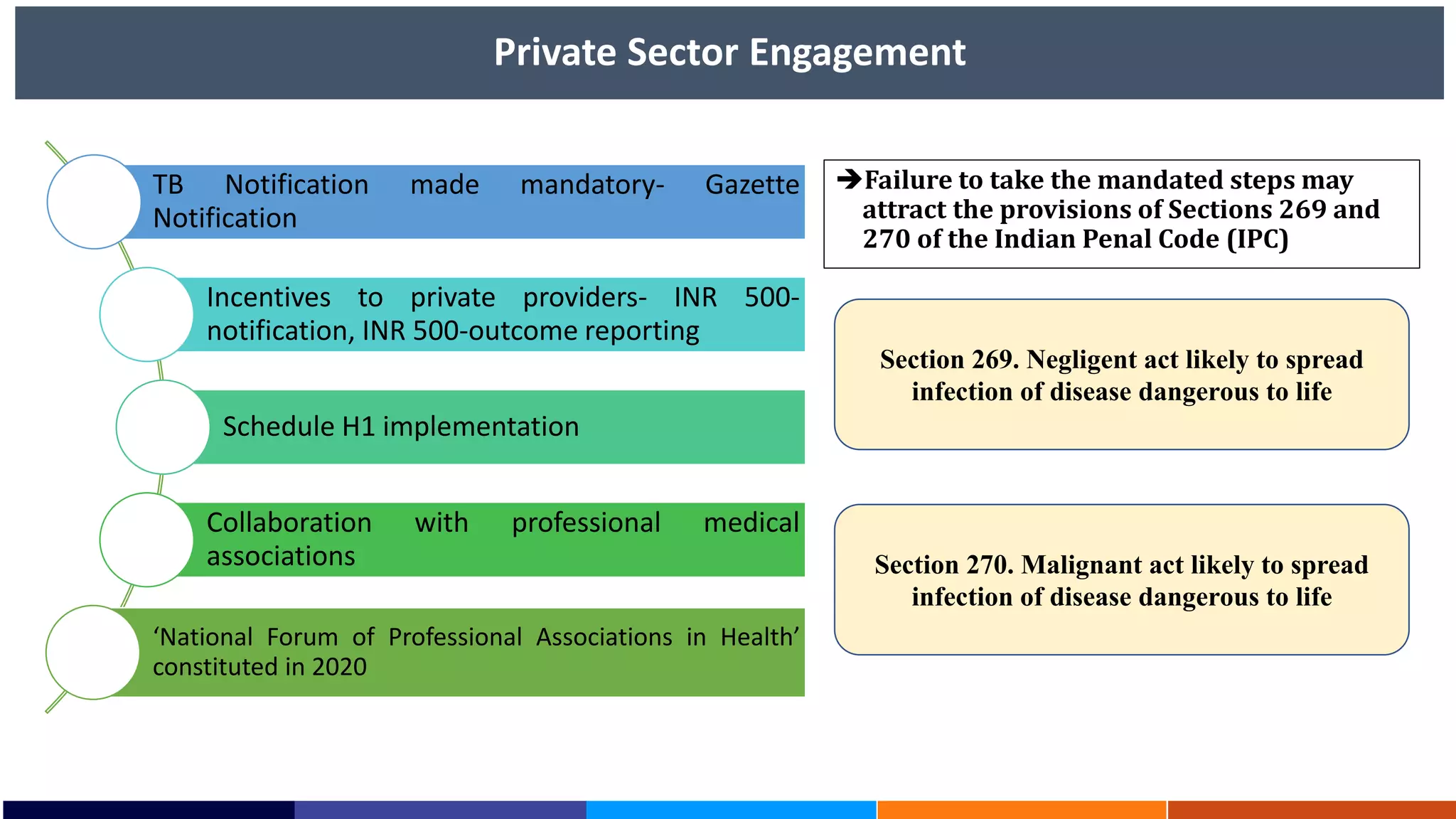
Private Sector Engagement
TB Notification made mandatory- Gazette
Notification
Incentives to private providers- INR 500-
notification, INR 500-outcome reporting
Schedule H1 implementation
Collaboration with professional medical
associations
‘National Forum of Professional Associations in Health’
constituted in 2020
Failure to take the mandated steps may
attract the provisions of Sections 269 and
270 of the Indian Penal Code (IPC)
Section 269. Negligent act likely to spread
infection of disease dangerous to life
Section 270. Malignant act likely to spread
infection of disease dangerous to life
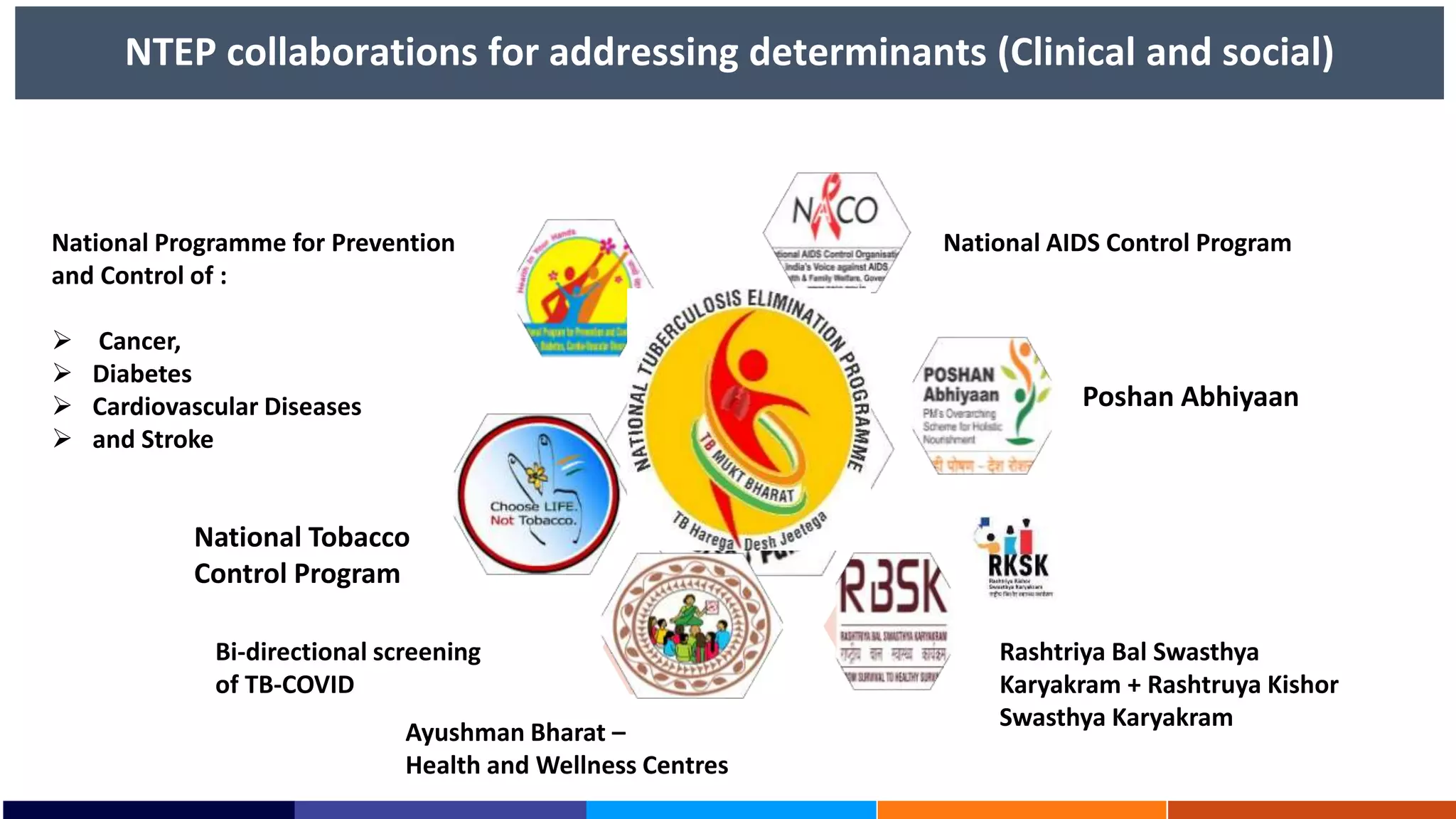
NTEP collaborations for addressing determinants (Clinical and social)
National AIDS Control Program
National Tobacco
Control Program
Rashtriya Bal Swasthya
Karyakram + Rashtruya Kishor
Swasthya Karyakram
National Programme for Prevention
and Control of :
 Cancer,
 Diabetes
 Cardiovascular Diseases
 and Stroke
Poshan Abhiyaan
Ayushman Bharat –
Health and Wellness Centres
Bi-directional screening
of TB-COVID
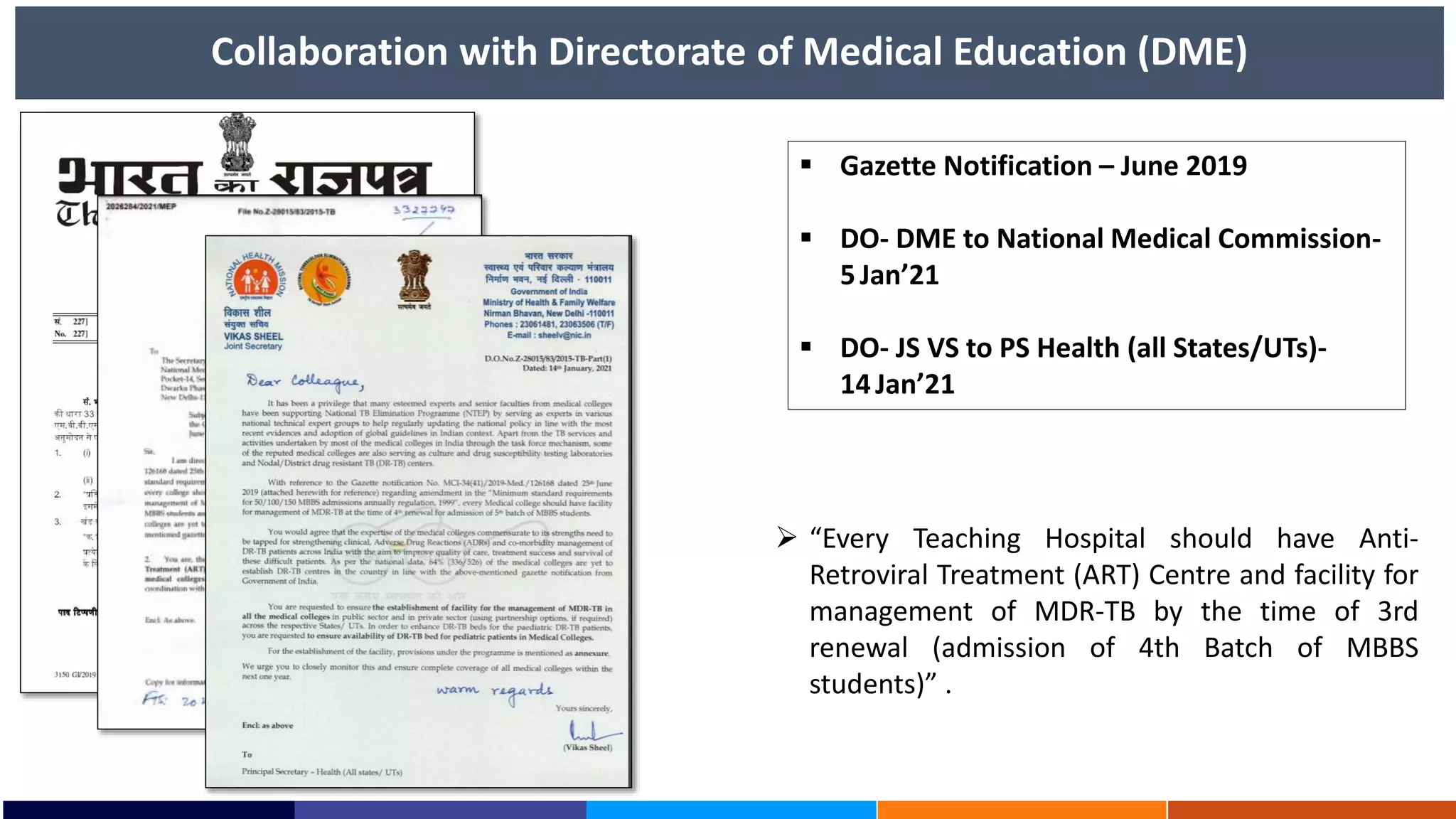
Collaboration with Directorate of Medical Education (DME)
 Gazette Notification – June 2019
 DO- DME to National Medical Commission-
5Jan’21
 DO- JS VS to PS Health (all States/UTs)-
14Jan’21
 “Every Teaching Hospital should have Anti-
Retroviral Treatment (ART) Centre and facility for
management of MDR-TB by the time of 3rd
renewal (admission of 4th Batch of MBBS
students)” .
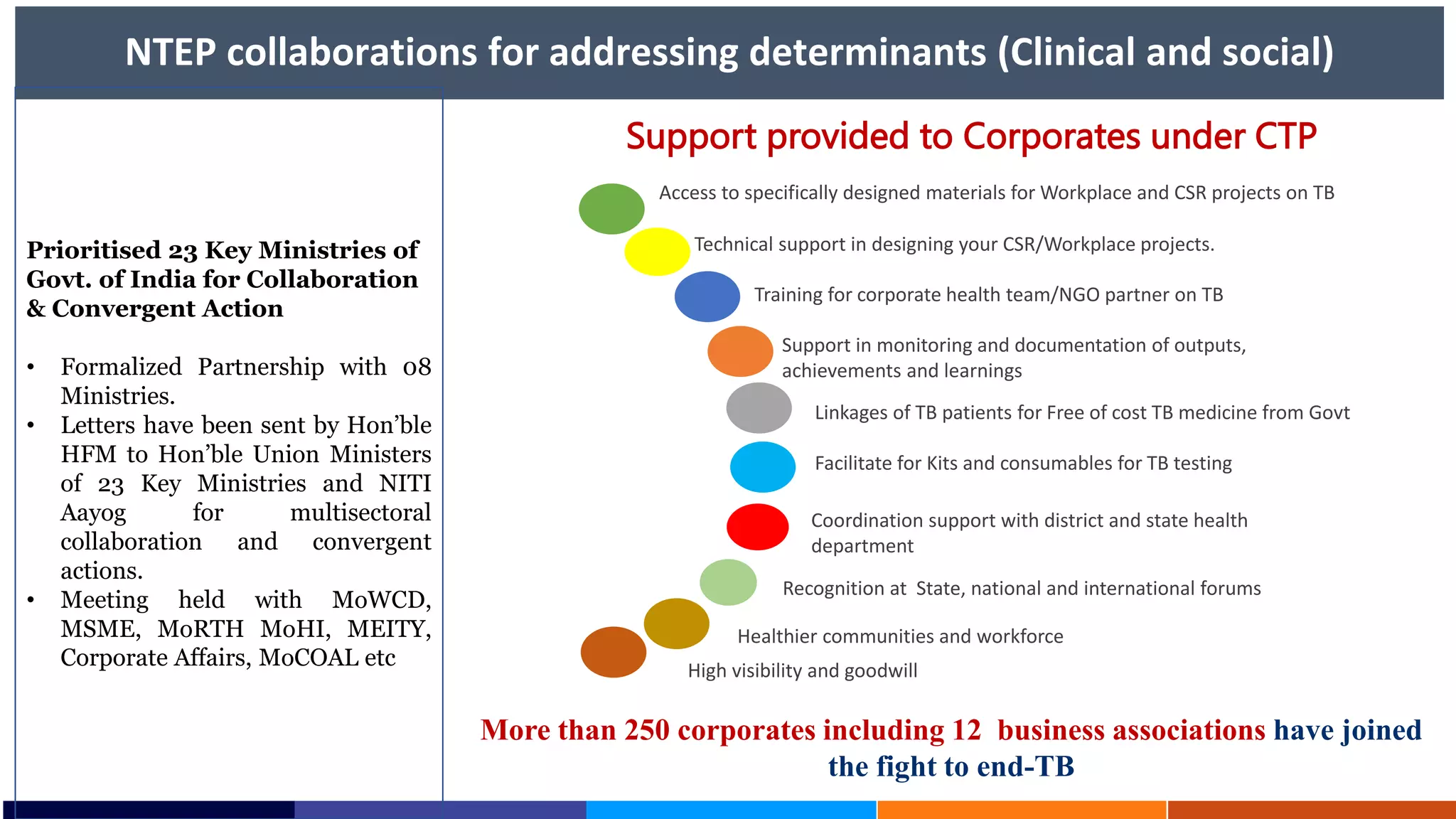
NTEP collaborations for addressing determinants (Clinical and social)
Prioritised 23 Key Ministries of
Govt. of India for Collaboration
& Convergent Action
• Formalized Partnership with 08
Ministries.
• Letters have been sent by Hon’ble
HFM to Hon’ble Union Ministers
of 23 Key Ministries and NITI
Aayog for multisectoral
collaboration and convergent
actions.
• Meeting held with MoWCD,
MSME, MoRTH MoHI, MEITY,
Corporate Affairs, MoCOAL etc
Support provided to Corporates under CTP
Access to specifically designed materials for Workplace and CSR projects on TB
Support in monitoring and documentation of outputs,
achievements and learnings
Facilitate for Kits and consumables for TB testing
Training for corporate health team/NGO partner on TB
Linkages of TB patients for Free of cost TB medicine from Govt
Technical support in designing your CSR/Workplace projects.
Healthier communities and workforce
Recognition at State, national and international forums
High visibility and goodwill
Coordination support with district and state health
department
More than 250 corporates including 12 business associations have joined
the fight to end-TB
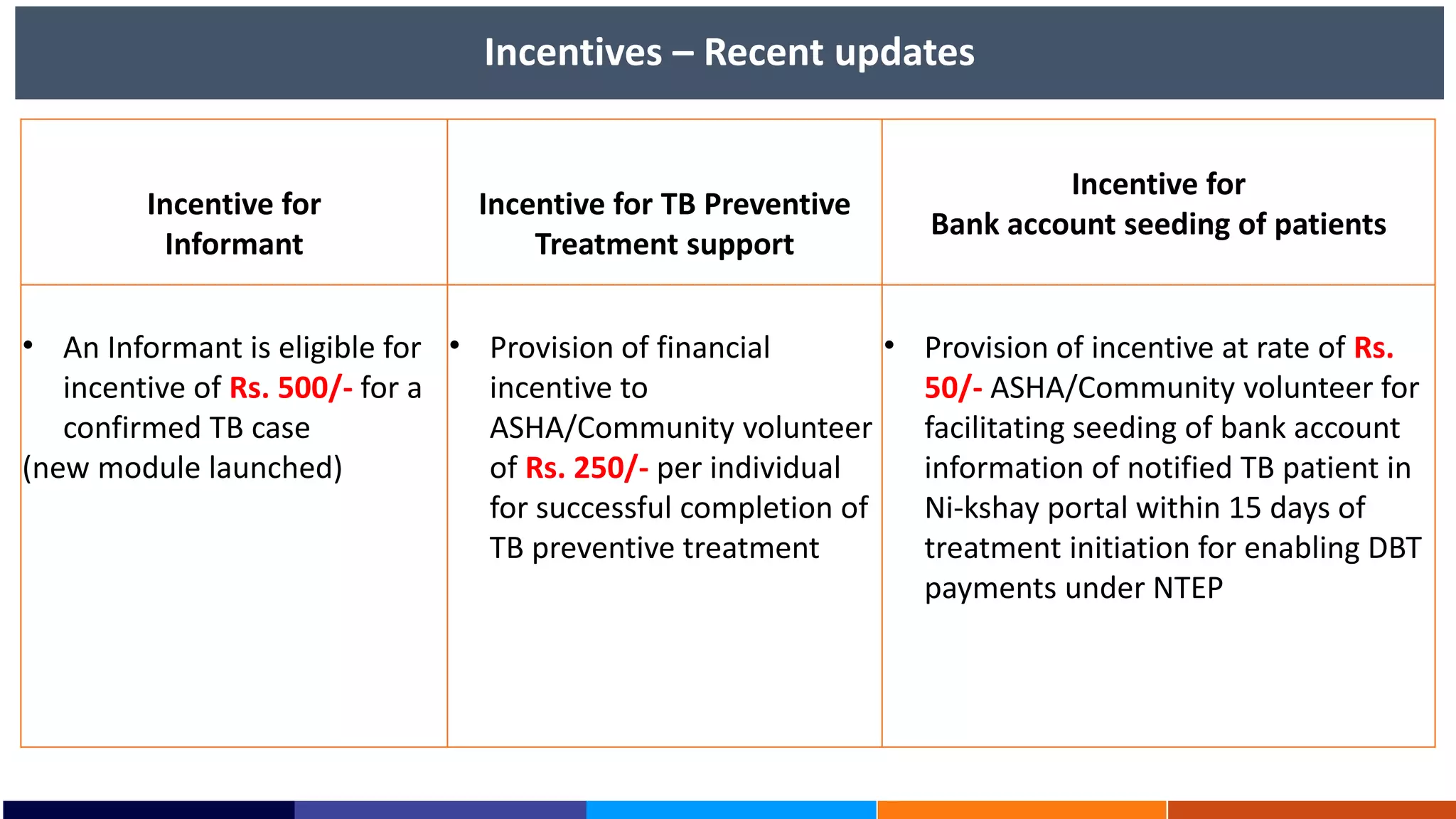
Incentives – Recent updates
Incentive for
Informant
Incentive for TB Preventive
Treatment support
Incentive for
Bank account seeding of patients
• An Informant is eligible for
incentive of Rs. 500/- for a
confirmed TB case
(new module launched)
• Provision of financial
incentive to
ASHA/Community volunteer
of Rs. 250/- per individual
for successful completion of
TB preventive treatment
• Provision of incentive at rate of Rs.
50/- ASHA/Community volunteer for
facilitating seeding of bank account
information of notified TB patient in
Ni-kshay portal within 15 days of
treatment initiation for enabling DBT
payments under NTEP
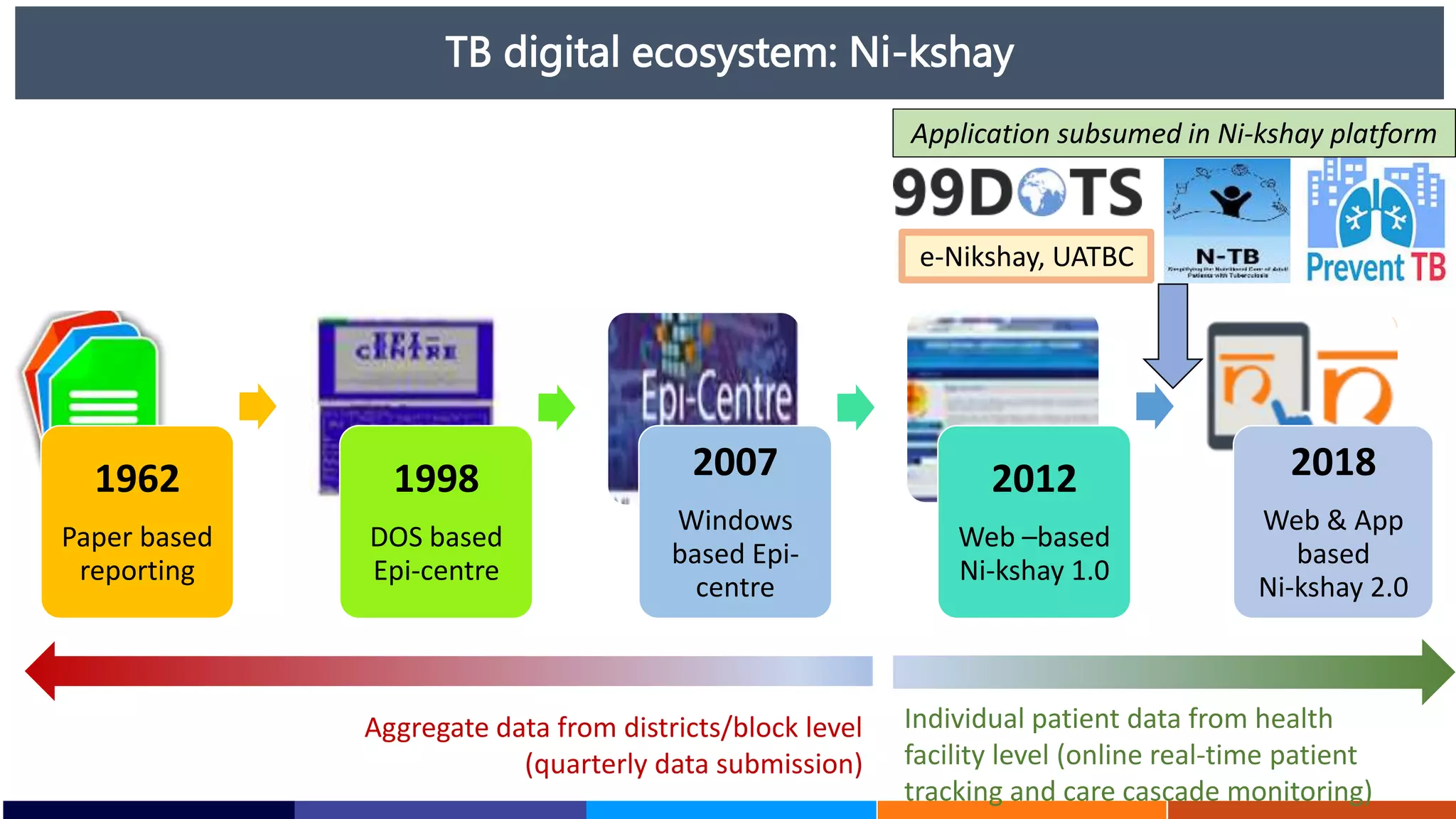
TB digital ecosystem: Ni-kshay
1962
Paper based
reporting
1998
DOS based
Epi-centre
2007
Windows
based Epi-
centre
2012
Web –based
Ni-kshay 1.0
2018
Web & App
based
Ni-kshay 2.0
Application subsumed in Ni-kshay platform
e-Nikshay, UATBC
Aggregate data from districts/block level
(quarterly data submission)
Individual patient data from health
facility level (online real-time patient
tracking and care cascade monitoring)
The e-learning tools – Knowledge building
Swasth e-Gurukul
WHO India’s
knowledge platform
platform for
e-learning
Expanded Clinical
Health Outcomes
Tele-mentoring
platform for learning
learning and capacity
capacity building
National
Programme on
Technology
Enhanced
Learning
ICMR-NIRT online
course “Manage TB”
Integrated
Government
Online Training
Integrated courses
across diseases and
different healthcare
providers
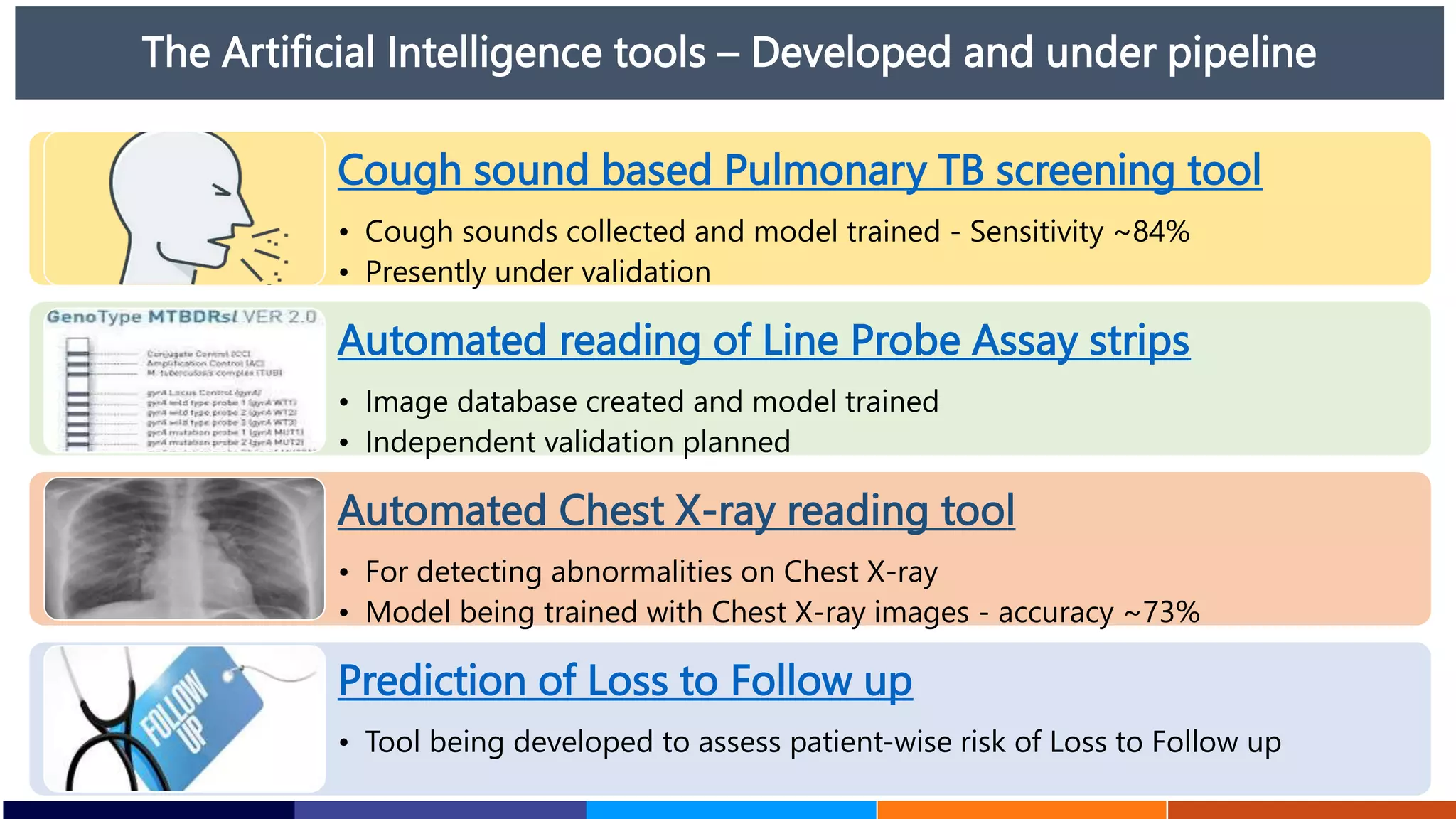
The Artificial Intelligence tools – Developed and under pipeline
Cough sound based Pulmonary TB screening tool
• Cough sounds collected and model trained - Sensitivity ~84%
• Presently under validation
Automated reading of Line Probe Assay strips
• Image database created and model trained
• Independent validation planned
Automated Chest X-ray reading tool
• For detecting abnormalities on Chest X-ray
• Model being trained with Chest X-ray images - accuracy ~73%
Prediction of Loss to Follow up
• Tool being developed to assess patient-wise risk of Loss to Follow up
Detect - Updates
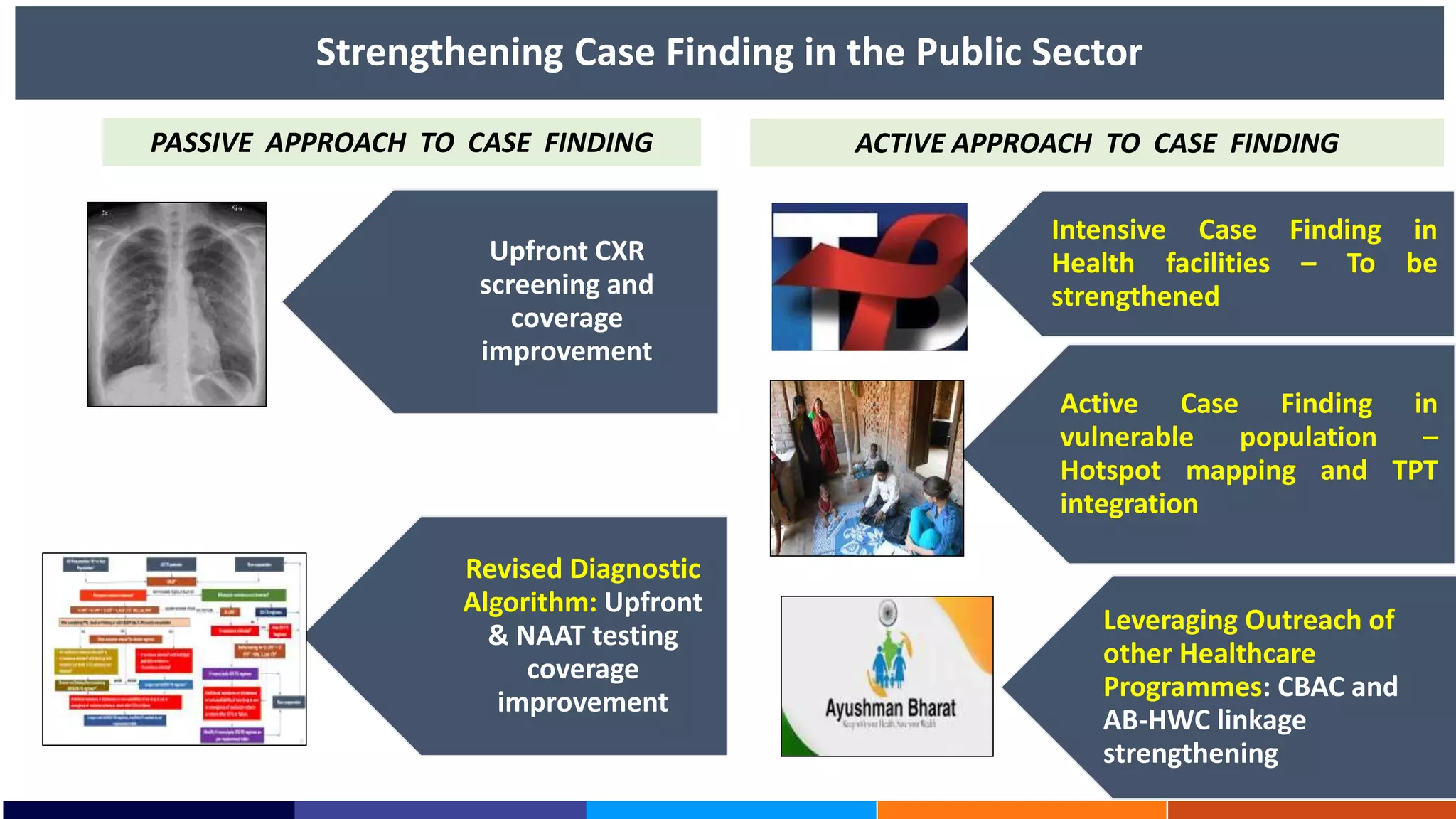
Strengthening Case Finding in the Public Sector
Upfront CXR
screening and
coverage
improvement
Revised Diagnostic
Algorithm: Upfront
& NAAT testing
coverage
improvement
Intensive Case Finding in
Health facilities – To be
strengthened
Active Case Finding in
vulnerable population –
Hotspot mapping and TPT
integration
Leveraging Outreach of
other Healthcare
Programmes: CBAC and
AB-HWC linkage
strengthening
PASSIVE APPROACH TO CASE FINDING ACTIVE APPROACH TO CASE FINDING
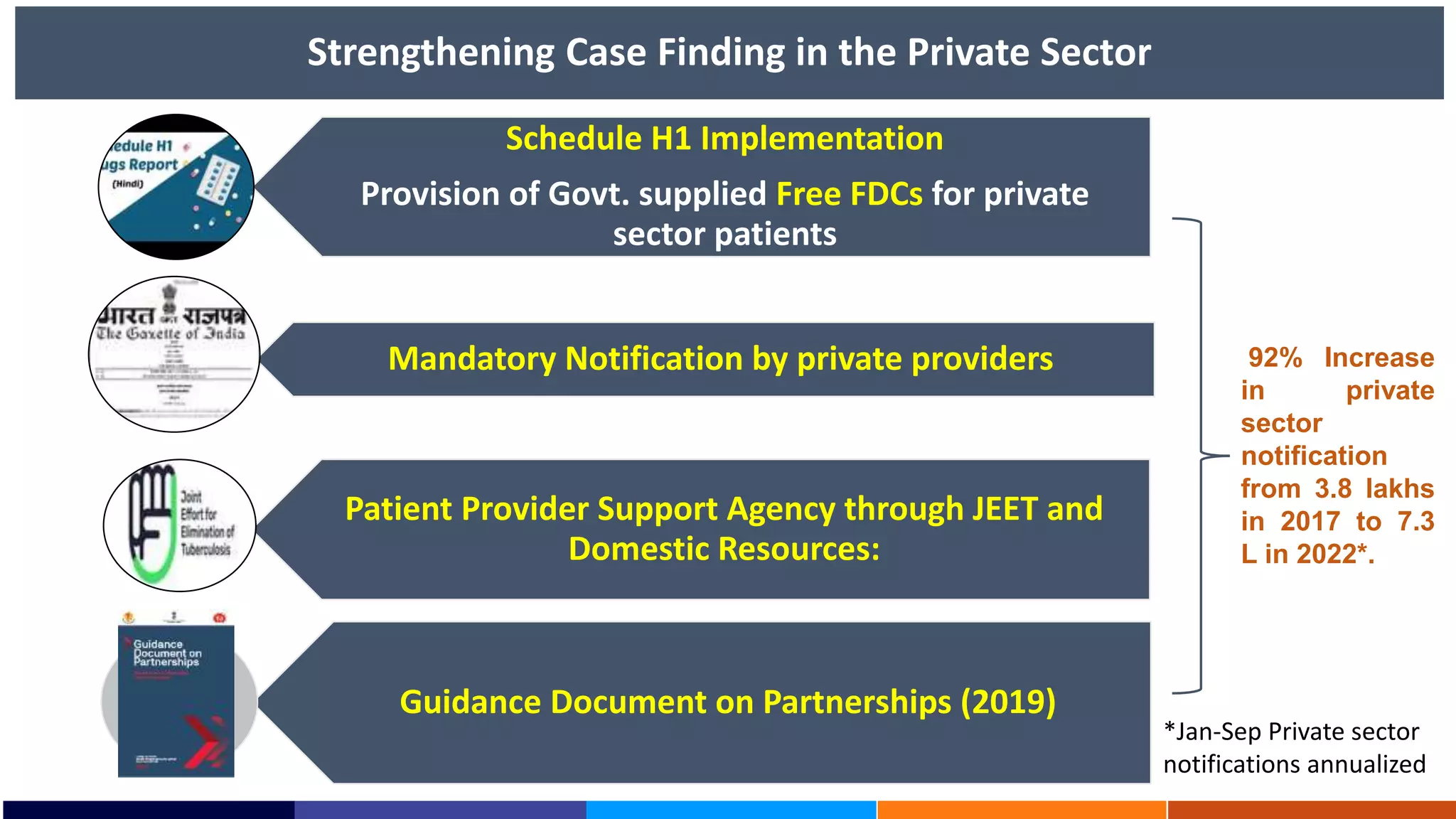
Strengthening Case Finding in the Private Sector
Schedule H1 Implementation
Provision of Govt. supplied Free FDCs for private
sector patients
Mandatory Notification by private providers
Patient Provider Support Agency through JEET and
Domestic Resources:
Guidance Document on Partnerships (2019)
92% Increase
in private
sector
notification
from 3.8 lakhs
in 2017 to 7.3
L in 2022*.
*Jan-Sep Private sector
notifications annualized
Treat
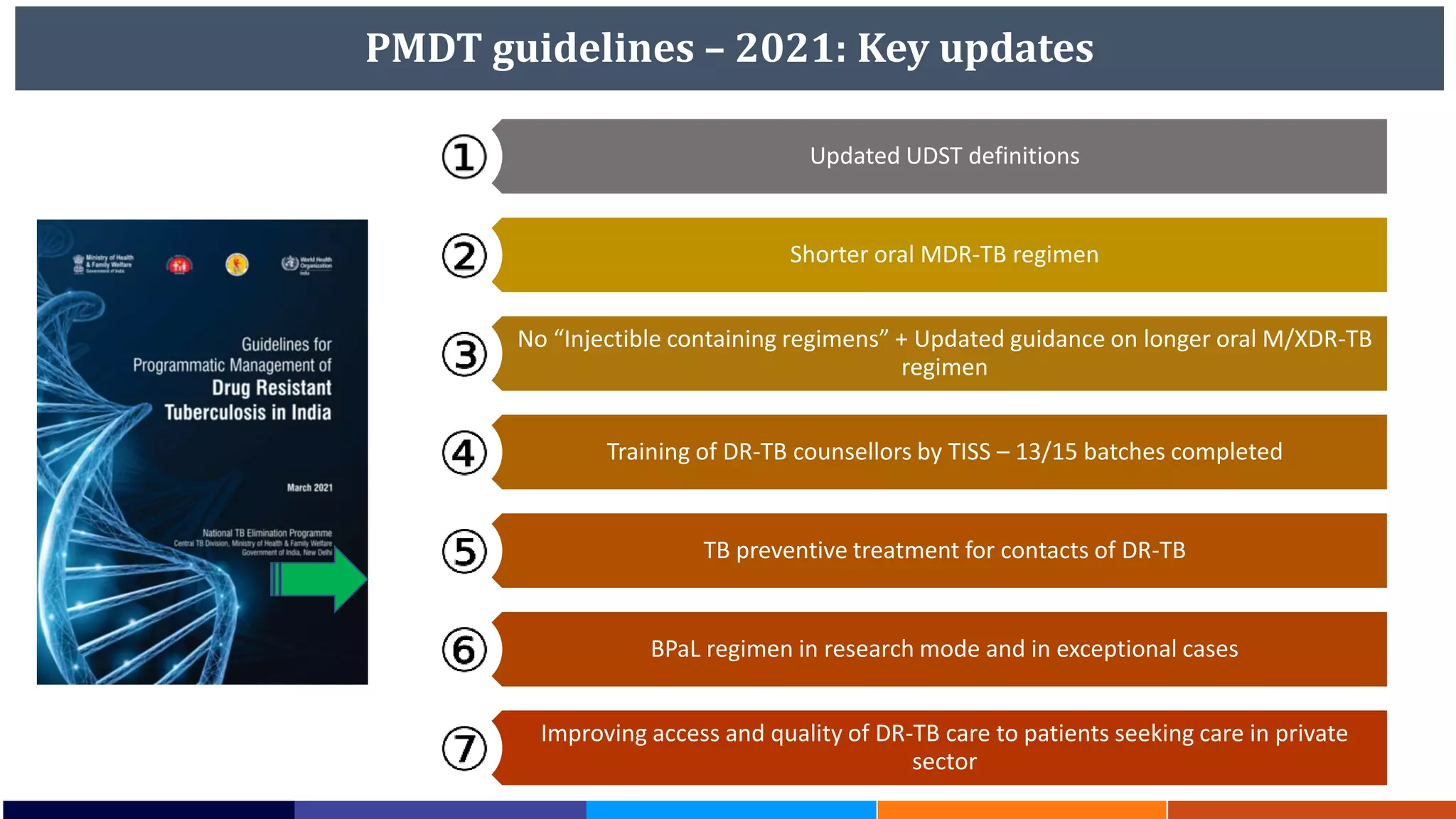
PMDT guidelines – 2021: Key updates
Updated UDST definitions
Shorter oral MDR-TB regimen
No “Injectible containing regimens” + Updated guidance on longer oral M/XDR-TB
regimen
Training of DR-TB counsellors by TISS – 13/15 batches completed
TB preventive treatment for contacts of DR-TB
BPaL regimen in research mode and in exceptional cases
Improving access and quality of DR-TB care to patients seeking care in private
sector
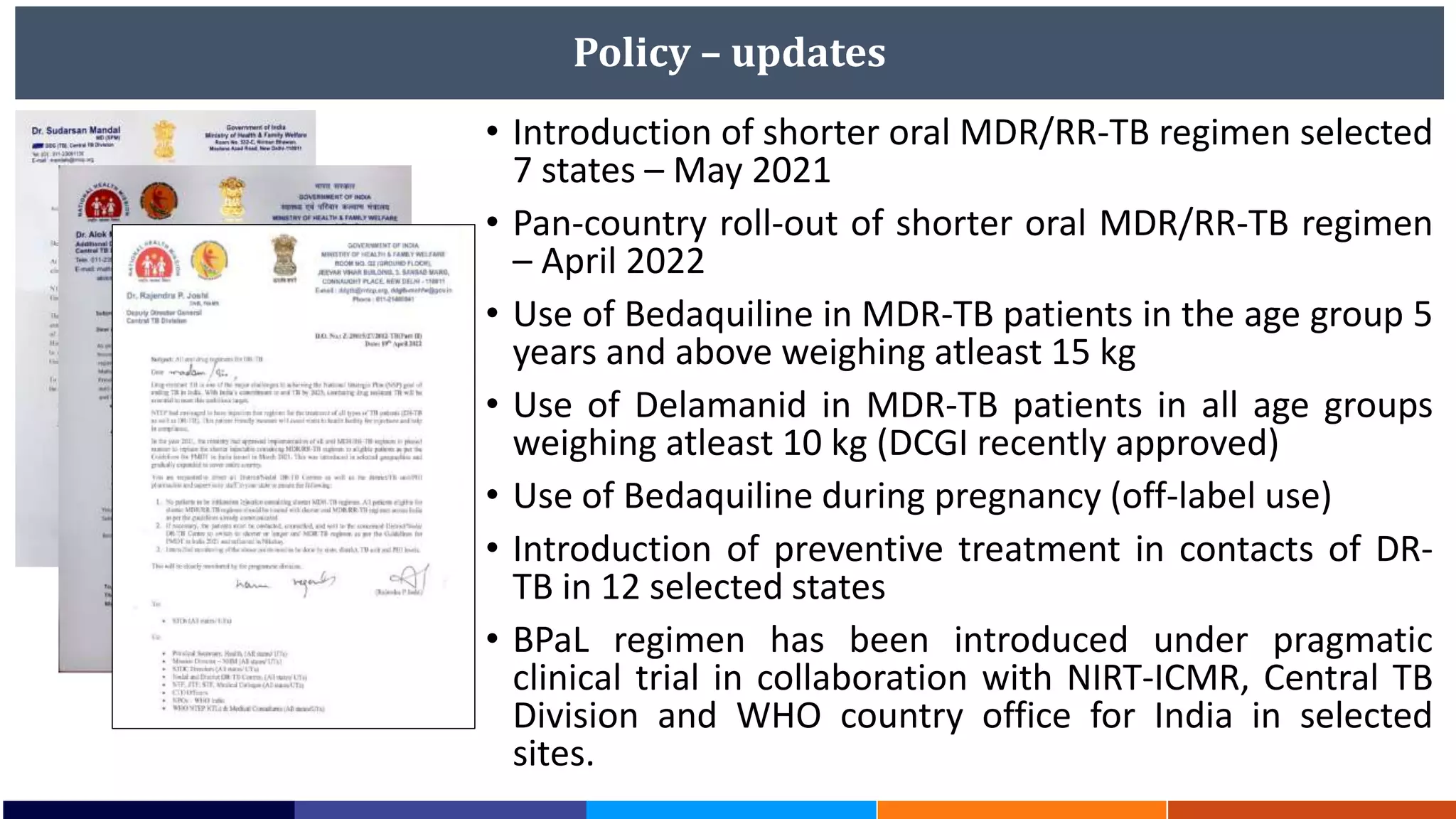
Policy – updates
• Introduction of shorter oral MDR/RR-TB regimen selected
7 states – May 2021
• Pan-country roll-out of shorter oral MDR/RR-TB regimen
– April 2022
• Use of Bedaquiline in MDR-TB patients in the age group 5
years and above weighing atleast 15 kg
• Use of Delamanid in MDR-TB patients in all age groups
weighing atleast 10 kg (DCGI recently approved)
• Use of Bedaquiline during pregnancy (off-label use)
• Introduction of preventive treatment in contacts of DR-
TB in 12 selected states
• BPaL regimen has been introduced under pragmatic
clinical trial in collaboration with NIRT-ICMR, Central TB
Division and WHO country office for India in selected
sites.
Prevent
Prevent - PMTPT policy related update
PMTPT policy Update
Target
population
Household contacts of pulmonary
TB*
Expansion of target population
PLHIV
NTEG meeting (23-24 Sep 2022): Malnourished,
Alcohol abusers, smokers and diabetics
Other risk groups - dialysis, silicosis,
initiated on Immunosuppresant or
anti-TNF, transplant recipients
NTEG meeting (23-24 Sep 2022): TPT intervention
to be merged with ACF and community level
intervention [next slide]
Testing
option
IGRA or TST
• IGRA or TST or Cy-TB
• DCGI approval for use of Cy-TB in age >/=18 years
• ICMR study is ongoing to validate feasibility of
Cy-TB in age <18 years [likely to get approval
from DCGI following study findings by year end]
Treatment
option
• 6H or 3HP
o 6H or 3HP
o 3RH expanded in 1+5 states
TPT in DR-
TB contact
• 6Lfx or 4R On-going and need to improve coverage
Newer initiatives
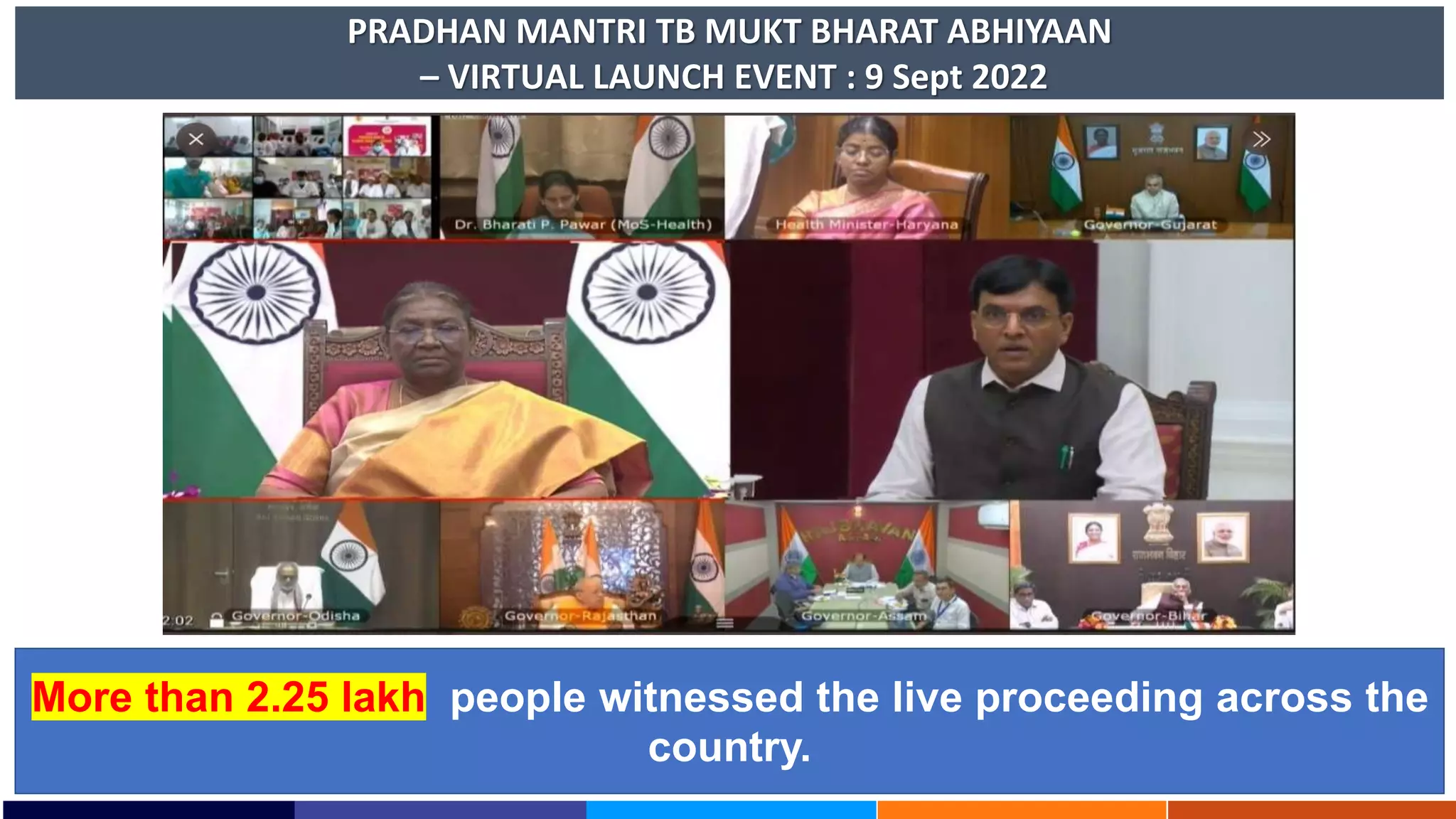
PRADHAN MANTRI TB MUKT BHARAT ABHIYAAN
– VIRTUAL LAUNCH EVENT : 9 Sept 2022
More than 2.25 lakh people witnessed the live proceeding across the
country.
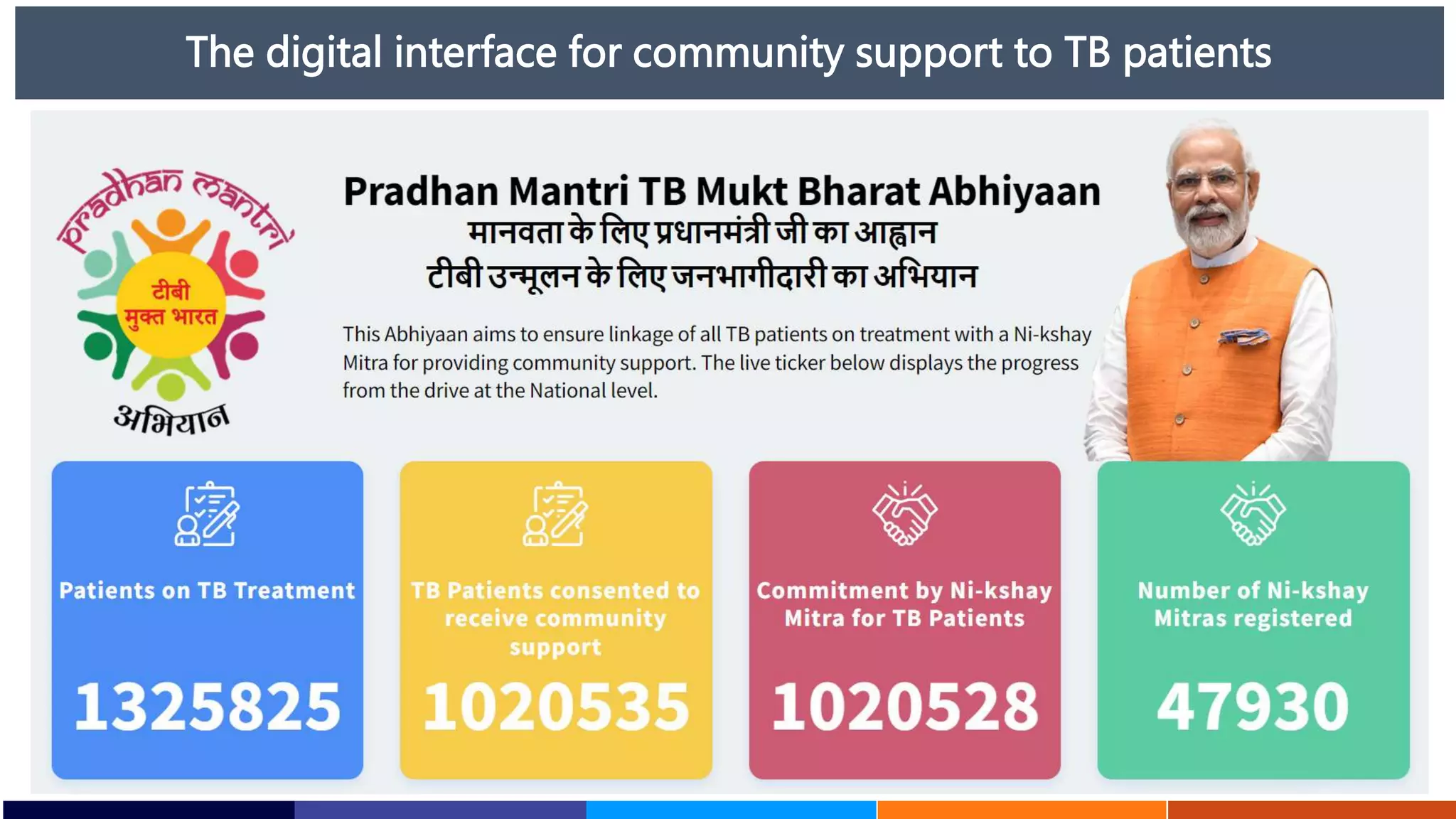
The digital interface for community support to TB patients
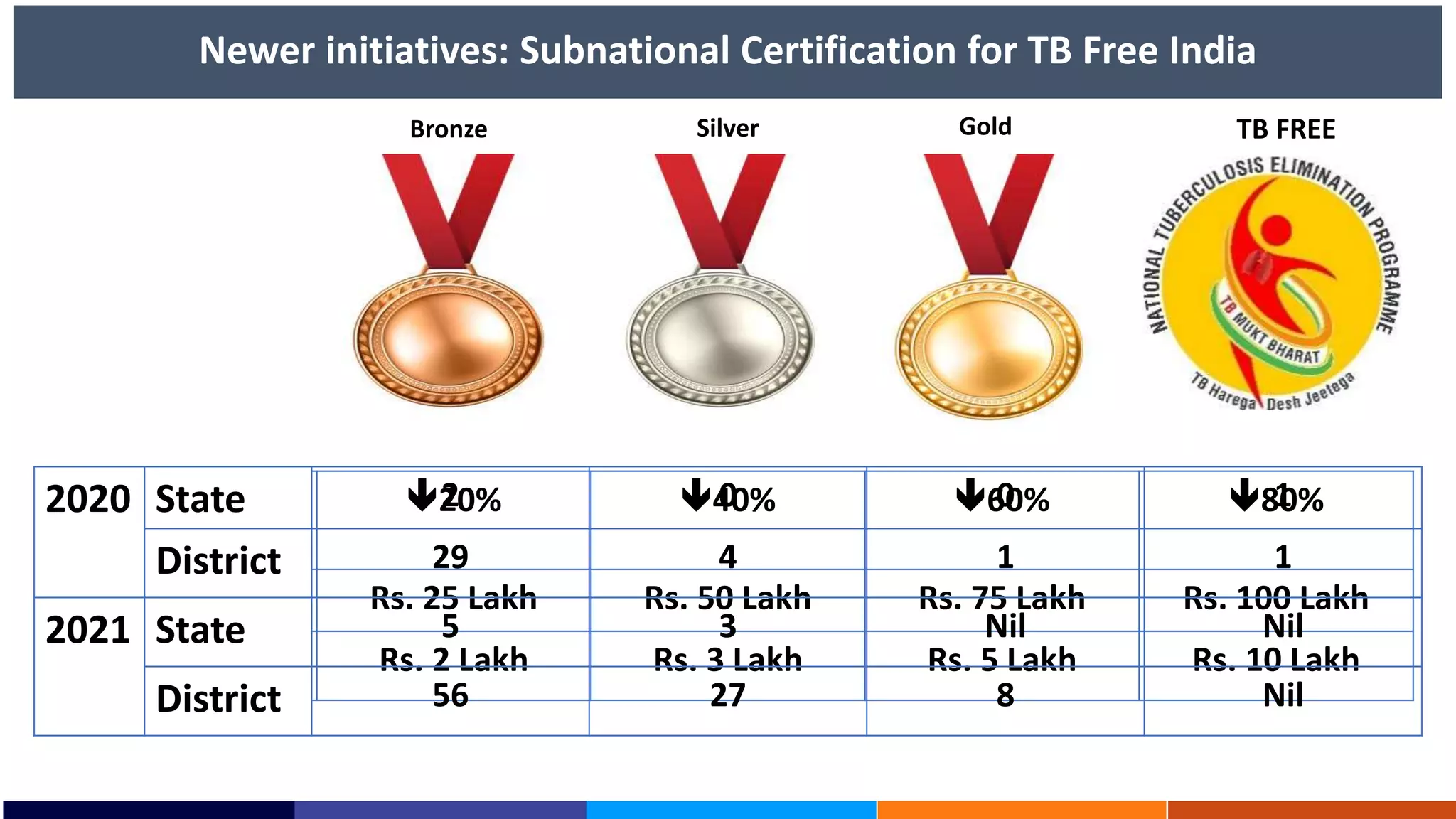
Newer initiatives: Subnational Certification for TB Free India
Criteria
(Incidence decline)
20% 40% 60% 80%
State Rs. 25 Lakh Rs. 50 Lakh Rs. 75 Lakh Rs. 100 Lakh
District Rs. 2 Lakh Rs. 3 Lakh Rs. 5 Lakh Rs. 10 Lakh
TB FREE
2020 State 2 0 0 1
District 29 4 1 1
2021 State 5 3 Nil Nil
District 56 27 8 Nil
Bronze Silver Gold
Towards 2025: Thrust from Medical Colleges
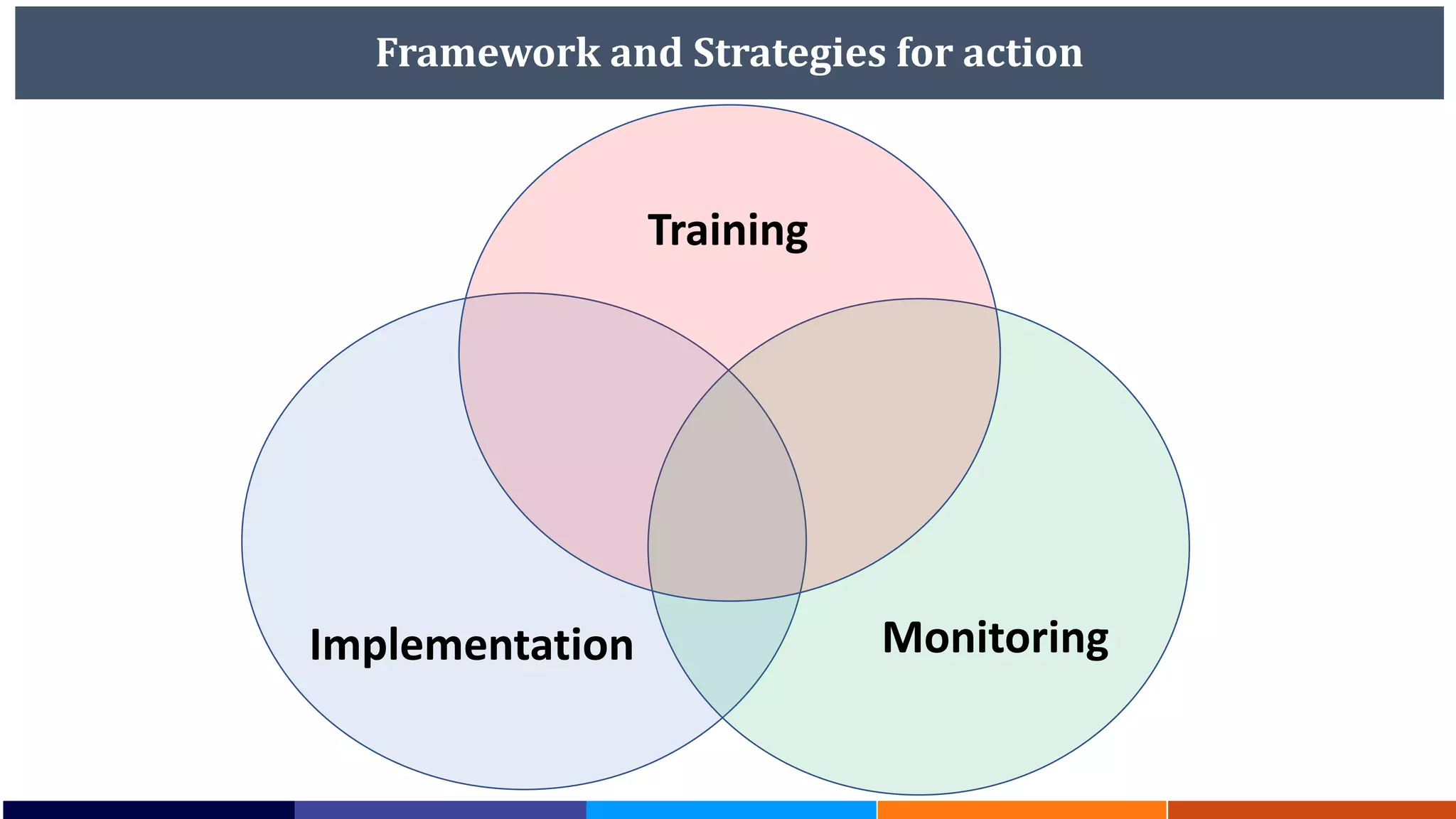
Framework and Strategies for action
Training
Implementation Monitoring
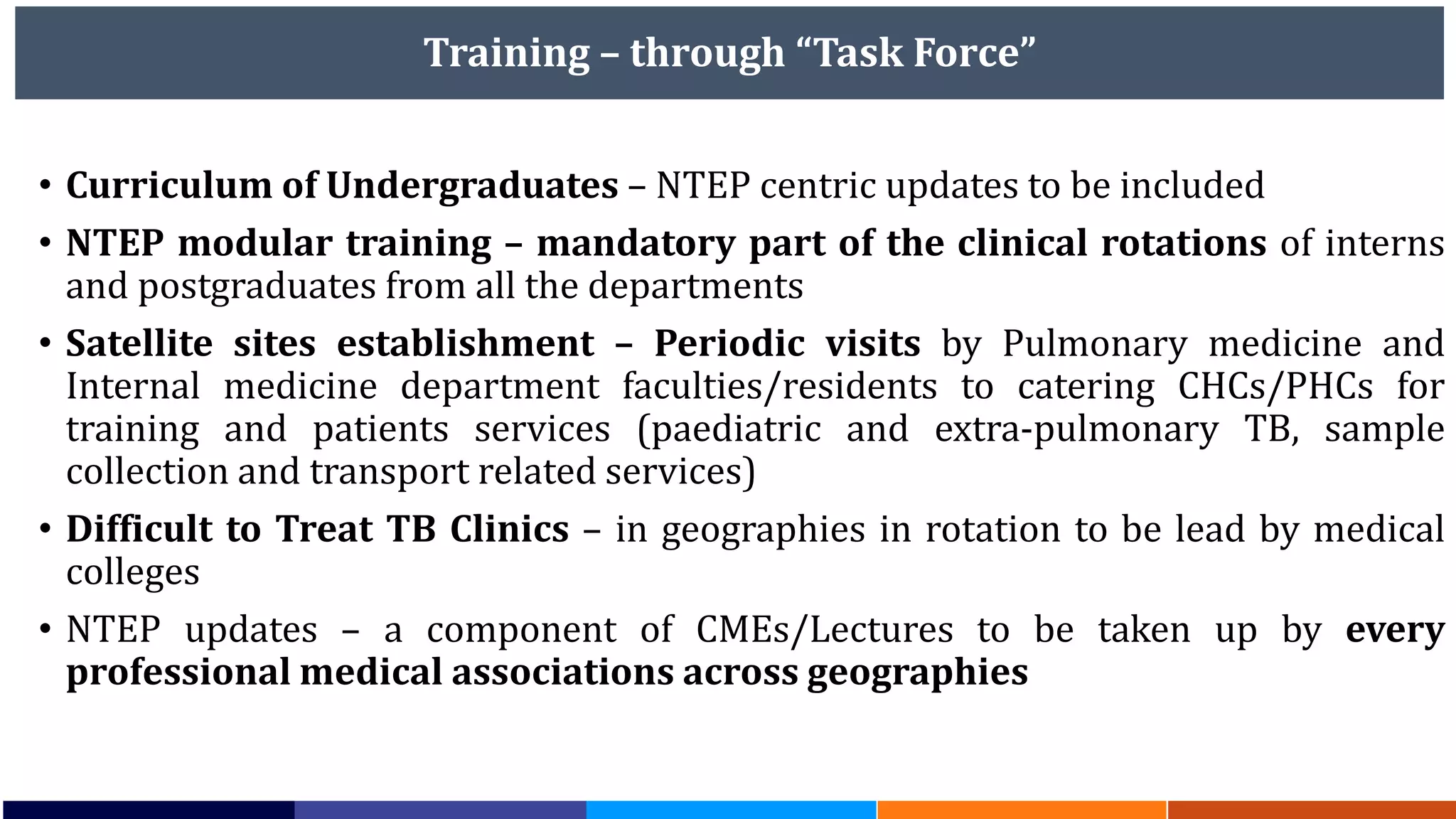
Training – through “Task Force”
• Curriculum of Undergraduates – NTEP centric updates to be included
• NTEP modular training – mandatory part of the clinical rotations of interns
and postgraduates from all the departments
• Satellite sites establishment – Periodic visits by Pulmonary medicine and
Internal medicine department faculties/residents to catering CHCs/PHCs for
training and patients services (paediatric and extra-pulmonary TB, sample
collection and transport related services)
• Difficult to Treat TB Clinics – in geographies in rotation to be lead by medical
colleges
• NTEP updates – a component of CMEs/Lectures to be taken up by every
professional medical associations across geographies
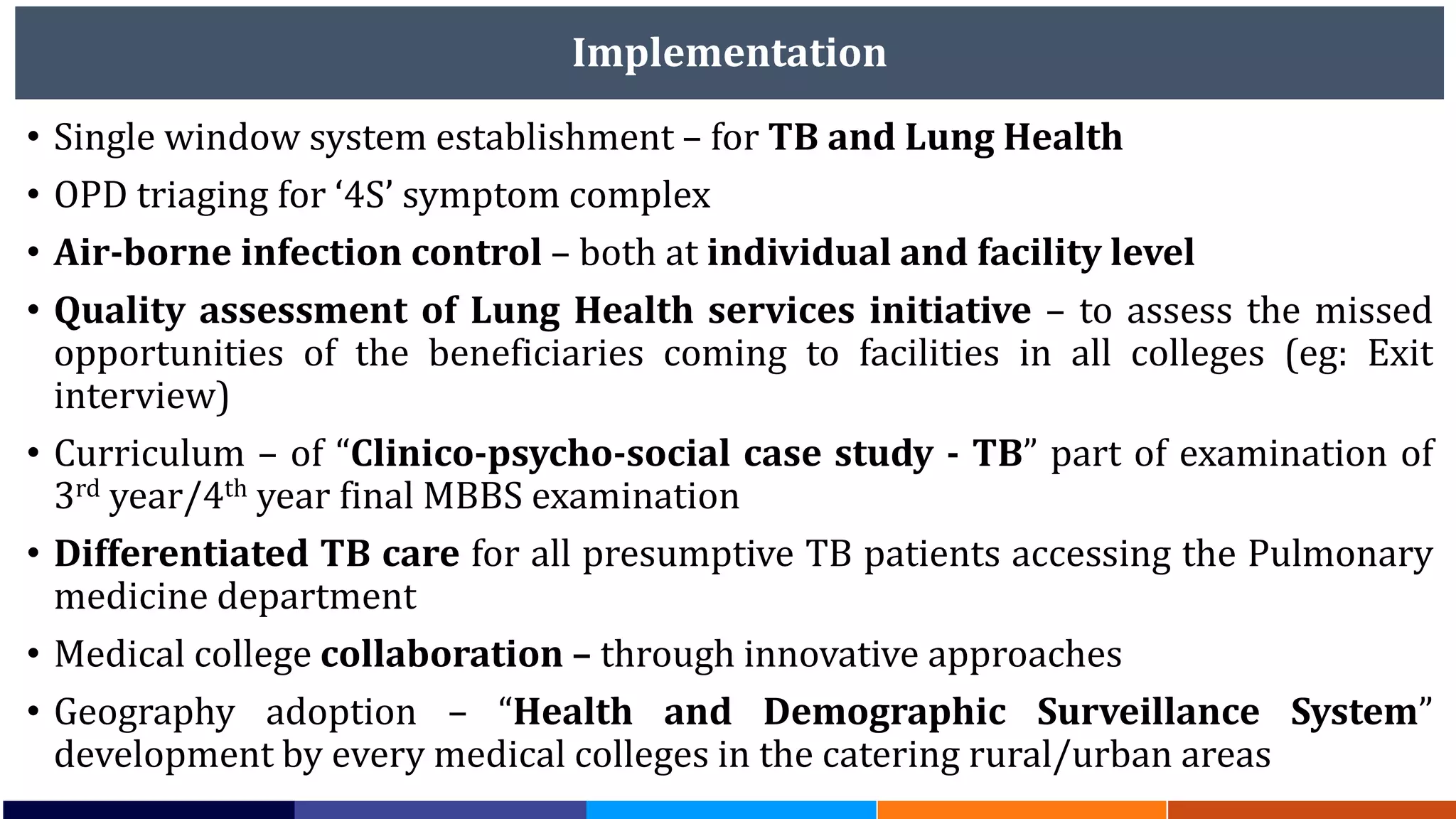
Implementation
• Single window system establishment – for TB and Lung Health
• OPD triaging for ‘4S’ symptom complex
• Air-borne infection control – both at individual and facility level
• Quality assessment of Lung Health services initiative – to assess the missed
opportunities of the beneficiaries coming to facilities in all colleges (eg: Exit
interview)
• Curriculum – of “Clinico-psycho-social case study - TB” part of examination of
3rd year/4th year final MBBS examination
• Differentiated TB care for all presumptive TB patients accessing the Pulmonary
medicine department
• Medical college collaboration – through innovative approaches
• Geography adoption – “Health and Demographic Surveillance System”
development by every medical colleges in the catering rural/urban areas
Monitoring
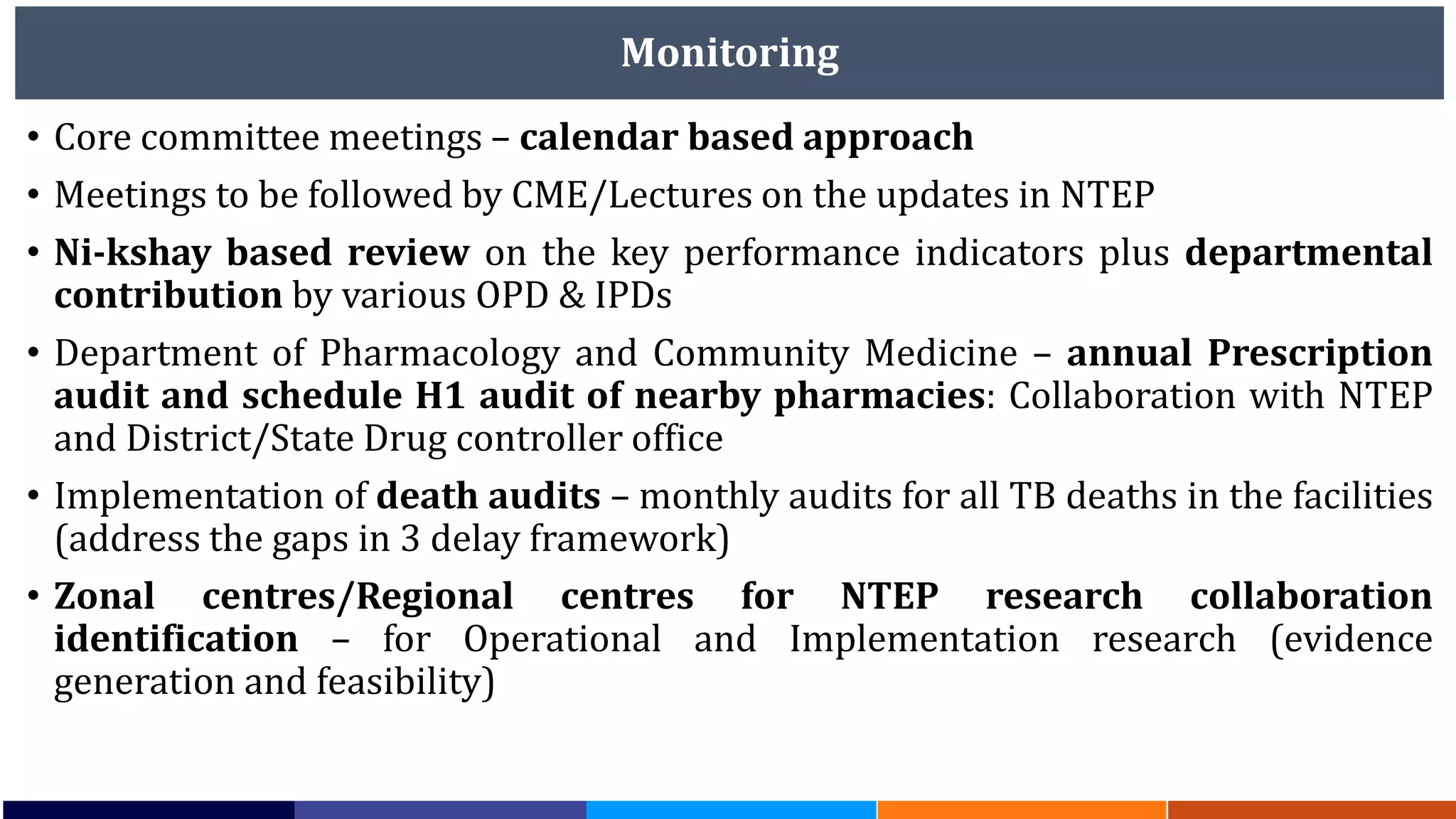
• Core committee meetings – calendar based approach
• Meetings to be followed by CME/Lectures on the updates in NTEP
• Ni-kshay based review on the key performance indicators plus departmental
contribution by various OPD & IPDs
• Department of Pharmacology and Community Medicine – annual Prescription
audit and schedule H1 audit of nearby pharmacies: Collaboration with NTEP
and District/State Drug controller office
• Implementation of death audits – monthly audits for all TB deaths in the facilities
(address the gaps in 3 delay framework)
• Zonal centres/Regional centres for NTEP research collaboration
identification – for Operational and Implementation research (evidence
generation and feasibility)
Thank you

NTEP status updates and plans for ending TB in India

  • 1.
    National Workshop forMedical Colleges Task Force to Accelerate Ending TB in India NTEP Policy updates and plans for Ending TB - 2025 Dr Rajendra P Joshi Deputy Director General ( TB ) Central TB Division, MoHFW, GOI
  • 2.
    Outline • National commitmenttowards TB Mukt Bharat • What is our SDG and Where are we? • Bending the curve – Know how? • Strategies/Interventions by the programme (DTPB) • Newer initiatives – SNC, PMTBMBA • Role of medical college
  • 3.
    National Commitment: TBMukt Bharat • Prime Minister of India launched TB Free India campaign at ‘Delhi End TB Summit’ on 13th March, 2018 • India has committed to End TB by 2025, 5 years ahead of the global SDG target • The campaign calls for a patient- centric and holistic care driven by integrated actions for TB Free India
  • 4.
    NTEP – India2022 (Jan-Sep*) 127 91 104 123 50 40 49 52 177 131 153 175 0 20 40 60 80 100 120 140 160 180 200 2019 2020 2021 2022* Public Private Total *Jan-Sep 2022 annualized. $ - among microbiologically confirmed TB. Incidence from Interim report of Global TB report, 2022. Rf sensitivity testing coverage$: 84.7% Total TPT initiations: 6.1L NPY payment status: 58% 2022* Treatment success rate: 84.2% Case Notification rate Incidence 2021: 210/lakh population
  • 5.
    Drivers of theepidemic India* 1 2 3 2 5 5 4 3 4 1 *Global TB Report, 2022 – Interim report for India
  • 6.
    Burden – Current Scenario •As per the Global TB Report, the estimated incidence of all forms of TB in India for the year 2021 was 210 per 100,000 population (178-244 per 100,000 population) • How to bend the curve*? TB Epidemic dynamics under different intervention scenarios Incidence slope Mortality slope 6 *Arinaminpathy N, Mandal S, Bhatia V, McLeod R, Sharma M, Swaminathan S, et al. Strategies for ending tuberculosis in the South-East Asian Region: A modelling approach. Indian J Med Res. 2019;149(4):517.
  • 7.
    Strategies and Initiativesby the programme: NSP 2017-2025
  • 8.
  • 9.
    Private Sector Engagement TBNotification made mandatory- Gazette Notification Incentives to private providers- INR 500- notification, INR 500-outcome reporting Schedule H1 implementation Collaboration with professional medical associations ‘National Forum of Professional Associations in Health’ constituted in 2020 Failure to take the mandated steps may attract the provisions of Sections 269 and 270 of the Indian Penal Code (IPC) Section 269. Negligent act likely to spread infection of disease dangerous to life Section 270. Malignant act likely to spread infection of disease dangerous to life
  • 10.
    NTEP collaborations foraddressing determinants (Clinical and social) National AIDS Control Program National Tobacco Control Program Rashtriya Bal Swasthya Karyakram + Rashtruya Kishor Swasthya Karyakram National Programme for Prevention and Control of :  Cancer,  Diabetes  Cardiovascular Diseases  and Stroke Poshan Abhiyaan Ayushman Bharat – Health and Wellness Centres Bi-directional screening of TB-COVID
  • 11.
    Collaboration with Directorateof Medical Education (DME)  Gazette Notification – June 2019  DO- DME to National Medical Commission- 5Jan’21  DO- JS VS to PS Health (all States/UTs)- 14Jan’21  “Every Teaching Hospital should have Anti- Retroviral Treatment (ART) Centre and facility for management of MDR-TB by the time of 3rd renewal (admission of 4th Batch of MBBS students)” .
  • 12.
    NTEP collaborations foraddressing determinants (Clinical and social) Prioritised 23 Key Ministries of Govt. of India for Collaboration & Convergent Action • Formalized Partnership with 08 Ministries. • Letters have been sent by Hon’ble HFM to Hon’ble Union Ministers of 23 Key Ministries and NITI Aayog for multisectoral collaboration and convergent actions. • Meeting held with MoWCD, MSME, MoRTH MoHI, MEITY, Corporate Affairs, MoCOAL etc Support provided to Corporates under CTP Access to specifically designed materials for Workplace and CSR projects on TB Support in monitoring and documentation of outputs, achievements and learnings Facilitate for Kits and consumables for TB testing Training for corporate health team/NGO partner on TB Linkages of TB patients for Free of cost TB medicine from Govt Technical support in designing your CSR/Workplace projects. Healthier communities and workforce Recognition at State, national and international forums High visibility and goodwill Coordination support with district and state health department More than 250 corporates including 12 business associations have joined the fight to end-TB
  • 13.
    Incentives – Recentupdates Incentive for Informant Incentive for TB Preventive Treatment support Incentive for Bank account seeding of patients • An Informant is eligible for incentive of Rs. 500/- for a confirmed TB case (new module launched) • Provision of financial incentive to ASHA/Community volunteer of Rs. 250/- per individual for successful completion of TB preventive treatment • Provision of incentive at rate of Rs. 50/- ASHA/Community volunteer for facilitating seeding of bank account information of notified TB patient in Ni-kshay portal within 15 days of treatment initiation for enabling DBT payments under NTEP
  • 14.
    TB digital ecosystem:Ni-kshay 1962 Paper based reporting 1998 DOS based Epi-centre 2007 Windows based Epi- centre 2012 Web –based Ni-kshay 1.0 2018 Web & App based Ni-kshay 2.0 Application subsumed in Ni-kshay platform e-Nikshay, UATBC Aggregate data from districts/block level (quarterly data submission) Individual patient data from health facility level (online real-time patient tracking and care cascade monitoring)
  • 15.
    The e-learning tools– Knowledge building Swasth e-Gurukul WHO India’s knowledge platform platform for e-learning Expanded Clinical Health Outcomes Tele-mentoring platform for learning learning and capacity capacity building National Programme on Technology Enhanced Learning ICMR-NIRT online course “Manage TB” Integrated Government Online Training Integrated courses across diseases and different healthcare providers
  • 16.
    The Artificial Intelligencetools – Developed and under pipeline Cough sound based Pulmonary TB screening tool • Cough sounds collected and model trained - Sensitivity ~84% • Presently under validation Automated reading of Line Probe Assay strips • Image database created and model trained • Independent validation planned Automated Chest X-ray reading tool • For detecting abnormalities on Chest X-ray • Model being trained with Chest X-ray images - accuracy ~73% Prediction of Loss to Follow up • Tool being developed to assess patient-wise risk of Loss to Follow up
  • 17.
  • 18.
    Strengthening Case Findingin the Public Sector Upfront CXR screening and coverage improvement Revised Diagnostic Algorithm: Upfront & NAAT testing coverage improvement Intensive Case Finding in Health facilities – To be strengthened Active Case Finding in vulnerable population – Hotspot mapping and TPT integration Leveraging Outreach of other Healthcare Programmes: CBAC and AB-HWC linkage strengthening PASSIVE APPROACH TO CASE FINDING ACTIVE APPROACH TO CASE FINDING
  • 19.
    Strengthening Case Findingin the Private Sector Schedule H1 Implementation Provision of Govt. supplied Free FDCs for private sector patients Mandatory Notification by private providers Patient Provider Support Agency through JEET and Domestic Resources: Guidance Document on Partnerships (2019) 92% Increase in private sector notification from 3.8 lakhs in 2017 to 7.3 L in 2022*. *Jan-Sep Private sector notifications annualized
  • 20.
  • 21.
    PMDT guidelines –2021: Key updates Updated UDST definitions Shorter oral MDR-TB regimen No “Injectible containing regimens” + Updated guidance on longer oral M/XDR-TB regimen Training of DR-TB counsellors by TISS – 13/15 batches completed TB preventive treatment for contacts of DR-TB BPaL regimen in research mode and in exceptional cases Improving access and quality of DR-TB care to patients seeking care in private sector
  • 22.
    Policy – updates •Introduction of shorter oral MDR/RR-TB regimen selected 7 states – May 2021 • Pan-country roll-out of shorter oral MDR/RR-TB regimen – April 2022 • Use of Bedaquiline in MDR-TB patients in the age group 5 years and above weighing atleast 15 kg • Use of Delamanid in MDR-TB patients in all age groups weighing atleast 10 kg (DCGI recently approved) • Use of Bedaquiline during pregnancy (off-label use) • Introduction of preventive treatment in contacts of DR- TB in 12 selected states • BPaL regimen has been introduced under pragmatic clinical trial in collaboration with NIRT-ICMR, Central TB Division and WHO country office for India in selected sites.
  • 23.
  • 24.
    Prevent - PMTPTpolicy related update PMTPT policy Update Target population Household contacts of pulmonary TB* Expansion of target population PLHIV NTEG meeting (23-24 Sep 2022): Malnourished, Alcohol abusers, smokers and diabetics Other risk groups - dialysis, silicosis, initiated on Immunosuppresant or anti-TNF, transplant recipients NTEG meeting (23-24 Sep 2022): TPT intervention to be merged with ACF and community level intervention [next slide] Testing option IGRA or TST • IGRA or TST or Cy-TB • DCGI approval for use of Cy-TB in age >/=18 years • ICMR study is ongoing to validate feasibility of Cy-TB in age <18 years [likely to get approval from DCGI following study findings by year end] Treatment option • 6H or 3HP o 6H or 3HP o 3RH expanded in 1+5 states TPT in DR- TB contact • 6Lfx or 4R On-going and need to improve coverage
  • 25.
  • 26.
    PRADHAN MANTRI TBMUKT BHARAT ABHIYAAN – VIRTUAL LAUNCH EVENT : 9 Sept 2022 More than 2.25 lakh people witnessed the live proceeding across the country.
  • 27.
    The digital interfacefor community support to TB patients
  • 28.
    Newer initiatives: SubnationalCertification for TB Free India Criteria (Incidence decline) 20% 40% 60% 80% State Rs. 25 Lakh Rs. 50 Lakh Rs. 75 Lakh Rs. 100 Lakh District Rs. 2 Lakh Rs. 3 Lakh Rs. 5 Lakh Rs. 10 Lakh TB FREE 2020 State 2 0 0 1 District 29 4 1 1 2021 State 5 3 Nil Nil District 56 27 8 Nil Bronze Silver Gold
  • 29.
    Towards 2025: Thrustfrom Medical Colleges
  • 30.
    Framework and Strategiesfor action Training Implementation Monitoring
  • 31.
    Training – through“Task Force” • Curriculum of Undergraduates – NTEP centric updates to be included • NTEP modular training – mandatory part of the clinical rotations of interns and postgraduates from all the departments • Satellite sites establishment – Periodic visits by Pulmonary medicine and Internal medicine department faculties/residents to catering CHCs/PHCs for training and patients services (paediatric and extra-pulmonary TB, sample collection and transport related services) • Difficult to Treat TB Clinics – in geographies in rotation to be lead by medical colleges • NTEP updates – a component of CMEs/Lectures to be taken up by every professional medical associations across geographies
  • 32.
    Implementation • Single windowsystem establishment – for TB and Lung Health • OPD triaging for ‘4S’ symptom complex • Air-borne infection control – both at individual and facility level • Quality assessment of Lung Health services initiative – to assess the missed opportunities of the beneficiaries coming to facilities in all colleges (eg: Exit interview) • Curriculum – of “Clinico-psycho-social case study - TB” part of examination of 3rd year/4th year final MBBS examination • Differentiated TB care for all presumptive TB patients accessing the Pulmonary medicine department • Medical college collaboration – through innovative approaches • Geography adoption – “Health and Demographic Surveillance System” development by every medical colleges in the catering rural/urban areas
  • 33.
    Monitoring • Core committeemeetings – calendar based approach • Meetings to be followed by CME/Lectures on the updates in NTEP • Ni-kshay based review on the key performance indicators plus departmental contribution by various OPD & IPDs • Department of Pharmacology and Community Medicine – annual Prescription audit and schedule H1 audit of nearby pharmacies: Collaboration with NTEP and District/State Drug controller office • Implementation of death audits – monthly audits for all TB deaths in the facilities (address the gaps in 3 delay framework) • Zonal centres/Regional centres for NTEP research collaboration identification – for Operational and Implementation research (evidence generation and feasibility)
  • 34.

Editor's Notes

  • #5 Jan-Sep annualized figures are included for Case notification rates.
  • #7 Pointers: Current burden as per G-TB report 2022: 210/lakh population. Various strategies and their impacts: Along with the routine programmatic interventions, strengthening prevent aspects along with a vaccine is expected to bend the curve faster and steeper.
  • #10 Notes: Section 269. Negligent act likely to spread infection of disease danger­ous to life.—Whoever unlawfully or negligently does any act which is, and which he knows or has reason to believe to be, likely to spread the infection of any disease dangerous to life, shall be punished with imprisonment of either description for a term which may extend to six months, or with fine, or with both. Section 270. Malignant act likely to spread infection of disease danger­ous to life.—Whoever malignantly does any act which is, and which he knows or has reason to believe to be, likely to spread the infection of any disease dangerous to life, shall be punished with imprisonment of either description for a term which may extend to two years, or with fine, or with both.
  • #20 *Jan-Sep Private sector notifications annualized
  • #22 Universal DST. Refers to universal access to rapid DST for at least rifampicin for MCTB, and further DST for at least fluoroquinolones among all TB patients with rifampicin resistance (preferably before initiation of treatment to maximum within 15 days of diagnosis). TISS: Tata Institute of Social Sciences