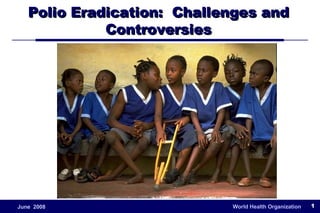
Polio Eradication:  Challenges and Controversies
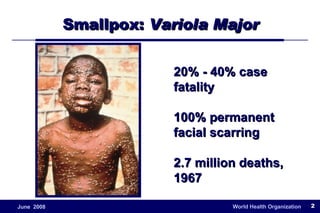
Smallpox:  Variola Major 20% - 40% case fatality 100% permanent facial scarring 2.7 million deaths, 1967
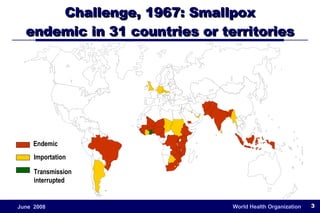
Challenge, 1967: Smallpox endemic in 31 countries or territories Endemic Importation Transmission  interrupted
Smallpox eradication: scientific basis for 1967 decision to eradicate No reservoir in nature Vaccine provides protection against infection,  easy to administer, inexpensive and heat stable Each infection full clinical expression/no  asymptomatic infection  Transmission mainly face to face by droplet, not  through environmental contamination Feasibility proven in industrialized countries
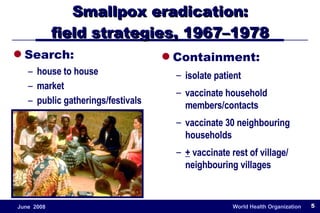
Smallpox eradication: field strategies, 1967–1978 Search: house to house market public gatherings/festivals Containment: isolate patient vaccinate household members/contacts vaccinate 30 neighbouring households +  vaccinate rest of village/ neighbouring villages
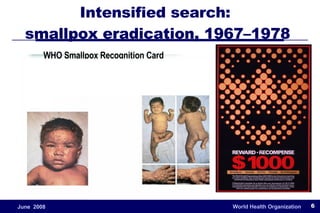
Intensified search:  smallpox eradication, 1967–1978  WHO Smallpox Recognition Card
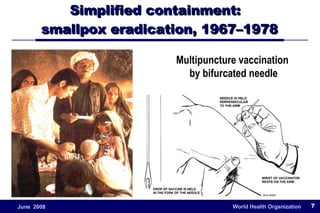
Simplified containment:  smallpox eradication, 1967–1978 Multipuncture vaccination  by bifurcated needle
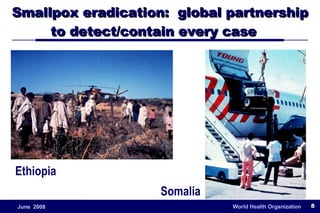
Smallpox eradication:  global partnership to detect/contain every case  Ethiopia Somalia
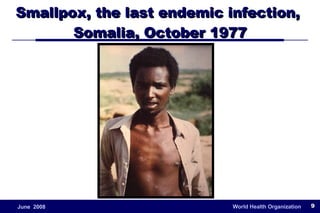
Smallpox, the last endemic infection,  Somalia, October 1977
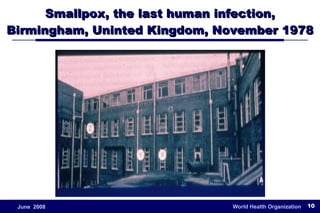
Smallpox, the last human infection, Birmingham, Uninted Kingdom, November 1978
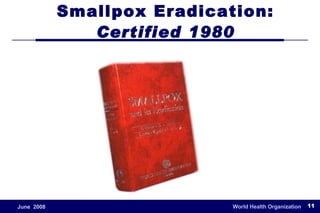
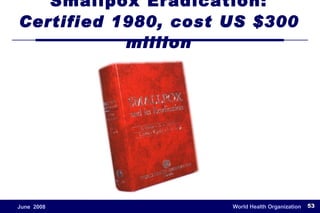
Smallpox Eradication: Certified 1980
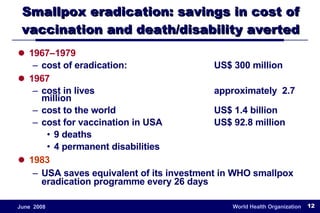
Smallpox eradication: savings in cost of vaccination and death/disability averted 1967–1979 cost of eradication: US$ 300 million 1967 cost in lives approximately  2.7  million cost to the world US$ 1.4 billion  cost for vaccination in USA  US$ 92.8 million 9 deaths 4 permanent disabilities  1983 USA saves equivalent of its investment in WHO smallpox eradication programme every 26 days
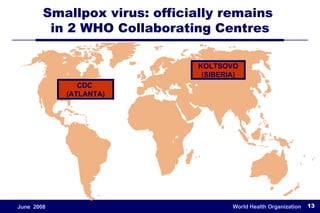
Smallpox virus: officially remains  in 2 WHO Collaborating Centres CDC  (ATLANTA) KOLTSOVO (SIBERIA)
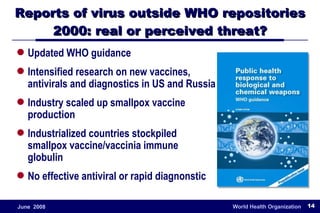
Reports of virus outside WHO repositories 2000: real or perceived threat? Updated WHO guidance Intensified research on new vaccines, antivirals and diagnostics in US and Russia Industry scaled up smallpox vaccine production  Industrialized countries stockpiled smallpox vaccine/vaccinia immune globulin No effective antiviral or rapid diagnonstic
No reservoir in nature Vaccine provides full protection, easy to administer from birth Transmission faecal/oral contamination in environment Feasibility proven in industrialized countries Up to 600 – 1000 asymptomatic infections for each child with acute flaccid paralysis (3 virus types) Polio eradication: scientific basis for 1988 resolution to eradicate
World Health Assembly Resolution: polio eradication by year 2000 1. DECLARES the commitment of WHO to the global eradication of poliomyelitis by the year 2000; 2. EMPHASIZES that eradication efforts should be pursued in ways which strengthen the development of the Expanded Programme on Immunization as a whole, fostering its contribution, in turn, to the development of the health infrastructure and of primary health care; FORTY-FIRST WORLD HEALTH ASSEMBLY GENEVA, 2-13 MAY WHA41.28 Global eradication of poliomyelitis by the year 2000
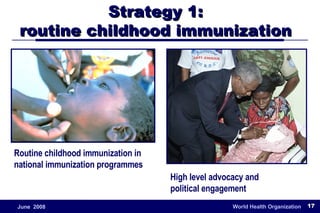
Strategy 1:  routine childhood immunization  Routine childhood immunization in national immunization programmes High level advocacy and political engagement
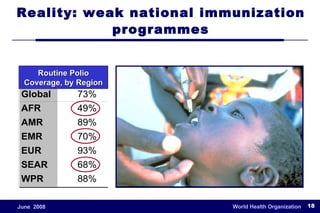
Reality: weak national immunization programmes Routine Polio Coverage, by Region
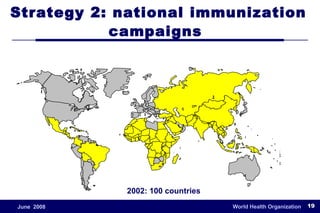
Strategy 2: national immunization campaigns  2002: 100 countries
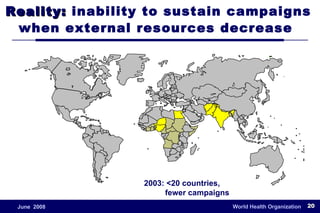
Reality:  inability to sustain campaigns when external resources decrease  2003: <20 countries, fewer campaigns
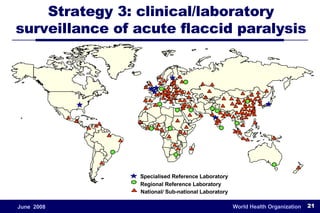
Specialised Reference Laboratory Regional Reference Laboratory National/ Sub-national Laboratory Strategy 3: clinical/laboratory surveillance of acute flaccid paralysis
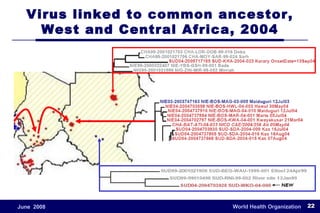
Virus linked to common ancestor, West and Central Africa, 2004
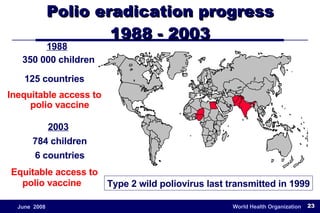
Polio eradication progress 1988 - 2003 1988   350 000 children  125 countries Inequitable access to polio vaccine Type 2 wild poliovirus last transmitted in 1999 2003 784 children 6 countries Equitable access to polio vaccine
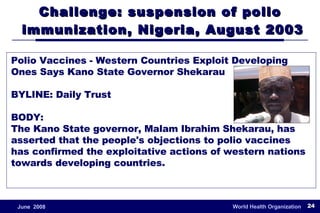
Challenge: suspension of polio  immunization, Nigeria, August 2003 Polio Vaccines - Western Countries Exploit Developing Ones Says Kano State Governor Shekarau BYLINE: Daily Trust BODY: The Kano State governor, Malam Ibrahim Shekarau, has asserted that the people's objections to polio vaccines has confirmed the exploitative actions of western nations towards developing countries.
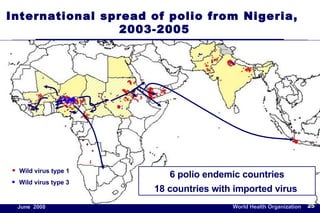
6 polio endemic countries 18 countries with imported virus  Wild virus type 1 Wild virus type 3 International spread of polio from Nigeria,  2003-2005
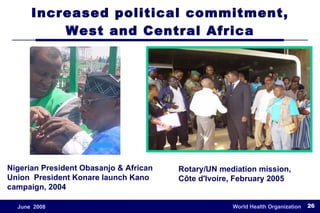
Increased political commitment, West and Central Africa Nigerian President Obasanjo & African Union  President Konare launch Kano campaign, 2004 Rotary/UN mediation mission, Côte d'Ivoire, February 2005
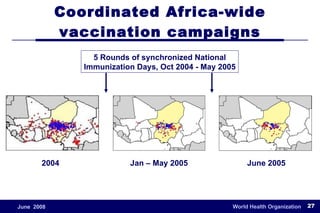
Coordinated Africa-wide vaccination campaigns 2004 Jan – May 2005 June 2005 5 Rounds of synchronized National Immunization Days, Oct 2004 - May 2005
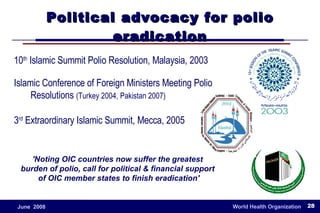
Political advocacy for polio eradication 10 th  Islamic Summit Polio Resolution, Malaysia, 2003 Islamic Conference of Foreign Ministers Meeting Polio Resolutions  (Turkey 2004, Pakistan 2007) 3 rd  Extraordinary Islamic Summit, Mecca, 2005 'Noting OIC countries now suffer the greatest  burden of polio, call for political & financial support  of OIC member states to finish eradication'
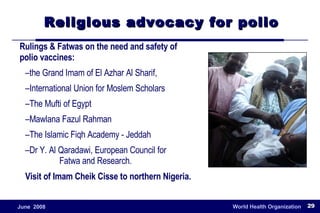
Religious advocacy for polio Rulings & Fatwas on the need and safety of polio vaccines: the Grand Imam of El Azhar Al Sharif,  International Union for Moslem Scholars The Mufti of Egypt Mawlana Fazul Rahman The Islamic Fiqh Academy - Jeddah Dr Y. Al Qaradawi, European Council for  Fatwa and Research . Visit of Imam Cheik Cisse to northern Nigeria.
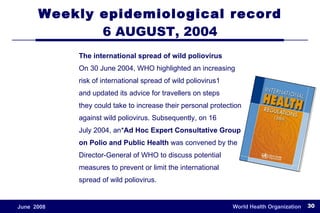
Weekly epidemiological record 6 AUGUST, 2004 The international spread of wild poliovirus On 30 June 2004, WHO highlighted an increasing risk of international spread of wild poliovirus1 and updated its advice for travellers on steps they could take to increase their personal protection against wild poliovirus. Subsequently, on 16 July 2004, an* Ad Hoc Expert Consultative Group on Polio and Public Health  was convened by the Director-General of WHO to discuss potential measures to prevent or limit the international spread of wild poliovirus.
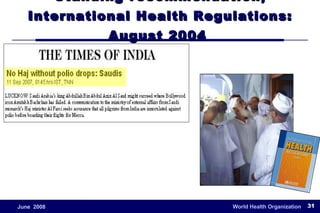
Standing recommendation, International Health Regulations: August 2004
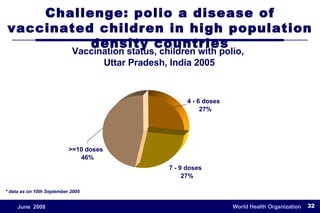
* data as on 10th September 2005 Challenge: polio a disease of vaccinated children in high population density countries 7 - 9 doses 27% 4 - 6 doses 27% >=10 doses 46% Vaccination status, children with polio,  Uttar Pradesh, India 2005
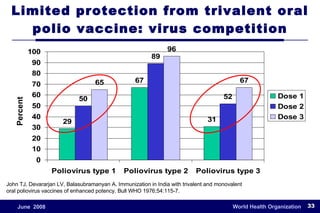
Limited protection from trivalent oral polio vaccine: virus competition Percent John TJ, Devararjan LV, Balasubramanyan A. Immunization in India with trivalent and monovalent oral poliovirus vaccines of enhanced potency. Bull WHO 1976;54:115-7.
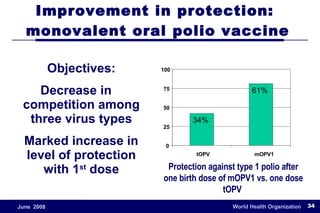
Objectives: Decrease in competition among three virus types Marked increase in level of protection with 1 st  dose Improvement in protection:  monovalent oral polio vaccine Protection against type 1 polio after one birth dose of mOPV1 vs. one dose tOPV  34% 61% 0 25 50 75 100 tOPV mOPV1
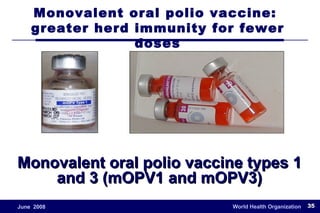
Monovalent oral polio vaccine types 1 and 3 (mOPV1 and mOPV3) Monovalent oral polio vaccine:  greater herd immunity for fewer doses
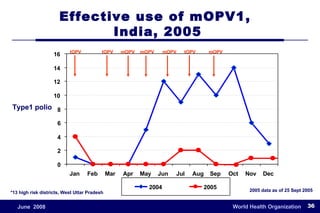
Effective use of mOPV1,  India, 2005 Type1 polio 2005 data as of 25 Sept 2005 mOPV mOPV mOPV tOPV tOPV tOPV mOPV *13 high risk districts, West Uttar Pradesh 0 2 4 6 8 10 12 14 16 Jan Feb Mar Apr May Jun Jul Aug Sep Oct Nov Dec 2004 2005
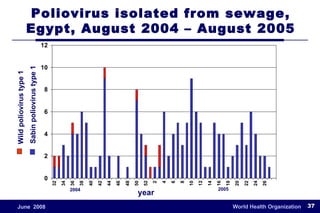
Wild poliovirus type 1 Sabin poliovirus type 1 2004 2005 Poliovirus isolated from sewage, Egypt, August 2004 – August 2005 year
Protective efficacy by dose, tOPV and OPV by country, 2005 - 2007
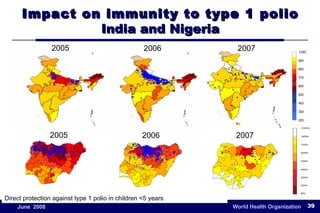
Direct protection against type 1 polio in children <5 years Impact on immunity to type 1 polio India and Nigeria 2005 2006 2007 2005 2006 2007
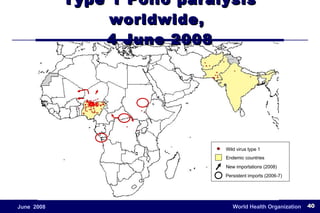
Type 1 Polio paralysis worldwide,  4 June 2008 Endemic countries Wild virus type 1 New importations (2008) Persistent imports (2006-7)
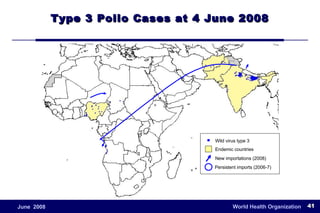
Type 3 Polio Cases at 4 June 2008 Endemic countries Wild virus type 3 New importations (2008) Persistent imports (2006-7)
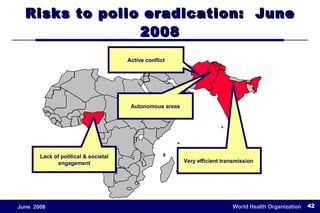
Risks to polio eradication:  June 2008 Active conflict Autonomous areas Lack of political & societal engagement Very efficient transmission
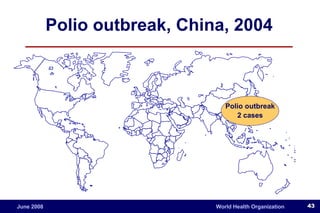
Polio outbreak, China, 2004 Polio outbreak 2 cases
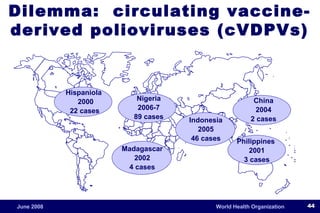
Dilemma:  circulating vaccine-derived polioviruses (cVDPVs) Philippines  2001 3 cases Madagascar 2002 4 cases China 2004 2 cases Indonesia 2005 46 cases Nigeria 2006-7 89 cases Hispaniola  2000 22 cases
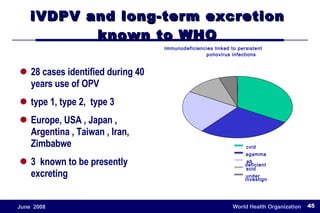
iVDPV and long-term excretion known to WHO 28 cases identified during 40 years use of OPV type 1, type 2,  type 3 Europe, USA , Japan , Argentina , Taiwan , Iran, Zimbabwe 3  known to be presently excreting Immunodeficiencies linked to persistent  poliovirus infections cvid agamma ab deficient scid under investign
Vaccine derived polio viruses: definitions iVDPV is a virus with >1% drift from parent  OPV strains by full VP1 sequence, isolated from a patient either with evidence of immune deficiency,  or with multiple isolates over several months cVDPV is a virus with >1% difference from parent OPV strains by full VP1 sequence homology found by AFP surveillance consistent with an extensive period of virus excretion or transmission generally in a areas with low OPV coverage rates
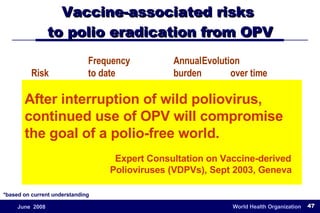
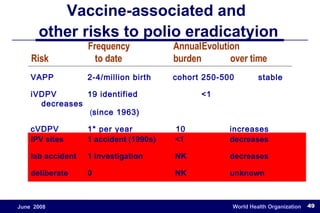
Vaccine-associated risks  to polio eradication from OPV iVDPV 28 identified   <1  decreases ( since 1963) cVDPV 1* per year  10 increases VAPP  2-4/million 1 st  dose  250-500 stable  Frequency Annual Evolution  Risk to date burden  over time *based on current understanding After interruption of wild poliovirus, continued use of OPV will compromise the goal of a polio-free world.   Expert Consultation on Vaccine-derived Polioviruses (VDPVs), Sept 2003, Geneva
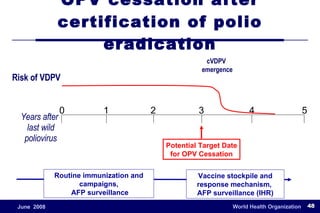
OPV cessation after certification of polio eradication Risk of VDPV Years after last wild poliovirus 0 1 2 4 5 3 Routine immunization and campaigns, AFP surveillance Vaccine stockpile and response mechanism,  AFP surveillance (IHR)   cVDPV emergence Potential Target Date for OPV Cessation
VAPP  2-4/million birth cohort  250-500 stable iVDPV 19 identified    <1  decreases   ( since 1963) cVDPV 1* per year  10 increases IPV sites 1 accident (1990s)  <1 decreases lab accident  1 investigation   NK decreases deliberate 0  NK unknown Frequency Annual Evolution  Risk   to date burden  over time Vaccine-associated and  other risks to polio eradicatyion
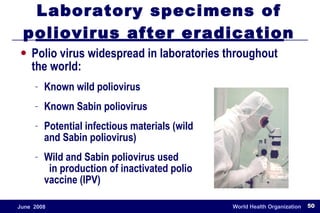
Laboratory specimens of poliovirus after eradication Polio virus widespread in laboratories throughout the world: Known wild poliovirus Known Sabin poliovirus Potential infectious materials (wild  and Sabin poliovirus)  Wild and Sabin poliovirus used  in production of inactivated polio  vaccine (IPV)
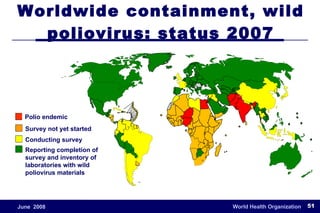
Worldwide containment, wild poliovirus: status 2007 Polio endemic Survey not yet started Conducting survey Reporting completion of survey and inventory of laboratories with wild poliovirus materials
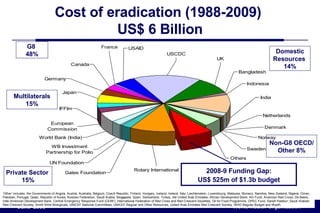
2008-9 Funding Gap: US$ 525m of $1.3b budget ‘ Other’ includes: the Governments of Angola, Austria, Australia, Belgium, Czech Republic, Finland, Hungary, Iceland, Ireland, Italy, Liechtenstein, Luxembourg, Malaysia, Monaco, Namibia, New Zealand, Nigeria, Oman, Pakistan, Portugal, Qatar, Republic of Korea, Russian Federation, Saudi Arabia,  Singapore,  Spain, Switzerland, Turkey, the United Arab Emirates; African Development Bank; AG Fund; American Red Cross; De Beers, Inter-American Development Bank, Central Emergency Response Fund (CERF), International Federation of Red Cross and Red Crescent Societies, Oil for Food Programme, OPEC Fund, Sanofi Pasteur; Saudi Arabian Red Crescent Society, Smith Kline Biologicals, UNICEF National Committees, UNICEF Regular and Other Resources, United Arab Emirates Red Crescent Society, WHO Regular Budget and Wyeth.  Domestic Resources  14% Non-G8 OECD/ Other 8% Multilaterals 15% Private Sector  15% Cost of eradication (1988-2009)  US$ 6 Billion G8  48%
Smallpox Eradication: Certified 1980, cost US $300 million
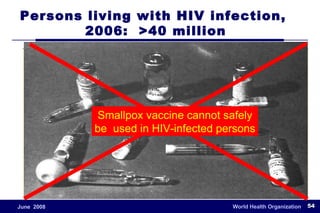
Persons living with HIV infection,  2006:  >40 million 3 million deaths during 2003 20 million deaths since 1981 Smallpox vaccine cannot safely be  used in HIV-infected persons
THE CHALLENGE Complete polio eradication while the window of opportunity remains open
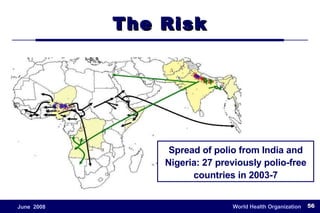
Spread of polio from India and Nigeria: 27 previously polio-free countries in 2003-7 The Risk
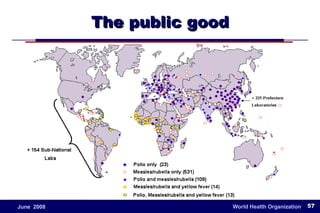
The public good
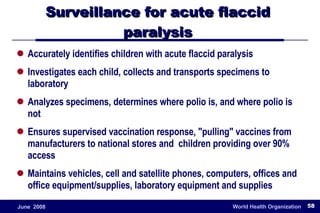
Surveillance for acute flaccid  paralysis  Accurately identifies children with acute flaccid paralysis Investigates each child, collects and transports specimens to laboratory Analyzes specimens, determines where polio is, and where polio is not Ensures supervised vaccination response, &quot;pulling&quot; vaccines from manufacturers to national stores and  children providing over 90% access Maintains vehicles, cell and satellite phones, computers, offices and office equipment/supplies, laboratory equipment and supplies
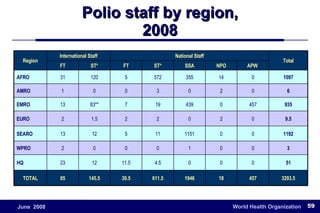
Polio staff by region, 2008 Region International Staff National Staff Total FT ST* FT ST* SSA NPO APW  AFRO 31 120 5 572 355 14 0 1097 AMRO 1 0 0 3 0 2 0 6 EMRO 13 83** 7 19 439 0 457 935 EURO 2 1.5 2 2 0 2 0 9.5 SEARO 13 12 5 11 1151 0 0 1192 WPRO 2 0 0 0 1 0 0 3 HQ 23 12 11.5 4.5 0 0 0 51 TOTAL 85 145.5 30.5 611.5 1946 18 457 3293.5
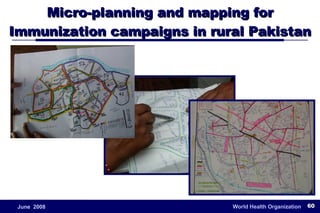
Micro-planning and mapping for Immunization campaigns in rural Pakistan
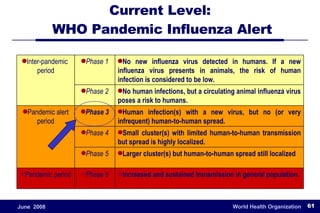
Current Level:  WHO Pandemic Influenza Alert Pandemic period Pandemic alert period Inter-pandemic  period Phase 6 Phase 5 Phase 4 Phase 3 Phase 2 Phase 1 Increased and sustained transmission in general population. Larger cluster(s) but human-to-human spread still localized Small cluster(s) with limited human-to-human transmission but spread is highly localized. Human infection(s) with a new virus, but no (or very infrequent) human-to-human spread. No human infections, but a circulating animal influenza virus poses a risk to humans. No new influenza virus detected in humans. If a new influenza virus presents in animals, the risk of human infection is considered to be low.
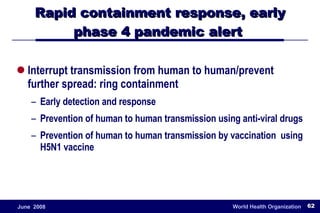
Rapid containment response, early phase 4 pandemic alert  Interrupt transmission from human to human/prevent further spread: ring containment Early detection and response Prevention of human to human transmission using anti-viral drugs Prevention of human to human transmission by vaccination  using H5N1 vaccine
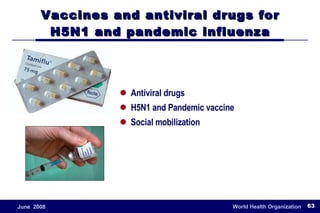
Vaccines and antiviral drugs for H5N1 and pandemic influenza Antiviral drugs H5N1 and Pandemic vaccine Social mobilization

WGHA Discovery Series: David Heymann

  • 1.
    Polio Eradication: Challenges and Controversies
  • 2.
    Smallpox: VariolaMajor 20% - 40% case fatality 100% permanent facial scarring 2.7 million deaths, 1967
  • 3.
    Challenge, 1967: Smallpoxendemic in 31 countries or territories Endemic Importation Transmission interrupted
  • 4.
    Smallpox eradication: scientificbasis for 1967 decision to eradicate No reservoir in nature Vaccine provides protection against infection, easy to administer, inexpensive and heat stable Each infection full clinical expression/no asymptomatic infection Transmission mainly face to face by droplet, not through environmental contamination Feasibility proven in industrialized countries
  • 5.
    Smallpox eradication: fieldstrategies, 1967–1978 Search: house to house market public gatherings/festivals Containment: isolate patient vaccinate household members/contacts vaccinate 30 neighbouring households + vaccinate rest of village/ neighbouring villages
  • 6.
    Intensified search: smallpox eradication, 1967–1978 WHO Smallpox Recognition Card
  • 7.
    Simplified containment: smallpox eradication, 1967–1978 Multipuncture vaccination by bifurcated needle
  • 8.
    Smallpox eradication: global partnership to detect/contain every case Ethiopia Somalia
  • 9.
    Smallpox, the lastendemic infection, Somalia, October 1977
  • 10.
    Smallpox, the lasthuman infection, Birmingham, Uninted Kingdom, November 1978
  • 11.
  • 12.
    Smallpox eradication: savingsin cost of vaccination and death/disability averted 1967–1979 cost of eradication: US$ 300 million 1967 cost in lives approximately 2.7 million cost to the world US$ 1.4 billion cost for vaccination in USA US$ 92.8 million 9 deaths 4 permanent disabilities 1983 USA saves equivalent of its investment in WHO smallpox eradication programme every 26 days
  • 13.
    Smallpox virus: officiallyremains in 2 WHO Collaborating Centres CDC (ATLANTA) KOLTSOVO (SIBERIA)
  • 14.
    Reports of virusoutside WHO repositories 2000: real or perceived threat? Updated WHO guidance Intensified research on new vaccines, antivirals and diagnostics in US and Russia Industry scaled up smallpox vaccine production Industrialized countries stockpiled smallpox vaccine/vaccinia immune globulin No effective antiviral or rapid diagnonstic
  • 15.
    No reservoir innature Vaccine provides full protection, easy to administer from birth Transmission faecal/oral contamination in environment Feasibility proven in industrialized countries Up to 600 – 1000 asymptomatic infections for each child with acute flaccid paralysis (3 virus types) Polio eradication: scientific basis for 1988 resolution to eradicate
  • 16.
    World Health AssemblyResolution: polio eradication by year 2000 1. DECLARES the commitment of WHO to the global eradication of poliomyelitis by the year 2000; 2. EMPHASIZES that eradication efforts should be pursued in ways which strengthen the development of the Expanded Programme on Immunization as a whole, fostering its contribution, in turn, to the development of the health infrastructure and of primary health care; FORTY-FIRST WORLD HEALTH ASSEMBLY GENEVA, 2-13 MAY WHA41.28 Global eradication of poliomyelitis by the year 2000
  • 17.
    Strategy 1: routine childhood immunization Routine childhood immunization in national immunization programmes High level advocacy and political engagement
  • 18.
    Reality: weak nationalimmunization programmes Routine Polio Coverage, by Region
  • 19.
    Strategy 2: nationalimmunization campaigns 2002: 100 countries
  • 20.
    Reality: inabilityto sustain campaigns when external resources decrease 2003: <20 countries, fewer campaigns
  • 21.
    Specialised Reference LaboratoryRegional Reference Laboratory National/ Sub-national Laboratory Strategy 3: clinical/laboratory surveillance of acute flaccid paralysis
  • 22.
    Virus linked tocommon ancestor, West and Central Africa, 2004
  • 23.
    Polio eradication progress1988 - 2003 1988 350 000 children 125 countries Inequitable access to polio vaccine Type 2 wild poliovirus last transmitted in 1999 2003 784 children 6 countries Equitable access to polio vaccine
  • 24.
    Challenge: suspension ofpolio immunization, Nigeria, August 2003 Polio Vaccines - Western Countries Exploit Developing Ones Says Kano State Governor Shekarau BYLINE: Daily Trust BODY: The Kano State governor, Malam Ibrahim Shekarau, has asserted that the people's objections to polio vaccines has confirmed the exploitative actions of western nations towards developing countries.
  • 25.
    6 polio endemiccountries 18 countries with imported virus Wild virus type 1 Wild virus type 3 International spread of polio from Nigeria, 2003-2005
  • 26.
    Increased political commitment,West and Central Africa Nigerian President Obasanjo & African Union President Konare launch Kano campaign, 2004 Rotary/UN mediation mission, Côte d'Ivoire, February 2005
  • 27.
    Coordinated Africa-wide vaccinationcampaigns 2004 Jan – May 2005 June 2005 5 Rounds of synchronized National Immunization Days, Oct 2004 - May 2005
  • 28.
    Political advocacy forpolio eradication 10 th Islamic Summit Polio Resolution, Malaysia, 2003 Islamic Conference of Foreign Ministers Meeting Polio Resolutions (Turkey 2004, Pakistan 2007) 3 rd Extraordinary Islamic Summit, Mecca, 2005 'Noting OIC countries now suffer the greatest burden of polio, call for political & financial support of OIC member states to finish eradication'
  • 29.
    Religious advocacy forpolio Rulings & Fatwas on the need and safety of polio vaccines: the Grand Imam of El Azhar Al Sharif, International Union for Moslem Scholars The Mufti of Egypt Mawlana Fazul Rahman The Islamic Fiqh Academy - Jeddah Dr Y. Al Qaradawi, European Council for Fatwa and Research . Visit of Imam Cheik Cisse to northern Nigeria.
  • 30.
    Weekly epidemiological record6 AUGUST, 2004 The international spread of wild poliovirus On 30 June 2004, WHO highlighted an increasing risk of international spread of wild poliovirus1 and updated its advice for travellers on steps they could take to increase their personal protection against wild poliovirus. Subsequently, on 16 July 2004, an* Ad Hoc Expert Consultative Group on Polio and Public Health was convened by the Director-General of WHO to discuss potential measures to prevent or limit the international spread of wild poliovirus.
  • 31.
    Standing recommendation, InternationalHealth Regulations: August 2004
  • 32.
    * data ason 10th September 2005 Challenge: polio a disease of vaccinated children in high population density countries 7 - 9 doses 27% 4 - 6 doses 27% >=10 doses 46% Vaccination status, children with polio, Uttar Pradesh, India 2005
  • 33.
    Limited protection fromtrivalent oral polio vaccine: virus competition Percent John TJ, Devararjan LV, Balasubramanyan A. Immunization in India with trivalent and monovalent oral poliovirus vaccines of enhanced potency. Bull WHO 1976;54:115-7.
  • 34.
    Objectives: Decrease incompetition among three virus types Marked increase in level of protection with 1 st dose Improvement in protection: monovalent oral polio vaccine Protection against type 1 polio after one birth dose of mOPV1 vs. one dose tOPV 34% 61% 0 25 50 75 100 tOPV mOPV1
  • 35.
    Monovalent oral poliovaccine types 1 and 3 (mOPV1 and mOPV3) Monovalent oral polio vaccine: greater herd immunity for fewer doses
  • 36.
    Effective use ofmOPV1, India, 2005 Type1 polio 2005 data as of 25 Sept 2005 mOPV mOPV mOPV tOPV tOPV tOPV mOPV *13 high risk districts, West Uttar Pradesh 0 2 4 6 8 10 12 14 16 Jan Feb Mar Apr May Jun Jul Aug Sep Oct Nov Dec 2004 2005
  • 37.
    Wild poliovirus type1 Sabin poliovirus type 1 2004 2005 Poliovirus isolated from sewage, Egypt, August 2004 – August 2005 year
  • 38.
    Protective efficacy bydose, tOPV and OPV by country, 2005 - 2007
  • 39.
    Direct protection againsttype 1 polio in children <5 years Impact on immunity to type 1 polio India and Nigeria 2005 2006 2007 2005 2006 2007
  • 40.
    Type 1 Polioparalysis worldwide, 4 June 2008 Endemic countries Wild virus type 1 New importations (2008) Persistent imports (2006-7)
  • 41.
    Type 3 PolioCases at 4 June 2008 Endemic countries Wild virus type 3 New importations (2008) Persistent imports (2006-7)
  • 42.
    Risks to polioeradication: June 2008 Active conflict Autonomous areas Lack of political & societal engagement Very efficient transmission
  • 43.
    Polio outbreak, China,2004 Polio outbreak 2 cases
  • 44.
    Dilemma: circulatingvaccine-derived polioviruses (cVDPVs) Philippines 2001 3 cases Madagascar 2002 4 cases China 2004 2 cases Indonesia 2005 46 cases Nigeria 2006-7 89 cases Hispaniola 2000 22 cases
  • 45.
    iVDPV and long-termexcretion known to WHO 28 cases identified during 40 years use of OPV type 1, type 2, type 3 Europe, USA , Japan , Argentina , Taiwan , Iran, Zimbabwe 3 known to be presently excreting Immunodeficiencies linked to persistent poliovirus infections cvid agamma ab deficient scid under investign
  • 46.
    Vaccine derived polioviruses: definitions iVDPV is a virus with >1% drift from parent OPV strains by full VP1 sequence, isolated from a patient either with evidence of immune deficiency, or with multiple isolates over several months cVDPV is a virus with >1% difference from parent OPV strains by full VP1 sequence homology found by AFP surveillance consistent with an extensive period of virus excretion or transmission generally in a areas with low OPV coverage rates
  • 47.
    Vaccine-associated risks to polio eradication from OPV iVDPV 28 identified <1 decreases ( since 1963) cVDPV 1* per year 10 increases VAPP 2-4/million 1 st dose 250-500 stable Frequency Annual Evolution Risk to date burden over time *based on current understanding After interruption of wild poliovirus, continued use of OPV will compromise the goal of a polio-free world. Expert Consultation on Vaccine-derived Polioviruses (VDPVs), Sept 2003, Geneva
  • 48.
    OPV cessation aftercertification of polio eradication Risk of VDPV Years after last wild poliovirus 0 1 2 4 5 3 Routine immunization and campaigns, AFP surveillance Vaccine stockpile and response mechanism, AFP surveillance (IHR) cVDPV emergence Potential Target Date for OPV Cessation
  • 49.
    VAPP 2-4/millionbirth cohort 250-500 stable iVDPV 19 identified <1 decreases ( since 1963) cVDPV 1* per year 10 increases IPV sites 1 accident (1990s) <1 decreases lab accident 1 investigation NK decreases deliberate 0 NK unknown Frequency Annual Evolution Risk to date burden over time Vaccine-associated and other risks to polio eradicatyion
  • 50.
    Laboratory specimens ofpoliovirus after eradication Polio virus widespread in laboratories throughout the world: Known wild poliovirus Known Sabin poliovirus Potential infectious materials (wild and Sabin poliovirus) Wild and Sabin poliovirus used in production of inactivated polio vaccine (IPV)
  • 51.
    Worldwide containment, wildpoliovirus: status 2007 Polio endemic Survey not yet started Conducting survey Reporting completion of survey and inventory of laboratories with wild poliovirus materials
  • 52.
    2008-9 Funding Gap:US$ 525m of $1.3b budget ‘ Other’ includes: the Governments of Angola, Austria, Australia, Belgium, Czech Republic, Finland, Hungary, Iceland, Ireland, Italy, Liechtenstein, Luxembourg, Malaysia, Monaco, Namibia, New Zealand, Nigeria, Oman, Pakistan, Portugal, Qatar, Republic of Korea, Russian Federation, Saudi Arabia, Singapore, Spain, Switzerland, Turkey, the United Arab Emirates; African Development Bank; AG Fund; American Red Cross; De Beers, Inter-American Development Bank, Central Emergency Response Fund (CERF), International Federation of Red Cross and Red Crescent Societies, Oil for Food Programme, OPEC Fund, Sanofi Pasteur; Saudi Arabian Red Crescent Society, Smith Kline Biologicals, UNICEF National Committees, UNICEF Regular and Other Resources, United Arab Emirates Red Crescent Society, WHO Regular Budget and Wyeth. Domestic Resources 14% Non-G8 OECD/ Other 8% Multilaterals 15% Private Sector 15% Cost of eradication (1988-2009) US$ 6 Billion G8 48%
  • 53.
    Smallpox Eradication: Certified1980, cost US $300 million
  • 54.
    Persons living withHIV infection, 2006: >40 million 3 million deaths during 2003 20 million deaths since 1981 Smallpox vaccine cannot safely be used in HIV-infected persons
  • 55.
    THE CHALLENGE Completepolio eradication while the window of opportunity remains open
  • 56.
    Spread of poliofrom India and Nigeria: 27 previously polio-free countries in 2003-7 The Risk
  • 57.
  • 58.
    Surveillance for acuteflaccid paralysis Accurately identifies children with acute flaccid paralysis Investigates each child, collects and transports specimens to laboratory Analyzes specimens, determines where polio is, and where polio is not Ensures supervised vaccination response, &quot;pulling&quot; vaccines from manufacturers to national stores and children providing over 90% access Maintains vehicles, cell and satellite phones, computers, offices and office equipment/supplies, laboratory equipment and supplies
  • 59.
    Polio staff byregion, 2008 Region International Staff National Staff Total FT ST* FT ST* SSA NPO APW AFRO 31 120 5 572 355 14 0 1097 AMRO 1 0 0 3 0 2 0 6 EMRO 13 83** 7 19 439 0 457 935 EURO 2 1.5 2 2 0 2 0 9.5 SEARO 13 12 5 11 1151 0 0 1192 WPRO 2 0 0 0 1 0 0 3 HQ 23 12 11.5 4.5 0 0 0 51 TOTAL 85 145.5 30.5 611.5 1946 18 457 3293.5
  • 60.
    Micro-planning and mappingfor Immunization campaigns in rural Pakistan
  • 61.
    Current Level: WHO Pandemic Influenza Alert Pandemic period Pandemic alert period Inter-pandemic period Phase 6 Phase 5 Phase 4 Phase 3 Phase 2 Phase 1 Increased and sustained transmission in general population. Larger cluster(s) but human-to-human spread still localized Small cluster(s) with limited human-to-human transmission but spread is highly localized. Human infection(s) with a new virus, but no (or very infrequent) human-to-human spread. No human infections, but a circulating animal influenza virus poses a risk to humans. No new influenza virus detected in humans. If a new influenza virus presents in animals, the risk of human infection is considered to be low.
  • 62.
    Rapid containment response,early phase 4 pandemic alert Interrupt transmission from human to human/prevent further spread: ring containment Early detection and response Prevention of human to human transmission using anti-viral drugs Prevention of human to human transmission by vaccination using H5N1 vaccine
  • 63.
    Vaccines and antiviraldrugs for H5N1 and pandemic influenza Antiviral drugs H5N1 and Pandemic vaccine Social mobilization