Clinical trials
RVS Chaitanya koppala
Assistant professor
Lovely professional university
Overview
• Introduction: Clinical research
• Drug development phases
• Pre-Phase 1 activities
• Phases of Clinical trial
• Regulatory approvals: IND & NDA
• Summary of Clinical trial phases
Introduction
• Clinical trial is a systematic investigation in human subjects for
evaluating the safety & efficacy of any new drug.
• Clinical trials are a set of tests in medical research and drug
development that generate safety and efficacy data for health
interventions in human beings.
Introduction
1. Clinical trials are conducted only
when satisfactory information has been gathered on the quality of the
nonclinical safety
health authority/ethics committee approval is granted in the country where
approval of the drug is sought.
2. Clinical Trial is the mainstay for bringing out New Drugs to the
Market
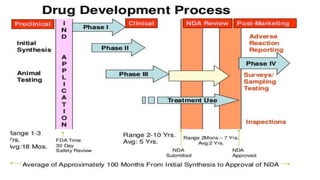
Drug Review Steps
1. Preclinical (animal) testing.
2. An investigational new drug application (IND) : outlines what the
sponsor of a new drug proposes for human testing in clinical trials.
3. Phase 1 studies
4. Phase 2 studies
5. Phase 3 studies
6. Submission of New Drug Application (NDA) is the formal step
asking the FDA to consider a drug for marketing approval.
7. FDA reviewers will approve the application or find it either
"approvable" or "not approvable."
8. Phase 4 studies
Drug review
1. Before one can initiate testing in human beings, extensive pre-
clinical or laboratory research is required
2. Research usually involves years of experiments in animal and
human cells.
3. If this stage of testing is successful, the sponsor then provides this
data to the FDA requesting approval to begin testing in human. This
is called an Investigational New Drug (IND) Application
4. If approved by the FDA, testing in humans begins. This is done
through a formally written and approved protocol.
Preclinical evaluation phase
( animal studies)
Pharmacodynamics studies in vivo in animals, In vitro preparation
Absorption, distribution , elimination studies (pharmacokinetics)
Acute ,sub acute, chronic toxicity studies (toxicity profile)
Therapeutic index (safety & efficacy evaluation)
Prephase I Activities
• A - Preclinical Data Review: Drug Discovery Team
Efficacy
Safety Pharmacology
Toxicology
ADME
• B - Preparation of Investigator’s Brochure
- Summaries of Preclinial data with clinical Extrapolation.
- Prediction of Clinical Effects & Safety
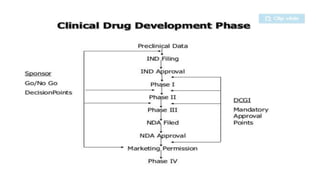
• C – Filing of Investigational New Drug Application with DCGI.
IND Application Filing
• Once preclinical studies have indicated the safety and efficacy of a
drug an IND application has to be filed with the regulatory authorities
• For obtaining regulatory Approval for Phase I, phase II and Phase III
clinical evaluation.
• Contents of IND application
Preclinical Data (All data from animal studies)
Information on composition and source of drug
Chemical and manufacturing information
Proposed clinical plans and protocol
Ethical Committee Clearance
IND Application
• Clinical Evaluation needs Prior Regulatory and IRB Clearance.
• Phase-wise clearances have to be obtained.
• The End Result of Phase I-III studies is the filing of NDA (New Drug
Application) for obtaining Marketing Permission from DCGI.
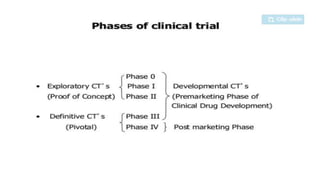
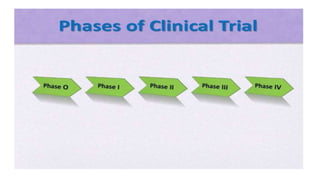
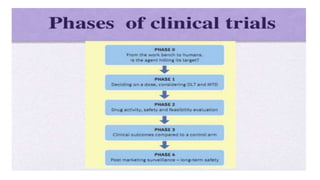
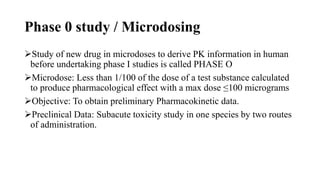
Phase 0 study / Microdosing
Study of new drug in microdoses to derive PK information in human
before undertaking phase I studies is called PHASE O
Microdose: Less than 1/100 of the dose of a test substance calculated
to produce pharmacological effect with a max dose ≤100 micrograms
Objective: To obtain preliminary Pharmacokinetic data.
Preclinical Data: Subacute toxicity study in one species by two routes
of administration.
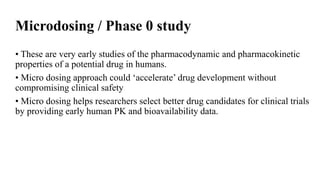
Microdosing / Phase 0 study
• These are very early studies of the pharmacodynamic and pharmacokinetic
properties of a potential drug in humans.
• Micro dosing approach could ‘accelerate’ drug development without
compromising clinical safety
• Micro dosing helps researchers select better drug candidates for clinical trials
by providing early human PK and bioavailability data.
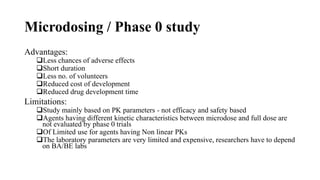
Microdosing / Phase 0 study
Advantages:
Less chances of adverse effects
Short duration
Less no. of volunteers
Reduced cost of development
Reduced drug development time
Limitations:
Study mainly based on PK parameters - not efficacy and safety based
Agents having different kinetic characteristics between microdose and full dose are
not evaluated by phase 0 trials
Of Limited use for agents having Non linear PKs
The laboratory parameters are very limited and expensive, researchers have to depend
on BA/BE labs
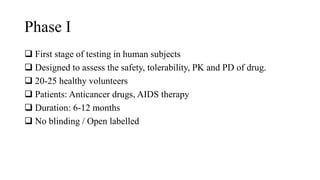
Phase I
 First stage of testing in human subjects
 Designed to assess the safety, tolerability, PK and PD of drug.
 20-25 healthy volunteers
 Patients: Anticancer drugs, AIDS therapy
 Duration: 6-12 months
 No blinding / Open labelled
Phase I:
Basic pre-requisites
Preclinical data
IND application
Approval by the regulatory authority
Protocol approval by the Ethics Committee
Informed consent
Adherence to Declaration of Helsinki /ICH-GCP guidelines, at the start as
well as from time to time, during the study
Phase I Study/ Clinical trial
• The aim of a Phase I trial is to determine the maximum tolerated dose
(MTD) of the new treatment.
• The MTD is found by escalating the treatment dose until the dose-
limiting toxicity (DLT) is reached.
• Kinds of Phase I
SAD: single ascending dose studies
MAD: multiple ascending dose studies
Food Effect: investigates differences in absorption caused by food
Single ascending dose studies (SAD)
• Small groups (3) of subjects are given a single dose of the drug while
they are observed and tested for a period of time.
• If no adverse effects :dose is escalated with 3 new healthy subjects
• If toxicity is observed then : 3 more subjects are given the same dose
• If found toxic : the dose is considered as max. tolerated dose (MTD).
Multiple ascending dose studies (MAD)
Conducted to understand the pharmacokinetics and pharmacodynamics
of multiple doses of the drug.
A group of patients receives multiple low doses of the drug
Samples (of blood, and other fluids) are collected at various time points
Analyzed: How the drug is processed within the body.
Phase I studies: Need
To make reliable and rapid Prediction of human response, from
Preclinical Data (PD, PK, Toxicity)
Involves Extrapolation from Animal data to first human exposure.
Phase I serves as an interface between Preclinical Research and
Clinical Drug development.
Once Phase I is complete, Human beings become first-choice test
species (Human Guinea- pigs).
Phase I study:
Objectives
1. Primary
Tolerability and Safety
Pharmacokinetics
2. Secondary iii. Pharmacodynamics
Phase I Studies: Subjects
• Healthy human volunteers: Most commonly used.
(Non-Therapeutic Research)
- Subjects receive no therapeutic benefit by participation
- Ethical issue.
• Patient Volunteers: Cytotoxic drugs, AIDS therapy
- Patients in advanced stage of disease
Phase I: Reasons for Using Healthy
Volunteers
• Large numbers available (vs. Patients)
• Rapid recruitment rate
• Potential risks are considerably reduced
• Results not confounded by presence of disease variables
• More homogenous group
• Greater compliance with Protocol
• In case of ADR’s Chances of Speedy and Complete recovery are better
• Advantages > Disadvantages
Phase I: Patient Volunteers
• Whenever Preclinical Toxicity Data indicates potential risks for
subjects & Ethical Concerns preclude use of healthy human subjects
e.g. Cancer/AIDs/Psychiatric patients
• Dose range of interest is appropriate to determine in patients than in
healthy volunteers
Phase I: Special Population Healthy
Volunteers
It is now a regulatory requirement to include
Women of child bearing age
Children, if NCE is proposed to be used in them.
Elderly (>65 years) of age.
Limitations of Phase I:
Trial restricted to homogenous subjects
Performance extrapolated to heterogeneous market place
Phase II
• Therapeutic Exploratory Trial
• 20-300 Subjects
• To confirm effectiveness, monitor side effects, & further evaluate safety
• First in patients (who have the disease that the drug is expected to treat)
• Duration: 6 months to several years.
Phase II: Objectives
• Efficacy in patients (primary objective)
• Safety issues (secondary objective)
• Optimum dose finding
• Dose efficacy relationship
• Therapeutic dose regimen
• Duration of therapy
• Frequency of administration
• Therapeutic window
Phase II studies : Pre-requisites
• Review of Phase I data
Innovator/ Experts
IRB
DCGI
• Prior approval by IRB and DCGI is Mandatory
* For New Actions of a marketed drug, start with Phase II (Phase I
exemption obtained)
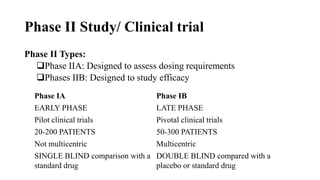
Phase II Study/ Clinical trial
Phase II Types:
Phase IIA: Designed to assess dosing requirements
Phases IIB: Designed to study efficacy
Phase IA Phase IB
EARLY PHASE LATE PHASE
Pilot clinical trials Pivotal clinical trials
20-200 PATIENTS 50-300 PATIENTS
Not multicentric Multicentric
SINGLE BLIND comparison with a
standard drug
DOUBLE BLIND compared with a
placebo or standard drug
Phase III
Therapeutic confirmatory trials.
Large scale, multicentre, Randomised, Controlled trials .
Target population: several 100’s to 3000 patients.
Takes a long time: up to 5 years
To establish efficacy of the drug against existing therapy in larger
number of patients, method of usage, & to collect safety data etc.
Phase III: Objectives
To assess overall and relative therapeutic value of the new drug
Efficacy, Safety and Special Properties
To determine optimal dosage schedule for use in general
The dosage schedule in C.T.’s should be as close as possible to its
anticipated clinical use
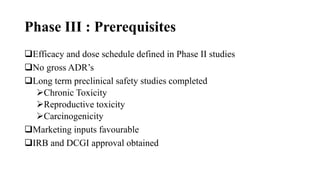
Phase III : Prerequisites
Efficacy and dose schedule defined in Phase II studies
No gross ADR’s
Long term preclinical safety studies completed
Chronic Toxicity
Reproductive toxicity
Carcinogenicity
Marketing inputs favourable
IRB and DCGI approval obtained
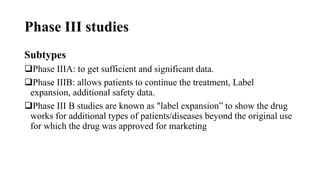
Phase III studies
Subtypes
Phase IIIA: to get sufficient and significant data.
Phase IIIB: allows patients to continue the treatment, Label
expansion, additional safety data.
Phase III B studies are known as "label expansion” to show the drug
works for additional types of patients/diseases beyond the original use
for which the drug was approved for marketing
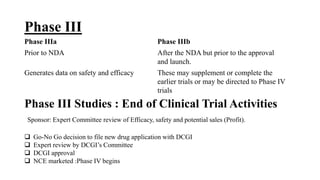
Phase III
Phase IIIa Phase IIIb
Prior to NDA After the NDA but prior to the approval
and launch.
Generates data on safety and efficacy These may supplement or complete the
earlier trials or may be directed to Phase IV
trials
Phase III Studies : End of Clinical Trial Activities
Sponsor: Expert Committee review of Efficacy, safety and potential sales (Profit).
 Go-No Go decision to file new drug application with DCGI
 Expert review by DCGI’s Committee
 DCGI approval
 NCE marketed :Phase IV begins
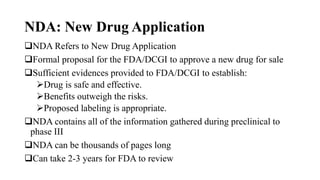
NDA: New Drug Application
NDA Refers to New Drug Application
Formal proposal for the FDA/DCGI to approve a new drug for sale
Sufficient evidences provided to FDA/DCGI to establish:
Drug is safe and effective.
Benefits outweigh the risks.
Proposed labeling is appropriate.
NDA contains all of the information gathered during preclinical to
phase III
NDA can be thousands of pages long
Can take 2-3 years for FDA to review
Phase IV
Done after drug has been marketed
Post Marketing Surveillance (PMS).
No fixed duration / patient population
Studies continue to collect data about effects in various populations &
side effects from long term use.
These are primarily observational or non- experimental in nature.
Phase IV Study / Clinical trial
Helps to detect rare ADRs, Drug interactions
Also to explore new uses for drugs [Sometimes called Phase V]
PERIODIC SAFETY UPDATE REPORTS
To be submitted by the manufacturer every 6 months for 2 yrs and
then annually for next 2 yrs after marketing approval
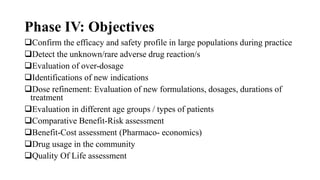
Phase IV: Objectives
Confirm the efficacy and safety profile in large populations during practice
Detect the unknown/rare adverse drug reaction/s
Evaluation of over-dosage
Identifications of new indications
Dose refinement: Evaluation of new formulations, dosages, durations of
treatment
Evaluation in different age groups / types of patients
Comparative Benefit-Risk assessment
Benefit-Cost assessment (Pharmaco- economics)
Drug usage in the community
Quality Of Life assessment
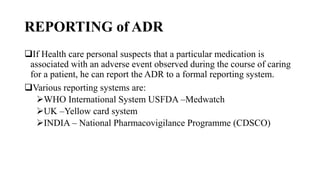
REPORTING of ADR
If Health care personal suspects that a particular medication is
associated with an adverse event observed during the course of caring
for a patient, he can report the ADR to a formal reporting system.
Various reporting systems are:
WHO International System USFDA –Medwatch
UK –Yellow card system
INDIA – National Pharmacovigilance Programme (CDSCO)
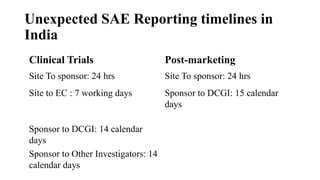
Unexpected SAE Reporting timelines in
India
Clinical Trials Post-marketing
Site To sponsor: 24 hrs Site To sponsor: 24 hrs
Site to EC : 7 working days Sponsor to DCGI: 15 calendar
days
Sponsor to DCGI: 14 calendar
days
Sponsor to Other Investigators: 14
calendar days
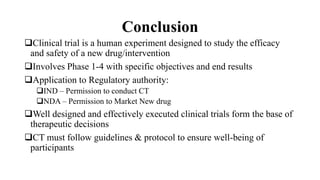
Conclusion
Clinical trial is a human experiment designed to study the efficacy
and safety of a new drug/intervention
Involves Phase 1-4 with specific objectives and end results
Application to Regulatory authority:
IND – Permission to conduct CT
NDA – Permission to Market New drug
Well designed and effectively executed clinical trials form the base of
therapeutic decisions
CT must follow guidelines & protocol to ensure well-being of
participants

Clincial trials and types

  • 1.
    Clinical trials RVS Chaitanyakoppala Assistant professor Lovely professional university
  • 2.
    Overview • Introduction: Clinicalresearch • Drug development phases • Pre-Phase 1 activities • Phases of Clinical trial • Regulatory approvals: IND & NDA • Summary of Clinical trial phases
  • 3.
    Introduction • Clinical trialis a systematic investigation in human subjects for evaluating the safety & efficacy of any new drug. • Clinical trials are a set of tests in medical research and drug development that generate safety and efficacy data for health interventions in human beings.
  • 4.
    Introduction 1. Clinical trialsare conducted only when satisfactory information has been gathered on the quality of the nonclinical safety health authority/ethics committee approval is granted in the country where approval of the drug is sought. 2. Clinical Trial is the mainstay for bringing out New Drugs to the Market
  • 5.
    Drug Review Steps 1.Preclinical (animal) testing. 2. An investigational new drug application (IND) : outlines what the sponsor of a new drug proposes for human testing in clinical trials. 3. Phase 1 studies 4. Phase 2 studies 5. Phase 3 studies 6. Submission of New Drug Application (NDA) is the formal step asking the FDA to consider a drug for marketing approval. 7. FDA reviewers will approve the application or find it either "approvable" or "not approvable." 8. Phase 4 studies
  • 9.
    Drug review 1. Beforeone can initiate testing in human beings, extensive pre- clinical or laboratory research is required 2. Research usually involves years of experiments in animal and human cells. 3. If this stage of testing is successful, the sponsor then provides this data to the FDA requesting approval to begin testing in human. This is called an Investigational New Drug (IND) Application 4. If approved by the FDA, testing in humans begins. This is done through a formally written and approved protocol.
  • 10.
    Preclinical evaluation phase (animal studies) Pharmacodynamics studies in vivo in animals, In vitro preparation Absorption, distribution , elimination studies (pharmacokinetics) Acute ,sub acute, chronic toxicity studies (toxicity profile) Therapeutic index (safety & efficacy evaluation)
  • 11.
    Prephase I Activities •A - Preclinical Data Review: Drug Discovery Team Efficacy Safety Pharmacology Toxicology ADME • B - Preparation of Investigator’s Brochure - Summaries of Preclinial data with clinical Extrapolation. - Prediction of Clinical Effects & Safety • C – Filing of Investigational New Drug Application with DCGI.
  • 12.
    IND Application Filing •Once preclinical studies have indicated the safety and efficacy of a drug an IND application has to be filed with the regulatory authorities • For obtaining regulatory Approval for Phase I, phase II and Phase III clinical evaluation. • Contents of IND application Preclinical Data (All data from animal studies) Information on composition and source of drug Chemical and manufacturing information Proposed clinical plans and protocol Ethical Committee Clearance
  • 13.
    IND Application • ClinicalEvaluation needs Prior Regulatory and IRB Clearance. • Phase-wise clearances have to be obtained. • The End Result of Phase I-III studies is the filing of NDA (New Drug Application) for obtaining Marketing Permission from DCGI.
  • 16.
    Phase 0 study/ Microdosing Study of new drug in microdoses to derive PK information in human before undertaking phase I studies is called PHASE O Microdose: Less than 1/100 of the dose of a test substance calculated to produce pharmacological effect with a max dose ≤100 micrograms Objective: To obtain preliminary Pharmacokinetic data. Preclinical Data: Subacute toxicity study in one species by two routes of administration.
  • 17.
    Microdosing / Phase0 study • These are very early studies of the pharmacodynamic and pharmacokinetic properties of a potential drug in humans. • Micro dosing approach could ‘accelerate’ drug development without compromising clinical safety • Micro dosing helps researchers select better drug candidates for clinical trials by providing early human PK and bioavailability data.
  • 18.
    Microdosing / Phase0 study Advantages: Less chances of adverse effects Short duration Less no. of volunteers Reduced cost of development Reduced drug development time Limitations: Study mainly based on PK parameters - not efficacy and safety based Agents having different kinetic characteristics between microdose and full dose are not evaluated by phase 0 trials Of Limited use for agents having Non linear PKs The laboratory parameters are very limited and expensive, researchers have to depend on BA/BE labs
  • 19.
    Phase I  Firststage of testing in human subjects  Designed to assess the safety, tolerability, PK and PD of drug.  20-25 healthy volunteers  Patients: Anticancer drugs, AIDS therapy  Duration: 6-12 months  No blinding / Open labelled
  • 20.
    Phase I: Basic pre-requisites Preclinicaldata IND application Approval by the regulatory authority Protocol approval by the Ethics Committee Informed consent Adherence to Declaration of Helsinki /ICH-GCP guidelines, at the start as well as from time to time, during the study
  • 21.
    Phase I Study/Clinical trial • The aim of a Phase I trial is to determine the maximum tolerated dose (MTD) of the new treatment. • The MTD is found by escalating the treatment dose until the dose- limiting toxicity (DLT) is reached. • Kinds of Phase I SAD: single ascending dose studies MAD: multiple ascending dose studies Food Effect: investigates differences in absorption caused by food
  • 22.
    Single ascending dosestudies (SAD) • Small groups (3) of subjects are given a single dose of the drug while they are observed and tested for a period of time. • If no adverse effects :dose is escalated with 3 new healthy subjects • If toxicity is observed then : 3 more subjects are given the same dose • If found toxic : the dose is considered as max. tolerated dose (MTD).
  • 23.
    Multiple ascending dosestudies (MAD) Conducted to understand the pharmacokinetics and pharmacodynamics of multiple doses of the drug. A group of patients receives multiple low doses of the drug Samples (of blood, and other fluids) are collected at various time points Analyzed: How the drug is processed within the body.
  • 24.
    Phase I studies:Need To make reliable and rapid Prediction of human response, from Preclinical Data (PD, PK, Toxicity) Involves Extrapolation from Animal data to first human exposure. Phase I serves as an interface between Preclinical Research and Clinical Drug development. Once Phase I is complete, Human beings become first-choice test species (Human Guinea- pigs).
  • 25.
    Phase I study: Objectives 1.Primary Tolerability and Safety Pharmacokinetics 2. Secondary iii. Pharmacodynamics
  • 26.
    Phase I Studies:Subjects • Healthy human volunteers: Most commonly used. (Non-Therapeutic Research) - Subjects receive no therapeutic benefit by participation - Ethical issue. • Patient Volunteers: Cytotoxic drugs, AIDS therapy - Patients in advanced stage of disease
  • 27.
    Phase I: Reasonsfor Using Healthy Volunteers • Large numbers available (vs. Patients) • Rapid recruitment rate • Potential risks are considerably reduced • Results not confounded by presence of disease variables • More homogenous group • Greater compliance with Protocol • In case of ADR’s Chances of Speedy and Complete recovery are better • Advantages > Disadvantages
  • 28.
    Phase I: PatientVolunteers • Whenever Preclinical Toxicity Data indicates potential risks for subjects & Ethical Concerns preclude use of healthy human subjects e.g. Cancer/AIDs/Psychiatric patients • Dose range of interest is appropriate to determine in patients than in healthy volunteers
  • 29.
    Phase I: SpecialPopulation Healthy Volunteers It is now a regulatory requirement to include Women of child bearing age Children, if NCE is proposed to be used in them. Elderly (>65 years) of age. Limitations of Phase I: Trial restricted to homogenous subjects Performance extrapolated to heterogeneous market place
  • 30.
    Phase II • TherapeuticExploratory Trial • 20-300 Subjects • To confirm effectiveness, monitor side effects, & further evaluate safety • First in patients (who have the disease that the drug is expected to treat) • Duration: 6 months to several years.
  • 31.
    Phase II: Objectives •Efficacy in patients (primary objective) • Safety issues (secondary objective) • Optimum dose finding • Dose efficacy relationship • Therapeutic dose regimen • Duration of therapy • Frequency of administration • Therapeutic window
  • 32.
    Phase II studies: Pre-requisites • Review of Phase I data Innovator/ Experts IRB DCGI • Prior approval by IRB and DCGI is Mandatory * For New Actions of a marketed drug, start with Phase II (Phase I exemption obtained)
  • 33.
    Phase II Study/Clinical trial Phase II Types: Phase IIA: Designed to assess dosing requirements Phases IIB: Designed to study efficacy Phase IA Phase IB EARLY PHASE LATE PHASE Pilot clinical trials Pivotal clinical trials 20-200 PATIENTS 50-300 PATIENTS Not multicentric Multicentric SINGLE BLIND comparison with a standard drug DOUBLE BLIND compared with a placebo or standard drug
  • 34.
    Phase III Therapeutic confirmatorytrials. Large scale, multicentre, Randomised, Controlled trials . Target population: several 100’s to 3000 patients. Takes a long time: up to 5 years To establish efficacy of the drug against existing therapy in larger number of patients, method of usage, & to collect safety data etc.
  • 35.
    Phase III: Objectives Toassess overall and relative therapeutic value of the new drug Efficacy, Safety and Special Properties To determine optimal dosage schedule for use in general The dosage schedule in C.T.’s should be as close as possible to its anticipated clinical use
  • 36.
    Phase III :Prerequisites Efficacy and dose schedule defined in Phase II studies No gross ADR’s Long term preclinical safety studies completed Chronic Toxicity Reproductive toxicity Carcinogenicity Marketing inputs favourable IRB and DCGI approval obtained
  • 37.
    Phase III studies Subtypes PhaseIIIA: to get sufficient and significant data. Phase IIIB: allows patients to continue the treatment, Label expansion, additional safety data. Phase III B studies are known as "label expansion” to show the drug works for additional types of patients/diseases beyond the original use for which the drug was approved for marketing
  • 38.
    Phase III Phase IIIaPhase IIIb Prior to NDA After the NDA but prior to the approval and launch. Generates data on safety and efficacy These may supplement or complete the earlier trials or may be directed to Phase IV trials Phase III Studies : End of Clinical Trial Activities Sponsor: Expert Committee review of Efficacy, safety and potential sales (Profit).  Go-No Go decision to file new drug application with DCGI  Expert review by DCGI’s Committee  DCGI approval  NCE marketed :Phase IV begins
  • 39.
    NDA: New DrugApplication NDA Refers to New Drug Application Formal proposal for the FDA/DCGI to approve a new drug for sale Sufficient evidences provided to FDA/DCGI to establish: Drug is safe and effective. Benefits outweigh the risks. Proposed labeling is appropriate. NDA contains all of the information gathered during preclinical to phase III NDA can be thousands of pages long Can take 2-3 years for FDA to review
  • 40.
    Phase IV Done afterdrug has been marketed Post Marketing Surveillance (PMS). No fixed duration / patient population Studies continue to collect data about effects in various populations & side effects from long term use. These are primarily observational or non- experimental in nature.
  • 41.
    Phase IV Study/ Clinical trial Helps to detect rare ADRs, Drug interactions Also to explore new uses for drugs [Sometimes called Phase V] PERIODIC SAFETY UPDATE REPORTS To be submitted by the manufacturer every 6 months for 2 yrs and then annually for next 2 yrs after marketing approval
  • 42.
    Phase IV: Objectives Confirmthe efficacy and safety profile in large populations during practice Detect the unknown/rare adverse drug reaction/s Evaluation of over-dosage Identifications of new indications Dose refinement: Evaluation of new formulations, dosages, durations of treatment Evaluation in different age groups / types of patients Comparative Benefit-Risk assessment Benefit-Cost assessment (Pharmaco- economics) Drug usage in the community Quality Of Life assessment
  • 43.
    REPORTING of ADR IfHealth care personal suspects that a particular medication is associated with an adverse event observed during the course of caring for a patient, he can report the ADR to a formal reporting system. Various reporting systems are: WHO International System USFDA –Medwatch UK –Yellow card system INDIA – National Pharmacovigilance Programme (CDSCO)
  • 44.
    Unexpected SAE Reportingtimelines in India Clinical Trials Post-marketing Site To sponsor: 24 hrs Site To sponsor: 24 hrs Site to EC : 7 working days Sponsor to DCGI: 15 calendar days Sponsor to DCGI: 14 calendar days Sponsor to Other Investigators: 14 calendar days
  • 45.
    Conclusion Clinical trial isa human experiment designed to study the efficacy and safety of a new drug/intervention Involves Phase 1-4 with specific objectives and end results Application to Regulatory authority: IND – Permission to conduct CT NDA – Permission to Market New drug Well designed and effectively executed clinical trials form the base of therapeutic decisions CT must follow guidelines & protocol to ensure well-being of participants