Conducting Phase I & II
Studies
1
2
Phase IVPhase IIIPhase IIbPhase IIa
Clinical Trials
Phase 1
Pre-
clinical
Phase
Candidate
Profiling
Phase
Discovery
Phase
Drug Development Frame
Life Cycle
Management
Full
Development
Early
Development
Research
Candidate
SelectionPoint
CSP sPoC DDP FDP 3CP SDP
Selectedfor
ProofofConcept
Development
DecisionPoint
Full
DevelopmentPoint
PhaseIII
Checkpoint
Submission
DecisionPoint
IND – Investigational New Drug NDA – New Drug Application
Clinical Trial
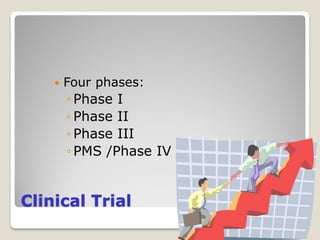
 Four phases:
◦ Phase I
◦ Phase II
◦ Phase III
◦ PMS /Phase IV
3
Pre-clinical to clinical studies
- the transition
 On completion of pre-clinical studies,
number of lead compounds whittled down
to many fewer useful candidate drugs.
 Some then advanced to clinical
development stage, involving testing in
humans.
 Data on Pre-clinical studies must be
submitted to regulatory authorities for
registration of compound as an
investigational drug.
 Permission from regulatory authorities
then obtained for undertaking studies in
humans
4
Objectives for First-In-Man
studies
5
One of the most exciting times in drug development process
Pharmacodynamic Activity
Pharmacokinetic
Characterization
General Pharmacology
Toxicologic Profile
Favorable pharmacodynamics
Toxicity Ratio
Toxicity –Not serious
Measurable, Reversible
NO
Develop for all patient classes
Acceptable to administration
to normal volunteers or patients
YES
Develop only for patient
with life-threatening
diseases
Phase I Clinical trials
 Tests take about a year.
 Involve about 20 to 80 normal healthy volunteers
aged 18 to 45 years
 May also be conducted in severely ill patients (e.g.
cancer patients) or in patients in whom the illness is
stabilized (e.g. to evaluate metabolism of a new drug
in Stable epileptic patients in whom liver enzymes
have been induced by other anti-epileptic drugs)
 Not included:
◦ Children
◦ Women of child –bearing age – unless nature of IND
necessitates their inclusion e.g. oral contraceptive study
◦ Elderly
6
Phase I Clinical trials
 Criteria for selection of volunteers needs to be
carefully laid down in protocol & strictly adhered
to.
 To document :
◦ Dose level at which signs of toxicity first appear in
humans
◦ Determine a safe tolerated dose
◦ Attempt made to establish dose range tolerated by
volunteers for single and multiple doses
 Pharmacokinetic trials – regardless of when
they are conducted during the development of
the drug
7
Phase I Clinical Trials
 Single or multiple doses.
 Dose range and route of
administration established.
 Pharmacokinetic data.
 Pharmacodynamic data.
 Maximum tolerated dose.
 Other parameters as necessary.
8
Phase I Clinical trials
 End point of these studies is toxicity
◦ Informed consent, a prerequisite
◦ Participants need to be closely supervised
by medical personnel and have access to
emergency facilities
 Protocol that describes the conditions
and personnel involved in the clinical
study needs to be submitted to
regulatory authorities before initiation of
Phase I study.
9
 Start with low dose
◦ Fraction of the “clean” or “no-effect” dose –
observed in toxicologic studies
◦ Unwritten rule is dose should be 1/25 to
1/100 of the no effect dose in mg/kg. or
◦ (1/3 to 1/5 that which is lethal to 10% of
the animals(LD10) expressed as mg/m2 for
oncology drugs
 Patient monitored for adverse drug
reactions
10
Phase I Clinical trials
Use of PK/PD in Phase I
studies
 In Phase I studies: PK/PD is
important in :
◦ Understanding dose–concentration–effect
(pharmacological and toxicological)-
relationship -
◦ Characterization of PK & PD in special
populations
◦ Probing effect of Drug-drug and drug–
disease interaction
◦ Initial determination of dosing regimens
to be used in Phase II studies
11
Phase I Studies
 Four major types of subjects enrolled:
◦ Normal, male volunteers
◦ Patients who are severely ill with disease –when it
is unethical to expose normal volunteer to test drug
◦ Patients with target disease who are stable and
generally healthy – to evaluate PKs or safety
◦ Surrogate patients who are severely ill, but do not
have targeted disease may be evaluated e.g.
patients with AIDS who do not have P carinii
pneumonia may be enrolled to test a new anti-PCP
drug in Phase I
12
Phase I Studies
 Four major reasons for enrolling
patients rather than volunteers in
Phase I Studies:
◦ Ethical- when test drug is too toxic
◦ Regulatory- some authorities e.g. Germany
prohibit enrollment of volunteers in Phase I
studies
◦ Pharmacokinetics- when patients are known or
suspected to have altered metabolism or
absorption
◦ Scientific or Medical interest
13
Phase I Clinical trials
 Types of clinical trials conducted:
◦ Single-dose tolerance trial in volunteers
/patients who are exposed to a single dose of
the drug
◦ Multiple –dose trial in volunteers or patients-
lasts for 3 to 28 days –subjects receive a fixed
–dose of drug although dose-titration is
sometimes permitted
◦ Evaluation of the PK parameters after multiple
doses
14
Phase I Clinical trials
 Types of clinical trials conducted:
◦ Increasing dose range of a IND to define the
upper limit of safety or to ensure safety when
lower dose have failed to demonstrate activity
◦ Interaction of the drugs with food or other
investigations in normal volunteers.
15
Phase I Clinical Trials
 Types of clinical trials conducted:
◦ Concentrations followed after a single
intravenous dose to measure PK
parameters.
◦ Evaluation of the distribution, metabolism &
elimination in normal volunteers using
radioactive or other methods
◦ Bioequivalence trials to compare two or
more formulations
16
Phase II Clinical Trial
 Begin after satisfactory preliminary evidence of
safety has been obtained.
 Involve supervised administration of the drug
to about 80 to 100 patients for Rx or
prophylaxis against the disorder for which the
drug is intended.
 Usually randomized study comparing new drug
with proto-type drug for the intended disorder.
 Provide first opportunity to observe the effect
of long-term administration of the drug to
humans.
 Ideally participants should have no health
problems other than the intended disorder.
17
Phase II Clinical trial
 Purpose
◦ To determine an optimal dose – response range for
the new drug
◦ To verify its efficacy for the intended disorders
 Participants also monitored for adverse
effects
◦ Population is large; hence greater chances of
detecting additional adverse effects
 Phase crucial
◦ Data used to determine whether to proceed with
extensive studies in large populations
18
Phase II- Clinical trial
 Types:
◦ Phase IIa
◦ Phase IIb
19
Phase IIa Clinical Trials
 Types of clinical trials conducted:
◦ Pilot trial (or trials) of test drug in patients;
may be either an open-label or single-or
double-blind manner
◦ Pilot trial (or trials) of test drug in normal
volunteers challenged to determine the
efficacy of drug (e.g. citric acid may be used
to produce cough)
20
Phase IIa Clinical Trials
 Types of clinical trials conducted
◦ Dose-response trial in patients to
identify the range of active doses
◦ Trials evaluating variations in dose
level or dosing schedule
21
Phase IIa Clinical Trials
 Types of clinical trials
conducted:
◦ Duration of dosing required to
achieve a sufficient magnitude
of efficacy
◦ Dose-interval trial evaluating
the time between doses
22
Phase I & II Studies –An Overview
23
First in Man
Safety and tolerability
of drug, including safe
dose range
Pharmacokinetics and
duration of action
PHASE I PHASE II
 Proof of concept
 Dose Ranging
 Safety / PKs in
special
populations
and Risk factors
Phase Test group Purpose Duration
Phase I 10 - 100 healthy
volunteers
To establish basic
safety and blood levels
achieved with different
doses of the drug
1.5 years
Phase
IIa &
IIb
50 to 500 people
who have the
disorder being
studied
To establish the drug’s
effectiveness and
dosage range, to
determine drug
kinetics, and to
identify side effects
2 years
24
Overview of Phase I and
Phase II trials
25

Clinical trials phase-i-ii-trials

  • 1.
    Conducting Phase I& II Studies 1
  • 2.
    2 Phase IVPhase IIIPhaseIIbPhase IIa Clinical Trials Phase 1 Pre- clinical Phase Candidate Profiling Phase Discovery Phase Drug Development Frame Life Cycle Management Full Development Early Development Research Candidate SelectionPoint CSP sPoC DDP FDP 3CP SDP Selectedfor ProofofConcept Development DecisionPoint Full DevelopmentPoint PhaseIII Checkpoint Submission DecisionPoint IND – Investigational New Drug NDA – New Drug Application
  • 3.
    Clinical Trial  Fourphases: ◦ Phase I ◦ Phase II ◦ Phase III ◦ PMS /Phase IV 3
  • 4.
    Pre-clinical to clinicalstudies - the transition  On completion of pre-clinical studies, number of lead compounds whittled down to many fewer useful candidate drugs.  Some then advanced to clinical development stage, involving testing in humans.  Data on Pre-clinical studies must be submitted to regulatory authorities for registration of compound as an investigational drug.  Permission from regulatory authorities then obtained for undertaking studies in humans 4
  • 5.
    Objectives for First-In-Man studies 5 Oneof the most exciting times in drug development process Pharmacodynamic Activity Pharmacokinetic Characterization General Pharmacology Toxicologic Profile Favorable pharmacodynamics Toxicity Ratio Toxicity –Not serious Measurable, Reversible NO Develop for all patient classes Acceptable to administration to normal volunteers or patients YES Develop only for patient with life-threatening diseases
  • 6.
    Phase I Clinicaltrials  Tests take about a year.  Involve about 20 to 80 normal healthy volunteers aged 18 to 45 years  May also be conducted in severely ill patients (e.g. cancer patients) or in patients in whom the illness is stabilized (e.g. to evaluate metabolism of a new drug in Stable epileptic patients in whom liver enzymes have been induced by other anti-epileptic drugs)  Not included: ◦ Children ◦ Women of child –bearing age – unless nature of IND necessitates their inclusion e.g. oral contraceptive study ◦ Elderly 6
  • 7.
    Phase I Clinicaltrials  Criteria for selection of volunteers needs to be carefully laid down in protocol & strictly adhered to.  To document : ◦ Dose level at which signs of toxicity first appear in humans ◦ Determine a safe tolerated dose ◦ Attempt made to establish dose range tolerated by volunteers for single and multiple doses  Pharmacokinetic trials – regardless of when they are conducted during the development of the drug 7
  • 8.
    Phase I ClinicalTrials  Single or multiple doses.  Dose range and route of administration established.  Pharmacokinetic data.  Pharmacodynamic data.  Maximum tolerated dose.  Other parameters as necessary. 8
  • 9.
    Phase I Clinicaltrials  End point of these studies is toxicity ◦ Informed consent, a prerequisite ◦ Participants need to be closely supervised by medical personnel and have access to emergency facilities  Protocol that describes the conditions and personnel involved in the clinical study needs to be submitted to regulatory authorities before initiation of Phase I study. 9
  • 10.
     Start withlow dose ◦ Fraction of the “clean” or “no-effect” dose – observed in toxicologic studies ◦ Unwritten rule is dose should be 1/25 to 1/100 of the no effect dose in mg/kg. or ◦ (1/3 to 1/5 that which is lethal to 10% of the animals(LD10) expressed as mg/m2 for oncology drugs  Patient monitored for adverse drug reactions 10 Phase I Clinical trials
  • 11.
    Use of PK/PDin Phase I studies  In Phase I studies: PK/PD is important in : ◦ Understanding dose–concentration–effect (pharmacological and toxicological)- relationship - ◦ Characterization of PK & PD in special populations ◦ Probing effect of Drug-drug and drug– disease interaction ◦ Initial determination of dosing regimens to be used in Phase II studies 11
  • 12.
    Phase I Studies Four major types of subjects enrolled: ◦ Normal, male volunteers ◦ Patients who are severely ill with disease –when it is unethical to expose normal volunteer to test drug ◦ Patients with target disease who are stable and generally healthy – to evaluate PKs or safety ◦ Surrogate patients who are severely ill, but do not have targeted disease may be evaluated e.g. patients with AIDS who do not have P carinii pneumonia may be enrolled to test a new anti-PCP drug in Phase I 12
  • 13.
    Phase I Studies Four major reasons for enrolling patients rather than volunteers in Phase I Studies: ◦ Ethical- when test drug is too toxic ◦ Regulatory- some authorities e.g. Germany prohibit enrollment of volunteers in Phase I studies ◦ Pharmacokinetics- when patients are known or suspected to have altered metabolism or absorption ◦ Scientific or Medical interest 13
  • 14.
    Phase I Clinicaltrials  Types of clinical trials conducted: ◦ Single-dose tolerance trial in volunteers /patients who are exposed to a single dose of the drug ◦ Multiple –dose trial in volunteers or patients- lasts for 3 to 28 days –subjects receive a fixed –dose of drug although dose-titration is sometimes permitted ◦ Evaluation of the PK parameters after multiple doses 14
  • 15.
    Phase I Clinicaltrials  Types of clinical trials conducted: ◦ Increasing dose range of a IND to define the upper limit of safety or to ensure safety when lower dose have failed to demonstrate activity ◦ Interaction of the drugs with food or other investigations in normal volunteers. 15
  • 16.
    Phase I ClinicalTrials  Types of clinical trials conducted: ◦ Concentrations followed after a single intravenous dose to measure PK parameters. ◦ Evaluation of the distribution, metabolism & elimination in normal volunteers using radioactive or other methods ◦ Bioequivalence trials to compare two or more formulations 16
  • 17.
    Phase II ClinicalTrial  Begin after satisfactory preliminary evidence of safety has been obtained.  Involve supervised administration of the drug to about 80 to 100 patients for Rx or prophylaxis against the disorder for which the drug is intended.  Usually randomized study comparing new drug with proto-type drug for the intended disorder.  Provide first opportunity to observe the effect of long-term administration of the drug to humans.  Ideally participants should have no health problems other than the intended disorder. 17
  • 18.
    Phase II Clinicaltrial  Purpose ◦ To determine an optimal dose – response range for the new drug ◦ To verify its efficacy for the intended disorders  Participants also monitored for adverse effects ◦ Population is large; hence greater chances of detecting additional adverse effects  Phase crucial ◦ Data used to determine whether to proceed with extensive studies in large populations 18
  • 19.
    Phase II- Clinicaltrial  Types: ◦ Phase IIa ◦ Phase IIb 19
  • 20.
    Phase IIa ClinicalTrials  Types of clinical trials conducted: ◦ Pilot trial (or trials) of test drug in patients; may be either an open-label or single-or double-blind manner ◦ Pilot trial (or trials) of test drug in normal volunteers challenged to determine the efficacy of drug (e.g. citric acid may be used to produce cough) 20
  • 21.
    Phase IIa ClinicalTrials  Types of clinical trials conducted ◦ Dose-response trial in patients to identify the range of active doses ◦ Trials evaluating variations in dose level or dosing schedule 21
  • 22.
    Phase IIa ClinicalTrials  Types of clinical trials conducted: ◦ Duration of dosing required to achieve a sufficient magnitude of efficacy ◦ Dose-interval trial evaluating the time between doses 22
  • 23.
    Phase I &II Studies –An Overview 23 First in Man Safety and tolerability of drug, including safe dose range Pharmacokinetics and duration of action PHASE I PHASE II  Proof of concept  Dose Ranging  Safety / PKs in special populations and Risk factors
  • 24.
    Phase Test groupPurpose Duration Phase I 10 - 100 healthy volunteers To establish basic safety and blood levels achieved with different doses of the drug 1.5 years Phase IIa & IIb 50 to 500 people who have the disorder being studied To establish the drug’s effectiveness and dosage range, to determine drug kinetics, and to identify side effects 2 years 24 Overview of Phase I and Phase II trials
  • 25.