APPROACH TO HEMATURIA
MODERATORS
Dr. T. MUNEESWAR REDDY
Associate professor
Dr. N. PADMAJA
Assistant professor
PROFESSOR AND CHIEF
Dr. M.S. SRIDHAR
What is Hematuria?
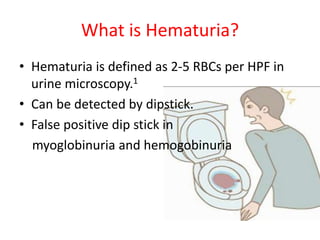
• Hematuria is defined as 2-5 RBCs per HPF in
urine microscopy.1
• Can be detected by dipstick.
• False positive dip stick in
myoglobinuria and hemogobinuria
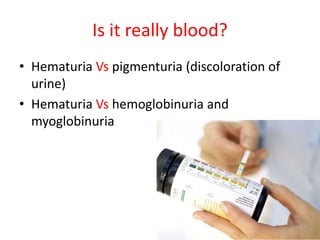
Is it really blood?
• Hematuria Vs pigmenturia (discoloration of
urine)
• Hematuria Vs hemoglobinuria and
myoglobinuria
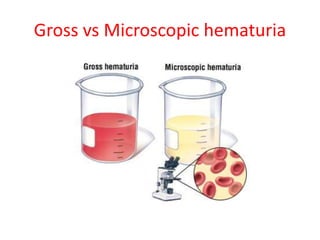
Gross vs Microscopic hematuria
Is that hematuria significant?
• A single urine analysis with hematuria is
common and can result from menstruation,
viral illness, allergy, exercise or mild trauma.1
• >3 RBCs per HPF on three urine analyses or a
single urinalysis with >100 RBCs or gross
hematuria is SIGNIFICANT.1
Clues from history
• When does blood appear during urination?
At start of urination – urethra
Through out- upper urinary tract or bladder
At the end- bladder neck or prostatic urethra
• Frequency and pain?
• H/o any medications?
• Family H/0 and travel H/0
Physical examination
• Hypertension especially if new, may be a sign
of renal disease.
• Petechiae, rash suggests coagulopathy,
immunological disease, vasculitis.
• Examination of urethral meatus.
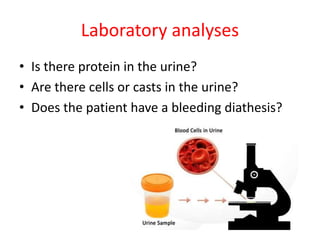
Laboratory analyses
• Is there protein in the urine?
• Are there cells or casts in the urine?
• Does the patient have a bleeding diathesis?
Interpretation
• Isolated hematuria without proteinuria, other
cells, or casts is often indicative of bleeding
from urinary tract.1
• Common causes of isolated hematuria are
stones, neoplasms, TB, trauma and prostatitis.
• Gross hematuria with blood clots suggest
postrenal source.
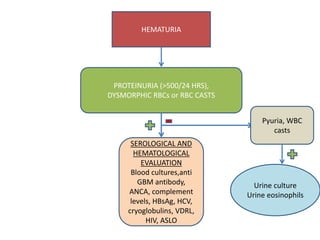
HEMATURIA
PROTEINURIA (>500/24 HRS),
DYSMORPHIC RBCs or RBC CASTS
SEROLOGICAL AND
HEMATOLOGICAL
EVALUATION
Blood cultures,anti
GBM antibody,
ANCA, complement
levels, HBsAg, HCV,
cryoglobulins, VDRL,
HIV, ASLO
Pyuria, WBC
casts
Urine culture
Urine eosinophils
Interpretation
• Isolated microscopic hematuria can be a
manifestation of glomerular diseases.
• RBCs of glomerular origin are often dysmorphic
when examined by phase contrast microscopy.
Causes are IgA nephropathy, hereditary nephritis
and thin basement membrane disease.
Hematuria with dysmorphic RBCs , RBC casts and
protein excretion >500 mg/d is virtually diagnostic
of glomerulonephritis.1
Interpretation
Even in the absence of azotemia, these patients
should undergo serologic evaluation and renal
biopsy.1
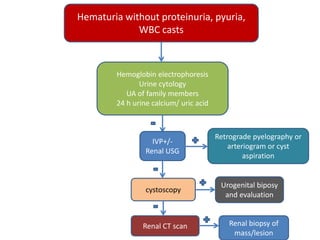
Hematuria without proteinuria, pyuria,
WBC casts
Hemoglobin electrophoresis
Urine cytology
UA of family members
24 h urine calcium/ uric acid
IVP+/-
Renal USG
Retrograde pyelography or
arteriogram or cyst
aspiration
cystoscopy
Urogenital biposy
and evaluation
Renal CT scan Renal biopsy of
mass/lesion
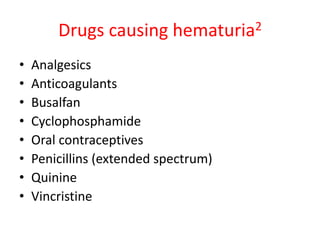
Drugs causing hematuria2
• Analgesics
• Anticoagulants
• Busalfan
• Cyclophosphamide
• Oral contraceptives
• Penicillins (extended spectrum)
• Quinine
• Vincristine
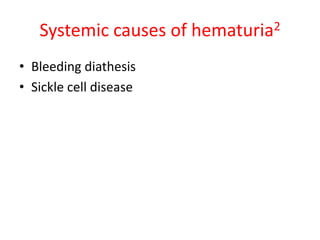
Systemic causes of hematuria2
• Bleeding diathesis
• Sickle cell disease
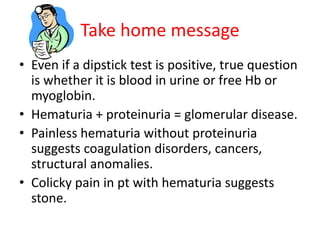
Take home message
• Even if a dipstick test is positive, true question
is whether it is blood in urine or free Hb or
myoglobin.
• Hematuria + proteinuria = glomerular disease.
• Painless hematuria without proteinuria
suggests coagulation disorders, cancers,
structural anomalies.
• Colicky pain in pt with hematuria suggests
stone.
References
1. Harrison’s principles of internal medicine 21st
edition p 294.
2. Hematuria: An algorithmic approach to
finding the cause mazhari etal. CLEVELAND CLINIC
JOURNAL OF MEDICINE VOLUME 69 NUMBER 11 NOVEMBER 2002
Approach to hematuria

Approach to hematuria

  • 1.
    APPROACH TO HEMATURIA MODERATORS Dr.T. MUNEESWAR REDDY Associate professor Dr. N. PADMAJA Assistant professor PROFESSOR AND CHIEF Dr. M.S. SRIDHAR
  • 2.
    What is Hematuria? •Hematuria is defined as 2-5 RBCs per HPF in urine microscopy.1 • Can be detected by dipstick. • False positive dip stick in myoglobinuria and hemogobinuria
  • 3.
    Is it reallyblood? • Hematuria Vs pigmenturia (discoloration of urine) • Hematuria Vs hemoglobinuria and myoglobinuria
  • 4.
  • 5.
    Is that hematuriasignificant? • A single urine analysis with hematuria is common and can result from menstruation, viral illness, allergy, exercise or mild trauma.1 • >3 RBCs per HPF on three urine analyses or a single urinalysis with >100 RBCs or gross hematuria is SIGNIFICANT.1
  • 6.
    Clues from history •When does blood appear during urination? At start of urination – urethra Through out- upper urinary tract or bladder At the end- bladder neck or prostatic urethra • Frequency and pain? • H/o any medications? • Family H/0 and travel H/0
  • 7.
    Physical examination • Hypertensionespecially if new, may be a sign of renal disease. • Petechiae, rash suggests coagulopathy, immunological disease, vasculitis. • Examination of urethral meatus.
  • 8.
    Laboratory analyses • Isthere protein in the urine? • Are there cells or casts in the urine? • Does the patient have a bleeding diathesis?
  • 9.
    Interpretation • Isolated hematuriawithout proteinuria, other cells, or casts is often indicative of bleeding from urinary tract.1 • Common causes of isolated hematuria are stones, neoplasms, TB, trauma and prostatitis. • Gross hematuria with blood clots suggest postrenal source.
  • 10.
    HEMATURIA PROTEINURIA (>500/24 HRS), DYSMORPHICRBCs or RBC CASTS SEROLOGICAL AND HEMATOLOGICAL EVALUATION Blood cultures,anti GBM antibody, ANCA, complement levels, HBsAg, HCV, cryoglobulins, VDRL, HIV, ASLO Pyuria, WBC casts Urine culture Urine eosinophils
  • 11.
    Interpretation • Isolated microscopichematuria can be a manifestation of glomerular diseases. • RBCs of glomerular origin are often dysmorphic when examined by phase contrast microscopy. Causes are IgA nephropathy, hereditary nephritis and thin basement membrane disease. Hematuria with dysmorphic RBCs , RBC casts and protein excretion >500 mg/d is virtually diagnostic of glomerulonephritis.1
  • 12.
    Interpretation Even in theabsence of azotemia, these patients should undergo serologic evaluation and renal biopsy.1
  • 13.
    Hematuria without proteinuria,pyuria, WBC casts Hemoglobin electrophoresis Urine cytology UA of family members 24 h urine calcium/ uric acid IVP+/- Renal USG Retrograde pyelography or arteriogram or cyst aspiration cystoscopy Urogenital biposy and evaluation Renal CT scan Renal biopsy of mass/lesion
  • 14.
    Drugs causing hematuria2 •Analgesics • Anticoagulants • Busalfan • Cyclophosphamide • Oral contraceptives • Penicillins (extended spectrum) • Quinine • Vincristine
  • 15.
    Systemic causes ofhematuria2 • Bleeding diathesis • Sickle cell disease
  • 16.
    Take home message •Even if a dipstick test is positive, true question is whether it is blood in urine or free Hb or myoglobin. • Hematuria + proteinuria = glomerular disease. • Painless hematuria without proteinuria suggests coagulation disorders, cancers, structural anomalies. • Colicky pain in pt with hematuria suggests stone.
  • 17.
    References 1. Harrison’s principlesof internal medicine 21st edition p 294. 2. Hematuria: An algorithmic approach to finding the cause mazhari etal. CLEVELAND CLINIC JOURNAL OF MEDICINE VOLUME 69 NUMBER 11 NOVEMBER 2002