UNIT 1
CLINICAL PHONOLOGY
(AN OVERVIEW OF CLINICAL PHONOLOGY FROM ARTICULATION TO CLINICAL PHONOLOGY,
MEDICAL AND LINGUISTIC MODELS)
SUBMITTED TO SUBMITTED BY
DR. ROHILA SHETTY HIMANI BANSAL
MVSCOSH MASLP 2ND YEAR
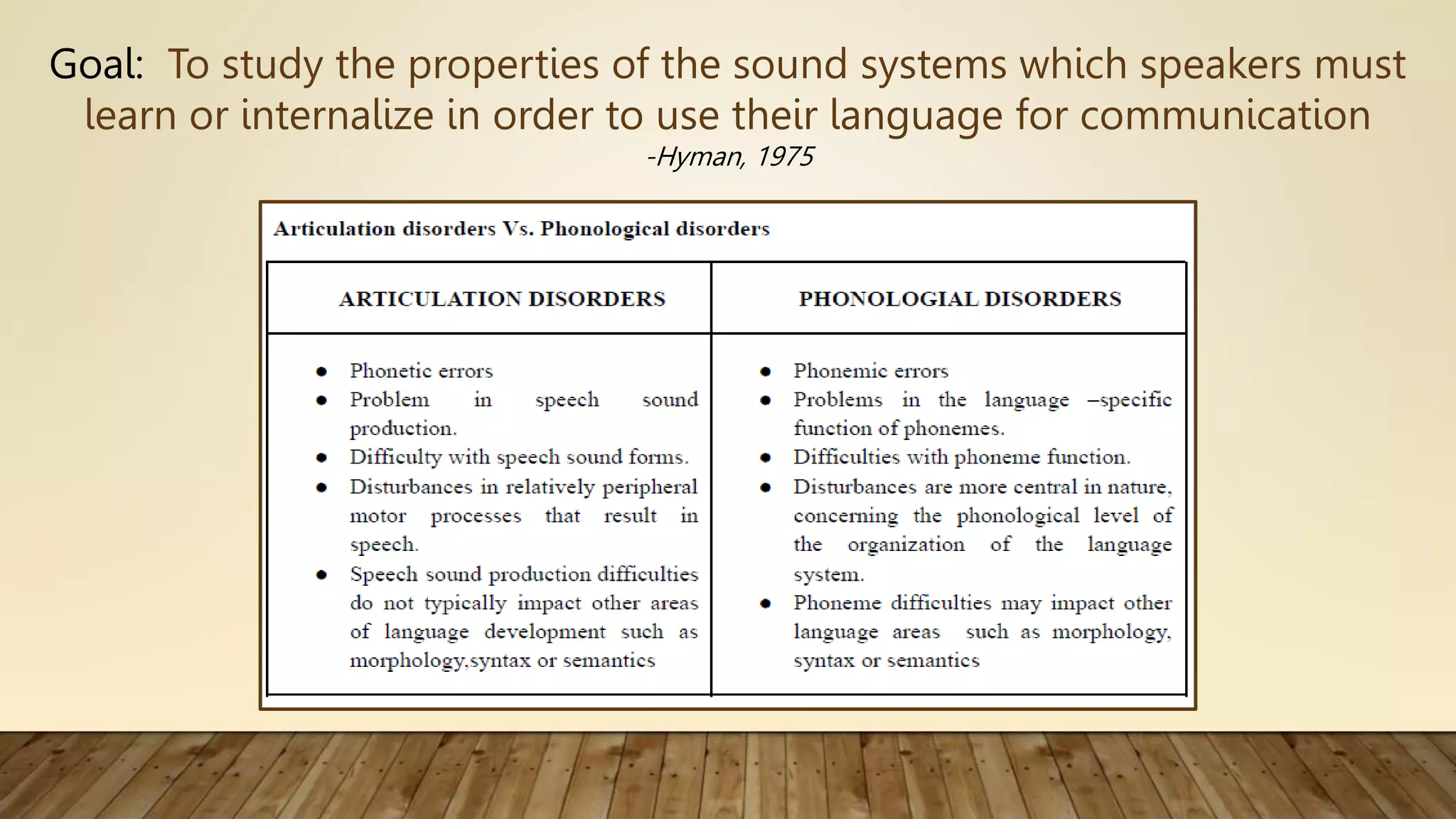
Goal: To study the properties of the sound systems which speakers must
learn or internalize in order to use their language for communication
-Hyman, 1975
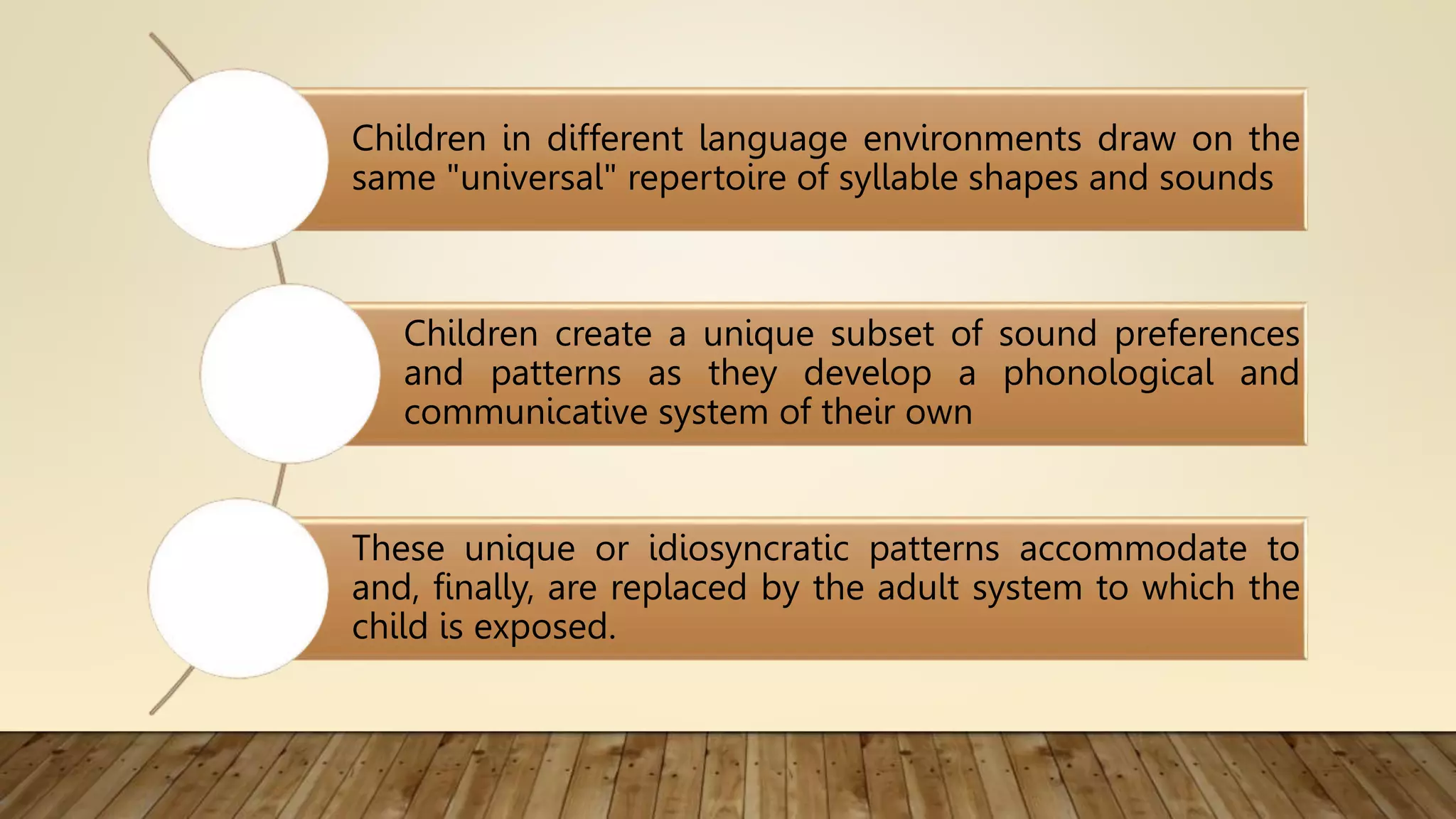
Children in different language environments draw on the
same "universal" repertoire of syllable shapes and sounds
Children create a unique subset of sound preferences
and patterns as they develop a phonological and
communicative system of their own
These unique or idiosyncratic patterns accommodate to
and, finally, are replaced by the adult system to which the
child is exposed.
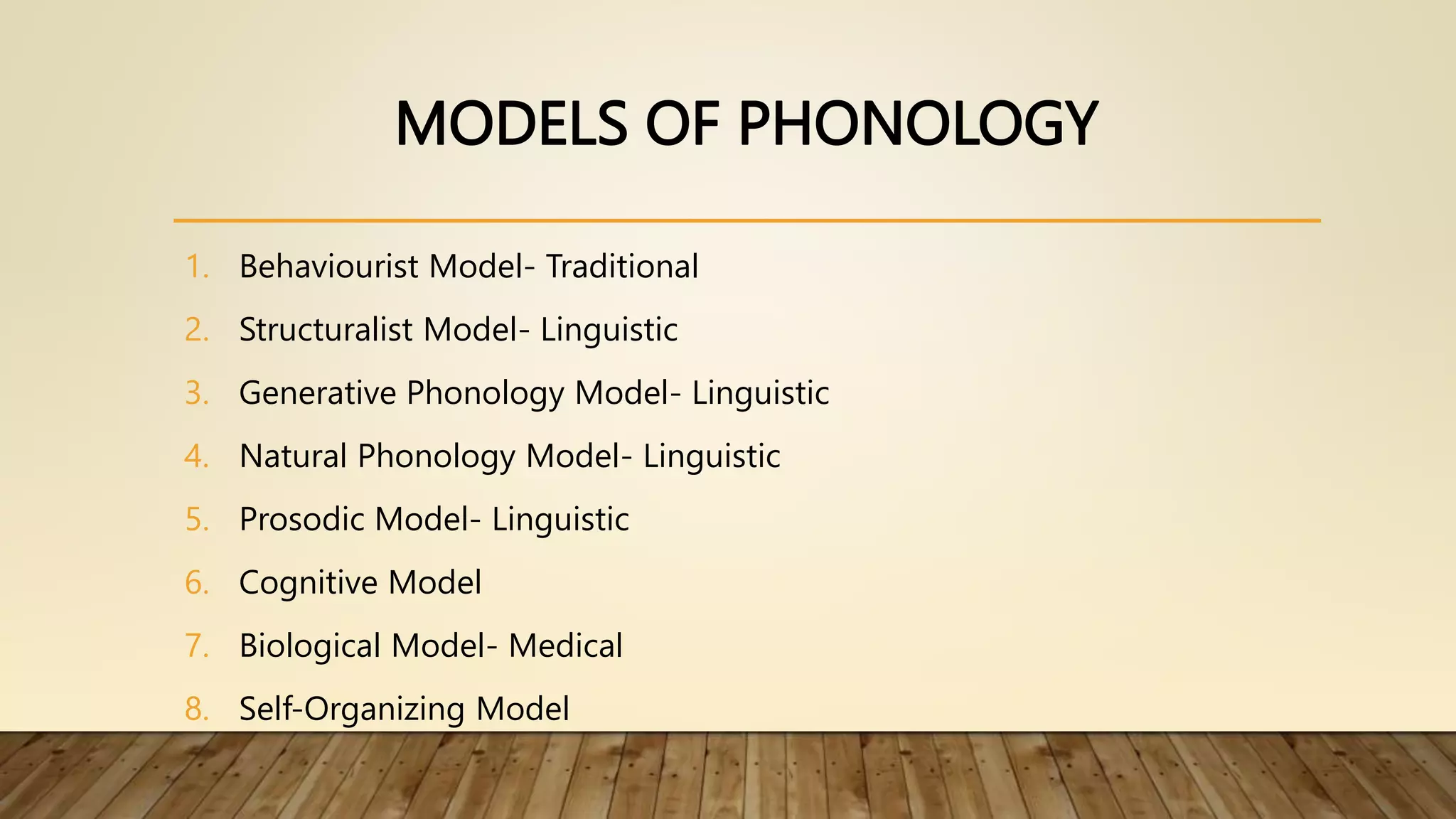
MODELS OF PHONOLOGY
1. Behaviourist Model- Traditional
2. Structuralist Model- Linguistic
3. Generative Phonology Model- Linguistic
4. Natural Phonology Model- Linguistic
5. Prosodic Model- Linguistic
6. Cognitive Model
7. Biological Model- Medical
8. Self-Organizing Model
BEHAVIOURIST MODEL
• Role of contingent reinforcement (environment) in speech acquisition
• Child’s babbling shaped through operant principles – Skinner
• Child associate vocalizations of caretaker with
• Primary reinforcement such as food and comfort
• Secondary reinforcement is the adult’s vocalization
• Caretaker continues to reinforce
• There is self-reinforcement
LIMITATIONS
Deaf infants unable to hear their own vocalization or
their parents, vocalize in spite of a lack of
reinforcement.
There is a little evidence that mothers selectively
reinforce those vocalizations which resembles adult
speech.
It is not compatible with studies indicating that
children take an active and creative role in learning
their sound system.
LITERATURE REVIEW
Murai (cited in Bernthal & Bankson, 1993) supports this model by concluding that babbling
should be seen as a stage as in speech development proper, providing the phonetic material,
repeatedly and pleasurably produced, out of which language is formed and selection from
adult models plays an important role in early speech development. He also said that the
abundance of babbling in normally developing infants stands in contrast with the
comparative poverty of vocalization in deaf or mentally handicapped, all of whom develop
language late or not at all.
STRUCTURALIST MODEL
• Phonological development follows a universal and innate order of
acquisition
• Distinctive features are arranged in a hierarchy- Jakobson
• Distinctive features unfold in a predictable order as the child produces
phonemic contrasts embodying them.
• Child continues to learn new feature contrasts
• Babbling has nothing to do with the development of the sound system
LIMITATIONS
Investigation of the relationship between babbling and
meaningful speech reveal that they are not distinctive and
independent periods of development but rather that they
share common properties of phonetic repertoire and
syllabic shapes.
Jakobson gives only the barest outline of his universal
order of acquisition and fails to address the effect of
position in a word on the acquisition of sounds. Fricatives in
the final position may be acquired earlier compared to
initial position, and stops in the initial position.
LITERATURE REVIEW
Gottardo & Mueller (2009) aimed to find out whether the L1 & L2 factors are related in
predicting L2 reading comprehension. Structural equation modeling confirmed a 5-factor
measurement model, suggesting that L1 & L2 phonological awareness should be viewed as
separate but related constructs and that L1 & L2 oral language proficiency, measured by
vocabulary and grammatical awareness, were separate constructs. The structural model
indicated that for the group of English Learners, who were educated in English, English oral
language proficiency and word reading were the strongest predictors of English reading
comprehension.
GENERATIVE PHONOLOGY MODEL
• Innateness and universality – Chomsky
• Phonological rules map representations from deep to surface structures*
• Phonological rules are dependent on information from other linguistic levels.
• Distinctive features
• Child looks at the adult model and rewrites it into his model
• Different way of organizing from adult
• Universal tendencies innate or learned very early
• Children can process and it is in their production that there are problems
LITERATURE REVIEW
Gaberell Drachman (1973) illustrated an important way in which the child creatively partakes
in his own phonological development. The particular developmental strategy discussed is the
use made of ‘long-domain 1 processes, processes whose ontogeny is held to lie in the
developing speech-tract control system. Such processes seem to contrast with the apparently
similar processes characterizing 'slips of the tongue'; in particular, the former interdigitate
with so-called low-level processes.
NATURAL PHONOLOGY MODEL
• Natural processes (patterns) are preferred or used.
• Those Universal across languages
• Those frequently used by young children
• Emphasized universal and maturational aspects of phonological acquisition- Stampe
• Child comes innately with a natural set of phonological processes that reflect the natural limitations
and capacities of human vocal production and perception (operations to delete or change
phonological units)
• Child’s task is to suppress those processes which do not occur in the particular adult language to which
he is exposed.
• Child can process (can represent at the deep level the adult sound), it is in the production that there
are problems
LITERATURE REVIEW
Balas (2009) presented Natural Phonology as a functional theory. Natural Phonology is shown
to be functional in two senses: as focusing on explanation and thus increasing our
understanding of how language works, and as having practical applications, especially to L2
acquisition and speech therapy. The contribution argues that crucial as formalism is in
computational linguistics and speech technology, Natural Phonology, with less rigid and less
formalized claims, has important applications in the areas where language and not totally
predictable human factors are involved. He also discussed approaches to autonomy in
language, explanation and hypothesis in Natural Phonology, and applications of Natural
Phonology.
PROSODIC MODEL
• Focus on the word as the basic unit
• Early words are schemas/templates that share features of adult forms (intonation
pattern, syllable structure, presence of fricatives or voicing- Waterson
• Child’s perception and production of adult features is imperfect and must
undergo development and change
• It provides a means of explaining the lack of systematic correspondence between
target phoneme and pronunciation by the child
LIMITATIONS
The theory is based on a small corpus from young child
and deals with the initial stages of acquisition.
It does not account for the general patterns of acquisition
that have been reported, nor does it make predictions
regarding the order of acquisition or error types.
LITERATURE REVIEW
Tur (2010)- studied Tibetan rhythmic structure based on the characteristics of the Lhasa
Tibetan, and determined the parameters that affect the prosodic features. To meet the actual
needs of establishing a high-quality Tibetan prosodic model, the paper designed corpus
selection rules and optimized them. Lhasa Tibetan annotation system is proposed and the
Lhasa Tibetan prosodic model corpus has been eventually established. The corpus has been
highly and scientifically completed, which basically covers the Lhasa Tibetan segment and
suprasegmental information. It will play a huge role in promoting the study of the Tibetan
prosodic model and in improving the naturalness of synthesized speech.
COGNITIVE MODEL
• Menn, 1983; Macken and Ferguson, 1983; Ferguson, 1978, 1986
• Individual strategies dependent on natural predispositions and external factors
• Different children begin mastering different articulatory patterns by attempting to
produce different adult words
• a. Selectivity in Early Word Choice
• b. Unique Reduction Devices
• c. “Phonological Idioms” and Regression
LITERATURE REVIEW
Kay & Ellis (1987)- The case of a neurological patient with severe anomic word-finding
difficulties is reported. A detailed cognitive neuropsychological investigation of the patient's
ability to name objects to confrontation was carried out in an attempt to determine where his
cognitive deficits might lie. It was observed that the patient seemed to have a clear
understanding of the items that he was trying to name, suggesting that his problems in
word-finding were not semantically based. Indeed, the patient would often generate partial
phonological information about the sought-after word, indicating that he had a specific
target in mind, and this was reminiscent of ‘tip-of-the-tongue’ states in normal word-finding.
A difficulty in retrieving complete phonological forms of words is considered as the probable
locus of his anomia.
BIOLOGICAL MODEL
• Innate perceptual biases and dispositions to certain motor actions- Locke (1983, 1990)
• Babbling is phonetic repertoire that is universal, constrained by the physical structure and size of
the mouth, articulators, etc.
• Language environment starts to influence as of first words
• Depends on storage and retrieval of some relatively stable perceived forms of language
• Developmental mechanisms
• Maintenance (of babbling patterns found in adult language
• Learning (of non-babbling patterns not found in adult language
• Loss (patterns not found in adults)
SELF-ORGANIZING MODEL
• Converges biological and linguistic models- Lindblom (1992)
• Phonetic forms in all languages have evolved to meet the complementary needs
of the two participants in vocal communication: listener & speaker
• Needs of the listener are met – Ex. when a language uses vowels that are
maximally distant from one another and easy to discriminate
• Needs of speaker are met – needs of speaker are met when language uses
consonant-vowel sequences which require little tongue movement and are easy
to articulate
SELF-ORGANIZING MODEL
• Compromise between these two sets of performance constraints leads to phonetic
universals or core segments – used in all languages and exotic segments which occur
only in languages with large phonetic inventories.
• A small set of articulatory gestures are used over and over in different combinations
to produce word patterns or syllables
• Children use a small number of articulatory gestures which relate to core segments
over and over again in different word patterns.
• This use will lead to the emergence of a network of phonologically contrastive
segments (individual sounds emerging from the above syllables) – self-segmentation
LITERATURE REVIEW
Zhao & Li (2009) studied acquisition of aspect in self-organizing connectionist models. Two
connectionist networks, DISLEX and DevLex-II, were used in the study to model the
acquisition of lexical and grammatical aspect. Both models use multi-layered self-organizing
feature maps, connected by associative links trained according to the Hebbian learning rule.
Previous empirical research has identified a strong association between lexical aspect and
grammatical aspect in child language, on the basis of which some researchers argue for
innate semantic categories or prelinguistic predispositions. Our simulations indicate that such
an association can emerge from dynamic self-organization and Hebbian learning in
connectionist networks, without the need of a priori assumptions about the structure of
innate knowledge. Our modeling results further attest to the utility of self-organizing neural
networks in the study of language acquisition.
REFERENCES
1. Balas, A. (2009). Natural Phonology as a Functional Theory. Poznań Studies in Contemporary Linguistics, 45(1), 43-
54. DOI 10.2478/v10010-009-0001-y
2. Bernthal, J. E., & Bankson, N. W. (1993). Articulation and Phonological Disorders. Prentice Hall, New Jersey.
3. Chen, Q., Yu, H., Chen, C., & Shi, J. (2011). A Study on Lhasa Tibetan Prosodic Model Corpus Establishment.
International Conference on Intelligent Computation Technology and Automation. DOI.10.1109/ICICTA.2010.720
4. Donegan, P., & Stampe, D. (2009). Hypotheses of Natural Phonology. Poznań Studies in Contemporary Linguistics
45(1)1-3. Doi.110.2478/v10010-009-0002-x
5. Dressler, U. (2009). Natural Phonology as Part of Natural Linguistics. Poznań Studies in Contemporary Linguistics,
45(1), 33- 42. doi10.2478/v10010-009-0003-9
6. Gottardo, A., & Mueller, J. (2009). Are First- and Second-Language Factors Related in Predicting Second-Language
Reading Comprehension? A Study of Spanish-Speaking Children Acquiring English as a Second Articulation and
Phonological Disorders-IInd edition
QUESTIONS ASKED IN PREVIOUS YEARS
1. Explain the linguistic model of clinical phonology and its application in
phonological assessment. 16 Marks (2020)
2. Explain the medical and linguistic models of clinical phonology and its
application in phonological assessment with current research. 16 Marks (2019)
THANKYOU

CLINICAL PHONOLOGY MASLP

  • 1.
    UNIT 1 CLINICAL PHONOLOGY (ANOVERVIEW OF CLINICAL PHONOLOGY FROM ARTICULATION TO CLINICAL PHONOLOGY, MEDICAL AND LINGUISTIC MODELS) SUBMITTED TO SUBMITTED BY DR. ROHILA SHETTY HIMANI BANSAL MVSCOSH MASLP 2ND YEAR
  • 2.
    Goal: To studythe properties of the sound systems which speakers must learn or internalize in order to use their language for communication -Hyman, 1975
  • 3.
    Children in differentlanguage environments draw on the same "universal" repertoire of syllable shapes and sounds Children create a unique subset of sound preferences and patterns as they develop a phonological and communicative system of their own These unique or idiosyncratic patterns accommodate to and, finally, are replaced by the adult system to which the child is exposed.
  • 4.
    MODELS OF PHONOLOGY 1.Behaviourist Model- Traditional 2. Structuralist Model- Linguistic 3. Generative Phonology Model- Linguistic 4. Natural Phonology Model- Linguistic 5. Prosodic Model- Linguistic 6. Cognitive Model 7. Biological Model- Medical 8. Self-Organizing Model
  • 5.
    BEHAVIOURIST MODEL • Roleof contingent reinforcement (environment) in speech acquisition • Child’s babbling shaped through operant principles – Skinner • Child associate vocalizations of caretaker with • Primary reinforcement such as food and comfort • Secondary reinforcement is the adult’s vocalization • Caretaker continues to reinforce • There is self-reinforcement
  • 6.
    LIMITATIONS Deaf infants unableto hear their own vocalization or their parents, vocalize in spite of a lack of reinforcement. There is a little evidence that mothers selectively reinforce those vocalizations which resembles adult speech. It is not compatible with studies indicating that children take an active and creative role in learning their sound system.
  • 7.
    LITERATURE REVIEW Murai (citedin Bernthal & Bankson, 1993) supports this model by concluding that babbling should be seen as a stage as in speech development proper, providing the phonetic material, repeatedly and pleasurably produced, out of which language is formed and selection from adult models plays an important role in early speech development. He also said that the abundance of babbling in normally developing infants stands in contrast with the comparative poverty of vocalization in deaf or mentally handicapped, all of whom develop language late or not at all.
  • 8.
    STRUCTURALIST MODEL • Phonologicaldevelopment follows a universal and innate order of acquisition • Distinctive features are arranged in a hierarchy- Jakobson • Distinctive features unfold in a predictable order as the child produces phonemic contrasts embodying them. • Child continues to learn new feature contrasts • Babbling has nothing to do with the development of the sound system
  • 9.
    LIMITATIONS Investigation of therelationship between babbling and meaningful speech reveal that they are not distinctive and independent periods of development but rather that they share common properties of phonetic repertoire and syllabic shapes. Jakobson gives only the barest outline of his universal order of acquisition and fails to address the effect of position in a word on the acquisition of sounds. Fricatives in the final position may be acquired earlier compared to initial position, and stops in the initial position.
  • 10.
    LITERATURE REVIEW Gottardo &Mueller (2009) aimed to find out whether the L1 & L2 factors are related in predicting L2 reading comprehension. Structural equation modeling confirmed a 5-factor measurement model, suggesting that L1 & L2 phonological awareness should be viewed as separate but related constructs and that L1 & L2 oral language proficiency, measured by vocabulary and grammatical awareness, were separate constructs. The structural model indicated that for the group of English Learners, who were educated in English, English oral language proficiency and word reading were the strongest predictors of English reading comprehension.
  • 11.
    GENERATIVE PHONOLOGY MODEL •Innateness and universality – Chomsky • Phonological rules map representations from deep to surface structures* • Phonological rules are dependent on information from other linguistic levels. • Distinctive features • Child looks at the adult model and rewrites it into his model • Different way of organizing from adult • Universal tendencies innate or learned very early • Children can process and it is in their production that there are problems
  • 12.
    LITERATURE REVIEW Gaberell Drachman(1973) illustrated an important way in which the child creatively partakes in his own phonological development. The particular developmental strategy discussed is the use made of ‘long-domain 1 processes, processes whose ontogeny is held to lie in the developing speech-tract control system. Such processes seem to contrast with the apparently similar processes characterizing 'slips of the tongue'; in particular, the former interdigitate with so-called low-level processes.
  • 13.
    NATURAL PHONOLOGY MODEL •Natural processes (patterns) are preferred or used. • Those Universal across languages • Those frequently used by young children • Emphasized universal and maturational aspects of phonological acquisition- Stampe • Child comes innately with a natural set of phonological processes that reflect the natural limitations and capacities of human vocal production and perception (operations to delete or change phonological units) • Child’s task is to suppress those processes which do not occur in the particular adult language to which he is exposed. • Child can process (can represent at the deep level the adult sound), it is in the production that there are problems
  • 14.
    LITERATURE REVIEW Balas (2009)presented Natural Phonology as a functional theory. Natural Phonology is shown to be functional in two senses: as focusing on explanation and thus increasing our understanding of how language works, and as having practical applications, especially to L2 acquisition and speech therapy. The contribution argues that crucial as formalism is in computational linguistics and speech technology, Natural Phonology, with less rigid and less formalized claims, has important applications in the areas where language and not totally predictable human factors are involved. He also discussed approaches to autonomy in language, explanation and hypothesis in Natural Phonology, and applications of Natural Phonology.
  • 15.
    PROSODIC MODEL • Focuson the word as the basic unit • Early words are schemas/templates that share features of adult forms (intonation pattern, syllable structure, presence of fricatives or voicing- Waterson • Child’s perception and production of adult features is imperfect and must undergo development and change • It provides a means of explaining the lack of systematic correspondence between target phoneme and pronunciation by the child
  • 16.
    LIMITATIONS The theory isbased on a small corpus from young child and deals with the initial stages of acquisition. It does not account for the general patterns of acquisition that have been reported, nor does it make predictions regarding the order of acquisition or error types.
  • 17.
    LITERATURE REVIEW Tur (2010)-studied Tibetan rhythmic structure based on the characteristics of the Lhasa Tibetan, and determined the parameters that affect the prosodic features. To meet the actual needs of establishing a high-quality Tibetan prosodic model, the paper designed corpus selection rules and optimized them. Lhasa Tibetan annotation system is proposed and the Lhasa Tibetan prosodic model corpus has been eventually established. The corpus has been highly and scientifically completed, which basically covers the Lhasa Tibetan segment and suprasegmental information. It will play a huge role in promoting the study of the Tibetan prosodic model and in improving the naturalness of synthesized speech.
  • 18.
    COGNITIVE MODEL • Menn,1983; Macken and Ferguson, 1983; Ferguson, 1978, 1986 • Individual strategies dependent on natural predispositions and external factors • Different children begin mastering different articulatory patterns by attempting to produce different adult words • a. Selectivity in Early Word Choice • b. Unique Reduction Devices • c. “Phonological Idioms” and Regression
  • 19.
    LITERATURE REVIEW Kay &Ellis (1987)- The case of a neurological patient with severe anomic word-finding difficulties is reported. A detailed cognitive neuropsychological investigation of the patient's ability to name objects to confrontation was carried out in an attempt to determine where his cognitive deficits might lie. It was observed that the patient seemed to have a clear understanding of the items that he was trying to name, suggesting that his problems in word-finding were not semantically based. Indeed, the patient would often generate partial phonological information about the sought-after word, indicating that he had a specific target in mind, and this was reminiscent of ‘tip-of-the-tongue’ states in normal word-finding. A difficulty in retrieving complete phonological forms of words is considered as the probable locus of his anomia.
  • 20.
    BIOLOGICAL MODEL • Innateperceptual biases and dispositions to certain motor actions- Locke (1983, 1990) • Babbling is phonetic repertoire that is universal, constrained by the physical structure and size of the mouth, articulators, etc. • Language environment starts to influence as of first words • Depends on storage and retrieval of some relatively stable perceived forms of language • Developmental mechanisms • Maintenance (of babbling patterns found in adult language • Learning (of non-babbling patterns not found in adult language • Loss (patterns not found in adults)
  • 21.
    SELF-ORGANIZING MODEL • Convergesbiological and linguistic models- Lindblom (1992) • Phonetic forms in all languages have evolved to meet the complementary needs of the two participants in vocal communication: listener & speaker • Needs of the listener are met – Ex. when a language uses vowels that are maximally distant from one another and easy to discriminate • Needs of speaker are met – needs of speaker are met when language uses consonant-vowel sequences which require little tongue movement and are easy to articulate
  • 22.
    SELF-ORGANIZING MODEL • Compromisebetween these two sets of performance constraints leads to phonetic universals or core segments – used in all languages and exotic segments which occur only in languages with large phonetic inventories. • A small set of articulatory gestures are used over and over in different combinations to produce word patterns or syllables • Children use a small number of articulatory gestures which relate to core segments over and over again in different word patterns. • This use will lead to the emergence of a network of phonologically contrastive segments (individual sounds emerging from the above syllables) – self-segmentation
  • 23.
    LITERATURE REVIEW Zhao &Li (2009) studied acquisition of aspect in self-organizing connectionist models. Two connectionist networks, DISLEX and DevLex-II, were used in the study to model the acquisition of lexical and grammatical aspect. Both models use multi-layered self-organizing feature maps, connected by associative links trained according to the Hebbian learning rule. Previous empirical research has identified a strong association between lexical aspect and grammatical aspect in child language, on the basis of which some researchers argue for innate semantic categories or prelinguistic predispositions. Our simulations indicate that such an association can emerge from dynamic self-organization and Hebbian learning in connectionist networks, without the need of a priori assumptions about the structure of innate knowledge. Our modeling results further attest to the utility of self-organizing neural networks in the study of language acquisition.
  • 24.
    REFERENCES 1. Balas, A.(2009). Natural Phonology as a Functional Theory. Poznań Studies in Contemporary Linguistics, 45(1), 43- 54. DOI 10.2478/v10010-009-0001-y 2. Bernthal, J. E., & Bankson, N. W. (1993). Articulation and Phonological Disorders. Prentice Hall, New Jersey. 3. Chen, Q., Yu, H., Chen, C., & Shi, J. (2011). A Study on Lhasa Tibetan Prosodic Model Corpus Establishment. International Conference on Intelligent Computation Technology and Automation. DOI.10.1109/ICICTA.2010.720 4. Donegan, P., & Stampe, D. (2009). Hypotheses of Natural Phonology. Poznań Studies in Contemporary Linguistics 45(1)1-3. Doi.110.2478/v10010-009-0002-x 5. Dressler, U. (2009). Natural Phonology as Part of Natural Linguistics. Poznań Studies in Contemporary Linguistics, 45(1), 33- 42. doi10.2478/v10010-009-0003-9 6. Gottardo, A., & Mueller, J. (2009). Are First- and Second-Language Factors Related in Predicting Second-Language Reading Comprehension? A Study of Spanish-Speaking Children Acquiring English as a Second Articulation and Phonological Disorders-IInd edition
  • 25.
    QUESTIONS ASKED INPREVIOUS YEARS 1. Explain the linguistic model of clinical phonology and its application in phonological assessment. 16 Marks (2020) 2. Explain the medical and linguistic models of clinical phonology and its application in phonological assessment with current research. 16 Marks (2019)
  • 26.