UNIT 4
B. VOICE DISORDERS:
(Recent advances in voice therapy including instrumentation, introduction to phono
surgical techniques. Treatment outcome in voice disorders)
SUBMITTED TO SUBMITTED BY
DR. ROHILA SHETTY HIMANI BANSAL
MVSCOSH MASLP 1ST YEAR
VOICE THERAPY
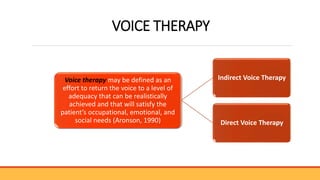
Voice therapy may be defined as an
effort to return the voice to a level of
adequacy that can be realistically
achieved and that will satisfy the
patient’s occupational, emotional, and
social needs (Aronson, 1990)
Indirect Voice Therapy
Direct Voice Therapy
Voice therapy program depends on both the type
and severity of a patient’s voice disorder
May be recommended before and/ or after surgical
treatment, depending on the patient’s needs
Helps to restore function so that the vocal profile
falls within the accepted normal range
TRAINING PRINCIPLES
Overload
Principle
Specificity
Principle
Reversibility
Principle
Individuality
Principle
INDIRECT VOICE THERAPY
Primarily educational
and includes an
overview of:
1. Normal vocal
anatomy and
physiology
2. Voice care/vocal
hygiene
DIRECT VOICE THERAPY
CONFIDENTIAL VOICE THERAPY
RESONANT VOICE THERAPY
VOCAL FUNCTION EXERCISES
ACCENT METHOD VOICE THERAPY
LEE SILVERMAN VOICE TREATMENT
RESPIRATORY TRAINING
DVT involves
alteration of a
patient's speaking
technique
It helps to increase
vocal efficiency and
improve voice quality
VOICE THERAPY ORIENTATION
Symptomatic
Voice Therapy
Etiological
Voice Therapy
Eclectic Voice
Therapy
Physiologic
Voice Therapy
Psychogenic
Voice Therapy
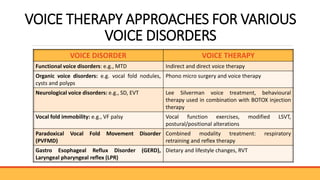
VOICE THERAPY APPROACHES FOR VARIOUS
VOICE DISORDERS
VOICE DISORDER VOICE THERAPY
Functional voice disorders: e.g., MTD Indirect and direct voice therapy
Organic voice disorders: e.g. vocal fold nodules,
cysts and polyps
Phono micro surgery and voice therapy
Neurological voice disorders: e.g., SD, EVT Lee Silverman voice treatment, behavioural
therapy used in combination with BOTOX injection
therapy
Vocal fold immobility: e.g., VF palsy Vocal function exercises, modified LSVT,
postural/positional alterations
Paradoxical Vocal Fold Movement Disorder
(PVFMD)
Combined modality treatment: respiratory
retraining and reflex therapy
Gastro Esophageal Reflux Disorder (GERD),
Laryngeal pharyngeal reflex (LPR)
Dietary and lifestyle changes, RVT
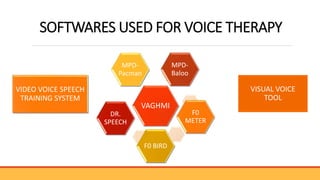
SOFTWARES USED FOR VOICE THERAPY
VAGHMI
MPD-
Pacman
MPD-
Baloo
F0
METER
F0 BIRD
DR.
SPEECH
VIDEO VOICE SPEECH
TRAINING SYSTEM
VISUAL VOICE
TOOL
STUDIES
AUTHOR SUMMARY
Spielman, Borod, Ramig (2003) Examined the effects of intensive voice therapy on facial
expression in Parkinson’s Disease and found that intensive
voice therapy may have a positive effect on facial
expressivity in PD
Speyer, Kempen, Wieneke (2002) Explored the digital laryngeals stroboscopic images to
demonstrate the changes in vocal fold vibration and found
that there were significant improvement in lesion size and
degree of maximal closure during vibration
Holmberg and Doyle (2001) Assessed the effects of voice therapy on vocal function
with vocal nodules and found that there were positive
effects of voice therapy on voice quality, vocal status and
vocal functions for majority of individuals with vocal
nodule
PHONOSURGERY
Any surgical procedure designed to
maintain, restore, or enhance the
human voice
Best possible restoration of laryngeal
function rather than the simple
removal of lesions to restore normal
laryngeal appearance
Based on: anatomy, physiology,
pathology, pathophysiology,
assessment of VF functioning and
patient history
AIMS OF PHONOSURGERY
1. Vocal fold lesions
with pathological tissue
impairing the vibratory
movement
2. Vocal fold movement
disorders with
inappropriate position
and/or tension of the
vocal folds
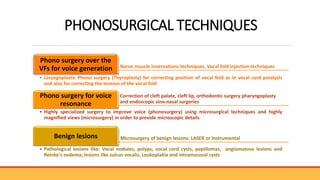
PHONOSURGICAL TECHNIQUES
Nerve muscle innervations techniques, Vocal fold injection techniques
Phono surgery over the
VFs for voice generation
• Laryngoplastic Phono surgery (Thyroplasty) for correcting position of vocal fold as in vocal cord paralysis
and also for correcting the tension of the vocal fold
Correction of cleft palate, cleft lip, orthodontic surgery pharyngoplasty
and endoscopic sino-nasal surgeries
Phono surgery for voice
resonance
• Highly specialized surgery to improve voice (phonosurgery) using microsurgical techniques and highly
magnified views (microsurgery) in order to provide microscopic details
Microsurgery of benign lesions: LASER or Instrumental
Benign lesions
• Pathological lesions like: Vocal nodules, polyps, vocal cord cysts, papillomas, angiomatous lesions and
Reinke's oedema; lesions like sulcus vocalis, Leukoplakia and intramucosal cysts
STUDIES
AUTHOR SUMMARY
Billante, Clary, Childs and Netterville
(2002)
Examined vocal improvements in persons
before thyroplasty at 3 months and one
year after surgery found the voice
improved after 3 months and 1 year post
thyroplasty surgery
Sommer and Schultz-Coulon (2007) Explored the long term results of micro
laryngoscopy after the removal of
Reinke’s oedema and found that its
necessary to select patients carefully for
surgical treatment as the long term
results vary from person to person
TREATMENT OUTCOMES IN VOICE
DISORDERS
John. A, Enderby. P, Hughes. A (2005) aimed studying the outcomes in speech and
language therapy (SLT) using the therapy outcome measure (TOM) for patients
with voice disorder (dysphonia) comparing outcomes of seven separate speech
and language therapy service and concluded that there were significant
differences in the number of treatment contacts provided by the different services
Smith, Kempster and Sims (2010) studied to determine whether patient-related
factors could be identified which distinguished patients who attended voice therapy
and had positive voice change from those who did not and concluded that patients
with more complex laryngeal diagnoses, more perceived vocal severity, occupational
issues, more health issues, and higher VHI scores at the time of the initial voice
evaluation may be at greater risk for failing to attend voice therapy sessions
Mathieson, Hirani, Epstein, Wood and Rubi (2009) studied the appropriate
acoustic and outcome measures of laryngeal manual therapy (LMT) used in the
treatment of patients with muscle tension dysphonia (MTD) and concluded that
there were positive evidence for LMT as a method of therapy in the treatment of
hyperfunctional voice disorders
REFERENCES
1.Moya. L. Andrews, (1999). Manual of voice treatment: Pediatrics through geriatrics. (2nd edtion), Cengage Learning.
2.Charles N. Ford, and Diane M. Bless (1991) Phonosurgery: Assessment and surgical management of voice disorders. (1st edition), Raven
Pr.
3.Marc Remacle, and Eckel Hans Edmund, (2000). Surgery of larynx and trachea. (1st Edition), Berlin: Springer, 2010.Brittanica
encyclopaedia.
4.Sheng Hwa Chen, Tzu-Yu Hsiao, Li-Chun Hsiao, Yu-Mei Chung, and Shu-Chiung Chiang, (2007). Outcome of resonant voice therapy for
female teachers with voice disorders: perceptual, physiological, acoustic, aerodynamic, and functional measurements. Journal of Voice,
21(4), https://doi.org/10.1016/j.jvoice.2006.02.001.
5.http://www.speech ville.com/speechtherapy/software-sips.html.
6.http://www.dr speech.com/speechtherapy5.html.
7.Bonnie E. Smith, Gail B. Kempster and H. Steven Sims, (2010). Patient factors related to voice therapy attendance and outcomes. Journal
of Voice, 24(6), https://doi.org/10.1016/j.jvoice.2009.03.004.
8.L. Mathieson, S. P. Hirani, R. Epstein, R. J. Baken, G. Wood, and J. S. Rubin. (2009). Laryngeal manual therapy: a preliminary study to
examine its treatment effects in the management of muscle tension dysphonia. Journal of Voice, 23(3),
https://doi.org/10.1016/j.jvoice.2007.10.002.
QUESTIONS ASKED IN PREVIOUS YEARS
1. What are the recent advances in the management of voice disorders in adults? (16 marks, 2011)
2. Short note on resonant voice therapy. (4 marks, 2013)
3. Short note on vocal hygiene. (4 marks, 2015)
4. Management of voice problems in Parkinson’s disease. (4 marks, 2012, 2015)
5. What is phono surgery? Explain its implications in voice management. (8 marks, 2015)
6. Explain vocal function exercises with rationale and procedure. (8 marks, 2017)
7. Compare and contrast between physiological therapy methods versus behavioural voice therapy
methods. (16 marks, 2019)
8. Describe RVT and VFE. (16 marks, 2018)
9. Explain RVT with rationale and procedure. (8 marks, 2016)

VOICE MASLP

  • 1.
    UNIT 4 B. VOICEDISORDERS: (Recent advances in voice therapy including instrumentation, introduction to phono surgical techniques. Treatment outcome in voice disorders) SUBMITTED TO SUBMITTED BY DR. ROHILA SHETTY HIMANI BANSAL MVSCOSH MASLP 1ST YEAR
  • 2.
    VOICE THERAPY Voice therapymay be defined as an effort to return the voice to a level of adequacy that can be realistically achieved and that will satisfy the patient’s occupational, emotional, and social needs (Aronson, 1990) Indirect Voice Therapy Direct Voice Therapy
  • 3.
    Voice therapy programdepends on both the type and severity of a patient’s voice disorder May be recommended before and/ or after surgical treatment, depending on the patient’s needs Helps to restore function so that the vocal profile falls within the accepted normal range
  • 4.
  • 5.
    INDIRECT VOICE THERAPY Primarilyeducational and includes an overview of: 1. Normal vocal anatomy and physiology 2. Voice care/vocal hygiene
  • 6.
    DIRECT VOICE THERAPY CONFIDENTIALVOICE THERAPY RESONANT VOICE THERAPY VOCAL FUNCTION EXERCISES ACCENT METHOD VOICE THERAPY LEE SILVERMAN VOICE TREATMENT RESPIRATORY TRAINING DVT involves alteration of a patient's speaking technique It helps to increase vocal efficiency and improve voice quality
  • 7.
    VOICE THERAPY ORIENTATION Symptomatic VoiceTherapy Etiological Voice Therapy Eclectic Voice Therapy Physiologic Voice Therapy Psychogenic Voice Therapy
  • 8.
    VOICE THERAPY APPROACHESFOR VARIOUS VOICE DISORDERS VOICE DISORDER VOICE THERAPY Functional voice disorders: e.g., MTD Indirect and direct voice therapy Organic voice disorders: e.g. vocal fold nodules, cysts and polyps Phono micro surgery and voice therapy Neurological voice disorders: e.g., SD, EVT Lee Silverman voice treatment, behavioural therapy used in combination with BOTOX injection therapy Vocal fold immobility: e.g., VF palsy Vocal function exercises, modified LSVT, postural/positional alterations Paradoxical Vocal Fold Movement Disorder (PVFMD) Combined modality treatment: respiratory retraining and reflex therapy Gastro Esophageal Reflux Disorder (GERD), Laryngeal pharyngeal reflex (LPR) Dietary and lifestyle changes, RVT
  • 9.
    SOFTWARES USED FORVOICE THERAPY VAGHMI MPD- Pacman MPD- Baloo F0 METER F0 BIRD DR. SPEECH VIDEO VOICE SPEECH TRAINING SYSTEM VISUAL VOICE TOOL
  • 10.
    STUDIES AUTHOR SUMMARY Spielman, Borod,Ramig (2003) Examined the effects of intensive voice therapy on facial expression in Parkinson’s Disease and found that intensive voice therapy may have a positive effect on facial expressivity in PD Speyer, Kempen, Wieneke (2002) Explored the digital laryngeals stroboscopic images to demonstrate the changes in vocal fold vibration and found that there were significant improvement in lesion size and degree of maximal closure during vibration Holmberg and Doyle (2001) Assessed the effects of voice therapy on vocal function with vocal nodules and found that there were positive effects of voice therapy on voice quality, vocal status and vocal functions for majority of individuals with vocal nodule
  • 11.
    PHONOSURGERY Any surgical proceduredesigned to maintain, restore, or enhance the human voice Best possible restoration of laryngeal function rather than the simple removal of lesions to restore normal laryngeal appearance Based on: anatomy, physiology, pathology, pathophysiology, assessment of VF functioning and patient history
  • 12.
    AIMS OF PHONOSURGERY 1.Vocal fold lesions with pathological tissue impairing the vibratory movement 2. Vocal fold movement disorders with inappropriate position and/or tension of the vocal folds
  • 13.
    PHONOSURGICAL TECHNIQUES Nerve muscleinnervations techniques, Vocal fold injection techniques Phono surgery over the VFs for voice generation • Laryngoplastic Phono surgery (Thyroplasty) for correcting position of vocal fold as in vocal cord paralysis and also for correcting the tension of the vocal fold Correction of cleft palate, cleft lip, orthodontic surgery pharyngoplasty and endoscopic sino-nasal surgeries Phono surgery for voice resonance • Highly specialized surgery to improve voice (phonosurgery) using microsurgical techniques and highly magnified views (microsurgery) in order to provide microscopic details Microsurgery of benign lesions: LASER or Instrumental Benign lesions • Pathological lesions like: Vocal nodules, polyps, vocal cord cysts, papillomas, angiomatous lesions and Reinke's oedema; lesions like sulcus vocalis, Leukoplakia and intramucosal cysts
  • 14.
    STUDIES AUTHOR SUMMARY Billante, Clary,Childs and Netterville (2002) Examined vocal improvements in persons before thyroplasty at 3 months and one year after surgery found the voice improved after 3 months and 1 year post thyroplasty surgery Sommer and Schultz-Coulon (2007) Explored the long term results of micro laryngoscopy after the removal of Reinke’s oedema and found that its necessary to select patients carefully for surgical treatment as the long term results vary from person to person
  • 15.
    TREATMENT OUTCOMES INVOICE DISORDERS John. A, Enderby. P, Hughes. A (2005) aimed studying the outcomes in speech and language therapy (SLT) using the therapy outcome measure (TOM) for patients with voice disorder (dysphonia) comparing outcomes of seven separate speech and language therapy service and concluded that there were significant differences in the number of treatment contacts provided by the different services Smith, Kempster and Sims (2010) studied to determine whether patient-related factors could be identified which distinguished patients who attended voice therapy and had positive voice change from those who did not and concluded that patients with more complex laryngeal diagnoses, more perceived vocal severity, occupational issues, more health issues, and higher VHI scores at the time of the initial voice evaluation may be at greater risk for failing to attend voice therapy sessions Mathieson, Hirani, Epstein, Wood and Rubi (2009) studied the appropriate acoustic and outcome measures of laryngeal manual therapy (LMT) used in the treatment of patients with muscle tension dysphonia (MTD) and concluded that there were positive evidence for LMT as a method of therapy in the treatment of hyperfunctional voice disorders
  • 16.
    REFERENCES 1.Moya. L. Andrews,(1999). Manual of voice treatment: Pediatrics through geriatrics. (2nd edtion), Cengage Learning. 2.Charles N. Ford, and Diane M. Bless (1991) Phonosurgery: Assessment and surgical management of voice disorders. (1st edition), Raven Pr. 3.Marc Remacle, and Eckel Hans Edmund, (2000). Surgery of larynx and trachea. (1st Edition), Berlin: Springer, 2010.Brittanica encyclopaedia. 4.Sheng Hwa Chen, Tzu-Yu Hsiao, Li-Chun Hsiao, Yu-Mei Chung, and Shu-Chiung Chiang, (2007). Outcome of resonant voice therapy for female teachers with voice disorders: perceptual, physiological, acoustic, aerodynamic, and functional measurements. Journal of Voice, 21(4), https://doi.org/10.1016/j.jvoice.2006.02.001. 5.http://www.speech ville.com/speechtherapy/software-sips.html. 6.http://www.dr speech.com/speechtherapy5.html. 7.Bonnie E. Smith, Gail B. Kempster and H. Steven Sims, (2010). Patient factors related to voice therapy attendance and outcomes. Journal of Voice, 24(6), https://doi.org/10.1016/j.jvoice.2009.03.004. 8.L. Mathieson, S. P. Hirani, R. Epstein, R. J. Baken, G. Wood, and J. S. Rubin. (2009). Laryngeal manual therapy: a preliminary study to examine its treatment effects in the management of muscle tension dysphonia. Journal of Voice, 23(3), https://doi.org/10.1016/j.jvoice.2007.10.002.
  • 17.
    QUESTIONS ASKED INPREVIOUS YEARS 1. What are the recent advances in the management of voice disorders in adults? (16 marks, 2011) 2. Short note on resonant voice therapy. (4 marks, 2013) 3. Short note on vocal hygiene. (4 marks, 2015) 4. Management of voice problems in Parkinson’s disease. (4 marks, 2012, 2015) 5. What is phono surgery? Explain its implications in voice management. (8 marks, 2015) 6. Explain vocal function exercises with rationale and procedure. (8 marks, 2017) 7. Compare and contrast between physiological therapy methods versus behavioural voice therapy methods. (16 marks, 2019) 8. Describe RVT and VFE. (16 marks, 2018) 9. Explain RVT with rationale and procedure. (8 marks, 2016)