Ambiguity
Lexical Ambiguity
Semantic ambiguity
Syntactic ambiguity
Structural Ambiguity
Lexical ambiguity
ď‚— Demonstrations of words which have
multiple meanings dependent on context.
ď‚— Rose rose to put rose roes on her rows of
roses. (Robert J. Baran) (Rose [a girl] rose
[stood] to put rose [pink-colored] roes [fish
eggs as fertilizer] on her rows of roses
[flower].)
ď‚— Will will Will will Will's will to Will? (Will [a
person], will Will [a second person] will
[bequeath] Will's [the second person] will [a
document] to Will [a third person]?
Alternatively, "Will will will Will's will?")
Syntactic ambiguity
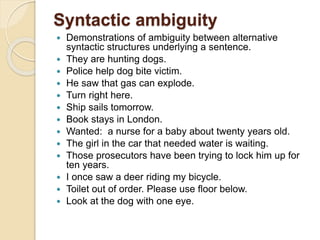
ď‚— Demonstrations of ambiguity between alternative
syntactic structures underlying a sentence.
ď‚— They are hunting dogs.
ď‚— Police help dog bite victim.
ď‚— He saw that gas can explode.
ď‚— Turn right here.
ď‚— Ship sails tomorrow.
ď‚— Book stays in London.
ď‚— Wanted: a nurse for a baby about twenty years old.
ď‚— The girl in the car that needed water is waiting.
ď‚— Those prosecutors have been trying to lock him up for
ten years.
ď‚— I once saw a deer riding my bicycle.
ď‚— Toilet out of order. Please use floor below.
ď‚— Look at the dog with one eye.
Structural Ambiguity
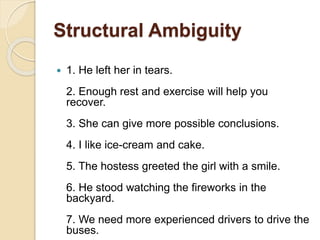
ď‚— 1. He left her in tears.
2. Enough rest and exercise will help you
recover.
3. She can give more possible conclusions.
4. I like ice-cream and cake.
5. The hostess greeted the girl with a smile.
6. He stood watching the fireworks in the
backyard.
7. We need more experienced drivers to drive the
buses.
Semantic Ambiguity
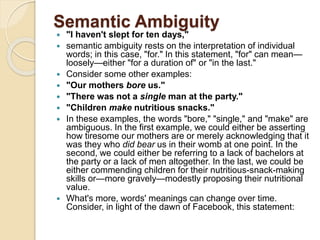
ď‚— "I haven't slept for ten days,"
ď‚— semantic ambiguity rests on the interpretation of individual
words; in this case, "for." In this statement, "for" can mean—
loosely—either "for a duration of" or "in the last."
ď‚— Consider some other examples:
ď‚— "Our mothers bore us."
ď‚— "There was not a single man at the party."
ď‚— "Children make nutritious snacks."
ď‚— In these examples, the words "bore," "single," and "make" are
ambiguous. In the first example, we could either be asserting
how tiresome our mothers are or merely acknowledging that it
was they who did bear us in their womb at one point. In the
second, we could either be referring to a lack of bachelors at
the party or a lack of men altogether. In the last, we could be
either commending children for their nutritious-snack-making
skills or—more gravely—modestly proposing their nutritional
value.
ď‚— What's more, words' meanings can change over time.
Consider, in light of the dawn of Facebook, this statement:
Semantic Ambiguity
ď‚— "I liked your picture."
ď‚— In a simpler time, this would be rather
straightforward, but the internet has
deftly redefined "like" in recent years,
bestowing upon it a second meaning. A
meaning such that one could actually
"like" a picture that one hates with every
fiber of his or her being. Just by clicking
"like." Such is the evolution of language.
ď‚— So how does semantic ambiguity differ
from the others? Check it out:
ď‚— Syntactic Ambiguity
ď‚— Punctuation Ambiguity
Synthesis
ď‚— Present Participles
ď‚— Past participles the best connectors
Still a long way to go ….

1 Ambiguity.pptx

  • 1.
  • 2.
    Lexical ambiguity ď‚— Demonstrationsof words which have multiple meanings dependent on context. ď‚— Rose rose to put rose roes on her rows of roses. (Robert J. Baran) (Rose [a girl] rose [stood] to put rose [pink-colored] roes [fish eggs as fertilizer] on her rows of roses [flower].) ď‚— Will will Will will Will's will to Will? (Will [a person], will Will [a second person] will [bequeath] Will's [the second person] will [a document] to Will [a third person]? Alternatively, "Will will will Will's will?")
  • 3.
    Syntactic ambiguity ď‚— Demonstrationsof ambiguity between alternative syntactic structures underlying a sentence. ď‚— They are hunting dogs. ď‚— Police help dog bite victim. ď‚— He saw that gas can explode. ď‚— Turn right here. ď‚— Ship sails tomorrow. ď‚— Book stays in London. ď‚— Wanted: a nurse for a baby about twenty years old. ď‚— The girl in the car that needed water is waiting. ď‚— Those prosecutors have been trying to lock him up for ten years. ď‚— I once saw a deer riding my bicycle. ď‚— Toilet out of order. Please use floor below. ď‚— Look at the dog with one eye.
  • 4.
    Structural Ambiguity ď‚— 1.He left her in tears. 2. Enough rest and exercise will help you recover. 3. She can give more possible conclusions. 4. I like ice-cream and cake. 5. The hostess greeted the girl with a smile. 6. He stood watching the fireworks in the backyard. 7. We need more experienced drivers to drive the buses.
  • 5.
    Semantic Ambiguity  "Ihaven't slept for ten days,"  semantic ambiguity rests on the interpretation of individual words; in this case, "for." In this statement, "for" can mean— loosely—either "for a duration of" or "in the last."  Consider some other examples:  "Our mothers bore us."  "There was not a single man at the party."  "Children make nutritious snacks."  In these examples, the words "bore," "single," and "make" are ambiguous. In the first example, we could either be asserting how tiresome our mothers are or merely acknowledging that it was they who did bear us in their womb at one point. In the second, we could either be referring to a lack of bachelors at the party or a lack of men altogether. In the last, we could be either commending children for their nutritious-snack-making skills or—more gravely—modestly proposing their nutritional value.  What's more, words' meanings can change over time. Consider, in light of the dawn of Facebook, this statement:
  • 6.
    Semantic Ambiguity ď‚— "Iliked your picture." ď‚— In a simpler time, this would be rather straightforward, but the internet has deftly redefined "like" in recent years, bestowing upon it a second meaning. A meaning such that one could actually "like" a picture that one hates with every fiber of his or her being. Just by clicking "like." Such is the evolution of language. ď‚— So how does semantic ambiguity differ from the others? Check it out: ď‚— Syntactic Ambiguity ď‚— Punctuation Ambiguity
  • 7.
    Synthesis ď‚— Present Participles ď‚—Past participles the best connectors
  • 8.
    Still a longway to go ….