Climate Modelling
General Circulation Models
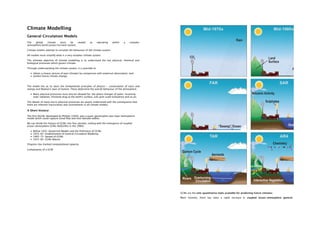
The   global    climate   must    be    viewed         as      operating    within    a    complex
atmosphere/earth/ocean/ice/land system.

Climate models attempt to simulate the behaviour of the climate system.

All models must simplify what is a very complex climate system.

The ultimate objective of climate modelling is to understand the key physical, chemical and
biological processes which govern climate.

Through understanding the climate system, it is possible to:

     obtain a clearer picture of past climates by comparison with empirical observation, and;
     predict future climate change.


The model has as its basis the fundamental principles of physics - conservation of mass and
energy and Newton's laws of motion. These determine the overall behaviour of the atmosphere.

     Many physical processes must also be allowed for: the phase changes of water, incoming
     solar radiation, frictional drag at the earth's surface, sub-grid-scale turbulence and so on.

The details of many micro-physical processes are poorly understood with the consequence that
there are inherent inaccuracies and uncertainties in all climate models.

A Short history:

The first AGCM, developed by Phillips (1956), was a quasi-geostrophic two-layer hemispheric
model which could capture zonal flow and mid-latitude eddies.

We can divide the history of GCMs into four periods, ending with the emergence of coupled
ocean-atmosphere GCMs (AOGCMs) in the 1980s:

     Before 1955: Numerical Models and the Prehistory of GCMs
     1955-65: Establishment of General Circulation Modeling
     1965-75: Spread of GCMs
     1975-85: GCMs Mature

Progress has tracked computational capacity

Components of a GCM


                                                                                                     GCMs are the only quantitative tools available for predicting future climates.

                                                                                                     More recently, there has been a rapid increase in coupled ocean-atmosphere general
circulation models (AOGCMs).                                                                            Convection
                                                                                                        Precipitation - large-scale and convective
These are the most complex type of model and is difficult to model accurately.                          Boundary-layer
The development of more accurate coupled models has been a primary focus for some time,            2. Processes over Land
since it is more generally accepted that it is through these models that we can get a scientific
understanding of climate and climate change.
                                                                                                        Vegetation - like a resistor to water loss
                                                                                                        Soil moisture - moisture and energy storage
                                                                                                        Albedo
What does a GCM do?                                                                                     Energy partitioning - latent, sensible, storage
                                                                                                        Hydrology
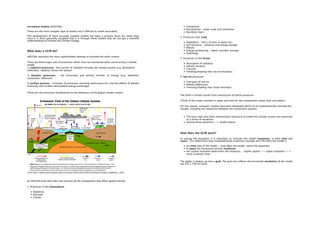
AOGCMs represent the most sophisticated attempt to simulate the earth system.
                                                                                                   3. Processes in the Ocean
There are three major sets of processes which must be considered when constructing a climate
                                                                                                        Absorption of radiation
model:
                                                                                                        Salinity variation
1) radiative processes- the transfer of radiation through the climate system (e.g. absorption,
                                                                                                        Currents
reflection); radiation drives the system!
                                                                                                        Freezing/thawing near sea ice boundary
2) dynamic processes - the horizontal and vertical transfer of energy (e.g. advection,
                                                                                                   4. Sea Ice processes
convection, diffusion);
                                                                                                        Transport of sea ice
3) surface process - inclusion of processes involving land/ocean/ice, and the effects of albedo,
                                                                                                        Albedo differences
emissivity and surface-atmosphere energy exchanges.
                                                                                                        Freezing/thawing near ocean boundary

These are the processes fundamental to the behaviour of the global climate system.
                                                                                                   The Earth’s climate results from interactions all these processes.

                                                                                                   (Think of the scales involved in space and time for the components shown here and below.)

                                                                                                   For this reason, computer models have been developed which try to mathematically simulate the
                                                                                                   climate, including the interaction between the component systems.


                                                                                                        The basic laws and other relationships necessary to model the climate system are expressed
                                                                                                        as a series of equations.
                                                                                                        Solving these equations --> model output.


                                                                                                   How does the GCM work?
                                                                                                   In solving the equations it is important to consider the model resolution, in both time and
                                                                                                   space. This determines how computationally expensive (storage and CPU time) the model is.

                                                                                                        the time step of the model.....how often the model solves the equations
                                                                                                        in space the horizontal/vertical resolution
                                                                                                        the spatial resolution determines the temporal......higher spatial --> higher temporal --->
                                                                                                        more computer time.


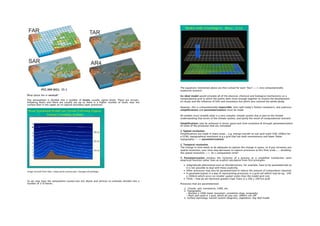
                                                                                                   The globe is broken up into a grid. The grid size reflects the horizontal resolution of the model
                                                                                                   (eg 250 x 200 km grid).


From http://www.acad.carleton.edu/curricular/GEOL/DaveSTELLA/climate/climate_modeling_1.htm


An AOGCM must then take into account all the components that affect global climate:

1. Processes in the Atmosphere:

     Radiation
     Aerosols
     Clouds
The equations mentioned above are then solved for each "box"---> very computationally
                                                                                               expensive process!

What about the in vertical?                                                                    An ideal model would simulate all of the physical, chemical and biological mechanisms on a
                                                                                               computational grid in which the points were close enough together to resolve the development
The atmosphere is divided into a number of levels, usually sigma levels. There are terrain-
following levels and there are usually set up so there is a higher number of levels near the   of clouds and the influence of hills and mountains but which also covered the whole globe.
surface than in the upper air to capture boundary layer processes.
                                                                                               However, this is computationally impossible, even with today’s fastest computers, and judicious
                                                                                               simplifications and parameterizations must be made.

                                                                                               All models must simplify what is a very complex climate system due in part to the limited
                                                                                               understanding that exists of the climate system, and partly the result of computational restraint

                                                                                               Simplifications may be achieved in terms space and time resolution & through parameterization
                                                                                               of some of the processes that are simulated:

                                                                                               1. Spatial resolution
                                                                                               Simplifications are made in many areas... e.g. energy transfer at sub-grid scale (100-200km for
                                                                                               a GCM), topographical resolution (e.g a grid that has both mountainous and lower flatter
                                                                                               topography) ---> parameterizations

                                                                                               2. Temporal resolution
                                                                                               The change in time needs to be adequate to capture the change in space, so if you increases you
                                                                                               spatial resolution, your time step decreases to capture processes at this finer scale...... doubling
                                                                                               the spatial resolution --> 16 x computation time!!

                                                                                               3. Parameterization involves the inclusion of a process as a simplified (sometimes semi-
                                                                                               empirical) function rather than an explicit calculation from first principles.

                                                                                                    Subgridscale phenomena such as thunderstorms, for example, have to be parameterized as
                                                                                                    it is not possible to deal with these explicitly.
Image sourced from http://www.atmo.arizona.edu/~barlage/climatology/                                Other processes may also be parameterized to reduce the amount of computation required.
                                                                                                    A parameterization is a way of representing processes in a grid cell (which may be eg. 200
                                                                                                    x 200km) which occur on smaller spatial scales than the model grid size.
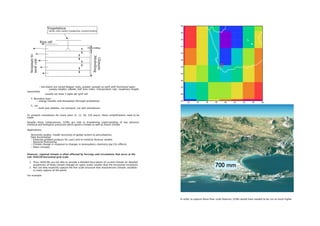
                                                                                                    Think - how do we represent greater Cape Town in a 200 x 200 km grid!
So we now have the atmosphere (ocean/sea ice) above and vertical co-ordinate divided into a
number of 3-D boxes.                                                                           Processes that are parameterized:

                                                                                                  1. Clouds, rain, convection, CAPE, etc.
                                                                                                  2. Topography:
                                                                                                    - Rockies a 1000 meter mountain; unrealistic drag, orography
                                                                                                    - Rock and sand in 1 grid, which do you use...affects run-off
                                                                                                  3. Surface hydrology, bucket system (diagram), vegetation, big-leaf model
- but plants are varied (deeper roots, greater canopy) so work with functional types:
                 : canopy heights, albedo, leaf area index, transpiration rate, roughness length,
seasonality
                : usually can have 2 types per grid cell.

   4. Boundary layer
        - energy transfer and dissipation (through turbulence)

   5. Ice
        - multi year albedos, ice transport, ice-atm interactions


To produce simulations for many years (5, 15, 50, 150 years), these simplifications need to be
made.

Despite these compromises, GCMs are vital in broadening understanding of key physical,
chemical and biological processes which govern climate as well as future climate.

Applications:

   Sensitivity studies: model sensitivity of global system to perturbations.
   Data Assimilation
   - Generate gridded products for users and to initialize forecast models
   - Seasonal forecasting
   - Climate change in response to changes in atmospheric chemistry (eg CO2 effects)
   - Paleo-climates


However, regional climate is often affected by forcings and circulations that occur at the
sub-AOGCM horizontal grid scale.

 1. Thus, AOGCMs are not able to provide a detailed description of current climate (or detailed
    projections of likely climate change) on space scales smaller than the horizontal resolution,
 2. Nor can they explicitly capture the fine scale structure that characterizes climatic variables
    in many regions of the world.

For example:


                                                                                                     In order to capture these finer scale features, GCMs would have needed to be run at much higher
resolutions.

This, however, is impractical as computational cost becomes too high. A doubling of resolution
results in an eight-fold increase in computational cost.

How to go from GCM resolution to finer regional scale of impact???


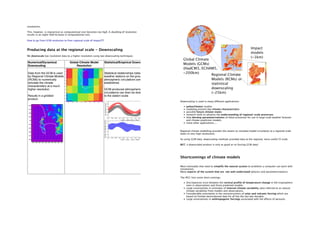
Producing data at the regional scale - Downscaling
We downscale low resolution data to a higher resolution using two downscaling techniques:

Numerical/Dynamical                 Global Climate Model             Statistical/Empirical Downscaling
Downscaling                             Resolution

Data from the GCM is used                                            Statistical relationships between
by Regional Climate Models                                           weather stations on the ground and
(RCMs) to numerically                                                atmospheric circulations are
simulate the climate                                                 established.
characteristics at a much
higher resolution.                                                   GCM-produced atmospheric
                                                                     circulations can then be downscaled
Results in a gridded                                                 to the station scale.
product.
                                                                                                           Downscaling is used in many different applications:

                                                                                                                paleoclimates studies
                                                                                                                modeling present day climate characteristics
                                                                                                                possible future climate states
                                                                                                                research tools to advance the understanding of regional-scale processes
                                                                                                                help develop parameterizations of these processes for use in large scale weather forecast
                                                                                                                and climate prediction models.
                                                                                                                many other applications....


                                                                                                           Regional climate modelling provides the means to simulate/model circulation at a regional scale
                                                                                                           down to very high resolutions.

                                                                                                           So using GCM data, downscaling methods provided data at the regional, more useful (?) scale.

                                                                                                           BUT, a downscaled product is only as good as its forcing GCM data!


                                                                                                           Shortcomings of climate models

                                                                                                           Most noticeably that need to simplify the natural system to problems a computer can work with
                                                                                                           (resolution),
                                                                                                           Many aspects of the system that are not well understood (physics and parameterizations).

                                                                                                           The IPCC lists some short comings:

                                                                                                                Discrepancies exist between the vertical profile of temperature change in the troposphere
                                                                                                                seen in observations and those predicted models.
                                                                                                                Large uncertainties in estimates of internal climate variability (also referred to as natural
                                                                                                                climate variability) from models and observations.
                                                                                                                Considerable uncertainty in the reconstructions of solar and volcanic forcing which are
                                                                                                                based on limited observational data for all but the last two decades.
                                                                                                                Large uncertainties in anthropogenic forcings associated with the effects of aerosols.
The roles of clouds and ocean currents in the climate system
     The sensitivity of the climate system to changes in greenhouse gas concentrations
     Large differences in the response of different models to the same forcing

     Future anthropogenic factors are also difficult to model:
          "Future human contributions to climate forcing and potential environmental changes
          will depend on the rates and levels of population change, economic growth,
          development and diffusion of technologies, and other dynamics in human systems.
          These developments are unpredictable over the long timescales relevant for climate
          change research."
          Storylines.....

     Future solar radiation
          Solar radiation is the source of energy in the climate system;
           Changes in the intensity of solar radiation will affect global climate
          We currently do not know how to forecast future changes in solar intensity.


Although climate models have shortcomings, they are an invaluable tool (perhaps the only tool)
in gaining an understanding of the way the climate system behaves as well as to how it may
behave in response to (mainly anthropogenic) changes in atmospheric chemistry.


Conclusion
     The overall success of climate models in simulating the present climate of the atmosphere
     is impressive. Although there are shortcomings in all models, they give a generally accurate
     picture of reality.

     They provide a valuable means for understanding the climate system and estimating the
     likely climatic consequences as a result of anthropogenic impacts on global as well as
     regional scales.

     Model sophistication will increase with time tracking computing power, so that detailed
     regional climate impact projections may be reliable in the future.....do GCMs get smaller, or
     RCMs get bigger?

     Results should be interpreted conservatively as many processes (land, sea, air & ice) are not
     well understood or well modelled.


NEXT: How do we use/interpret model data?
Climate Modelling

Climate Modelling

  • 1.
    Climate Modelling General CirculationModels The global climate must be viewed as operating within a complex atmosphere/earth/ocean/ice/land system. Climate models attempt to simulate the behaviour of the climate system. All models must simplify what is a very complex climate system. The ultimate objective of climate modelling is to understand the key physical, chemical and biological processes which govern climate. Through understanding the climate system, it is possible to: obtain a clearer picture of past climates by comparison with empirical observation, and; predict future climate change. The model has as its basis the fundamental principles of physics - conservation of mass and energy and Newton's laws of motion. These determine the overall behaviour of the atmosphere. Many physical processes must also be allowed for: the phase changes of water, incoming solar radiation, frictional drag at the earth's surface, sub-grid-scale turbulence and so on. The details of many micro-physical processes are poorly understood with the consequence that there are inherent inaccuracies and uncertainties in all climate models. A Short history: The first AGCM, developed by Phillips (1956), was a quasi-geostrophic two-layer hemispheric model which could capture zonal flow and mid-latitude eddies. We can divide the history of GCMs into four periods, ending with the emergence of coupled ocean-atmosphere GCMs (AOGCMs) in the 1980s: Before 1955: Numerical Models and the Prehistory of GCMs 1955-65: Establishment of General Circulation Modeling 1965-75: Spread of GCMs 1975-85: GCMs Mature Progress has tracked computational capacity Components of a GCM GCMs are the only quantitative tools available for predicting future climates. More recently, there has been a rapid increase in coupled ocean-atmosphere general
  • 2.
    circulation models (AOGCMs). Convection Precipitation - large-scale and convective These are the most complex type of model and is difficult to model accurately. Boundary-layer The development of more accurate coupled models has been a primary focus for some time, 2. Processes over Land since it is more generally accepted that it is through these models that we can get a scientific understanding of climate and climate change. Vegetation - like a resistor to water loss Soil moisture - moisture and energy storage Albedo What does a GCM do? Energy partitioning - latent, sensible, storage Hydrology AOGCMs represent the most sophisticated attempt to simulate the earth system. 3. Processes in the Ocean There are three major sets of processes which must be considered when constructing a climate Absorption of radiation model: Salinity variation 1) radiative processes- the transfer of radiation through the climate system (e.g. absorption, Currents reflection); radiation drives the system! Freezing/thawing near sea ice boundary 2) dynamic processes - the horizontal and vertical transfer of energy (e.g. advection, 4. Sea Ice processes convection, diffusion); Transport of sea ice 3) surface process - inclusion of processes involving land/ocean/ice, and the effects of albedo, Albedo differences emissivity and surface-atmosphere energy exchanges. Freezing/thawing near ocean boundary These are the processes fundamental to the behaviour of the global climate system. The Earth’s climate results from interactions all these processes. (Think of the scales involved in space and time for the components shown here and below.) For this reason, computer models have been developed which try to mathematically simulate the climate, including the interaction between the component systems. The basic laws and other relationships necessary to model the climate system are expressed as a series of equations. Solving these equations --> model output. How does the GCM work? In solving the equations it is important to consider the model resolution, in both time and space. This determines how computationally expensive (storage and CPU time) the model is. the time step of the model.....how often the model solves the equations in space the horizontal/vertical resolution the spatial resolution determines the temporal......higher spatial --> higher temporal ---> more computer time. The globe is broken up into a grid. The grid size reflects the horizontal resolution of the model (eg 250 x 200 km grid). From http://www.acad.carleton.edu/curricular/GEOL/DaveSTELLA/climate/climate_modeling_1.htm An AOGCM must then take into account all the components that affect global climate: 1. Processes in the Atmosphere: Radiation Aerosols Clouds
  • 3.
    The equations mentionedabove are then solved for each "box"---> very computationally expensive process! What about the in vertical? An ideal model would simulate all of the physical, chemical and biological mechanisms on a computational grid in which the points were close enough together to resolve the development The atmosphere is divided into a number of levels, usually sigma levels. There are terrain- following levels and there are usually set up so there is a higher number of levels near the of clouds and the influence of hills and mountains but which also covered the whole globe. surface than in the upper air to capture boundary layer processes. However, this is computationally impossible, even with today’s fastest computers, and judicious simplifications and parameterizations must be made. All models must simplify what is a very complex climate system due in part to the limited understanding that exists of the climate system, and partly the result of computational restraint Simplifications may be achieved in terms space and time resolution & through parameterization of some of the processes that are simulated: 1. Spatial resolution Simplifications are made in many areas... e.g. energy transfer at sub-grid scale (100-200km for a GCM), topographical resolution (e.g a grid that has both mountainous and lower flatter topography) ---> parameterizations 2. Temporal resolution The change in time needs to be adequate to capture the change in space, so if you increases you spatial resolution, your time step decreases to capture processes at this finer scale...... doubling the spatial resolution --> 16 x computation time!! 3. Parameterization involves the inclusion of a process as a simplified (sometimes semi- empirical) function rather than an explicit calculation from first principles. Subgridscale phenomena such as thunderstorms, for example, have to be parameterized as it is not possible to deal with these explicitly. Image sourced from http://www.atmo.arizona.edu/~barlage/climatology/ Other processes may also be parameterized to reduce the amount of computation required. A parameterization is a way of representing processes in a grid cell (which may be eg. 200 x 200km) which occur on smaller spatial scales than the model grid size. Think - how do we represent greater Cape Town in a 200 x 200 km grid! So we now have the atmosphere (ocean/sea ice) above and vertical co-ordinate divided into a number of 3-D boxes. Processes that are parameterized: 1. Clouds, rain, convection, CAPE, etc. 2. Topography: - Rockies a 1000 meter mountain; unrealistic drag, orography - Rock and sand in 1 grid, which do you use...affects run-off 3. Surface hydrology, bucket system (diagram), vegetation, big-leaf model
  • 4.
    - but plantsare varied (deeper roots, greater canopy) so work with functional types: : canopy heights, albedo, leaf area index, transpiration rate, roughness length, seasonality : usually can have 2 types per grid cell. 4. Boundary layer - energy transfer and dissipation (through turbulence) 5. Ice - multi year albedos, ice transport, ice-atm interactions To produce simulations for many years (5, 15, 50, 150 years), these simplifications need to be made. Despite these compromises, GCMs are vital in broadening understanding of key physical, chemical and biological processes which govern climate as well as future climate. Applications: Sensitivity studies: model sensitivity of global system to perturbations. Data Assimilation - Generate gridded products for users and to initialize forecast models - Seasonal forecasting - Climate change in response to changes in atmospheric chemistry (eg CO2 effects) - Paleo-climates However, regional climate is often affected by forcings and circulations that occur at the sub-AOGCM horizontal grid scale. 1. Thus, AOGCMs are not able to provide a detailed description of current climate (or detailed projections of likely climate change) on space scales smaller than the horizontal resolution, 2. Nor can they explicitly capture the fine scale structure that characterizes climatic variables in many regions of the world. For example: In order to capture these finer scale features, GCMs would have needed to be run at much higher
  • 5.
    resolutions. This, however, isimpractical as computational cost becomes too high. A doubling of resolution results in an eight-fold increase in computational cost. How to go from GCM resolution to finer regional scale of impact??? Producing data at the regional scale - Downscaling We downscale low resolution data to a higher resolution using two downscaling techniques: Numerical/Dynamical Global Climate Model Statistical/Empirical Downscaling Downscaling Resolution Data from the GCM is used Statistical relationships between by Regional Climate Models weather stations on the ground and (RCMs) to numerically atmospheric circulations are simulate the climate established. characteristics at a much higher resolution. GCM-produced atmospheric circulations can then be downscaled Results in a gridded to the station scale. product. Downscaling is used in many different applications: paleoclimates studies modeling present day climate characteristics possible future climate states research tools to advance the understanding of regional-scale processes help develop parameterizations of these processes for use in large scale weather forecast and climate prediction models. many other applications.... Regional climate modelling provides the means to simulate/model circulation at a regional scale down to very high resolutions. So using GCM data, downscaling methods provided data at the regional, more useful (?) scale. BUT, a downscaled product is only as good as its forcing GCM data! Shortcomings of climate models Most noticeably that need to simplify the natural system to problems a computer can work with (resolution), Many aspects of the system that are not well understood (physics and parameterizations). The IPCC lists some short comings: Discrepancies exist between the vertical profile of temperature change in the troposphere seen in observations and those predicted models. Large uncertainties in estimates of internal climate variability (also referred to as natural climate variability) from models and observations. Considerable uncertainty in the reconstructions of solar and volcanic forcing which are based on limited observational data for all but the last two decades. Large uncertainties in anthropogenic forcings associated with the effects of aerosols.
  • 6.
    The roles ofclouds and ocean currents in the climate system The sensitivity of the climate system to changes in greenhouse gas concentrations Large differences in the response of different models to the same forcing Future anthropogenic factors are also difficult to model: "Future human contributions to climate forcing and potential environmental changes will depend on the rates and levels of population change, economic growth, development and diffusion of technologies, and other dynamics in human systems. These developments are unpredictable over the long timescales relevant for climate change research." Storylines..... Future solar radiation Solar radiation is the source of energy in the climate system; Changes in the intensity of solar radiation will affect global climate We currently do not know how to forecast future changes in solar intensity. Although climate models have shortcomings, they are an invaluable tool (perhaps the only tool) in gaining an understanding of the way the climate system behaves as well as to how it may behave in response to (mainly anthropogenic) changes in atmospheric chemistry. Conclusion The overall success of climate models in simulating the present climate of the atmosphere is impressive. Although there are shortcomings in all models, they give a generally accurate picture of reality. They provide a valuable means for understanding the climate system and estimating the likely climatic consequences as a result of anthropogenic impacts on global as well as regional scales. Model sophistication will increase with time tracking computing power, so that detailed regional climate impact projections may be reliable in the future.....do GCMs get smaller, or RCMs get bigger? Results should be interpreted conservatively as many processes (land, sea, air & ice) are not well understood or well modelled. NEXT: How do we use/interpret model data?